Island \(A\) is located at longitude \(104^{\circ}\text{E}\) and Island \(B\) is located at longitude \(56^{\circ}\text{W}\). Ignoring timezones, estimate the time on Island \(B\) when it is 9:20 am on Island \(A\)?
- 10:16 pm
- 8:40 pm
- 10:40 pm
- 8:16 am
Aussie Maths & Science Teachers: Save your time with SmarterEd
Island \(A\) is located at longitude \(104^{\circ}\text{E}\) and Island \(B\) is located at longitude \(56^{\circ}\text{W}\). Ignoring timezones, estimate the time on Island \(B\) when it is 9:20 am on Island \(A\)?
\(C\)
\(\text{Longitudinal difference} = 104^{\circ}+56^{\circ}=160^{\circ}\)
\(\text{Calculate the time difference (using 15° = 1 hour time difference):}\)
\(\text{Time Difference} = \dfrac{160}{15} \text{ hours} = 10.666…\ \text{ hours}=10\text{ hours}\ 40\ \text{minutes} \)
\(\text{Island A is east of Island B}\ \ \Rightarrow\ \ \text{Island A is ahead}\)
\(\text{Time on Island A}\ =\ 9:20\ \text{am}\)
| \(\text{Time on Island B}\) | \(=9:20\ \text{am}-10\ \text{hours}\ 40\text{ minutes}\) |
| \(=11:20\ \text{pm}-40\ \text{minutes}\) | |
| \(=10:40\ \text{pm (previous day)}\) |
\(\Rightarrow C\)
City \(A\) is located at longitude \(0^{\circ}\) (on the Prime Meridian) and while City \(B\) is located at longitude \(118^{\circ}\text{W}\). Ignoring timezones, what is the estimated time in City \(B\) when it is 11:00 pm in city \(A\)?
\(A\)
\(\text{Longitudinal difference}= 118^{\circ}-0=118^{\circ}\)
\(\text{Calculate time difference (using 15° = 1 hour):}\)
\(\text{Time Difference} = \dfrac{118}{15} \text{ hours} = 7.866\text{ hours}=7\text{ hours}\ 52\ \text{minutes} \)
\(\text{City B is west of City A}\ \ \Rightarrow\ \ \text{City B is behind}\)
\(\text{Time in City A}\ =\ 11:00\ \text{pm}\)
| \(\therefore\ \text{Time in City B}\) | \( = 11:00\ \text{pm}-7\ \text{hours}\ 52\text{ minutes}\) |
| \(=\ 4:00\ \text{pm}-52\ \text{minutes}\) | |
| \(=3:08\ \text{pm}\) |
\(\Rightarrow A\)
Melbourne is located at longitude \(145 ^{\circ}\text{E}\) and Tokyo is located at longitude \(140^{\circ}\text{E}\). Based purely on longitudinal difference, what is the time in Tokyo when it is 2:00 pm in Melbourne?
\(A\)
\(\text{Longitudinal difference} = 145^{\circ}-140^{\circ} = 5^{\circ} \)
\(\text{Time difference (15° = 1 hour time difference):}\)
\(\text{Time Difference} = \dfrac{5}{15} \text{ hours} = \dfrac{1}{3} \text{ hour} = 20 \text{ minutes} \)
\(\text{Since Melbourne is further east}\ \ \Rightarrow\ \ \text{it is ahead}\)
\(\text{Time in Melbourne}\ =\ 2:00\ \text{pm}\)
\(\text{Time in Tokyo}= 2:00\ \text{pm}-20\ \text{minutes}=\ 1:40\ \text{pm}\)
\(\Rightarrow A\)
Tokyo is 45\(^{\circ}\) west of Sydney. Using longitudinal difference, what is the time in Tokyo when it is 3:00 pm in Sydney?
\(D\)
\(15^{\circ}\ =\text{1 hour time difference}\)
\(\text{Longitudinal distance}=45^{\circ}\)
\(\text{Time Difference}=\dfrac{45}{15}=3\ \text{hours}\)
\(\text{Time in Sydney}\ =\ 3:00\ \text{pm}\)
\(\text{Since Sydney is East of Tokyo:}\)
\(\text{Time in Tokyo}=\ 3:00\ \text{pm}-3\ \text{hours}=\ 12:00\ \text{pm}\)
\(\Rightarrow D\)
Kathmandu is 30\(^{\circ}\) west of Perth. Using longitudinal distance, what is the time in Kathmandu when it is noon in Perth?
\(A\)
\(15^{\circ}\ =\text{1 hour time difference}\)
\(\text{Longitudinal distance}=30^{\circ}\)
\(\text{Time Difference}=\dfrac{30}{15}=2\ \text{hours}\)
\(\text{Time in Perth}\ =\ 12\ \text{pm}\)
\(\text{Time in Kathmandu}=\ 12\ \text{pm}-2\ \text{hours}=\ 10:00\ \text{am}\)
\(\Rightarrow A\)
The table shows the approximate coordinates of two cities.
\begin{array} {|l|c|c|}
\hline
\rule{0pt}{2.5ex} \textit{City} \rule[-1ex]{0pt}{0pt} & \textit{Latitude} \rule[-1ex]{0pt}{0pt} & \textit{Longitude}\\
\hline
\rule{0pt}{2.5ex} \text{Buenos Aires} \rule[-1ex]{0pt}{0pt} & 35^{\circ}\ \text{S} \rule[-1ex]{0pt}{0pt} & 60^{\circ}\ \text{W} \\
\hline
\rule{0pt}{2.5ex} \text{Adelaide} \rule[-1ex]{0pt}{0pt} & 35^{\circ}\ \text{S} \rule[-1ex]{0pt}{0pt} & 140^{\circ}\ \text{E} \\
\hline
\end{array}
--- 4 WORK AREA LINES (style=lined) ---
--- 2 WORK AREA LINES (style=lined) ---
a. \(13\ \text{hours}\ 20\ \text{minutes}\)
b. \(8:20\ \text{am on Saturday}\)
a. \(15^{\circ}\ =\text{1 hour time difference}\)
\(\text{Angular distance}=60+140=200^{\circ}\)
\(\text{Time Difference}=\dfrac{200}{15}=13.\dot{3}=13\ \text{hours}\ 20\ \text{minutes}\)
b. \(\text{Time in Buenos Aires}\ =\ 7\ \text{pm Friday night}\)
| \(\therefore\ \text{Time in Adelaide}\) | \( =\ 7\ \text{pm}\ +\ 13\ \text{hours}\ 20\ \text{minutes}\) |
| \(=\ 8:20\ \text{am on Saturday}\) |
City A is in Sweden and is located at (`58^{circ}`N, `16^{circ}`E). Sydney, in Australia, is located at (`33^{circ}`S, `151^{circ}`E).
Robert lives in Sydney and needs to give an online presentation to his colleagues in City A starting at 5:00 pm Thursday, local time in Sweden.
What time and day, in Sydney, should Robert start his presentation?
It is given that `15^{circ}` = 1 hour time difference. Ignore daylight saving. (3 marks)
`text(2 am Friday)`
`text{Angular difference}\ = 151-16 = 135^{circ}`
`=>\ text{Time difference}\ = 135/15 = 9\ text(hours)`
`text(Sydney is east of Sweden → ahead)`
| `text{Presentation time (Sydney)}` | `=\ text(5 pm Thurs + 9 hours)` |
| `=\ text(2 am Friday)` |
An aircraft travels at an average speed of 913 km/h. It departs from a town in Kenya (0°, 38°E) on Tuesday at 10 pm and flies east to a town in Borneo (0°, 113°E).
`d=theta/360 xx 2 pi r` where `theta = 75^@` and `r=6400` km (2 marks)
--- 4 WORK AREA LINES (style=lined) ---
--- 2 WORK AREA LINES (style=lined) ---
--- 4 WORK AREA LINES (style=lined) ---
a. `8378\ text(km)`
b. `9\ text(hours)`
c. `text(12 midday on Wednesday)`
a. `\text{Longitudinal difference}=113-38= 75^@`
| `d` | `= 75/360 xx 2 xx pi xx 6400` |
| `= 8377.58…` | |
| `=8378\ text(km)\ text{(nearest km)}` |
b. `text(Flight time)= text(Distance)/text(Speed)= 8378/913= 9.176…= 9\ text(hours)\ text{(nearest hr)}`
c. `text(Time Difference)= 75 xx 4= 300\ text(minutes)= 5\ text(hours)`
`text(Kenya is further East)\ =>\ text(Kenya is +5 hours)`
`:.\ text(Arrival time in Kenya)`
`= text{10 pm (Tues) + 5 hrs + 9 hrs}\ text{(flight)}`
`= 12\ text(midday on Wednesday)`
Island A and island B are both on the equator. Island B is west of island A. The longitude of island A is 5°E and the angle at the centre of Earth (O), between A and B, is 30°.
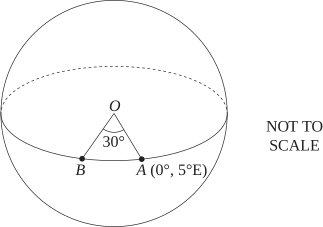
--- 4 WORK AREA LINES (style=lined) ---
--- 1 WORK AREA LINES (style=lined) ---
a. `(0°, 25W)`
b. `8\ text(am)`
a. `text{Longitude (island}\ B)= 5-30=-25= 25^@\ text(W)`
`text{Latitude (island}\ B)=0^@`
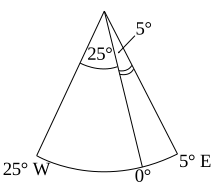
`:.\ text(Island)\ B\ text{is (0°, 25°W).}`
b. `text(Time difference) = 30 xx 4 = 120 \ text(mins)\ =2\ text(hours)`
`text(S)text(ince)\ B\ text(is west of)\ A:`
`text(Time on island)\ B= 10\ text(am less 2 hours)= 8\ text(am)`