Aussie Maths & Science Teachers: Save your time with SmarterEd
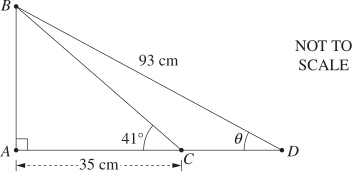
The diagram shows two right-angled triangles, `A B C` and `A B D`,
where `A C=35 \ text{cm}`, `B D=93 \ text{cm}`, `/_ A C B=41^@` and ` /_ A D B=\theta`.
Calculate the size of angle `\theta`, to the nearest minute. (4 marks)
--- 8 WORK AREA LINES (style=lined) ---
`19^@6^{′}`
`text{In}\ Delta ABC:`
| `tan 41^@` | `=(AB)/35` |
| `AB` | `=35xxtan 41^@` |
| `=30.425\ …` |
`text{In}\ Delta ABD:`
| `sin theta` | `=(AB)/(BD)` |
| `=(30.425\ …)/93` | |
| `:.theta` | `=sin^(-1)((30.425\ …)/93)` |
| `=19.09…` | |
| `=19^@6^{′}\ \ text{(nearest minute)}` |
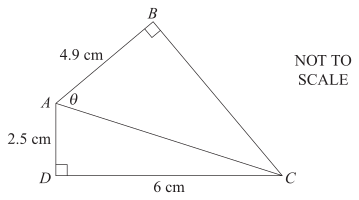
Two right-angled triangles, `ABC` and `ADC`, are shown.
Calculate the size of angle `theta`, correct to the nearest minute. (3 marks)
--- 6 WORK AREA LINES (style=lined) ---
`41^@5^{′}\ text{(nearest minute)}`
`text(Using Pythagoras in)\ DeltaACD:`♦♦♦ Mean mark 15%.
| `AC^2` | `= 2.5^2 + 6^2` |
| `= 42.25` | |
| `:.AC` | `= 6.5\ text(cm)` |
`text(In)\ DeltaABC:`
| `costheta` | `= 4.9/6.5` |
| `theta` | `= cos^(−1)\ 4.9/6.5` |
| `= 41.075\ …` | |
| `= 41^@4^{′}31^{″}` | |
| `= 41^@5^{′}\ text{(nearest minute)}` |
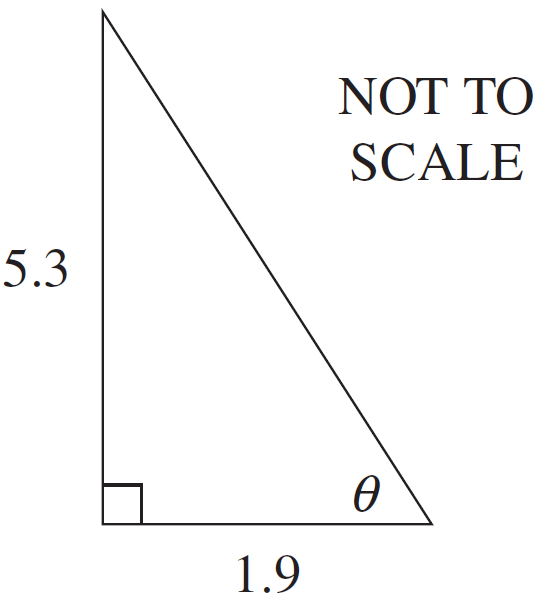
The diagram shows a right-angled triangle.
What is the value of `theta`, to the nearest minute?
`B`
| `tan theta` | `= text(opp)/text(adj)` |
| `= 5.3/1.9= 2.789\ …` |
| `:. theta` | `= 70.277\ …^@` |
| `=70°16^{′}39.8^{″}~~ 70^@17^{′}` |
`=>B`
--- 2 WORK AREA LINES (style=lined) ---
--- 4 WORK AREA LINES (style=lined) ---
a. `text(Proof)`
b. `67°23^{′}`
a. `ΔABC\ text(is right-angled if)\ \ a^2 + b^2 = c^2`
| `a^2 + b^2` | `= 5^2 + 12^2` |
| `= 169` | |
| `= 13^2` | |
| `= c^2\ …\ text(as required.)` |
MARKER’S COMMENT: Know your calculator process for producing an angle in minutes/seconds. Note >30 “seconds” rounds up to the higher “minute”.
b. `sin ∠ABC = 12/13`
| `:.∠ABC` | `= 67.38\ …°` |
| `=67°22^{′}48^{″}` | |
| `= 67°23^{′}\ \ \ text{(nearest minute)}` |