SmarterEd

Aussie Maths & Science Teachers: Save your time with SmarterEd

  • Login
  • Get Help
  • About

Calculus, 2ADV C3 2024 13 MC

The function  \(f(x)=\dfrac{x}{2}+\dfrac{2}{x}\)  undergoes the following sequence of transformations to become \(g(x)\):

  1. dilation by a factor of 3 from the \(y\)-axis
  2. translation by 1 unit in the negative direction of the \(y\)-axis.

The function \(g\) has a local minimum at the point with the coordinates

  1. \((6,1)\)
  2. \(\left(\dfrac{2}{3}, 1\right)\)
  3. \((2,5)\)
  4. \(\left(2,-\dfrac{1}{3}\right)\)
Show Answers Only

\(A\)

Show Worked Solution

\(\text{Dilate by a factor of 3 from the}\ y\text{-axis:}\)

\(f(x) \rightarrow f_1(x)=\dfrac{\frac{x}{3}}{2}+\dfrac{2}{\frac{x}{3}}=\dfrac{x}{6}+\dfrac{6}{x}\)

\(\text{Translate 1 unit down:}\)

\(f_1(x) \rightarrow g(x)=\dfrac{x}{6}+\dfrac{6}{x}-1\)

\(g'(x)=\dfrac{1}{6}-\dfrac{6}{x^{2}}\)

\(\text{Max/min when}\ \ \dfrac{1}{6}-\dfrac{6}{x^{2}}=0\)

\(\Rightarrow A\)

♦ Mean mark 45%.
 

Filed Under: Interpreting and Graphing Derivatives, The Derivative Function and its Graph Tagged With: Band 5, smc-1089-48-Transformations, smc-7133-60-X-topic

Calculus, 2ADV C3 2020 HSC 10 MC

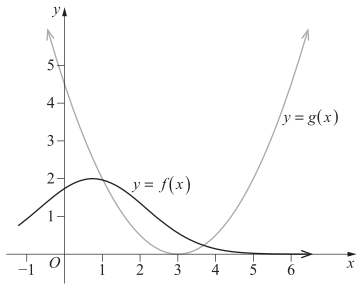
The graph shows two functions  `y = f(x)`  and  `y = g(x)`.

Define  `h(x) = f(g(x))`.

How many stationary points does  `y = h(x)`  have for  `1 <= x <= 5`?

  1. 0
  2. 1
  3. 2
  4. 3
Show Answers Only

`D`

Show Worked Solution

`h(x) = f(g(x))`

♦♦♦ Mean mark 11%.

`h^{′}(x) = g^{′}(x) xx f^{′}(g(x))`
  

`text(S.P.’s occur when)\ \ g^{′}(x) = 0\ \ text(or)\ \ f^{′}(g(x)) = 0`

`g^{′}(x) = 0\ \ text(when)\ \ x =3\ (text(from graph))`

`f^{′}(x) = 0\ \ text(when)\ \ x ~~ 1  \ \ text{(i.e.}\ xtext{-value is just under 1)}`
 

`text(Find values of)\ x\ text(when)\ g(x) ~~ 1:`

`text(By inspection, there are 2 values where)`

`g(x) ~~ 1, \ x ∈ [1, 5]`

`:.\ text(There are 3 S.P.’s for)\ y = h(x), \ x ∈ [1, 5]`

`=> D`

Filed Under: Interpreting and Graphing Derivatives, The Derivative Function and its Graph Tagged With: Band 6, smc-1089-45-Composite Functions, smc-7133-60-X-topic

Copyright © 2014–2026 SmarterEd.com.au · Log in