SmarterEd

Aussie Maths & Science Teachers: Save your time with SmarterEd

  • Login
  • Get Help
  • About

Probability, MET2 2022 VCAA 20 MC

A soccer player kicks a ball with an angle of elevation of `theta` °, where `theta` is a normally distributed random variable with a mean of 42° and a standard deviation of 8°.

The horizontal distance that the ball travels before landing is given by the function `d=50 \ sin (2\theta)`.

The probability that the ball travels more than 40 m horizontally before landing is closest to

  1. 0.969
  2. 0.937
  3. 0.226
  4. 0.149
  5. 0.027
Show Answers Only

`A`

Show Worked Solution

Using CAS

Solve:  `50\ sin(2\theta)>=40`   for    `0<= theta <= 90`°

`26.565 \ldots \leq \theta \leq 63.434 \ldots`
 

`\theta \~ N\left(42°,8^2°\right)`

`\text{Pr}(26.565 \leq \theta \leq 63.435)~~0.96947`
 
`=>A`


♦♦ Mean mark 30%.
MARKER’S COMMENT: 24% incorrectly chose B and 25% incorrectly chose C.

Filed Under: Normal Distribution Tagged With: Band 6, smc-719-50-Conditional probability

Probability, MET2 2023 VCAA 4

A manufacturer produces tennis balls.

The diameter of the tennis balls is a normally distributed random variable \(D\), which has a mean of 6.7 cm and a standard deviation of 0.1 cm.

  1. Find  \(\Pr(D>6.8)\), correct to four decimal places.   (1 mark)

    --- 1 WORK AREA LINES (style=lined) ---

  2. Find the minimum diameter of a tennis ball that is larger than 90% of all tennis balls produced.
  3. Give your answer in centimetres, correct to two decimal places.   (1 mark)

    --- 2 WORK AREA LINES (style=lined) ---

Tennis balls are packed and sold in cylindrical containers. A tennis ball can fit through the opening at the top of the container if its diameter is smaller than 6.95 cm.

  1. Find the probability that a randomly selected tennis ball can fit through the opening at the top of the container.
  2. Give your answer correct to four decimal places.   (1 mark)

    --- 2 WORK AREA LINES (style=lined) ---

  3. In a random selection of 4 tennis balls, find the probability that at least 3 balls can fit through the opening at the top of the container.
  4. Give your answer correct to four decimal places.   (2 marks)

    --- 2 WORK AREA LINES (style=lined) ---

A tennis ball is classed as grade A if its diameter is between 6.54 cm and 6.86 cm, otherwise it is classed as grade B.

  1. Given that a tennis ball can fit through the opening at the top of the container, find the probability that it is classed as grade A.
  2. Give your answer correct to four decimal places.   (2 marks)

    --- 4 WORK AREA LINES (style=lined) ---

  3. The manufacturer would like to improve processes to ensure that more than 99% of all tennis balls produced are classed as grade A.
  4. Assuming that the mean diameter of the tennis balls remains the same, find the required standard deviation of the diameter, in centimetres, correct to two decimal places.   (2 marks)

    --- 5 WORK AREA LINES (style=lined) ---

  5. An inspector takes a random sample of 32 tennis balls from the manufacturer and determines a confidence interval for the population proportion of grade A balls produced.
  6. The confidence interval is (0.7382, 0.9493), correct to four decimal places.
  7. Find the level of confidence that the population proportion of grade A balls is within the interval, as a percentage correct to the nearest integer.   (2 marks)

    --- 5 WORK AREA LINES (style=lined) ---

A tennis coach uses both grade A and grade B balls. The serving speed, in metres per second, of a grade A ball is a continuous random variable, \(V\), with the probability density function
 

\(f(v) = \begin {cases}
\dfrac{1}{6\pi}\sin\Bigg(\sqrt{\dfrac{v-30}{3}}\Bigg)         &\ \ 30 \leq v \leq 3\pi^2+30 \\
0         &\ \ \text{elsewhere}
\end{cases}\)
 

  1. Find the probability that the serving speed of a grade A ball exceeds 50 metres per second.
  2. Give your answer correct to four decimal places.   (1 mark)

    --- 2 WORK AREA LINES (style=lined) ---

  3. Find the exact mean serving speed for grade A balls, in metres per second.   (1 mark)

    --- 3 WORK AREA LINES (style=lined) ---

The serving speed of a grade B ball is given by a continuous random variable, \(W\), with the probability density function \(g(w)\).

A transformation maps the graph of \(f\) to the graph of \(g\), where \(g(w)=af\Bigg(\dfrac{w}{b}\Bigg)\).

  1. If the mean serving speed for a grade B ball is \(2\pi^2+8\) metres per second, find the values of \(a\) and \(b\).   (2 marks)

    --- 5 WORK AREA LINES (style=lined) ---

Show Answers Only

a.    \(0.1587\)

b.    \(d\approx6.83\)

c.    \(0.9938\)

d.    \(0.9998\)

e.    \(0,8960\)

f.    \(0.06\)

g.    \(90\%\)

h.    \(0.1345\)

i.    \(3(\pi^2+4)\)

j.    \(a=\dfrac{3}{2}, b=\dfrac{2}{3}\)

Show Worked Solution

a.    \(\text{Normal distribution:}\to \mu=6.7, \sigma=0.1\)

\(D\sim N(6.7, 0.1^2)\)

\(\text{Using CAS: }[\text{normCdf}(6.8, \infty, 6.7, 0.1)]\)

\(\Pr(D>6.8)=0.15865…\approx0.1587\)
 

b.    \(\Pr(D<d)=0.90\)  

\(\Pr\Bigg(Z<\dfrac{d-6.7}{0.1}\Bigg)=0.90\)

\(\text{Using CAS: }[\text{invNorm}(0.9, 6.7, 0.1)]\)

\(\therefore\ d=6.828155…\approx6.83\ \text{cm}\)


c.   \(\text{Normal distribution:}\to \mu=6.7, \sigma=0.1\)

\(D\sim N(6.7, 0.1^2)\)

\(\text{Using CAS: }[\text{normCdf}(-\infty, 6.95, 6.7, 0.1)]\)

\(\Pr(D<6.95)=0.99379…\approx0.9938\)
 

d.    \(\text{Binomial:}\to  n=4, p=0.99379…\)

\(X=\text{number of balls}\)

\(X\sim \text{Bi}(4, 0.999379 …)\)

\(\text{Using CAS: }[\text{binomCdf}(4, 0.999379 …, 3, 4)]\)

\(\Pr(X\geq 3)=0.99977 …\approx 0.9998\)


e.    \(\Pr(\text{Grade A|Fits})\) \(=\Pr(6.54<D<6.86|D<6.95)\)
    \(=\dfrac{\Pr(6.54<D<6.86)}{\Pr(D<6.95)}\)
  \(\text{Using CAS: }\) \(=\Bigg[\dfrac{\text{normCdf}(6.54, 6.86, 6.7, 0.1)}{\text{normCdf}(-\infty, 6.95, 6.7, 0.1)}\Bigg]\)
    \(=\dfrac{0.89040…}{0.99977…}\)
    \(=0.895965…\approx 0.8960\)


f.    \(\text{Normally distributed → symmetrical}\)

\(\text{Pr ball diameter outside the 99% interval}=1-0.99=0.01\)

\(D\sim N(6.7, \mu^2)\)

\(\Pr(6.54<D<6.86)>0.99\)

\(\therefore\ \Pr(D<6.54)<\dfrac{1-0.99}{2}\)

\(\text{Find z score using CAS: }\Bigg[\text{invNorm}\Bigg(\dfrac{1-0.99}{2},0,1\Bigg)\Bigg]=-2.575829…\)

\(\text{Then solve:} \ \dfrac{6.54-6.7}{\sigma}<-2.575829…\)

\(\therefore\ \sigma<0.0621\approx 0.06\)


♦♦ Mean mark (f) 35%.
MARKER’S COMMENT: Incorrect responses included using \(\Pr(D<6.86)=0.99\). Many answers were accepted in the range \(0<\sigma\leq0.06\) as max value of SD was not asked for provided sufficient working was shown.

g.   \(\hat{p}=\dfrac{0.7382+0.9493}{2}=0.84375\)

\(\text{Solve the following simultaneous equations for }z, \hat{p}=0.84375\)

\(0.84375-z\sqrt{\dfrac{0.84375(1-0.84375)}{32}}\) \(=0.7382\)      \((1)\)
\(0.84375+z\sqrt{\dfrac{0.84375(1-0.84375)}{32}}\) \(=0.9493\) \((2)\)
\(\text{Equation}(2)-(1)\)    
\(2z\sqrt{\dfrac{0.84375(1-0.84375)}{32}}\) \(=0.2111\)  
\(z=\dfrac{0.10555}{\sqrt{\dfrac{0.84375(1-0.84375)}{32}}}\) \(=1.64443352\)  

 
\(\text{Alternatively using CAS: Solve the following simultaneous equations for }z, \hat{p}\)

\(\hat{p}-z\sqrt{\dfrac{\hat{p}(1-\hat{p})}{32}}\) \(=0.7382\)
\(\text{and}\)  
\(\hat{p}+z\sqrt{\dfrac{\hat{p}(1-\hat{p})}{32}}\) \(=0.9493\)

\(\rightarrow \ z=1.64444…\ \text{and}\ \hat{p}=0.84375\)
 

\(\therefore\ \text{Using CAS: normCdf}(-1.64443352, 1.64443352, 0 , 1)\)

\(\text{Level of Confidence} =0.89999133…=90\%\)


♦♦ Mean mark (g) 25%.
MARKER’S COMMENT: \(\hat{p}\) was often calculated incorrectly with \(\hat{p}=0.8904\) frequently seen.

h.   \(\text{Using CAS: Evaluate }\to \displaystyle \int_{50}^{3\pi^2+30} \frac{1}{6\pi}\sin\Bigg(\sqrt{\dfrac{v-30}{3}}\Bigg)\,dx=0.1345163712\approx 0.1345\)

i.   \(\text{Using CAS: Evaluate }\to \displaystyle \int_{30}^{3\pi^2+30} v.\dfrac{1}{6\pi}\sin\Bigg(\sqrt{\dfrac{v-30}{3}}\Bigg)\,dx=3(\pi^2+4)=3\pi^2+12\)

j.  \(\text{When the function is dilated in both directions, }a\times b=1\)
 

\(\text{Method 1 : Simultaneous equations}\)

\(g(w) = \begin {cases}
\dfrac{b}{6\pi}\sin\Bigg(\sqrt{\dfrac{\dfrac{w}{b}-30}{3}}\Bigg)         &\ \ 30b \leq v \leq b(3\pi^2+30) \\
\\ 0         &\ \ \text{elsewhere}
\end{cases}\)

\(\text{Using CAS: Define }g(w)\ \text{and solve the simultaneous equations below for }a, b.\)
 

\(\displaystyle \int_{30.b}^{b.(3\pi^2+30)} g(w)\,dw=1\)

\(\displaystyle \int_{30.b}^{b.(3\pi^2+30)} w.g(w)\,dw=2\pi^2+8\)

\(\therefore\ b=\dfrac{2}{3}\ \text{and}\ a=\dfrac{3}{2}\)

 
\(\text{Method 2 : Transform the mean}\)


\(\text{Area}\) \(=1\)
\(\therefore\ a\) \(=\dfrac{1}{b}\)
\(\to\ b\) \(=\dfrac{E(W)}{E(V)}\)
  \(=\dfrac{2\pi^2+8}{3\pi^2+12}\)
  \(=\dfrac{2(\pi^2+4)}{3(\pi^2+4)}\)
  \(=\dfrac{2}{3}\)
 
\(\therefore\ a\) \(=\dfrac{3}{2}\)

♦♦♦ Mean mark (j) 10%.

Filed Under: Normal Distribution, Probability density functions Tagged With: Band 3, Band 4, Band 5, Band 6, smc-637-45-Other probability, smc-637-80-Trig PDF, smc-719-10-Single z-score, smc-719-20-95% confidence intervals, smc-719-30-Other z-score intervals, smc-719-50-Conditional probability

Statistics, MET2 2020 VCAA 3

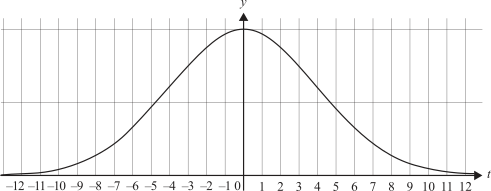
A transport company has detailed records of all its deliveries. The number of minutes a delivery is made before or after its schedule delivery time can be modelled as a normally distributed random variable, `T`, with a mean of zero and a standard deviation of four minutes. A graph of the probability distribution of `T` is shown below.
 

  1. If  `"Pr"(T <= a)=0.6`, find `a` to the nearest minute.   (1 mark)

    --- 3 WORK AREA LINES (style=lined) ---

  2. Find the probability, correct to three decimal places, of a delivery being no later than three minutes after its scheduled delivery time, given that it arrives after its scheduled delivery time.   (2 marks)

    --- 3 WORK AREA LINES (style=lined) ---

  3. Using the model described above, the transport company can make 46.48% of its deliveries over the interval  `-3 <= t <= 2`.
  4. It has an improved delivery model with a mean of `k` and a standard deviation of four minutes.
  5. Find the values of `k`, correct to one decimal place, so that 46.48% of the transport company's deliveries can be made over the interval  `-4.5 <= t <= 0.5`   (3 marks)

    --- 5 WORK AREA LINES (style=lined) ---

A rival transport company claims that there is a 0.85 probability that each delivery it makes will arrive on time or earlier.

Assume that whether each delivery is on time or earlier is independent of other deliveries.

  1. Assuming that the rival company's claim is true, find the probability that on a day in which the rival company makes eight deliveries, fewer than half of them arrive on time or earlier. Give your answer correct to three decimal places.   (2 marks)

    --- 3 WORK AREA LINES (style=lined) ---

  2. Assuming that the rival company's claim is true, consider a day in which it makes `n` deliveries.
    1. Express, in terms of `n`, the probability that one or more deliveries will not arrive on time or earlier.   (1 mark)

      --- 3 WORK AREA LINES (style=lined) ---

    2. Hence, or otherwise, find the minimum value of `n` such that there is at least a 0.95 probability that one or more deliveries will not arrive on time or earlier.   (1 mark)

      --- 3 WORK AREA LINES (style=lined) ---

  3. An analyst from a government department believes the rival transport company's claim is only true for deliveries made before 4 pm. For deliveries made after 4 pm, the analyst believes the probability of a delivery arriving on time or earlier is `x`, where  `0.3 <=x <= 0.7`
  4. After observing a large number of the rival transport company's deliveries, the analyst believes that the overall probability that a delivery arrives on time or earlier is actually 0.75
  5. Let the probability that a delivery is made after 4 pm be `y`.
  6. Assuming that the analyst's belief are true, find the minimum and maximum values of `y`.   (2 marks)

    --- 5 WORK AREA LINES (style=lined) ---

Show Answers Only

  1. `a= 1\ text(minute)`
  2. `0.547`
  3. `k=-1.5, -2.5`
  4. `0.003`
  5.  i. `1-0.85^n`
  6. ii. `19`
  7. `2/3`

Show Worked Solution

a.   `T\ ~\ N(0, 4^2)`

`text(Solve (by CAS): Pr)(T<=a) = 0.6`

`:. a= 1\ text(minute)`
 

b.    `text{Pr}(T <= 3∣T > 0)` `=(text{Pr}(0 < T <= 3))/(text{Pr}(T > 0))`
    `=(0.27337 dots)/(0.5)`
    `=0.547\ \ text{(to 3 d.p.)}`


c.   `text(Given)\ \ text{Pr}(-3 <= T <= 2) = 0.4648`

`sigma = 4 text{minutes}`

`=> \ text{Pr}(-4.5 <= T – 1.5 <= 0.5) = 0.4648`

`=> k=-1.5`

`text(By symmetry of the normal distribution)`

`text{Pr}(-2 <= T <= 3) = text{Pr}(-3 <= T <= 2) = 0.4648`

`=> \ text{Pr}(-4.5 <= T – 2.5 <= 0.5) = 0.4648`

`=> k=-2.5`

`:. k=-1.5, -2.5`


d.   `text{Let}\ \ X\ ~\ text{Bi}(8, 0.85)`

`text(Solve (by CAS):)`

`text{Pr}(X<=3) = 0.003\ \ text{(to 3 d.p.)}`
 

e.i.   `text{Pr(at least 1 delivery is late)}`

`= 1-\ text{Pr(all deliveries are on time)}`

`=1-0.85^n`
 

e.ii.   `text{Solve for}\ n:`

`1-0.85^n` `<0.95`  
`n` `>18.43…`  

 
`:.n_min=19`
 

f.   `text{Pr(delivery made after 4pm)} = y`

`=>\ text{Pr(delivery made before 4pm)} = 1-y`

`0.85(1-y)+xy` `=0.75`  
`y` `=-(0.1)/(x-0.85)`  
  `=(2)/(17-20 x)`  

 
`text(Given ) 0.3<=x<=0.7:`

`y_min = (2)/(17-20 xx 0.3) = 2/11`

`y_max = (2)/(17-20 xx 0.7) = 2/3`

Filed Under: Binomial, Normal Distribution Tagged With: Band 4, Band 5, Band 6, smc-638-20-binomCdf (CAS), smc-638-40-Inverse Binom N (CAS), smc-719-30-Other z-score intervals, smc-719-50-Conditional probability

Probability, MET1 2006 VCAA 5

Let `X` be a normally distributed random variable with a mean of 72 and a standard deviation of 8. Let `Z` be the standard normal random variable. Use the result that `text(Pr) (Z < 1) = 0.84`, correct to two decimal places, to find

  1. the probability that `X` is greater than `80`  (1 mark)

    --- 4 WORK AREA LINES (style=lined) ---

  2. the probability that  `64 < X < 72`  (1 mark)

    --- 4 WORK AREA LINES (style=lined) ---

  3. the probability that  `X < 64`  given that  `X < 72`  (2 marks)

    --- 4 WORK AREA LINES (style=lined) ---

Show Answers Only

  1. `0.16`
  2. `0.34`
  3. `8/25`

Show Worked Solution

a.   vcaa-2006-meth-5ai

`text(Pr) (X > 80)`

`= text(Pr) (Z > (80 – 72)/8)`

`= text(Pr) (Z > 1)`

`= 0.16`


b.   `text(Pr) (64 < X < 72)`

♦ Mean mark 45%.

`= text(Pr) (72 < X < 80)\ \ \ text(due to symmetry)`

`= 0.5 – 0.16`

`= 0.34`


♦ Mean mark 40%.
MARKER’S COMMENT: Notation was poor, showing a lack of understanding in this area.

c.   `text(Conditional probability)`

`text(Pr) (X < 64 | X < 72)` `= (text{Pr} (X < 64))/(text{Pr} (X < 72))`
  `= 0.16/0.50`
  `= 8/25 or 0.32`

Filed Under: Normal Distribution Tagged With: Band 4, Band 5, smc-719-10-Single z-score, smc-719-30-Other z-score intervals, smc-719-50-Conditional probability

Probability, MET1 2015 VCAA 6

Let the random variable `X` be normally distributed with mean 2.5 and standard deviation 0.3

Let `Z` be the standard normal random variable, such that  `Z ∼\ text(N)(0, 1)`.

  1. Find `b` such that  `text(Pr)(X > 3.1) = text(Pr)(Z < b)`.  (1 mark)

    --- 3 WORK AREA LINES (style=lined) ---

  2. Using the fact that, correct to two decimal places,  `text(Pr)(Z < –1) = 0.16`, find  `text(Pr)(X < 2.8 | X > 2.5)`.
  3. Write the answer correct to two decimal places.  (2 marks) 

    --- 5 WORK AREA LINES (style=lined) ---

Show Answers Only

  1. `−2`
  2. `0.68`

Show Worked Solution
♦ Part (a) mean mark 50%.

a.    `text(Pr)(X > 3.1)` `= text(Pr)(Z > (3.1 – 2.5)/0.3)`
    `= text(Pr)(Z > 2)`
    `= text(Pr)(Z < − 2)`

`:. b = −2`


♦ Part (b) mean mark 48%.
MARKER’S COMMENT: Students who drew a diagram of a “normal” curve with relevent shaded areas were more successful.

b.    met1-2015-vcaa-q6-answer

`text(Pr)(X < 2.8 | X > 2.5)`

`= (text(Pr)(2.5 < X < 2.8))/(text(Pr)(X > 2.5))`
`= 0.34/0.5`
`= 34/50`
`= 68/100`
`= 0.68`

Filed Under: Normal Distribution Tagged With: Band 5, smc-719-10-Single z-score, smc-719-50-Conditional probability

Copyright © 2014–2025 SmarterEd.com.au · Log in