SmarterEd

Aussie Maths & Science Teachers: Save your time with SmarterEd

  • Login
  • Get Help
  • About

Calculus, MET1 2023 VCAA 7

Consider \(f:(-\infty, 1]\rightarrow R, f(x)=x^2-2x\). Part of the graph of  \(y=f(x)\)  is shown below.
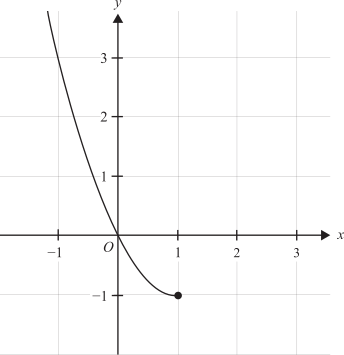
 

  1. State the range of \(f\).   (1 mark)

    --- 2 WORK AREA LINES (style=lined) ---

  2. Sketch the graph of the inverse function  \(y=f^{-1}(x)\) on the axes above. Label any endpoints and axial intercepts with their coordinates.   (2 marks)

    --- 0 WORK AREA LINES (style=lined) ---

  3. Determine the equation of the domain for the inverse function  \(f^{-1}\).   (2 marks)

    --- 3 WORK AREA LINES (style=lined) ---

  4. Calculate the area of the regions enclosed by the curves of \(f,\ f^{-1}\)  and  \(y=-x\).   (2 marks)

    --- 8 WORK AREA LINES (style=lined) ---

Show Answers Only

a.    \([-1, \infty)\)

b.   
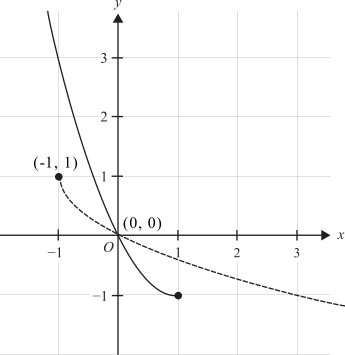
c.    \(f^{-1}(x)=1-\sqrt{x+1}\)

\(\text{Domain}\ [-1, \infty)\)

d.    \(A=\dfrac{1}{3}\)

Show Worked Solution

a.    \([-1, \infty)\)

b.   

c.    \(\text{When }f(x)\ \text{is written in turning point form}\)

\(y=(x-1)^2-1\)
 

\(\text{Inverse function: swap}\ x \leftrightarrow y\)

\(x\) \(=(y-1)^2-1\)
\(x+1\) \(=(y-1)^2\)
\(-\sqrt{x+1}\) \(=y-1\)
\(f^{-1}(x)\) \(=1-\sqrt{x+1}\)

 
\(\text{Domain}\ [-1, \infty)\)


♦ Mean mark (c) 48%.
MARKER’S COMMENT: Common error → writing the function as \(f^{-1}(x)=1+\sqrt{x+1}\).

d.     \(\text{One strategy of many possibilities:}\)

  \(A\) \(=2\displaystyle \int_{0}^{1} \big(-x-(x^2-2x)\big)\,dx\)
    \(=2\displaystyle \int_{0}^{1} \big(x-x^2\big)\,dx\)
    \(=2\left[\dfrac{x^2}{2}-\dfrac{x^3}{3}\right]_0^1\)
    \(=2\bigg(\dfrac{1}{2}-\dfrac{1}{3}-(0)\bigg)\)
    \(=\dfrac{1}{3}\)

♦♦♦ Mean mark (d) 24%.
MARKER’S COMMENT: Using the symmetry properties of the graph and its inverse helped answer this question efficiently.
Filed Under: Area Under Curves Tagged With: Band 3, Band 4, Band 5, smc-723-30-Square root, smc-723-80-Area between graphs

Calculus, MET1 2020 VCAA 6

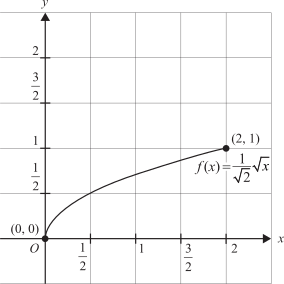
Let  `f:[0,2] -> R`, where  `f(x) = 1/sqrt2 sqrtx`.

  1. Find the domain and the rule for  `f^(-1)`, the inverse function of  `f`.   (2 marks)

    --- 5 WORK AREA LINES (style=lined) ---

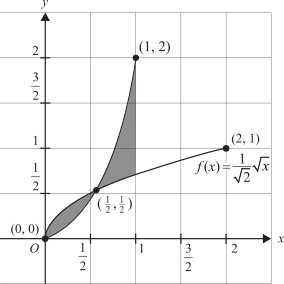
The graph of  `y = f(x)`, where  `x ∈ [0, 2]`, is shown on the axes below.


  1. On the axes above, sketch the graph of  `f^(-1)`  over its domain. Label the endpoints and point(s) of intersection with the function  `f`, giving their coordinates.   (2 marks)

    --- 0 WORK AREA LINES (style=lined) ---

  2. Find the total area of the two regions: one region bounded by the functions  `f` and `f^(-1)`, and the other region bounded by  `f, f^(-1)`  and the line  `x = 1`. Give your answer in the form  `(a-bsqrtb)/6`, where  `a, b ∈ ZZ^+`.   (4 marks)

    --- 8 WORK AREA LINES (style=lined) ---

Show Answers Only
  1. `text(Domain) = [0, 1]`


    `f^(-1)(x) = 2x^2`

  2.  
       
  3.  `(5 + 2sqrt2)/6\ \ text(u²)`
Show Worked Solution
a.    `text(Domain)\ \ f^(-1)(x)` `= text(Range)\ \ f(x)=[0,1]`

 
`y = 1/sqrt2 x`

`text(Inverse: swap)\ \ x ↔ y`

`x` `= 1/sqrt2 sqrty`
`sqrty` `= sqrt2 x`
`y` `= 2x^2`

 
`:. f^(-1)(x) = 2x^2`


b.     


c.     
`A` `= int_0^(1/2) 1/sqrt2 sqrtx-2x^2 dx + int_(1/2)^1 2x^2-1/sqrt2 sqrtx\ dx`
  `= [sqrt2/3 x^(3/2)-2/3 x^3]_0^(1/2) + [2/3 x^3-sqrt2/3 x^(3/2)]_(1/2)^1`
  `= [sqrt2/3 (1/sqrt2)^3-2/3(1/2)^3] + [(2/3-sqrt2/3)-(2/24-sqrt2/3 · 1/(2sqrt2))]`
  `= (1/6-1/12) + 2/3-sqrt2/3-(1/12-1/6)`
  `= 1/12 + 2/3-sqrt2/3 + 1/12`
  `= (1 + 8-4sqrt2 + 1)/12`
  `= (5-2sqrt2)/6\ \ text(u²)`

Filed Under: Area Under Curves, Polynomial and Other Functions Tagged With: Band 4, Band 5, smc-5205-20-Square root, smc-5205-70-Sketch graph, smc-5205-80-Area between curves, smc-723-30-Square root

Calculus, MET1 2017 VCAA 9

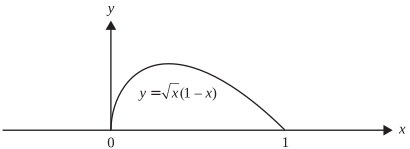
The graph of  `f: [0, 1] -> R,\ f(x) = sqrt x (1-x)`  is shown below.
 

  1. Calculate the area between the graph of `f` and the `x`-axis.   (2 marks)

    --- 6 WORK AREA LINES (style=lined) ---

  2. For `x` in the interval `(0, 1)`, show that the gradient of the tangent to the graph of `f` is  `(1-3x)/(2 sqrt x)`.   (1 mark)

    --- 4 WORK AREA LINES (style=lined) ---

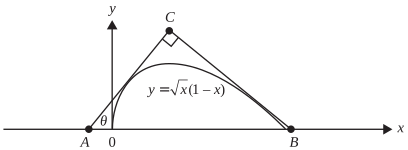
The edges of the right-angled triangle `ABC` are the line segments `AC` and `BC`, which are tangent to the graph of `f`, and the line segment `AB`, which is part of the horizontal axis, as shown below.

Let `theta` be the angle that `AC` makes with the positive direction of the horizontal axis, where  `45^@ <= theta < 90^@`.

  1. Find the equation of the line through `B` and `C` in the form  `y = mx + c`, for  `theta = 45^@`.   (2 marks)

    --- 7 WORK AREA LINES (style=lined) ---

  2. Find the coordinates of `C` when  `theta = 45^@`.   (4 marks)

    --- 10 WORK AREA LINES (style=lined) ---

Show Answers Only
  1. `4/15\ text(units)^2`
  2. `text(Proof)\ \ text{(See Workes Solutions)}`
  3. `y = -x + 1`
  4. `C (11/27, 16/27)`
Show Worked Solution
a.   `text(Area)` `= int_0^1 (sqrt x-x sqrt x)\ dx`
    `= int_0^1 (x^(1/2)-x^(3/2))\ dx`
    `= [2/3 x^(3/2)-2/5 x^(5/2)]_0^1`
    `= (2/3-2/5)-(0-0)`
    `= 10/15-6/15`
    `= 4/15\ text(units)^2`


♦♦ Mean mark part (b) 35%.
MARKER’S COMMENT: Establishing the common denominator in the working was required!
b.   `f (x)` `= x^(1/2)-x^(3/2)`
  `f^{′}(x)` `= 1/2 x^(-1/2)-3/2 x^(1/2)`
    `= 1/(2 sqrt x)-(3 sqrt x)/2`
    `= (1-3x)/(2 sqrt x)\ \ text(.. as required.)`


c.  `m_(AC) = tan 45^@=1`

♦♦♦ Mean mark part (c) 20%.
MARKER’S COMMENT: Most successful answers introduced a pronumeral such as `a=sqrtx` to solve.

`=> m_(BC) = -1\ \ (m_text(BC) _|_ m_(AC))`


`text(At point of tangency of)\ BC,\  f^{prime}(x) = -1`

`(1-3x)/(2 sqrt x)` `=-1`
`1-3x` `=-2sqrtx`
`3x-2sqrt x-1` `=0`


`text(Let)\ \ a=sqrtx,`

`3a^2-2a-1` `=0`
`(3a+1)(a-1)` `=0`
`a=1 or -1/3`   
`:. sqrt x` `=1` `or`   `sqrt x=- 1/3\ \ text{(no solution)}`
`x` `=1`    

 
`f(1)=sqrt1(1-1)=0\ \ =>B(1,0)`
 

`:.\ text(Equation of)\ \ BC, \ m=-1, text{through (1,0) is:}`

`y-0` `=-1(x-1)`
`y` `=-x+1`


d.  `text(Find Equation)\ AC:`

♦♦♦ Mean mark part (d) 17%.

`m_(AC) =1`

`text(At point of tangency of)\ AC,\  f^{prime}(x) = 1`

`(1-3x)/(2 sqrt x)` `=1`
`1-3x` `=2sqrtx`
`3x+2sqrt x-1` `=0`
`(3 sqrtx-1)(sqrtx+1)` `=0`
   
`:. sqrt x` `=1/3` `or`   `sqrt x=-1\ \ text{(no solution)}`
`x` `=1/9`    

 
`f(1/9)=sqrt(1/9)(1-1/9)=1/3 xx 8/9 = 8/27\ \ =>P(1/9,8/27)`
 

`:.\ text(Equation of)\ AC, m=1, text(through)\ \ P\ \ text(is):`

`y-8/27` `= 1 (x-1/9)`
`y` `= x + 5/27`

 
`C\ text(is at intersection of)\ AC and CB:`

`-x + 1` `= x + 5/27`
`2x` `= 22/27`
`:. x` `= 11/27`
`y` `= -11/27 + 1 = 16/27`

 
`:. C (11/27, 16/27)`

Filed Under: Area Under Curves, Tangents and Normals Tagged With: Band 4, Band 5, Band 6, smc-634-40-Other Function, smc-634-80-Angle between tangents/axes, smc-723-30-Square root, smc-723-70-Other

Calculus, MET2 2009 VCAA 1

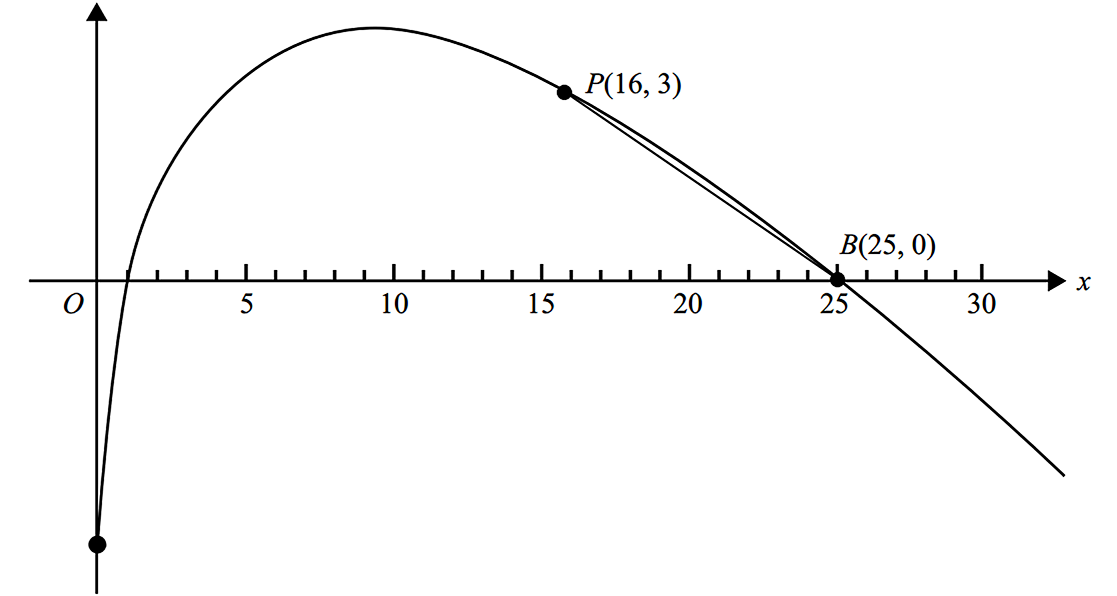
Let  `f: R^+ uu {0} -> R,\ f(x) = 6 sqrt x-x-5.`

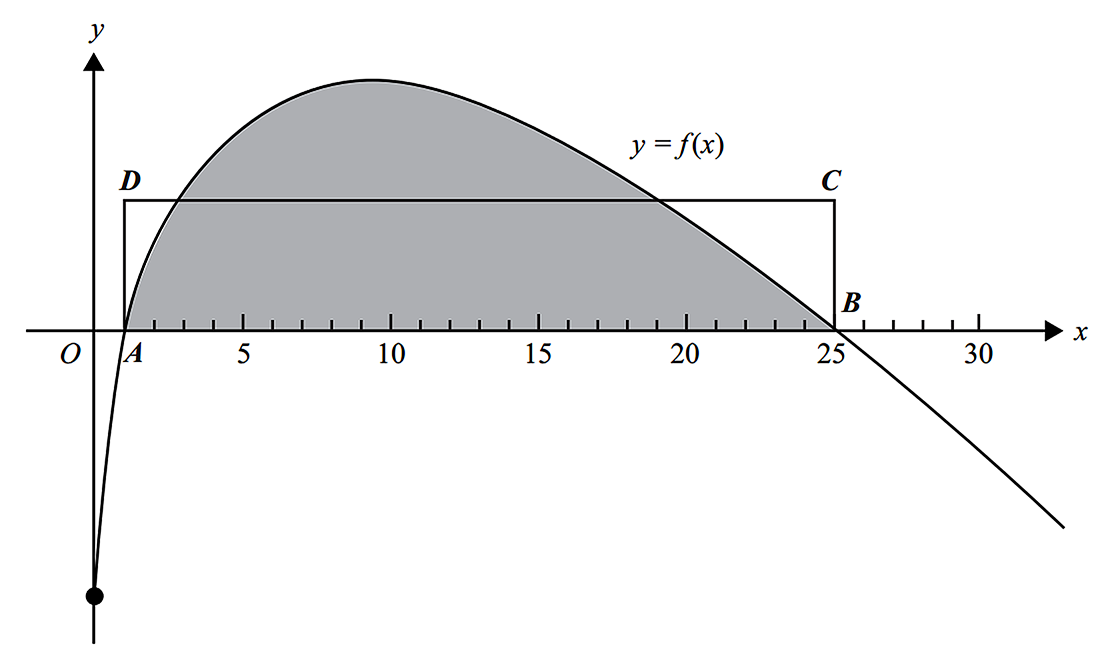
The graph of  `y = f (x)`  is shown below.

VCAA 2009 1a

  1. State the interval for which the graph of `f` is strictly decreasing.   (2 marks)

    --- 3 WORK AREA LINES (style=lined) ---

  2. Points `A` and `B` are the points of intersection of  `y = f (x)`  with the `x`-axis. Point `A` has coordinates `(1, 0)` and point `B` has coordinates `(25, 0)`.


    Find the length of `AD` such that the area of rectangle `ABCD` is equal to the area of the shaded region.   (2 marks)
     
    VCAA 2009 1c

    --- 3 WORK AREA LINES (style=lined) ---

  3. The points `P (16, 3)` and `B (25, 0)` are labelled on the diagram.


          VCAA 2009 1d


    1. Find `m`, the gradient of the chord `PB`.   (Exact value to be given.)   (1 mark)

      --- 2 WORK AREA LINES (style=lined) ---

    2. Find  `a in [16, 25]`  such that  `f prime (a) = m`.  (Exact value to be given.)   (2 marks)

      --- 3 WORK AREA LINES (style=lined) ---

Show Answers Only

a.  `x in [9,oo)`

b.  `8/3`

c.i.   `m=-1/3`

c.ii.  `a=81/4`

Show Worked Solution
a.   vcaa-2009-1ai
`text(Stationary point when)\ \ f^{′}(x)` `= 0`
`x` `= 9`

 
`:.\ text(Strictly decreasing for)\ \ x in [9, oo)`


b.   vcaa-2009-1ci
`AD` `= y_text(average)`
  `= 1/(25-1) int_1^25\ f(x)\ dx`
  `= 8/3\ \ text{[by CAS]}`


c.i.   `m_(PB)` `= (3-0)/(16-25)`
  `:. m_(PB)` `=-1/3`


 c.ii.   `text(Solve)\ \ f^{′}(a)` `= -1/3\ \ text(for)\ \ a in [16, 25]`
  `:. a` `= 81/4`

Filed Under: Area Under Curves Tagged With: Band 3, Band 4, smc-723-30-Square root

Calculus, MET2 2014 VCAA 19 MC

Jake and Anita are calculating the area between the graph of  `y = sqrt x`  and the `y`-axis between  `y = 0`  and  `y = 4.`

Jake uses a partitioning, shown in the diagram below, while Anita uses a definite integral to find the exact area.
 

VCAA 2014 19mc
 

The difference between the results obtained by Jake and Anita is

A.   `0`

B.   `22/3`

C.   `26/3`

D.   `14`

E.   `35`

Show Answers Only

`C`

Show Worked Solution

`text(Jake:)`

`A_J` `~~ 1[1 + 4 + 9 + 16]`
  `~~ 30`


`text(Anita:)`

`A_A = 16 xx 4 – int_0^16 sqrtx\ dx`

`text(or)`

`A_A` `= int_0^4 y^2\ dy`
  `= 64/3`


`:.\ text(Difference)` `= 30 – 64/3`
  `= 26/3`

`=>   C`

Filed Under: Area Under Curves (old) Tagged With: Band 4, smc-723-30-Square root, smc-723-90-Approximations

Calculus, MET2 2013 VCAA 16 MC

The graph of  `f: [1, 5] -> R,\ f(x) = sqrt (x - 1)`  is shown below.

met2-16

Which one of the following definite integrals could be used to find the area of the shaded region?

A.   `int_1^5 (sqrt (x - 1))\ dx`

B.   `int_0^2 (sqrt (x - 1))\ dx`

C.   `int_0^5 (2 - sqrt (x - 1))\ dx`

D.   `int_0^2 (x^2 + 1)\ dx`

E.   `int_0^2 (x^2)\ dx`

Show Answers Only

`E`

Show Worked Solution

`f(5)=2,\ \ f(1)=0`

♦♦♦ Mean mark 21%.

`f(x)=sqrt(x-1)`

`text(Find inverse:)`

`f^-1(x)=x^2 +1`
 

`:.\ text(Shaded Area)`

`= int_0^2(x^2+1)\ dx – 2 xx 1`

`=int_0^2 (x^2)\ dx`
 

`=>   E`

Filed Under: Area Under Curves Tagged With: Band 6, smc-723-30-Square root, smc-723-80-Area between graphs

Calculus, MET2 2012 VCAA 14 MC

The graph of  `f: R^+ uu {0} -> R,\ f(x) = sqrt x`  is shown below.

In order to find an approximation to the area of the region bounded by the graph of  `f`, the `y`-axis and the line  `y = 4`, Zoe draws four rectangles, as shown, and calculates their total area.

VCAA 2012 14mc

Zoe's approximation to the area of the region is

A.   `14`

B.   `21`

C.   `29`

D.   `30`

E.   `64/3`

Show Answers Only

`D`

Show Worked Solution

`text(Width of each rectangle)\ = 1`

`text(Height of each rectangle:)`

`text(When)\ \ y=1 => 1=sqrt x, \ x=1`

`text(When)\ \ y=2\ => 2=sqrt x, \ x=4`

`text(When)\ \ y=3 => x=9`

`text(When)\ \ y=2 => x=16`


`:. A` `~~ 1[1 + 4 + 9 + 16]`
  `~~ 30\ \ text(u²)`

`=>   D`

Filed Under: Area Under Curves (old) Tagged With: Band 4, smc-723-30-Square root, smc-723-90-Approximations

Copyright © 2014–2025 SmarterEd.com.au · Log in