Let \(g: R \backslash\{-3\} \rightarrow R, \ g(x)=\dfrac{1}{(x+3)^2}-2\). --- 0 WORK AREA LINES (style=lined) --- --- 6 WORK AREA LINES (style=lined) --- a. b. \(\dfrac{10}{3}\ \text{sq units}\) a. \(y\text{-intercept:}\ x=0\) \(y=\dfrac{1}{(0+3)^2}-2=-\dfrac{17}{9}\) \(x\text{-intercepts:}\ y=0\) b. \(\text{Area is below}\ x\text{-axis:}\)
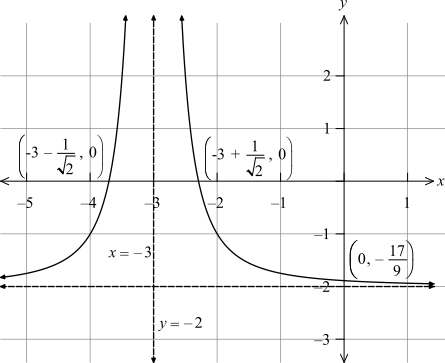
\(\dfrac{1}{(x+3)^2}-2\)
\(=0\)
\((x+3)^2\)
\(=\dfrac{1}{2}\)
\(x+3\)
\(=\pm\dfrac{1}{\sqrt{2}}\)
\(x\)
\(=-3\pm\dfrac{1}{\sqrt{2}}\)
\(\text{Area}\)
\(=-\displaystyle\int_{-2}^0 (x+3)^{-3}-2\,dx\)
\(=-\left[\dfrac{1}{-1}(x+3)^{-1}-2x\right]_{-2}^0\)
\(=-\left[\dfrac{-1}{x+3}-2x\right]_{-2}^0\)
\(=-\left[\dfrac{-1}{3}-\left(\dfrac{-1}{-2+3}-2(-2)\right)\right]\)
\(=-\Big[\dfrac{-1}{3}-(-1+4)\Big] \)
\(=\dfrac{10}{3}\ \text{u}^{2}\)
Calculus, MET1 2019 VCAA 5
Let `f: R\ text(\{1}) -> R, \ f(x) = 2/(x-1)^2 + 1`.
-
- Evaluate `f(-1)`. (1 mark)
--- 1 WORK AREA LINES (style=lined) ---
- Sketch the graph of `f` on the axes below, labelling all asymptotes with their equations. (2 marks)
--- 0 WORK AREA LINES (style=lined) ---
- Evaluate `f(-1)`. (1 mark)
- Find the area bounded by the graph of `f`, the `x`-axis, the line `x = -1` and the line `x = 0`. (2 marks)
--- 5 WORK AREA LINES (style=lined) ---
Show Worked Solution
| a.i. | `f(-1)` | `= 2/(-1-1)^2 + 1` |
| `= 3/2` |
| a.ii. | 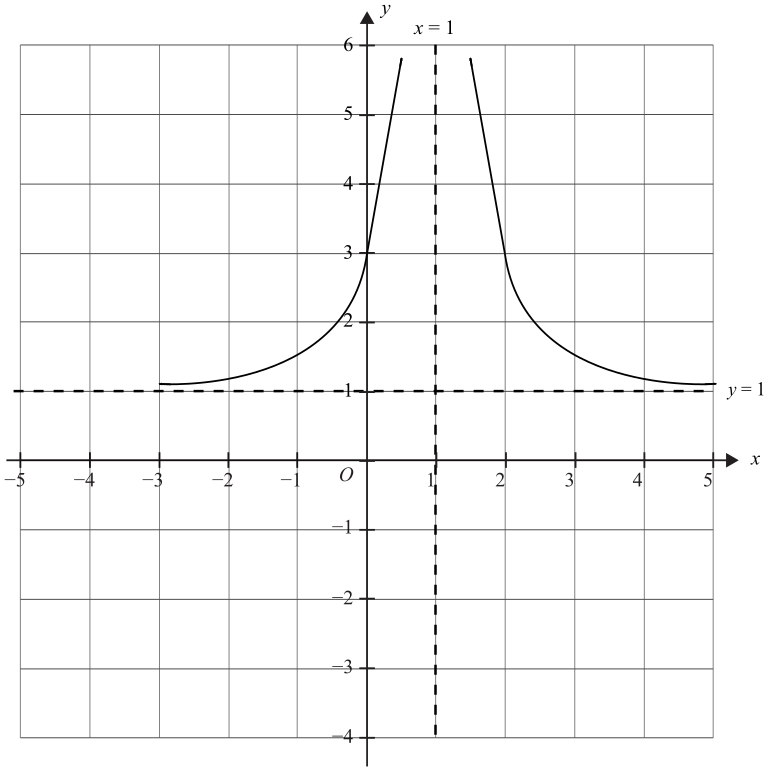 |
| b. | `text(Area)` | `= int_(-1)^0 2/(x-1)^2 + 1\ dx` |
| `= int_(-1)^0 2(x-1)^(-2) + 1\ dx` | ||
| `= [-2(x-1)^(-1) + x]_(-1)^0` | ||
| `= [((-2)/-1 + 0)-((-2)/-2-1)]` | ||
| `= 2` |
Calculus, MET1 2016 VCAA 3
Let `f: R text{\}{1} -> R` where `f(x) = 2 + 3/(x - 1)`.
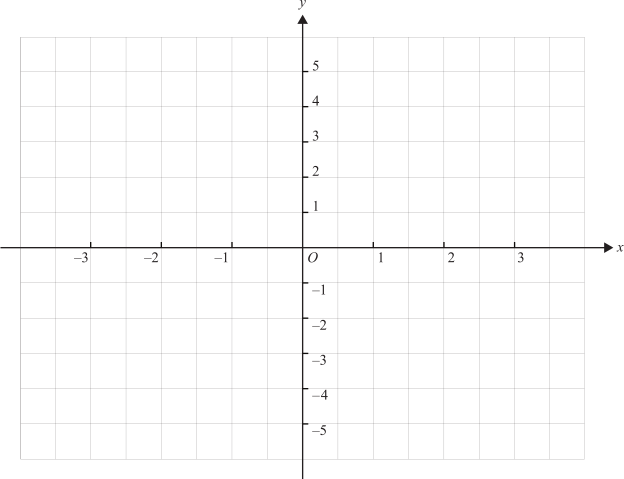
- Sketch the graph of `f`. Label the axis intercepts with their coordinates and label any asymptotes with the appropriate equation. (3 marks)
- Find the area enclosed by the graph of `f`, the lines `x = 2` and `x = 4`, and the `x`-axis. (2 marks)
--- 5 WORK AREA LINES (style=lined) ---
Show Answers Only
-

- `4 + 3log_e(3)\ text(units)`
Show Worked Solution
| a. | |
| b. | `text(Area)` | `= int_2^4 2 + 3(x – 1)^(−1)\ dx` |
| `= [2x + 3 log_e(x – 1)]_2^4` | ||
| `= (8 + 3log_e(3)) – (4 + 3log_e(1))` | ||
| `= 4 + 3log_e(3)\ \ text(u²)` |
Calculus, MET2 2016 VCAA 4
- Express `(2x + 1)/(x + 2)` in the form `a + b/(x + 2)`, where `a` and `b` are non-zero integers. (2 marks)
--- 2 WORK AREA LINES (style=lined) ---
- Let `f: R text(\){−2} -> R,\ f(x) = (2x + 1)/(x + 2)`.
- Find the rule and domain of `f^(-1)`, the inverse function of `f`. (2 marks)
--- 3 WORK AREA LINES (style=lined) ---
- Part of the graphs of `f` and `y = x` are shown in the diagram below.
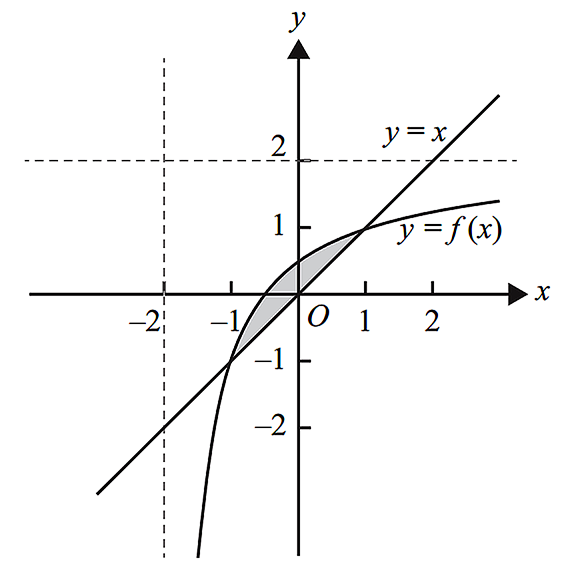
- Find the area of the shaded region. (1 mark)
--- 5 WORK AREA LINES (style=lined) ---
- Part of the graphs of `f` and `f^(-1)` are shown in the diagram below.
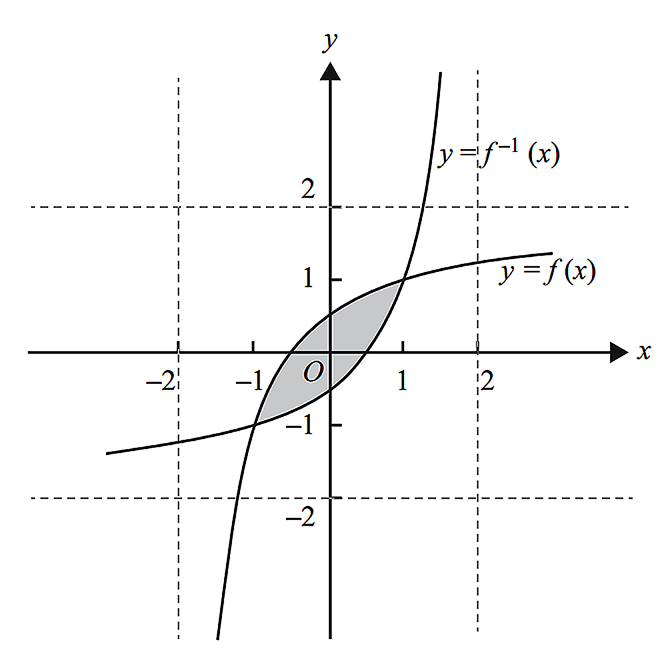
- Find the area of the shaded region. (1 mark)
--- 5 WORK AREA LINES (style=lined) ---
- Find the rule and domain of `f^(-1)`, the inverse function of `f`. (2 marks)
- Part of the graph of `f` is shown in the diagram below.
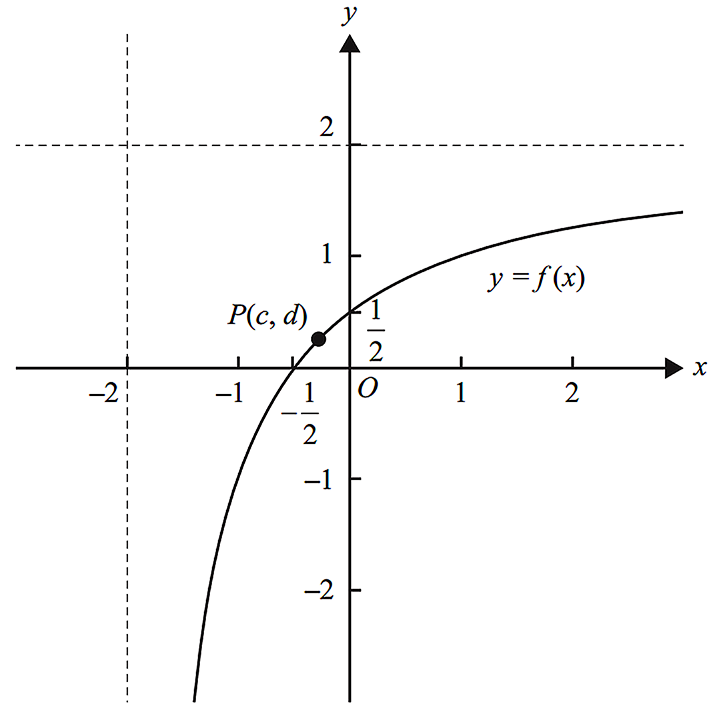
The point `P(c, d)` is on the graph of `f`.
Find the exact values of `c` and `d` such that the distance of this point to the origin is a minimum, and find this minimum distance. (3 marks)
--- 6 WORK AREA LINES (style=lined) ---
Let `g: (−k, oo) -> R, g(x) = (kx + 1)/(x + k)`, where `k > 1`.
- Show that `x_1 < x_2` implies that `g(x_1) < g(x_2),` where `x_1 in (−k, oo) and x_2 in (−k, oo)`. (2 marks)
--- 7 WORK AREA LINES (style=lined) ---
- Let `X` be the point of intersection of the graphs of `y = g (x) and y = −x`.
- Find the coordinates of `X` in terms of `k`. (2 marks)
--- 7 WORK AREA LINES (style=lined) ---
- Find the value of `k` for which the coordinates of `X` are `(-1/2, 1/2)`. (2 marks)
--- 5 WORK AREA LINES (style=lined) ---
- Let `Ztext{(− 1, − 1)}, Y(1, 1)` and `X` be the vertices of the triangle `XYZ`. Let `s(k)` be the square of the area of triangle `XYZ`.
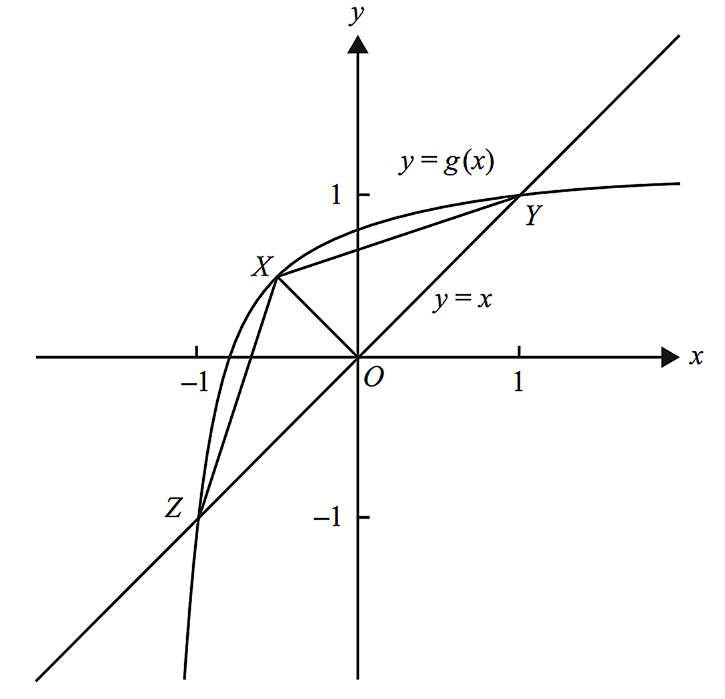
Find the values of `k` such that `s(k) >= 1`. (2 marks)
--- 5 WORK AREA LINES (style=lined) ---
- Find the coordinates of `X` in terms of `k`. (2 marks)
- The graph of `g` and the line `y = x` enclose a region of the plane. The region is shown shaded in the diagram below.
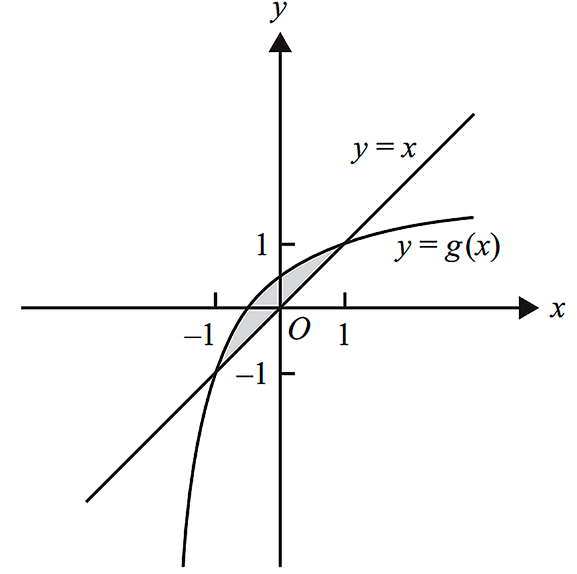
Let `A(k)` be the rule of the function `A` that gives the area of this enclosed region. The domain of `A` is `(1, oo)`.
- Give the rule for `A(k)`. (2 marks)
--- 4 WORK AREA LINES (style=lined) ---
- Show that `0 < A(k) < 2` for all `k > 1`. (2 marks)
--- 6 WORK AREA LINES (style=lined) ---
- Give the rule for `A(k)`. (2 marks)
Show Worked Solution
a. `text(Solution 1)`
| `(2x + 1)/(x + 2)` | `= 2-3/(x + 2)` |
| `= 2 + {(-3)}/(x + 2) qquad [text(CAS: prop Frac) ((2x + 1)/(x + 2))]` |
`text(Solution 2)`
| `(2x + 1)/(x + 2)` | `=(2(x+2)-3)/(x+2)` |
| `=2+ (-3)/(x+2)` |
b.i. `text(Let)\ \ y = f(x)`
`text(For Inverse: swap)\ \ x ↔ y`
| `x` | `=2-3/(y + 2)` |
| `(x-2)(y+2)` | `=-3` |
| `y` | `=(-3)/(x-2)-2` |
`text(Range of)\ f(x):\ \ y in R text(\){2}`
`:. f^(-1) (x) = (-3)/(x-2)-2, \ x in R text(\){2}`
b.ii. `text(Find intersection points:)`
| `f(x)` | `= x` |
| `(2x+1)/(x+2)` | `=x` |
| `2x+1` | `=x^2+2x` |
| `:. x` | `= +- 1` |
| `:.\ text(Area)` | `= int_(-1)^1 (f(x)-x)\ dx` |
| `=int_(-1)^1 (2-3/(x + 2)-x)\ dx` | |
| `= 4-3 ln(3)\ text(u²)` |
| b.iii. | `text(Area)` | `= int_(-1)^1 (f(x)-f^(-1) (x)) dx` |
| `=2 xx (4-3 ln(3))\ \ \ text{(twice the area in (b)(ii))}` | ||
| `= 8-6 log_e (3)\ text(u²)` |
♦♦♦ Mean mark part (c) 25%.
| c. |  |
|
| `text(Let)\ \ z` | `= OP, qquad P(c, -3/(c + 2) + 2)` | |
| `z` | `= sqrt (c^2 + (2-3/(c + 2))^2), \ c > -2` | |
`text(Stationary point when:)`
`(dz)/(dc) = 0, c > -2`
`:.\ c = sqrt 3-2 overset and (->) d = 2-sqrt 3`
`:. text(Minimum distance) = (2 sqrt 2-sqrt 6)`
d. `text(Given:)\ \ -k < x_1 < x_2`
♦♦♦ Mean mark part (d) 8%.
`text(Must prove:)\ \ g(x_2)-g(x_1) > 0`
`text(LHS:)`
`g(x_2)-g(x_1)`
`= (kx_2 +1)/(x_2+k)-(kx_1 +1)/(x_1+k)`
`=((kx_2 +1)(x_1+k)-(kx_1 +1)(x_2+k))/((x_2+k)(x_1+k))`
`=(k^2(x_2-x_1)-(x_2-x_1))/((x_2+k)(x_1+k))`
`=((k^2-1)(x_2-x_1))/((x_2+k)(x_1+k))`
`x_2-x_1 >0,\ and \ k^2-1>0`
`text(S)text(ince)\ \ x_2>x_1> -k,`
`=> -x_2<-x_1<k`
`=>k+x_1 >0, \ and \ k+x_2>0`
`:.g(x_2)-g(x_1) >0`
`:. g(x_2) > g(x_1)`
♦♦ Mean mark part (e)(i) 32%.
| e.i. | `g(x)` | `= -x` |
| `(kx +1)/(x+k)` | `=-x` | |
| `kx+1` | `=-x^2-xk` | |
| `x^2+2k+1` | `=0` | |
| `:. x` | `=(-2k +- sqrt(4k^2-4))/2` | |
| `= sqrt (k^2-1)-k\ \ text(for)\ \ x > -k` |
`:. X (-k + sqrt(k^2-1),\ \ k-sqrt(k^2-1))`
e.ii. `text(Equate)\ \ x text(-coordinates:)`
♦ Mean mark part (e)(ii) 44%.
| `-k + sqrt(k^2-1)` | `= -1/2` |
| `sqrt(k^2-1)` | `=k-1/2` |
| `k^2-1` | `=k^2-k+1/4` |
| `:. k` | `= 5/4` |
| e.iii. | `s(k)` | `= (1/2 xx YZ xx XO)^2` |
| `= 1/4 xx (YZ)^2 xx (XO)^2` |
`ZO = sqrt(1^2+1^2) = sqrt2`
♦♦♦ Mean mark (e)(iii) 6%.
`YZ=2 xx ZO = 2sqrt2`
`(YZ)^2 = 8`
| `(XO)^2` | `=(-k + sqrt(k^2-1))^2-(k-sqrt (k^2-1))^2` |
| `=2(-k + sqrt(k^2-1))^2` | |
`text(Solve)\ \ s(k) >= 1\ \ text(for)\ \ k >= 1,`
| `1/4 xx 8 xx 2(-k + sqrt(k^2-1))^2` | `>=1` |
| `(-k + sqrt(k^2-1))^2` | `>=1/4` |
| `k-sqrt(k^2-1)` | `>=1/2` |
| `k-1/2` | `>= sqrt(k^2-1)` |
| `k^2-k+1/4` | `>=k^2-1` |
| `:.k` | `<= 5/4` |
`:. 1<k<= 5/4`
♦♦ Mean mark (f)(i) 28%.
| f.i. | `A(k)` | `= int_(-1)^1 (g(x)-x)\ dx,\ \ k > 1` |
| `= int_(-1)^1 ((kx+1)/(x+k) -x)\ dx` | ||
| `= int_(-1)^1 (k+ (1-k^2)/(x+k) -x)` | ||
| `=[kx + (1-k^2) log_e(x+k)-x^2/2]_(-1)^1` | ||
| `=(k+(1-k^2)log_e(1+k)-1/2)-(-k+(1-k^2)log_e(k-1)-1/2)` | ||
| `=2k+(1-k^2)log_e ((1+k)/(k-1))` | ||
| `= (k^2-1) log_e ((k-1)/(k + 1)) + 2k` |
♦♦♦ Mean mark part (f)(ii) 4%.
| f.ii. |  |
|
| `0` | `< A(k) < text(Area of)\ Delta ABC` | |
| `0` | `< A(k) < 1/2 xx AC xx BO` | |
| `0` | `< A(k) < 1/2 sqrt(2^2 + 2^2) xx (sqrt(1^2 + 1^2))` | |
| `0` | `< A(k) < 1/2 xx 2 sqrt 2 xx sqrt 2` | |
| `:. 0` | `< A(k) < 2` | |