SmarterEd

Aussie Maths & Science Teachers: Save your time with SmarterEd

  • Login
  • Get Help
  • About

Calculus, MET1 SM-Bank 30

A function is given by  `f(x) = 3x^4 + 4x^3-12x^2`.

  1. Find the coordinates of the stationary points of  `f(x)`  and determine their nature.   (3 marks)

    --- 9 WORK AREA LINES (style=lined) ---

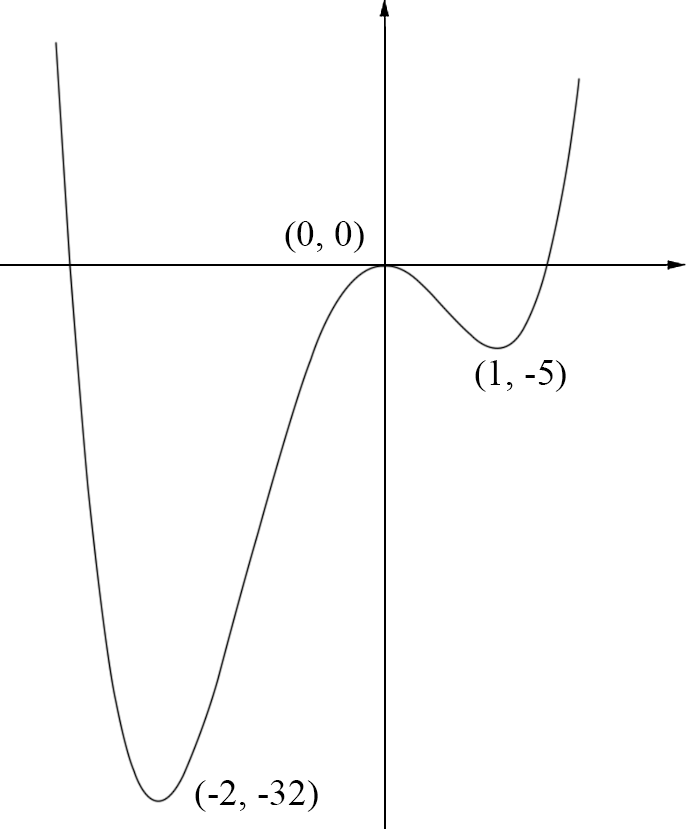
  2. Hence, sketch the graph  `y = f(x)`  showing the stationary points.   (2 marks)

    --- 6 WORK AREA LINES (style=lined) ---

  3. For what values of `x` is the function increasing?   (1 mark)

    --- 2 WORK AREA LINES (style=lined) ---

  4. For what values of `k` will  `f(x) = 3x^4 + 4x^3-12x^2 + k = 0`  have no solution?   (1 mark)

    --- 3 WORK AREA LINES (style=lined) ---

Show Answers Only
  1. `text(MAX at)\ (0,0)`
  2. `text(MIN at)\ text{(1,–5)}`
  3. `text(MIN at)\ text{(–2,–32)}`
  4. 2UA HSC 2012 14ai
     
  5. `f(x)\ text(is increasing for)\ -2 < x < 0\ text(and)\ x > 1`
  6. `text(No solution when)\ k > 32`
Show Worked Solution
i. `f(x)` `= 3x^4 + 4x^3 -12x^2`
  `f^{′}(x)` `= 12x^3 + 12x^2-24x`
  `f^{″}(x)` `= 36x^2 + 24x-24`


`text(Stationary points when)\ f prime (x) = 0`

`=> 12x^3 + 12x^2-24x` `=0`
`12x(x^2 + x-2)` `=0`
`12x (x+2) (x -1)` `=0`


`:.\ text(Stationary points at)\ x=0,\ 1\ text(or)\ –2`

`text(When)\ x=0,\ \ \ \ f(0)=0`
`f^{″}(0)` `= -24 < 0`
`:.\ text{MAX at  (0,0)}`


`text(When)\ x=1`

`f(1)` `= 3+4\-12 = -5`
`f^{″}(1)` `= 36 + 24\-24 = 36 > 0`
`:.\ text{MIN at  (1,–5)}`


`text(When)\ x=–2`

`f(–2)` `=3(–2)^4 + 4(–2)^3-12(–2)^2`
  `= 48 -32\-48`
  `= -32`
`f^{″}(–2)` `= 36(–2)^2 + 24(–2) -24`
  `=144-48-24 = 72 > 0`
`:.\ text{MIN at  (–2,–32)}`


ii.  2UA HSC 2012 14ai


♦ Mean mark (HSC) 42%
MARKER’S COMMENT: Be careful to use the correct inequality signs, and not carelessly include `>=` or `<=` by mistake.


iii. `f(x)\ text(is increasing for)`
  `-2 < x < 0\ text(and)\ x > 1`


iv.   `text(Find)\ k\ text(such that)`

♦♦♦ Mean mark (HSC) 12%.

`3x^4 + 4x^3-12x^2 + k = 0\ \ text(has no solution)`

`k\ text(is the vertical shift of)\ \ y = 3x^4 + 4x^3-12x^2`

`=>\ text(No solution if it does not cross the)\ x text(-axis.)`

`:.\ text(No solution when)\ \ k > 32`

Filed Under: Curve Sketching Tagged With: Band 4, Band 5, Band 6, smc-724-20-Degree 4, smc-724-60-Increasing/Decreasing intervals

Calculus, MET2 2016 VCAA 2

Consider the function  `f(x) = -1/3 (x + 2) (x-1)^2.`

  1.  i. Given that  `g^{′}(x) = f (x) and g (0) = 1`,
  2.      show that  `g(x) = -x^4/12 + x^2/2-(2x)/3 + 1`.   (1 mark)

    --- 3 WORK AREA LINES (style=lined) ---

  3. ii. Find the values of `x` for which the graph of  `y = g(x)`  has a stationary point.   (1 mark)

    --- 3 WORK AREA LINES (style=lined) ---

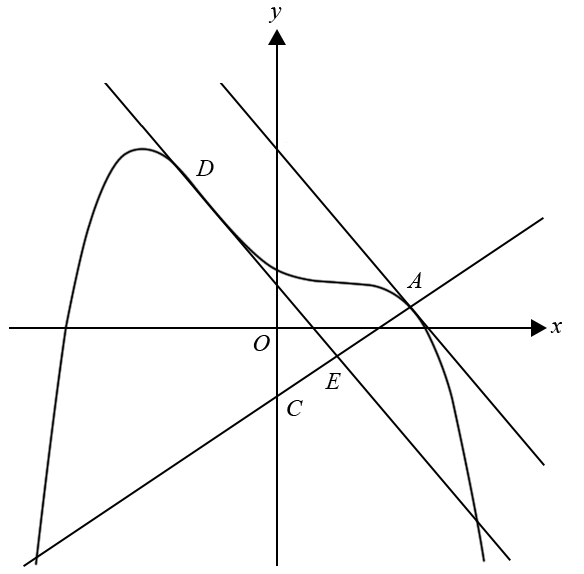
The diagram below shows part of the graph of  `y = g(x)`, the tangent to the graph at  `x = 2`  and a straight line drawn perpendicular to the tangent to the graph at  `x = 2`. The equation of the tangent at the point `A` with coordinates  `(2, g(2))`  is  `y = 3-(4x)/3`.

The tangent cuts the `y`-axis at `B`. The line perpendicular to the tangent cuts the `y`-axis at `C`.


  1.   i. Find the coordinates of `B`.   (1 mark)

    --- 2 WORK AREA LINES (style=lined) ---

  2.  ii. Find the equation of the line that passes through `A` and `C` and, hence, find the coordinates of `C`.   (2 marks)

    --- 5 WORK AREA LINES (style=lined) ---

  3. iii. Find the area of triangle `ABC`.   (2 marks)

    --- 4 WORK AREA LINES (style=lined) ---

  4. The tangent at `D` is parallel to the tangent at `A`. It intersects the line passing through `A` and `C` at `E`.


     i. Find the coordinates of `D`.   (2 marks)

    --- 4 WORK AREA LINES (style=lined) ---

  5. ii. Find the length of `AE`.   (3 marks)

    --- 6 WORK AREA LINES (style=lined) ---

Show Answers Only
  1.  i. `text(Proof)\ \ text{(See worked solutions)}`
  2. ii. `x = -2, 1`
  3.   i. `(0, 3)`
  4. ii. `y = 3/4 x-7/6`
  5.      `(0, -7/6)`
  6. iii. `25/6\ text(u²)`
  7. `(-1, 25/12)`
  8. `27/20\ text(u)`
Show Worked Solution
a.i.    `g(x)` `= int f(x)\ dx`
    `=-1/3 int (x + 2) (x-1)^2\ dx`
    `=-1/3int(x^3-3x+2)\ dx`
  `:.g(x)` `= -x^4/12 + x^2/2-(2x)/3 + c`

 
`text(S)text(ince)\ \ g(0) = 1,`

`1` `= 0 + 0-0 + c`
`:. c` `= 1`

  
`:. g(x) = -x^4/12 + x^2/2-(2x)/3 + 1\ \ …\ text(as required)`
 

a.ii.   `text(Stationary point when:)`

`g^{′}(x) = f(x) = 0`

`-1/3(x + 2) (x-1)^2=0`

`:. x = -2, 1`
 

b.i.   

`B\ text(is the)\ y text(-intercept of)\ \ y = 3-4/3 x`

`:. B (0, 3)`
 

b.ii.   `m_text(norm) = 3/4, \ text(passes through)\ \ A(2, 1/3)`

   `text(Equation of normal:)`

`y-1/3` `=3/4(x-2)`
`y` `=3/4 x-7/6`
   

`:. C (0, -7/6)`
 

b.iii.   `text(Area)` `= 1/2 xx text(base) xx text(height)`
    `= 1/2 xx (3 + 7/6) xx 2`
    `= 25/6\ text(u²)`


♦ Mean mark part (c)(i) 43%.
MARKER’S COMMENT: Many students gave an incorrect `y`-value here. Be careful!
c.i.    `text(Solve)\ \ \ g^{′}(x)` `= -4/3\ \ text(for)\ \ x < 0`
  `=> x` `= -1`
  `g(-1)` `=-1/12+1/2+2/3+1`
    `=25/12`

  
`:. D (−1, 25/12)`
 

c.ii.   `text(T) text(angent line at)\ \ D:`

`y-25/12` `=-4/3(x+1)`
`y` `=-4/3x + 3/4`

 
`DE\ \ text(intersects)\ \ AE\ text(at)\ E:`

♦♦ Mean mark 32%.
`-4/3 x + 3/4` `= 3/4 x-7/6`
`25/12 x` `= 23/12`
`x` `=23/25`

 
`:. E (23/25, -143/300)`
 

`:. AE` `= sqrt((2-23/25)^2 + (1/3-(-143/300))^2)`
  `= 27/20\ text(units)`

Filed Under: Coordinate Geometry, Curve Sketching, Tangents and Normals Tagged With: Band 3, Band 4, Band 5, smc-634-10-Polynomial, smc-634-50-Find tangent given curve, smc-634-70-Find point of tangency, smc-724-20-Degree 4, smc-727-10-Equation of line, smc-727-20-Distance

Calculus, MET2 2010 VCAA 4

Consider the function  `f: R -> R,\ f(x) = 1/27 (2x-1)^3 (6-3x) + 1.`

  1. Find the `x`-coordinate of each of the stationary points of  `f` and state the nature of each of these stationary points.   (4 marks)

    --- 7 WORK AREA LINES (style=lined) ---

In the following, `f` is the function  `f: R -> R,\ f(x) = 1/27 (ax-1)^3 (b-3x) + 1` where `a` and `b` are real constants.

  1. Write down, in terms of `a` and `b`, the possible values of `x` for which `(x, f (x))` is a stationary point of `f`.   (3 marks)

    --- 5 WORK AREA LINES (style=lined) ---

  2. For what value of `a` does `f` have no stationary points?   (1 mark)

    --- 2 WORK AREA LINES (style=lined) ---

  3. Find `a` in terms of `b` if `f` has one stationary point.   (2 marks)

    --- 3 WORK AREA LINES (style=lined) ---

  4. What is the maximum number of stationary points that `f` can have?  (1 mark)

    --- 2 WORK AREA LINES (style=lined) ---

  5. Assume that there is a stationary point at `(1, 1)` and another stationary point `(p, p)` where  `p != 1`.
  6. Find the value of `p`.   (3 marks)

    --- 4 WORK AREA LINES (style=lined) ---

Show Answers Only
  1. `text(Point of inflection at)\ \ x = 1/2`
    `text(Local max at)\ \ x = 13/8`
  2. `x = (ab + 1)/(4a) or x = 1/a`
  3. `0`
  4. `3/b`
  5. `2`
  6. `4`
Show Worked Solution

a.   `text(S.P. occurs when)\ \ f^{′}(x) = 0`

`f(x)` `=1/27 (2x-1)^3 (6-3x) + 1`
`f^{′}(x)` `=- 1/9 (2x-1)^2 (8x-13) `

 
`text(Solve:)\ \ f^{′}(x)=0\ \ text(for)\ x,`

`:. x = 1/2 or x = 13/8`
 

 `text(Sketch the graph:)`

vcaa-graphs-fur2-2010-4ai

`=>\ text(Point of inflection at)\ \ x = 1/2`

`=>\ text(Local max at)\ \ x = 13/8`
 

b.   `text(S.P. occurs when)\ \ f prime (x) = 0`

♦ Mean mark (b) 46%.
MARKER’S COMMENT: Issues with use of CAS caused significant difficulties in this question.
`f(x)` `=1/27 (ax-1)^3 (b-3x) + 1`
`f^{′}(x)` `=1/9 (ax-1)^2 (ab+1-4ax)`

 
`text(Solve:)\ \ f^{′}(x) = 0\ \ text(for)\ \ x,`

`:. x = (ab + 1)/(4a)\ \ \text{or}\  \ x = 1/a`
 

c.   `text(For)\ \ x = (ab + 1)/(4a) or x = 1/a\ \ text(to exist,)`

♦ Mean mark part (c) 47%.

`a != 0`

`:.\ text(No stationary points when)\ \ a = 0`
 

d.   `text(If there is 1 S.P.,)`

♦♦♦ Mean mark (d) 16%.
`(ab + 1)/(4a)` `= 1/a`
`:. a` `= 3/b`


♦ Mean mark (e) 37%.

e.   `text(The maximum number of SP’s for a quartic)`

`text(polynomial is 3. In the function given, one of)`

`text(the SP’s is a point of inflection.)`

`:.f(x)\ \ text(has a maximum of 2 SP’s.)`


f.   `text{Solution 1 [by CAS]}` 

`text(Define)\ \ f(x) = 1/27 (x-1)^3 (b-3x) + 1`

`text(Solve:)\ \ f(p) = p, f^{′}(1) = 1  and f^{′}(p) = p\ \ text(for)\ \ p,`

`:. p = 4,\  \ \ (p != 1)`
 

`text(Solution 2)`

`text(SP’s occur at)\ \ (1,1) and (p,p),\ \ text(where,)`

♦♦♦ Mean mark (f) 9%.

`x = (ab + 1)/(4a) or x = 1/a`

`text(Consider)\ \ p=1/a,`

`f(p)` `=f(1/a)`
 

`=1/27 (a*1/a-1)^3(b-3*1/a)+1=1`


`f(p)=1,\ \ text(SP at)\ (1,1) and p!=1`

`=> p!=1/a`
 

`text(Consider)\ \ 1=1/a,`

`=> a=1 and  b=4p-1`

`f(1)=1`

`f(p)=p`

`1/27 (p-1)^3(4p-1-3p)+1` `=p`
`1/27(p-1)^4-(p-1)` `=0`
`(p-1)(1/27(p-1)^3-1)` `=0`
`(p-1)^3` `=27`
`p` `=4`


Filed Under: Curve Sketching Tagged With: Band 4, Band 5, Band 6, smc-724-20-Degree 4

Calculus, MET2 2014 VCAA 5

Let  `f: R -> R, \ \ f (x) = (x-3)(x-1)(x^2 + 3)  and  g: R-> R, \ \ g (x) = x^4-8x.`

  1. Express  `x^4-8x`  in the form  `x(x-a) ((x + b)^2 + c)`.   (2 marks)

    --- 4 WORK AREA LINES (style=lined) ---

  2. Describe the translation that maps the graph of  `y = f (x)`  onto the graph of  `y = g (x)`.   (1 mark)

    --- 2 WORK AREA LINES (style=lined) ---

  3. Find the values of `d` such that the graph of  `y = f (x + d)` has
    1. one positive `x`-axis intercept.   (1 mark)

      --- 3 WORK AREA LINES (style=lined) ---

    2. two positive `x`-axis intercepts.   (1 mark)

      --- 2 WORK AREA LINES (style=lined) ---

  4. Find the value of `n` for which the equation  `g (x) = n`  has one solution.   (1 mark)

    --- 3 WORK AREA LINES (style=lined) ---

  5. At the point  `(u, g(u))`, the gradient of  `y = g(x)`  is `m` and at the point `(v, g(v))`, the gradient is  `-m`, where `m` is a positive real number.
    1. Find the value of  `u^3 + v^3`.   (2 marks)

      --- 3 WORK AREA LINES (style=lined) ---

    2. Find `u` and `v` if  `u + v = 1`.   (1 mark)

      --- 3 WORK AREA LINES (style=lined) ---

    1. Find the equation of the tangent to the graph of  `y = g(x)`  at the point  `(p, g(p))`.   (1 mark)

      --- 4 WORK AREA LINES (style=lined) ---

    2. Find the equations of the tangents to the graph of  `y = g(x)`  that pass through the point with coordinates  `(3/2, -12)`.   (3 marks)

      --- 5 WORK AREA LINES (style=lined) ---

Show Answers Only
  1. `x(x-2)((x + 1)^2 + 3)`
  2. `text(See Worked Solutions)`
  3.  i. `[1,3)`
  4. ii. `d < 1`
  5. `-6 xx 2^(1/3)`
  6.  i. `4`
  7. ii. `u = (sqrt5 + 1)/2,quad v = (-sqrt5 + 1)/2`
  8. i. `y = 4(p^3-2)x-3p^4`
  9. ii. `y = -8x;quady = 24x-48`
Show Worked Solution

a.  `text(Solution 1)`

`g(x) = x^4-8x`

`= x(x-2)(x^2 + 2x + 4)\ \ \ text([by CAS])`

`= x(x-2)((x + 1)^2 + 3)`
 

`text(Solution 2)`

`x^4-8x` `=x(x^3-2^3)`
  `=x(x-2)(x^2 +2x+4)`
  `=x(x-2)(x^2 +2x+1+3)`
  `=x(x-2)((x+1)^2+3)`


b.    `f(x + 1)` `= ((x + 1)-3)((x + 1)-1)((x + 1)^2 + 3)`
    `= x(x-2)((x + 1)^2 + 3)`
    `= g(x)`


♦ Mean mark (b) 37%.

`:.\ text(Horizontal translation of 1 unit to the left.)`
 

c.i.  `text(Consider part of the)\ \ f(x)\ text(graph below:)`

♦♦♦ Mean mark 7%.

 
met2-2014-vcaa-sec5-answer
 

`text(For one positive)\ xtext(-axis intercept, translate at least)`

`text(1 unit left, but not more than 3 units left.)`

`:. d ∈ [1,3)`
 

c.ii.   `text(Translate less than 1 unit left, or translate)`

♦♦♦ Mean mark part (c)(ii) 19%.

`text(right.)`

`:. d < 1`
 

d.   `text(If)\ \ g(x)=n\ \ text(has one solution, then it)`

`text(will occur when)\ \ g^{′}(x)=0  and  x>0.`

♦♦♦ Mean mark 17%.
`g^{′}(x)` `=4x^3-8`
`4x^3` `=8`
`x` `=2^(1/3)`


met2-2014-vcaa-sec5-answer1
 

`n` `=g(2^(1/3))`
  `=2^(4/3)-8xx2^(1/3)`
  `=-6 xx 2^(1/3)`


e.i.   `gprime(u) = mqquadgprime(v) = −m`

♦♦ Mean mark (e.i.) 28%.
`g^{prime}(u)` `= -g^{prime}(v)`
`4u^3-8` `= -(4v^3-8)`
`4u^3 + 4v^3` `= 16`
`:. u^3 + v^3` `= 4`


e.ii.   `u^3 + v^3 = 4\ …\ (1)`

♦♦♦ Mean mark (e.ii.) 10%.

`u + v = 1\ …\ (2)`

`text(Solve simultaneous equation for)\ \ u > 0:`

`:. u = (sqrt5 + 1)/2,quad v = (-sqrt5 + 1)/2`
 

f.i.   `text(Solution 1)`

`text(Using the point-gradient formula,)`

`y-g(p)` `=g^{prime}(p)(x-p)`
`y-(p^4-8p)` `=(4p^3-8)(x-p)`
`y` `=(4p^3-8)x -3p^4`

 
`text(Solution 2)`

♦♦ Mean mark (f.i.) 22%.

`y = 4(p^3-2)x-3p^4`

`text([CAS: tangentLine)\ (g(u),x,p)]`


f.ii.   `text(Sub)\ (3/2,-12)\ text(into tangent equation,)`

`text(Solve:)\ \ -12 = 4(p^3-2)(3/2)-3p^4\ \ text(for)\ p,`

♦♦♦ Mean mark (f.ii.) 14%.

`p = 0\ \ text(or)\ \ p = 2`

`text(When)\ \ p = 0:`    `y` `= 4(-2)x`
    `= -8x`
`text(When)\ \ p = 2:`    `y` `= 4(2^3-2)x-3(2)^4`
    `= 24x-48`

 
`:. text(Equations are:)\ \ y =-8x, \ y = 24x-48`

Filed Under: Curve Sketching, Polynomials, Tangents and Normals Tagged With: Band 4, Band 5, Band 6, smc-634-50-Find tangent given curve, smc-724-20-Degree 4, smc-750-60-Other

Graphs, MET2 2015 VCAA 3 MC

VCAA 2015 3mc
 

The rule for a function with the graph above could be

  1. `y = -2(x + b)(x - c)^2(x - d)`
  2. `y = 2(x + b)(x - c)^2(x - d)`
  3. `y = -2(x - b)(x - c)^2(x - d)`
  4. `y = 2(x - b)(x - c)(x - d)`
  5. `y = -2(x - b)(x + c)^2(x + d)`
Show Answers Only

`C`

Show Worked Solution

`text(Polynomial Equation:)`

♦♦♦ Mean mark 20% (lowest in 2015 exam).
MARKER’S COMMENT: `b` is negative. If `b= – 2` for example, the factor is `(x-(– 2))“=(x+2)`.

`y = a(x – b)(x – c)^n(x – d),`

`text(where)\ a < 0`

`n = text(even integer)` 

`=>   C`


Filed Under: Curve Sketching, Polynomials Tagged With: Band 6, smc-724-20-Degree 4, smc-750-60-Other

Copyright © 2014–2025 SmarterEd.com.au · Log in