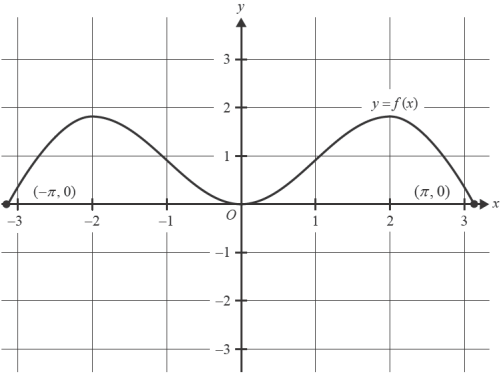
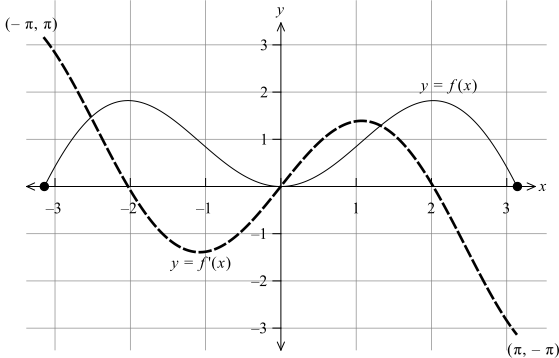
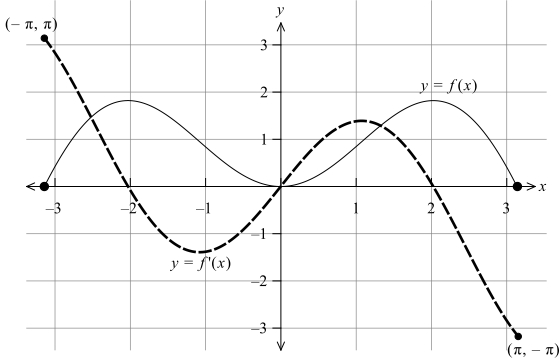
Part of the graph of \(f:[-\pi, \pi] \rightarrow R, f(x)=x \sin (x)\) is shown below. --- 8 WORK AREA LINES (style=lined) --- --- 3 WORK AREA LINES (style=lined) --- --- 3 WORK AREA LINES (style=lined) --- --- 3 WORK AREA LINES (style=lined) --- --- 0 WORK AREA LINES (style=lined) --- a. \(\dfrac{\sqrt{3}\pi^2}{6}\) bi. \(x\cos(x)+\sin(x)\) bii. \(\left[-\dfrac{\pi}{3}+\dfrac{\sqrt{3}}{3},\ 1\right]\) biii. \(\text{In the interval }\left[\dfrac{\pi}{2}, \dfrac{2\pi}{3}\right],\ f^{\prime}(x)\ \text{changes from positive to negative.}\) \(f^{\prime}(x)=0\ \text{at some point in the interval.}\) \(\therefore\ \text{A stationary point must exist in the given range.}\) b.ii. \(\text{Gradient in given range gradually decreases.}\) \(\text{Range of}\ f^{\prime}(x)\ \text{will be defined by the endpoints.}\) \(f^{\prime}(x)=0\ \text{at some point in the interval.}\) \(\therefore\ \text{A stationary point must exist in the given range.}\) \(f^{\prime}(-\pi)=-\pi\cos(-\pi)+\sin(-\pi)=\pi\) \(\therefore\ \text{Endpoints are }\ (-\pi,\ \pi)\ \text{and}\ (\pi,\ -\pi).\)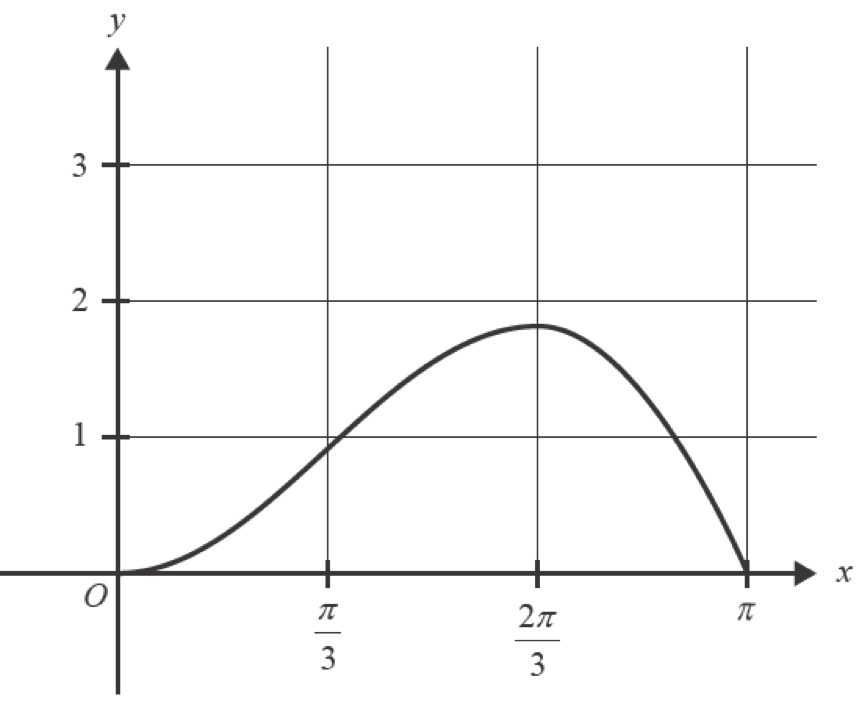
a.
\(A\)
\(=\dfrac{\pi}{3}\times\dfrac{1}{2}\left(f(0)+2f\left(\dfrac{\pi}{3}\right)+2f\left(\dfrac{2\pi}{3}\right)+f(\pi)\right)\)
\(=\dfrac{\pi}{6}\left(0+2\times \dfrac{\pi}{3}\sin\left(\dfrac{\pi}{3}\right)+2\times \dfrac{2\pi}{3}\sin\left(\dfrac{2\pi}{3}\right)+\pi\sin({\pi})\right)\)
\(=\dfrac{\pi}{6}\left(2\times \dfrac{\pi}{3}\times\dfrac{\sqrt{3}}{2}+2\times\dfrac{2\pi}{3}\times \dfrac{\sqrt{3}}{2}+0\right)\)
\(=\dfrac{\pi}{6}\left(\dfrac{2\pi\sqrt{3}}{6}+\dfrac{4\pi\sqrt{3}}{6}\right)\)
\(=\dfrac{\pi}{6}\times \dfrac{6\pi\sqrt{3}}{6}\)
\(=\dfrac{\sqrt{3}\pi^2}{6}\)
bi.
\(f(x)\)
\(=x\sin(x)\)
\(f^{\prime}(x)\)
\(=x\cos(x)+\sin(x)\)
\(f^{\prime}\left(\dfrac{\pi}{2}\right)\)
\(=1\)
\(f^{\prime}\left(\dfrac{2\pi}{3}\right)\)
\(=\dfrac{2\pi}{3}\left(\dfrac{-1}{2}+\dfrac{\sqrt{3}}{2}\right)=-\dfrac{\pi}{3}+\dfrac{\sqrt{3}}{3}\)
\(\therefore\ \text{Range of }\ f^{\prime} (x)\ \text{is}\quad\left[-\dfrac{\pi}{3}+\dfrac{\sqrt{3}}{3},\ 1\right]\)
♦♦♦ Mean mark (b.iii.) 12%.
biii. \(\text{In the interval }\left[\dfrac{\pi}{2}, \dfrac{2\pi}{3}\right],\ f^{\prime}(x)\ \text{changes from positive to negative.}\)
c. \(f^{\prime}(\pi)=\pi\cos(\pi)+\sin(\pi)=-\pi\)
Calculus, MET2 2024 VCAA 15 MC
The points of inflection of the graph of \(y=2-\tan \left(\pi\left(x-\dfrac{1}{4}\right)\right)\) are
- \(\left(k+\dfrac{1}{4}, 2\right), k \in Z\)
- \(\left(k-\dfrac{1}{4}, 2\right), k \in Z\)
- \(\left(k+\dfrac{1}{4},-2\right), k \in Z\)
- \(\left(k-\dfrac{3}{4},-2\right), k \in Z\)
Show Worked Solution
\(\text{The graph of}\ \ y=-\tan(\pi x)\ \text{is translated 2 units upwards and then}\)
\(\text{translated }\dfrac{1}{4}\ \text{units to the right to become the graph shown below.}\)
\(\text{Hence all points of inflection lie of the line}\ y=2\)
\(\rightarrow\ \text{Eliminate Options C and D}\)
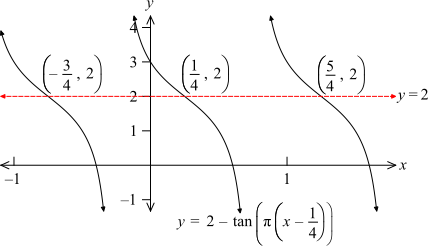
\(\text{Consider Option A:}\)
\(\text{When}\ \ k=0, x=0+\dfrac{1}{4}=\dfrac{1}{4}\)
\(\text{then}\ \ y=2-\tan \left(\pi\left(\dfrac{1}{4}-\dfrac{1}{4}\right)\right)=2\)
\(\text{Similarly for any}\ k \in Z\ \text{a point of inflection will be found at }\ \left(k+\dfrac{1}{4}, 2\right)\)
\(\Rightarrow A\)
Functions, MET2 2023 VCAA 9 MC
The function \(f\) is given by
\(f(x) = \begin {cases}
\tan\Bigg(\dfrac{x}{2}\Bigg) &\ \ 4 \leq x \leq 2\pi \\
\sin(ax) &\ \ \ 2\pi\leq x\leq 8
\end{cases}\)
The value of \(a\) for which \(f\) is continuous and smooth at \( x\) = \(2\pi\) is
- \(-2\)
- \(-\dfrac{\pi}{2}\)
- \(-\dfrac{1}{2}\)
- \(\dfrac{1}{2}\)
- \(2\)
Calculus, MET1 2021 VCAA 8
The gradient of a function is given by `(dy)/(dx) = sqrt(x + 6)-x/2-3/2`.
The graph of the function has a single stationary point at `(3, 29/4)`.
- Find the rule of the function. (3 marks)
--- 7 WORK AREA LINES (style=lined) ---
- Determine the nature of the stationary point. (2 marks)
--- 4 WORK AREA LINES (style=lined) ---
Show Worked Solution
| a. | `dy/dx` | `= sqrt(x + 6)-x/2-3/2` |
| `y` | `=int sqrt(x + 6)-x/2-3/2\ dx` | |
| `=2/3(x+6)^(3/2)-x^2/4-3/2x + c` |
`text{Graph passes through}\ (3, 29/4)`
| `29/4` | `=2/3*9^(3/2)-3^2/4-3/2 * 3+c` | |
| `29/4` | `=18-9/4-9/2+c` | |
| `c` | `=29/4-18+9/4+9/2` | |
| `=-4` |
`:. y=2/3(x+6)^(3/2)-x^2/4-3/2x-4`
♦ Mean mark part (b) 37%.
b.
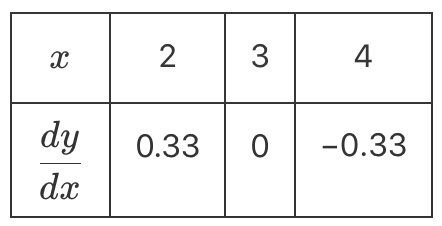
`:.(3,29/4)\ text{is a maximum}.`
Graphs, MET2 2015 VCAA 7 MC
The range of the function `f:\ text{(−1, 2]} -> R,\ \ f(x) = -x^2 + 2x-3` is
- `R`
- `text{(−6, −3]}`
- `text{(−6, −2]}`
- `text{[−6, −3]}`
- `text{[−6, −2]}`
Show Worked Solution
`text(A sketch of the equation:)`
| `y` | `=-x^2 + 2x-3` |
| `dy/dx` | `=-2x+2` |
`=>\ text(Concave down with turning point when)\ \ x=1,`

`:. text(Range) = (-6,-2]`
`=> C`