All asymptotes of the graph of \(y=2\, \tan \left(\pi\left(x+\dfrac{1}{2}\right)\right)\) are given by
- \(x=k, k \in Z\)
- \(x=2 k, k \in Z\)
- \(x=2 k+1, k \in Z\)
- \(x=\dfrac{4 k+1}{2}, k \in Z\)
Aussie Maths & Science Teachers: Save your time with SmarterEd
All asymptotes of the graph of \(y=2\, \tan \left(\pi\left(x+\dfrac{1}{2}\right)\right)\) are given by
\(A\)
\(y=2\, \tan \left(\pi\left(x+\dfrac{1}{2}\right)\right)\)
\(\text{Since}\ 2\, \tan (x)\ \text {has asymptote at} \ \ x=\dfrac{\pi}{2}:\)
\(\text{Find \(x\) when}\)
\(\pi\left(x+\dfrac{1}{2}\right)=\dfrac{\pi}{2} \ \ \Rightarrow \ \ x=0\)
\(\text{Period}=1\)
\(\therefore \ \text{General solution:} \ x=k, k \in Z\)
\(\Rightarrow A\)
The function \(f\) is given by
\(f(x) = \begin {cases}
\tan\Bigg(\dfrac{x}{2}\Bigg) &\ \ 4 \leq x \leq 2\pi \\
\sin(ax) &\ \ \ 2\pi\leq x\leq 8
\end{cases}\)
The value of \(a\) for which \(f\) is continuous and smooth at \( x\) = \(2\pi\) is
\(C\)
\(\text{Solve for}\ a\ \text{given}\ \ x=2\pi:\)
\(\tan\Bigg(\dfrac{2\pi}{2}\Bigg)=\sin(a2\pi)=0\)
\(a=\pm \dfrac{1}{2}\)
\(\text{For smoothness, solve for}\ a\ \text{given}\ \ x=2\pi:\)
\(\dfrac{d}{dx}\tan\Bigg(\dfrac{x}{2}\Bigg)=\dfrac{d}{dx}\sin(ax)\)
\(\therefore a=-\dfrac{1}{2}\)
\(\Rightarrow C\)
The period of the function with rule `y = tan((pix)/2)` is
`B`
`n= pi/2`
`text{Period} = pi/n = 2`
`=> B`
Shown below is part of the graph of a period of the function of the form `y = tan(ax + b)`.
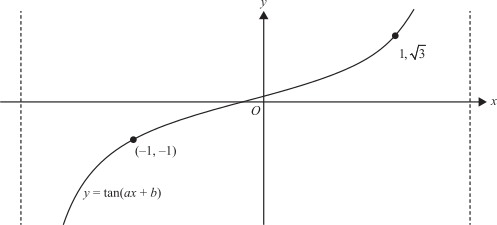
The graph is continuous for `x = ∈ [-1, 1]`.
Find the value of `a` and the value of `b`, where `a > 0` and `0 < b < 1`. (3 marks)
--- 10 WORK AREA LINES (style=lined) ---
`a = (7pi)/24, b = pi/24`
`y = tan(ax + b)`
`text(Substitute)\ \ (1, sqrt3), (-1,-1)\ \ text(into equation:)`
| `tan(a + b)` | `= sqrt3` |
| `tan(b-a)` | `=-1` |
| `a + b` | `= pi/3 \ …\ (1)` |
| `b-1` | `=-pi/4 \ …\ (2)` |
`text{Add (1) + (2):}`
| `2b` | `= pi/3-pi/4` |
| `b` | `= pi/24` |
`text{Substitute into (1):}`
| `a + pi/24` | `= pi/3` |
| `a` | `= (7pi)/24` |
The graph of `y = tan(ax)`, where `a ∈ R^+`, has a vertical asymptote `x = 3 pi` and has exactly one `x`-intercept in the region `(0, 3 pi)`.
The value of `a` is
`C`
`y = tan(ax)`
`tan x ->\ text(period of)\ pi,\ text(asymptotes at)\ \ x = pi/2, (3 pi)/2`
`tan(x/2) ->\ text(period of)\ 2 pi,\ text(asymptotes at)\ \ x=pi, 3 pi`
`tan(x/2) -> text(has one)\ x text(-intercept of)\ 2 pi\ \ {x: (0, 3 pi)}`
`:. a = 1/2`
`=> C`
The function with rule `f(x) = 4 tan (x/3)` has period
`D`
| `text(Period) ` | `=pi/n` |
| `= pi/(1/3)` | |
| `= 3 pi` |
`=> D`
A section of the graph of `f` is shown below.
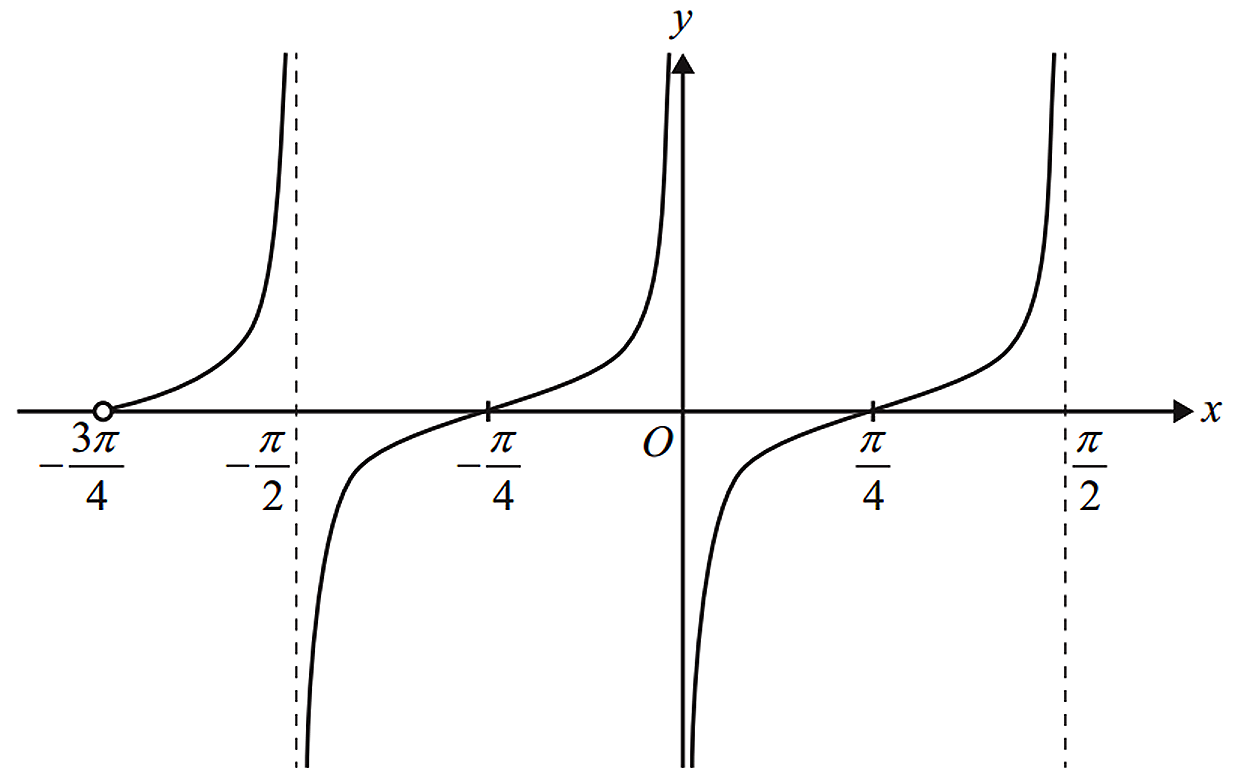
The rule of `f` could be
`C`
`text(Period) = pi/2`
`=>\ text(must be)\ C\ text(or)\ D`
`text(Shift)\ \ y = tan(x)\ \ text(right)\ \ pi/4.`
`=> C`
The function with rule `f(x) = -3 tan(2 pi x)` has period
`C`
| `text(Period)` | `= pi/n` |
| `=pi/(2 pi)` | |
| `= 1/2` |
`=> C`