Suppose \(z\) is a complex number on the unit circle such that
\(\text{Im}\left(z^3+z^2+z\right)=0\).
Find all possible values of \(z\). (4 marks)
--- 16 WORK AREA LINES (style=lined) ---
Aussie Maths & Science Teachers: Save your time with SmarterEd
Suppose \(z\) is a complex number on the unit circle such that
\(\text{Im}\left(z^3+z^2+z\right)=0\).
Find all possible values of \(z\). (4 marks)
--- 16 WORK AREA LINES (style=lined) ---
\(z=\pm 1, \pm i,\ -\dfrac{1}{2} \pm\dfrac{\sqrt{3}}{2} i\)
\(z\ \text{on unit circle}\ \Rightarrow \ z=\cos \theta+i \sin \theta,\ \ -\pi<\theta \leq \pi\)
\(\abs{z}=1\ \Rightarrow \ \dfrac{1}{z}=\overline{z}\)
| \(z^3+z^2+z\) | \(=z^2\left(z+1+\dfrac{1}{z}\right)\) |
| \(=z^2\left(z+\overline{z}+1\right)\) | |
| \(=(1+2 \cos \theta)\left(\cos 2\theta+i \sin 2\theta\right)\) |
\(\text{Since}\ \ 1+2 \cos \theta\ \ \text{is real:}\)
| \(\text{Im}\left(z^3+z^2+z\right)\) | \(=(1+2 \cos \theta) \sin 2\theta\) |
| \((1+2 \cos \theta) \sin 2\theta\) | \(=0\) |
\(\text{Case 1:}\ \ \sin 2\theta=0\)
\(2\theta=-\pi,\ 0,\ \pi,\ 2\pi\ \ (-2\pi<2\theta \leq 2\pi)\)
\(\theta=-\dfrac{\pi}{2},\ 0,\ \dfrac{\pi}{2},\ \pi\)
\(\Rightarrow z=-i,\ 1,\ i,\ -1\)
\(\text{Case 2:}\ \ \cos \theta=-\dfrac{1}{2}\)
\(\theta=\pm \dfrac{2\pi}{3}\)
\(\Rightarrow z=-\dfrac{1}{2} \pm \dfrac{\sqrt{3}}{2} i\)
\(\therefore z=\pm 1, \pm i,\ -\dfrac{1}{2} \pm\dfrac{\sqrt{3}}{2} i\)
If \(z=a+ai\) where \(a\) is a positive real number, find: --- 3 WORK AREA LINES (style=lined) --- --- 6 WORK AREA LINES (style=lined) --- i. \(4\sqrt{2}\,a^5\) ii. \(-\dfrac{3\pi}{4}\) i. \(\abs{z}=\sqrt{a^2+a^2}=\sqrt{2}\,a\ \ \ (a>0)\) \(\abs{z^5}=\abs{z}^5=\left(\sqrt{2}\,a\right)^5=4\sqrt{2}\,a^5\) ii. \(\text{Since}\ \ a>0\ \ \Rightarrow\ \ z\ \text{lies in the 1st quadrant}\) \(\arg(z)=\tan^{-1}\left(\dfrac{a}{a}\right)=\dfrac{\pi}{4}\) \(\arg(z^5)=5\arg(z)=\dfrac{5\pi}{4}\) \(\text{Principal argument:}\) \(-\pi<\text{Arg}(z^5)\leq \pi\) \(\text{Arg}(z^5)=\dfrac{5\pi}{4}-2\pi=-\dfrac{3\pi}{4}\)
The complex number `z` is such that `|\ z\ |=2` and `text(arg)(z) = pi/4.`
Plot each of the following complex numbers on the same half-page Argand diagram.
--- 6 WORK AREA LINES (style=lined) ---
--- 2 WORK AREA LINES (style=lined) ---
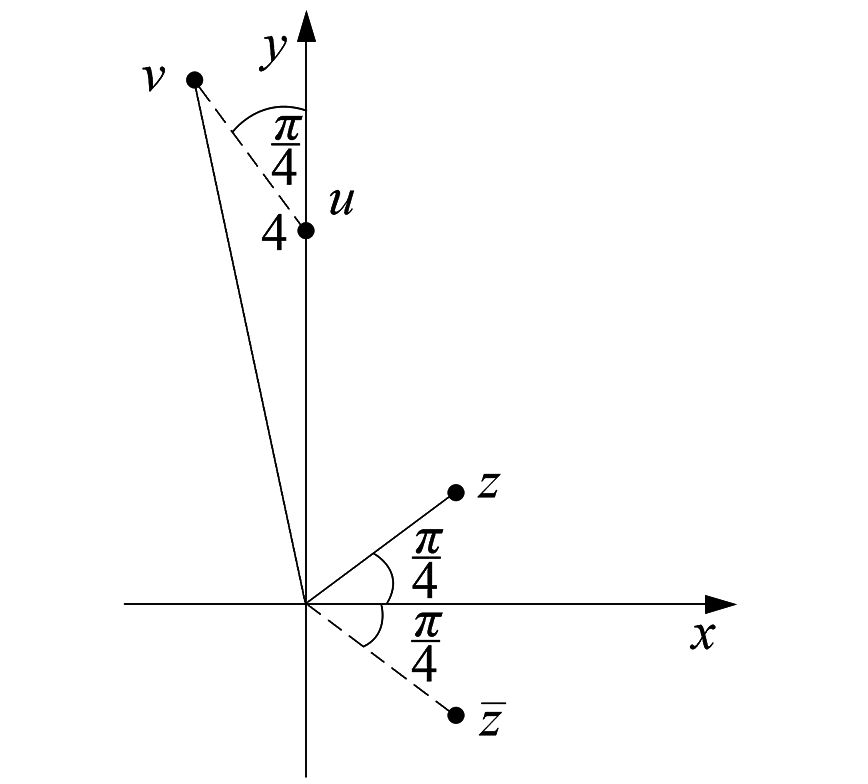
a. `text(See Worked Solutions)`
b. `text(See Worked Solutions)`
c. `text(See Worked Solutions)`
Given `z = 2(cos\ pi/3 + i sin\ pi/3)`, which expression is equal to `(bar {:z:})^(−1)`?
`C`
| `z` | `= 2text(cis)(pi/3)` |
| `barz` | `= 2text(cis)(−pi/3)` |
| `(barz)^(−1)` | `= (2text(cis)(−pi/3))^(−1)` |
| `= 2^(−1)text(cis)(pi/3)` | |
| `= 1/2text(cis)(pi/3)` | |
| `= 1/2(cos\ pi/3 + i sin\ pi/3)` |
`=> C`