SmarterEd

Aussie Maths & Science Teachers: Save your time with SmarterEd

  • Login
  • Get Help
  • About

Complex Numbers, EXT2 N2 2025 SPEC1 8

Consider the function with rule  \(f(z)=z^4+6 z^2+25\), where \(z \in C\).

  1. Consider  \(z_1=1+2 i\).
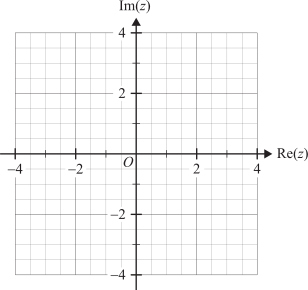
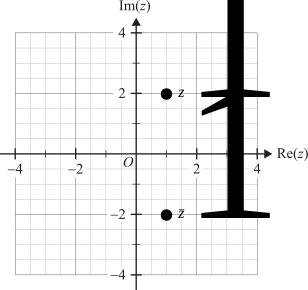
  2. Plot and label \(z_1\) and \(\overline{z}_1\) on the Argand plane below.   (1 mark)  

    --- 0 WORK AREA LINES (style=lined) ---
     
  3. Given that  \(1+2 i\)  is a solution of  \(f(z)=0\), find a quadratic factor of \(f(z)\).   (2 marks)  

    --- 6 WORK AREA LINES (style=lined) ---

  4. Hence, find all remaining solutions of  \(f(z)=0\).   (2 marks)

    --- 10 WORK AREA LINES (style=lined) ---

Show Answers Only

a.    \(z_1=1+z_i \ \Rightarrow \ \overline{z}_1=1-z_i\)
 

b.    \(z^2-2 z+5\)

c.    \(z=-1+2 i, z=-1-2 i\)

Show Worked Solution

a.    \(z_1=1+z_i \ \Rightarrow \ \overline{z}_1=1-z_i\)
 

b.    \(\text{Since} \ \ 1+2 i \ \ \text{is a solution of}\ \ f(z)=0:\)

\(\Rightarrow 1-2 i \ \ \text{is also a solution (conjugate factor theorem).}\)

\(\text {Express as a quadratic factor:}\)

\((z-(1+2 i))(z-(1-2 i))\) \(=((z-1)-2 i)((z-1)+2 i)\)
  \(=(z-1)^2-4 i^2\)
  \(=z^2-2 z+5\)


c.    \(f(z)=z^4+6 z^2+25, \quad z \in C\)

\(\text{Since \(\ z^2-2 z+5\ \) is a factor:}\)

\(f(z)\) \(=\left(z^2-2 z+5\right)\left(z^2+a z+b\right)\)
  \(=z^2\left(z^2+a z+b\right)-2 z\left(z^2+a z+b\right)+5\left(z^2+a z+b\right)\)
  \(=z^4+a z^3+b z^2-2 z^3-2 a z^2-2 b z+5 z^2+5 a z+5 b\)
  \(=z^4+(a-2) z^3+(b-2 a+5) z^2+(-2 b+5 a) z+5 b\)
Mean mark (c) 53%.

\(\text{Equating co-efficients:}\)

\(a-2=0 \ \Rightarrow \ a=2\)

\(5 b=25 \ \Rightarrow \ b=5\)

\(f(z)=\left(z^2-2 z+5\right)\left(z^2+2 z+5\right)\)
 

\(\text{Solve:} \ \ z^2+2 z+5=0\)

\(z=\dfrac{-2 \pm \sqrt{2^2-4 \cdot 1 \cdot 5}}{2}=\dfrac{-2 \pm \sqrt{-16}}{2}=-1 \pm 2 i\)

\(\therefore \ \text{Other solutions:}\ \ z=-1+2 i, z=-1-2 i\)
Filed Under: Solving Equations, Solving Equations with Complex Numbers Tagged With: Band 3, Band 4, smc-1050-10-Quadratic roots, smc-1050-30-Roots > 3, smc-1050-35-Conjugate roots, smc-7429-10-Quadratic roots, smc-7429-30-Roots > 3, smc-7429-35-Conjugate roots

Complex Numbers, EXT2 N2 2023 HSC 12e

The complex number  \(2+i\)  is a zero of the polynomial

\(P(z)=z^4-3 z^3+c z^2+d z-30\)

where \(c\) and \(d\) are real numbers.

  1. Explain why  \(2-i\)  is also a zero of the polynomial \(P(z)\).  (1 marks)

    --- 2 WORK AREA LINES (style=lined) ---

  2. Find the remaining zeros of the polynomial \(P(z)\).  (2 marks)

    --- 6 WORK AREA LINES (style=lined) ---

Show Answers Only

i.    \(\text{Since all coefficients are real and given}\ P(x)\ \text{has a complex root} \)

\((2+i), \ \text{then its conjugate pair}\ (2-i)\ \text{is also a root.} \)

ii.   \(\text{Remaining zeros:}\ \ -3, 2 \)

Show Worked Solution

i.    \(\text{Since all coefficients are real and given}\ P(x)\ \text{has a complex root} \)

\((2+i), \ \text{then its conjugate pair}\ (2-i)\ \text{is also a root.} \)


ii.    \(P(z)=z^4-3 z^3+c z^2+d z-30\)

\(\text{Let roots be:}\ \ 2+i, 2-i, \alpha, \beta \)

\( \sum\ \text{roots:}\)

\(2+i+2-i+\alpha + \beta\) \(=-\dfrac{b}{a} \)  
\(4+\alpha+\beta\) \(=3\)  
\(\alpha + \beta\) \(=-1\ \ \ …\ (1) \)  

 
\(\text{Product of roots:} \)

\((2+i)(2-i)\alpha\beta \) \(= \dfrac{e}{a} \)  
\(5\alpha\beta\) \(=-30\)  
\(\alpha \beta \) \(=-6\ \ \ …\ (2) \)  

 
\(\text{Substitute}\ \ \beta=-\alpha-1\ \ \text{into (2):} \)

\(\alpha(-\alpha-1) \) \(=-6 \)  
\(-\alpha^2-\alpha \) \(=-6\)  
\(\alpha^2+\alpha-6\) \(=0\)  
\( (\alpha+3)(\alpha-2) \) \(=0\)  

 
\(\therefore\ \text{Remaining zeros:}\ \ -3, 2 \)

Filed Under: Solving Equations, Solving Equations with Complex Numbers Tagged With: Band 3, Band 4, smc-1050-30-Roots > 3, smc-1050-35-Conjugate roots, smc-7429-30-Roots > 3, smc-7429-35-Conjugate roots

Complex Numbers, EXT2 N2 2018 HSC 6 MC

Which complex number is a 6th root of `i`?

  1. `−1/sqrt2 + 1/sqrt2i`
  2. `−1/sqrt2-1/sqrt2i`
  3. `−sqrt2 + sqrt2i`
  4. `−sqrt2-sqrt2i`
Show Answers Only

`A`

Show Worked Solution

`text(Consider option A:)`
 

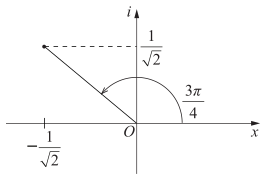
`|−1/sqrt2 + 1/sqrt2i|= sqrt((−1/sqrt2)^2 + (1/sqrt2)^2) = 1`

`text(arg)(z)` `= (3pi)/4`
`z` `= 1(cos\ (3pi)/4 + i sin\ (3pi)/4)`
`z^6` `= cos\ (18pi)/4 + i sin\ (18pi)/4\ \ \ text{(De Moivre)}`
  `= i`

 
`=> A`

Filed Under: Powers and Roots, Powers and Roots, Solving Equations with Complex Numbers Tagged With: Band 4, smc-1050-30-Roots > 3, smc-7429-30-Roots > 3, smc-7430-40-Roots \(\pm 1\)

Copyright © 2014–2026 SmarterEd.com.au · Log in