SmarterEd

Aussie Maths & Science Teachers: Save your time with SmarterEd

  • Login
  • Get Help
  • About

Complex Numbers, EXT2 N2 2025 HSC 15c

  1. Show that
  2.     \(\dfrac{1+\cos \theta+i \sin \theta}{1-\cos \theta-i \sin \theta}=i \cot \dfrac{\theta}{2}.\)   (3 marks)

    --- 12 WORK AREA LINES (style=lined) ---

  3. Use De Moivre's theorem to show that the sixth roots of \(-1\) are given by
  4.    \(\cos \left(\dfrac{(2 k+1) \pi}{6}\right)+i \sin \left(\dfrac{(2 k+1) \pi}{6}\right)\)  for  \(k=0,1,2,3,4,5\).   (2 marks)

    --- 6 WORK AREA LINES (style=lined) ---

  5. Hence, or otherwise, show the solutions to  \(\left(\dfrac{z-1}{z+1}\right)^6=-1\)  are
  6. \(z=i \cot \left(\dfrac{\pi}{12}\right), i \cot \left(\dfrac{3 \pi}{12}\right), i \cot \left(\dfrac{5 \pi}{12}\right), i \cot \left(\dfrac{7 \pi}{12}\right), i \cot \left(\dfrac{9 \pi}{12}\right)\), and \(i \cot \left(\dfrac{11 \pi}{12}\right)\).   (2 marks)

    --- 8 WORK AREA LINES (style=lined) ---

Show Answers Only

i.     \(\text{Show} \ \ \dfrac{1+\cos \theta+i \sin \theta}{1-\cos \theta-i \sin \theta}=i \cot \left(\frac{\theta}{2}\right)\)

\(\text{Method 1:}\)

\(\text{LHS}\) \(=\dfrac{2\cos^{2}\frac{\theta}{2}+2i\,\sin\frac{\theta}{2}\cos\frac{\theta}{2}}{2\sin^{2}\frac{\theta}{2}-2i\,\sin\frac{\theta}{2}\cos\frac{\theta}{2}} \)  
  \(=\dfrac{2\cos\frac{\theta}{2}\left(\cos\frac{\theta}{2}+i\,\sin\frac{\theta}{2}\right)}{2\sin\frac{\theta}{2}\left(\sin\frac{\theta}{2}-i\,\cos\frac{\theta}{2}\right) } \)  
  \(=\dfrac{i\,\cos\frac{\theta}{2}\left(\sin\frac{\theta}{2}-i\,\cos\frac{\theta}{2}\right)}{\sin\frac{\theta}{2}\left( \sin\frac{\theta}{2}-i\,\cos\frac{\theta}{2}\right)} \)  
  \(=i\, \cot \left(\frac{\theta}{2}\right)\)  

 
\(\text{Method 2 (exponential form – ex-syllabus in 2027):}\)

\(\text{LHS}\) \(=\dfrac{1+e^{i \theta}}{1-e^{i \theta}} \times \dfrac{e^{-\tfrac{i \theta}{2}}}{e^{-\tfrac{i \theta}{2}}}\)
  \(=\dfrac{e^{-\tfrac{i \theta}{2}}+e^{\tfrac{i \theta}{2}}}{e^{-\tfrac{i \theta}{2}}-e^{\tfrac{i \theta}{2}}}\)
  \(=\dfrac{2 \cos \left(\frac{\theta}{2}\right)}{-2 i \sin \left(\frac{\theta}{2}\right)}\)
  \(=i \cot \left(\frac{\theta}{2}\right)\)

 
ii.
  \(z=\cos \theta+i \sin \theta\)

\(\text{Find sixth roots of}\ -1 \ \text{(by De Moivre):}\)

\(z^6=\cos (6 \theta)+i \sin (6 \theta)=-1\)

\(\cos (6 \theta)\) \(=-1 \ \text{and} \ \ \sin (6 \theta)=0\)
\(6 \theta\) \(=\pi, 3 \pi, 5 \pi, \ldots\)
\(\theta\) \(=\dfrac{(2 k+1) \pi}{6}\ \ \text{for}\ \ k=0,1,2, \ldots, 5\)

\(\therefore \operatorname{Roots }=\cos \left(\dfrac{(2 k+1) \pi}{6}\right)+i \sin \left(\dfrac{(2 k+1) \pi}{6}\right) \ \  \text{for} \ \ k=0,1, \ldots, 5\)
 

iii.  \(\left(\dfrac{z-1}{z+1}\right)^6=-1\)

\(\text {Let} \ \ \alpha=\dfrac{z-1}{z+1} \ \Rightarrow \ \alpha^6=-1\)
 

\(\text {Using part (ii):}\)

\(\alpha=\operatorname{cis}\left(\dfrac{(2 k+1) \pi}{6}\right) \ \ \text{for}\ \ k=0,1,2,3,4,5\ \ldots\ (1)\)

\(\alpha=\dfrac{z-1}{z+1}\  \ \Rightarrow\ \ \alpha z+\alpha=z-1 \ \ \Rightarrow\ \ z=\dfrac{1+\alpha}{1-\alpha}\)
 

\(\text{Consider} \ \ \alpha=\operatorname{cis}\left(\frac{\pi}{6}\right) \ \text{(i.e. where}\ \ k=0 \ \ \text{from (1) above):}\)

\(z=\dfrac{1+\operatorname{cis}\left(\frac{\pi}{6}\right)}{1-\operatorname{cis}\left(\frac{\pi}{6}\right)} \ \Rightarrow \ z=i \cot \left(\frac{\pi}{12}\right) \quad \text{(using part (i))}\)

\(\text{Similarly}\ (k=1), \ z=\dfrac{1+\operatorname{cis}\left(\frac{3 \pi}{6}\right)}{1-\operatorname{cis}\left(\frac{3 \pi}{6}\right)} \ \Rightarrow \ z=i \cot \left(\frac{3 \pi}{12}\right)\)

\(\therefore z=i \cot \left(\frac{\pi}{12}\right), \, i \cot \left(\frac{3 \pi}{12}\right), \, i \cot \left(\frac{5 \pi}{12}\right), \ldots, i \cot \left(\frac{11 \pi}{12}\right)\)
Show Worked Solution

i.     \(\text{Show} \ \ \dfrac{1+\cos \theta+i \sin \theta}{1-\cos \theta-i \sin \theta}=i \cot \left(\frac{\theta}{2}\right)\)

\(\text{Method 1:}\)

\(\text{LHS}\) \(=\dfrac{2\cos^{2}\frac{\theta}{2}+2i\,\sin\frac{\theta}{2}\cos\frac{\theta}{2}}{2\sin^{2}\frac{\theta}{2}-2i\,\sin\frac{\theta}{2}\cos\frac{\theta}{2}} \)  
  \(=\dfrac{2\cos\frac{\theta}{2}\left(\cos\frac{\theta}{2}+i\,\sin\frac{\theta}{2}\right)}{2\sin\frac{\theta}{2}\left(\sin\frac{\theta}{2}-i\,\cos\frac{\theta}{2}\right) } \)  
  \(=\dfrac{i\,\cos\frac{\theta}{2}\left(\sin\frac{\theta}{2}-i\,\cos\frac{\theta}{2}\right)}{\sin\frac{\theta}{2}\left( \sin\frac{\theta}{2}-i\,\cos\frac{\theta}{2}\right)} \)  
  \(=i\, \cot \left(\frac{\theta}{2}\right)\)  

 
\(\text{Method 2 (exponential form – ex-syllabus in 2027):}\)

\(\text{LHS}\) \(=\dfrac{1+e^{i \theta}}{1-e^{i \theta}} \times \dfrac{e^{-\tfrac{i \theta}{2}}}{e^{-\tfrac{i \theta}{2}}}\)
  \(=\dfrac{e^{-\tfrac{i \theta}{2}}+e^{\tfrac{i \theta}{2}}}{e^{-\tfrac{i \theta}{2}}-e^{\tfrac{i \theta}{2}}}\)
  \(=\dfrac{2 \cos \left(\frac{\theta}{2}\right)}{-2 i \sin \left(\frac{\theta}{2}\right)}\)
  \(=i \cot \left(\frac{\theta}{2}\right)\)

 
ii.
  \(z=\cos \theta+i \sin \theta\)

\(\text{Find sixth roots of}\ -1 \ \text{(by De Moivre):}\)

\(z^6=\cos (6 \theta)+i \sin (6 \theta)=-1\)

\(\cos (6 \theta)\) \(=-1 \ \text{and} \ \ \sin (6 \theta)=0\)
\(6 \theta\) \(=\pi, 3 \pi, 5 \pi, \ldots\)
\(\theta\) \(=\dfrac{(2 k+1) \pi}{6}\ \ \text{for}\ \ k=0,1,2, \ldots, 5\)

\(\therefore \operatorname{Roots }=\cos \left(\dfrac{(2 k+1) \pi}{6}\right)+i \sin \left(\dfrac{(2 k+1) \pi}{6}\right) \ \  \text{for} \ \ k=0,1, \ldots, 5\)
 

iii.  \(\left(\dfrac{z-1}{z+1}\right)^6=-1\)

\(\text {Let} \ \ \alpha=\dfrac{z-1}{z+1} \ \Rightarrow \ \alpha^6=-1\)

♦♦♦ Mean mark (iii) 23%.

\(\text {Using part (ii):}\)

\(\alpha=\operatorname{cis}\left(\dfrac{(2 k+1) \pi}{6}\right) \ \ \text{for}\ \ k=0,1,2,3,4,5\ \ldots\ (1)\)

\(\alpha=\dfrac{z-1}{z+1}\  \ \Rightarrow\ \ \alpha z+\alpha=z-1 \ \ \Rightarrow\ \ z=\dfrac{1+\alpha}{1-\alpha}\)
 

\(\text{Consider} \ \ \alpha=\operatorname{cis}\left(\frac{\pi}{6}\right) \ \text{(i.e. where}\ \ k=0 \ \ \text{from (1) above):}\)

\(z=\dfrac{1+\operatorname{cis}\left(\frac{\pi}{6}\right)}{1-\operatorname{cis}\left(\frac{\pi}{6}\right)} \ \Rightarrow \ z=i \cot \left(\frac{\pi}{12}\right) \quad \text{(using part (i))}\)

\(\text{Similarly}\ (k=1), \ z=\dfrac{1+\operatorname{cis}\left(\frac{3 \pi}{6}\right)}{1-\operatorname{cis}\left(\frac{3 \pi}{6}\right)} \ \Rightarrow \ z=i \cot \left(\frac{3 \pi}{12}\right)\)

\(\therefore z=i \cot \left(\frac{\pi}{12}\right), \, i \cot \left(\frac{3 \pi}{12}\right), \, i \cot \left(\frac{5 \pi}{12}\right), \ldots, i \cot \left(\frac{11 \pi}{12}\right)\)

Filed Under: Powers and Roots, Solving Equations with Complex Numbers Tagged With: Band 4, Band 6, smc-1050-30-Roots > 3, smc-1050-40-De Moivre and trig identities, smc-1050-50-Exponential form, smc-7430-40-Roots \(\pm 1\), smc-7430-55-Trig Identities

Complex Numbers, EXT2 N2 2025 HSC 14c

Let \(w\) be a complex number such that  \(1+w+w^2+\cdots+w^6=0\).

  1. Show that \(w\) is a 7th root of unity.   (1 mark)

    --- 4 WORK AREA LINES (style=lined) ---

The complex number  \(\alpha=w+w^2+w^4\)  is a root of the equation  \(x^2+b x+c=0\), where \(b\) and \(c\) are real and \(\alpha\) is not real.

  1. Find the other root of  \(x^2+b x+c=0\)  in terms of positive powers of \(w\).   (2 marks)

    --- 8 WORK AREA LINES (style=lined) ---

  2. Find the numerical value of \(c\).   (1 mark)

    --- 5 WORK AREA LINES (style=lined) ---

Show Answers Only

i.    \(\text{If \(w\) is a \(7^{\text{th}}\) root of \(1 \ \Rightarrow \ w^7=1\)}\)

\(1+w+w^2+\ldots+w^6=0\ \text{(given)}\)

\((1-w)\left(1+w+w^2+\cdots+w^6\right)\) \(=0\)
\(1-w^7\) \(=0\)
\(w^7=1\) \(=1\)

ii.   \(w^6+w^5+w^3\)

iii.  \(2\)

Show Worked Solution

i.    \(\text{If \(w\) is a \(7^{\text{th}}\) root of \(1 \ \Rightarrow \ w^7=1\)}\)

\(1+w+w^2+\ldots+w^6=0\ \ \text{(given,}\ w\neq 1)\)

\((1-w)\left(1+w+w^2+\cdots+w^6\right)\) \(=0\)
\(1-w^7\) \(=0\)
\(w^7\) \(=1\)
♦♦ Mean mark (i) 35%.

ii.    \(\text {Find the other root of:} \ \ x^2+b x+c=0\)

\(\text{Since \(b, c\) are real (given),}\)

\(\text{Using conjugate root theory, other root}\ =\bar{\alpha}\)

\(\bar{\alpha}\) \(=\overline{w+w^2+w^4}\)
  \(=\overline{w}+\overline{w^2}+\overline{w^4}\)
  \(=\dfrac{1}{w}+\dfrac{1}{w^2}+\dfrac{1}{w^4} \quad\left( \bar{w}=\dfrac{1}{w} \ \text{since} \ \ \abs{w}=1\right)\)
  \(=\dfrac{w^7}{w}+\dfrac{w^7}{w^2}+\dfrac{w^7}{w^4}\)
  \(=w^6+w^5+w^3\)


iii.    \(\text{Product of roots}=\dfrac{c}{a}=c\)

\(c\) \(=\left(w+w^2+w^4\right)\left(w^6+w^5+w^3\right)\)
  \(=w^7+w^6+w^4+w^8+w^7+w^5+w^{10}+w^9+w^7\)
  \(=1+w^6+w^4+\left(w^7 \cdot w\right)+1+w^5+\left(w^7 \cdot w^3\right)+\left(w^7 \cdot w^2\right)+1\)
  \(=2+\underbrace{1+w+w^2+w^3+w^4+w^5+w^6}_{=0}\)
  \(=2\)
♦♦ Mean mark (iii) 32%.

Filed Under: Powers and Roots, Solving Equations with Complex Numbers Tagged With: Band 4, Band 5, smc-1050-10-Quadratic roots, smc-1050-30-Roots > 3, smc-1050-35-Conjugate roots, smc-7430-40-Roots \(\pm 1\)

Complex Numbers, EXT2 N2 2024 HSC 9 MC

Consider the solutions of the equation  \(z^4=-9\).

What is the product of all of the solutions that have a positive principal argument?

  1. \(3\)
  2. \(-3\)
  3. \(3 i\)
  4. \(-3 i\)
Show Answers Only

\(B\)

Show Worked Solution

\(z^4=-9\)

\(\text{Convert}\ z^4 \ \text{to Mod/Arg form:}\)

\(\left|z^4\right|=9, \ \ \arg \left(z^4\right)=\pi \ \text{(\(-9\) is on negative real axis})\)

Mean mark 57%.

\(\text{By De Moivre:}\)

   \(\abs{z}=\sqrt[4]{9}=\sqrt{3}\)

   \(\arg (z)=\dfrac{\pi}{4}\)

\(\text{Roots are} \ \ \dfrac{\pi}{2} \ \ \text{rotations of}\ \  z=\sqrt{3} \, \text{cis}\left(\dfrac{\pi}{4}\right)\)

\(z=\sqrt{3} \, \text{cis}\left( \pm \dfrac{\pi}{4}\right), z=\sqrt{3} \, \text{cis}\left( \pm \dfrac{3 \pi}{4}\right)\)

\(\sqrt{3}\, \text{cis}\left(\dfrac{\pi}{4}\right) \cdot \sqrt{3} \, \text{cis}\left(\dfrac{3 \pi}{4}\right)=3 \, \text{cis}(\pi)=-3\)

\(\Rightarrow B\)

Filed Under: Powers and Roots, Solving Equations with Complex Numbers Tagged With: Band 4, smc-1050-30-Roots > 3, smc-7430-40-Roots \(\pm 1\)

Complex Numbers, EXT2 N2 2022 HSC 13c

Consider the equation  `z^5+1=0`, where `z` is a complex number.

  1. Solve the equation  `z^5+1=0`  by finding the 5th roots of `-1`.   (2 marks)

    --- 6 WORK AREA LINES (style=lined) ---

  2. Show that if `z` is a solution of  `z^5+1=0`  and  `z !=-1`, then  `u=z+(1)/(z)`  is a solution of  `u^2-u-1=0`.   (2 marks)

    --- 7 WORK AREA LINES (style=lined) ---

  3. Hence find the exact value of `cos\ (3pi)/(5)`.   (3 marks)

    --- 9 WORK AREA LINES (style=lined) ---

Show Answers Only
  1. `z=e^(i(pi)/5), e^(i(3pi)/5), e^(-i(pi)/5), -1, e^(-i(3pi)/5)`
  2. `text{Proof (See Worked Solutions)}`
  3. `(1-sqrt5)/4`
Show Worked Solution

i.   `z^5+1=0\ \ =>\ \ z^5=-1`

`text{cis}\ pi=-1\ \ =>\ \ z=text{cis} ((pi+2k pi)/5),\ k=0,1,2,3,4`

`:.z=text{cis} ((pi)/5), text{cis} ((3pi)/5),-1,text{cis} (-(3pi)/5),text{cis} (-(pi)/5)`
  

ii.   `z^5+1=(z+1)(z^4-z^3+z^2-z+1)`

`text{Given}\ \ z!=-1,`

`z^4-z^3+z^2-z+1=0`
 

`text{Divide by}\ z^2\ \ (z!=0)`

`z^2-z+1-1/z+1/z^2` `=0`  
`z^2+1/z^2-(z+1/z)+1` `=0`  
`z^2+2+1/z^2-(z+1/z)-1` `=0`  
`(z+1/z)^2-(z-1/z)-1` `=0`  

 
`text{Let}\ \ u=z+1/z:`

`:.u^2-u-1=0`


Mean mark (ii) 53%.

iii.  `u^2-u-1=0`

`text{By quadratic formula:}`

`u=(1+-sqrt(1-4xx1xx(-1)))/(2)(1+-sqrt5)/2`


♦ Mean mark (iii) 43%.

`z+1/z=(1+-sqrt5)/2`

`text{Let}\ \ z=text{cis} ((3pi)/5)\ \ =>\ \ 1/z=text{cis} (-(3pi)/5)`

`text{cis}((3pi)/5)+text{cis} (-(3pi)/5)` `=(1-sqrt5)/2,\ \ (cos((3pi)/5) <0)`  
`2cos((3pi)/5)` `=(1-sqrt5)/2`  
`cos((3pi)/5)` `=(1-sqrt5)/4`  

Filed Under: Powers and Roots, Solving Equations with Complex Numbers Tagged With: Band 3, Band 4, Band 5, smc-1050-10-Quadratic roots, smc-1050-30-Roots > 3, smc-7430-40-Roots \(\pm 1\)

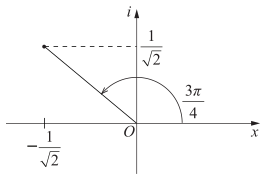
Complex Numbers, EXT2 N2 2018 HSC 6 MC

Which complex number is a 6th root of `i`?

  1. `−1/sqrt2 + 1/sqrt2i`
  2. `−1/sqrt2-1/sqrt2i`
  3. `−sqrt2 + sqrt2i`
  4. `−sqrt2-sqrt2i`
Show Answers Only

`A`

Show Worked Solution

`text(Consider option A:)`
 

`|−1/sqrt2 + 1/sqrt2i|= sqrt((−1/sqrt2)^2 + (1/sqrt2)^2) = 1`

`text(arg)(z)` `= (3pi)/4`
`z` `= 1(cos\ (3pi)/4 + i sin\ (3pi)/4)`
`z^6` `= cos\ (18pi)/4 + i sin\ (18pi)/4\ \ \ text{(De Moivre)}`
  `= i`

 
`=> A`

Filed Under: Powers and Roots, Powers and Roots, Solving Equations with Complex Numbers Tagged With: Band 4, smc-1050-30-Roots > 3, smc-7429-30-Roots > 3, smc-7430-40-Roots \(\pm 1\)

Complex Numbers, EXT2 N2 2017 HSC 1 MC

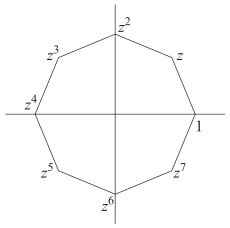
The complex number `z` is chosen so that  `1, z, …, z^7`  form the vertices of the regular polygon shown.

Which polynomial equation has all of these complex numbers as roots?

  1. `x^7 - 1 = 0`
  2. `x^7 + 1 = 0`
  3. `x^8 - 1 = 0`
  4. `x^8 + 1 = 0`
Show Answers Only

`C`

Show Worked Solution

`P(x)\ \ text(has 8 separate roots.)`

`:.\ text(Must be of degree at least 8.)`

`text(S) text(ince 1 is also a root,)`

`=>  C`

Filed Under: Geometrical Implications of Complex Numbers, Geometry and Complex Numbers (vectors), Powers and Roots, Solving Equations with Complex Numbers Tagged With: Band 3, smc-1050-30-Roots > 3, smc-1052-50-Sketch roots, smc-7430-40-Roots \(\pm 1\)

Complex Numbers, EXT2 N2 2009 HSC 2e

  1. Find all the 5th roots of  `–1`  in modulus-argument form.   (2 marks)

    --- 6 WORK AREA LINES (style=lined) ---

  2. Sketch the 5th roots of  `–1`  on an Argand diagram.   (1 mark)

    --- 8 WORK AREA LINES (style=lined) ---

Show Answers Only

a.    `z_1 = text(cis)\ pi/5,\ \ \ z_2 = text(cis) (3 pi)/5,\ \ \ z_3 = text(cis) pi=-1,`

`z_4 = text(cis) (7 pi)/5,\ \ z_5 = text(cis) (9 pi)/5`

b.    
       

Show Worked Solution

a.    `z=cos theta+i sin theta`

`z^5=cos\ 5 theta+i sin\ 5 theta=-1,\ \ text{(De Moivre)}`

  `cos\ 5 theta` `=-1`
  `5 theta` `=pi,\ 3pi,\ 5pi,\ 7pi,\ 9pi`
  `theta` `=pi/5,\ (3pi)/5,\ pi,\ (7pi)/5,\ (9pi)/5`


`:.\ text(The roots are)`

`z_1 = text(cis)\ pi/5,\ \ \ z_2 = text(cis)\ (3 pi)/5,\ \ \ z_3 = text(cis) pi=-1,`

`z_4 = text(cis)\ (7 pi)/5,\ \ z_5 = text(cis)\ (9 pi)/5`


b.    

Filed Under: Powers and Roots, Powers and Roots, Solving Equations with Complex Numbers Tagged With: Band 4, smc-1050-30-Roots > 3, smc-7430-40-Roots \(\pm 1\)

Copyright © 2014–2026 SmarterEd.com.au · Log in