SmarterEd

Aussie Maths & Science Teachers: Save your time with SmarterEd

  • Login
  • Get Help
  • About

Mechanics, EXT2 EQ-Bank 19

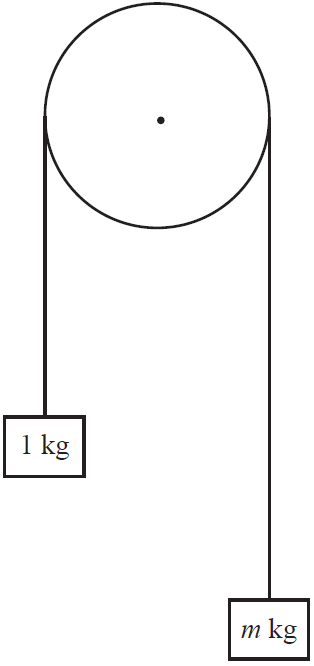
A light inextensible string passes over a smooth pulley, as shown below, with particles of mass 1 kg and \(m\) kg attached to the ends of the string.

The acceleration due to gravity is 9.8 m s\(^{-2}\).
 

SPEC2 2015 VCAA 19 MC

If the acceleration of the 1 kg particle is 4.9 ms\(^{-2}\) upwards, then determine the value of \(m\).   (2 marks)

--- 7 WORK AREA LINES (style=lined) ---

Show Answers Only

\(m=3\ \text{kg}\)

Show Worked Solution

\(\text{Resolving the forces:}\)
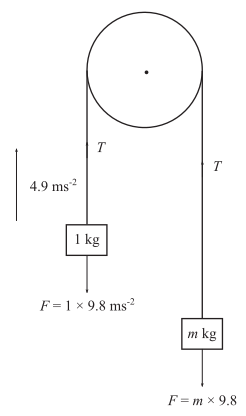
\(\text{Using}\ \ \Sigma F = m \ddot{x},\ \text{consider forces on 1 kg mass:}\)

\(T-(9.8 \times 1) = 4.9 \times 1\ \ \Rightarrow\ \ T=14.7\)
 

\(\text{Consider forces on}\ m\ \text{kg mass:}\)

\(m \times 9.8-T\) \(=m \times 4.9\)
\(4.9m\) \(= 14.7\)
\(:. m\) \(= \dfrac{14.7}{4.9}=3\ \text{kg}\)

Filed Under: Motion Without Resistence Tagged With: Band 4, smc-7439-40-Pulleys

Mechanics, EXT2 EQ-Bank 16

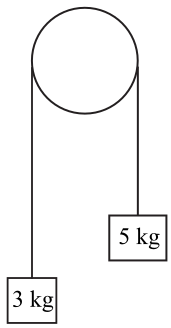
Particles of mass 3 kg and 5 kg are attached to the ends of a light inextensible string that passes over a fixed smooth pulley, as shown above. The system is released from rest and with acceleration due to gravity equal to 9.8 m s\(^{-2}\).

Assuming the system remains connected, determine the speed of the 5 kg mass after two seconds.   (3 marks)

--- 8 WORK AREA LINES (style=lined) ---

Show Answers Only

\(v= 4.9\ \text{m s}^{-1}\)

Show Worked Solution

\(\Sigma F=5g-3g=2 \times 9.8 = 19.6\ \text{N}\)

\(\text{Find acceleration, using}\ \ \Sigma F=m \ddot{x}:\)

\(19.6\) \(=(5+3) \ddot{x}\)
\(\ddot{x}\) \(=\dfrac{19.6}{8}=2.45\ \text{m s}^{-2}\)

  
\(v= \displaystyle \int \ddot{x}\,dt=\int 2.45\,dt=2.45t+c\)

\(v=0\ \ \text{at}\ \ t=0\ \ \Rightarrow\ \ c=0\)

\(\text{At}\ \ t=2:\)

\(v=2 \times 2.45 = 4.9\ \text{m s}^{-1}\)

Filed Under: Motion Without Resistence Tagged With: Band 4, smc-7439-40-Pulleys

Mechanics, EXT2 EQ-Bank 7 MC

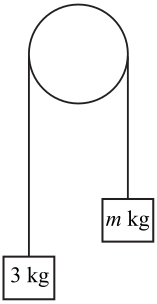
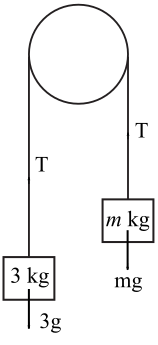
Particles of mass 3 kg and \(m\) kg are attached to the ends of a light inextensible string that passes over a smooth pulley, as shown.
 

If the acceleration of the 3 kg mass is 4.9 m s\(^{-2}\) upwards, then

  1. \(m= 4.5\)
  2. \(m = 6.0\)
  3. \(m= 9.0\)
  4. \(m= 13.5\)
Show Answers Only

\(C\)

Show Worked Solution

\(\text{Using}\ \ \Sigma F=m \ddot{x}:\)

\(mg-3g\) \(= (m + 3) \times 4.9\)
\(9.8m-3 \times 9.8\) \(= 4.9m + 14.7\)
\(m\) \(= 9\)

 
\(\Rightarrow C\)

Filed Under: Motion Without Resistence Tagged With: Band 5, smc-7439-40-Pulleys

Mechanics, EXT2 EQ-Bank 25

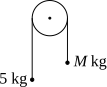
The diagram below shows objects of mass 5 kg and \(M\) kg attached to the ends of a light, inextensible string that passes over a smooth pulley.

The 5 kg object is accelerating upwards at a rate of 4.9 m/s\(^2\). Let the tension in the string be \(T\) newtons.

Using 9.8 m s\(^{-2}\) as the acceleration due to gravity, find the value of \(T\) and hence determine the value of \(M\).   (3 marks)

--- 8 WORK AREA LINES (style=lined) ---

Show Answers Only

\(M=15\ \text{kg}\)

Show Worked Solution

\(\text{Using} \ \ F=m \ddot{x}:\)

\(\text{Consider the 5 kg mass:}\)

\(T-5 g\) \(=m \ddot{x}\)
\(T-5(9.8)\) \(=5(4.9)\)
\(T\) \(=73.5 \ N\)

 
\(\text{Consider the \(M\) kg mass:}\)

\(\text{Mass is accelerating downward at 4.9 ms\(^{-2}\)}\) 

\(M \times 9.8-73.5\) \(=M \times 4.9\)
\(4.9 M\) \(=73.5\)
\(M\) \(=\dfrac{73-5}{49}=15 \ \text{kg}\)

Filed Under: Motion Without Resistence Tagged With: Band 4, smc-7439-40-Pulleys

Mechanics, EXT2 EQ-Bank 20

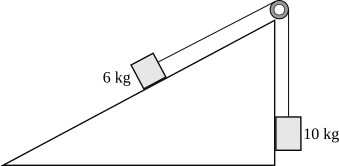
A 6-kilogram mass is placed on a frictionless plane inclined 30° to the horizontal.

The mass is connected to another 10-kilogram mass by a light, inextensible string via a pulley, as shown in the diagram
 

The 6-kilogram mass is released from rest and slides up the plane. 

Given the acceleration due to gravity is \(g\) m s\(^{-2}\), express the velocity, \(v\), of the 6 kilogram mass in terms of \(t\) as it moves up the plane.   (3 marks)

--- 10 WORK AREA LINES (style=lined) ---

Show Answers Only

\(v=\dfrac{7}{16}gt\)

Show Worked Solution

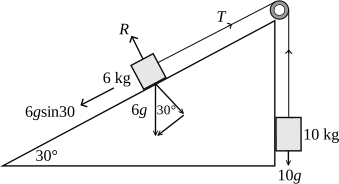
\(\text{Resolving forces on the 6 kg mass:}\)
 

\(\text{Let} \ \ F_d=\text{force down slope:}\)

\(\sin 30^{\circ}\) \(=\dfrac{F_d}{6 g}\)
\(F_d\) \(=6 g\, \sin 30=3 g\)


\(\text{Using} \ \ \sum F=m a\):

\(T-3 g=6 a\ \ldots\ (1)\)
 

\(\text{Consider 10 kg mass:}\)

\(10 g-T=10 a\ \ldots\ (2)\)

\(\text{Add (1) + (2):}\)

\(7 g=16 a \ \Rightarrow \ a=\dfrac{7}{16} g\)

\(v=\displaystyle \int \dfrac{7}{16}g \, dt=\dfrac{7}{16} g t+c\)

\(\text{When} \ \ t=0 \quad v=0 \ \Rightarrow \ c=0\)

\(\therefore v=\dfrac{7}{16}gt\)

Filed Under: Motion Without Resistence Tagged With: Band 4, smc-7439-20-Inclined planes, smc-7439-40-Pulleys

Mechanics, EXT2 EQ-Bank 21

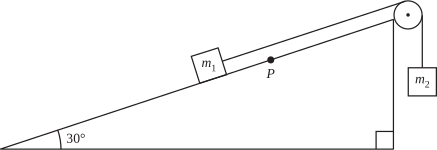
A mass of `m_1` kilograms is placed on a plane inclined at 30° to the horizontal. It is connected by a light inextensible string to a second mass of `m_2` kilograms that hangs below a frictionless pulley situated at the top end of the incline, over which the string passes.
 

Given that the inclined plane is smooth, find the relationship between `m_1` and `m_2` if the mass `m_1` moves down the plane at constant speed.   (3 marks)

--- 7 WORK AREA LINES (style=lined) ---

Show Answers Only

`m_1=2m_2`

Show Worked Solution

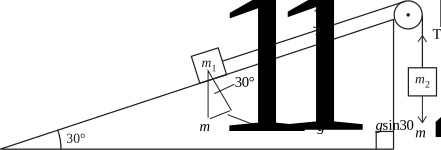
`m_1g\ sin30-m_2g = (m_1 + m_2)a`

`text(S)text(ince)\ m_1\ text(moves at constant speed,)\ a = 0`

`m_1 g · 1/2-m_2 g` `= 0`
`m_1` `= 2m_2`

Filed Under: Motion Without Resistence Tagged With: Band 4, smc-7439-40-Pulleys

Mechanics, EXT2 M1 2024 HSC 6 MC

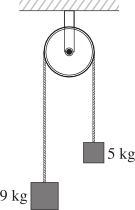
A light string passes over a smooth pulley. Attached to the ends of the string are masses of 9 kg and 5 kg , as shown.
 

The acceleration due to gravity is \(g\) m s\(^{-2}\).

What is the acceleration of the 9 kg mass?

  1. \(\dfrac{2}{7}g\)
  2. \(1 g\)
  3. \(\dfrac{7}{2}g\)
  4. \(4 g\)
Show Answers Only

\(A\)

Show Worked Solution

\(\text{Net force on 9 kg mass}\ = 9g-T\ \text{(down)}\)

\(\text{Net force on 5 kg mass}\ = 5g-T\ \text{(up)}\)

\(\text{Using}\ \ F=ma: \)

\(9 \times a\) \(=9g-T\ …\ (1)\)  
\(5 \times a\) \(=-(5g-T)\ …\ (2) \)  

 
\(\text{Adding (1) + (2):}\)

\(14a\) \(=4g\)  
\(a\) \(=\dfrac{2}{7}g\)  

 
\(\Rightarrow A\)

Filed Under: Motion Without Resistance, Motion Without Resistence Tagged With: Band 4, smc-1060-40-Pulleys (no air resistance), smc-7439-40-Pulleys

Copyright © 2014–2026 SmarterEd.com.au · Log in