SmarterEd

Aussie Maths & Science Teachers: Save your time with SmarterEd

  • Login
  • Get Help
  • About

Mechanics, EXT2 EQ-Bank 19

A light inextensible string passes over a smooth pulley, as shown below, with particles of mass 1 kg and \(m\) kg attached to the ends of the string.

The acceleration due to gravity is 9.8 m s\(^{-2}\).
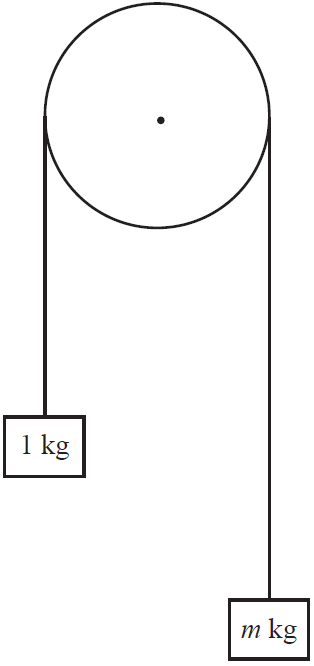
 

SPEC2 2015 VCAA 19 MC

If the acceleration of the 1 kg particle is 4.9 ms\(^{-2}\) upwards, then determine the value of \(m\).   (2 marks)

--- 7 WORK AREA LINES (style=lined) ---

Show Answers Only

\(m=3\ \text{kg}\)

Show Worked Solution

\(\text{Resolving the forces:}\)
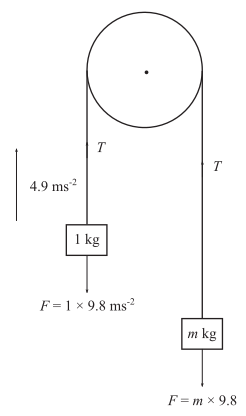
\(\text{Using}\ \ \Sigma F = m \ddot{x},\ \text{consider forces on 1 kg mass:}\)

\(T-(9.8 \times 1) = 4.9 \times 1\ \ \Rightarrow\ \ T=14.7\)
 

\(\text{Consider forces on}\ m\ \text{kg mass:}\)

\(m \times 9.8-T\) \(=m \times 4.9\)
\(4.9m\) \(= 14.7\)
\(:. m\) \(= \dfrac{14.7}{4.9}=3\ \text{kg}\)

Filed Under: Motion Without Resistence Tagged With: Band 4, smc-7439-40-Pulleys

Mechanics, EXT2 EQ-Bank 16

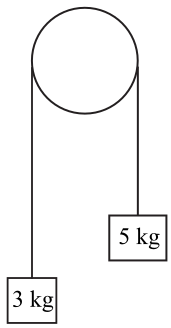
Particles of mass 3 kg and 5 kg are attached to the ends of a light inextensible string that passes over a fixed smooth pulley, as shown above. The system is released from rest and with acceleration due to gravity equal to 9.8 m s\(^{-2}\).

Assuming the system remains connected, determine the speed of the 5 kg mass after two seconds.   (3 marks)

--- 8 WORK AREA LINES (style=lined) ---

Show Answers Only

\(v= 4.9\ \text{m s}^{-1}\)

Show Worked Solution

\(\Sigma F=5g-3g=2 \times 9.8 = 19.6\ \text{N}\)

\(\text{Find acceleration, using}\ \ \Sigma F=m \ddot{x}:\)

\(19.6\) \(=(5+3) \ddot{x}\)
\(\ddot{x}\) \(=\dfrac{19.6}{8}=2.45\ \text{m s}^{-2}\)

  
\(v= \displaystyle \int \ddot{x}\,dt=\int 2.45\,dt=2.45t+c\)

\(v=0\ \ \text{at}\ \ t=0\ \ \Rightarrow\ \ c=0\)

\(\text{At}\ \ t=2:\)

\(v=2 \times 2.45 = 4.9\ \text{m s}^{-1}\)

Filed Under: Motion Without Resistence Tagged With: Band 4, smc-7439-40-Pulleys

Mechanics, EXT2 EQ-Bank 13

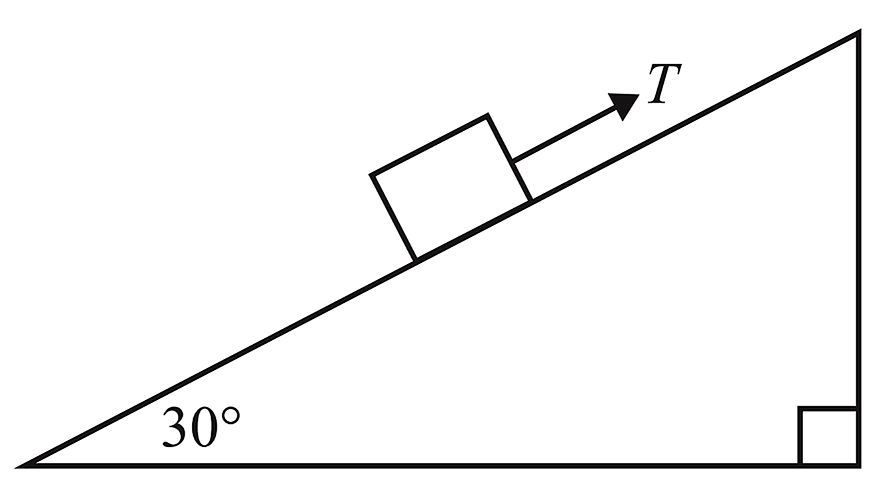
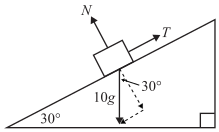
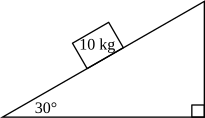
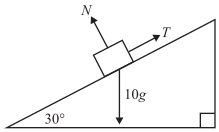
A body of mass 10 kg is held in place on a smooth plane inclined at 30° to the horizontal by a tension force, \(T\) newtons, acting parallel to the plane.
  

               VCAA 2013 spec 1a

Assuming that the acceleration due to gravity is 9.8 m s\(^{-2}\), find the value of \(T\) in newtons.   (2 marks)

--- 6 WORK AREA LINES (style=lined) ---

Show Answers Only

 \(49\ \text{N}\)

Show Worked Solution


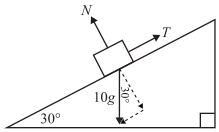
\(T-10g\,\sin30^{\circ}\) \(= 0\)
\(T-\dfrac{10g}{2}\) \(= 0\)
\(T\) \(= \dfrac{10g}{2}\)
\(T\) \(= 5g=49\ \text{N}\)

Filed Under: Motion Without Resistence Tagged With: Band 3, smc-7439-20-Inclined planes

Mechanics, EXT2 EQ-Bank 7 MC

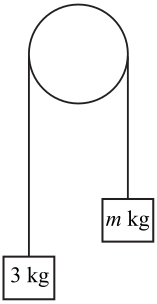
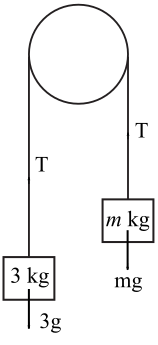
Particles of mass 3 kg and \(m\) kg are attached to the ends of a light inextensible string that passes over a smooth pulley, as shown.
 

If the acceleration of the 3 kg mass is 4.9 m s\(^{-2}\) upwards, then

  1. \(m= 4.5\)
  2. \(m = 6.0\)
  3. \(m= 9.0\)
  4. \(m= 13.5\)
Show Answers Only

\(C\)

Show Worked Solution

\(\text{Using}\ \ \Sigma F=m \ddot{x}:\)

\(mg-3g\) \(= (m + 3) \times 4.9\)
\(9.8m-3 \times 9.8\) \(= 4.9m + 14.7\)
\(m\) \(= 9\)

 
\(\Rightarrow C\)

Filed Under: Motion Without Resistence Tagged With: Band 5, smc-7439-40-Pulleys

Mechanics, EXT2 EQ-Bank 25

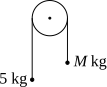
The diagram below shows objects of mass 5 kg and \(M\) kg attached to the ends of a light, inextensible string that passes over a smooth pulley.

The 5 kg object is accelerating upwards at a rate of 4.9 m/s\(^2\). Let the tension in the string be \(T\) newtons.

Using 9.8 m s\(^{-2}\) as the acceleration due to gravity, find the value of \(T\) and hence determine the value of \(M\).   (3 marks)

--- 8 WORK AREA LINES (style=lined) ---

Show Answers Only

\(M=15\ \text{kg}\)

Show Worked Solution

\(\text{Using} \ \ F=m \ddot{x}:\)

\(\text{Consider the 5 kg mass:}\)

\(T-5 g\) \(=m \ddot{x}\)
\(T-5(9.8)\) \(=5(4.9)\)
\(T\) \(=73.5 \ N\)

 
\(\text{Consider the \(M\) kg mass:}\)

\(\text{Mass is accelerating downward at 4.9 ms\(^{-2}\)}\) 

\(M \times 9.8-73.5\) \(=M \times 4.9\)
\(4.9 M\) \(=73.5\)
\(M\) \(=\dfrac{73-5}{49}=15 \ \text{kg}\)

Filed Under: Motion Without Resistence Tagged With: Band 4, smc-7439-40-Pulleys

Mechanics, EXT2 EQ-Bank 20

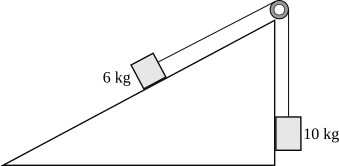
A 6-kilogram mass is placed on a frictionless plane inclined 30° to the horizontal.

The mass is connected to another 10-kilogram mass by a light, inextensible string via a pulley, as shown in the diagram
 

The 6-kilogram mass is released from rest and slides up the plane. 

Given the acceleration due to gravity is \(g\) m s\(^{-2}\), express the velocity, \(v\), of the 6 kilogram mass in terms of \(t\) as it moves up the plane.   (3 marks)

--- 10 WORK AREA LINES (style=lined) ---

Show Answers Only

\(v=\dfrac{7}{16}gt\)

Show Worked Solution

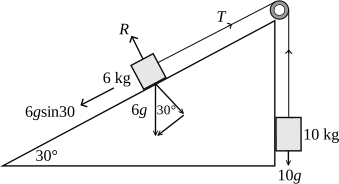
\(\text{Resolving forces on the 6 kg mass:}\)
 

\(\text{Let} \ \ F_d=\text{force down slope:}\)

\(\sin 30^{\circ}\) \(=\dfrac{F_d}{6 g}\)
\(F_d\) \(=6 g\, \sin 30=3 g\)


\(\text{Using} \ \ \sum F=m a\):

\(T-3 g=6 a\ \ldots\ (1)\)
 

\(\text{Consider 10 kg mass:}\)

\(10 g-T=10 a\ \ldots\ (2)\)

\(\text{Add (1) + (2):}\)

\(7 g=16 a \ \Rightarrow \ a=\dfrac{7}{16} g\)

\(v=\displaystyle \int \dfrac{7}{16}g \, dt=\dfrac{7}{16} g t+c\)

\(\text{When} \ \ t=0 \quad v=0 \ \Rightarrow \ c=0\)

\(\therefore v=\dfrac{7}{16}gt\)

Filed Under: Motion Without Resistence Tagged With: Band 4, smc-7439-20-Inclined planes, smc-7439-40-Pulleys

Mechanics, EXT2 EQ-Bank 18

An object of mass 5 kg is on a slope that is inclined at an angle of 60° to the horizontal. The acceleration due to gravity is \(g \ \text{ms} ^{-2}\) and the velocity of the object down the slope is \(v \ \text{ms} ^{-1}\).

As well as the force due to gravity, the object is acted on by two forces, one of magnitude \(2 v\) newtons and one of magnitude \(2 v^2\) newtons, both acting up the slope.

  1. Show that the resultant force down the slope is
  2.    \(\dfrac{5 \sqrt{3}}{2} g-2 v-2 v^2 \) newtons.   (2 marks)

    --- 8 WORK AREA LINES (style=lined) ---

  3. There is one value of \(v\) such that the object will slide down the slope at a constant speed.
  4. Find this value of \(v\) in \(\text{ms}^{-1}\), correct to 1 decimal place, given that  \(g=10\).   (2 marks)

    --- 8 WORK AREA LINES (style=lined) ---

Show Answers Only

a.    \(\text{See Worked Solution}\)

b.    \(v=4.2 \ \text{ms}^{-1} \)

Show Worked Solution

a.    


\(\Sigma F\ \text{(down slope) }\) \(=5 g\ \cos 30^{\circ}-2 v-2 v^2\)
  \(=\dfrac{5 \sqrt{3}}{2} g-2 v-2 v^2 \ \ \text{newtons }\)


b.    \(\text{Constant speed} \ \Rightarrow \ \ \Sigma F=0\)

\(\dfrac{5 \sqrt{3}}{2} \times 10\) \(=2 v+2 v^2\)  
\(0\) \(=2 v^2+2 v-25 \sqrt{3}\)  

 
\(v=\dfrac{-2 \pm \sqrt{4+4(2)(25 \sqrt{3})}}{4} =4.1798 \ldots \text { or }-5.1798 \ldots\)
 

\(\text{Since object is moving down the slope,}\ \ v \gt 0.\)

\(\therefore v=4.1798 = 4.2 \ \text{ms}^{-1} \ \ \text{(1 d.p.)}\)

Filed Under: Motion Without Resistence Tagged With: Band 4, smc-7439-20-Inclined planes

Mechanics, EXT2 EQ-Bank 12

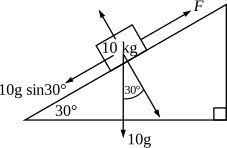
A 10 kg mass is placed on a smooth plane that is inclined at 30° to the horizontal, as shown in the diagram below. A force, `F` is applied to the mass up the slope and parallel to the slope so that when released, the mass remains at rest.
 

If the acceleration due to gravity, `g`, is `9.8\ text(m s)^{-2}`, determine the magnitude of the force, in newtons, acting up the slope.   (2 marks)

--- 5 WORK AREA LINES (style=lined) ---

Show Answers Only

`49 \ text(N)`

Show Worked Solution

`sin 30^@` `= F/(10g)`
`F` `=10g\ sin30^@`
`F` `= 10 xx 9.8 xx 1/2 = 49\ text{N}`

Filed Under: Motion Without Resistence Tagged With: Band 3, smc-7439-20-Inclined planes

Mechanics, EXT2 2021 SPEC2 16 MC

An object of mass `m` kilograms slides down a smooth slope that is inclined at an angle of `theta^@` to the horizontal, where  `0^@ < theta^@ < 45^@`. The acceleration of the object down the slope is `a\ text(ms)^(-2), a > 0`.

If the angle of inclination of the slope is doubled to `2theta^@`, then the acceleration of the object down the slope, in `text(ms)^(-2)`, is

  1. `2a`
  2. `(2a)/gsqrt(g^2-a^2)`
  3. `(2a^2-g^2)/g`
  4. `a/g sqrt(g^2-a^2)`
Show Answers Only

`B`

Show Worked Solution

`ma = mg\ sintheta`

`sintheta` `= a/g`
`cos^2theta` `= 1-(a^2)/(g^2)`
`costheta` `= sqrt(1-(a^2)/(g^2))`

 
`text(If incline angle) = 2theta:`

`ma` `= mgsin(2theta)`
`a` `= g*2sinthetacostheta`
  `= g *2* a/g sqrt(1-(a^2)/(g^2))`
  `= (2a)/g sqrt(g^2-a^2)`

 
`=>\ B`

Filed Under: Motion Without Resistence Tagged With: Band 5, smc-7439-20-Inclined planes

Mechanics, EXT2 EQ-Bank 21

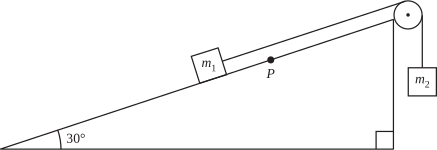
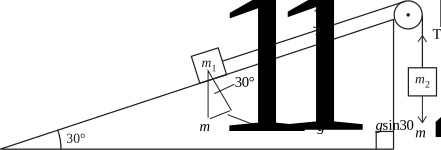
A mass of `m_1` kilograms is placed on a plane inclined at 30° to the horizontal. It is connected by a light inextensible string to a second mass of `m_2` kilograms that hangs below a frictionless pulley situated at the top end of the incline, over which the string passes.
 

Given that the inclined plane is smooth, find the relationship between `m_1` and `m_2` if the mass `m_1` moves down the plane at constant speed.   (3 marks)

--- 7 WORK AREA LINES (style=lined) ---

Show Answers Only

`m_1=2m_2`

Show Worked Solution

`m_1g\ sin30-m_2g = (m_1 + m_2)a`

`text(S)text(ince)\ m_1\ text(moves at constant speed,)\ a = 0`

`m_1 g · 1/2-m_2 g` `= 0`
`m_1` `= 2m_2`

Filed Under: Motion Without Resistence Tagged With: Band 4, smc-7439-40-Pulleys

Mechanics, EXT2 M1 2024 HSC 6 MC

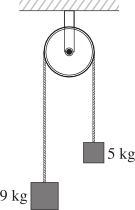
A light string passes over a smooth pulley. Attached to the ends of the string are masses of 9 kg and 5 kg , as shown.
 

The acceleration due to gravity is \(g\) m s\(^{-2}\).

What is the acceleration of the 9 kg mass?

  1. \(\dfrac{2}{7}g\)
  2. \(1 g\)
  3. \(\dfrac{7}{2}g\)
  4. \(4 g\)
Show Answers Only

\(A\)

Show Worked Solution

\(\text{Net force on 9 kg mass}\ = 9g-T\ \text{(down)}\)

\(\text{Net force on 5 kg mass}\ = 5g-T\ \text{(up)}\)

\(\text{Using}\ \ F=ma: \)

\(9 \times a\) \(=9g-T\ …\ (1)\)  
\(5 \times a\) \(=-(5g-T)\ …\ (2) \)  

 
\(\text{Adding (1) + (2):}\)

\(14a\) \(=4g\)  
\(a\) \(=\dfrac{2}{7}g\)  

 
\(\Rightarrow A\)

Filed Under: Motion Without Resistance, Motion Without Resistence Tagged With: Band 4, smc-1060-40-Pulleys (no air resistance), smc-7439-40-Pulleys

Mechanics, EXT2 M1 2023 HSC 12c

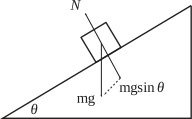
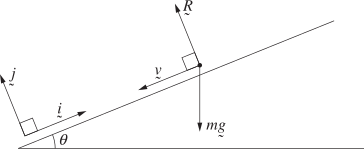
An object with mass \(m\) kilograms slides down a smooth inclined plane with velocity \( \underset{\sim}{v}(t)\), where \(t\) is the time in seconds after the object started sliding down the plane. The inclined plane makes an angle \(\theta\) with the horizontal, as shown in the diagram. The normal reaction force is \(\underset{\sim}{R}\). The acceleration due to gravity is \(\underset{\sim}{g}\) and has magnitude \(g\). No other forces act on the object.

The vectors \(\underset{\sim}{i}\) and \( \underset{\sim}{j} \) are unit vectors parallel and perpendicular, respectively, to the plane, as shown in the diagram.
 

  1. Show that the resultant force on the object is  \(\underset{\sim}{F}=-(m g \ \sin \theta) \underset{\sim}{i}\).   (2 marks)

    --- 5 WORK AREA LINES (style=lined) ---

  2. Given that the object is initially at rest, find its velocity \(\underset{\sim}{v}(t)\) in terms of \(g\), \(\theta, t\) and \(\underset{\sim}{i}\).   (2 marks)

    --- 5 WORK AREA LINES (style=lined) ---

Show Answers Only

i.    \(\text{Proof (See Worked Solution)} \)

ii.   \(\underset{\sim}{v}=-gt\ \sin \theta \ \underset{\sim}{i} \)

Show Worked Solution

i.       
         

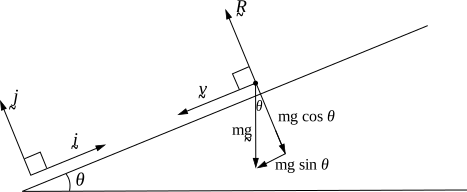
\(\text{Resolving forces in}\ \underset{\sim}{j} \ \text{direction:} \)

\( {\underset{\sim}{F}}_\underset{\sim}{j} = \underset{\sim}{R} + m\underset{\sim}{g}\ \cos \theta = 0\ \ \text{(in equilibrium)} \)

\(\text{Resolving forces in}\ \underset{\sim}{i} \ \text{direction:} \)

\( {\underset{\sim}{F}}_\underset{\sim}{i} = -m\underset{\sim}{g} \ \sin \theta \ \ \ \text{(down slope)} \)

\(\therefore \text{Resultant force:}\ \ \underset{\sim}{F}=-(m g \ \sin \theta) \underset{\sim}{i} \)
 

♦ Mean mark (i) 50%.

ii.   \(\text{Using}\ \ \underset{\sim}{F}=m \underset{\sim}{a}: \)

\(m \underset{\sim}{a}\) \(=-mg\ \sin \theta \ \underset{\sim}{i} \)  
\(\underset{\sim}{a}\) \(=-g\ \sin \theta \ \underset{\sim}{i} \)  
\(\underset{\sim}{v}\) \(= \displaystyle \int \underset{\sim}{a}\ dt \)  
  \(=-gt\ \sin \theta +c \)  

 
\(\text{When}\ \ t=0,\ \ \underset{\sim}{v}=0\ \ \Rightarrow \ \ c=0 \)

\(\therefore \underset{\sim}{v}=-gt\ \sin \theta \ \underset{\sim}{i} \)

Filed Under: Motion Without Resistance, Motion Without Resistence Tagged With: Band 4, Band 5, smc-1060-04-Motion as f(t), smc-1060-45-Inclined planes, smc-1060-50-Vectors and motion, smc-7439-20-Inclined planes

Copyright © 2014–2026 SmarterEd.com.au · Log in