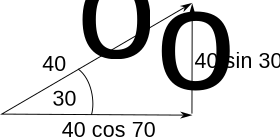
SmarterEd

Aussie Maths & Science Teachers: Save your time with SmarterEd

  • Login
  • Get Help
  • About

Mechanics, EXT2 EQ-Bank 31

A particle is projected from the origin with speed, \(V\), at an angle of \(\alpha\) above the horizontal. It is subject to both gravity and an air resistance proportional to its velocity, so that its horizontal and vertical components of acceleration while it is rising are given by

\(\ddot{x}=-k\dot{x}\)  and  \(\ddot{y} = -g-k\dot{y}\)

  1. Show that  \(\dot{x} = V\cos\,\alpha\ e^{-kt}\)  and  \(\dot{y} = \left( \dfrac{g}{k} + V\sin\,\alpha\right)e^{-kt}-\dfrac{g}{k} \)   (2 marks)

    --- 10 WORK AREA LINES (style=lined) ---

  2. Show that when the particle reaches its greatest height, it has travelled a horizontal distance of
  3.      \(\dfrac{V^2\sin\,2\alpha}{2(g+Vk\,\sin\,\alpha)}\).   (3 marks)

    --- 12 WORK AREA LINES (style=blank) ---
Show Answers Only

a.    \(\text{See Worked Solutions}\)

b.    \(\text{See Worked Solutions}\)

Show Worked Solution

a.    \(\ddot{x}=-k \dot{x} \ \Rightarrow \ \dfrac{d \dot{x}}{d t}=-k \dot{x}\)

\(\text{Solving 1st order differential equation:}\)

\(\dot{x}=A e^{-k t}\)

\(\text{Since}\ \ \dot{x}=V \cos \alpha\ \ \text{when} \ \ t=0\ \ \Rightarrow\ \ A=V \cos \alpha\)

\(\dot{x}=V \cos \alpha e^{-k t}\)
 

\(\ddot{y}=-g-k \dot{y}\ \Rightarrow \ \dfrac{d \dot{y}}{d t}+k \dot{y}=-g\)

\(\text{Solving 1st order differential equation:}\)

\(\dot{y}=B e^{-k t}-\dfrac{g}{k}\)

\(\text{Since} \ \ \dot{y}=V \sin \alpha \ \ \text{when} \ \ t=0:\)

\(V \sin \alpha=B e^{-k t}-\dfrac{g}{k} \ \Rightarrow \ B=\dfrac{g}{k}+V \sin \alpha\)

\(\dot{y}=\left(V \sin \alpha+\dfrac{g}{k}\right) e^{-k t}-\dfrac{g}{k}\)
 

b.    \(\text{At max height,} \ \ \dot{y}=0\)

\(\left(V \sin \alpha+\dfrac{g}{k}\right) e^{-k t}-\dfrac{g}{k}=0 \ \Rightarrow \ e^{-k t}=\dfrac{g}{g+V k \, \sin \alpha}\ \ldots\ (1)\)

\(\text{Find horizontal distance} \ (x):\)

\(x\) \(=\displaystyle \int_0^t V \cos \alpha\, e^{-k t}\, d t\)
  \(=-\dfrac{V \cos \alpha}{k}\big[e^{-k t}\big]_0^t\)
  \(=\dfrac{V \cos \alpha}{k}\left(1-e^{-k t}\right)\)
  \(=\dfrac{V \cos \alpha}{k}\left(1-\dfrac{g}{g+Vk\, \sin \alpha}\right)\ \ \ \text{(using (1) above)}\)
  \(=\dfrac{V \cos \alpha}{k}\left(\dfrac{g+Vk\, \sin \alpha-g}{g+Vk\, \sin \alpha}\right)\)
  \(=\dfrac{V^2 \sin \alpha\, \cos \alpha}{g+Vk\, \sin \alpha}\)
  \(=\dfrac{V^2 \sin 2 \alpha}{2(g+Vk\, \sin \alpha)}\)

Filed Under: Projectiles and Resisted Motion Tagged With: Band 4, Band 5, smc-7442-10-Range/Time of Flight, smc-7442-20-Max Height

Mechanics, EXT2 M1 2023 HSC 13c

A particle of mass 1 kg is projected from the origin with speed 40 m s\( ^{-1}\) at an angle 30° to the horizontal plane.

  1. Use the information above to show that the initial velocity of the particle is
  2.     \(\mathbf{v}(0)={\displaystyle\left(\begin{array}{cc}20 \sqrt{3} \\ 20\end{array}\right)} \).   (1 mark)

    --- 6 WORK AREA LINES (style=lined) ---

The forces acting on the particle are gravity and air resistance. The air resistance is proportional to the velocity vector with a constant of proportionality 4 . Let the acceleration due to gravity be 10 m s \( ^{-2}\).

The position vector of the particle, at time \(t\) seconds after the particle is projected, is \(\mathbf{r}(t)\) and the velocity vector is \(\mathbf{v}(t)\).
 

  1. Show that  \(\mathbf{v}(t)={\displaystyle \left(\begin{array}{cc}20 \sqrt{3} e^{-4 t} \\ \dfrac{45}{2} e^{-4 t}-\dfrac{5}{2}\end{array}\right)}\)  (3 marks)

    --- 12 WORK AREA LINES (style=lined) ---

  2. Show that  \(\mathbf{r}(t)=\left(\begin{array}{c}5 \sqrt{3}\left(1-e^{-4 t}\right) \\ \dfrac{45}{8}\left(1-e^{-4 t}\right)-\dfrac{5}{2} t\end{array}\right)\)  (2 marks)

    --- 10 WORK AREA LINES (style=lined) ---

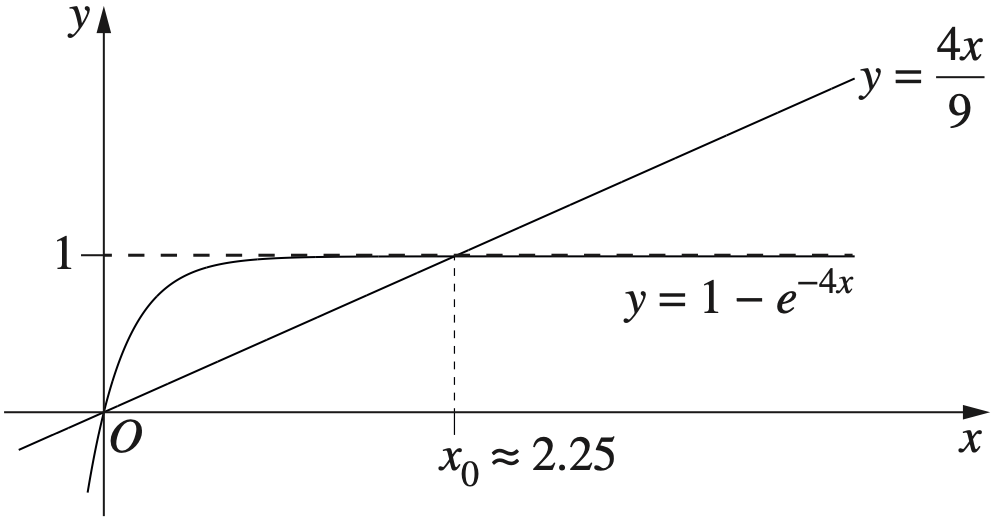
  3. The graphs  \(y=1-e^{-4 x}\)  and  \(y=\dfrac{4 x}{9}\) are given in the diagram below.
     
     
  4. Using the diagram, find the horizontal range of the particle, giving your answer rounded to one decimal place.  (2 marks)

    --- 7 WORK AREA LINES (style=lined) ---

Show Answers Only

  1. \(\text{Proof (See Worked Solutions)}\)
  2. \(\text{Proof (See Worked Solutions)}\)
  3. \(\text{Proof (See Worked Solutions)}\)
  4. \(8.7\ \text{metres}\)

Show Worked Solution

i. 

\(\underset{\sim}{v}(0)={\displaystyle\left(\begin{array}{cc} 40 \cos\ 30° \\ 40 \sin\ 30°\end{array}\right)} = {\displaystyle\left(\begin{array}{cc} 40 \times \frac{\sqrt3}{2} \\ 40 \times \frac{1}{2}\end{array}\right)}  = {\displaystyle\left(\begin{array}{cc}20 \sqrt{3} \\ 20\end{array}\right)} \)
 

ii.   \(\text{Air resistance:} \)

\(\underset{\sim}{F} = -4\underset{\sim}{v} = {\displaystyle\left(\begin{array}{cc} -4\dot{x} \\ -4\dot{y} \end{array}\right)} \)

\(\text{Horizontally:}\)

\(1 \times \ddot{x} \) \(=-4 \dot{x} \)  
\(\dfrac{d\dot{x}}{dt}\) \(=-4\dot{x}\)  
\(\dfrac{dt}{d\dot{x}}\) \(= -\dfrac{1}{4\dot{x}} \)  
\(t\) \(=-\dfrac{1}{4} \displaystyle \int \dfrac{1}{\dot{x}} \ d\dot{x} \)  
\(-4t\) \(=\ln |\dot{x}|+c \)  

 
\(\text{When}\ \ t=0, \ \dot{x}=20\sqrt3 \ \ \Rightarrow\ \ c=-\ln{20\sqrt3} \)

\(-4t\) \(=\ln|\dot{x}|-\ln 20\sqrt3 \)  
\(-4t\) \(=\ln\Bigg{|}\dfrac{\dot{x}}{20\sqrt{3}} \Bigg{|} \)  
\(\dfrac{\dot{x}}{20\sqrt{3}} \) \(=e^{-4t} \)  
\(\dot{x}\) \(=20\sqrt{3}e^{-4t}\)  

 
\(\text{Vertically:} \)

\(1 \times \ddot{y} \) \(=-1 \times 10-4 \dot{y} \)  
\(\dfrac{d\dot{y}}{dt}\) \(=-(10+4\dot{y})\)  
\(\dfrac{dt}{d\dot{y}}\) \(= -\dfrac{1}{10+4\dot{y}} \)  
\(t\) \(=- \displaystyle \int \dfrac{1}{10+4\dot{y}} \ d\dot{y} \)  
\(-4t\) \(=- \displaystyle \int \dfrac{4}{10+4\dot{y}} \ d\dot{y} \)  
\(-4t\) \(=\ln |10+4\dot{y}|+c \)  

 
\(\text{When}\ \ t=0, \ \dot{y}=20 \ \ \Rightarrow\ \ c=-\ln{90} \)

\(-4t\) \(=\ln|10+4\dot{y}|-\ln 90 \)  
\(-4t\) \(=\ln\Bigg{|}\dfrac{10+4\dot{y}}{\ln{90}} \Bigg{|} \)  
\(\dfrac{10+4\dot{y}}{90} \) \(=e^{-4t} \)  
\(4\dot{y}\) \(=90e^{-4t}-10\)  
\(\dot{y}\) \(=\dfrac{45}{2} e^{-4t}-\dfrac{5}{2} \)  

 
\(\therefore \underset{\sim}v={\displaystyle \left(\begin{array}{cc}20 \sqrt{3} e^{-4 t} \\ \dfrac{45}{2} e^{-4 t}-\dfrac{5}{2}\end{array}\right)}\) 

 
iii.
   \(\text{Horizontally:}\)

\(x\) \(= \displaystyle \int \dot{x}\ dx\)  
  \(= \displaystyle \int 20\sqrt3 e^{-4t}\ dt \)  
  \(=-5\sqrt3 e^{-4t}+c \)  

 
\(\text{When}\ \ t=0, \ x=0\ \ \Rightarrow\ \ c=5\sqrt3 \)

\(x\) \(=5\sqrt3-5\sqrt3 e^{-4t} \)  
  \(=5\sqrt3(1-e^{-4t}) \)  

 
\(\text{Vertically:}\)

\(y\) \(= \displaystyle \int \dot{y}\ dx\)  
  \(= \displaystyle \int \dfrac{45}{2} e^{-4t}-\dfrac{5}{2}\ dt \)  
  \(=-\dfrac{45}{8}e^{-4t}-\dfrac{5}{2}t+c \)  

 
\(\text{When}\ \ t=0, \ y=0\ \ \Rightarrow\ \ c= \dfrac{45}{8} \)

\(y\) \(=\dfrac{45}{8}-\dfrac{45}{8} e^{-4t}-\dfrac{5}{2}t \)  
  \(=\dfrac{45}{8}(1-e^{-4t})-\dfrac{5}{2} \)  

 
\(\therefore \underset{\sim}{r}=\left(\begin{array}{c}5 \sqrt{3}\left(1-e^{-4 t}\right) \\ \dfrac{45}{8}\left(1-e^{-4 t}\right)-\dfrac{5}{2} t\end{array}\right)\)
 

iv.   \(\text{Range}\ \Rightarrow\ \text{Find}\ \ t\ \ \text{when}\ \ y=0: \)

\(\dfrac{45}{8}(1-e^{-4t})-\dfrac{5}{2}t \) \(=0\)  
\(\dfrac{45}{8}(1-e^{-4t}) \) \(=\dfrac{5}{2}t \)  
\(1-e^{-4t}\) \(=\dfrac{4}{9}t \)  

 
\(\text{Graph shows intersection of these two graphs.}\)

\(\Rightarrow \text{Solution when}\ \ t\approx 2.25\)

\(\therefore\ \text{Range}\) \(=5\sqrt3(1-e^{(-4 \times 2.25)}) \)  
  \(=8.659…\)  
  \(=8.7\ \text{metres (to 1 d.p.)}\)  

♦ Mean mark (iv) 43%.
 

Filed Under: Projectiles and Resisted Motion, Resisted Motion Tagged With: Band 3, Band 4, Band 5, smc-1061-05-Projectile Motion, smc-1061-10-R ~ v, smc-1061-60-Time of Travel / Distance, smc-1061-95-Vectors, smc-7442-10-Range/Time of Flight

Copyright © 2014–2026 SmarterEd.com.au · Log in