Consider the function \( f: R \rightarrow R, f(x)=(x+1)(x+a)(x-2)(x-2 a) \text { where } a \in R \text {. } \) --- 2 WORK AREA LINES (style=lined) --- --- 4 WORK AREA LINES (style=lined) --- ii. exactly four \(x\)-intercepts. (1 mark) --- 3 WORK AREA LINES (style=lined) --- --- 2 WORK AREA LINES (style=lined) --- ii. Find the coordinates of the local maximum of \(g\). (1 mark) --- 3 WORK AREA LINES (style=lined) --- iii. Find the values of \(x\) for which \(g^{\prime}(x)>0\). (1 mark) --- 3 WORK AREA LINES (style=lined) --- iv. Consider the two tangent lines to the graph of \(y=g(x)\) at the points where --- 5 WORK AREA LINES (style=lined) --- Let \(h\) be the function \(h: R \rightarrow R, h(x)=(x+1)(x-1)(x+2)(x-2)\), which is the function \(f\) where \(a=-1\). --- 4 WORK AREA LINES (style=lined) --- ii. Using a dilation and translations, describe a different sequence of transformations of \(h\), for which its image would have both local minimums at the same coordinates as that of \(g\). (2 marks) --- 6 WORK AREA LINES (style=lined) ---
a. \(x=-1, x=a, x=2, x=2a\) bi. \(a=0, -2, -\dfrac{1}{2}\) bii. \(\text{The solution must be all }R\ \text{except those that give 3 or less solutions.}\) \(\therefore\ R\ \backslash\left\{ -2, -\dfrac{1}{2}, 0, 1\right\}\) \(\text{From graph local maximum occurs when }x=\dfrac{1}{2}\) ciii. \(\text{From graph}\ g^{\prime}(x)>0\ \text{when }x\in\left(-1, \dfrac{1}{2}\right)\cup (2, \infty)\) civ. \(\text{Use CAS to find tangent lines and solve to find intersection.}\) \(\text{Point of intersection of tangent lines}\ \left(\dfrac{1}{2}, \dfrac{27}{4}\right)\) di. \(\text{Local maximum of }g(x)\ \rightarrow\left(\dfrac{1}{2}, \dfrac{81}{16}\right)\) \(\text{From CAS local maximum of }h(x)\ \rightarrow \left(0, 4\right)\) \(\therefore\ \text{Translate }\dfrac{1}{2}\ \text{unit to the right and }\dfrac{81}{16}-4=\dfrac{17}{16}\ \text{units upwards.}\) dii. \(\text{Using CAS to solve }g^{\prime}(x)=0\ \text{and }h^{\prime}(x)=0\) \(\text{Local Minimums for }g(x)\ \text{at }(-1, 0)\ \text{and }(2, 0)\ \text{which are 3 apart.}\) \(\text{Local minimums for at }h(x)\ \text{at }\left(-\sqrt{\dfrac{5}{2}}, -\dfrac{9}{4}\right)\ \text{and }\left(\sqrt{\dfrac{5}{2}}, -\dfrac{9}{4}\right)\) \(\therefore\ \text{Combination is a dilation of }h(x)\ \text{by a factor of}\ \dfrac{3}{\sqrt{10}}\ \text{followed by a }\) \(\text{translation of }\dfrac{1}{2} \ \text{a unit to the right and an upwards translation of}\ \dfrac{9}{4} \ \text{units.}\)
i. exactly three \(x\)-intercepts. (2 marks)
i. Find \(g^{\prime}(x)\) (1 mark)
\(x=\dfrac{-\sqrt{3}+1}{2}\) and \(x=\dfrac{\sqrt{3}+1}{2}\). Determine the coordinates of the point of intersection of these two tangent lines. (2 marks)
i. Using translations only, describe a sequence of transformations of \(h\), for which its image would have a local maximum at the same coordinates as that of \(g\). (1 mark)
ci.
\(g^{\prime}(x)\)
\(=2(2-x)(x+1)^2+(x-2)^22(x+1)\)
\(=2(x-2)(x+1)(x+1+x+2)\)
\(=2(x-2)(x+1)(2x-1)\)
cii. \(\text{When }g^{\prime}(x)=0, x=2, -1, \dfrac{1}{2}\)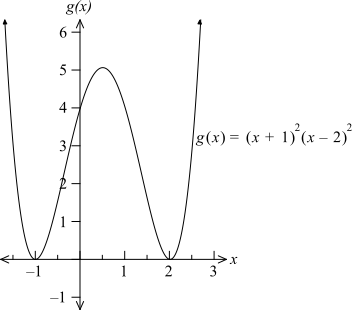
\(g\left(\dfrac{1}{2}\right)\)
\(=\left(\dfrac{1}{2}+1\right)^2\left(\dfrac{1}{2}-2\right)^2\)
\(=\dfrac{9}{4}\times \dfrac{9}{4}=\dfrac{81}{16}\)
\(\therefore\ \text{Local maximum at}\ \left(\dfrac{1}{2} , \dfrac{81}{16}\right)\)
Functions, MET2 2022 VCAA 5 MC
The largest value of `a` such that the function `f:(-\infty, a] \rightarrow R, f(x)=x^2+3 x-10`, where `f` is one-to-one, is
- `-12.25`
- `-5`
- `-1.5`
- `0`
- `2`
Calculus, MET2 2023 VCAA 14 MC
A polynomial has the equation \(y=x(3x-1)(x+3)(x+1)\).
The number of tangents to this curve that pass through the positive \(x\)-intercept is
- 0
- 1
- 2
- 3
- 4
Algebra, MET2 2023 VCAA 2 MC
For the parabola with equation \(y=ax^2+2bx+c\), where \(a, b, c \in R\), the equation of the axis of symmetry is
- \(x=-\dfrac{b}{a}\)
- \(x=-\dfrac{b}{2a}\)
- \(y=c\)
- \(x=\dfrac{b}{a}\)
- \(x=\dfrac{b}{2a}\)
Graphs, MET2-NHT 2019 VCAA 1
Parts of the graphs of `f(x) = (x-1)^3(x + 2)^3` and `g(x) = (x-1)^2(x + 2)^3` are shown on the axes below.
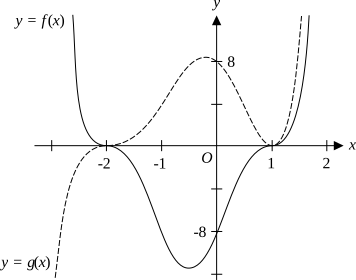
The two graphs intersect at three points, (–2, 0), (1, 0) and (`c`, `d`). The point (`c`, `d`) is not shown in the diagram above.
- Find the values of `c` and `d`. (2 marks)
--- 4 WORK AREA LINES (style=lined) ---
- Find the values of `x` such that `f(x) > g(x)`. (1 mark)
--- 2 WORK AREA LINES (style=lined) ---
- State the values of `x` for which
- `f^{'}(x) > 0` (1 mark)
--- 2 WORK AREA LINES (style=lined) ---
- `g^{'}(x) > 0` (1 mark)
--- 2 WORK AREA LINES (style=lined) ---
- `f^{'}(x) > 0` (1 mark)
- Show that `f(1 + m) = f(–2-m)` for all `m`. (1 mark)
--- 3 WORK AREA LINES (style=lined) ---
- Find the values of `h` such that `g(x + h) = 0` has exactly one negative solution. (2 marks)
--- 4 WORK AREA LINES (style=lined) ---
- Find the values of `k` such that `f(x) + k = 0` has no solutions. (1 mark)
--- 2 WORK AREA LINES (style=lined) ---
Graphs, MET2 2017 VCAA 2 MC
Part of the graph of a cubic polynomial function `f` and the coordinates of its stationary points are shown below.
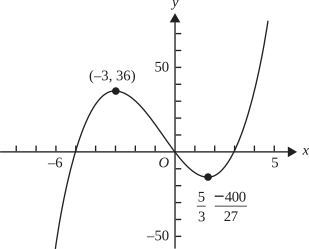
`f′(x) < 0` for the interval
- `(0,3)`
- `(−oo,−5) ∪ (0,3)`
- `(−oo,−3) ∪ (5/3,oo)`
- `(−3,5/3)`
- `((−400)/27,36)`
Show Worked Solution
`f′(x) < 0\ \ text(when the gradient of the curve is negative.)`
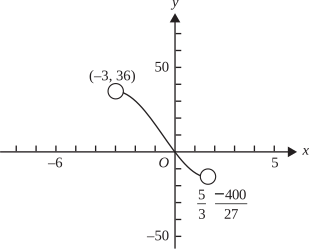
`=> D`
Calculus, MET2 2014 VCAA 5
Let `f: R -> R, \ \ f (x) = (x-3)(x-1)(x^2 + 3) and g: R-> R, \ \ g (x) = x^4-8x.`
- Express `x^4-8x` in the form `x(x-a) ((x + b)^2 + c)`. (2 marks)
--- 4 WORK AREA LINES (style=lined) ---
- Describe the translation that maps the graph of `y = f (x)` onto the graph of `y = g (x)`. (1 mark)
--- 2 WORK AREA LINES (style=lined) ---
- Find the values of `d` such that the graph of `y = f (x + d)` has
- one positive `x`-axis intercept. (1 mark)
--- 3 WORK AREA LINES (style=lined) ---
- two positive `x`-axis intercepts. (1 mark)
--- 2 WORK AREA LINES (style=lined) ---
- one positive `x`-axis intercept. (1 mark)
- Find the value of `n` for which the equation `g (x) = n` has one solution. (1 mark)
--- 3 WORK AREA LINES (style=lined) ---
- At the point `(u, g(u))`, the gradient of `y = g(x)` is `m` and at the point `(v, g(v))`, the gradient is `-m`, where `m` is a positive real number.
- Find the value of `u^3 + v^3`. (2 marks)
--- 3 WORK AREA LINES (style=lined) ---
- Find `u` and `v` if `u + v = 1`. (1 mark)
--- 3 WORK AREA LINES (style=lined) ---
- Find the value of `u^3 + v^3`. (2 marks)
-
- Find the equation of the tangent to the graph of `y = g(x)` at the point `(p, g(p))`. (1 mark)
--- 4 WORK AREA LINES (style=lined) ---
- Find the equations of the tangents to the graph of `y = g(x)` that pass through the point with coordinates `(3/2, -12)`. (3 marks)
--- 5 WORK AREA LINES (style=lined) ---
- Find the equation of the tangent to the graph of `y = g(x)` at the point `(p, g(p))`. (1 mark)
Show Worked Solution
a. `text(Solution 1)`
`g(x) = x^4-8x`
`= x(x-2)(x^2 + 2x + 4)\ \ \ text([by CAS])`
`= x(x-2)((x + 1)^2 + 3)`
`text(Solution 2)`
| `x^4-8x` | `=x(x^3-2^3)` |
| `=x(x-2)(x^2 +2x+4)` | |
| `=x(x-2)(x^2 +2x+1+3)` | |
| `=x(x-2)((x+1)^2+3)` |
| b. | `f(x + 1)` | `= ((x + 1)-3)((x + 1)-1)((x + 1)^2 + 3)` |
| `= x(x-2)((x + 1)^2 + 3)` | ||
| `= g(x)` |
♦ Mean mark (b) 37%.
`:.\ text(Horizontal translation of 1 unit to the left.)`
c.i. `text(Consider part of the)\ \ f(x)\ text(graph below:)`
♦♦♦ Mean mark 7%.

`text(For one positive)\ xtext(-axis intercept, translate at least)`
`text(1 unit left, but not more than 3 units left.)`
`:. d ∈ [1,3)`
c.ii. `text(Translate less than 1 unit left, or translate)`
♦♦♦ Mean mark part (c)(ii) 19%.
`text(right.)`
`:. d < 1`
d. `text(If)\ \ g(x)=n\ \ text(has one solution, then it)`
`text(will occur when)\ \ g^{′}(x)=0 and x>0.`
♦♦♦ Mean mark 17%.
| `g^{′}(x)` | `=4x^3-8` |
| `4x^3` | `=8` |
| `x` | `=2^(1/3)` |

| `n` | `=g(2^(1/3))` |
| `=2^(4/3)-8xx2^(1/3)` | |
| `=-6 xx 2^(1/3)` |
e.i. `gprime(u) = mqquadgprime(v) = −m`
♦♦ Mean mark (e.i.) 28%.
| `g^{prime}(u)` | `= -g^{prime}(v)` |
| `4u^3-8` | `= -(4v^3-8)` |
| `4u^3 + 4v^3` | `= 16` |
| `:. u^3 + v^3` | `= 4` |
e.ii. `u^3 + v^3 = 4\ …\ (1)`
♦♦♦ Mean mark (e.ii.) 10%.
`u + v = 1\ …\ (2)`
`text(Solve simultaneous equation for)\ \ u > 0:`
`:. u = (sqrt5 + 1)/2,quad v = (-sqrt5 + 1)/2`
f.i. `text(Solution 1)`
`text(Using the point-gradient formula,)`
| `y-g(p)` | `=g^{prime}(p)(x-p)` |
| `y-(p^4-8p)` | `=(4p^3-8)(x-p)` |
| `y` | `=(4p^3-8)x -3p^4` |
`text(Solution 2)`
♦♦ Mean mark (f.i.) 22%.
`y = 4(p^3-2)x-3p^4`
`text([CAS: tangentLine)\ (g(u),x,p)]`
f.ii. `text(Sub)\ (3/2,-12)\ text(into tangent equation,)`
`text(Solve:)\ \ -12 = 4(p^3-2)(3/2)-3p^4\ \ text(for)\ p,`
♦♦♦ Mean mark (f.ii.) 14%.
`p = 0\ \ text(or)\ \ p = 2`
| `text(When)\ \ p = 0:` | `y` | `= 4(-2)x` |
| `= -8x` |
| `text(When)\ \ p = 2:` | `y` | `= 4(2^3-2)x-3(2)^4` |
| `= 24x-48` |
`:. text(Equations are:)\ \ y =-8x, \ y = 24x-48`
Calculus, MET2 2015 VCAA 2
A city is located on a river that runs through a gorge.
The gorge is 80 m across, 40 m high on one side and 30 m high on the other side.
A bridge is to be built that crosses the river and the gorge.
A diagram for the design of the bridge is shown below.

The main frame of the bridge has the shape of a parabola. The parabolic frame is modelled by `y = 60-3/80x^2` and is connected to concrete pads at `B (40, 0)` and `A (– 40, 0).`
The road across the gorge is modelled by a cubic polynomial function.
- Find the angle, `theta`, between the tangent to the parabolic frame and the horizontal at the point `(– 40, 0)` to the nearest degree. (2 marks)
--- 4 WORK AREA LINES (style=lined) ---
The road from `X` to `Y` across the gorge has gradient zero at `X (– 40, 0)` and at `Y (40, 30)`, and has equation `y = x^3/(25\ 600)-(3x)/16 + 35`.
- Find the maximum downwards slope of the road. Give your answer in the form `-m/n` where `m` and `n` are positive integers. (2 marks)
--- 4 WORK AREA LINES (style=lined) ---
Two vertical supporting columns, `MN` and `PQ`, connect the road with the parabolic frame.
The supporting column, `MN`, is at the point where the vertical distance between the road and the parabolic frame is a maximum.
- Find the coordinates `(u, v)` of the point `M`, stating your answers correct to two decimal places. (3 marks)
--- 5 WORK AREA LINES (style=lined) ---
The second supporting column, `PQ`, has its lowest point at `P (– u, w)`.
- Find, correct to two decimal places, the value of `w` and the lengths of the supporting columns `MN` and `PQ`. (3 marks)
--- 5 WORK AREA LINES (style=lined) ---
For the opening of the bridge, a banner is erected on the bridge, as shown by the shaded region in the diagram below.

- Find the `x`-coordinates, correct to two decimal places, of `E` and `F`, the points at which the road meets the parabolic frame of the bridge. (3 marks)
--- 4 WORK AREA LINES (style=lined) ---
- Find the area of the banner (shaded region), giving your answer to the nearest square metre. (1 mark)
--- 2 WORK AREA LINES (style=lined) ---
Graphs, MET2 2015 VCAA 3 MC

The rule for a function with the graph above could be
- `y = -2(x + b)(x - c)^2(x - d)`
- `y = 2(x + b)(x - c)^2(x - d)`
- `y = -2(x - b)(x - c)^2(x - d)`
- `y = 2(x - b)(x - c)(x - d)`
- `y = -2(x - b)(x + c)^2(x + d)`