SmarterEd

Aussie Maths & Science Teachers: Save your time with SmarterEd

  • Login
  • Get Help
  • About

Networks, STD2 N3 SM-Bank 44

A project involves nine activities, `A` to `I`.

The immediate predecessor(s) of each activity is shown in the table below.
 

             Activity            Immediate
     predecessor(s)     
  `A` `-`
  `B` `A`
  `C` `A`
  `D` `B`
  `E` `B, C`
  `F` `D`
  `G` `D`
  `H` `E, F`
  `I` `G, H`

 
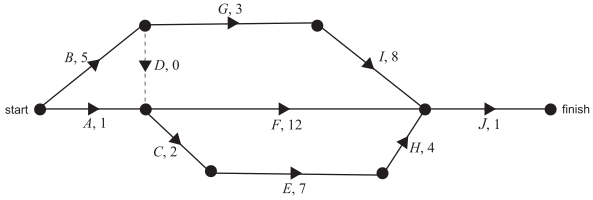
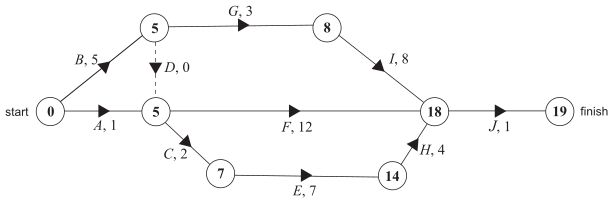
A directed network for this project will require a dummy activity.

Sketch the network diagram, clearly identifying the dummy activity.   (3 marks)

Show Answers Only

`B`

Show Worked Solution

`text(Sketch network diagram:)`


`text(The dummy activity needs to be drawn)`

`text(from the end of activity)\ B\ text(to the start)`

`text(of activity)\ E.`

Filed Under: Critical Paths Tagged With: Band 5, smc-916-10-Table to Network, smc-916-50-Dummy Activity

Networks, STD2 N3 EQ-Bank 19

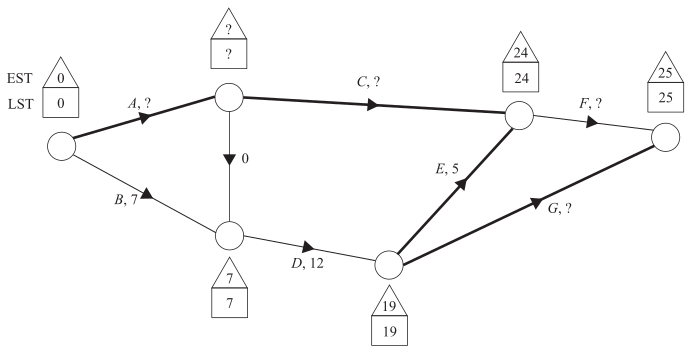
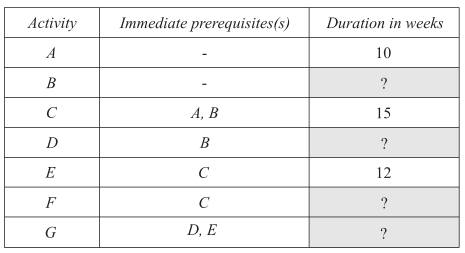
An engineering project requires activities A to G to be completed, as shown in the table.


The minimum completion time for the project is 25 days and the critical path includes activities B, D, E and F. The float for activity G is two days and the float for activity C is four days.

Find the possible duration for each of the activities A, C, F and G. Include a network diagram in your answer.  (5 marks)

Show Answers Only

`text(Duration of)\ F = 1\ text(day)`

`text(Duration of)\ G = 4\ text(days)`

`text(*Understand why there are many possibilities for the duration of)`

`A and C, text(provided they add up to 20 days and)\ A\ text(is not longer)`

`text{than 7 days (or a new critical path is created)}.`

Show Worked Solution

`text(Sketch the network:)`
 

`text{Critical path information included in the network (where EST = LST)}`

`F\ text(is on critical path ⇒ no float)`

`:.\ text(Duration of)\ F=  25 – 24 = 1\ text(day)`


`text(Duration of)\ G` `=\ text(LST of next activity − EST of)\ G – text(float)`
  `= 25 – 19 – 2`
  `= 4\ text(days)`


`text(The float of)\ C\ text{is 4 days (given)}`

`:.\ text(Duration of)\ C` `=\ text(LST of)\ F -\ text(EST of)\ C – 4`
  `= 24 -\ text(EST of)\ C – 4`
  `= 20 -\ text(EST of)\ C`


`text(EST of)\ C =\ text(Duration of)\ A\ \ (A\ text(has no prerequisites))`

`=>\ text(Duration of)\ A +\ text(Duration of)\ C = 20\ text(days)`

`:.\ text(Possible durations of)\ A\ text(and)\ C\ text(are:)`

`A = 5\ text(days), C = 15\ text(days)`
 

`text(*Understand why there are many possibilities for the duration of)`

`A and C, text(provided they add up to 20 days and)\ A\ text(is not longer)`

`text{than 7 days (or a new critical path is created)}.`

Filed Under: Critical Paths Tagged With: Band 5, smc-916-10-Table to Network, smc-916-30-Scanning Both Ways, smc-916-50-Dummy Activity

Networks, STD2 N3 EQ-Bank 18

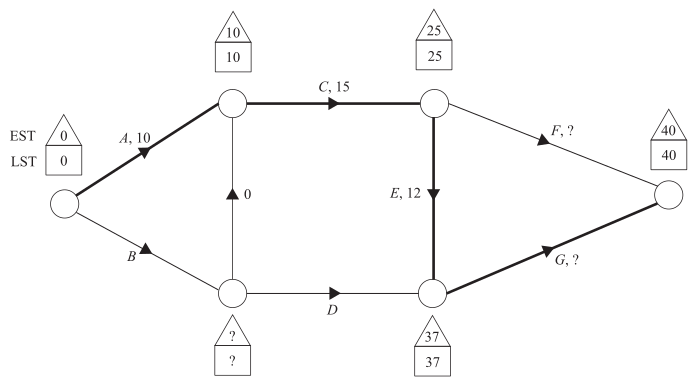
An engineering project requires activities A to G to be completed, as shown in the table.


The minimum completion time for the project is 40 weeks and the critical path includes activities A, C, E and G. The float for activity F is six weeks and the float for activity D is 9 weeks.

Find the possible duration for each of the activities B, D, F and G. Include a network diagram in your answer.  (5 marks)

Show Answers Only


`text(Duration of)\ G = 3\ text(weeks)`

`text(Duration of)\ F = 9\ text(weeks)`

`text(There are many possibilities for the duration of)\ B and D`

`text(provided they add up to 28 weeks and)\ B\ text(is not longer)`

`text{than 10 weeks (new critical path)}.`

Show Worked Solution

`text(Sketch network:)`

`text{Critical path added to network (where EST = LST)}`

`G\ text(is on critical path ⇒ no float)`

`:.\ text(Duration of)\ G = 40-37 = 3\ text(weeks)`


`text(Duration of)\ F` `=\ text(40 − EST of)\ F – text(float)`
  `= 40 – 25 – 6`
  `= 9\ text(weeks)`


`text(Float of)\ D = 9\ text{weeks (given)}`

`:.\ text(Duration of)\ D` `=\ text(LST of)\ G -\ text(EST of)\ D – 9`
  `= 37 -\ text(EST of)\ D – 9`
  `= 28 -\ text(EST of)\ D`


`text(EST of)\ D =\ text(Duration of)\ B\ \ \ (B\ text(has no prerequisites))`

`text(Duration of)\ B +\ text(Duration of)\ D = 28\ text(weeks)`

`:.\ text(Possible durations of)\ B\ text(and)\ D\ text(are:)`

`B = 1\ text(week), D = 27\ text(weeks)`


`text(*Understand why there are many possibilities for the duration of)`

`B and D, text(provided they add up to 28 weeks and)\ B\ text(is not longer)`

`text{than 10 weeks (or a new critical path is created)}.`

Filed Under: Critical Paths Tagged With: Band 5, smc-916-10-Table to Network, smc-916-30-Scanning Both Ways, smc-916-50-Dummy Activity

Networks, STD2 N3 2012 FUR2 2

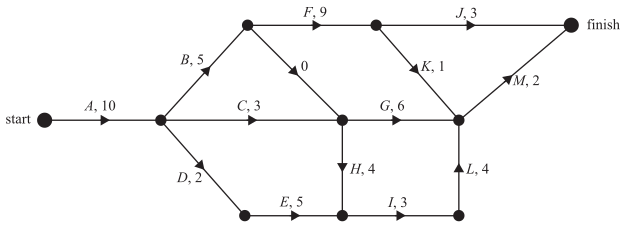
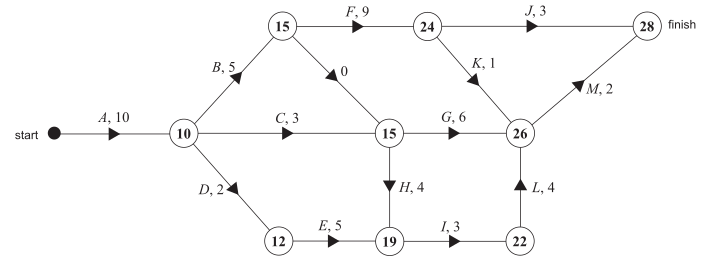
Thirteen activities must be completed before the produce grown on a farm can be harvested. 

The directed network below shows these activities and their completion times in days.


  1. Determine the earliest starting time, in days, for activity `E`.  (1 mark)

    --- 1 WORK AREA LINES (style=lined) ---

  2. An activity with zero duration starts at the end of activity `B`.


    Explain why this activity is used on the network diagram.  (1 mark)

    --- 1 WORK AREA LINES (style=lined) ---

  3. Determine the earliest starting time, in days, for activity `H`.  (1 mark)

    --- 1 WORK AREA LINES (style=lined) ---

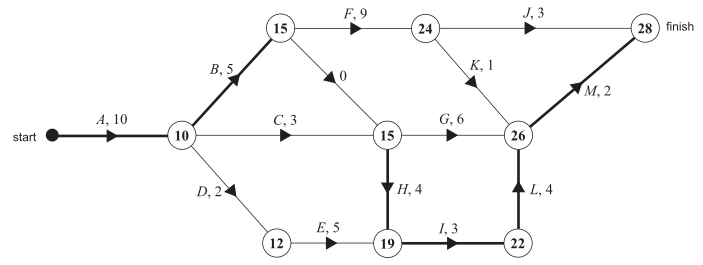
  4. In order, list the activities on the critical path.  (1 mark)

    --- 2 WORK AREA LINES (style=lined) ---

  5. Determine the latest starting time, in days, for activity `J`.  (1 mark)

    --- 1 WORK AREA LINES (style=lined) ---

Show Answers Only
  1. `12\ text(days)`
  2. `F\ text(has)\ B\ text(as a predecessor while)\ G\ text(and)\ H`
    `text(have)\ B\ text(and)\ C\ text(as predecessors.)`
    `text(S)text(ince there cannot be 2 activities called)\ B, text(a zero)`
    `text{duration activity is drawn as an extension of}\ B\ text(to)`
    `B\ text(show that it is also a predecessor of)\ G\ text(and)\ H.`
  3. `15\ text(days)`
  4. `ABHILM`
  5. `25\ text(days)`
Show Worked Solution
a.    `text(EST of)\ E` `= 10 + 2`
    `= 12\ text(days)`
♦ Mean mark of all parts (combined) 47%.


b.   `F\ text(has)\ B\ text(as a predecessor while)\ G\ text(and)\ H`

`text(have)\ B\ text(and)\ C\ text(as predecessors.)`

`text(S)text(ince there cannot be 2 activities called)\ B, text(a zero)`

`text{duration activity is drawn as an extension of}\ B\ text(to)`

`text(show that it is also a predecessor of)\ G\ text(and)\ H.`
 

♦♦ “Few students” were able to correctly deal with the zero duration activity in part (c).

c.  `text(Scanning forwards:)`


`text(EST for)\ H = 15\ text(days)`
 

d.   `text(The critical path is)\ \ ABHILM`


e.   `text(The shortest time to complete all the activities)`

MARKER’S COMMENT: A correct calculation based on an incorrect critical path in part (d) gained a consequential mark here. Show your working!.

`= 10 + 5 + 4 + 3  + 4 + 2`

`= 28\ text(days)`
 

`:.\ text(LST of)\ J` `= 28 − 3`
  `= 25\ text(days)`

Filed Under: Critical Paths Tagged With: Band 3, Band 4, Band 5, smc-916-30-Scanning Both Ways, smc-916-50-Dummy Activity

Networks, STD2 N3 2006 FUR1 9 MC

The network below shows the activities and their completion times (in hours) that are needed to complete a project.


The project is to be optimised by reducing the completion time of one activity only.

This will reduce the completion time of the project by a maximum of

A.   1 hour 

B.   3 hours

C.   4 hours

D.   5 hours

Show Answers Only

`C`

Show Worked Solution

`text(Scanning forward:)`


`text(Critical path:)`

♦♦♦ Mean mark 17%.
MARKER’S COMMENT: When choosing an activity to crash, take care that a new critical path is not created.

`=> BDCEHJ\ text{(19 hours)}`
 

`text(Other routes not through)\ B,`

`ACEHJ\ text{(15 hours),}\ AFJ\ text{(14 hours)}`
 

`:.\ text(Activity)\ B\ text(could be reduced by 4 hours without)`

`text(a new critical path emerging.)`
 

`rArr C`

Filed Under: Critical Paths Tagged With: Band 6, smc-916-20-Forward Scanning, smc-916-50-Dummy Activity

Copyright © 2014–2025 SmarterEd.com.au · Log in