SmarterEd

Aussie Maths & Science Teachers: Save your time with SmarterEd

  • Login
  • Get Help
  • About

Calculus, 2ADV C3 2019 HSC 15c

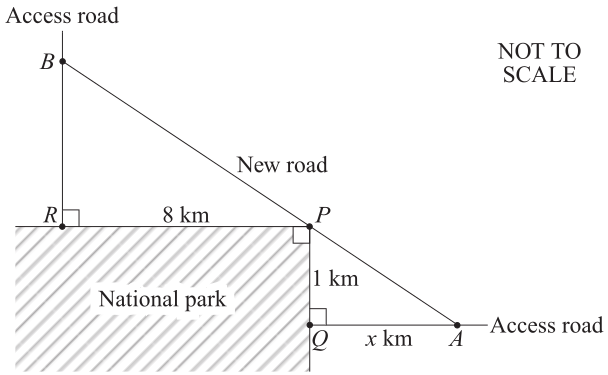
The entry points, `R`  and  `Q`, to a national park can be reached via two straight access roads. The access roads meet the national park boundaries at right angles. The corner, `P`, of the national park is 8 km from  `R`  and 1 km from  `Q`. The boundaries of the national park form a right angle at  `P`.

A new straight road is to be built joining these roads and passing through  `P`.

Points  `A`  and  `B`  on the access roads are to be chosen to minimise the distance, `D`  km, from  `A`  to  `B`  along the new road.

Let the distance  `QA`  be  `x`  km.


  1. Show that  `D^2 = (x + 8)^2 + (8/x + 1)^2`.  (3 marks)

    --- 6 WORK AREA LINES (style=lined) ---

  2. Show that  `x = 2`  gives the minimum value of  `D^2`.  (3 marks)

    --- 6 WORK AREA LINES (style=lined) ---
Show Answers Only
  1. `text(Proof)\ text{(See Worked Solutions)}`
  2. `text(Proof)\ text{(See Worked Solutions)}`
Show Worked Solution
i.    `/_ BRP` `= /_ PQA = 90^@\ \ text{(given)}`
  `/_ BPR` `= /_ PAQ\ \ text{(corresponding)}`
  `=> Delta  BRP\ text(|||)\ Delta PQA\ \ text{(equiangular)}`


`(BR)/(RP)` `= (PQ)/(QA)` `text{(corresponding sides of}`
  `text{similar triangles)}`
`(BR)/8` `= 1/x`  
`BR` `= 8/x`  

 
`text(Using Pythagoras,)`

♦ Mean mark part (i) 41%.

`D^2` `= (QA + RP)^2 + (BR + PQ)^2`
  `= (x + 8)^2 + (8/x + 1)^2`


ii.    `(D^2) prime` `= 2*(x + 8) + 2(-1) ⋅ 8/x^2 (8/x + 1)`
    `= 2x + 16 – 16/x^2 (8/x + 1)`
    `= 2x + 16 – 128/x^3 – 16/x^2`
  `(D^2)″` `= 2 – (-3) ⋅ 128/x^4 -(-2) ⋅ 16/x^3`
    `= 2 + 384/x^4 + 32/x^3`

 
`text(When)\ \ x = 2,`

♦♦ Mean mark part (ii) 31%.

`(D^2) prime = 2 xx 2 + 16 – 128/8 – 16/4 = 0`

`=>\ text(S.P. at)\ \ x = 2`

`(D^2)″ = 2 + 384/16 + 32/8 > 0`
 

`:.\ text(MIN value of)\ \ D^2\ \ text(at)\ \ x = 2.`

Filed Under: Maxima and Minima (Y12) Tagged With: Band 5, smc-970-50-Distance

Calculus, 2ADV C3 2017 HSC 16a

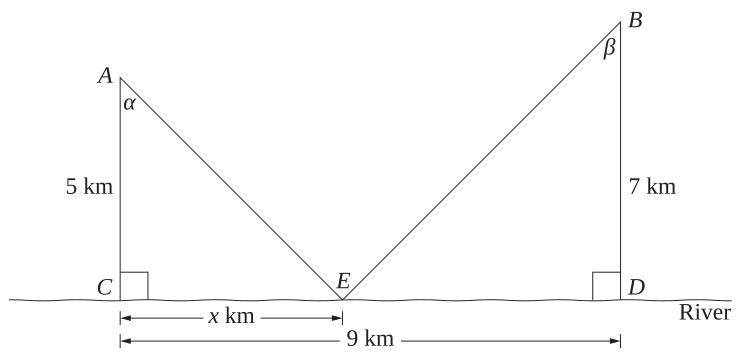
John’s home is at point `A` and his school is at point `B`. A straight river runs nearby.

The point on the river closest to `A` is point `C`, which is 5 km from `A`.

The point on the river closest to `B` is point `D`, which is 7 km from `B`.

The distance from `C` to `D` is 9 km.

To get some exercise, John cycles from home directly to point `E` on the river, `x` km from `C`, before cycling directly to school at `B`, as shown in the diagram.


The total distance John cycles from home to school is `L` km.

  1. Show that  `L = sqrt (x^2 + 25) + sqrt (49 + (9 - x)^2)`.   (1 mark)

    --- 2 WORK AREA LINES (style=lined) ---

  2. Show that if  `(dL)/(dx) = 0`, then  `sin alpha = sin beta`.   (3 marks)

    --- 6 WORK AREA LINES (style=lined) ---

  3. Find the value of `x` that makes  `sin alpha = sin beta`.   (2 marks)

    --- 5 WORK AREA LINES (style=lined) ---

  4. Explain why this value of `x` gives a minimum for `L`.   (1 mark)

    --- 3 WORK AREA LINES (style=lined) ---

Show Answers Only
  1. `text(Proof)\ \ text{(See Worked Solutions)}`
  2. `text(Proof)\ \ text{(See Worked Solutions)}`
  3. `45/12`
  4. `text(See Worked Solutions)`
Show Worked Solution
i.  

`text(Using Pythagoras:)`

`L` `= AE + EB`
  `= sqrt (5^2 + x^2) + sqrt (7^2 + (9 – x)^2)`
  `= sqrt(25 + x^2) + sqrt (49 + (9 – x)^2)\ text(… as required)`


ii.  `text(From diagram):`

♦ Mean mark 41%.

`sin alpha = x/sqrt(25 + x^2) and sin beta = (9 – x)/sqrt(49 + (9 – x)^2)`

`L` `= sqrt(25 + x^2) + sqrt (49 + (9 – x)^2)`
`(dL)/(dx)` `= (2x)/sqrt(25 + x^2) – (2(9 – x))/sqrt(49 + (9 – x)^2)`


`text(If)\ \ (dL)/(dx) = 0,`

`=> (2x)/sqrt(25 + x^2)` `= (2(9 – x))/sqrt(49 + (9 – x)^2)`
`x/sqrt(25 + x^2)` `= (9 – x)/sqrt(49 + (9 – x)^2)`
`sin alpha` `= sin beta\ text(… as required)`


iii.  `text(If)\ sin alpha = sin beta,\ text(then)\ alpha = beta and`

♦♦ Mean mark 29%.

`Delta ACE\ text(|||)\ Delta BDE`

`text(Using corresponding sides of similar triangles:)`

`x/5` `= (9 – x)/7`
`7x` `= 45 – 5x`
`12x` `= 45`
`:. x` `= 45/12\ text(km)`
♦♦♦ Mean mark 9%.


iv.  

`text(If point)\ B\ text(is reflected across the)`

`text(river),\ AEB\ text(will be a straight line.)`

`text(If any other point is chosen,)\ AEB`

`text(would not be straight and the distance)`

`text(would be longer.)`

Filed Under: Maxima and Minima, Maxima and Minima (Y12) Tagged With: Band 4, Band 5, Band 6, smc-970-50-Distance

Calculus, 2ADV C3 2009 HSC 9b

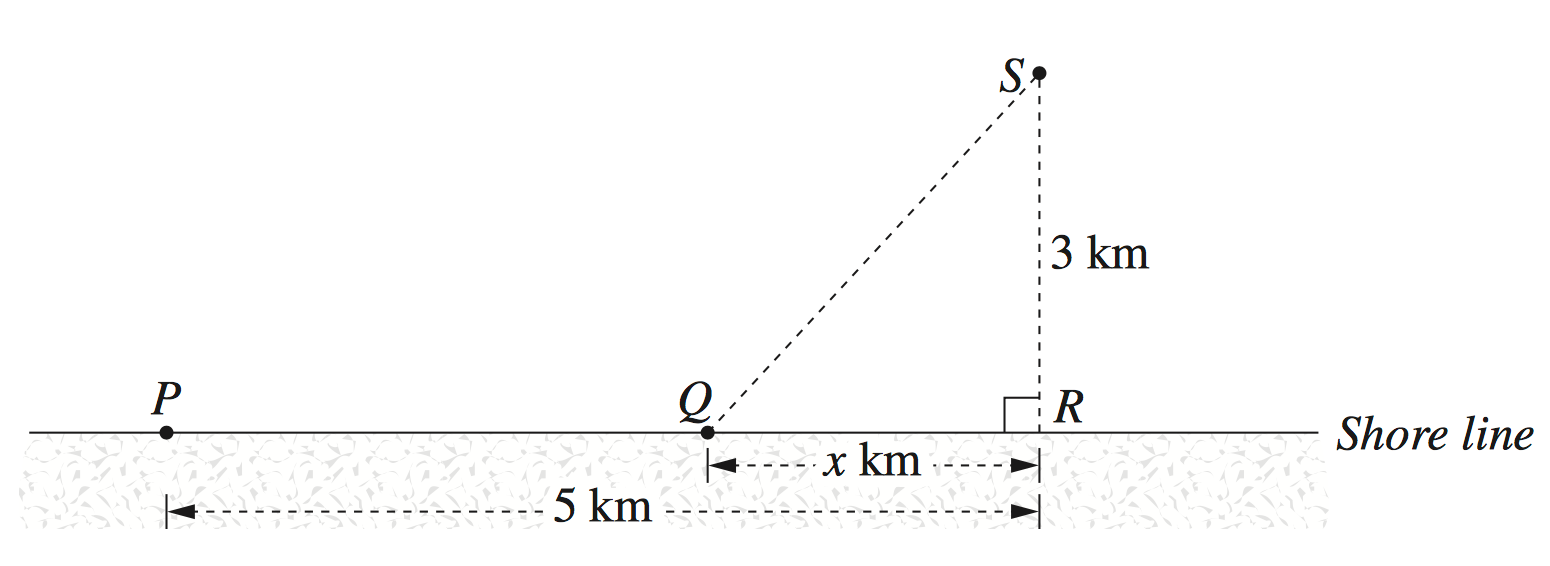
An oil rig,  `S`,  is 3 km offshore. A power station,  `P`,  is on the shore. A cable is to be laid from `P`  to  `S`.  It costs $1000 per kilometre to lay the cable along the shore and $2600 per kilometre to lay the cable underwater from the shore to  `S`.

The point  `R`  is the point on the shore closest to  `S`,  and the distance  `PR`  is 5 km.

The point  `Q`  is on the shore, at a distance of  `x`  km from  `R`,  as shown in the diagram.


  1. Find the total cost of laying the cable in a straight line from  `P`  to  `R`  and then in a straight line from  `R`  to  `S`.   (1 mark)

    --- 2 WORK AREA LINES (style=lined) ---

  2. Find the cost of laying the cable in a straight line from  `P`  to  `S`.  (1 mark)

    --- 2 WORK AREA LINES (style=lined) ---

  3. Let  `$C`  be the total cost of laying the cable in a straight line from  `P`  to  `Q`,  and then in a straight line from `Q`  to  `S`.
     
    Show that  `C=1000(5-x+2.6sqrt(x^2+9))`.    (2 marks)

    --- 5 WORK AREA LINES (style=lined) ---

  4. Find the minimum cost of laying the cable.    (4 marks)

    --- 8 WORK AREA LINES (style=lined) ---

  5. New technology means that the cost of laying the cable underwater can be reduced to $1100 per kilometre.


    Determine the path for laying the cable in order to minimise the cost in this case.    (2 marks)

    --- 5 WORK AREA LINES (style=lined) ---

Show Answers Only
  1. `$12\ 800`
  2. `$15\ 160`
  3. `text{Proof (See Worked Solutions)}`
  4. `$12\ 200`
  5. `P\ text(to)\  S\ text(in a straight line.)`
Show Worked Solution
♦♦ Although specific data is unavailable for question parts, mean marks were 35% for Q9 in total.
i.   `text(C)text(ost)` `=(PRxx1000)+(SRxx2600)`
  `=(5xx1000)+(3xx2600)`
  `=12\ 800`

 
`:. text(C)text(ost is)\   $12\ 800`


ii.   `text(C)text(ost)=PSxx2600`

`text(Using Pythagoras:)`

`PS^2` `=PR^2+SR^2`
  `=5^2+3^2`
  `=34`
`PS` `=sqrt34`


`:.\ text(C)text(ost)` `=sqrt34xx2600`
  `=15\ 160.474…`
  `=$15\ 160\ \ text{(nearest dollar)}`


iii.  `text(Show)\ \ C=1000(5-x+2.6sqrt(x^2+9))`

`text(C)text(ost)=(PQxx1000)+(QSxx2600)`

`PQ` `=5-x`
`QS^2` `=QR^2+SR^2`
  `=x^2+3^2`
`QS` `=sqrt(x^2+9)`
`:.C` `=(5-x)1000+sqrt(x^2+9)\ (2600)`
  `=1000(5-x+2.6sqrt(x^2+9))\ \ text(…  as required)`


iv.   `text(Find the MIN cost of laying the cable)`

`C` `=1000(5-x+2.6sqrt(x^2+9))`
`(dC)/(dx)` `=1000(–1+2.6xx1/2xx2x(x^2+9)^(–1/2))`
  `=1000(–1+(2.6x)/(sqrt(x^2+9)))`

`text(MAX/MIN when)\ (dC)/(dx)=0`

IMPORTANT: Tougher derivative questions often require students to deal with multiple algebraic constants. See Worked Solutions in part (iv).

`1000(–1+(2.6x)/(sqrt(x^2+9)))=0`

`(2.6x)/sqrt(x^2+9)` `=1`
`2.6x` `=sqrt(x^2+9)`
`(2.6)^2x^2` `=x^2+9`
`x^2(2.6^2-1)` `=9`
`x^2` `=9/5.76`
  `=1.5625`
`x` `=1.25\ \ \ \ (x>0)`
MARKER’S COMMENT: Check the nature of the critical points in these type of questions. If using the first derivative test, make sure some actual values are substituted in.

`text(If)\ \ x=1,\ \ (dC)/(dx)<0`

`text(If)\ \ x=2,\ \ (dC)/(dx)>0`

`:.\ text(MIN when)\ \ x=1.25`

`C` `=1000(5-1.25+2.6sqrt(1.25^2+9))`
  `=1000(122)`
  `=12\ 200` 


`:.\ text(MIN cost is)\  $12\ 200\ text(when)\   x=1.25`


v.   `text(Underwater cable now costs $1100 per km)`

`=>\ C` `=1000(5-x)+1100sqrt(x^2+9)`
  `=1000(5-x+1.1sqrt(x^2+9))`
`(dC)/(dx)` `=1000(–1+1.1xx1/2xx2x(x^2+9)^(-1/2))`
  `=1000(–1+(1.1x)/sqrt(x^2+9))`

 
`text(MAX/MIN when)\ (dC)/(dx)=0`

`1000(–1+(1.1x)/sqrt(x^2+9))` `=0`
`(1.1x)/sqrt(x^2+9)` `=1`
`1.1x` `=sqrt(x^2+9)`
`1.1^2x^2` `=x^2+9`
`x^2(1.1^2-1)` `=9`
`x^2` `=9/0.21`
`x` `~~6.5\ text{km (to 1 d.p.)}`
  `=>\ text(no solution since)\ x<=5`

 
`text(If we lay cable)\ PR\ text(then)\ RS`

MARKER’S COMMENT: Many students failed to interpret a correct calculation of  `x>5`  as providing no solution.

`=>\ text(C)text(ost)=5xx1100+3xx1000=8500`

`text(If we lay cable directly underwater via)\ PS`

`=>\ text(C)text(ost)=sqrt34xx1100=6414.047…`

`:.\ text{MIN cost is  $6414 by cabling directly from}\ P\ text(to)\ S`.

Filed Under: Maxima and Minima, Maxima and Minima (Y12) Tagged With: Band 3, Band 4, Band 5, Band 6, smc-970-50-Distance, smc-970-60-Other Themes

Calculus, 2ADV C3 2013 HSC 14b

Two straight roads meet at  `R`  at an angle of 60°.  At time  `t=0`  car  `A`  leaves  `R`  on one road, and car  `B`  is 100km from  `R`  on the other road.  Car  `A`  travels away from  `R`  at a speed of 80 km/h, and car  `B`  travels towards  `R`  at a speed of 50 km/h.
 

2013 14b

The distance between the cars at time  `t`  hours is  `r`  km.

  1. Show that  `r^2=12\ 900t^2-18\ 000t+10\ 000`.   (2 marks)

    --- 5 WORK AREA LINES (style=lined) ---

  2. Find the minimum distance between the cars.    (3 marks)

    --- 7 WORK AREA LINES (style=lined) ---

Show Answers Only
  1. `text{Proof  (See Worked Solutions)}`
  2. `61\ text(km)`
Show Worked Solution

i.   `text(Need to show)\  r^2=12\ 900t^2-18\ 000t+10\ 000`

♦♦ Mean mark 26%

`RB=100-50t`

`RA=80t`

`text(Using the cosine rule)`

`r^2` `=(RB)^2+(RA)^2-2(RB)(RA)cos/_R`
  `=(100-50t)^2+(80t)^2-2(100-50t)(80t)cos60`
  `=10\ 000-10\ 000t+2500t^2+6400t^2-8000t+4000t^2`
  `=12\ 900t^2-18\ 000t+10\ 000\ \ \ \ text(… as required)` 


ii.   `text(Max/min when)\ (dr^2)/(dt)=0`

♦♦ Mean mark 27%
ALGEBRA TIP: Finding the derivative of `r^2` (rather than making `r` the subject), makes calculations much easier. ENSURE you apply the test to confirm a minimum.

`(dr^2)/(dt)=25\ 800t-18\ 000=0`

`t=(18\ 000)/(25\ 800)=30/43`

`text(When)\  t=30/43,\   (d^2(r^2))/(dt^2)=25\ 800>0\ \ =>text(MIN)`

`:.\ text(Minimum distance when)\  t=30/43\ text(hr)`

`text(Find)\  r\ text(when)\ t=30/43`

`r^2` `=12\ 900(30/43)^2-18\ 000(30/43)+10\ 000`
  `=3720.9302…`
`:.\ r` `=sqrt3702.9302…`
  `~~60.99942…`
  `~~61\ text{km  (nearest km)}`


`:.\ text(MIN distance between the cars is 61 km.)`

Filed Under: Maxima and Minima, Maxima and Minima (Y12) Tagged With: Band 5, Band 6, smc-970-50-Distance

Copyright © 2014–2025 SmarterEd.com.au · Log in