A function that has a range of \([6,12]\) is
- \(f(x)=6+3 \cos (9 x)\)
- \(f(x)=6+6 \cos (3 x)\)
- \(f(x)=9-3 \cos (6 x)\)
- \(f(x)=9-6 \cos (3 x)\)
Aussie Maths & Science Teachers: Save your time with SmarterEd
A function that has a range of \([6,12]\) is
Let \(f(x)=2 \cos (2 x)+1\) over the domain \(x \in\left[0, 2 \pi \right]\).
--- 2 WORK AREA LINES (style=lined) ---
--- 8 WORK AREA LINES (style=lined) ---
--- 0 WORK AREA LINES (style=lined) ---
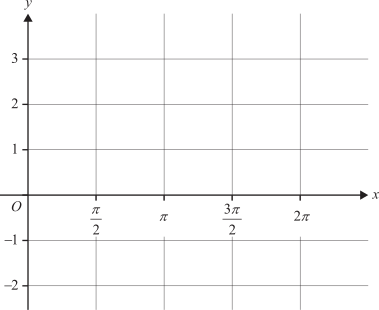
a. \(\text{Range of } f(x):-1 \leqslant y \leqslant 3\)
b. \(x=\dfrac{\pi}{3}, \dfrac{2 \pi}{3}, \dfrac{4 \pi}{3}, \dfrac{5 \pi}{3}\)
c.
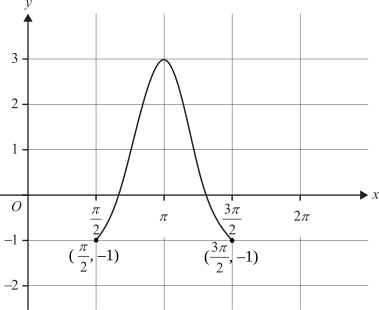
a. \(\text{Amplitude}=2 \ \ \text{about} \ \ y=1.\)
\(\text{Range of } f(x):\ -1 \leqslant y \leqslant 3\)
| b. | \(2 \cos (2 x)+1\) | \(=0\) |
| \(\cos (2 x)\) | \(=-\dfrac{1}{2}\) |
\(\text{Base angle}=\dfrac{\pi}{3}\)
\(2x=\pi-\dfrac{\pi}{3}, \pi+\dfrac{\pi}{3}, \cdots\)
\(2x=\dfrac{2 \pi}{3}, \dfrac{4 \pi}{3}, \dfrac{8 \pi}{3}, \dfrac{10 \pi}{3}\)
\(x=\dfrac{\pi}{3}, \dfrac{2 \pi}{3}, \dfrac{4 \pi}{3}, \dfrac{5 \pi}{3}\)
c.
A function is defined as \(f(x)=-2\cos\Big( \dfrac{\pi x}{3} \Big). \)
--- 5 WORK AREA LINES (style=lined) ---
--- 12 WORK AREA LINES (style=lined) ---
a. \(\text{Amplitude}\ = 2\)
\(\text{Period}\ (T) = 6 \)
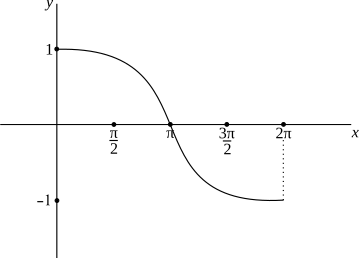
b.
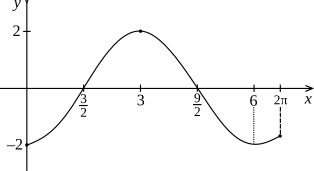
a. \(\text{Amplitude}\ = 2\)
\(\text{Period}\ (T) = \dfrac{2\pi}{n} = \dfrac{2\pi}{\frac{\pi}{3}} = 6 \)
b.
--- 0 WORK AREA LINES (style=blank) --- --- 6 WORK AREA LINES (style=lined) --- a. b. \(x=\dfrac{2\pi}{3}\) a.
 Show Answers Only
 Show Worked Solution
b.
\(\quad y\)
\(=\cos \Big(\dfrac{x}{2}\Big)\)
\(0.5\)
\(=\cos \Big(\dfrac{x}{2}\Big) \)
\(\dfrac{x}{2}\)
\(=\cos^{-1} (0.5) \)
\(\dfrac{x}{2}\)
\(=\dfrac{\pi}{3}, \ \dfrac{5\pi}{3}\)
\(x\)
\(=\dfrac{2\pi}{3}\ \ (0 \leqslant x \leqslant 2 \pi) \)
Which interval gives the range of the function `y = 5 + 2cos3x` ?
By drawing graphs on the number plane, show how many solutions exist for the equation `cosx = |(x-pi)/4|` in the domain `(-∞, ∞)` (3 marks)
--- 1 WORK AREA LINES (style=lined) ---
`text(4 solutions)`
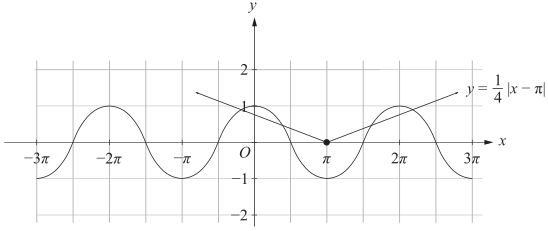
`text(Sketch:)`
| `y` | `= cos x` |
| `y` | `= |(x-pi)/4|` |
`text(Translate)\ pi\ text(units to the right: )`
`y=|x| \ => \ y=|x-pi|`
`text(Multiply by)\ 1/4 :`
`y=|x-pi| \ => \ y= 1/4 |x-pi| = |(x-pi)/4|`
`:.\ text(There are 4 solutions.)`
For the function `f(x) = 5 cos (2 (x + pi/3)),\ \ \ -pi<=x<=pi`
--- 4 WORK AREA LINES (style=lined) ---
Label endpoints of the graph with their coordinates. (3 marks)
--- 0 WORK AREA LINES (style=lined) ---
a. `text(Amplitude) = 5;\ \ \ text(Period) = pi`
| b. | 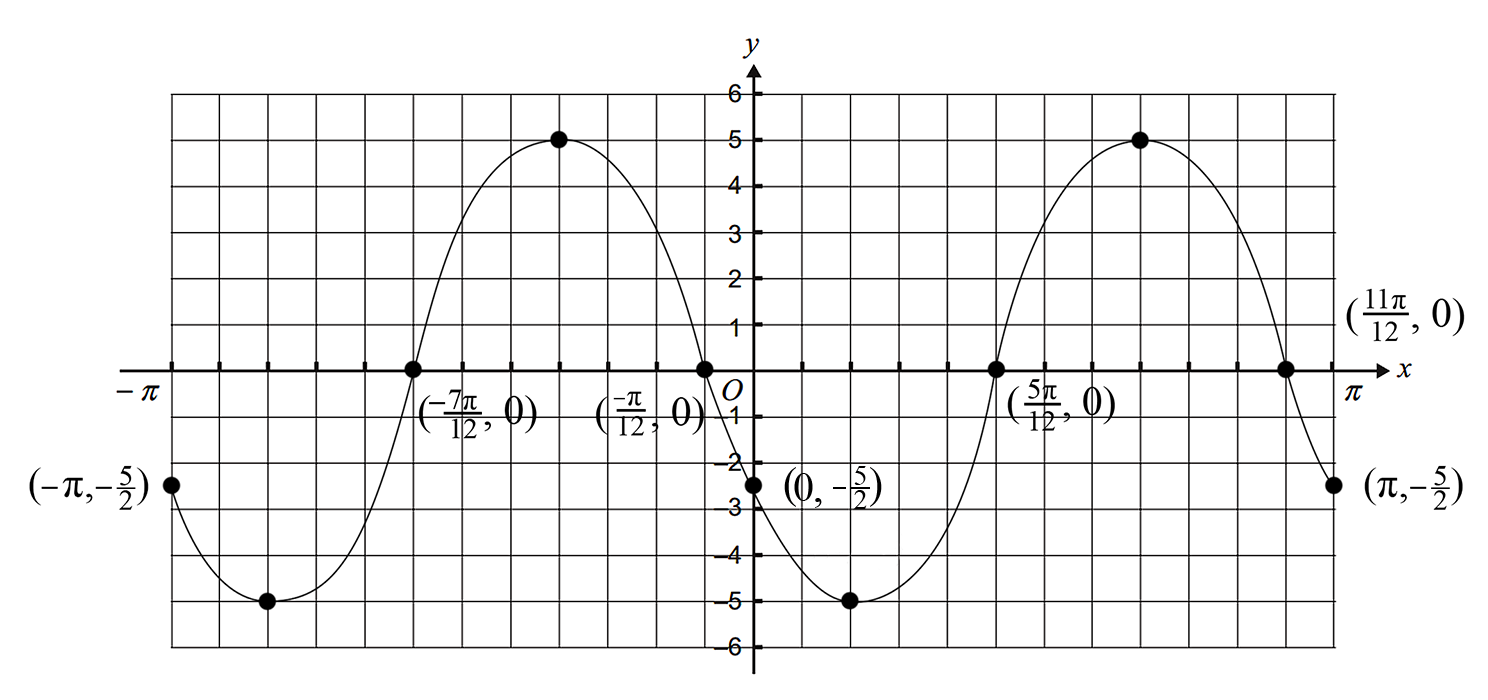 |
a. `text(Amplitude) = 5`
`text(Period) = (2 pi)/2 = pi`
b. `text(Shift)\ \ y = 5 cos (2x)\ \ text(left)\ \ pi/3\ \ text(units).`
`text(Period) = pi`
`text(Endpoints are)\ \ (-pi, -5/2) and (pi,-5/2)`
State the range and period of the function
`h(x) = 4 + 3 cos ((pi x)/2).` (2 marks)
--- 4 WORK AREA LINES (style=lined) ---
Let `f(x) = 2cos(x) + 1` for `0<=x<=2pi`.
--- 4 WORK AREA LINES (style=lined) ---
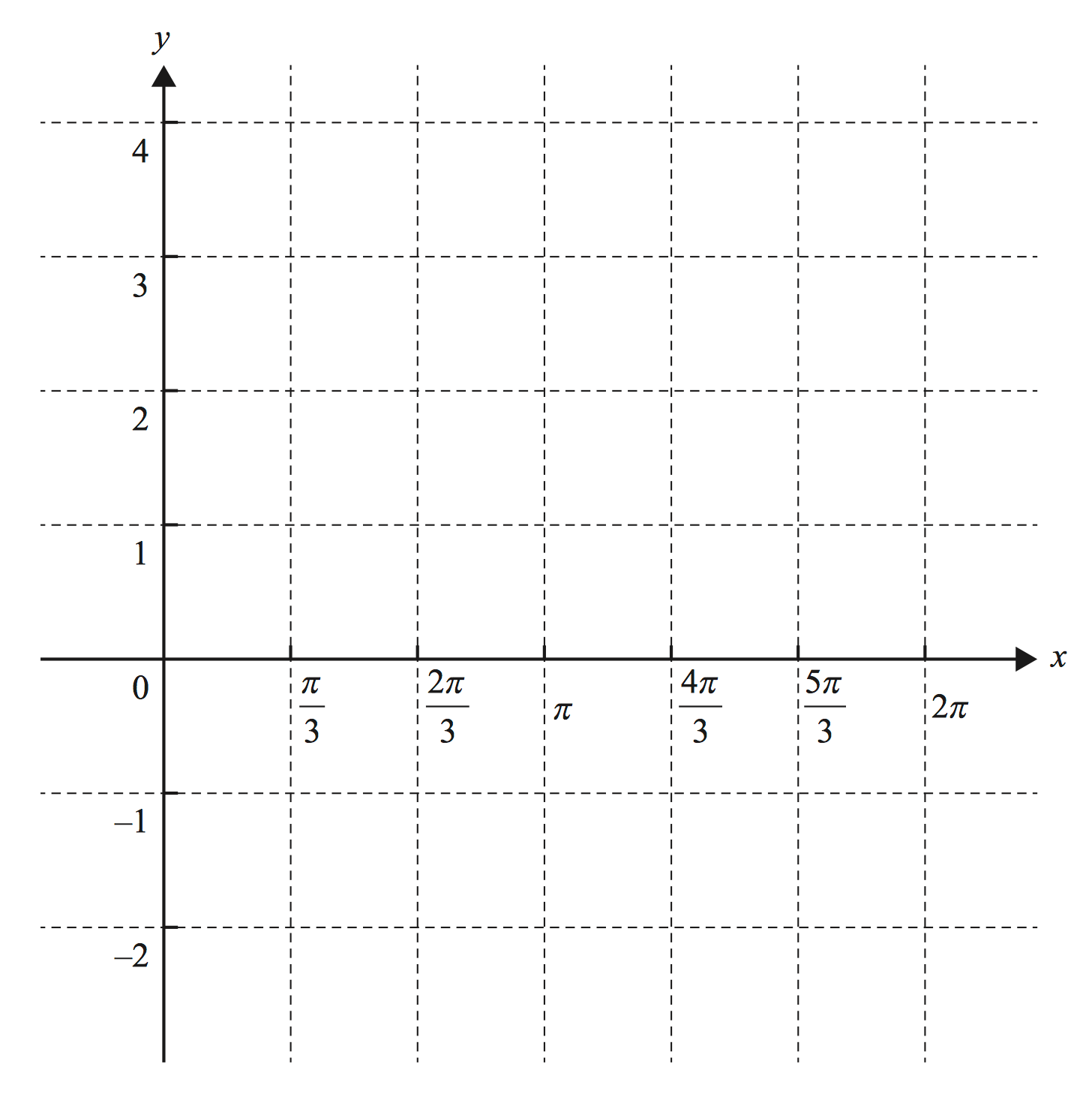
--- 0 WORK AREA LINES (style=lined) ---
a. `(2pi)/3, (4pi)/3`
b.
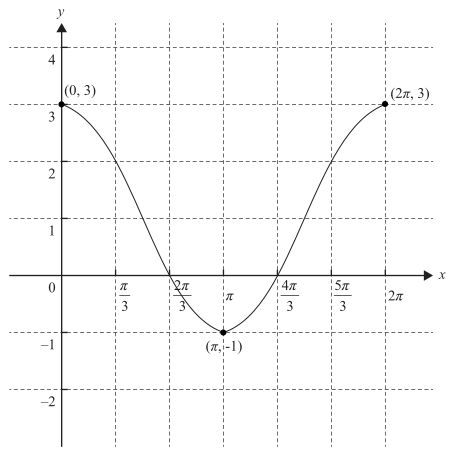
| a. | `2cos(x) + 1` | `= 0` |
| `cos(x)` | `=-1/2` |
`=> cos\ pi/3 = 1/2\ text(and cos is negative)`
`text(in 2nd/3rd quadrant)`
| `:.x` | `= pi-pi/3, pi + pi/3` |
| `= (2pi)/3, (4pi)/3` |
| b. | |
Let `f(x) = 1-2 cos ({pi x}/2).`
The period and range of this function are respectively
A function `f(x)` is defined by `f(x) = 1 + 2 cos x`.
--- 3 WORK AREA LINES (style=lined) ---
--- 7 WORK AREA LINES (style=blank) ---
--- 6 WORK AREA LINES (style=lined) ---
a. `text(Proof)\ \ text{(See Worked Solutions)}`
b.
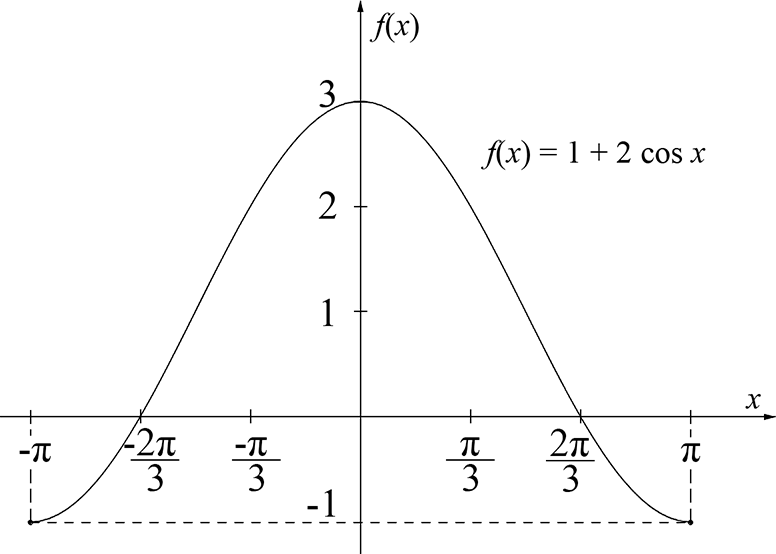
c. `((7 pi)/6 + sqrt 3 + 1)\ text(u²)`
a. `f(x) = 1 + 2 cos x`
`f(x)\ text(cuts the)\ x text(-axis when)\ f(x) = 0`
| `1 + 2 cos x` | `= 0` |
| `2 cos x` | `=-1` |
| `cos x` | `=-1/2` |
`:. x = (2 pi)/3\ …\ text(as required)`
| b. | |
| c. `text(Area)` | `= int_(-pi/2)^((2 pi)/3) 1 + 2 cos x\ \ dx` |
| `= [x + 2 sin x]_(-pi/2)^((2 pi)/3)` | |
| `= [((2 pi)/3 + 2 sin (2 pi)/3)-((-pi)/2 + 2 sin (-pi)/2)]` | |
| `= ((2 pi)/3 + 2 xx sqrt 3/2)-((-pi)/2 +2(- 1))` | |
| `= (2 pi)/3 + sqrt(3) + pi/2 + 2` | |
| `= ((7 pi)/6 + sqrt(3) + 2)\ text(u²)` |