SmarterEd

Aussie Maths & Science Teachers: Save your time with SmarterEd

  • Login
  • Get Help
  • About

Probability, 2ADV S1 2023 HSC 12

The table shows the probability distribution of a discrete random variable.

\begin{array} {|c|c|c|c|c|c|}
\hline
\rule{0pt}{2.5ex} x \rule[-1ex]{0pt}{0pt} & 0 & 1 & 2 & 3 & 4 \\
\hline
\rule{0pt}{2.5ex} P(X = x) \rule[-1ex]{0pt}{0pt} & \ \ \ 0\ \ \  & \ \ 0.3\ \  & \ \ 0.5\ \  & \ \ 0.1\ \  & \ \ 0.1\ \  \\
\hline
\end{array}

  1. Show that the expected value `E(X)=2`.  (1 mark)

    --- 2 WORK AREA LINES (style=lined) ---

  2. Calculate the standard deviation, correct to one decimal place.  (2 marks)

    --- 4 WORK AREA LINES (style=lined) ---
Show Answers Only
  1. `text{See Worked Solutions}`
  2. `0.9`
Show Worked Solution
a.     `E(X)` `=0+1xx0.3+2xx0.5+3xx0.1+4xx0.1`
    `=0.3+1+0.3+0.4`
    `=2`


b.     `text{Var}(X)` `=E(X^2)-[E(X)]^2`
    `=(0+1^2xx0.3+2^2xx0.5+3^2xx0.1+4^2xx0.1)-2^2`
    `=(0.3+2+0.9+1.6)-4`
    `=0.8`


`:. sigma` `=sqrt(0.8)`  
  `=0.8944…`  
  `=0.9\ \ text{(to 1 d.p.)}`  

Filed Under: Discrete Probability Distributions (Y11) Tagged With: Band 3, Band 4, smc-992-20-E(X) / Mean, smc-992-30-Var(X) / Std Dev

Probability, 2ADV S1 2021 HSC 34

A discrete random variable has probability distribution as shown in the table where  `n`  is a finite positive integer.

\begin{array} {|c|c|c|c|c|c|c|c|}
\hline
\rule{0pt}{2.5ex} x \rule[-1ex]{0pt}{0pt} & \ \ \ r\ \ \  & \ \ \ r^{2}\ \ \  & \ \ \ r^{3}\ \ \  & \ \ \ ...\ \ \  & \ \ \ r^{k}\ \ \ &\ \ \ ...\ \ \ & \ \ \ r^{n}\ \ \ \\
\hline
\rule{0pt}{2.5ex} P(X=x) \rule[-1ex]{0pt}{0pt} & r^{n} & r^{n-1} & r^{n-2} & ... & r^{n-k+1} & ... & r  \\
\hline
\end{array}

Show that  `E(X) = n( 2r-1)`.   (3 marks)

--- 6 WORK AREA LINES (style=lined) ---

Show Answers Only

`text(See Worked Solution)`

Show Worked Solution
♦♦♦ Mean mark 18%.
`E(X)` `= ∑x · P(X = x)`
  `= r · r^n + r^2 · r^(n + 1) + … + r^n · r`
  `= r^(n + 1) + r^(n + 1) + … + r^(n + 1)`
  `= nr^(n + 1) …\ (1)`


`text(Sum of probabilities = 1)`

`underset (text(GP where)\ a = r,\ r = r) (underbrace {r + r^2 + r^3 + … + r^(n-1) + r^n}) = 1`

`(r(1-r^n))/(1-r)` `= 1`
`r-r^(n + 1)` `= 1-r`
`r^(n + 1)` `= 2r-1 …\ (2)`

 
`text{Substitute (2) into (1):}`

`E(X) = n(2r-1)`

Filed Under: Discrete Probability Distributions (Y11) Tagged With: Band 6, smc-992-10-Sum of Probabilities = 1, smc-992-20-E(X) / Mean

Probability, 2ADV S1 2021 HSC 2 MC

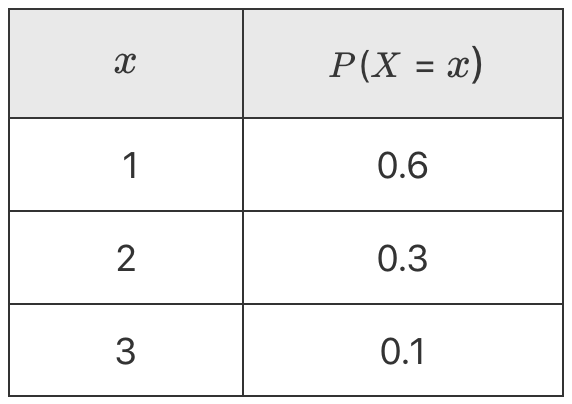
The probability distribution table for a discrete random variable `X` is shown.
 

What is the expected value of `X`?

  1. 0.6
  2. 1.0
  3. 1.5
  4. 2.0
Show Answers Only

`C`

Show Worked Solution
`E(X)` `= 1 xx 0.6 + 2 xx 0.3 + 3 xx 0.1`
  `= 1.5`

 
`=>  C`

Filed Under: Discrete Probability Distributions (Y11) Tagged With: Band 4, smc-992-20-E(X) / Mean

Probability, 2ADV S1 EQ-Bank 42

The discrete random variable `X` has the probability distribution shown in the table below.
 

     `X = x` `4` `5` `6` `7` `8`
  `P(x)` `0.3` `a` `0.1` `0.15` `0.2`

   
 Find the value of  `a`, and hence calculate the the expected value and variance of  `X`.  (3 marks)

--- 8 WORK AREA LINES (style=lined) ---

Show Answers Only

`2.31`

Show Worked Solution

`0.3 + a + 0.1 + 0.15 + 0.2 = 1`

`=> \ a = 0.25`
 

`E(X) = ∑ x P(x)`
 

  `qquad X = x` `4` `5` `6` `7` `8`
  `qquad P(x) qquad` `0.3` `0.25` `0.1` `0.15` `0.2`
  `qquad x xx P(x) qquad` `1.2` `1.25` `0.6` `1.05` `1.6`


`E(X)` `= 1.2 + 1.25 + 0.6 + 1.05 + 1.6`
  `= 5.7`


`text(Var)(X)` `= E(X^2) – [E(X)]^2`
  `= (4^2 xx 0.3) + (5^2 xx 0.25) + (6^2 xx 0.1) + (7^2 xx 0.15) + (8^2 xx 0.2) – 5.7^2`
  `= 2.31`

Filed Under: Discrete Probability Distributions (Y11) Tagged With: Band 4, smc-992-10-Sum of Probabilities = 1, smc-992-20-E(X) / Mean, smc-992-30-Var(X) / Std Dev

Probability, 2ADV S1 2019 MET2-N 5 MC

Consider the probability distribution for the discrete random variable `X` shown in the table below.

\begin{array} {|c|c|c|c|c|}
\hline
\rule{0pt}{2.5ex} x \rule[-1ex]{0pt}{0pt} & \ \ \ \ -1\ \ \ \  & \ \ \ \ \ 0\ \ \ \ \  & \ \ \ \ \ 1\ \ \ \ \  & \ \ \ \ \ 2\ \ \ \ \  &\ \ \ \ \ 3\ \ \ \ \ \\
\hline
\rule{0pt}{2.5ex} P(X=x) \rule[-1ex]{0pt}{0pt} & b & b & b & \dfrac{3}{5}-b & \dfrac{3b}{5} \\
\hline
\end{array}

The value of `E(X)` is

  1.  `(76)/(65)`
  2.  `1`
  3.  `0`
  4.  `(2)/(13)`
  5.  `(86)/(65)`
Show Answers Only

`A`

Show Worked Solution
`1` `= b + b + b + (3)/(5) – b + (3b)/(5)`
`(2)/(5)` `= (13b)/(5)`
`b` `= (2)/(13)`


`E(X)` `= -(2)/(13) + 0 + (2)/(13) + 2((3)/(5) – (2)/(13)) +3 ((6)/(65))`
  `= (76)/(65)`


\(\Rightarrow A\)

Filed Under: Discrete Probability Distributions (Y11) Tagged With: Band 4, smc-992-20-E(X) / Mean

Probability, 2ADV S1 SM-Bank 41

Evaluate `p` and `q` in the discrete probability distribution table below, given that  `E(X) = 3`.   (3 marks)

\begin{array} {|c|c|c|c|c|}
\hline
\rule{0pt}{2.5ex} x \rule[-1ex]{0pt}{0pt} & \ \ \ 1\ \ \  & \ \ \ 2\ \ \  & \ \ \ 3\ \ \  & \ \ \ 4\ \ \  \\
\hline
\rule{0pt}{2.5ex} P(X=x) \rule[-1ex]{0pt}{0pt} & p & q & 0.2 & 0.4 \\
\hline
\end{array}

--- 6 WORK AREA LINES (style=lined) ---

Show Answers Only

`text(See Worked Solutions)`

Show Worked Solution
`p + q + 0.2 + 0.4` `= 1`
`p + q` `= 0.4\ \ …\ (1)`

 
`text(Given)\ \ E(X) = 3,`

`p + 2q + 0.6 + 1.6` `= 3`
`p + 2q` `= 0.8\ \ …\ (2)`

 
`text{Subtract: (2) – (1)}`

`q` `= 0.4`
`:.p` `= 0`

Filed Under: Discrete Probability Distributions (Y11) Tagged With: Band 4, smc-992-10-Sum of Probabilities = 1, smc-992-20-E(X) / Mean

Probability, 2ADV S1 2015 MET2 14 MC

Consider the following discrete probability distribution for the random variable `X.`

\begin{array} {|c|c|c|c|c|c|}
\hline
\rule{0pt}{2.5ex} x \rule[-1ex]{0pt}{0pt} & \ \ \ 1\ \ \  & \ \ \ 2\ \ \  & \ \ \ 3\ \ \ &\ \ \ 4\ \ \ &\ \ \ 5\ \ \ \\
\hline
\rule{0pt}{2.5ex} P(X=x) \rule[-1ex]{0pt}{0pt} & p & 2p & 3p & 4p & 5p \\
\hline
\end{array} 

The mean of this distribution is

  1. `2`
  2. `3`
  3. `7/2`
  4. `11/3`
Show Answers Only

`D`

Show Worked Solution

`text(Find)\ p:`

`p + 2p + 3p + 4p + 5p` `= 1`
`:. p` `= 1/15`


`E(X)` `= 1 xx p + 2(2p) + 3(3p) + 4(4p) + 5(5p)`
  `= 55p`
  `= 55 xx (1/15)`
  `= 11/3`

`=>   D`

Filed Under: Discrete Probability Distributions (Y11) Tagged With: Band 3, smc-992-20-E(X) / Mean

Probability, 2ADV S1 2013 MET1 7

The probability distribution of a discrete random variable, `X`, is given by the table below.

\begin{array} {|c|c|c|c|c|}
\hline
\rule{0pt}{2.5ex} x \rule[-1ex]{0pt}{0pt} & \ \ \ 0\ \ \  & \ \ \ 1\ \ \  & \ \ \ 2\ \ \  & \ \ \ 3\ \ \ &\ \ \ 4\ \ \  \\
\hline
\rule{0pt}{2.5ex} P(X=x) \rule[-1ex]{0pt}{0pt} & 0.2 & 0.6p^{2} & 0.1 & 1-p & 0.1 \\
\hline
\end{array}

  1. Show that  `p = 2/3 or p = 1`.  (3 marks)

    --- 6 WORK AREA LINES (style=lined) ---

  2. Let  `p = 2/3`.

    1. Calculate  `E(X)`.  Answer in exact form.  (2 marks)

      --- 4 WORK AREA LINES (style=lined) ---

    2. Find  `P(X >= E(X))`.  (1 mark)

      --- 2 WORK AREA LINES (style=lined) ---

Show Answers Only
  1. `text(Proof)\ \ text{(See Worked Solutions)}`
    1. `28/15`
    2. `8/15`
Show Worked Solution

a.   `text(S)text(ince probabilities must sum to 1:)`

`0.2 + 0.6p^2 + 0.1 + 1-p + 0.1` `= 1`
`0.6p^2-p + 0.4` `= 0`
`6p^2-10p + 4` `= 0`
`3p^2-5p + 2` `= 0`
`(p-1) (3p-2)` `= 0`

`:. p = 1 or p = 2/3`


b.i.   `E(X)` `= sum x * P (X = x)`
    `= 1 xx (3/5 xx 2^2/3^2) + 2 (1/10) + 3 (1-2/3) + 4 (1/10)`
    `= 4/15 + 1/5 + 1 + 2/5`
    `= 28/15`


♦♦ Part (b)(ii) mean mark 32%.
  ii.   `P(X >= 28/15)` `=P(X = 2) + P(X = 3) + P(X = 4)`
    `= 1/10 + 1/3 + 1/10`
    `= 8/15`

Filed Under: Discrete Probability Distributions (Y11) Tagged With: Band 4, Band 5, smc-992-10-Sum of Probabilities = 1, smc-992-20-E(X) / Mean

Probability, 2ADV S1 2012 MET1 4

On any given day, the number `X` of telephone calls that Daniel receives is a random variable with probability distribution given by

\begin{array} {|c|c|c|c|c|}
\hline
\rule{0pt}{2.5ex} x \rule[-1ex]{0pt}{0pt} & \ \ \ 0\ \ \  & \ \ \ 1\ \ \  & \ \ \ 2\ \ \  & \ \ \ 3\ \ \  \\
\hline
\rule{0pt}{2.5ex} P(X=x) \rule[-1ex]{0pt}{0pt} & 0.2 & 0.2 & 0.5 & 0.1 \\
\hline
\end{array}

  1. Find the mean of  `X`.   (2 marks)

    --- 3 WORK AREA LINES (style=lined) ---

  2. What is the probability that Daniel receives only one telephone call on each of three consecutive days?   (1 mark)

    --- 2 WORK AREA LINES (style=lined) ---

  3. Daniel receives telephone calls on both Monday and Tuesday.


    What is the probability that Daniel receives a total of four calls over these two days?   (3 marks)

    --- 6 WORK AREA LINES (style=lined) ---

Show Answers Only
  1. `1.5`
  2. `0.008`
  3. `29/64`
Show Worked Solution
i.    `E(X)` `= 0 xx 0.2 + 1 xx 0.2 + 2 xx 0.5 + 3 xx 0.1`
    `= 0 + .2 + 1 + 0.3`
    `= 1.5`


ii.   `P(1, 1, 1)` `= 0.2 xx 0.2 xx 0.2`
    `= 0.008`


iii.   `text(Conditional Probability:)`

♦ Mean mark 36%.

`P(x = 4 | x >= 1\ text{both days})`

`= (P(1, 3) + P(2, 2) + P(3, 1))/(P(x>=1\ text{both days}))`

`= (0.2 xx 0.1 + 0.5 xx 0.5 + 0.1 xx 0.2)/(0.8 xx 0.8)`

`= (0.02 + 0.25 + 0.02)/0.64`

`= 0.29/0.64`

`= 29/64`

Filed Under: Discrete Probability Distributions (Y11) Tagged With: Band 3, Band 4, Band 5, smc-992-20-E(X) / Mean, smc-992-60-Conditional Probability, smc-992-70-Other Probability

Probability, 2ADV S1 2016 MET2 19 MC

Consider the discrete probability distribution with random variable `X` shown in the table below.

\begin{array} {|c|c|c|c|c|}
\hline
\rule{0pt}{2.5ex} x \rule[-1ex]{0pt}{0pt} & \ \ \ -1\ \ \  & \ \ \ \ 0\ \ \ \  & \ \ \ \ b\ \ \ \  & \ \ \ \ 2b\ \ \ \ &\ \ \ \ 4\ \ \ \  \\
\hline
\rule{0pt}{2.5ex} P(X=x) \rule[-1ex]{0pt}{0pt} & a & b & b & 2b & 0.2 \\
\hline
\end{array}

The smallest and largest possible values of `text(E)(X)` are respectively

  1. `-0.8 and 1`
  2. `-0.8 and 1.6`
  3. `0 and 2.4`
  4. `0 and 1`
Show Answers Only

`D`

Show Worked Solution

`text(Smallest)\ E(X)\ \ text(occurs when)\ \ a=0.8,`

♦♦♦ Mean mark 15%.
`:.\ text(Smallest)\ E(X)` `=0.8 xx -1 + 0.2 xx 4`
  `=0`

 
`text(Consider the value of)\ b,`

`text(Sum of probabilities) = 1`

`:. 0 <= 4b <= 0.8 -> 0 <= b <= 0.2`
 

`text(Largest)\ E(X)\ \ text(occurs when)\ \ a=0, and b=0.2,`

`:.\ text(Largest)\ E(X)`

`=0.2 xx 0 + 0.2 xx 0.2+(2xx0.2)xx(2xx0.2)+0.2 xx 4`

`=0.04 + 0.16 + 0.8`

`=1`

`=>   D`

Filed Under: Discrete Probability Distributions (Y11) Tagged With: Band 6, smc-992-20-E(X) / Mean

Probability, 2ADV S1 2010 MET2 15 MC

The discrete random variable `X` has the following probability distribution.

\begin{array} {|c|c|c|c|}
\hline
\rule{0pt}{2.5ex} x \rule[-1ex]{0pt}{0pt} & \ \ \ 0\ \ \  & \ \ \ 1\ \ \  & \ \ \ 2\ \ \ \\
\hline
\rule{0pt}{2.5ex} P(X=x) \rule[-1ex]{0pt}{0pt} & a & b & 0.4 \\
\hline
\end{array}

If the mean of `X` is 1 then

  1. `a = 0.3 and b = 0.1`
  2. `a = 0.2 and b = 0.2`
  3. `a = 0.4 and b = 0.2`
  4. `a = 0.1 and b = 0.3`
Show Answers Only

`C`

Show Worked Solution

`E(X) = 1:`

`1 xx b + 2 xx 0.4` `=1`
`b` `=0.2`

 
`text(Sum of probabilities) = 1:`

`a + 0.2 + 0.4` `= 1`
`a` `=0.4`

`=>   C`

Filed Under: Discrete Probability Distributions (Y11) Tagged With: Band 3, smc-992-20-E(X) / Mean

Probability, 2ADV S1 2007 MET2 19 MC

The discrete random variable `X` has probability distribution as given in the table. The mean of `X` is 5.

\begin{array} {|c|c|c|c|c|}
\hline
\rule{0pt}{2.5ex} x \rule[-1ex]{0pt}{0pt} & \ \ \ 0\ \ \  & \ \ \ 2\ \ \  & \ \ \ 4\ \ \  & \ \ \ 6\ \ \ &\ \ \ 8\ \ \ \\
\hline
\rule{0pt}{2.5ex} P(X=x) \rule[-1ex]{0pt}{0pt} & a & 0.2 & 0.2 & 0.3 & b \\
\hline
\end{array}

The values of `a` and `b` are

  1. `{:(a = 0.05,\ and b = 0.25):}`
  2. `{:(a = 0.1­,\ and b = 0.29):}`
  3. `{:(a = 0.2­,\ and b = 0.9):}`
  4. `{:(a = 0.3­,\ and b = 0):}`
Show Answers Only

`A`

Show Worked Solution

`text(Sum of probabilities) = 1`

`a + 0.2 + 0.2 + 0.3 + b = 1`
  

`text(S)text{ince}\ E(X) = 5,`

`5` `=(0 xx a) + (2 xx 0.2) + (4 xx 0.2) + (6 xx 0.3) + 8b`
`8b` `=2`
`:. b` `=0.25`

 
`:. a = 0.05,\ \  b = 0.25`

`=>   A`

Filed Under: Discrete Probability Distributions (Y11) Tagged With: Band 3, smc-992-10-Sum of Probabilities = 1, smc-992-20-E(X) / Mean

Copyright © 2014–2025 SmarterEd.com.au · Log in