A fair six-sided die is repeatedly rolled. What is the minimum number of rolls required so that the probability of rolling a six at least once is greater than 0.95? (2 marks)
--- 5 WORK AREA LINES (style=lined) ---
Aussie Maths & Science Teachers: Save your time with SmarterEd
A fair six-sided die is repeatedly rolled. What is the minimum number of rolls required so that the probability of rolling a six at least once is greater than 0.95? (2 marks)
--- 5 WORK AREA LINES (style=lined) ---
In a game, the probability that a particular player scores a goal at each attempt is 0.15.
--- 2 WORK AREA LINES (style=lined) ---
--- 6 WORK AREA LINES (style=lined) ---
A box contains \(n\) green balls and \(m\) red balls. A ball is selected at random, and its colour is noted. The ball is then replaced in the box.
In 8 such selections, where \(n\neq m\), what is the probability that a green ball is selected at least once?
A game involves throwing a die and spinning a spinner.
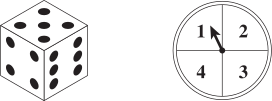
The sum of the two numbers obtained is the score.
The table of scores below is partially completed.
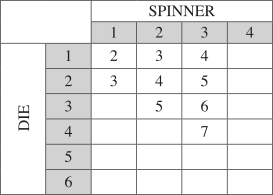
What is the probability of getting a score of 7 or more?
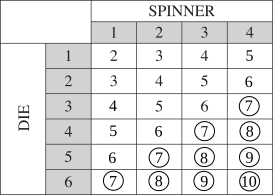
`Ptext{(score 7+)} = 10/24=5/12`
`=>D`
Liam is playing two games. He is equally likely to win each game. The probability that Liam will win at least one of the games is 80%.
Which of the following is closest to the probability that Liam will win both games?
There are 8 chocolates in a box. Three have peppermint centres (P) and five have caramel centres (C).
Kim randomly chooses a chocolate from the box and eats it. Sam then randomly chooses and eats one of the remaining chocolates.
A partially completed probability tree is shown.

What is the probability that Kim and Sam choose chocolates with different centres?
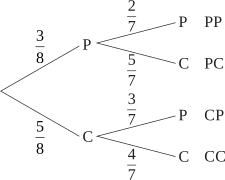
| `Ptext{(different centres)}` | `= P text{(PC)} + P text{(CP)}` |
| `=\frac{3}{8} · \frac{5}{7} + \frac{5}{8} · \frac{3}{7}` | |
| `= \frac{15}{56} + \frac{15}{56}` | |
| `= \frac{15}{28}` |
`=> D`
At the start of a particular week, Kim has three red apples and two green apples. She eats one apple everyday. On Monday, Tuesday and Wednesday of that week, she randomly selects an apple to eat. In this three-day period, the probability that Kim does not eat an apple of the same colour on any two consecutive days is
A box contains `n` marbles that are identical in every way except colour, of which `k` marbles are coloured red and the remainder of the marbles are coloured green. Two marbles are drawn randomly from the box.
If the first marble is not replaced into the box before the second marble is drawn, then the probability that the two marbles drawn are the same colour is
`n\ text(marbles) \ => \ k\ text(red), \ (n – k)\ \ text(green)`
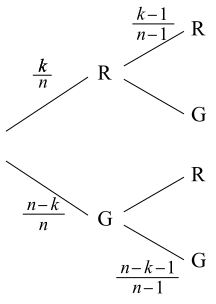
| `:.\ P(text{same colour})` | `= k/n ⋅ ((k – 1))/((n – 1)) + ((n – k))/n ⋅ ((n – k – 1))/((n – 1))` |
| `= (k(k – 1) + (n – k)(n – k – 1))/(n(n – 1))` |
`=> D`
The probability that a person chosen at random has red hair is 0.02
What is the probability that at least ONE has red hair? (2 marks)
--- 4 WORK AREA LINES (style=lined) ---
--- 5 WORK AREA LINES (style=lined) ---
A bag contains 5 green beads and 7 purple beads. Two beads are selected at random, without replacement.
What is the probability that the two beads are the same colour? (2 marks)
--- 8 WORK AREA LINES (style=lined) ---
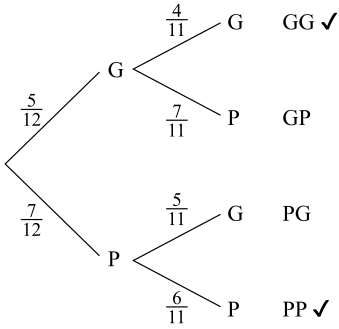
| `P\ text{(same colour)}` | `= P (GG) + P(PP)` |
| `= 5/12 ⋅ 4/11 + 7/12 ⋅ 6/11` | |
| `= 62/132` | |
| `= 31/66` |
A game is played by tossing an ordinary 6-sided die and an ordinary coin at the same time. The game is won if the uppermost face of the die shows an even number or the uppermost face of the coin shows a tail (or both).
What is the probability of winning this game?
A game involves rolling two six-sided dice, followed by rolling a third six-sided die. To win the game, the number rolled on the third die must lie between the two numbers rolled previously. For example, if the first two dice show 1 and 4, the game can only be won by rolling a 2 or 3 with the third die.
--- 8 WORK AREA LINES (style=lined) ---
--- 4 WORK AREA LINES (style=lined) ---
i. `text(Construct a sample space of the number)`♦ Mean mark 40%.
COMMENT: Constructing the full sample space is a critical step here..
`text(of possible winning rolls:)`
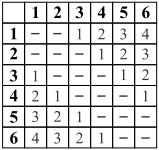
| `text{P(no chance)}` | `= text(number of pairs with no gap)/text(total possibilities)` |
| `= 16/36` | |
| `= 4/9` |
ii. `text(The sample space in the table shows:)`♦♦♦ Mean mark 7%.
`text(→ 8 combinations leave a gap for a single winning number,)`
`text(→ 6 combinations leave a gap for two winning numbers,)`
`vdots`
| `:.\ text{P(winning)}` | `= 1/36 [8 xx 1/6 + 6 xx 2/6 + 4 xx 3/6 + 2 xx 4/6]` |
| `= 1/36 (8/6 + 12/6 + 12/6 + 8/6)` | |
| `= 1/36 (40/6)` | |
| `= 5/27` |
Two machines, `A` and `B`, produce pens. It is known that 10% of the pens produced by machine `A` are faulty and that 5% of the pens produced by machine `B` are faulty.
What is the probability that at least one of the pens is faulty? (1 mark)
--- 2 WORK AREA LINES (style=lined) ---
What is the probability that neither pen is faulty? (2 marks)
--- 4 WORK AREA LINES (style=lined) ---
A runner has four different pairs of shoes.
If two shoes are selected at random, what is the probability that they will be a matching pair?
An eight- sided die is marked with numbers 1, 2, … , 8. A game is played by rolling the die until an 8 appears on the uppermost face. At this point the game ends.
`qquad qquad 1/8 + 7/8 xx 1/8 + (7/8)^2 xx 1/8`. (2 marks)
--- 8 WORK AREA LINES (style=lined) ---
--- 6 WORK AREA LINES (style=lined) ---
In a game, a turn involves rolling two dice, each with faces marked 0, 1, 2, 3, 4 and 5. The score for each turn is calculated by multiplying the two numbers uppermost on the dice.
--- 5 WORK AREA LINES (style=lined) ---
--- 1 WORK AREA LINES (style=lined) ---
--- 4 WORK AREA LINES (style=lined) ---
| i. |  |
`:. P(0) = (11)/(36)`
ii. `P(≥ 16)= 4/36=1/9`
iii. `Ptext{(Sum} < 45) = 1 − Ptext{(Sum} ≥ 45)`
| `Ptext{(Sum} ≥ 45)` | `=P(20,25)+P(25,20)+P(25,25)` |
| `=(2/36 xx 1/36) + (2/36 xx 1/36)+(1/36 xx 1/36)` | |
| `=2/1296 + 2/1296+ 1/1296` | |
| `=5/1296` |
| `:.Ptext{(Sum} < 45)` | `= 1 − 5/1296` |
| `= 1291/1296` |
A pack of 52 cards consists of four suits with 13 cards in each suit.
--- 3 WORK AREA LINES (style=lined) ---
--- 4 WORK AREA LINES (style=lined) ---
Two ordinary dice are rolled. The score is the sum of the numbers on the top faces.
--- 4 WORK AREA LINES (style=lined) ---
--- 2 WORK AREA LINES (style=lined) ---
| i. |  |
`text{P (score = 10)}`
`= 3/36`
`= 1/12`
ii. `text{P (score is not ten)}`
`= 1 – text{P (score is ten)}`
`= 1 – 1/12`
`= 11/12`
Weather records for a town suggest that:
In a specific week Thursday is dry. The tree diagram shows the possible outcomes for the next three days: Friday, Saturday and Sunday.

--- 2 WORK AREA LINES (style=lined) ---
--- 4 WORK AREA LINES (style=lined) ---
--- 2 WORK AREA LINES (style=lined) ---
The probability that Mel’s soccer team wins this weekend is `5/7`.
The probability that Mel’s rugby league team wins this weekend is `2/3`.
What is the probability that neither team wins this weekend?
A chessboard has 32 black squares and 32 white squares. Tanya chooses three different squares at random.
--- 4 WORK AREA LINES (style=lined) ---
--- 2 WORK AREA LINES (style=lined) ---
--- 2 WORK AREA LINES (style=lined) ---
A total of 300 tickets are sold in a raffle which has three prizes. There are 100 red, 100 green and 100 blue tickets.
At the drawing of the raffle, winning tickets are NOT replaced before the next draw.
--- 3 WORK AREA LINES (style=lined) ---
--- 2 WORK AREA LINES (style=lined) ---
--- 5 WORK AREA LINES (style=lined) ---
A packet contains 12 red, 8 green, 7 yellow and 3 black jellybeans.
One jellybean is selected from the packet at random.
What is the probability that the selected jellybean is red or yellow? (2 marks)
It is estimated that 85% of students in Australia own a mobile phone.
--- 4 WORK AREA LINES (style=lined) ---
--- 2 WORK AREA LINES (style=lined) ---
Xena and Gabrielle compete in a series of games. The series finishes when one player has won two games. In any game, the probability that Xena wins is `2/3` and the probability that Gabrielle wins is `1/3`.
Part of the tree diagram for this series of games is shown.

--- 4 WORK AREA LINES (style=lined) ---
--- 4 WORK AREA LINES (style=lined) ---
| i. |  |
ii. `P text{(} G\ text(wins) text{)}`
`= P(XGG) + P (GXG) + P (GG)`
`= 2/3 * 1/3 * 1/3 + 1/3 * 2/3 * 1/3 + 1/3 * 1/3`
`= 2/27 + 2/27 + 1/9`
`= 7/27`
iii. `text(Method 1:)`
`P text{(3 games played)}`
`= P (XG) + P(GX)`
`= 2/3 * 1/3 + 1/3 * 2/3`
`= 4/9`
`text(Method 2:)`
`P text{(3 games)}`
`= 1 – [P(XX) + P(GG)]`
`= 1 – [2/3 * 2/3 + 1/3 * 1/3]`
`= 1 – 5/9`
`= 4/9`
A packet of lollies contains 5 red lollies and 14 green lollies. Two lollies are selected at random without replacement.
--- 6 WORK AREA LINES (style=lined) ---
--- 2 WORK AREA LINES (style=lined) ---

| i. | |
ii. `P text{(different colours)}`
`= P(RG) + P(GR)`
`= 5/19 xx 14/18 + 14/19 xx 5/18`
`= 70/342 + 70/342`
`= 140/342`
`= 70/171`
Three runners compete in a race. The probabilities that the three runners finish the race in under 10 seconds are `1/4`, `1/6` and `2/5` respectively.
What is the probability that at least one of the three runners will finish the race in under 10 seconds?
Each week Van and Marie take part in a raffle at their respective workplaces.
The probability that Van wins a prize in his raffle is `1/9`. The probability that Marie wins a prize in her raffle is `1/16`.
What is the probability that, during the next three weeks, at least one of them wins a prize? (2 marks)
--- 5 WORK AREA LINES (style=lined) ---
On each working day James parks his car in a parking station which has three levels. He parks his car on a randomly chosen level. He always forgets where he has parked, so when he leaves work he chooses a level at random and searches for his car. If his car is not on that level, he chooses a different level and continues in this way until he finds his car.
--- 1 WORK AREA LINES (style=lined) ---
--- 2 WORK AREA LINES (style=lined) ---
--- 2 WORK AREA LINES (style=lined) ---
Two identical biased coins are tossed together, and the outcome is recorded.
After a large number of trials it is observed that the probability that both coins land showing heads is 0.36.
What is the probability that both coins land showing tails? (2 marks)
--- 5 WORK AREA LINES (style=lined) ---
There are twelve chocolates in a box. Four of the chocolates have mint centres, four have caramel centres and four have strawberry centres. Ali randomly selects two chocolates and eats them.
--- 2 WORK AREA LINES (style=lined) ---
--- 2 WORK AREA LINES (style=lined) ---
--- 2 WORK AREA LINES (style=lined) ---
Two buckets each contain red marbles and white marbles. Bucket `A` contains 3 red and 2 white marbles. Bucket `B` contains 3 red and 4 white marbles.
Chris randomly chooses one marble from each bucket.
--- 2 WORK AREA LINES (style=lined) ---
--- 3 WORK AREA LINES (style=lined) ---
--- 5 WORK AREA LINES (style=lined) ---
A bag contains 4 red marbles and 6 blue marbles. Three marbles are selected at random without replacement.
What is the probability that at least one of the marbles selected is red?
Pat and Chandra are playing a game. They take turns throwing two dice. The game is won by the first player to throw a double six. Pat starts the game.
--- 2 WORK AREA LINES (style=lined) ---
--- 5 WORK AREA LINES (style=lined) ---
--- 5 WORK AREA LINES (style=lined) ---