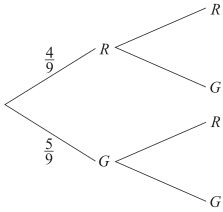
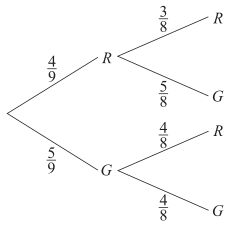
A biased six-sided die has faces numbered \(-4,\ {-3},\ 0,\ 1,\ 2\) and \(6\).
The table shows the probability distribution for \(X\), the number which lands face up after the die is rolled.
| \(X\) | \(-4\) | \(-3\) | \(0\) | \(1\) | \(2\) | \(6\) |
| \(P(X)\) | \(\dfrac{3}{18}\) | \(\dfrac{4}{18}\) | \(\dfrac{3}{18}\) | \(\dfrac{1}{18}\) | \(\dfrac{1}{18}\) | \(\dfrac{6}{18}\) |
The die is rolled twice.
What is the probability that the sum of the two numbers rolled is \(-3\)?
- \(\dfrac{1}{54}\)
- \(\dfrac{5}{54}\)
- \(\dfrac{4}{18}\)
- \(\dfrac{6}{18}\)