SmarterEd

Aussie Maths & Science Teachers: Save your time with SmarterEd

  • Login
  • Get Help
  • About

v1 Algebra, STD2 A4 2019 HSC 33

The time taken for a student to type an assignment varies inversely with their typing speed.

It takes the student 180 minutes to finish the assignment when typing at 40 words per minute.

  1. Calculate the length of the assignment in words.   (1 mark)

    --- 5 WORK AREA LINES (style=lined) ---

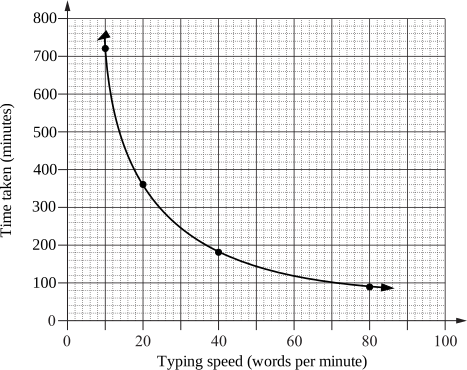
  2. By first plotting four points, draw the curve that shows the time taken to complete the assignment at different constant typing speeds.   (3 marks)
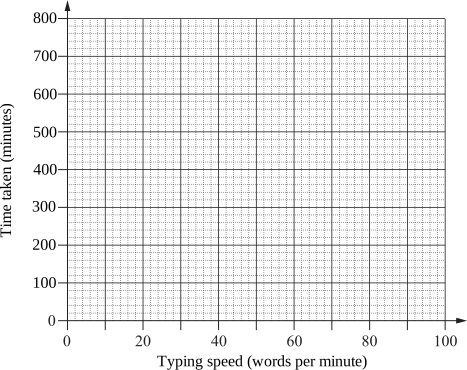


--- 0 WORK AREA LINES (style=lined) ---
Show Answers Only

a.   `7200\ text(words)`

b.   
     

Show Worked Solution

a.   `text{Assignment length}\ = 180 xx 40=7200\ \text{words}`

b.   `text{Time} (T) prop 1/{\text{Typing speed}\ (S)} \ \ =>\ \ T = k/S`
 

\begin{array} {|c|c|c|c|c|}
\hline
\rule{0pt}{2.5ex} \ \ T\ \  \rule[-1ex]{0pt}{0pt} & 720 & 360 & 180 & 90 \\
\hline
\rule{0pt}{2.5ex} S \rule[-1ex]{0pt}{0pt} & 10 & 20 & 40 & 80 \\
\hline
\end{array}

Filed Under: Non-Linear: Inverse and Other Problems (Std 2-X) Tagged With: Band 3, Band 4, num-title-ct-patha, num-title-qs-hsc, smc-4239-30-a prop 1/b, smc-795-10-Inverse

v1 Algebra, STD2 A4 2004 HSC 28a

A fitness index, `F`, is calculated by dividing a person’s weight, `w`, in kilograms by the square of the person’s height, `h`, in metres.

  1. Albert is 160 cm and weighs 76.8 kg. Calculate Albert’s health rating.   (1 mark)

    --- 3 WORK AREA LINES (style=lined) ---

  2. In the next few years, Albert expects to grow 20 cm taller. By then he wants her fitness index to be 23. How much weight should he gain or lose to achieve this? Justify your answer with mathematical calculations.   (2 marks)

    --- 5 WORK AREA LINES (style=lined) ---

Show Answers Only

a.   `30`

b.   `text(Albert needs to gain 4.2 kg)`

Show Worked Solution

a.   `\text{160 cm = 1.60 m.}`

`text(When)\ w = 76.8 and h = 1.60:`

`F=w/h^2 = 76.8/1.60^2 = 30`
 

b.   `text(Find)\ w\ text(given)\ F= 25 and h = 1.80:`

`25` `= w/1.8^2`
`w` `= 25 xx 1.8^2`
  `= 81\ text(kg)`


`:.\ text(Weight Albert should gain)`

`= 81-76.8`

`= 4.2\ text(kg)`

Filed Under: Non-Linear: Inverse and Other Problems (Std 2-X) Tagged With: Band 5, Band 6, smc-795-10-Inverse

v1 Algebra, STD2 A4 2014 HSC 29a

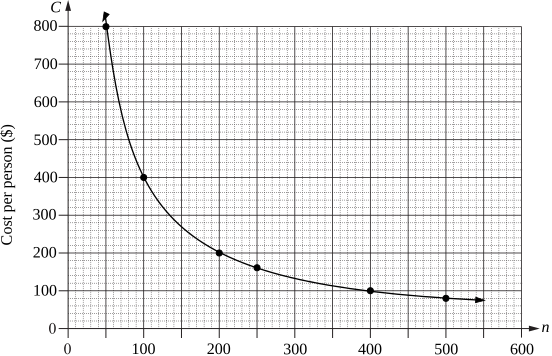
A golf club hires an entire course for a charity event at a total cost of `$40\ 000`. The cost will be shared equally among the players, so that `C` (in dollars) is the cost per player when `n` players attend.

  1. Complete the table below by filling in the three missing values.   (1 mark)
    \begin{array} {|l|c|c|c|c|c|c|}
    \hline
    \rule{0pt}{2.5ex}\text{Number of players} (n) \rule[-1ex]{0pt}{0pt} & \ 50\ & \ 100 \ & 200 \ & 250 \ & 400\ & 500 \ \\
    \hline
    \rule{0pt}{2.5ex}\text{Cost per person} (C)\rule[-1ex]{0pt}{0pt} &  &  &  & 160 & 100\ & 80 \ \\
    \hline
    \end{array}
  2. Using the values from the table, draw the graph showing the relationship between `n` and `C`.   (2 marks)
     
  3. What equation represents the relationship between `n` and `C`?   (1 mark)

    --- 1 WORK AREA LINES (style=lined) ---

  4. Give ONE limitation of this equation in relation to this context.   (1 mark)

    --- 2 WORK AREA LINES (style=lined) ---

  5. Is it possible for the cost per person to be $94? Support your answer with appropriate calculations.   (1 mark)

    --- 4 WORK AREA LINES (style=lined) ---

Show Answers Only

a.   

\begin{array} {|l|c|c|c|c|c|c|}
\hline
\rule{0pt}{2.5ex}\text{Number of players} (n) \rule[-1ex]{0pt}{0pt} & \ 500\ & \ 1000 \ & 1500 \ & 2000 \ & 2500\ & 3000 \ \\
\hline
\rule{0pt}{2.5ex}\text{Cost per person} (C)\rule[-1ex]{0pt}{0pt} & 240 & 120 & 80 & 60 & 48\ & 40 \ \\
\hline
\end{array}
 

b. 

c.   `C = (40\ 000)/n`

`n\ text(must be a whole number)`
 

d.    `text(Limitations can include:)`

  `•\ n\ text(must be a whole number)`

  `•\ C > 0`
 

e.   `text(If)\ C = 94:`

`94` `= (120\ 000)/n`
`94n` `= 120\ 000`
`n` `= (120\ 000)/94`
  `= 1276.595…`

 
`:.\ text(C)text(ost cannot be $94 per person, because)\ n\ text(isn’t a whole number.)`

Show Worked Solution

a.   

\begin{array} {|l|c|c|c|c|c|c|}
\hline
\rule{0pt}{2.5ex}\text{Number of players} (n) \rule[-1ex]{0pt}{0pt} & \ 50\ & \ 100 \ & 200 \ & 250 \ & 400\ & 500 \ \\
\hline
\rule{0pt}{2.5ex}\text{Cost per person} (C)\rule[-1ex]{0pt}{0pt} & 800 & 400 & 200 & 160 & 100\ & 80 \ \\
\hline
\end{array}

b.   


c.   `C = (40\ 000)/n`


TIP: Limitations require looking at possible restrictions of both the domain and range.

d.   `text(Limitations can include:)`

  `•\ n\ text(must be a whole number)`

  `•\ C > 0`
 

e.   `text(If)\ C = 120`

`120` `= (40\ 000)/n`
`120n` `= 40\ 000`
`n` `= (40\ 000)/120`
  `= 333.33..`

  
`:.\ text{Cost cannot be $120 per person because the required}\ n\ \text{is not a whole number.}`

Filed Under: Non-Linear: Inverse and Other Problems (Std 2-X) Tagged With: Band 4, Band 5, Band 6, num-title-ct-pathc, num-title-qs-hsc, smc-4445-60-Hyperbola applications, smc-795-10-Inverse, smc-795-30-Limitations

v1 Algebra, STD2 A4 EO-Bank 2

The number of chairs that can be placed around a circular stage varies inversely with the space left between each chair.

There will be 72 chairs if the distance between them is 0.5 metres.

  1. How many chairs can be placed if the distance between them is 0.9 metres?   (2 marks)

    --- 4 WORK AREA LINES (style=lined) ---

  2. What is the spacing between chairs if 90 chairs are placed around the stage?   (1 mark)

    --- 1 WORK AREA LINES (style=lined) ---

Show Answers Only

a.   40 chairs

b.   0.4 metres

Show Worked Solution

a.   `c \prop 1/d\ \ =>\ \ c=k/d`

`72` `= k/0.5`
`k` `= 0.5 xx 72 = 36`

 
`text(Find)\ c\ text(when)\ \ d = 0.9:`

`c=36/0.9=40\ \text{chairs}`
 

b.   `text(Find)\ d\ text(when)\ \ c = 90:`

`90` `= 36/d`
`d` `= 36/90`
  `= 0.4\ text(metres)`

Filed Under: Non-Linear: Inverse and Other Problems (Std 2-X) Tagged With: Band 5, smc-795-10-Inverse, smc-795-40-Proportional

v1 Algebra, STD2 A4 2022 HSC 24

A chef believes that the time it takes to defrost a turkey (`D` hours) varies inversely with the room temperature (`T^\circ \text{C}`). The chef observes that at a room temperature of `20^\circ \text{C}`, it takes 15 hours for the turkey to fully defrost.

  1. Find the equation relating `D` and `T`.   (2 marks)

    --- 4 WORK AREA LINES (style=lined) ---

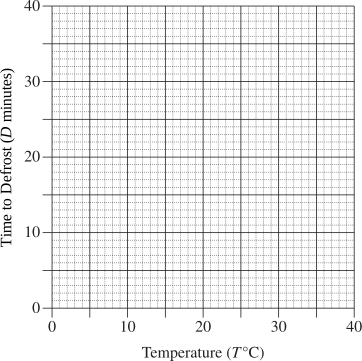
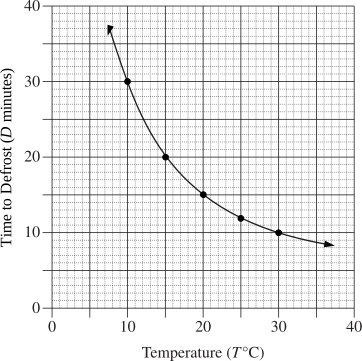
  2. By first completing this table of values, graph the relationship between temperature and time.   (2 marks)

\begin{array} {|l|c|c|c|c|c|}
\hline
\rule{0pt}{2.5ex} \ \ T\ \  \rule[-1ex]{0pt}{0pt} & \ \ \ 10\ \ \  & \ \ 15\ \ \  & \ \ \ 20\ \ \  & \ \ \ 25\ \ \ & \ \ \ 30\ \ \ \\
\hline
\rule{0pt}{2.5ex} \ \ D\ \  \rule[-1ex]{0pt}{0pt} & \ \ \ \  & \ \ \  & \ \ \ \  & \ \ \ \ & \ \ \ \\
\hline
\end{array}


--- 0 WORK AREA LINES (style=lined) ---

Show Answers Only

a.   `D \prop 1/T\ \ =>\ \ D=k/T`

  `15` `=k/20`
  `k` `=15 xx 20=300`

 
`:.D=300/T`

b.   

\begin{array} {|l|c|c|c|c|c|}
\hline
\rule{0pt}{2.5ex} \ \ T\ \  \rule[-1ex]{0pt}{0pt} & \ \ \ 10\ \ \  & \ \ 15\ \ \  & \ \ \ 20\ \ \  & \ \ \ 25\ \ \ & \ \ \ 30\ \ \ \\
\hline
\rule{0pt}{2.5ex} \ \ D\ \  \rule[-1ex]{0pt}{0pt} & \ \ \ 30\ \ \  & \ \ 20\ \ \  & \ \ \ 15\ \ \  & \ \ \ 12\ \ \ & \ \ \ 10\ \ \ \\
\hline
\end{array}


Show Worked Solution

a.   `D \prop 1/T\ \ =>\ \ D=k/T`

  `15` `=k/20`
  `k` `=15 xx 20=300`

 
`:.D=300/T`

b.   

\begin{array} {|l|c|c|c|c|c|}
\hline
\rule{0pt}{2.5ex} \ \ D\ \  \rule[-1ex]{0pt}{0pt} & \ \ \ 10\ \ \  & \ \ 15\ \ \  & \ \ \ 20\ \ \  & \ \ \ 25\ \ \ & \ \ \ 30\ \ \ \\
\hline
\rule{0pt}{2.5ex} \ \ T\ \ \rule[-1ex]{0pt}{0pt} & 30 & 20 & 15 & 12 & 10  \\
\hline
\end{array}


Filed Under: Non-Linear: Inverse and Other Problems (Std 2-X) Tagged With: 2adv-std2-common, Band 5, num-title-ct-pathc, num-title-qs-hsc, smc-4445-60-Hyperbola applications, smc-795-10-Inverse

v1 Algebra, STD2 A4 2018 HSC 29c

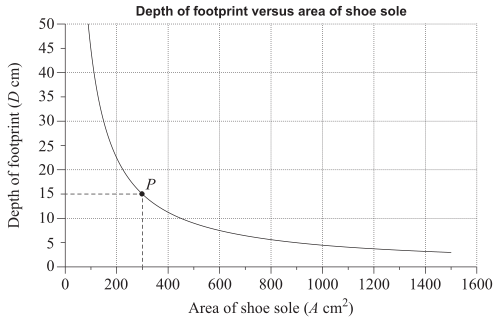
Snowhound makes snow shoes of various sizes. In its design phase, Snowhound collect data on the different footprint depths of snow shoes of different sizes, all worn by the same person.

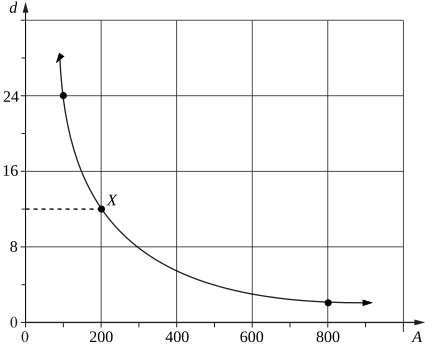
 The footprint depth (`d` cm) is then graphed against the area of the sole of the snow shoe (`A` cm).


  1. The graph shape shows that `d` is inversely proportional to `A`. The point `X` lies on the graph.


    Find the equation relating `d` and `A`.  (2 marks)

    --- 4 WORK AREA LINES (style=lined) ---

  2. A man from this group walks in snow and the depth of his footprint is 5 cm.


    Use your equation from part (a) to calculate the area of his shoe sole.  (1 mark)

    --- 1 WORK AREA LINES (style=lined) ---

Show Answers Only

a.   `D = 4500/A`

b.   `480\ text(cm)^2`

Show Worked Solution

a.   `d prop 1/A \ =>\ d = k/A`

`text(When)\ D = 12, A = 200:`

`12` `= k/200`
`k` `= 12 xx 200 = 2400`
`:. d` `=2400/A`


b.    `5` `= 2400/A`
  `:. A` `= 2400/5= 480\ text(cm)^2`

Filed Under: Non-Linear: Inverse and Other Problems (Std 2-X) Tagged With: Band 5, smc-795-10-Inverse, smc-795-40-Proportional

v1 Algebra, STD2 A4 2011 HSC 28a

The intensity of light, `I`, from a lamp varies inversely with the square of the distance, `d`, from the lamp.

  1. Write an equation relating `I`, `d` and `k`, where `k` is a constant.    (1 mark)

    --- 2 WORK AREA LINES (style=lined) ---

  2. It is known that `I = 20` when `d = 2`.


    By finding the value of the constant, `k`, find the value of `I` when `d = 5`.    (2 marks)

    --- 4 WORK AREA LINES (style=lined) ---

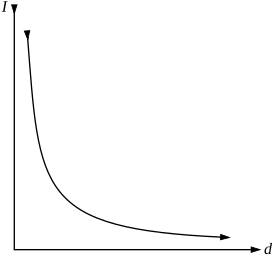
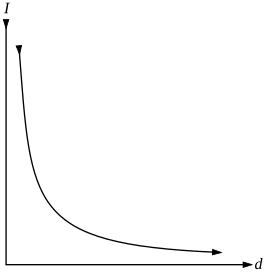
  3. Sketch a graph to show how `I` varies for different values of `d`.


    Use the horizontal axis to represent distance and the vertical axis to represent light intensity.   (2 marks)

    --- 8 WORK AREA LINES (style=lined) ---


Show Answers Only

a.   `I = k/d^2`

b.   `P = 1 1/2`

c.   
         

Show Worked Solution

a.   `I prop 1/d\ \ =>\ \ I=k/d^2`
 

b.  `text(When)\ I=20, d=2:`

`20` `= k/2^2`
`k` `=4 xx 20=80`

 
`text(Find)\ I\ text(when)\ d = 5:`

`I=80/5^2=16/5`
 

c.

Filed Under: Non-Linear: Inverse and Other Problems (Std 2-X) Tagged With: Band 5, num-title-ct-patha, num-title-qs-hsc, smc-4239-30-a prop 1/b, smc-795-10-Inverse, smc-795-40-Proportional

v1 Algebra, STD2 A4 2021 HSC 13 MC

The time taken to harvest a field varies inversely with the number of workers employed.

It takes 12 workers 36 hours to harvest the field.

Working at the same rate, how many hours would it take 27 workers to harvest the same field?

  1. 12
  2. 16
  3. 24
  4. 54
Show Answers Only

`B`

Show Worked Solution

`text{Time to harvest}\ (T) prop 1/text{Number of workers (W)}`

`T=k/W`

`text(When)\ \ T=36, W=12:`

`36=k/12\ \ =>\ \ k=36 xx 12 = 432`  
 

`text{Find}\ T\ text(when)\ \ W=27:`

`T=432/27=16\ \text{hours}`

 `=>  B`

Filed Under: Non-Linear: Inverse and Other Problems (Std 2-X) Tagged With: Band 5, smc-795-10-Inverse, smc-795-40-Proportional

v1 Algebra, STD2 A4 2007 HSC 15 MC

If the speed `(s)` of a journey varies inversely with the time `(t)` taken, which formula correctly expresses `s` in terms of `t` and `k`, where `k` is a constant?

  1. `s = k/t`
  2. `s = kt`
  3. `s = k + t`
  4. `s = t/k`
Show Answers Only

`A`

Show Worked Solution

`s prop 1/t \ \ => \ s = k/t`

`=>  A`

Filed Under: Non-Linear: Inverse and Other Problems (Std 2-X) Tagged With: Band 4, num-title-ct-patha, num-title-qs-hsc, smc-4239-30-a prop 1/b, smc-795-10-Inverse, smc-795-40-Proportional

v1 Algebra, STD2 A4 2010 HSC 13 MC

The time taken to charge a battery varies inversely with the charging voltage. At 24 volts \((V)\) it takes 15 hours to fully charge a battery.

How long will it take the same battery to fully charge at 40 volts?

  1. 8 hours
  2. 9 hours
  3. 10.5 hours
  4. 12 hours
Show Answers Only

`B`

Show Worked Solution
 
♦ Mean mark 50% 

`text{Time to charge}\ (T) prop 1/text(Voltage) \ => \ T=k/V`

`text(When) \ T=15, V = 24:`

`15=k/24\ \ => \ k=15 xx 24=360` 
   

`text{Find}\ T\ text{when}\ \ V= 40:}`

`T=360/40=9\ \text{hours}`

 `=>  B`

Filed Under: Non-Linear: Inverse and Other Problems (Std 2-X) Tagged With: Band 5, num-title-ct-patha, num-title-qs-hsc, smc-4239-30-a prop 1/b, smc-795-10-Inverse, smc-795-40-Proportional

v1 Algebra, STD2 A4 2024 HSC 9 MC

The time taken to fill a swimming pool varies inversely with the number of hoses being used.

Using 4 hoses, it takes 18 hours to fill the pool.

How many hours would it take 9 hoses to fill the same pool?

  1. 6
  2. 7.5
  3. 8
  4. 12
Show Answers Only

\(C\)

Show Worked Solution

\(T \propto \dfrac{1}{H} \ \Rightarrow \ \ T=\dfrac{k}{H}\)

\(\text {Find}\ k\ \text{given}\ \  T=18\ \ \text {when}\ \ H=4 \text {:}\)

\(18=\dfrac{k}{4} \ \Rightarrow\ \ k=72\)
 

\(\text {Find}\ T \ \text {if}\ \ H=9:\)

\(T=\dfrac{72}{9}=8 \text { hours}\)

\(\Rightarrow C\)

Filed Under: Non-Linear: Inverse and Other Problems (Std 2-X) Tagged With: Band 4, smc-795-10-Inverse, smc-795-40-Proportional

Copyright © 2014–2025 SmarterEd.com.au · Log in