The mass of a food packet is measured as 620 grams, correct to the nearest 20 grams.
What is the percentage error for this measurement? (1 mark)
Aussie Maths & Science Teachers: Save your time with SmarterEd
The mass of a food packet is measured as 620 grams, correct to the nearest 20 grams.
What is the percentage error for this measurement? (1 mark)
`text(1.6%)`
`text{Absolute error} = 1/2 xx 20 = 10\ \text{g}`
| `:.\ \text{% error}` | `= 10 / 620 xx 100` |
| `= \text{1.6129…} ≈ 1.6%` |
A new weed killer bottle contains 18 litres of solution.
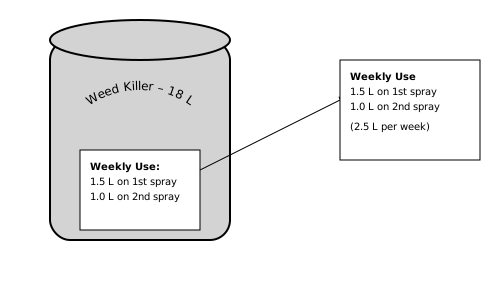
It is used to spray the lawn twice a week. The instructions state:
How many full weeks will this bottle last? (2 marks)
--- 4 WORK AREA LINES (style=lined) ---
`text(7 full weeks.)`
| `text{Total weekly usage}` | `= 1.5 + 1 = 2.5\ \text{litres}` |
| `text{Total amount available}` | `= 18\ \text{litres}` |
| `text{Weeks it will last}` | `= 18 / 2.5 = 7.2` |
`:.` The bottle will last 7 full weeks.
The length and width of a rectangular pool are measured to be 13 m and 7.5 m respectively, correct to the nearest metre and nearest 0.1 metre.
What are the lower and upper bounds for the area of the pool?
`B`
`text{Length absolute error} = 1/2 xx 1 = 0.5\ \text{m}`
`text{Width absolute error} = 1/2 xx 0.1 = 0.05\ \text{m}`
`text{Length bounds: } 13 ± 0.5 = [12.5,\ 13.5]\ \text{m}`
`text{Width bounds: } 7.5 ± 0.05 = [7.45,\ 7.55]\ \text{m}`
`text{Lower bound area} = 12.5 xx 7.45 = 93.125\ \text{m}^2`
`text{Upper bound area} = 13.5 xx 7.55 = 101.925\ \text{m}^2`
`⇒ B`
How many square millimetres are in 0.004 square metres?
`D`
| `text{Since 1 m}^2` | `= 1000\ text{mm} xx 1000\ text{mm}` |
| `= 1\ 000\ 000\ \text{mm}^2` |
| `:. 0.004\ \text{m}^2` | `= 0.004 xx 1\ 000\ 000` |
| `= 4000` | |
| `= 4000\ \text{mm}^2` |
`⇒ D`
A pencil is measured to be 12.8 cm long, correct to one decimal place.
What is the percentage error in this measurement?
`B`
`text{Absolute error} = 1/2 xx \text{precision} = 1/2 xx 0.1 = 0.05\ \text{cm}`
| `% \text{error}` | `= \frac{0.05}{12.8} xx 100` |
| `= 0.390625%` | |
| `= 0.39%` |
`⇒ B`
What is 0.0004782 expressed in standard form with two significant figures?
`A`
| `0.0004782` | `= 4.782 xx 10^(-4)` |
| `= 4.8 xx 10^(-4)\ \ \ text{(to 2 sig fig)}` |
`⇒ A`
A newborn baby’s length is recorded as 52.4 cm.
What is the absolute error of this measurement?
`B`
| `text{Absolute error}` | `= 1/2 xx\ text{precision}` |
| `= 1/2 xx 1\ text{ cm}` | |
| `= 0.5\ text{ cm}` |
`⇒ B`
A sprinter’s reaction time at the start of a race was recorded as 0.25 seconds, correct to the nearest hundredth of a second.
What is the percentage error in this measurement, correct to one significant figure?
`C`
`text{Absolute error}\ =1/2 xx text{precision}\ = 1/2 xx 0.01 = 0.005\ text{s}`
| `text{% error}` | `=\ frac{text{absolute error}}{text{measurement}} xx 100%` | |
| `=0.005/0.25 xx 100%` | ||
| `=2%` |
`⇒ C`
The height of Mount Kosciuszko is measured to be 2228.1 m above sea level.
What is the percentage error in this measurement?
`B`
`text{Absolute error}\ = 1/2 xx text{precision}\ = 1/2 xx 0.1 = 0.05\ text{m}`
| `text{% error}` | `= \frac{text{absolute error}}{text{measurement}} xx 100%` | |
| `= 0.05 / 2228.1 xx 100%` | ||
| `= 0.0022%` |
`⇒ B`
What is 0.04967 correct to two significant figures?
`B`
`text(We are rounding 0.04967 to 2 significant figures.)`
• `text(First 2 significant digits: 4 and 9)`
• `text(Next digit is 6 → round **up**)`
• `text(0.04967 rounds to 0.050 (2 sig. fig.))`
`=> B`
The distance from Earth to the Moon is approximately 384 400 km.
What is this distance in standard form correct to two significant figures?
`C`
`384\ 400`
`= 3.844 × 10^5`
`\text(Rounded to 2 significant figures) → 3.9 × 10^5\ \text{km}`
`⇒ C`
Sarah jogs at a speed of 18 km/h.
What is this speed in m/s?
`B`
| `text(18 km/h)` | `= 18\ 000\ text(metres per hour)` |
| `= (18\ 000)/60\ text(metres per minute)` | |
| `= (18\ 000)/(60 xx 60)\ text(metres per second)` | |
| `=5\ text(m/s)` |
`=> B`
During a study break, Sam is walking while Alex is sitting.
Sam breathes in air at a rate of 30 litres per minute while walking. Alex breathes in air at a rate of 8 litres per minute while sitting.
During a 20-minute break, how much more air would Sam breathe than Alex?
`=>\ B`
| `text{Sam’s total}` | `= 30 × 20 = 600\ \text{L}` |
| `text{Alex’s total}` | `= 8 × 20 = 160\ \text{L}` |
| `text{Difference}` | `= 600 − 160 = 440\ \text{L}` |
`=>\ B`
In a food technology class, a slice of bread is measured and its thickness is recorded as 1.6 cm.
What is the upper limit of accuracy of this measurement?
`=>\ C`
`text{Absolute error} = 0.05\ \text{cm}`
| `text{Upper limit}` | `= 1.6 + 0.05` |
| `= 1.65\ \text{cm}` |
`=>\ C`