SmarterEd

Aussie Maths & Science Teachers: Save your time with SmarterEd

  • Login
  • Get Help
  • About

Calculus, EXT1 EQ-Bank 4 MC

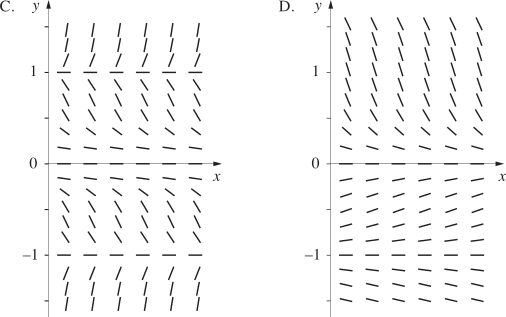
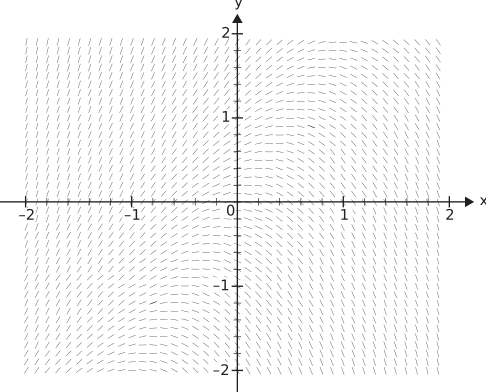
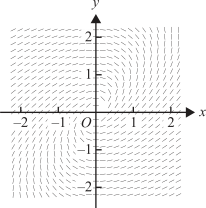
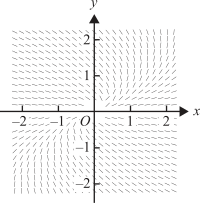
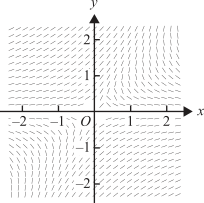
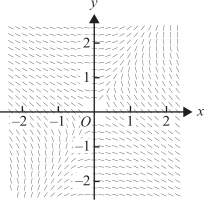
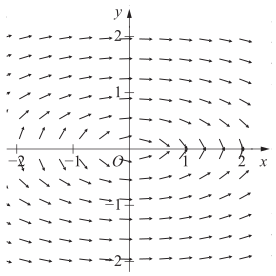
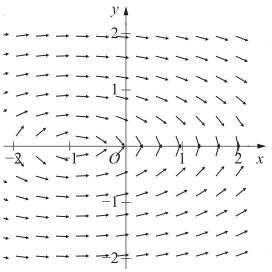
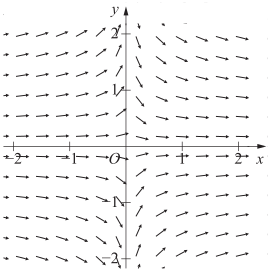
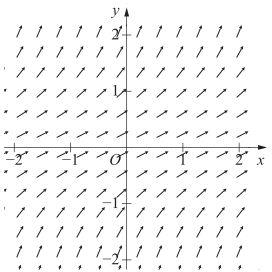
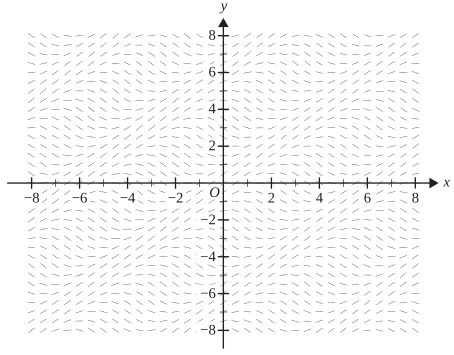
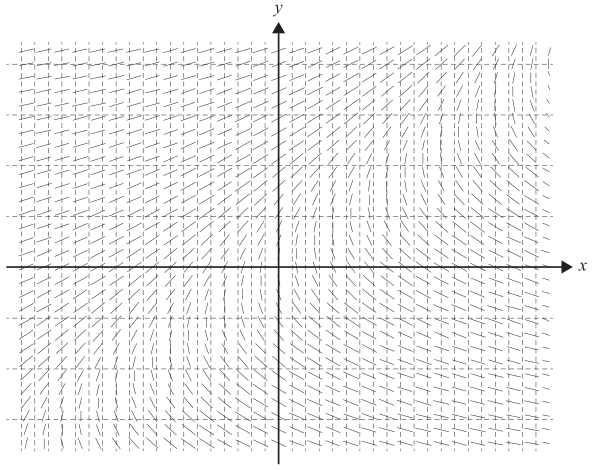
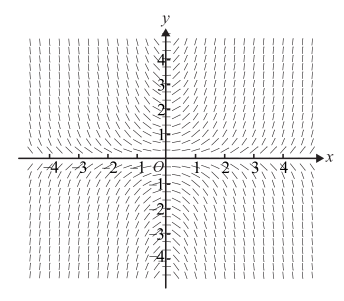
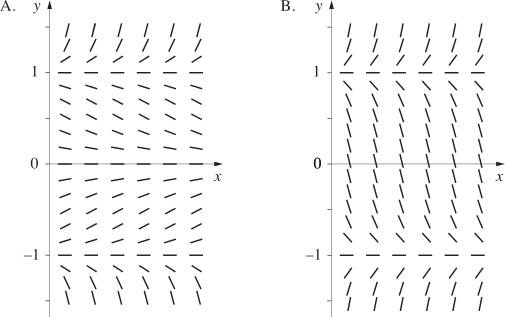
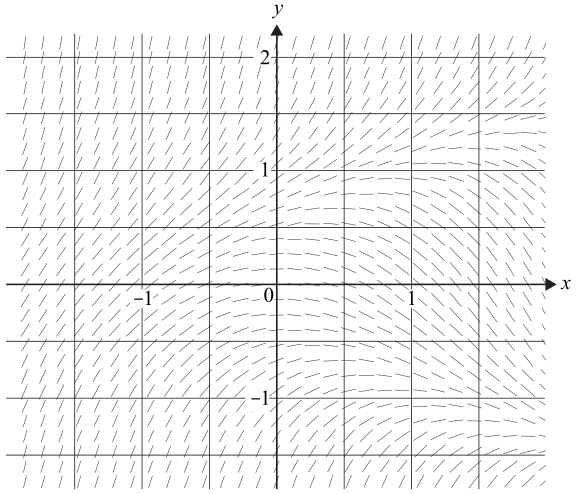
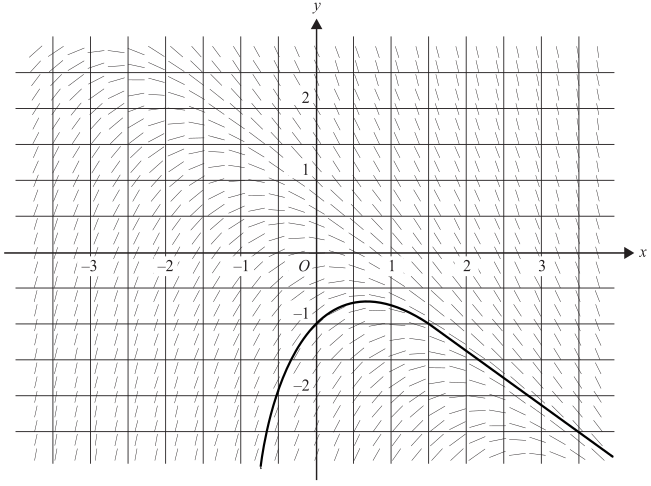
Which slope field best matches the differential equation  \(\dfrac{d y}{d x}=-y^2\left(1- y ^2\right)\) ?
 

Show Answers Only

\(C\)

Show Worked Solution

\(\text{By elimination:}\)

\(\text{At}\ \ y=0, \ \dfrac{dy}{dx}=0\ \ \text{(eliminate B)}\)

\(\text{At}\ \ y=1, \ \dfrac{dy}{dx}=-1(1-1)=0\ \ \text{(eliminate D)}\)

\(\text{At}\ \ y=-\dfrac{3}{2}, \ \dfrac{dy}{dx}=-\dfrac{9}{4}\left(1-\dfrac{9}{4}\right) \gt 0\ \ \text{(eliminate A)}\)

\(\Rightarrow C\)

Filed Under: Equations and Slope Fields Tagged With: Band 4, smc-7296-10-Slope Fields

Calculus, EXT1 EQ-Bank 28

Given the differential equation  \(\dfrac{d y}{d x}=-\dfrac{x}{y e^{x^2}}\),  determine the particular solution that passes through the point \((0,1 )\).   (3 marks)

--- 10 WORK AREA LINES (style=lined) ---

Show Answers Only

\(y=e^{-\tfrac{x^2}{2}}\)

Show Worked Solution
\(\dfrac{d y}{d x}\) \(=-\dfrac{x}{y e^{x^{2}}}\)
\(\displaystyle \int y\, d y\) \(=-\displaystyle \int x e^{-x^2}\, d x\)
\(\dfrac{y^2}{2}\) \(=\displaystyle \dfrac{1}{2} \int(-2 x) e^{-x^2}\, d x\)
\(y^2\) \(=e^{-x^2}+c\)

 
\(\text{Given the solution passes through}\ (0,1):\)

\(1^2=e^0+c \ \ \Rightarrow \ \ c=0\)

\(y^2=e^{-x^2}\)

\(y=\left(e^{-x^2}\right)^{\tfrac{1}{2}}=e^{-\tfrac{x^2}{2}}\)

Filed Under: Equations and Slope Fields Tagged With: Band 5, smc-7296-20-Differential Equations, smc-7296-30-\(\dfrac{dy}{dx}=f(x y)\)

Calculus, EXT1 EQ-Bank 22

Solve the differential equation  \(\dfrac{d y}{d x}=20 e^{-5 y}\).   (3 marks)

--- 8 WORK AREA LINES (style=blank) ---

Show Answers Only

\(y=\dfrac{1}{5} \ln \abs{100 x+c}\)

Show Worked Solution
\(\dfrac{d y}{d x}\) \(=20 e^{-5 y}\)
\(\displaystyle \int e^{5y}\,d y\) \(=\displaystyle \int 20\, d x\)
\(\dfrac{1}{5} e^{5 y}\) \(=20 x+c\)
\(e^{5 y}\) \(=100 x+c\)
\(5 y\) \(=\ln \abs{100 x+c}\)
\( y\) \(=\dfrac{1}{5} \ln \abs{100 x+c}\)

Filed Under: Equations and Slope Fields Tagged With: Band 4, smc-7296-20-Differential Equations, smc-7296-40-\(\dfrac{dy}{dx}=f(y)\)

Calculus, EXT1 EQ-Bank 13

Solve the differential equation  \(\dfrac{d y}{d x}=3 y\).   (3 marks)

--- 7 WORK AREA LINES (style=lined) ---

Show Answers Only

\(y=e^{3 x} \times e^c=A e^{3 x}\)

Show Worked Solution
\(\dfrac{d y}{d x}\) \(=3 y\)
\(\displaystyle \int \frac{1}{y}\, d y\) \(=\displaystyle \int 3\, d x\)
\(\ln \abs{y}\) \(=3 x+c\)
\(\abs{y}\) \(=e^{3 x+c}\)
\(y\) \(=e^{3 x} \times e^c=A e^{3 x}\)

Filed Under: Equations and Slope Fields Tagged With: Band 3, smc-7296-20-Differential Equations, smc-7296-40-\(\dfrac{dy}{dx}=f(y)\)

Calculus, EXT1 C3 EQ-Bank 31

Given that \(y(x)\) is a solution to the differential equation  \(\dfrac{d y}{d x}=x^2 y^3\), where  \(y(1)=3\), determine the domain of \(y\).   (4 marks)

--- 12 WORK AREA LINES (style=lined) ---

Show Answers Only

\(x< \sqrt[3]{\dfrac{7}{6}}\)

Show Worked Solution

\(\dfrac{d y}{d x}=x^2 y^3\)

\(\displaystyle \int \frac{1}{y^3}\ d y\) \(=\displaystyle \int x^2\ d x\)  
\(-\dfrac{1}{2 y^2}\) \(=\dfrac{1}{3} x^3+c\)  

 
\(\text{Since} \ \ y(1)=3:\)

\(-\dfrac{1}{2(9)}=\dfrac{1}{3}+c \ \ \Rightarrow \ \ c=-\dfrac{1}{18}-\dfrac{1}{3}=-\dfrac{7}{18}\)

\(-\dfrac{1}{2 y^2}\) \(=\dfrac{x^3}{3}-\dfrac{7}{18}\)
\(\dfrac{1}{2 y^2}\) \(=\dfrac{7}{18}-\dfrac{x^3}{3}=\dfrac{7-6 x^3}{18}\)
\(2 y^2\) \(=\dfrac{18}{7-6 x^3}\)
\(y\) \(= \pm \sqrt{\dfrac{9}{7-6 x^3}}\)

\(\text{Find domain of}\  y :\)

\(7-6 x^3\) \(>0\)
\(6 x^3\) \(<7\)
\(x^3\) \(<\dfrac{7}{6}\)
\(x\) \(< \sqrt[3]{\dfrac{7}{6}}\)

Filed Under: Equations and Slope Fields, Equations and Slope Fields Tagged With: Band 5, smc-1197-20-Differential Equations, smc-1197-30-\(\dfrac{dy}{dx}=f(x y)\), smc-7296-20-Differential Equations, smc-7296-30-\(\dfrac{dy}{dx}=f(x y)\)

Calculus, EXT1 C3 2025 SPEC2 8 MC

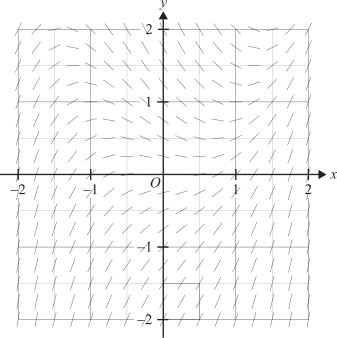
Consider the direction field below.
 

The direction field best represents the differential equation

  1. \(\dfrac{d y}{d x}=x^2-y\)
  2. \(\dfrac{d y}{d x}=x-y^2\)
  3. \(\dfrac{d y}{d x}=y-x\)
  4. \(\dfrac{d y}{d x}=x-y\)
Show Answers Only

\(A\)

Show Worked Solution

\(\text{By elimination:}\)

\(\text{At \((-1,0)\), gradient is positive (eliminate B and D)}\).

\(\text{At \((1,0)\), gradient is positive (eliminate C)}\).

\(\Rightarrow A\)

Filed Under: Equations and Slope Fields, Equations and Slope Fields Tagged With: Band 3, smc-1197-10-Slope Fields, smc-7296-10-Slope Fields

Calculus, EXT1 C3 2025 HSC 13a

It is given that  \(\dfrac{d y}{d x}=\dfrac{5}{y}\)  and  \(y=-4\)  when  \(x=0\).

Find \(y\) as a function of \(x\).   (3 marks)

--- 5 WORK AREA LINES (style=lined) ---

Show Answers Only

\(y=-\sqrt{10 x+16}\)

Show Worked Solution
\(\dfrac{dy}{dx}\) \(=\dfrac{5}{y}\)
\(\displaystyle \int y\,dy\) \(=\displaystyle \int 5 \,d x\)
\(\dfrac{y^2}{2}\) \(=5 x+c\)


\(\text{Given} \ \ y=-4 \ \ \text{when} \ \ x=0:\)

\(\dfrac{(-4)^2}{2}\) \(=0+c \ \Rightarrow \ c=8\)
\(\dfrac{y^2}{2}\) \(=5 x+8\)
\(y^2\) \(=10 x+16\)
\(y\) \(=-\sqrt{10 x+16} \quad \text{(Since \((0,-4)\) lies on graph)}\)

Filed Under: Equations and Slope Fields, Equations and Slope Fields Tagged With: Band 4, smc-1197-20-Differential Equations, smc-1197-40-\(\dfrac{dy}{dx}=f(y)\), smc-7296-20-Differential Equations, smc-7296-40-\(\dfrac{dy}{dx}=f(y)\)

Calculus, EXT1 C3 2025 HSC 12d

Find the solution of  \(\dfrac{dy}{dx}=\sqrt{(2-y)(2+y)}\), given that  \(y=1\)  when  \(x=0\).   (3 marks)

--- 8 WORK AREA LINES (style=lined) ---

Show Answers Only

\(y=2\, \sin \left(x+\dfrac{\pi}{6}\right)\)

Show Worked Solution
\(\dfrac{d y}{d x}\) \(=\sqrt{(2-y)(2+y)}\) \(=\sqrt{4-y^2}\)
\(\dfrac{d x}{d y}\) \(=\dfrac{1}{\sqrt{4-y^2}}\)
\(\displaystyle \int d x\) \(=\displaystyle \int \dfrac{1}{\sqrt{4-y^2}} d y\)
\(x\) \(=\sin ^{-1}\left(\dfrac{y}{2}\right)+c\)


\(\text{When} \ \ x=0, y=1:\)

\(0=\sin ^{-1}\left(\dfrac{1}{2}\right)+c \ \ \Rightarrow \ \ c=-\dfrac{\pi}{6}\)

\(x\) \(=\sin ^{-1}\left(\dfrac{y}{2}\right)-\dfrac{\pi}{6}\)
\(\sin ^{-1}\left(\dfrac{y}{2}\right)\) \(=x+\dfrac{\pi}{6}\)
\(\dfrac{y}{2}\) \(=\sin \left(x+\dfrac{\pi}{6}\right)\)
\(y\) \(=2\, \sin \left(x+\dfrac{\pi}{6}\right)\)

Filed Under: Equations and Slope Fields, Equations and Slope Fields Tagged With: Band 4, smc-1197-20-Differential Equations, smc-1197-40-\(\dfrac{dy}{dx}=f(y)\), smc-7296-20-Differential Equations, smc-7296-40-\(\dfrac{dy}{dx}=f(y)\)

Calculus, EXT1 C3 2025 HSC 7 MC

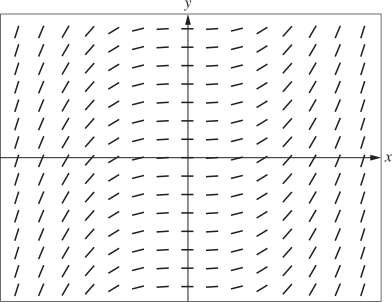
A slope field is shown.
 

Which of the following could be the differential equation represented by the slope field?

  1. \(\dfrac{d y}{d x}=x^2\)
  2. \(\dfrac{d y}{d x}=x^2+C, C \neq 0\)
  3. \(\dfrac{d y}{d x}=x^3\)
  4. \(\dfrac{d y}{d x}=x^3+C, C \neq 0\)
Show Answers Only

\(A\)

Show Worked Solution

\(\text{For all \(x<0\), gradients are positive (from graph):}\)

\(\text{Eliminate C and D.}\)

\(\text{At \(x=0\), gradient = 0 (from graph):}\)

\(\text{Eliminate B.}\)

\(\Rightarrow A\)

♦ Mean mark 41%.

Filed Under: Equations and Slope Fields, Equations and Slope Fields Tagged With: Band 5, smc-1197-10-Slope Fields, smc-7296-10-Slope Fields

Calculus, EXT1 C3 EQ-Bank 16

Find the general solution to the differential equation  \(y^{\prime}=e^{-y}\).   (2 marks)

--- 6 WORK AREA LINES (style=lined) ---

Show Answers Only

\(\ln \left|x+c_1\right|\)

Show Worked Solution
\(\dfrac{d y}{d x}\) \(=e^{-y}\)
\(\dfrac{d x}{d y}\) \(=e^y\)
\(\displaystyle \int d x\) \(=\displaystyle \int e^y\, d y\)
\(x\) \(=e^y+c\)
\(e^y\) \(=x+c_1\)
\(y\) \(=\ln \left|x+c_1\right|\)

Filed Under: Equations and Slope Fields, Equations and Slope Fields Tagged With: Band 4, smc-1197-20-Differential Equations, smc-1197-40-\(\dfrac{dy}{dx}=f(y)\), smc-7296-20-Differential Equations, smc-7296-40-\(\dfrac{dy}{dx}=f(y)\)

Calculus, EXT1 C3 2024 SPEC2 7 MC

A solution to the differential equation

\(\dfrac{d y}{d x}=e^{x-y}(\cos (x-y)-\cos (x+y))\)  can be found using

  1. \(\displaystyle \int e^y \cos (y) d y=2 \int e^x \cos (x) d x\)
  2. \(\displaystyle\int \frac{e^y}{\sin (y)} d y=2 \int e^{-x} \sin (x) d x\)
  3. \(\displaystyle\int \frac{e^y}{\sin (y)} d y=2 \int e^x \sin (x) d x\)
  4. \(\displaystyle\int e^{-y} \sin (y) d y=2 \int \frac{e^x}{\cos (x)} d x\)
Show Answers Only

\(C\)

Show Worked Solution

\(\cos(x-y)-\cos(x+y)\)

\(=[\cos(x)\cos(y)+\sin(x)\sin(y)]-[\cos(x)\cos(y)-\sin(x)\sin(y)]\)

\(=2\sin(x)\sin(y)\)
 

\(\dfrac{d y}{d x}\) \(=e^{x-y}(\cos (x-y)-\cos (x+y))\)  
  \(=e^{x-y} \times 2\sin(x)\sin(y)\)  
  \(=2e^{x}\sin(x) \left(\dfrac{\sin(y)}{e^{y}}\right) \)  

 
\(\displaystyle \int \dfrac{e^{y}}{\sin(y)}\,dy=\displaystyle \int 2e^{x}\sin(x)\,dx\)

\(\Rightarrow C\)

Filed Under: Equations and Slope Fields, Equations and Slope Fields Tagged With: Band 4, smc-1197-20-Differential Equations, smc-1197-30-\(\dfrac{dy}{dx}=f(x y)\), smc-7296-20-Differential Equations, smc-7296-30-\(\dfrac{dy}{dx}=f(x y)\)

Calculus, EXT1 C3 2024 HSC 14a

Find the domain and range of the function that is the solution to the differential equation

\(\dfrac{d y}{d x}=e^{x+y}\)

and whose graph passes through the origin.   (4 marks)

--- 9 WORK AREA LINES (style=lined) ---

Show Answers Only

\(\text{Domain:}\ \ x<\ln 2\)

\(\text{Range:}\ \ y>-\ln 2\)

Show Worked Solution

\(\dfrac{d y}{d x}=e^{x+y}=e^{x}\cdot e^{y}\)

  \(\displaystyle\int e^{-y}\, d y\) \(=\displaystyle \int e^x\, d x\)
  \(-e^{-y}\) \(=e^x+c\)
♦ Mean mark 52%.

\(\text{Passes through }(0,0):\)

\(-e^0=e^0+c \ \Rightarrow \ c=-2\)

  \(-e^{-y}\) \(=e^x-2\)
  \(e^{-y}\) \(=2-e^x\)
  \(-y\) \(=\ln \left(2-e^x\right)\)
  \(y\) \(=-\ln \left(2-e^x\right)\)

\(\text{Since}\ \ 2-e^x>0 \ \Rightarrow \ e^x<2\)

\(\Rightarrow \ \text{Domain:}\ \ x<\ln 2\)

\(\text{Since}\ \ e^x>0 \ \Rightarrow \ 2-e^x<2\)

\(\Rightarrow \ \text{Range:}\ \ y>-\ln 2\)

Filed Under: Equations and Slope Fields, Equations and Slope Fields Tagged With: Band 5, smc-1197-20-Differential Equations, smc-1197-30-\(\dfrac{dy}{dx}=f(x y)\), smc-7296-20-Differential Equations, smc-7296-30-\(\dfrac{dy}{dx}=f(x y)\)

Calculus, EXT1 C3 2024 HSC 11d

Solve the differential equation  \(\dfrac{d y}{d x}=x y\),  given  \(y>0\). Express your answer in the form  \(y=e^{f(x)}\).   (2 marks)

--- 6 WORK AREA LINES (style=lined) ---

Show Answers Only

\(y=e^{\frac{x^2}{2}}\)

Show Worked Solution

  \(\dfrac{d y}{d x}\) \(=x y\)
  \(\displaystyle\int \frac{1}{y}\, d y\) \(=\displaystyle\int x\, d x\)
  \(\ln y\) \(=\dfrac{1}{2} x^2+c\)
  \(y\) \(=e^{\frac{x^2}{2}+c}\)
    \(=e^{\frac{x^2}{2}} \cdot e^c\)
    \(=A e^{\frac{x^2}{2}} \text{ (where \(A=e^c)\)}\)

 
\(\therefore y=e^{\frac{x^2}{2}}\ \  \text{is a solution } (A=1)\)

Filed Under: Equations and Slope Fields, Equations and Slope Fields Tagged With: Band 3, smc-1197-20-Differential Equations, smc-1197-30-\(\dfrac{dy}{dx}=f(x y)\), smc-7296-20-Differential Equations, smc-7296-30-\(\dfrac{dy}{dx}=f(x y)\)

Calculus, EXT1 C3 2022 SPEC1 2

Solve the initial value problem  `(dy)/(dx) = -x sqrt(4-y^2)`  given that  `y(2) = 0`. Give your answer in the form  `y = f(x)`.   (3 marks)

--- 7 WORK AREA LINES (style=lined) ---

Show Answers Only

`y=2sin(-(1)/(2)x^(2)+2)`

Show Worked Solution
`int(dy)/(sqrt(4-y^(2)))` `=int-x\ dx`  
`sin^(-1)((y)/(2))` `=-(1)/(2)x^(2)+c`  

 
`y(2)=0\ \=> \ c=2`

`(y)/(2)` `=sin(-(1)/(2)x^(2)+2)`  
`y` `=2sin(-(1)/(2)x^(2)+2)`  

Filed Under: Equations and Slope Fields, Equations and Slope Fields Tagged With: Band 4, smc-1197-20-Differential Equations, smc-1197-30-\(\dfrac{dy}{dx}=f(x y)\), smc-7296-20-Differential Equations, smc-7296-30-\(\dfrac{dy}{dx}=f(x y)\), smc-7296-70-IVP Terminology

Calculus, EXT1 C3 2023 HSC 3 MC

The diagram shows the direction field of a differential equation. A particular solution to the differential equation passes through \((-2,1)\).
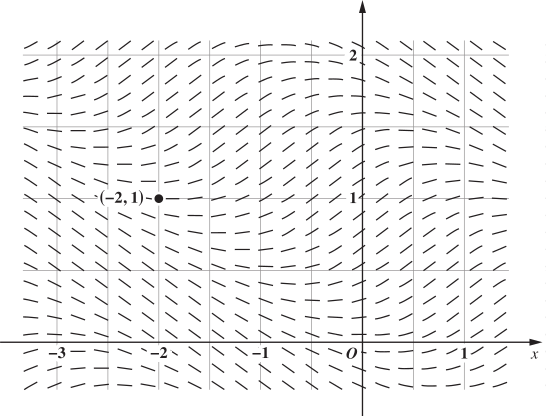
Where does the solution that passes through \((-2,1)\) cross the \(y\)-axis?

  1. \(y=1.12\)
  2. \(y=1.34\)
  3. \(y=1.56\)
  4. \(y=1.78\)
Show Answers Only

\(C\)

Show Worked Solution

\(\text{Following gradients → cross y-axis slightly above 1.5}\)

\(\Rightarrow C\)

Filed Under: Equations and Slope Fields, Equations and Slope Fields Tagged With: Band 3, smc-1197-10-Slope Fields, smc-7296-10-Slope Fields

Calculus, EXT1 C3 EQ-Bank 20

Find the particular solution to the initial value problem  `(dy)/(dx)=e^(2x+3y)`  that passes through the point `(0,0)`.   (3 marks)

--- 9 WORK AREA LINES (style=lined) ---

Show Answers Only

`y=-1/3ln((5-3e^(2x))/2)`

Show Worked Solution
`(dy)/(dx)` `=e^(2x+3y)`  
`dy/dx` `=e^(2x)*e^(3y)`  
`e^(-3y)\ dy` `=e^(2x)\ dx`  
`int e^(-3y)\ dy` `=int e^(2x)\ dx`  
`-1/3 e^(-3y)` `=1/2 e^(2x)+c`  

 
`text{Passes through}\ (0,0):`

`-1/3e^0=1/2e^0+c\ \ =>\ \ c=5/6`
 

`-1/3 e^(-3y)` `=1/2 e^(2x)-5/6`  
`2e^(-3y)` `=5-3e^(2x)`  
`e^(-3y)` `=(5-3e^(2x))/2`  
`ln (e^(-3y))` `=ln((5-3e^(2x))/2)`  
`-3y` `=ln((5-3e^(2x))/2)`  
`y` `=-1/3ln((5-3e^(2x))/2)`  

Filed Under: Equations and Slope Fields, Equations and Slope Fields Tagged With: Band 4, smc-1197-20-Differential Equations, smc-1197-30-\(\dfrac{dy}{dx}=f(x y)\), smc-7296-20-Differential Equations, smc-7296-30-\(\dfrac{dy}{dx}=f(x y)\), smc-7296-70-IVP Terminology

Calculus, EXT1 C3 EQ-Bank 29

Find the particular solution to the initial value problem  `(dy)/(dx)=(2y+1)(x-3)`  that passes through the point `(2,-1)`.   (4 marks)

--- 12 WORK AREA LINES (style=lined) ---

Show Answers Only

`y=-1/2(e^((x-2)(x-4))+1)`

Show Worked Solution
`(dy)/(dx)` `=(2y+1)(x-3)`  
`dy/(2y+1)` `=x-3\ dx`  
`int 1/(2y+1)\ dy` `=int x-3\ dx`  
`1/2ln|2y+1|` `=x^2/2-3x+c`  

 
`text{Passes through}\ (2,-1):`

`1/2ln|-1|=2-6+c\ \ =>\ \ c=4`
 

`1/2ln|2y+1|` `=x^2/2-3x+4`  
`ln|2y+1|` `=x^2-6x+8`  
`ln|2y+1|` `=(x-4)(x-2)`  
`2y+1` `=+-e^((x-2)(x-4))`  
`2y` `=-e^((x-2)(x-4))-1,\ \ (text{passes through}\ ( 2,-1))`  
`y` `=-1/2(e^((x-2)(x-4))+1)`  

Filed Under: Equations and Slope Fields, Equations and Slope Fields Tagged With: Band 5, smc-1197-20-Differential Equations, smc-1197-30-\(\dfrac{dy}{dx}=f(x y)\), smc-7296-20-Differential Equations, smc-7296-30-\(\dfrac{dy}{dx}=f(x y)\), smc-7296-70-IVP Terminology

Calculus, EXT1 C3 EQ-Bank 18

Find an expression for `y` in terms of `x` given the initial value problem

  `dy/dx=4y-3`  and when  `x=-2, \ y=1`.   (3 marks)

--- 10 WORK AREA LINES (style=lined) ---

Show Answers Only

`y=(e^(4(x+2))+3)/4`

Show Worked Solution
`dy/dx` `=4y-3`  
`(dy)/(4y-3)` `=1\ dx`  
`int 1/(4y-3)\ dy` `=int 1\ dx`  
`1/4ln abs(4y-3)` `=x+c`  

 
`text{When}\ \ y=1, x=-2:`

`1/4ln(4-3)=-2+c\ \ =>\ \ c=2`
 

`1/4ln abs(4y-3)` `=x+2`  
`ln abs(4y-3)` `=4(x+2)`  
`4y-3` `=+-e^(4(x+2))`  
`4y-3` `=e^(4(x+2)),\ \ (text{since}\ y(-2)=1)`  
`4y` `=e^(4(x+2))+3`  
`y` `=(e^(4(x+2))+3)/4`  

Filed Under: Equations, Equations and Slope Fields, Equations and Slope Fields Tagged With: Band 4, smc-1197-20-Differential Equations, smc-1197-40-\(\dfrac{dy}{dx}=f(y)\), smc-5161-50-\(\dfrac{dy}{dx}=f(y)\), smc-7296-20-Differential Equations, smc-7296-40-\(\dfrac{dy}{dx}=f(y)\), smc-7296-70-IVP Terminology

Calculus, EXT1 C3 EQ-Bank 12

Solve the differential equation  `dy/dx=2x^2-3x`  given that when  `x=3`, `y=-1`.   (2 marks)

--- 5 WORK AREA LINES (style=lined) ---

Show Answers Only

`y=2/3x^3-3/2x^2-11/2`

Show Worked Solution
`dy/dx` `=2x^2-3x`  
`1\ dy` `=2x^2-3x\ dx`  
`int1\ dy` `=int2x^2-3x\ dx`  
`y` `=2/3x^3-3/2x^2+c`  

 
`text{When}\ \ x=3,\ y=-1:`

`-1` `=2/3 3^3-3/2 3^2+c`  
`c` `=-11/2`  

 
`:.y=2/3x^3-3/2x^2-11/2`

Filed Under: Equations and Slope Fields, Equations and Slope Fields Tagged With: Band 3, smc-1197-20-Differential Equations, smc-1197-45-\(\dfrac{dy}{dx}=f(x)\), smc-7296-20-Differential Equations, smc-7296-50-\(\dfrac{dy}{dx}=f(x)\)

Calculus, EXT1 C3 2022 HSC 12a

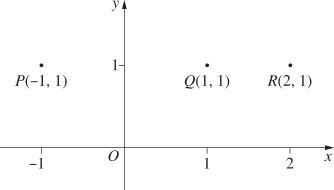
A direction field is to be drawn for the differential equation

`(dy)/(dx)=(x-2y)/(x^(2)+y^(2)). `

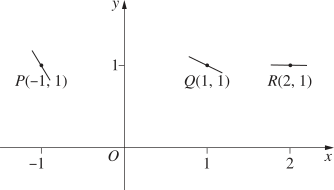
On the diagram, clearly draw the correct slopes of the direction field at the points `P, Q` and `R`.  (2 marks)


--- 0 WORK AREA LINES (style=lined) ---
Show Answers Only

Show Worked Solution

`text{At (–1, 1):}\ \ dy/dx=(-1-2)/(1+1)=-3/2`

`text{At (1, 1):}\ \ dy/dx=(1-2)/(1+1)=-1/2`

`text{At (2, 1):}\ \ dy/dx=(2-2)/(4+1)=0`
 

Filed Under: Equations and Slope Fields, Equations and Slope Fields, Euler, Pseudocode and Slope Fields Tagged With: Band 3, smc-1183-20-Slope fields, smc-1197-10-Slope Fields, smc-7296-10-Slope Fields

Calculus, EXT1 C3 2022 HSC 14a

Find the particular solution to the differential equation  `(x-2)(dy)/(dx)=xy`  that passes through the point `(0,1)`.  (4 marks)

--- 8 WORK AREA LINES (style=lined) ---

Show Answers Only

`y=(e^x(x-2)^2)/4`

Show Worked Solution
`(x-2)(dy)/(dx)` `=xy`  
`1/y* dy/dx` `=x/(x-2)`  
`int 1/y\ dy` `=int x/(x-2)\ dx`  
`ln|y|` `=int (x-2)/(x-2)+2/(x-2)\ dx`  
  `=int 1+2/(x-2)\ dx`  
  `=x+2ln|x-2|+c`  

 
`text{Passes through (0,1):`

`ln1` `=0+2ln|-2|+c`  
`c` `=-2ln2`  


`ln|y|` `=x+2ln|x-2|-2ln2`  
  `=lne^x+ln(x-2)^2-ln2^2`  
  `=ln(e^x((x-2)^2)/4)`  
`|y|` `=(e^x(x-2)^2)/4`  
`:.y` `=(e^x(x-2)^2)/4\ \ (e^x>0,\ \ (x-2)^2>0)`  

♦ Mean mark 43%.

Filed Under: Equations, Equations and Slope Fields, Equations and Slope Fields Tagged With: Band 5, smc-1197-20-Differential Equations, smc-1197-30-\(\dfrac{dy}{dx}=f(x y)\), smc-5161-30-(dfrac{dy}{dx}=f(x,y)), smc-7296-20-Differential Equations, smc-7296-30-\(\dfrac{dy}{dx}=f(x y)\)

Calculus, EXT1 C3 2022 HSC 10 MC

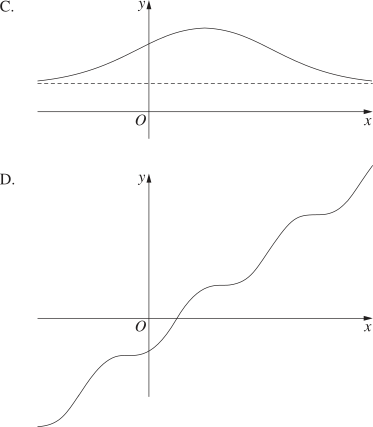
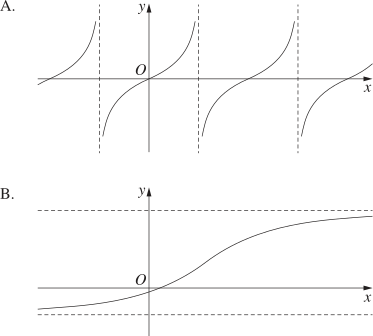
Which of the following could be the graph of a solution to the differential equation

`(dy)/(dx)=sin y+1?`


Show Answers Only

`B`

Show Worked Solution

`text{One Strategy}`

`text{When}\ \ (dy)/(dx)=0:`

`siny=-1\ \ =>\ \ y=(3pi)/2 + 2kpi\ \ (kinZZ)`

`text{Graphically,}\ \ y=(3pi)/2 + 2kpi\ \ text{are horizontal asymptotes.}`

`=>B`


♦♦♦ Mean mark 27%.

Filed Under: Equations and Slope Fields, Equations and Slope Fields Tagged With: Band 6, smc-1197-20-Differential Equations, smc-1197-40-\(\dfrac{dy}{dx}=f(y)\), smc-7296-20-Differential Equations, smc-7296-40-\(\dfrac{dy}{dx}=f(y)\)

Calculus, EXT1 C3 2021 SPEC2 10 MC

The differential equation that has the diagram above as its direction field is

  1. `(dy)/(dx) = y + 2x`
  2. `(dy)/(dx) = 2x - y`
  3. `(dy)/(dx) = x+2y`
  4. `(dy)/(dx) = y - 2x`
Show Answers Only

`D`

Show Worked Solution

`text(By elimination:)`

`text(At)\ (1, 2), m = 0`

`->\ text(Eliminate)\ A, C`

`text(At)\ (0, 1),\ m\ text(is positive)`

`->\ text(Eliminate)\ B`

`=>\ D`

Filed Under: Equations and Slope Fields, Equations and Slope Fields Tagged With: Band 4, smc-1197-10-Slope Fields, smc-7296-10-Slope Fields

Calculus, EXT1 C3 2021 HSC 12a

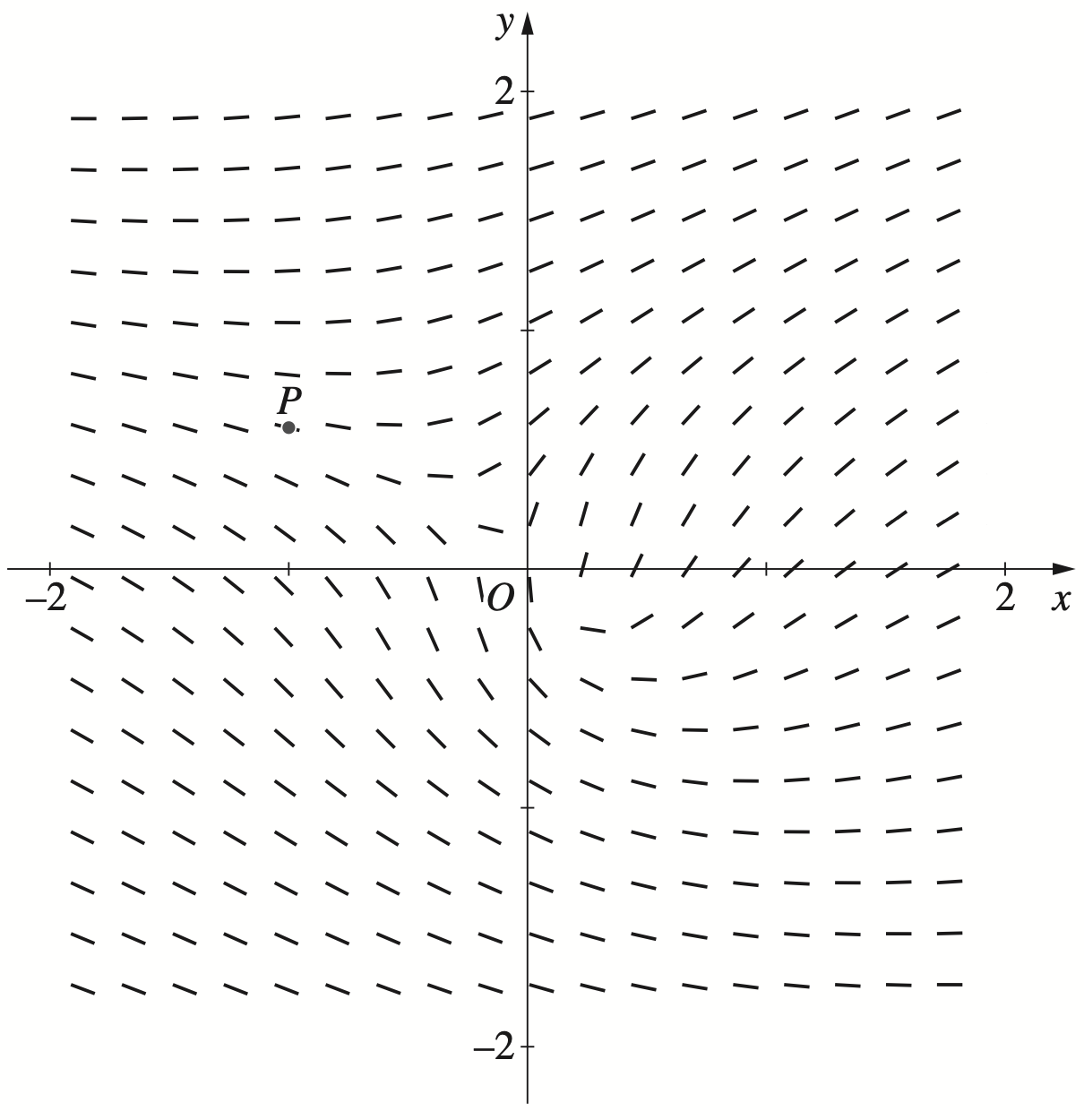
The direction field for a differential equation is shown below.

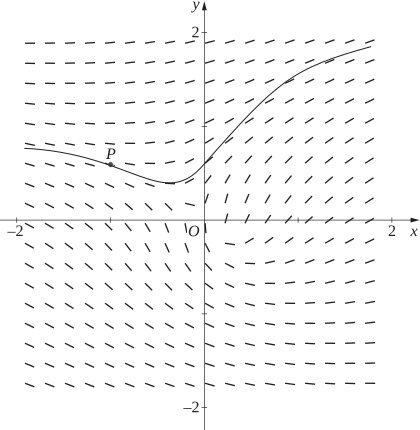
The graph of a particular solution to the differential equation passes through the point `P`.

On the graph, sketch the graph of this particular solution.  (1 mark)
--- 0 WORK AREA LINES (style=lined) ---
Show Answers Only

Show Worked Solution

♦♦♦ Mean mark 18%!
MARKER COMMENT: A solution curve does not cross any tangent line.

Filed Under: Equations and Slope Fields, Equations and Slope Fields, Euler, Pseudocode and Slope Fields Tagged With: Band 6, smc-1183-20-Slope fields, smc-1197-10-Slope Fields, smc-7296-10-Slope Fields

Calculus, EXT1 C3 2021 HSC 4 MC

Consider the differential equation  `(dy)/(dx) = x/y`.

Which of the following equations best represents this relationship between `x` and `y`?

  1. `y^2 = x^2 + c`
  2. `y^2 = (x^2)/2 + c`
  3. `y = x ln\ | y | + c`
  4. `y = (x^2)/2 ln\ |y| + c`
Show Answers Only

`A`

Show Worked Solution
`(dy)/(dx)` `= x/y`
`int y\ dy` `= int x\ dx`
`1/2 y^2` `= 1/2 x^2 + c`
`y^2` `= x^2 + c_1`

 
`=> A`

Filed Under: Equations and Slope Fields, Equations and Slope Fields Tagged With: Band 3, smc-1197-20-Differential Equations, smc-1197-30-\(\dfrac{dy}{dx}=f(x y)\), smc-7296-20-Differential Equations, smc-7296-30-\(\dfrac{dy}{dx}=f(x y)\)

Calculus, EXT1 C3 2020 SPEC2 9 MC

`P(x, y)`  is a point on a curve. The `x`-intercept of a tangent to point  `P(x, y)`  is equal to the `y`-value at `P`.

Which one of the following slope fields best represents this curve?

A.   B.
C. D.
Show Answers Only

`B`

Show Worked Solution

`text(The tangent to the curve passes through)`

`(x, y)\ and\ (y, 0)`

`(dy)/(dx) = (0 – y)/(y – x) = y/(x – y)`
 

`text(When)\ \ x = 0:`

`(dy)/(dx) = y/(−y) = −1`

`=>B`

Filed Under: Equations and Slope Fields, Equations and Slope Fields Tagged With: Band 5, smc-1197-10-Slope Fields, smc-7296-10-Slope Fields

Calculus, EXT1 C3 2020 HSC 12e

Find the curve which satisfies the differential equation  `(dy)/(dx) = -x/y`  and passes through the point  `(1, 0)`.   (3 marks)

--- 6 WORK AREA LINES (style=lined) ---

Show Answers Only

`x^2+y^2=1`

Show Worked Solution
COMMENT: Note the answer requires a curve equation, not a function.

`(dy)/(dx) = -x/y`

`int y\ dy = −int x\ dx`

`(y^2)/2 = -(x^2)/2 + c`

 
`text{Curve passes through (1, 0):}`

`0` `= -1/2 + c`
`c` `= 1/2`
`(y^2)/2` `= -(x^2)/2 + 1/2`
`y^2` `= -x^2 + 1`
`:.x^2+y^2` `= 1`

Filed Under: Equations, Equations and Slope Fields, Equations and Slope Fields Tagged With: Band 5, smc-1197-20-Differential Equations, smc-1197-30-\(\dfrac{dy}{dx}=f(x y)\), smc-5161-30-(dfrac{dy}{dx}=f(x,y)), smc-7296-20-Differential Equations, smc-7296-30-\(\dfrac{dy}{dx}=f(x y)\)

Calculus, EXT1 C3 2020 HSC 11e

Solve  `(dy)/(dx) = e^(2y)`, finding `x` as a function of `y`.  (2 marks)

Show Answers Only

`x = −1/2 e^(−2y) + c`

Show Worked Solution
`(dy)/(dx)` `= e^(2y)`
`(dx)/(dy)` `= e^(−2y)`
`x` `= int e^(−2y)\ dy`
`:. x` `= −1/2 e^(−2y) + c`

Filed Under: Equations, Equations and Slope Fields, Equations and Slope Fields Tagged With: Band 3, smc-1197-20-Differential Equations, smc-1197-40-\(\dfrac{dy}{dx}=f(y)\), smc-5161-50-\(\dfrac{dy}{dx}=f(y)\), smc-7296-20-Differential Equations, smc-7296-40-\(\dfrac{dy}{dx}=f(y)\)

Calculus, EXT1 C3 2020 HSC 7 MC

Which of the following best represents the direction field for the differential equation  `(dy)/(dx) = −x/(4y)`?

A. B.
C. D.
Show Answers Only

`A`

Show Worked Solution

`text(At)\ \ x = 0, (dy)/(dx) = 0\ (text(horizontal))`

`=>A`

Filed Under: Equations and Slope Fields, Equations and Slope Fields Tagged With: Band 4, smc-1197-10-Slope Fields, smc-7296-10-Slope Fields

Calculus, EXT1 C3 2019 SPEC2 9 MC

The differential equation that has the diagram above as its direction field is

  1. `(dy)/(dx) = sin(y - x)`
  2. `(dy)/(dx) = cos(y - x)`
  3. `(dy)/(dx) = 1/(cos(y - x))`
  4. `(dy)/(dx) = 1/(sin(y - x))`
Show Answers Only

`B`

Show Worked Solution

`text(By elimination:)`

`text(Along line)\ y = x,\ text(gradient = 1)`

`:.\ text(Eliminate A and D.)`
 

`text{At (1, 0),  0 < gradient < 1}`

`1/(cos(-1)) > 1`

`:.\ text(Eliminate C)`

`=>B`

Filed Under: Equations and Slope Fields, Equations and Slope Fields Tagged With: Band 4, smc-1197-10-Slope Fields, smc-7296-10-Slope Fields

Calculus, EXT1 C3 2017 SPEC1 8

A slope field representing the differential equation  `dy/dx = −x/(1 + y^2)`  is shown below.
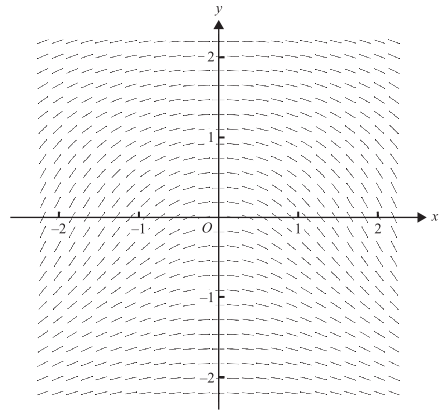
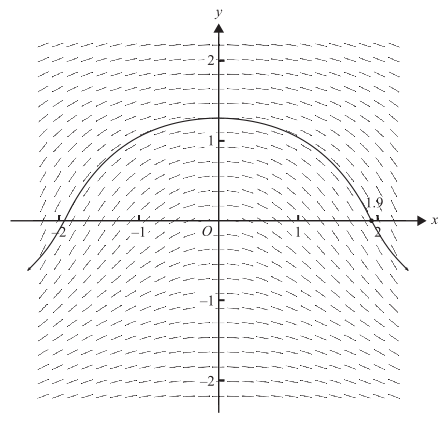
  1. Sketch the solution curve of the differential equation corresponding to the condition  `y(−1) = 1`  on the slope field above and, hence, estimate the positive value of `x` when  `y = 0`. Give your answer correct to one decimal place.  (2 marks)
  2. Solve the differential equation  `(dy)/(dx) = (−x)/(1 + y^2)`  with the condition  `y(−1) = 1`. Express your answer in the form  `ay^3 + by + cx^2 + d = 0`, where `a`, `b`, `c` and `d` are integers.  (2 marks)

    --- 6 WORK AREA LINES (style=lined) ---
Show Answers Only
  1.  

  2. `2y^3 + 6y + 3x^2 – 11 = 0`
Show Worked Solution
a.   

♦♦ Mean mark part (a) 32%.
MARKER’S COMMENT: Solution curve should follow slope ticks and not cross them.


b.    `(1 + y^2)(dy)/(dx)` `= −x`
  `int 1 + y^2 dy` `= −int x\ dx`
  `y + (y^3)/3` `= −(x^2)/2 + C, C ∈ R`

 
`text(Substituting)\ (-1,1):`

`1 + (1^3)/3` `= −((−1)^2)/2 + C`
`1 + 1/3` `= −1/2 + C`
`:. C` `= 11/6`


`y + 1/3y^3` `= −1/2x^2 + 11/6`
`6y + 2y^3` `= −3x^2 + 11`

 
`:. 2y^3 + 6y + 3x^2 – 11 = 0`

Filed Under: Equations and Slope Fields, Equations and Slope Fields Tagged With: Band 4, Band 5, smc-1197-10-Slope Fields, smc-7296-10-Slope Fields

Calculus, EXT1 C3 2015 SPEC2 13 MC

SPEC2 2015 VCAA 13 MC
 

The direction field for a certain differential equation is shown above.

The solution curve to the differential equation that passes through the point  `(–2.5, 1.5)`  could also pass through

A.   `(0, 2)`

B.   `(1, 2)`

C.   `(3, 1)`

D.   `(3, –0.5)`

Show Answers Only

`D`

Show Worked Solution

`text{Draw a graph that goes through (–2.5, 1.5) such that all}`

♦ Mean mark 47%.

`text{gradient curve lines are tangential:}`
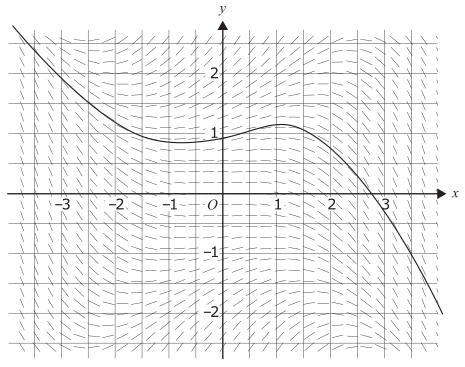
 

`(3, –0.5)`

`=> D`
Filed Under: Equations and Slope Fields, Equations and Slope Fields Tagged With: Band 5, smc-1197-10-Slope Fields, smc-7296-10-Slope Fields

Calculus, EXT1 C3 2017 SPEC2 8 MC

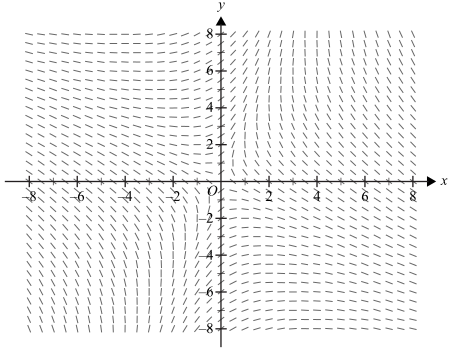
The differential equation that best represents the direction field above is

A.   `(dy)/(dx) = x - y^2`

B.   `(dy)/(dx) = y - x`

C.   `(dy)/(dx) = y^2 - x^2`

D.   `(dy)/(dx) = y^2 - x`
Show Answers Only

`D`

Show Worked Solution

`text(Use CAS to graph the direction field of each option.)`

`=>   D`

Filed Under: Equations and Slope Fields, Equations and Slope Fields Tagged With: Band 4, smc-1197-10-Slope Fields, smc-7296-10-Slope Fields

Calculus, EXT1 C3 2018 SPEC2 10 MC

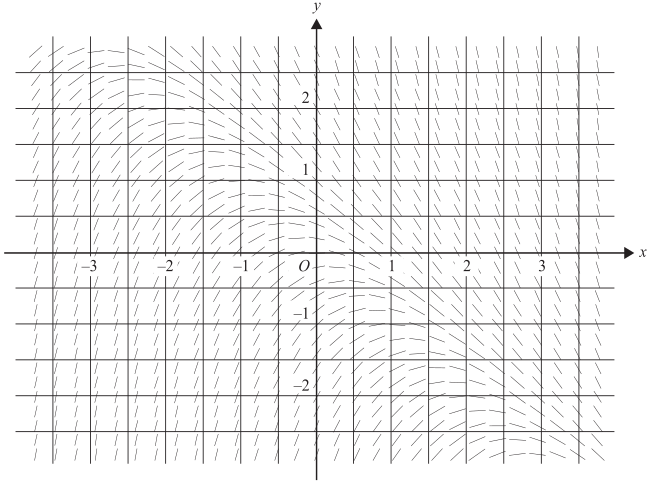
The differential equation that best represents the direction field above is

A.  `(dy)/(dx) = (2x + y)/(y - 2x)`

B.  `(dy)/(dx) = (x + 2y)/(2x - y)`

C.  `(dy)/(dx) = (2x - y)/(x + 2y)`

D.  `(dy)/(dx) = (x - 2y)/(y - 2x)`
Show Answers Only

`A`

Show Worked Solution

`text(When)\ \ x=0, \ m=1`

`text(When)\ \ y=0, \ m=-1`

`=>  A`

Filed Under: Equations and Slope Fields, Equations and Slope Fields Tagged With: Band 4, smc-1197-10-Slope Fields, smc-7296-10-Slope Fields

Calculus, EXT1 C3 2016 SPEC2 10 MC

The direction field for the differential equation  `(dy)/(dx) + x + y = 0`  is shown above.

A solution to this differential equation that includes  `(0, -1)`  could also include

A.  `(3, –1)`

B.  `(3.5, –2.5)`

C.  `(–1.5, –2)`

D.  `(2.5, –1)`
Show Answers Only

`B`

Show Worked Solution

 
`=>  B`

Filed Under: Equations and Slope Fields, Equations and Slope Fields Tagged With: Band 4, smc-1197-10-Slope Fields, smc-7296-10-Slope Fields

Calculus, EXT1 C3 2014 SPEC2 14 MC

The differential equation that is best represented by the above direction field is

A.   `(dy)/(dx) = 1/(x - y)`

B.   `(dy)/(dx) = y - x`

C.   `(dy)/(dx) = 1/(y - x)`

D.   `(dy)/(dx) = x - y`

Show Answers Only

`C`

Show Worked Solution

`text(Consider quadrant 2,)`

`x < 0, \ \ y > 0, \ \  m > 0\ \ => text(Eliminate A and D)`
 

`text(Consider vertical gradients where)\ \ m=oo\ \ => text(Eliminate B)`

 
`=> C`

Filed Under: Equations and Slope Fields, Equations and Slope Fields Tagged With: Band 4, smc-1197-10-Slope Fields, smc-7296-10-Slope Fields

Calculus, EXT1 C3 2013 SPEC2 12 MC

SPEC2 2013 VCAA 12 MC

The differential equation that best represents the above direction field is

A.   `(dy)/(dx) = x^2 - y^2`

B.   `(dy)/(dx) = y^2 - x^2`

C.   `(dy)/(dx) = −x/y`

D.   `(dy)/(dx) = x/y`

Show Answers Only

`D`

Show Worked Solution

`text(By inspection:)`

`text(When)\ \ x=0\ \ =>\ \ (dy)/(dx) = 0`

`text(When)\ \ y=0\ \ => (dy)/(dx) -> oo`

`:.\ text(Eliminate A, and B)`
 

`text(Along)\ \ y = x\ \ =>\ \ (dy)/(dx) > 0`

`:.\ text(Eliminate C)`

`=> D`

Filed Under: Equations and Slope Fields, Equations and Slope Fields Tagged With: Band 4, smc-1197-10-Slope Fields, smc-7296-10-Slope Fields

Calculus, EXT1 C3 2012 SPEC2 10 MC

The diagram that best represents the direction field of the differential equation  `(dy)/(dx) = xy`  is

A. B. 
C. D.
Show Answers Only

`A`

Show Worked Solution

`(dy)/(dx) = xy`

`text(When)\ \ x=0 \ or\  y=0\ \ =>\ text(gradient = 0)`

`text(In 1st and 3rd quartile)\ \ =>\ \ text(gradients positive)`

`text(In 2nd and 4th quartile)\ \ =>\ \ text(gradients negative)`

`=> A`

Filed Under: Equations and Slope Fields, Equations and Slope Fields Tagged With: Band 4, smc-1197-10-Slope Fields, smc-7296-10-Slope Fields

Calculus, EXT1 C3 2011 SPEC2 17 MC

SPEC2 2011 VCAA 17 MC

The differential equation which best represents the above direction field is

A.   `(dy)/(dx) = (y - 2x)/(2y + x)`

B.   `(dy)/(dx) = (2x - y)/(y - 2x)`

C.   `(dy)/(dx) = (2y - x)/(y + 2x)`

D.   `(dy)/(dx) = (y - 2x)/(2y - x)`

E.   `(dy)/(dx) = (x - 2y)/(2y + x)`

Show Answers Only

`A`

Show Worked Solution

`text(When)\ \ x=0\ \ => \ \ text(gradients are all positive)`

Almost half of all students answered incorrectly – mean mark 52%.

`text(Eliminate B and E.)`

`text(When)\ \ y=0\ \ => \ \ text(gradients are all negative)`

`text(Eliminate D.)`

`text(Option A will have zero gradient along)\ \ y=2x\ \ text{(correct)}`

`text(Option C will have zero gradient along)\ \ y=1/2 x\ \ text{(incorrect)}`

`=> A`

Filed Under: Equations and Slope Fields, Equations and Slope Fields Tagged With: Band 4, smc-1197-10-Slope Fields, smc-7296-10-Slope Fields

Calculus, EXT1 C3 2016 SPEC1 10

Solve the differential equation  `sqrt(2-x^2) (dy)/(dx) = 1/(2-y)`, given that  `y(1) = 0`. Express `y` as a function of  `x`.  (4 marks)

--- 10 WORK AREA LINES (style=lined) ---

Show Answers Only

`y = 2-sqrt(4 + pi/2-2 sin^(-1)(x/sqrt 2))`

Show Worked Solution
`sqrt(2-x^2) *(dy)/(dx)` `= 1/(2-y)`
`(2-y)* (dy)/(dx)` `= 1/sqrt(2-x^2)`
`int 2-y\ dy` `= int 1/(sqrt(2-x^2))\ dx`
`2y-y^2/2` `= sin^(-1) (x/sqrt 2) + c`

 
`text(Given)\ \ y(1) = 0:`

♦ Mean mark 46%.

`0=sin^(-1) (1/sqrt 2) + c`

`c=-pi/4`

`2y-y^2/2` `= sin^(-1) (x/sqrt 2)-pi/4`
`y^2-4y` `= -2 sin^(-1) (x/sqrt 2) + pi/2`
`(y-2)^2-4` `= -2 sin^(-1) (x/sqrt 2) + pi/2`
`(y-2)^2` `= 4 + pi/2-2 sin^(-1) (x/sqrt 2)`
`(y-2)` `= +- sqrt(4 + pi/2-2 sin^(-1) (x/sqrt 2))`
`y` `=2 +- sqrt(4 + pi/2-2 sin^(-1) (x/sqrt 2))`

 
`text(Given)\ \ y=0\ \ text(when)\ \ x=1:`

`:. y=2-sqrt(4 + pi/2-2 sin^(-1) (x/sqrt 2))`

Filed Under: Equations and Slope Fields, Equations and Slope Fields Tagged With: Band 5, smc-1197-20-Differential Equations, smc-1197-30-\(\dfrac{dy}{dx}=f(x y)\), smc-7296-20-Differential Equations, smc-7296-30-\(\dfrac{dy}{dx}=f(x y)\), y)

Calculus, EXT1 C3 2017 SPEC1-N 7

Let  `(dy)/(dx) = (4 - y)^2`.

Express  `y`  in terms of  `x`, where  `y(0) = 3`.  (3 marks)

--- 6 WORK AREA LINES (style=lined) ---

Show Answers Only

`y = 4-1/(x + 1)`

Show Worked Solution
`(dy)/(dx)` `=(4-y)^2`
`(dx)/(dy)` `= 1/(4-y)^2`
`x` `= int 1/(4-y)^2\ dy`
  `= int (4-y)^(-2) dy`
  `= (-1)(-1)(4-y)^(-1)+ c`
  `= 1/(4-y) + c`

 
`text(When)\ \ x=0,\ \ y=3:`

`0` `= 1/(4-3) + c`
`:.c` `= -1`


`x` `= 1/(4-y) – 1`
`x + 1` `= 1/(4-y)`
`1/(x + 1)` `= 4-y`
`:. y` `= 4-1/(x + 1)`

Filed Under: Equations and Slope Fields, Equations and Slope Fields Tagged With: Band 4, smc-1197-20-Differential Equations, smc-1197-40-\(\dfrac{dy}{dx}=f(y)\), smc-7296-20-Differential Equations, smc-7296-40-\(\dfrac{dy}{dx}=f(y)\)

Calculus, EXT1 C3 2017 SPEC2 9 MC

The gradient of the tangent to a curve at any point  `P(x, y)`  is half the gradient of the line segment joining `P` and the point  `Q(-1, 1)`.

The coordinates of points on the curve satisfy the differential equation

A.   `(dy)/(dx) = (y + 1)/(2(x - 1))`

B.   `(dy)/(dx) = (2(y - 1))/(x + 1)`

C.   `(dy)/(dx) = (x - 1)/(2(y + 1))`

D.   `(dy)/(dx) = (y - 1)/(2(x + 1))`

Show Answers Only

`D`

Show Worked Solution
`m_text(tang)` `= 1/2 m_(PQ)`
`m_(PQ)` `= (y – 1)/(x – (-1))`
  `= (y – 1)/(x + 2)`

 
`:. m_text(tang) = (dy)/(dx) = (y – 1)/(2(x + 1))`

`=>   D`

Filed Under: Equations and Slope Fields, Equations and Slope Fields Tagged With: Band 4, smc-1197-10-Slope Fields, smc-7296-10-Slope Fields

Calculus, EXT1 C3 2017 SPEC2-N 10 MC

A solution to the differential equation  `(dy)/(dx) = (cos(x + y) - cos(x - y))/(e^(x + y))`  can be obtained from

  1. `int e^y/(sin(y))\ dy = -int (2 sin(x))/e^x\ dx`
  2. `int e^y/(cos(y))\ dy = int 2/e^x\ dx`
  3. `int e^y/(cos(y))\ dy = -int (2 cos(x))/e^x\ dx`
  4. `int e^y/(cos(y))\ dy = int (2 sin(x))/e^x\ dx`
Show Answers Only

`A`

Show Worked Solution
`dy/dx` `=(cos(x + y) – cos(x – y))/(e^(x + y))`
`(dy)/(dx)` `= (cos(x) cos(y) – sin(x) sin(y) – cos(x) cos(y) – sin(x) sin(y))/(e^x ⋅ e^y)`
`e^y *(dy)/(dx)` `= (-2 sin(x) sin(y))/(e^x)`
`e^y/(sin(y)) *(dy)/(dx)` `= (-2 sin(x))/(e^x)`
`:. int e^y/(sin(y))\ dy` `= -int (2 sin(x))/e^x\ dx`

 
`=>   A`

Filed Under: Equations and Slope Fields, Equations and Slope Fields Tagged With: Band 4, smc-1197-20-Differential Equations, smc-1197-30-\(\dfrac{dy}{dx}=f(x y)\), smc-7296-20-Differential Equations, smc-7296-30-\(\dfrac{dy}{dx}=f(x y)\), y)

Calculus, EXT1 C3 2018 SPEC2 9 MC

A solution to the differential equation  `(dy)/(dx) = 2/{sin(x + y) - sin(x - y)}`  can be obtained from

  1. `int 1\ dx = int 2 sin(y)\ dy`
  2. `int cos(y)\ dy = int text{cosec}(x)\ dx`
  3. `int cos(x)\ dx = int text{cosec}(y)\ dy`
  4. `int sec(x)\ dx = int sin(y)\ dy`
Show Answers Only

`D`

Show Worked Solution
`(dy)/(dx)` `= 2/{sin(x) cos(y) + sin(y) cos(x) – (sin(x) cos(y) – sin(y) cos(x))}`
  `= 2/{2 sin(y) cos(x)}`
  `= 1/{sin(y) cos(x)}`

 
`sin(y) *(dy)/(dx)= sec(x)`

`int sin (y)\ dy= int sec(x)\ dx`

`=>  D`

Filed Under: Equations and Slope Fields, Equations and Slope Fields Tagged With: Band 4, smc-1197-20-Differential Equations, smc-1197-30-\(\dfrac{dy}{dx}=f(x y)\), smc-7296-20-Differential Equations, smc-7296-30-\(\dfrac{dy}{dx}=f(x y)\), y)

Calculus, EXT1 C3 2015 SPEC2 12

Find  `y`  given  `dy/dx = 1 - y/3`  and  `y = 4`  when  `x = 2`.   (2 marks)

--- 6 WORK AREA LINES (style=lined) ---

Show Answers Only

`y= 3 + e^((2 – x)/3)`

Show Worked Solution
`(dy)/(dx)` `= (3 – y)/3`
`(dx)/(dy)` `= 3/(3 – y)`
`x` `= int 3/(3 – y)\ dy`
`x/3` `= -ln |3 – y| + c`

 
`text(Given)\ \ y=4\ \ text(when)\ \ x=2:`

`2/3= -ln|-1| + c`

`c=2/3`
 

` x/3` `=-ln |3 – y| +2/3`
`ln|3-y|` `= (2-x)/3`
`3-y` `= ±e^((2 – x)/3)`
`:. y` `= 3 + e^((2 – x)/3)`

Filed Under: Equations and Slope Fields, Equations and Slope Fields Tagged With: Band 3, smc-1197-20-Differential Equations, smc-1197-40-\(\dfrac{dy}{dx}=f(y)\), smc-7296-20-Differential Equations, smc-7296-40-\(\dfrac{dy}{dx}=f(y)\)

Copyright © 2014–2026 SmarterEd.com.au · Log in