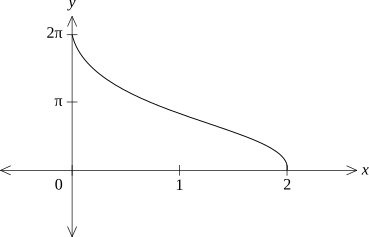
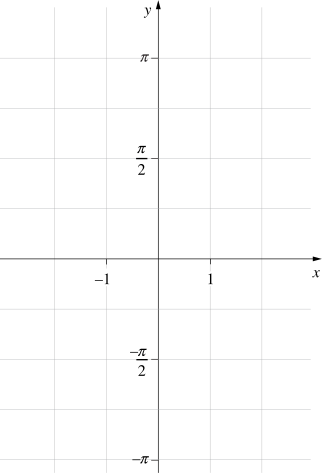
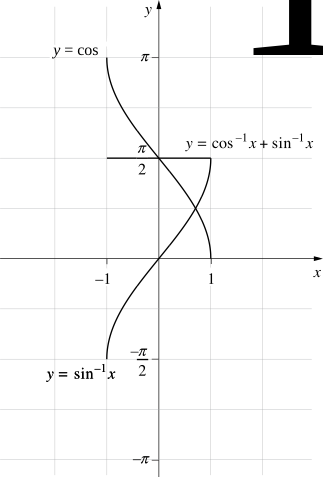
On the number plane provided below, draw \(y=\cos ^{-1} x+\sin ^{-1} x\) by first drawing \(y=\cos ^{-1} x\) and \(y=\sin ^{-1} x\). (3 marks)
--- 3 WORK AREA LINES (style=lined) ---
Show Answers Only
Show Worked Solution
Aussie Maths & Science Teachers: Save your time with SmarterEd
On the number plane provided below, draw \(y=\cos ^{-1} x+\sin ^{-1} x\) by first drawing \(y=\cos ^{-1} x\) and \(y=\sin ^{-1} x\). (3 marks)
--- 3 WORK AREA LINES (style=lined) ---
Sketch the graph of \(y=\dfrac{1}{3} \cos ^{-1}(2 x)\). (2 marks)
--- 5 WORK AREA LINES (style=lined) ---
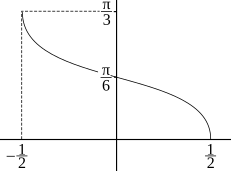
\(y=\dfrac{1}{3} \cos ^{-1}(2 x)\)
\(\text{Domain:} \ -1 \leqslant 2 x \leqslant 1 \ \Rightarrow \ -\dfrac{1}{2} \leqslant x \leqslant \dfrac{1}{2}\)
\(\text{Range:} \ \cos (2 x) \in[0, \pi] \ \Rightarrow \ \dfrac{1}{3} \cos (2x) \in\left[0, \dfrac{\pi}{3}\right]\)
Consider the function \(g(x) = 2 \sin^{-1}(3x)\).
Which transformations have been applied to \(f(x) = \sin^{-1}(x)\) to obtain \(g(x)\)?
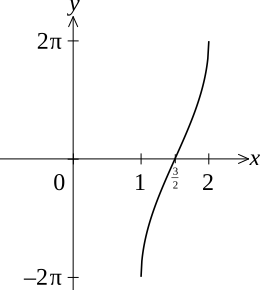
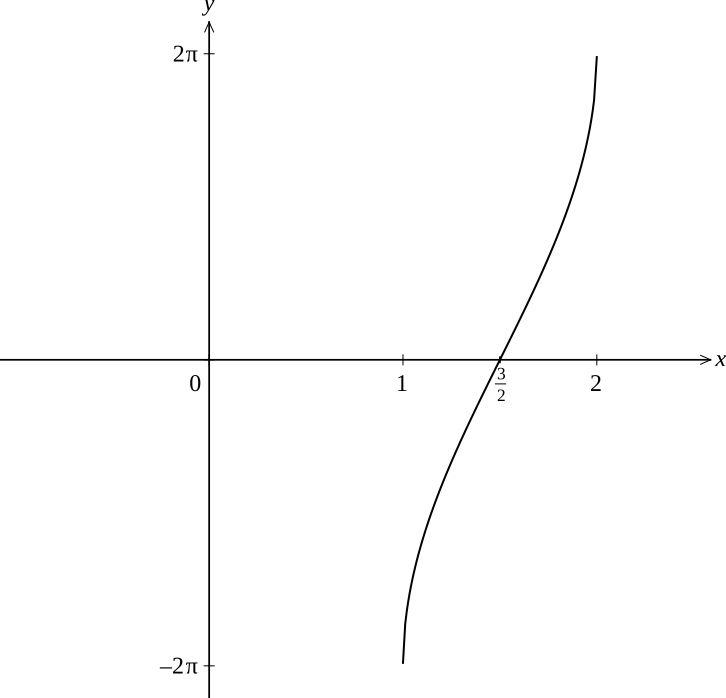
What are the domain and range of the function \(y = 2 \cos^{-1}(2x) + 2 \sin^{-1}(2x)\)?
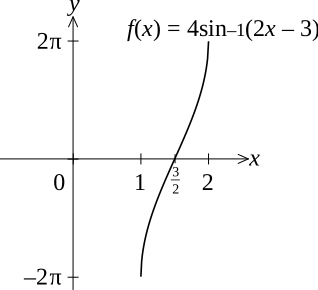
--- 5 WORK AREA LINES (style=lined) --- --- 6 WORK AREA LINES (style=blank) --- a. \(\text{Domain:}\ \ 1 \leqslant x \leqslant 2\) \(\text{Range:}\ \ -2 \pi \leqslant 4 y \leqslant 2 \pi\) b.
Show Answers Only
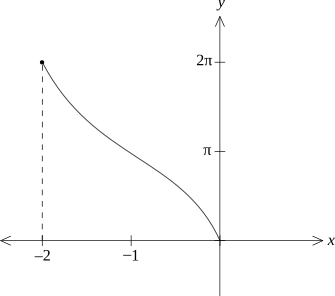
Sketch the graph \(y=2 \cos ^{-1}(x+1)\). (3 marks) --- 10 WORK AREA LINES (style=lined) --- \(\text{Domain:}\) \(-1 \leqslant x+1 \leqslant 1 \ \Rightarrow \ -2 \leqslant x \leqslant 0\) \(\text{Range:}\) \(0 \leqslant \cos ^{-1}(x) \leqslant \pi\ \ \Rightarrow \ \ 0\leqslant 2 \cos ^{-1}(x) \leqslant 2 \pi\)
Show Answers Only
 Show Worked Solution
State the domain and range of the function \(y=\arccos \, 3x\). (2 marks) --- 5 WORK AREA LINES (style=lined) ---
Which statement is always true for real numbers \(a\) and \(b\) where \(-1 \leqslant a<b \leqslant 1\)?
\(\text{Consider the graph of}\ \ y=\sin^{-1}x \)
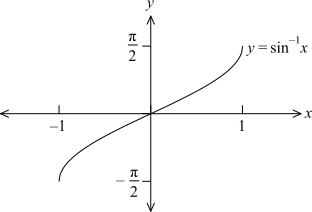
\( y=\sin^{-1}x\ \ \text{is an increasing function in range}\ \ -1 \leqslant x \leqslant 1 \)
\(\therefore\ \text{Given}\ \ -1 \leqslant a<b \leqslant 1\ \ \Rightarrow \sin ^{-1} a<\sin ^{-1} b \)
\(\Rightarrow B\)
Which of the following is the value of \(\sin ^{-1}(\sin a)\) given that \(\pi<a<\dfrac{3 \pi}{2}\)?
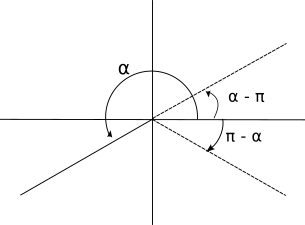
| \(\sin(a)\) | \(=-\sin(a-\pi)\ \ \text{(see above)}\) |
| \(\sin^{-1}(\sin(a))\) | \(=\sin^{-1}(-\sin(a-\pi))\) |
| \(=\sin^{-1}(\sin(\pi-a)) \) | |
| \(=\pi-a \) |
\(\Rightarrow B\)
Sketch `y=3cos^(-1)(2x-1).` (3 marks)
--- 10 WORK AREA LINES (style=lined) ---

`text{Domain:}`
| `-1` | `<=(2x-1)<=1` |
| `0` | `<=2x<=2` |
| `0` | `<=x<=1` |
`text{Range of}\ \ cos^(-1)(x)=[0,pi]`
`=>\ text{Range of}\ \ 3cos^(-1)(x)=[0,3pi]`
`text{At}\ \ x=0,\ \ y=3cos^(-1)(-1)=3pi`
`text{Sketch}\ \ y=3cos^(-1)(2x-1):`
The function `f` is defined by `f(x)=\sin (x)` for all real numbers `x`. Let `g` be the function defined on `[-1,1]` by `g(x)=\arcsin (x)`.
Is `g` the inverse of `f`? Justify your answer. (2 marks)
--- 5 WORK AREA LINES (style=lined) ---
It is given that `cos((23 pi)/(12))=(sqrt6+sqrt2)/(4)`.
Which of the following is the value of `cos^(-1)((sqrt6+sqrt2)/(4))`?
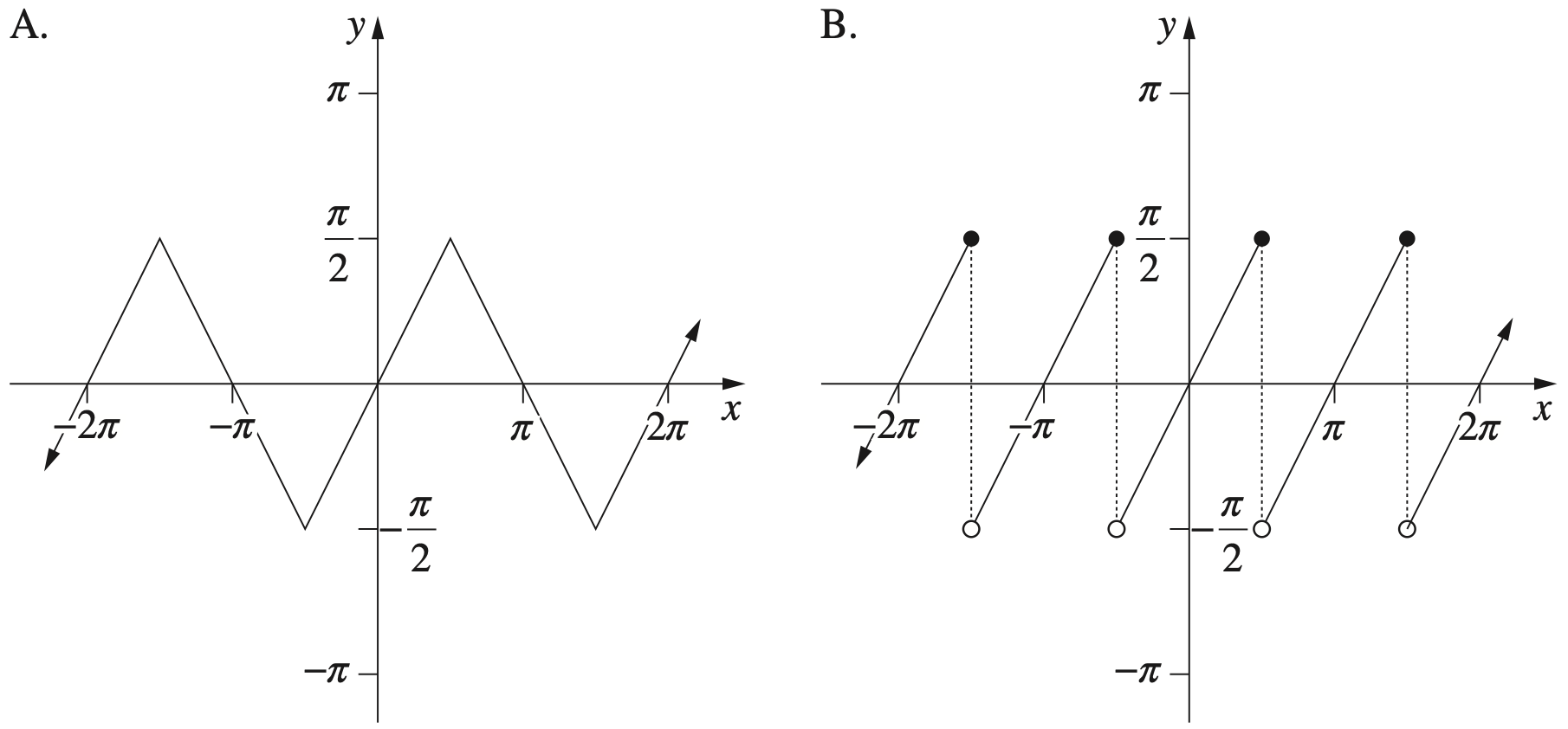
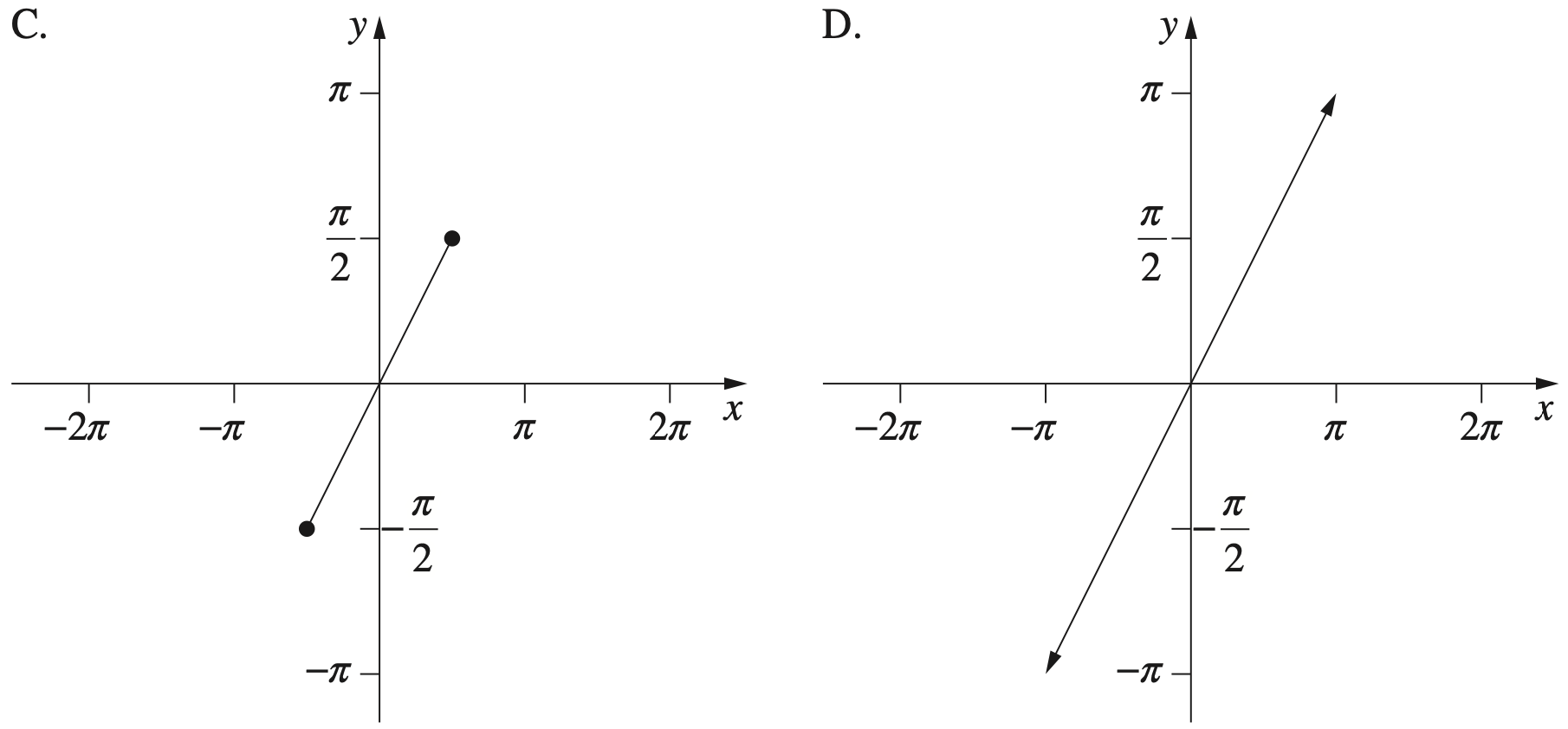
Which graph represents the function `y = sin^(-1) (sin x)`?
The graph of the function `y = sin^(-1)(x-2)` is transformed by being dilated by a factor of 3 from the `y`-axis and then translated to the right by 2.
What is the equation of the transformed graph?
The graph of the function `y = arccos(x-3)` is transformed by being dilated horizontally with a scale factor of `1/2` and then translated to the left by `1`.
What is the equation of the transformed graph?
Determine the exact value of
`sin^(-1)(sqrt3/2)-sin^(-1)(-sqrt3/2)-cos^(-1)(-1/2)`. (3 marks)
--- 8 WORK AREA LINES (style=lined) ---
Evaluate `beta` if `beta = cos^(-1)(-sqrt3/2)`. (2 marks)
--- 5 WORK AREA LINES (style=lined) ---
Show that `cos(sin^(-1)q) = sqrt(1-q^2)` (2 marks)
--- 6 WORK AREA LINES (style=lined) ---
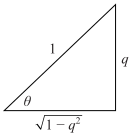
| `sin theta` | `=q` |
| `theta` | `=sin^(-1)q` |
| `:. cos(sin^(-1)q)` | `= cos theta` |
| `= sqrt(1-q^2)` |
Find `sin theta` given that `theta = arccos (12/13) + arctan (3/4)`, and `0<=theta<=pi/2`. (3 marks)
--- 7 WORK AREA LINES (style=lined) ---
| `sin theta` | `= sin (cos^(-1) (12/13) + tan^(-1)(3/4))` |
| `= sin (cos^(-1) (12/13)) cos (tan^(-1) (3/4)) + sin (tan^(-1)(3/4)) cos (cos^(-1)(12/13))` |
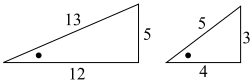
| `:. sin theta` | `= 5/13 xx 4/5 + 3/5 xx 12/13` |
| `= 20/65 + 36/65` | |
| `= 56/65` |
Which graph best represents `y = cos^(-1) (-sin x)`, for `-pi/2 <= x <= pi/2`?
| A. | 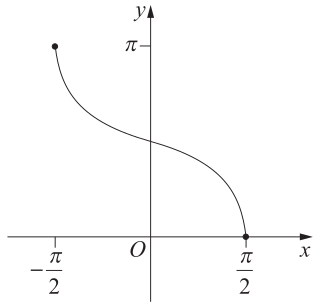 |
B. | 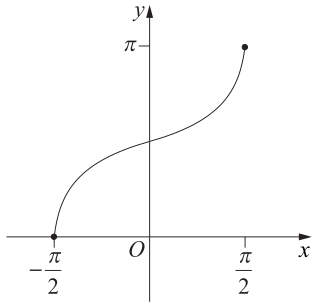 |
| C. | 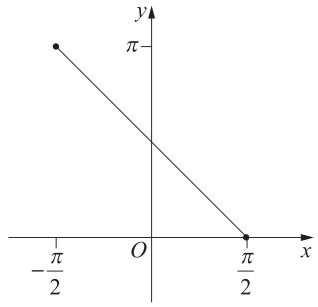 |
D. | 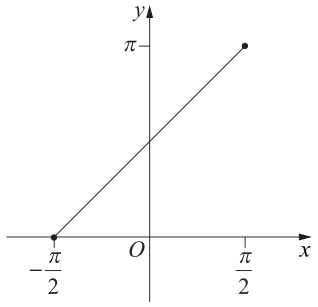 |
Sketch the graph of the function `y = 2cos^(-1)x`. (2 marks)
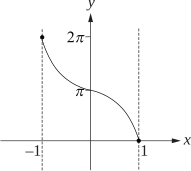
`y = 2cos^(-1)x`
`=> text(Domain)\ -1 <= x <= 1`
`text(Range)\ \ y = 2cos^(-1)x\ \ text(is)\ \ 0 <= y <= pi`
`=> text(Range)\ \ y = 2cos^(-1)x\ \ text(is)\ \ 0 <= y <= 2pi`
Which diagram represents the domain of the function `f(x) = sin^(−1)(3/x)`?
| A. |  |
| B. |  |
| C. |  |
| D. |  |
Find the exact values of `x` and `y` which satisfy the simultaneous equations
`sin^(-1)\ x + 1/2\ cos^(-1)\ y = pi/3` and
`3\ sin^(-1)\ x-1/2\ cos^(-1)\ y = (2pi)/3`. (3 marks)
--- 8 WORK AREA LINES (style=lined) ---
Let `f(x) = 2 cos^(-1)x`.
--- 8 WORK AREA LINES (style=lined) ---
--- 2 WORK AREA LINES (style=lined) ---
a. `y= 2\ cos^(-1)x`
`text(Domain:)\ -1 ≤ x ≤ 1`
| `text{Range:}\ \0 ≤` | `y/2 ≤ pi` |
| `0 ≤` | `y ≤ 2pi` |

b. `text(Range:)\ \ 0 ≤ y ≤ 2pi`
Let `f(x) = sin^-1 (x + 5).`
--- 4 WORK AREA LINES (style=lined) ---
--- 4 WORK AREA LINES (style=lined) ---
--- 8 WORK AREA LINES (style=lined) ---
a. `text(Domain):\ -6 <= x <= -4, \ \ \ text(Range):\ -pi/2 <= y <= pi/2`
b. `1`
c.

a. `f(x) = sin^-1 (x + 5)`
`text(Domain)`
`-1 <= x + 5 <= 1`
`-6 <= x <= -4`
`text(Range)`
`-pi/2 <= y <= pi/2`
b. `y = sin^-1 (x + 5)`
`(dy)/(dx) = 1/sqrt(1-(x + 5)^2)`
`text(When)\ \ x = -5`
| `(dy)/(dx)` | `= 1/sqrt(1-(-5 + 5)^2)` |
| `= 1/sqrt(1-0)` | |
| `= 1` |
`:.\ text(Gradient of)\ \ y = f(x)\ \ text(at)\ \ x = -5\ \ text(is)\ \ 1.`
|
c. |
|
State the domain and range of `y = cos^-1 (x/4)`. (2 marks)
--- 5 WORK AREA LINES (style=lined) ---
What is the domain of the function `f(x) = sin^(-1)\ (2x)`?
Sketch the graph `y = 6 tan^(-1)x`, clearly indicating the range. (2 marks)

`y = 6 tan^(-1)x`
The diagram shows the graph of a function.

Which function does the graph represent?
Let `f(x) = cos^(-1) (x/2)`. What is the domain of `f(x)`? (1 mark)
Sketch the graph of the function `f(x) = 2arccos x`. Clearly indicate the domain and range of the function. (2 marks)

| `y` | `= 2 cos^(-1) x` |
| `y/2` | `= cos^(-1)x` |
`text(Domain)\ -1 <= x <= 1`
`text(S)text(ince)\ \ 0 <= y/2 <= pi`
`text(Range)\ 0 <= y <= 2pi`
Find the exact value of `cos^(-1)(-1/2)`. (1 mark)
Write `sin(2 cos ^(-1) (2/3))` in the form `a sqrtb`, where `a` and `b` are rational. (2 mark)
--- 5 WORK AREA LINES (style=lined) ---
`sin (2 cos^(-1) (2/3))`
`text(Let)\ \ x = cos ^(-1) (2/3)`
`:.\ cos x = 2/3`

`sin x = sqrt5/3`
| `sin(2 cos^(-1) (2/3))` | `= sin 2x` |
| `= 2 sin x cos x` | |
| `= 2 xx sqrt5/3 xx 2/3` | |
| `= 4/9 sqrt5` |
Which function best describes the following graph?