SmarterEd

Aussie Maths & Science Teachers: Save your time with SmarterEd

  • Login
  • Get Help
  • About

Trigonometry, 2ADV T1 2025 HSC 29

The point \(T\) is the peak of a mountain and the point \(O\) is directly below the mountain's peak. The point \(Y\) is due east of \(O\) and the angle of elevation of \(T\) from \(Y\) is 60°. The point \(F\) is 4 km south-west of \(Y\). The points \(O, Y\) and \(F\) are on level ground. The angle of elevation of \(T\) from \(F\) is 45°.
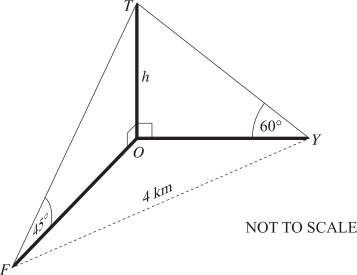
 

  1. Let the height of the mountain be \(h\).
  2. Show that  \(O Y=\dfrac{h}{\sqrt{3}}\).   (1 mark)

    --- 5 WORK AREA LINES (style=lined) ---

  3. Hence, or otherwise, find the value of \(h\), correct to 2 decimal places.   (3 marks)

    --- 16 WORK AREA LINES (style=lined) ---

  4. Find the bearing of point \(O\) from point \(F\), correct to the nearest degree.   (3 marks)

    --- 8 WORK AREA LINES (style=lined) ---

Show Answers Only

a.   \(\text{See Worked Solutions}\)

b.   \(h=3.03 \ \text{km}\)

c.   \(\text {Bearing of \(O\) from \(F\)}=021^{\circ} \)

Show Worked Solution

a.    \(\text{In}\ \triangle TOY:\)

\(\tan 60^{\circ}\) \(=\dfrac{h}{OY}\)  
\(OY\) \(=\dfrac{h}{\tan 60^{\circ}}\) \(=\dfrac{h}{\sqrt{3}}\)


b.   \(\text{In}\ \triangle TOF:\)

\(\tan 45^{\circ}=\dfrac{h}{OF} \ \Rightarrow \ OF=h\)

\(\text{Since \(Y\) is due east of \(O\) and \(F\) is south-west of \(Y\):}\)

\(\angle OYF =45^{\circ}\)
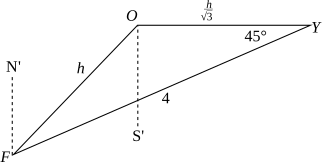
 

♦♦♦ Mean mark (b) 25%.

\(\text{Using cosine rule in} \ \triangle OYF:\)

\(OY^2+YF^2-2 \times OY \times YF\, \cos 45^{\circ}\) \(=OF^2\)
\(\left(\dfrac{h}{\sqrt{3}}\right)^2+4^2-2 \times \dfrac{h}{\sqrt{3}} \times 4 \times \dfrac{1}{\sqrt{2}}\) \(=h^2\)
\(\dfrac{h^2}{3}+16-\dfrac{8}{\sqrt{6}} h\) \(=h^2\)
\(\dfrac{2}{3} h^2+\dfrac{8}{\sqrt{6}} h-16\) \(=0\)


\(h\)

\(=\dfrac{\dfrac{-8}{\sqrt{6}}+\sqrt{\frac{64}{6}+4 \times \frac{2}{3} \times 16}}{2 \times \frac{2}{3}}\ \ \ (h>0)\)
  \(=3.0277 \ldots\)
  \(=3.03 \ \text{km (to 2 d.p.)}\)

 
c.
    \(\text {Using sine rule in} \ \ \triangle OYF:\)

\(\dfrac{\sin\angle FOY}{4}\) \(=\dfrac{\sin 45^{\circ}}{3.03}\)  
\(\sin \angle F O Y\) \(=\dfrac{4 \times \sin 45^{\circ}}{3.03}=0.93347\)  
\(\angle FOY\) \(=180-\sin^{-1}(0.93347)=180-68.98 \ldots = 111^{\circ} \ \text{(angle is obtuse)}\)  
♦♦♦ Mean mark (c) 12%.

\(\angle FO\text{S}^{\prime}=111-90=21^{\circ}\)

\(\angle \text{N}^{\prime}FO=21^{\circ}(\text {alternate})\)

\(\therefore \ \text {Bearing of \(O\) from \(F\)}=021^{\circ} \)
Filed Under: 3D Trigonometry, 3D Trigonometry (Y11) Tagged With: Band 4, Band 5, Band 6

Trigonometry, 2ADV T1 EQ-Bank 4

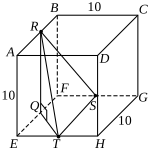
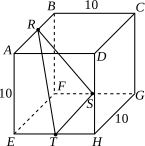
A cube \(ABCDEFGH\) is pictured below. \(R\), \(S\), and \(T\) are the midpoints of \(A B, F G\) and \(E H\) as shown.


Calculate the size of the angle \(TRS\), giving your answer to one decimal place.    (4 marks)

--- 10 WORK AREA LINES (style=lined) ---

Show Answers Only

\(\angle T R S = 41.2^{\circ}\)

Show Worked Solution
 

\(S T=10\)

\(\text{Find} \ \ RT \ \ \text{using} \ \ \triangle RQT:\)

\(R Q=10\)

\(\text{In} \ \ \triangle QET, QE=ET=5\)

\(\text{By Pythagoras }\)

\(QT=\sqrt{5^2+5^2}=\sqrt{50}\)

\(RT=\sqrt{10^2+(\sqrt{50})^2}=\sqrt{150}\)

\(\text{By symmetry,} \ \ RS=\sqrt{150}\)
 

\(\text{Using cosine rule in} \ \ \triangle RST:\)

\(\cos \angle TRS=\dfrac{(\sqrt{150})^2+(\sqrt{150})^2-10^2}{2 \times \sqrt{150} \times \sqrt{150}}=\dfrac{2}{3}\)

\(\therefore \angle T R S\) \(=\cos ^{-1}\left(\frac{2}{3}\right)\)
  \(=41.18^{\circ} \ldots\)
  \(=41.2^{\circ}\)

Filed Under: 3D Trigonometry, 3D Trigonometry (Y11) Tagged With: Band 5

Trigonometry, 2ADV T1 2024 HSC 20

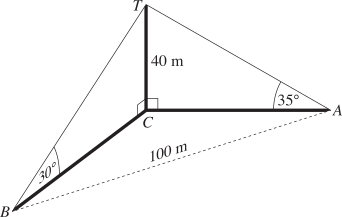
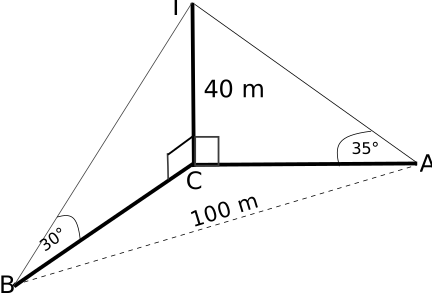
A vertical tower \(T C\) is 40 metres high. The point \(A\) is due east of the base of the tower \(C\). The angle of elevation to the top \(T\) of the tower from \(A\) is 35°. A second point \(B\) is on a different bearing from the tower as shown. The angle of elevation to the top of the tower from \(B\) is 30°. The points \(A\) and \(B\) are 100 metres apart.
 

  1. Show that distance \(A C\) is 57.13 metres, correct to 2 decimal places.  (1 mark)

    --- 5 WORK AREA LINES (style=lined) ---

  1. Find the bearing of \(B\) from \(C\) to the nearest degree.  (3 marks)

    --- 12 WORK AREA LINES (style=lined) ---

Show Answers Only

\(194^{\circ}\)

Show Worked Solution

a.   \(\text{In}\ \Delta TCA:\)

\(\tan 35°\) \( =\dfrac{40}{AC}\)  
\(AC\) \( =\dfrac{40}{\tan 35°}\)  
  \(=57.125…\)  
  \(=57.13\ \text{m (2 d.p.)}\)  

 
b. 
 \(\text{In}\ \Delta TCB:\)

\(\tan 30°\) \( =\dfrac{40}{BC}\)  
\(BC\) \( =\dfrac{40}{\tan 30°}\)  
  \(=69.28\ \text{m}\)  

  
\( \text{Find} \ \angle BCA \ \text{using cosine rule:}\)

\(\cos \angle B CA\) \( = \dfrac{57.13^2+69.28^2-100^2}{2 \times 57.13 \times 69.28}\)  
  \(= -0.2446 \)…  
\(\angle BCA\) \( = 104.2° \)  

\(\therefore\ \text{Bearing of}\ B\ \text{from}\ C= 90+104=194^{\circ} \text{(nearest degree)} \)

Filed Under: 3D Trigonometry, 3D Trigonometry (Y11) Tagged With: Band 2, Band 4

Trigonometry, 2ADV T1 EQ-Bank 3

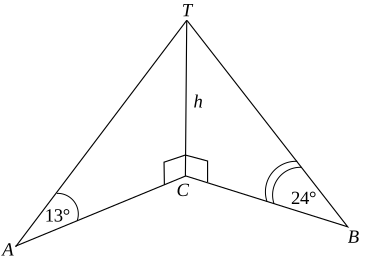
A tower \(T C\) is \(h\) metres high.

At point \(A\), due south of the tower, the angle of elevation to the top of the tower, point \(T\), is 13°.

Point \(B\) is due east of the tower, with an angle of elevation to the top of 24°, as shown in the diagram.

Point \(A\) is 1.1 kilometres from Point \(B\) and both points are on the same ground level as the base of the tower, point \(C\).


  1. Show \(B C=h \times \tan 66^{\circ}\).   (1 mark)

    --- 3 WORK AREA LINES (style=lined) ---

  2. Find a similar expression for \(A C\).   (1 mark)

    --- 3 WORK AREA LINES (style=lined) ---

  3. Hence, or otherwise, determine the height, \(h\), of the tower. Give your answer correct to the nearest metre.   (3 marks)

    --- 5 WORK AREA LINES (style=lined) ---

Show Answers Only

a.   \(\text{See Worked Solutions}\)

b.   \(\text{See Worked Solutions}\)

c.   \(\text{225 metres}\)

Show Worked Solution

a.   \(\text{In}\ \Delta TBC\ \Rightarrow \angle CTB=90-24=66^{\circ}\)

\(\tan 66^{\circ}\) \(=\dfrac{BC}{h} \)  
\(BC\) \(=h \times \tan 66^{\circ}\)  


b.   \(\text{In}\ \Delta TAC\ \Rightarrow \angle CTA=90-13=77^{\circ}\)

\(\tan 77^{\circ}\) \(=\dfrac{AC}{h} \)  
\(AC\) \(=h \times \tan 77^{\circ}\)  

 
c.   \(\Delta ACB\ \text{is right-angled.}\)
  

\(\text{By Pythagoras:}\)

\(AC^{2}+BC^{2}\) \(=1100^{2}\)  
\(h^2 \times \tan^{2} 77^{\circ} + h^2 \times \tan^{2}66^{\circ}\) \(=1100^2\)  
\(h^2(\tan^{2} 77^{\circ}+\tan^{2} 66^{\circ})\) \(=1100^2\)  
\(h^2\) \(=\dfrac{1100^2}{(\tan^{2} 77^{\circ}+\tan^{2} 66^{\circ})}\)  
\(h\) \(=225.44…\)  
  \(=225\ \text{m (nearest m)}\)  

Filed Under: 3D Trigonometry, 3D Trigonometry (Y11) Tagged With: Band 4, Band 5

Trigonometry, 2ADV T1 2023 HSC 22

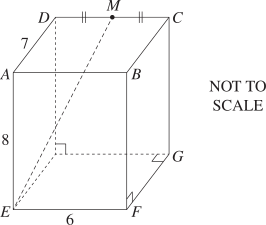
In the rectangular prism shown, \(AD\) = 7 cm, \(AE\) = 8 cm, \(EF\) = 6 cm. Point \(M\) is the midpoint \(CD\).
  

Find \(\angle AEM\) to the nearest degree.  (3 marks)

--- 6 WORK AREA LINES (style=lined) ---

Show Answers Only

\(44°\)

Show Worked Solution

\(DM=MC= \frac{1}{2} \times 6 = 3\)

\(\text{Consider}\ \triangle ADM:\)

\(\text{By Pythagoras,}\)

\(AM^2\) \(= 7^2 + 3^2\)  
  \(=58\)  
\(AM\) \(=\sqrt{58}\)  


\(\text{In}\ \triangle AEM:\)

\(\tan \angle AEM\) \(= \dfrac{AM}{AE}\)  
  \(= \dfrac{\sqrt{58}}{8}\)  
\(\angle AEM\) \(=\tan^{-1}\Big{(}\dfrac{\sqrt{58}}{8}\Big{)}\)  
  \(= 43.59…\)  
  \(= 44°\ \text{(nearest degree)}\)  

Filed Under: 3D Trigonometry, 3D Trigonometry (Y11) Tagged With: Band 4

Trigonometry, 2ADV T1 2022 HSC 3 MC

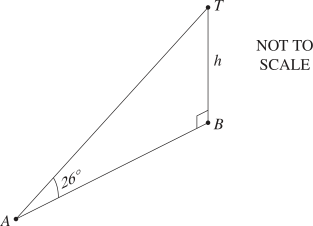
A tower `B T` has height `h` metres.

From point `A`, the angle of elevation to the top of the tower is `26^@` as shown.


Which of the following is the correct expression for the length of `A B` ?

  1. `h  tan 26^(@)`
  2. `h  cot 26^(@)`
  3. `h  sin 26^(@)`
  4. `h\ text{cosec}\ 26^(@)`
Show Answers Only

`B`

Show Worked Solution
`tan 26^@` `=h/(AB)`  
`AB` `=h/(tan26^@)`  
  `=h\ cot26^@`  

 
`=>B`

Filed Under: 3D Trigonometry, 3D Trigonometry (Y11) Tagged With: Band 4

2ADV Snapshot: T1 3D Trigonometry

HISTORICAL CONTRIBUTION

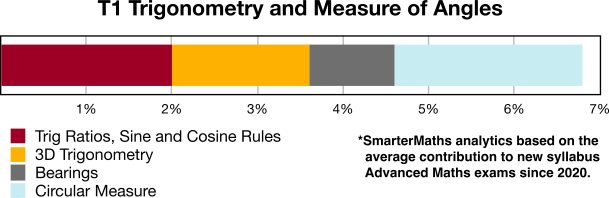
  • T1 Trigonometry and Measure of Angles has contributed a healthy average of 6.8% per Advanced exam since the new syllabus was introduced in 2020.
  • This topic has been split into four sub-topics for analysis purposes: 1-Trig Ratios, Sine and Cosine Rules (2.0%), 2- 3D Trigonometry (1.6%), 3-Bearings (1.0%) and 4-Circular Measure (2.2%).
  • This analysis looks at 3D Trigonometry (previously Ext1 content).

HSC ANALYSIS - What to expect and common pitfalls

  • 3D Trigonometry (1.6%) now has two consecutive years of 3-mark allocations after being allocated just a single mark in the 3 previous new syllabus Advanced exams.
  • 3D Trig in its existence in the Advanced syllabus so far, has been tested around the band 4 difficulty level. We note that questions can get much more challenging and cater for this in the database (note questions taken from past Ext1 exams have ADV' in the title).
  • The challenging T1 SM-Bank 1 represents the highest level of difficulty this topic could present.

Filed Under: 3D Trigonometry, 3D Trigonometry (Y11) Tagged With: worksheet-preamble

Trigonometry, 2ADV T1 SM-Bank 1

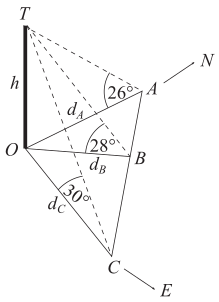
A tower is built on flat ground.

Three tourists, `A`, `B` and `C` are observing the tower from ground level.

`A` is due north of the tower, `C` is due east and `B` is on the line of sight from `A` and `C` and between them.

The angles of elevation to the top of the tower from `A`, `B` and `C` are 26°, 28° and 30°, respectively.

What is the bearing of `B` from the tower?  (4 marks)

Show Answers Only

`005°`

Show Worked Solution


`text(Let)\ \ h =\ text(height of tower)`

`text(In)\ DeltaOAT:`

`tan26^@` `= h/(d_A)`
`d_A` `= h/(tan26^@)`

 
`text(Similarly,)`

`d_B` `= h/(tan28^@)`
`d_C` `= h/(tan30^@)`

   
`text(In)\ DeltaOAC:`

`tan angleOAC` `= (d_C)/(d_A)`
  `= (h/(tan30^@))/(h/(tan26^@))`
  `= (tan26^@)/(tan30^@)`
  `= 0.8447…`
`angleOAC` `= 40.19^@`

 
`text(Using sine rule in)\ DeltaOAB:`

`(sinangleABO)/(d_A)` `= (sinangleOAC)/(d_B)`
`sinangleABO` `= sin40.2^@ xx (tan28^@)/(tan26^@)`
  `= 0.7035…`
`angleABO` `= 44.71^@\ text(or)\ 135.29^@`


`text(S)text(ince)\ \ angleOCA` `= tan^(−1)((tan30)/(tan26))`
  `= 49.8^@`

 
`=> angleOBC = 44.71°`

`(text(otherwise angle sum)\ DeltaOBC > 180°)`
 

`angleAOB` `= 180 – (40.19 + 135.29)`
  `= 4.52`

 
`:.\ text(Bearing of)\ B\ text(from tower is)\ 005°.`

Filed Under: 3D Trigonometry, 3D Trigonometry (Y11), 5. Trig Ratios EXT1 Tagged With: Band 6

Trigonometry, 2ADV’ T1 2004 HSC 3d

Trig Ratios, EXT1 2004 HSC 3d
 

The length of each edge of the cube  `ABCDEFGH`  is 2 metres. A circle is drawn on the face  `ABCD`  so that it touches all four edges of the face. The centre of the circle is  `O`  and the diagonal  `AC`  meets the circle at  `X`  and  `Y`.

  1. Explain why  `∠FAC = 60^@`.  (1 mark)

    --- 2 WORK AREA LINES (style=lined) ---

  2. Show that  `FO = sqrt6` metres.  (1 mark)

    --- 4 WORK AREA LINES (style=lined) ---

  3. Calculate the size of  `∠XFY`  to the nearest degree.  (1 mark)

    --- 4 WORK AREA LINES (style=lined) ---

Show Answers Only
  1. `text(See Worked Solution)`
  2. `text(See Worked Solution)`
  3. `44^@\ text{(nearest degree)}`
Show Worked Solution
i.   

Trig Ratios, EXT1 2004 HSC 3d Answer

`text(S)text(ince)\ \ FA, \ AC\ \ text(and)\ \ FC\ \ text(are all)`

`text(diagonals of sides of a cube,)`

`FA = AC = FC`

`:.ΔFAC\ \ text(is equilateral)`

`:.∠FAC = 60^@`


ii.   

Trig Ratios, EXT1 2004 HSC 3d Answer2

`text(In)\ \ ΔAEF`

`AF^2` `= EF^2 + EA^2`
  `= 2^2 + 2^2`
  `= 8`
`AF` `= sqrt8`
  `= 2sqrt2`


`text(In)\ \ ΔAFO`

`sin\ 60^@` `= (FO)/(AF)`
`sqrt3/2` `= (FO)/(2sqrt2)`
`FO` `= sqrt3/2 xx 2sqrt2`
  `= sqrt6\ text(metres … as required.)`


iii.

Trig Ratios, EXT1 2004 HSC 3d Answer3

`XY\ \ text(is the diameter of a circle AND the width)`

`text(of the cube.)`

`:.XY` `= 2`
`:.OX` `= OY = 1`
`tan\ ∠OFX` `=1 /sqrt6`
`∠OFX` `= 22.207…^@`


`:.∠XFY` `= 2 xx 22.407…`
  `= 44.415…`
  `= 44^@\ text{(nearest degree)}`

Filed Under: 3D Trigonometry, 3D Trigonometry (Y11) Tagged With: Band 4, Band 5

Trigonometry, 2ADV’ T1 2010 HSC 5a

A boat is sailing due north from a point  `A`  towards a point  `P`  on the shore line.

The shore line runs from west to east.

In the diagram,  `T`  represents a tree on a cliff vertically above  `P`, and  `L`  represents a landmark on the shore. The distance  `PL`  is 1 km.

From  `A`  the point  `L`  is on a bearing of 020°, and the angle of elevation to  `T`  is 3°.

After sailing for some time the boat reaches a point  `B`, from which the angle of elevation to  `T`  is 30°.
 

5a
 

  1. Show that  `BP = (sqrt3 tan 3°)/(tan20°)`.   (3 marks) 

    --- 6 WORK AREA LINES (style=lined) ---

  2. Find the distance `AB`. Give your answer to 1 decimal place.   (1 mark)

    --- 3 WORK AREA LINES (style=lined) ---

Show Answers Only
  1. `text(Proof)\ \ text{(See Worked Solutions)}`
  2. `2.5\ text(km)\ \ text{(to 1 d.p.)}`
Show Worked Solution

i.   `text(Show)\ BP = (sqrt3 tan 3°)/(tan 20°)` 

`text(In)\ Delta ATP`
`tan 3°` `= (TP)/(AP)`
`=> AP` `= (TP)/(tan 3)`

 
`text(In)\ Delta APL:`

`tan 20°` `= 1/(AP)`
`=> AP` `= 1/tan 20`


`:. (TP)/(tan3)` `= 1/(tan20)`
`TP` `= (tan3°)/(tan20°)\ \ \ text(…)\ text{(} text(1)text{)}`


`text(In)\ \ Delta BTP:`

`tan 30°` `= (TP)/(BP)`
`1/sqrt3` `= (TP)/(BP)`
`BP` `= sqrt3 xx TP\ \ \ \ \ text{(using (1) above)}`
  `= (sqrt3 tan3°)/(tan20°)\ \ \ text(… as required)`


ii.    `AB` `= AP\ – BP`
  `AP` `= 1/(tan20°)\ \ \ text{(} text(from part)\ text{(i)} text{)}`
`:.\ AB` `= 1/(tan 20°)\ – (sqrt3 tan3°)/(tan20°)`
  `= (1\ – sqrt3 tan 3)/(tan20°)`
  `= 2.4980…`
  `= 2.5\ text(km)\ text{(to 1 d.p.)`

Filed Under: 3D Trigonometry, 3D Trigonometry (Y11) Tagged With: Band 3, Band 4, page-break-before-solution

Trigonometry, 2ADV’ T1 2008 HSC 6a

From a point  `A`  due south of a tower, the angle of elevation of the top of the tower  `T`, is 23°. From another point  `B`, on a bearing of 120° from the tower, the angle of elevation of  `T`  is 32°. The distance  `AB`  is 200 metres.
 

Trig Ratios, EXT1 2008 HSC 6a 
 

  1. Copy or trace the diagram into your writing booklet, adding the given information to your diagram.  (1 mark)

    --- 8 WORK AREA LINES (style=lined) ---

  2. Hence find the height of the tower. Give your answer to the nearest metre.  (3 marks)

    --- 6 WORK AREA LINES (style=lined) ---

Show Answers Only
  1.  
    Trig Ratios, EXT1 2008 HSC 6a Answer

  2. `96\ text(m)`
Show Worked Solution

i.

Trig Ratios, EXT1 2008 HSC 6a Answer 


ii.  `text(Find)\ \ OT = h`

`text(Using the cosine rule in)\ Delta AOB :`

`200^2 = OA^2 + OB^2 – 2 * OA * OB * cos 60\ …\ text{(*)}`

 `text(In)\ Delta OAT,\tan 23^@= h/(OA)`

`=> OA= h/(tan 23^@)\  …\ (1)`

 `text(In)\ Delta OBT,\ tan 32^@= h/(OB)`

`=> OB= h/(tan 32^@)\ \ \ …\ (2)`
 

`text(Substitute)\ (1)\ text(and)\ (2)\ text(into)\ text{(*):}`

`200^2` `= (h^2)/(tan^2 23^@) + (h^2)/(tan^2 32^@) – 2 * h/(tan 23^@) * h/(tan 32^@) * 1/2`
  `= h^2 (1/(tan^2 23^@) + 1/(tan^2 32^@) + 1/(tan23^@ * tan32^@) )`
  `= h^2 (4.340…)`
`h^2` `= (40\ 000)/(4.340…)`
  `= 9214.55…`
`:. h` `= 95.99…`
  `= 96\ text(m)\ \ \ text{(to nearest m)}`

Filed Under: 3D Trigonometry, 3D Trigonometry (Y11) Tagged With: Band 3, Band 4

Trigonometry, 2ADV’ T1 2015 HSC 12c

A person walks 2000 metres due north along a road from point `A` to point `B`. The point `A` is due east of a mountain `OM`, where `M` is the top of the mountain. The point `O` is directly below point `M` and is on the same horizontal plane as the road. The height of the mountain above point `O` is `h` metres.

From point `A`, the angle of elevation to the top of the mountain is 15°.

From point `B`, the angle of elevation to the top of the mountain is 13°.
 

Trig Ratios, EXT1 2015 HSC 12c
 

  1. Show that  `OA = h\ cot\ 15°`.  (1 mark)

    --- 2 WORK AREA LINES (style=lined) ---

  2. Hence, find the value of  `h`.  (2 marks)

    --- 4 WORK AREA LINES (style=lined) ---

Show Answers Only
  1. `text(See Worked Solutions)`
  2. `910\ text{m  (nearest metre)}`
Show Worked Solution

i.   `text(Show)\ \ OA = h\ cot\ 15^@` 

Trig Ratios, EXT1 2015 HSC 12c Answer1

`text(In)\ \ Delta MOA,`

`tan\ 15^@` `= h/(OA)`
`OA` `= h/(tan\ 15^@)`
  `= h\ cot\ 15^@\ \ …text(as required)`


ii.   `text(In)\ \ ΔMOB`

`tan\ 13^@` `= h/(OB)`
`OB` `= h/(tan\ 13^@)`
  `= h\ cot\ 13^@`


Trig Ratios, EXT1 2015 HSC 12c Answer2 
 

`text(In)\ \ ΔAOB:`

`OA^2 + AB^2` `= OB^2`
`OB^2 − OA^2` `= AB^2`
`(h\ cot\ 13^@)^2 − (h\ cot\ 15^@)^2` `= 2000^2`
`h^2[(cot^2\ 13^@ − cot^2\ 15^@)]` `= 2000^2`
`h^2` `= (2000^2)/(cot^2\ 13^@ − cot^2\ 15^@)`
`:. h` `= sqrt((2000^2)/(cot^2\ 13^@ − cot^2\ 15^@))`
  `= 909.704…`
  `= 910\ text{m  (nearest metre)}`

Filed Under: 3D Trigonometry, 3D Trigonometry (Y11) Tagged With: Band 3, Band 4

Copyright © 2014–2026 SmarterEd.com.au · Log in