SmarterEd

Aussie Maths & Science Teachers: Save your time with SmarterEd

  • Login
  • Get Help
  • About

Trigonometry, EXT1 T3 2025 HSC 11b

Solve  \(\sin 2 \theta-\sin \theta=0\)  for  \(0 \leq \theta \leq \pi\).   (3 marks)

--- 6 WORK AREA LINES (style=lined) ---

Show Answers Only

\(\theta=0, \dfrac{\pi}{3}\ \text{or}\ \pi\)

Show Worked Solution
\(\sin\,2\theta-\sin\,\theta\) \(=0\)  
\(2\,\sin\,\theta\,\cos\,\theta-\sin\,\theta\) \(=0\)  
\(\sin\,\theta(2\,\cos\,\theta-1)\) \(=0\)  

 
\(\sin\,\theta=0\ \ \Rightarrow\ \ \theta=0, \pi\)

\(2\,\cos\,\theta-1=0\ \ \Rightarrow\ \ \cos\,\theta=\dfrac{1}{2}\ \ \Rightarrow\ \ \theta=\dfrac{\pi}{3}\)

\(\therefore \theta=0, \dfrac{\pi}{3}\ \text{or}\ \pi.\)

Filed Under: Identities, Equations and 't' formulae, Trigonometric Identities Tagged With: Band 3, smc-1076-10-Double Angles, smc-6647-10-Double Angles

Trigonometry, EXT1 T2 EQ-Bank 26

Prove  \(\dfrac{\sin A}{\cos A+\sin A}+\dfrac{\sin A}{\cos A-\sin A}=\tan 2 A\).   (2 marks)

--- 7 WORK AREA LINES (style=lined) ---

Show Answers Only
\(\text{LHS}\) \(=\dfrac{\sin A}{\cos A+\sin A}+\dfrac{\sin A}{\cos A-\sin A}\)
  \(=\dfrac{\sin A(\cos A-\sin A)+\sin A(\cos A+\sin A)}{(\cos A+\sin A)(\cos A-\sin A)}\)
  \(=\dfrac{\sin A \cos A-\sin ^2 A+\sin A \cos A+\sin ^2 A}{\cos ^2 A-\sin ^2 A}\)
  \(=\dfrac{2 \sin A \cos A}{\cos 2 A}\)
  \(=\dfrac{\sin 2 A}{\cos 2 A}\)
  \(=\tan 2 A\)
Show Worked Solution
\(\text{LHS}\) \(=\dfrac{\sin A}{\cos A+\sin A}+\dfrac{\sin A}{\cos A-\sin A}\)
  \(=\dfrac{\sin A(\cos A-\sin A)+\sin A(\cos A+\sin A)}{(\cos A+\sin A)(\cos A-\sin A)}\)
  \(=\dfrac{\sin A \cos A-\sin ^2 A+\sin A \cos A+\sin ^2 A}{\cos ^2 A-\sin ^2 A}\)
  \(=\dfrac{2 \sin A \cos A}{\cos 2 A}\)
  \(=\dfrac{\sin 2 A}{\cos 2 A}\)
  \(=\tan 2 A\)

Filed Under: T2 Further Trigonometric Identities (Y11), Trigonometric Identities Tagged With: Band 4, smc-1025-10-Double Angles, smc-6647-10-Double Angles

Trigonometry, EXT1 T2 EQ-Bank 31

Prove that \(\dfrac{\cos \alpha-\cos (\alpha+2 \beta)}{2 \sin \beta}=\sin (\alpha+\beta)\).   (3 marks)

--- 8 WORK AREA LINES (style=lined) ---

Show Answers Only
\(\text{LHS}\) \(=\dfrac{\cos \alpha-\cos (\alpha+2 \beta)}{2 \sin \beta}\)
  \(=\dfrac{\cos \alpha-[\cos \alpha\, \cos 2 \beta+\sin \alpha\, \sin 2 \beta]}{2 \sin \beta}\)
  \(=\dfrac{\cos \alpha-\left[\cos \alpha\left(\cos ^2 \beta-\sin ^2 \beta\right)+\sin \alpha(2 \sin \beta\, \cos \beta)\right]}{2 \sin \beta}\)
  \(=\dfrac{\cos \alpha-\cos \alpha\, \cos ^2 \beta+\cos \alpha\, \sin ^2 \beta+2 \sin \alpha\, \sin \beta\, \cos \beta}{2 \sin \beta}\)
  \(=\dfrac{\cos \alpha-\cos \alpha\left(1-\sin ^2 \beta\right)+\cos \alpha\, \sin ^2 \beta+2 \sin \alpha\, \sin \beta\, \cos \beta}{2 \sin \beta}\)
  \(=\dfrac{\cos \alpha-\cos \alpha+\cos \alpha\, \sin ^2 \beta+\cos \alpha\, \sin ^2 \beta+2 \sin \alpha\, \sin \beta\, \cos \beta}{2 \sin \beta}\)
  \(=\dfrac{2 \sin \beta(\cos \alpha\, \sin \beta+\sin \alpha\, \cos \beta)}{2 \sin \beta}\)
  \(=\sin (\alpha+\beta)\)
Show Worked Solution
\(\text{LHS}\) \(=\dfrac{\cos \alpha-\cos (\alpha+2 \beta)}{2 \sin \beta}\)
  \(=\dfrac{\cos \alpha-[\cos \alpha\, \cos 2 \beta+\sin \alpha\, \sin 2 \beta]}{2 \sin \beta}\)
  \(=\dfrac{\cos \alpha-\left[\cos \alpha\left(\cos ^2 \beta-\sin ^2 \beta\right)+\sin \alpha(2 \sin \beta\, \cos \beta)\right]}{2 \sin \beta}\)
  \(=\dfrac{\cos \alpha-\cos \alpha\, \cos ^2 \beta+\cos \alpha\, \sin ^2 \beta+2 \sin \alpha\, \sin \beta\, \cos \beta}{2 \sin \beta}\)
  \(=\dfrac{\cos \alpha-\cos \alpha\left(1-\sin ^2 \beta\right)+\cos \alpha\, \sin ^2 \beta+2 \sin \alpha\, \sin \beta\, \cos \beta}{2 \sin \beta}\)
  \(=\dfrac{\cos \alpha-\cos \alpha+\cos \alpha\, \sin ^2 \beta+\cos \alpha\, \sin ^2 \beta+2 \sin \alpha\, \sin \beta\, \cos \beta}{2 \sin \beta}\)
  \(=\dfrac{2 \sin \beta(\cos \alpha\, \sin \beta+\sin \alpha\, \cos \beta)}{2 \sin \beta}\)
  \(=\sin (\alpha+\beta)\)

Filed Under: T2 Further Trigonometric Identities (Y11), Trigonometric Identities Tagged With: Band 5, smc-1025-10-Double Angles, smc-1025-20-Compound Angles, smc-6647-10-Double Angles, smc-6647-20-Compound Angles

Trigonometry, EXT1 T2 EQ-Bank 14

Show that  \(\sin 75^{\circ}=\dfrac{\sqrt{2}+\sqrt{6}}{4}\).   (2 marks)

--- 5 WORK AREA LINES (style=lined) ---

Show Answers Only
\(\sin 75^{\circ}\) \(=\sin \left(30^{\circ}+45^{\circ}\right)\)
  \(=\sin 30^{\circ} \cos 45^{\circ}+\cos 30^{\circ} \sin 45^{\circ}\)
  \(=\dfrac{1}{2} \cdot \dfrac{1}{\sqrt{2}}+\dfrac{\sqrt{3}}{2} \cdot \dfrac{1}{\sqrt{2}}\)
  \(=\dfrac{1+\sqrt{3}}{2 \sqrt{2}} \times \dfrac{\sqrt{2}}{\sqrt{2}}\)
  \(=\dfrac{\sqrt{2}+\sqrt{6}}{4}\)
Show Worked Solution
\(\sin 75^{\circ}\) \(=\sin \left(30^{\circ}+45^{\circ}\right)\)
  \(=\sin 30^{\circ} \cos 45^{\circ}+\cos 30^{\circ} \sin 45^{\circ}\)
  \(=\dfrac{1}{2} \cdot \dfrac{1}{\sqrt{2}}+\dfrac{\sqrt{3}}{2} \cdot \dfrac{1}{\sqrt{2}}\)
  \(=\dfrac{1+\sqrt{3}}{2 \sqrt{2}} \times \dfrac{\sqrt{2}}{\sqrt{2}}\)
  \(=\dfrac{\sqrt{2}+\sqrt{6}}{4}\)

Filed Under: T2 Further Trigonometric Identities (Y11), Trigonometric Identities Tagged With: Band 3, smc-1025-20-Compound Angles, smc-6647-20-Compound Angles

Trigonometry, EXT1 T2 2024 SPEC2 4 MC

Given that  \(\sin (x)=a\),  where  \(x \in\left(\dfrac{3 \pi}{2}, 2 \pi\right)\),  then  \(\cos \left(\dfrac{x}{2}\right)\)  is equal to

  1. \(-\dfrac{\sqrt{1+\sqrt{1-a^2}}}{\sqrt{2}}\)
  2. \(\dfrac{\sqrt{1-\sqrt{a^2-1}}}{\sqrt{2}}\)
  3. \(\dfrac{\sqrt{1+\sqrt{1-a^2}}}{\sqrt{2}}\)
  4. \(-\dfrac{\sqrt{\sqrt{1-a^2}-1}}{\sqrt{2}}\)
Show Answers Only

\(A\)

Show Worked Solution
\(\cos^2(x)+\sin^2(x)\) \(=1\)  
\(\cos^2(x)+a^2\) \(=1\)  
\(\cos(x)\) \(=\sqrt{1-a^2}\ \ \Big(\text{take +ve root since}\ x \in\left(\frac{3 \pi}{2}, 2\pi\right),\ \cos(x)>0 \Big)\)  
\(2\cos^2 \left(\dfrac{x}{2}\right)-1\) \(=\sqrt{1-a^2}\)  
\(\cos^2 \left(\dfrac{x}{2}\right)\) \(=\dfrac{\sqrt{1-a^2}+1}{2}\)  
\(\cos\left(\dfrac{x}{2}\right)\) \(=\pm \sqrt{\dfrac{\sqrt{1-a^2}+1}{2}}\)  

 
\(x \in\left(\dfrac{3 \pi}{2}, 2 \pi\right)\ \ \Rightarrow \ \ \dfrac{x}{2} \in\left(\dfrac{3 \pi}{4}, \pi\right) \)

\(\cos \left( \dfrac{x}{2} \right) \lt 0\ \ \text{(take negative root)}\)

\(\Rightarrow A\)

♦♦♦ Mean mark 27%.

Filed Under: T2 Further Trigonometric Identities (Y11), Trigonometric Identities Tagged With: Band 6, smc-1025-10-Double Angles, smc-6647-10-Double Angles

Trigonometry, EXT1 C1 EQ-Bank 8 MC

Simplify  \(\dfrac{\sqrt{1+\tan ^2 \theta} \sqrt{1-\sin ^2 \theta}}{\sqrt{\operatorname{cosec}^2 \theta-1}}, \operatorname{cosec}^2 \theta \neq 1\)

  1. \(\tan \theta\)
  2. \(\cot \theta\)
  3. \(\sec \theta\)
  4. \(1\)
Show Answers Only

\(A\)

Show Worked Solution
  \(\dfrac{\sqrt{1+\tan ^2 \theta} \sqrt{1-\sin ^2 \theta}}{\sqrt{\operatorname{cosec}^2 \theta-1}} \) \(=\dfrac{\sqrt{\sec ^2 \theta} \sqrt{\cos ^2 \theta}}{\sqrt{\cot ^2 \theta}} \)
    \( =\dfrac{\sec \theta\, \cos \theta}{\cot \theta}\)
    \( =\dfrac{1}{\cot \theta}\)
    \( =\tan \theta\)

 
\(\Rightarrow A\)

Filed Under: T2 Further Trigonometric Identities (Y11), Trigonometric Identities Tagged With: Band 5, smc-1025-30-Other, smc-6647-30-Other Problems

Trigonometry, EXT1 T2 EQ-Bank 15

Using compound angles, determine the exact value of \(\sin 15^{\circ}\) in its simplest form.   (2 marks)

--- 6 WORK AREA LINES (style=lined) ---

Show Answers Only

\( \sin 15^{\circ}=\dfrac{\sqrt{6}-\sqrt{2}}{4} \)

Show Worked Solution

  \( \sin 15^{\circ}\) \( =\sin (45-30)^{\circ}\)
    \(=\sin 45^{\circ} \, \cos 30^{\circ}-\cos 45^{\circ} \, \sin 30^{\circ} \)
    \(=\dfrac{1}{\sqrt{2}} \times \dfrac{\sqrt{3}}{2}-\dfrac{1}{\sqrt{2}} \cdot \dfrac{1}{2} \)
    \(=\dfrac{\sqrt{3}-1}{2 \sqrt{2}} \times \dfrac{\sqrt{2}}{\sqrt{2}} \)
    \(=\dfrac{\sqrt{6}-\sqrt{2}}{4} \)

Filed Under: T2 Further Trigonometric Identities (Y11), Trigonometric Identities Tagged With: Band 3, smc-1025-20-Compound Angles, smc-6647-20-Compound Angles

Trigonometry, EXT1 T2 EQ-Bank 19

  1. Show that  \(\dfrac{\sin 2 x}{1+\cos 2 x}=\tan x\).   (1 mark)

    --- 3 WORK AREA LINES (style=lined) ---

  2. Hence find the exact value of \(\tan \dfrac{\pi}{8}\) in simplest form.   (2 marks)

    --- 5 WORK AREA LINES (style=lined) ---

Show Answers Only

a.   \(\dfrac{\sin 2 x}{1+\cos 2 x}\) \(=\dfrac{2\sin x \cos x}{2\cos^{2} x}\)  
  \(=\dfrac{\sin x}{\cos x}\)  
  \(=\tan x\)  

b.   \(\sqrt2-1\)

Show Worked Solution

a.   \(\dfrac{\sin 2 x}{1+\cos 2 x}\) \(=\dfrac{2\sin x\, \cos x}{2\cos^{2} x}\)  
  \(=\dfrac{\sin x}{\cos x}\)  
  \(=\tan x\)  


b.    \(\tan \dfrac{\pi}{8}\) \(=\dfrac{\sin \frac{\pi}{4}}{1+\cos \frac{\pi}{4}}\)
    \(= \dfrac{\frac{1}{\sqrt2}}{1+\frac{1}{\sqrt2}} \times \dfrac{\sqrt2}{\sqrt2} \)
    \(= \dfrac{1}{\sqrt2+1} \times \dfrac{\sqrt2-1}{\sqrt2-1}\)
    \(=\sqrt2-1\)

Filed Under: T2 Further Trigonometric Identities (Y11), Trigonometric Identities Tagged With: Band 3, Band 4, smc-1025-10-Double Angles, smc-6647-10-Double Angles

Trigonometry, EXT1 T2 EQ-Bank 28

  1. Show that  \(\cos 30^{\circ} \cos 15^{\circ}=\dfrac{1}{2}\left[\cos 15^{\circ}+\dfrac{1}{\sqrt{2}}\right]\).   (2 marks)

    --- 7 WORK AREA LINES (style=lined) ---

  2. Hence, or otherwise, find the exact value of \(\cos 15^{\circ}\).   (2 marks)

    --- 7 WORK AREA LINES (style=lined) ---

Show Answers Only

a.   \(\text{Show:}\ \cos 30^{\circ} \cos 15^{\circ}=\dfrac{1}{2}\left[\cos 15^{\circ}+\dfrac{1}{\sqrt{2}}\right]\)

\(\cos(30^{\circ}+15^{\circ})=\cos 30^{\circ} \cos 15^{\circ}-\sin 30^{\circ} \sin 15^{\circ}\ …\ (1)\)

\(\cos(30^{\circ}-15^{\circ})=\cos 30^{\circ} \cos 15^{\circ}+\sin 30^{\circ} \sin 15^{\circ}\ …\ (2)\)

  \(\text{Add (1) + (2):}\)

\(2\cos 30^{\circ} \cos 15^{\circ}\) \(=\cos 45^{\circ}+\cos 15^{\circ}\)  
\(\cos 30^{\circ} \cos 15^{\circ}\) \(=\dfrac{1}{2}\Big[\cos 15^{\circ}+\dfrac{1}{\sqrt2}\Big] \)  

 
b.
  \(\cos 15^{\circ}=\dfrac{\sqrt6+\sqrt2}{4} \)

Show Worked Solution

a.   \(\text{Show:}\ \cos 30^{\circ} \cos 15^{\circ}=\dfrac{1}{2}\left[\cos 15^{\circ}+\dfrac{1}{\sqrt{2}}\right]\)

\(\cos(30^{\circ}+15^{\circ})=\cos 30^{\circ} \cos 15^{\circ}-\sin 30^{\circ} \sin 15^{\circ}\ …\ (1)\)

\(\cos(30^{\circ}-15^{\circ})=\cos 30^{\circ} \cos 15^{\circ}+\sin 30^{\circ} \sin 15^{\circ}\ …\ (2)\)

  \(\text{Add (1) + (2):}\)

\(2\cos 30^{\circ} \cos 15^{\circ}\) \(=\cos 45^{\circ}+\cos 15^{\circ}\)  
\(\cos 30^{\circ} \cos 15^{\circ}\) \(=\dfrac{1}{2}\Big[\cos 15^{\circ}+\dfrac{1}{\sqrt2}\Big] \)  


b.    \(2\cos 30^{\circ} \cos 15^{\circ}\) \(=\cos 15^{\circ}+\dfrac{1}{\sqrt2}\)
  \(\cos 15^{\circ}(2\cos 30^{\circ}-1)\) \(=\dfrac{1}{\sqrt2}\)
  \(\cos 15^{\circ}(\sqrt3-1)\) \(=\dfrac{1}{\sqrt2}\)
  \(\cos 15^{\circ}\) \(=\dfrac{1}{\sqrt2(\sqrt3-1)}\)
    \(=\dfrac{1}{\sqrt6-\sqrt2} \times \dfrac{\sqrt6+\sqrt2}{\sqrt6+\sqrt2}\)
    \(=\dfrac{\sqrt6+\sqrt2}{4} \)

Filed Under: T2 Further Trigonometric Identities (Y11), Trigonometric Identities Tagged With: Band 4, Band 5, smc-1025-20-Compound Angles, smc-6647-20-Compound Angles

Trigonometry, EXT1 T2 2022 SPEC2 2 MC

The expression `1-\frac{4\sin^2(x)}{\tan^2(x)+1}` simplifies to

  1. `1-2\cos^2(2x)`
  2. `2\sin(2x)`
  3. `2\sin^2(2x)`
  4. `\cos^2(2x)`
Show Answers Only

`D`

Show Worked Solution
`1-\frac{4 \sin ^2 x}{\tan ^2 x+1}` `= 1-\frac{4 \sin ^2 x}{\sec ^2 x}`  
  `= 1-(2 \sin x\ \cos x)^2`  
  `= 1-\sin ^2 (2 x)`  
  `= \cos ^2 (2 x)`  

 
`=>D`

Filed Under: T2 Further Trigonometric Identities (Y11), Trigonometric Identities Tagged With: Band 4, smc-1025-10-Double Angles, smc-6647-10-Double Angles

Trigonometry, EXT1 T2 EQ-Bank 32

Let  `cos (x) = 3/5`  and  `sin^2(y) = 25/169`, where  `x ∈ [{3pi}/{2} , 2 pi]`  and  `y ∈ [{3pi}/{2} , 2 pi]`.

Find the value of  `sin(x) + cos(y)`.   (3 marks)

--- 6 WORK AREA LINES (style=lined) ---

Show Answers Only

`8/65`

Show Worked Solution

`text{Both angles are in 4th quadrant (given)}`

`cos(x) = 3/5`
 

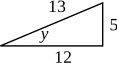
`sin(x)` `= -4/5\ \ text{(4th quadrant)}`
`sin^2(y)` `= 25/169`
`sin(y)` `= -5/13\ \ text{(4th quadrant)}`


`cos(y) = 12/13`

`:. \ sin(x) + cos(y)= -4/5 + 12/13= 8/65`

Filed Under: T2 Further Trigonometric Identities (Y11), Trigonometric Identities Tagged With: Band 5, smc-1025-30-Other, smc-6647-30-Other Problems

Trigonometry, EXT1 T2 2021 HSC 13d

  1. The numbers `A`, `B` and `C` are related by the equations  `A = B-d`  and  `C = B + d`,  where `d` is a constant.
  2. Show that  `(sin A + sin C)/(cos A + cos C) = tan B`.   (2 marks)

    --- 5 WORK AREA LINES (style=lined) ---

  3. Hence, or otherwise, solve  `(sin\ (5theta)/7 + sin\ (6theta)/7)/(cos\ (5theta)/7 + cos\ (6theta)/7) = sqrt3`  for  `0 <= theta <= 2pi`.   (2 marks)

    --- 6 WORK AREA LINES (style=lined) ---

Show Answers Only
  1. `text(See Worked Solution)`
  2. `(14pi)/33, (56pi)/33`
Show Worked Solution
i.    `(sin A + sin C)/(cos A + cos C)` `= (sin (B-d) + sin (B + d))/(cos (B-d) + cos (B + d))`
    `= (2sin B cos d)/(2cos B cosd)`
    `= tan B=\ text(RHS)`


ii.   `text(Let)\ \ A = (5theta)/7,\ \ C = (6theta)/7`

♦ Mean mark 50%.

`B= (A + C)/2= 1/2((5theta)/7 + (6theta)/7)= (11theta)/14`

`tan\ ((11theta)/14)` `= sqrt3`
`(11theta)/14` `= pi/3, (4pi)/3`
`:.theta` `= (14pi)/33, (56pi)/33`

Filed Under: Identities, Equations and 't' formulae, Other Trig Equations, T2 Further Trigonometric Identities (Y11), Trigonometric Identities Tagged With: Band 4, Band 5, smc-1025-20-Compound Angles, smc-1076-15-Compound Angles, smc-6647-20-Compound Angles, smc-6675-20-Compound Angles

Trigonometry, EXT1 T2 EQ-Bank 3 MC

If  \(\sin (\theta+\phi)=a\)  and  \(\sin (\theta-\phi)=b\),  then  \(\sin (\theta) \cos (\phi)\)  is equal to

  1. \(\sqrt{a^2+b^2}\)
  2. \(\sqrt{a b}\)
  3. \(\sqrt{a^2-b^2}\)
  4. \(\dfrac{a+b}{2}\)
Show Answers Only

\(D\)

Show Worked Solution

\(\text{Solution 1}\)

\(\sin \theta \cos \phi=\dfrac{1}{2} [(\sin (\theta+\phi)+\sin (\theta-\phi)]=\dfrac{1}{2}(a+b)\)

\(\Rightarrow D\)
 

\(\text{Solution 2}\)

\(\sin (\theta+\phi)=a\)

\(\sin \theta \cos \phi+\sin \phi \cos \theta\) \(=a \ldots(1)\)
\(\sin (\theta-\phi)=b\)  
\(\sin \theta \cos \phi-\sin \phi \cos \theta\) \(=b \ldots(2)\)

 
\((1)+(2):\)

\(2 \sin \theta \cos \phi\) \(=a+b\)
\(\therefore \sin \theta \cos \phi\) \(=\dfrac{a+b}{2}\)


Filed Under: T2 Further Trigonometric Identities (Y11), Trigonometric Identities Tagged With: Band 3, smc-1025-20-Compound Angles, smc-6647-20-Compound Angles

Calculus, EXT1 C2 2019 HSC 14c

The diagram shows the two curves  `y = sin x`  and  `y = sin(x-alpha) + k`, where  `0 < alpha < pi`  and  `k > 0`. The two curves have a common tangent at `x_0` where  `0 < x_0 < pi/2`.
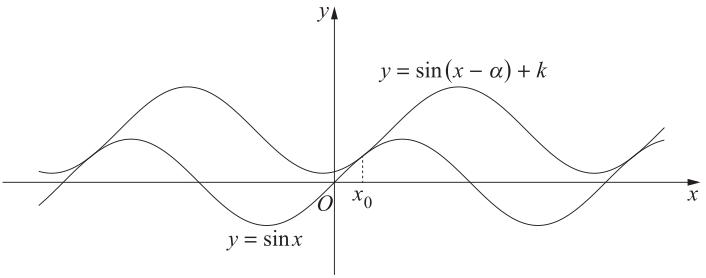
 

  1. Explain why   `cos x_0 = cos (x_0-alpha)`.   (1 mark)

    --- 4 WORK AREA LINES (style=lined) ---

  2. Show that  `sin x_0 = -sin(x_0-alpha)`.   (2 marks)

    --- 5 WORK AREA LINES (style=lined) ---

  3. Hence, or otherwise, find `k` in terms of `alpha`.   (2 marks)

    --- 8 WORK AREA LINES (style=lined) ---

Show Answers Only
  1. `text(See Worked Solutions)`
  2. `text(Proof)\ text{(See Worked Solutions)}`
  3. `k = 2 sin\ alpha/2`
Show Worked Solution
i.    `y_1` `= sin x`
  `(dy_1)/(dx)` `= cos x`
  `y_2` `= sin(x-alpha) + k`
  `(dy_2)/(dx)` `= cos (x-alpha)`

 
`text(At)\ \ x = x_0,\ \ text(tangent is common)`

♦ Mean mark part (i) 47%.

`:. cos x_0 = cos(x_0-alpha)`
 

ii.   `x_0\ text{is in 1st quadrant (given).}`

`text{Using part  (i):}`

`cos\ x_0 = cos(x_0-alpha) >0`

♦♦♦ Mean mark part (ii) 19%.

`=> x_0-alpha\ text(is in 4th quadrant)\ (0 < alpha < pi)`

`text(S)text(ince sin is positive in 1st quadrant and)`

`text(negative in 4th quadrant)`

`=> sin x_0 = -sin(x_0-alpha)`


iii.   

`text(When)\ \ x = x_0:`

`y_1` `=sin x_0`  
`y_2` `=sin(x_0-alpha) + k`  
`sin x_0` `=sin (x_0-alpha) + k`  
`sin x_0` `= -sin x_0 + k`  
`k` `== 2\ sin x_0`  


♦♦ Mean mark part (iii) 21%.

`text(S)text(ince)\ \ cos x_0` `= cos(x_0-alpha)`
`x_0` `= -(x_0-alpha)`
`2x_0` `= alpha`
`x_0` `= alpha/2`

 
 `:. k = 2 sin\ alpha/2`

Filed Under: Harder Trig Calculus, T2 Further Trigonometric Identities (Y11), Trigonometric Identities Tagged With: Band 5, Band 6, smc-1025-20-Compound Angles, smc-1038-30-Compound angles, smc-6647-20-Compound Angles

Trigonometry, EXT1 T2 2019 HSC 6 MC

It is given that  `sin x = 1/4`, where  `pi/2 < x < pi`.

What is the value of `sin 2x`?

  1. `-7/8`
  2. `-sqrt 15/8`
  3. `sqrt 15/8`
  4. `7/8`
Show Answers Only

`B`

Show Worked Solution

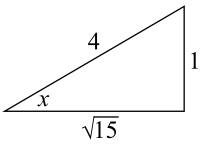
`sin x = 1/4`

`cos x = -sqrt 15/4, \ \ (pi/2 < x < pi)`

`sin 2x` `= 2 sin x cos x`
  `= 2 xx 1/4 xx-sqrt 15/4`
  `= -sqrt 15/8`

 
`=>  B`

Filed Under: T2 Further Trigonometric Identities (Y11), Trigonometric Identities Tagged With: Band 4, smc-1025-10-Double Angles, smc-6647-10-Double Angles

Trigonometry, EXT1 T2 EQ-Bank 22

Find the exact value of `cos((11pi)/12)`.   (2 marks)

--- 6 WORK AREA LINES (style=lined) ---

Show Answers Only

`-((sqrt2 + sqrt6))/4`

Show Worked Solution
`cos((11pi)/12)` `= cos((2pi)/3 + pi/4)`
  `= cos((2pi)/3) · cos(pi/4)-sin((2pi)/3) · sin(pi/4)`
  `= cos(pi-pi/3) · 1/sqrt2-sin (pi-pi/3) · 1/sqrt2`
  `= -1/2 · 1/sqrt2-sqrt3/2 · 1/sqrt2`
  `= -((1 + sqrt3))/(2sqrt2)`
  `= -((sqrt2 + sqrt6))/4`

Filed Under: T2 Further Trigonometric Identities (Y11), Trigonometric Identities Tagged With: Band 4, smc-1025-20-Compound Angles, smc-6647-20-Compound Angles

Trigonometry, EXT1 T2 EQ-Bank 17

Find the exact value of `sin\ pi/12`.   (2 marks)

Show Answers Only

`(sqrt6-sqrt2)/4`

Show Worked Solution
`sin\ pi/12` `= sin(pi/3-pi/4)`
  `= sin\ pi/3 · cos\ pi/4-cos\ pi/3 · sin\ pi/4`
  `= sqrt3/2 · 1/sqrt2-1/2 · 1/sqrt2`
  `= (sqrt3-1)/(2sqrt2) xx sqrt2/sqrt2`
  `= (sqrt6-sqrt2)/4`

Filed Under: T2 Further Trigonometric Identities (Y11), Trigonometric Identities Tagged With: Band 3, smc-1025-20-Compound Angles, smc-6647-20-Compound Angles

Trigonometry, EXT1 T2 EQ-Bank 25

If  `sintheta = -4/6`  and  `-pi/2 < theta < pi/2`,

determine the exact value of `costheta` in its simplest form.  (2 marks)

--- 5 WORK AREA LINES (style=lined) ---

Show Answers Only

`sqrt5/3`

Show Worked Solution

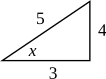
`text(Consider the angle graphically:)`

COMMENT: Pay careful attention to the range of `theta`.

`text(S)text(ince)\ sintheta\ text(is negative) => underbrace(text(4th quadrant))_(-pi/2 <\ theta\ < pi/2)`

`text(Using Pythagoras:)`

`x^2 = 6^2-4^2`

`x = sqrt20 = 2sqrt5`

`:. costheta= (2sqrt5)/6= sqrt5/3`

Filed Under: T2 Further Trigonometric Identities (Y11), Trigonometric Identities Tagged With: Band 4, smc-1025-30-Other, smc-6647-30-Other Problems

Trigonometry, EXT1 T2 EQ-Bank 12

If  `costheta = −3/4`  and  `0 < theta < pi`,

determine the exact value of `tantheta`.   (2 marks)

--- 5 WORK AREA LINES (style=lined) ---

Show Answers Only

`tan theta =-sqrt7/3`

Show Worked Solution

`text(Consider the angle graphically:)`

 
`text(S)text(ince)\ \ costheta\ \ text(is negative  ⇒  2nd quadrant.)`

`text(Using Pythagoras:)`

`x^2` `= 4^2-3^2`
`x` `= sqrt7`

 
`:. tan theta =-sqrt7/3`

Filed Under: T2 Further Trigonometric Identities (Y11), Trigonometric Identities Tagged With: Band 3, smc-1025-30-Other, smc-6647-30-Other Problems

Trigonometry, EXT1 T2 EQ-Bank 11

Show that

`sin(8x + 3x) + sin(8x-3x) = 2sin(8x)cos(3x)`.   (1 mark)

Show Answers Only

`text(See Worked Solutions)`

Show Worked Solution

`text(Expanding the LHS:)`

`text(LHS)` `= sin(8x)cos(3x) + cos(8x)sin(3x) + sin(8x)cos(3x)-cos(8x)sin(3x)`
  `= 2sin(8x)cos(3x)`

Filed Under: T2 Further Trigonometric Identities (Y11), Trigonometric Identities Tagged With: Band 2, smc-1025-20-Compound Angles, smc-6647-20-Compound Angles

Trigonometry, EXT1 T2 EQ-Bank 23

Find the exact value of `cos\ pi/8`.   (2 marks)

--- 6 WORK AREA LINES (style=lined) ---

Show Answers Only

`(sqrt(sqrt2 + 2))/2`

Show Worked Solution

`text(Using)\ \ cos2A = 2cos^2A-1:`

`2cos^2\ pi/8-1` `= cos\ pi/4`
`2cos^2\ pi/8` `= 1/sqrt2 + 1`
`cos^2\ pi/8` `= (1 + sqrt2)/(2sqrt2) xx sqrt2/sqrt2= (sqrt2 + 2)/4`
`:. cos\ pi/8` `= sqrt((sqrt2 + 2)/4)= (sqrt(sqrt2 + 2))/2`

Filed Under: T2 Further Trigonometric Identities (Y11), Trigonometric Identities Tagged With: Band 4, smc-1025-20-Compound Angles, smc-6647-20-Compound Angles

Trigonometry, EXT1 T2 EQ-Bank 16

Find `a` and `b` such that

`tan75^@ = a + bsqrt3`   (2 marks)

--- 5 WORK AREA LINES (style=lined) ---

Show Answers Only

`a = 2, b = 1`

Show Worked Solution
`tan75^@` `= tan(45 + 30)^@`
  `= (tan45^@ + tan30^@)/(1-tan45^@tan30^@)`
  `= (1 + 1/sqrt3)/(1-1 · 1/sqrt3) xx sqrt3/sqrt3`
  `= (sqrt3 + 1)/(sqrt3-1) xx (sqrt3 + 1)/(sqrt3 + 1)`
  `= (3 + 2sqrt3 + 1)/((sqrt3)^2-1^2)`
  `= 2 + sqrt3`

 
`:. a = 2, \ b = 1`

Filed Under: T2 Further Trigonometric Identities (Y11), Trigonometric Identities Tagged With: Band 3, smc-1025-20-Compound Angles, smc-6647-20-Compound Angles

Trigonometry, EXT1 T2 2016 HSC 3 MC

Which expression is equivalent to  `(tan2x - tanx)/(1 + tan2xtanx)`?

  1. `tanx`
  2. `tan3x` 
  3. `(tan2x - 1)/(1 + tan2x)`
  4. `(tanx)/(1 + tan2xtanx)`
Show Answers Only

`A`

Show Worked Solution

`(tan 2x – tan x)/(1 + tan 2x tan x)`

`= tan (2x – x)`

`= tan x`

`=>   A`

Filed Under: 5. Trig Ratios EXT1, T2 Further Trigonometric Identities (Y11), Trigonometric Identities Tagged With: Band 3, smc-1025-20-Compound Angles, smc-6647-20-Compound Angles

Trigonometry, EXT1 T2 2006 HSC 1d

  1. Simplify  `(sin theta + cos theta) (sin^2 theta-sin theta cos theta + cos^2 theta)`   (1 mark)

    --- 3 WORK AREA LINES (style=lined) ---

  2. Hence, or otherwise, express  `(sin^3 theta + cos^3 theta)/(sin theta + cos theta)-1`,  in its simplest form for  `0 < theta < pi/2.`   (2 marks)

    --- 6 WORK AREA LINES (style=lined) ---

Show Answers Only

a.    `sin^3 theta + cos^3 theta`

b.    `-sin theta cos theta`

Show Worked Solution

a.    `(sin theta + cos theta) (sin^2 theta-sin theta cos theta + cos^2 theta)`

`=sin^3 theta -sin^2thetacos theta + sin theta cos^2 theta + cos theta sin^2 theta-sin theta cos^2 theta + cos^3 theta`

`=sin^3 theta + cos^3 theta`
 

b.    `(sin^3 theta + cos^3 theta)/(sin theta + cos theta)-1`

`= {(sin theta + cos theta) (sin^2 theta-sin theta cos theta + cos^2 theta)}/(sin theta + cos theta)-1`

`= sin^2 theta + cos^2 theta-sin theta cos theta-1`

`= 1-sin theta cos theta-1`

`= -sin theta cos theta`

Filed Under: 1. Basic Arithmetic and Algebra EXT1, 5. Trig Ratios EXT1, T2 Further Trigonometric Identities (Y11), Trigonometric Identities Tagged With: Band 3, smc-1025-30-Other, smc-6647-30-Other Problems

Trigonometry, EXT1 T2 2013 HSC 8 MC

The angle `theta` satisfies  `sin theta = 5/13`  and  `pi/2 < theta < pi`.

What is the value of `sin 2 theta` ?

  1. `10/13`
  2. `- 10/13` 
  3. `120/169`
  4. `- 120/169`
Show Answers Only

`D`

Show Worked Solution
 
♦ Mean mark 44% 

`sin theta = 5/13\ \ \ (pi/2 < theta < pi)`

`text(S)text(ince)\ \ theta\ \ text(is in the 2nd quadrant,)`

`cos theta = -12/13`

`:.sin 2theta` `= 2 sin theta cos theta`
  `= 2 xx 5/13 xx -12/13`
  `= -120/169`

 
`=>  D`

Filed Under: 5. Trig Ratios EXT1, T2 Further Trigonometric Identities (Y11), Trigonometric Identities Tagged With: Band 5, smc-1025-10-Double Angles, smc-6647-10-Double Angles

Copyright © 2014–2026 SmarterEd.com.au · Log in