75 Tasmanian Devils are placed in a Devil's Ark sanctuary that can support a maximum population of 500 devils. The increase in the devil population is proportional to the difference between the devil population and the number of devils that the sanctuary can support. --- 3 WORK AREA LINES (style=lined) --- --- 6 WORK AREA LINES (style=lined) --- --- 3 WORK AREA LINES (style=lined) ---
Calculus, EXT1 C1 2023 HSC 1 MC
The temperature \(T(t)^{\circ} \text{C}\) of an object at time \(t\) seconds is modelled using Newton's Law of Cooling,
\(T(t)=15+4 e^{-3 t}\)
What is the initial temperature of the object?
- \(-3\)
- \(4\)
- \(15\)
- \(19\)
Calculus, EXT1 C1 2022 HSC 12d
In a room with temperature 12°C, coffee is poured into a cup. The temperature of the coffee when it is poured into the cup is 92°C, and it is far too hot to drink.
The temperature, `T`, in degrees Celsius, of the coffee, `t` minutes after it is made, can be modelled using the differential equation `(dT)/(dt)=k(T-T_(1))`, where `k` is the constant of proportionality and `T_1` is a constant.
- It takes 5 minutes for the coffee to cool to a temperature of 76°C.
- Using separation of variables, solve the given differential equation to show that `T=12+80e^((t)/(5)ln((4)/(5)))`. (3 marks)
--- 10 WORK AREA LINES (style=lined) ---
- The optimal drinking temperature for a hot beverage is 57°C.
- Find the value of `t` when the coffee reaches this temperature, giving your answer to the nearest minute. (1 mark)
--- 5 WORK AREA LINES (style=lined) ---
Calculus, EXT1 C1 2021 HSC 12b
A bottle of water, with temperature 5°C, is placed on a table in a room. The temperature of the room remains constant at 25°C. After `t` minutes, the temperature of the water, in degrees Celsius, is `T`.
The temperature of the water can be modelled using the differential equation
`(dT)/(dt) = k(T-25)` (Do NOT prove this.)
where `k` is the growth constant
After 8 minutes, the temperature of the water is 10°C.
- By solving the differential equation, find the value of `t` when the temperature of the water reaches 20°C. Give your answer to the nearest minute. (3 marks)
--- 8 WORK AREA LINES (style=lined) ---
- Sketch the graph of `T` as a function of `t`. (1 mark)
--- 10 WORK AREA LINES (style=lined) ---
Show Answers Only
i. `text(39 minutes)`
ii.
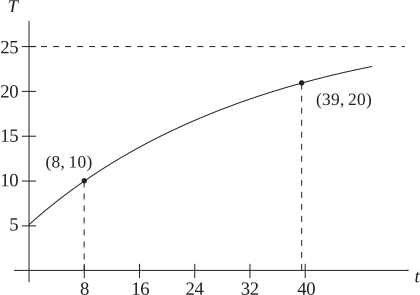
Show Worked Solution
| i. | `(dT)/(dt)` | `= k(T-25)` |
| `(dt)/(dT)` | `= 1/(k(T-25))` | |
| `t` | `= 1/k int 1/(T-25)\ dT` | |
| `kt` | `= ln |T-25| + c` |
`text(When)\ \ t = 0, T = 5 \ \ =>\ \ c = -ln 20`
| `kt` | `= ln |T-25|-ln 20` |
| `= ln |(T-25)/20|` |
`text(When)\ \ t = 8, T = 10`
| `8k` | `= ln (15/20)` |
| `k` | `= 1/8 ln(3/4)` |
`text(Find)\ t\ text(when)\ \ T = 20:`
| `1/8 ln (3/4)t` | `= ln |(20-25)/20|` |
| `t` | `= (8 ln(1/4))/(ln(3/4))` |
| `= 38.55…` | |
| `= 39\ text{minutes (0 d.p.)}` |
ii.
♦ Mean mark part (ii) 37%.
Calculus, EXT1 C1 2019 HSC 12d
A refrigerator has a constant temperature of 3°C. A can of drink with temperature 30°C is placed in the refrigerator.
After being in the refrigerator for 15 minutes, the temperature of the can of drink is 28°C.
The change in the temperature of the can of drink can be modelled by `(dT)/(dt) = k(T - 3)`, where `T` is the temperature of the can of drink, `t` is the time in minutes after the can is placed in the refrigerator and `k` is a constant.
- Show that `T = 3 + Ae^(kt)`, where `A` is a constant, satisfies
`qquad(dT)/(dt) = k(T - 3)`. (1 mark)
--- 2 WORK AREA LINES (style=lined) ---
- After 60 minutes, at what rate is the temperature of the can of drink changing? (3 marks)
--- 10 WORK AREA LINES (style=lined) ---
Calculus, EXT1 C1 2013 VCE 5
A container of water is heated to boiling point (100°C) and then placed in a room that has a constant temperature of 20°C. After five minutes the temperature of the water is 80°C.
- Use Newton’s law of cooling `(dT)/(dt) = -k (T - 20)`, where `T text(°C)` is the temperature of the water at the time `t` minutes after the water is placed in the room, to show that `e^(-5k) = 3/4.` (2 marks)
--- 7 WORK AREA LINES (style=lined) ---
- Find the temperature of the water 10 minutes after it is placed in the room. (3 marks)
--- 8 WORK AREA LINES (style=lined) ---
Calculus, EXT1 C1 2017 HSC 14c
The concentration of a drug in a body is `F(t)`, where `t` is the time in hours after the drug is taken.
Initially the concentration of the drug is zero. The rate of change of concentration of the drug is given by
`F^{′}(t) = 50e^(−0.5t)-0.4F(t)`.
- By differentiating the product `F(t)e^(0.4t)` show that
`qquadd/(dt)(F(t)e^(0.4t)) = 50e^(−0.1t)`. (2 marks)
--- 4 WORK AREA LINES (style=lined) ---
- Hence, or otherwise, show that `F(t) = 500(e^(−0.4t)-e^(−0.5t))`. (2 marks)
--- 8 WORK AREA LINES (style=lined) ---
- The concentration of the drug increases to a maximum.
For what value of `t` does this maximum occur? (2 marks)
--- 6 WORK AREA LINES (style=lined) ---
Calculus, EXT1 C1 2016 HSC 12b
In a chemical reaction, a compound `X` is formed from a compound `Y`. The mass in grams of `X` and `Y` are `x(t)` and `y(t)` respectively, where `t` is the time in seconds after the start of the chemical reaction.
Throughout the reaction the sum of the two masses is 500 g. At any time `t`, the rate at which the mass of compound `X` is increasing is proportional to the mass of compound `Y`.
At the start of the chemical reaction, `x = 0` and `(dx)/(dt) = 2`.
- Show that `(dx)/(dt) = 0.004(500 - x)`. (3 marks)
--- 6 WORK AREA LINES (style=lined) ---
- Show that ` x = 500 - Ae^(−0.004t)` satisfies the equation in part (i), and find the value of `A`. (2 marks)
--- 6 WORK AREA LINES (style=lined) ---
Calculus, EXT1 C1 2008 HSC 4a
A turkey is taken from the refrigerator. Its temperature is 5°C when it is placed in an oven preheated to 190°C.
Its temperature, `T`° C, after `t` hours in the oven satisfies the equation
`(dT)/(dt) = -k(T − 190)`.
- Show that `T = 190 - 185e^(-kt)` satisfies both this equation and the initial condition. (2 marks)
--- 5 WORK AREA LINES (style=lined) ---
- The turkey is placed into the oven at 9 am. At 10 am the turkey reaches a temperature of 29°C. The turkey will be cooked when it reaches a temperature of 80°C.
At what time (to the nearest minute) will it be cooked? (3 marks)
--- 10 WORK AREA LINES (style=lined) ---
Calculus, EXT1 C1 2005 HSC 2d
A salad, which is initially at a temperature of 25°C, is placed in a refrigerator that has a constant temperature of 3°C. The cooling rate of the salad is proportional to the difference between the temperature of the refrigerator and the temperature, `T`, of the salad. That is, `T` satisfies the equation
`(dT)/(dt) = -k (T-3),`
where `t` is the number of minutes after the salad is placed in the refrigerator.
- Show that `T = 3 + Ae^(–kt)` satisfies this equation. (1 mark)
--- 3 WORK AREA LINES (style=lined) ---
- The temperature of the salad is 11°C after 10 minutes. Find the temperature of the salad after 15 minutes. (3 marks)
--- 6 WORK AREA LINES (style=lined) ---
Calculus, EXT1 C1 2015 HSC 2 MC
Given that `N = 100 + 80e^(kt)`, which expression is equal to `(dN)/(dt)?`
- `k\ (100 - N)`
- `k\ (180 - N)`
- `k\ (N - 100)`
- `k\ (N - 180)`
Calculus, EXT1 C1 2014 HSC 12f
Milk taken out of a refrigerator has a temperature of 2° C. It is placed in a room of constant temperature 23°C. After `t` minutes the temperature, `T`°C, of the milk is given by
`T = A-Be ^(-0.03t)`,
where `A` and `B` are positive constants.
How long does it take for the milk to reach a temperature of 10°C? (3 marks)
--- 8 WORK AREA LINES (style=lined) ---
Calculus, EXT1 C1 2010 HSC 2b
The mass `M` of a whale is modelled by
`M=36-35.5e^(-kt)`
where `M` is measured in tonnes, `t` is the age of the whale in years and `k` is a positive constant.
- Show that the rate of growth of the mass of the whale is given by the differential equation
`qquad qquad (dM)/(dt)=k(36-M)` (1 mark)
--- 2 WORK AREA LINES (style=lined) ---
- When the whale is 10 years old its mass is 20 tonnes.
Find the value of `k`, correct to three decimal places. (2 marks)
--- 8 WORK AREA LINES (style=lined) ---
- According to this model, what is the limiting mass of the whale? (1 mark)
--- 3 WORK AREA LINES (style=lined) ---
Calculus, EXT1 C1 2011 HSC 5b
To test some forensic science students, an object has been left in the park. At 10am the temperature of the object is measured to be 30°C. The temperature in the park is a constant 22°C. The object is moved immediately to a room where the temperature is a constant 5°C.
The temperature of the object in the room can be modelled by the equation
`T=5+25e^(-kt)`,
where `T` is the temperature of the object in degrees Celcius, `t` is the time in hours since the object was placed in the room and `k` is a constant.
After one hour in the room the temperature of the object is 20°C.
- Show that `k=ln(5/3)` (2 marks)
--- 6 WORK AREA LINES (style=lined) ---
- In a similar manner, the temperature of the object in the park before it was discovered can be modelled by an equation in the form `T=A+Be^(-kt)`, with the same constant `k=ln(5/3)`.
Find the time of day when the object had a temperature of 37°C. (3 marks)
--- 8 WORK AREA LINES (style=lined) ---
Calculus, EXT1 C1 2013 HSC 12c
A cup of coffee with an initial temperature of 80°C is placed in a room with a constant temperature of 22°C.
The temperature, `T`°C, of the coffee after `t` minutes is given by
`T=A+Be^(-kt)`,
where `A`, `B` and `k` are positive constants. The temperature of the coffee drops to 60°C after 10 minutes.
How long does it take for the temperature of the coffee to drop to 40°C? Give your answer to the nearest minute. (3 marks)
--- 8 WORK AREA LINES (style=lined) ---