SmarterEd

Aussie Maths & Science Teachers: Save your time with SmarterEd

  • Login
  • Get Help
  • About

Calculus, EXT1 C3 2025 SPEC2 10*

The region bounded by the curve given by  \(y=3 \cos ^{-1}(x)\), for  \(0 \leq y \leq a\),  where  \(a>0\), and the line  \(x=0\)  is rotated about the \(y\)-axis to form a solid of revolution.

If the volume of the solid is  \(\dfrac{\pi(4 \pi+3 \sqrt{3})}{8}\), determine the value of \(a\).   (3 marks)

--- 9 WORK AREA LINES (style=lined) ---
Show Answers Only

\(a=\pi\)

Show Worked Solution

\(y=3 \cos ^{-1}(x) \ \Rightarrow \ x=\cos \left(\dfrac{y}{3}\right)\)

  \(V=\pi \displaystyle \int x^2\, d y\) \(=\pi  \displaystyle \int_0^a \cos ^2\left(\frac{y}{3}\right)\, d y\)
    \(=\pi  \displaystyle \int_0^a \dfrac{1}{2}\left(1+\cos\dfrac{2y}{3} \right)\,dy\)
    \(=\pi\,\left[\dfrac{y}{2}+\dfrac{3}{4}\sin \dfrac{2y}{3}\right]_0^a\)
    \(=\pi\,\left(\dfrac{a}{2}+\dfrac{3}{4}\sin \dfrac{2a}{3}\right)\)
    \(=\pi\,\left(\dfrac{4a+6 \times \sin\frac{2a}{3}}{8}\right)\)

 
\(\text{Equating volumes:}\ \ \dfrac{\pi(4 \pi+3 \sqrt{3})}{8}=\pi\,\left(\dfrac{4a+6 \times \sin\frac{2a}{3}}{8}\right)\)

\(\Rightarrow a=\pi\)

Filed Under: Further Area and Solids of Revolution, Further Areas and Solids of Revolution Tagged With: Band 4, smc-1039-20-Trig Function, smc-1039-61-y-axis Rotation, smc-7294-30-\(\large y\)-axis Rotation, smc-7294-55-Trig Function

Calculus, EXT1 2025 SPEC1 6

Find the volume of the solid of revolution formed when the area between the curve  \(y=\sqrt{\dfrac{\arctan (x)}{1+x^2}}\)  and the \(x\)-axis from  \(x=1\)  to  \(x=\sqrt{3}\)  is rotated about the \(x\)-axis.

Give your answer in exact form.   (4 marks)

--- 12 WORK AREA LINES (style=lined) ---

Show Answers Only

\(V=\dfrac{7 \pi^3}{288}\ \ \text{u}^3\)

Show Worked Solution
\(y\) \(=\sqrt{\dfrac{\tan ^{-1}(x)}{1+x^2}}\)
\(V\) \(=\displaystyle\pi \int_1^{\sqrt{3}} \frac{\tan ^{-1}(x)}{1+x^2} d x\)


\(\text{Let} \ \ u=\tan ^{-1}(x) \ \Rightarrow \ du=\dfrac{d x}{1+x^2}\)

\(\text{When} \ \ x=\sqrt{3}, u=\tan ^{-1} \sqrt{3}=\dfrac{\pi}{3}\)

\(\text{When} \ \ x=1, u=\tan ^{-1} 1=\dfrac{\pi}{4}\)

\(V\) \(=\displaystyle \pi \int_{\tfrac{\pi}{4}}^{\tfrac{\pi}{3}} u\,dx\)
  \(=\dfrac{\pi}{2}\Big[u^2\Big]_{\tfrac{\pi}{4}}^{\tfrac{\pi}{3}}\)
  \(=\dfrac{\pi}{2}\left[\left(\dfrac{\pi}{3}\right)^2-\left(\dfrac{\pi}{4}\right)^2\right]\)
  \(=\dfrac{\pi^3}{2}\left(\dfrac{1}{9}-\dfrac{1}{16}\right)\)
  \(=\dfrac{7 \pi^3}{288}\ \ \text{u}^3\)

Filed Under: Further Area and Solids of Revolution, Further Areas and Solids of Revolution Tagged With: Band 4, smc-1039-20-Trig Function, smc-1039-60-x-axis Rotation, smc-7294-20-\(\large x\)-axis Rotation, smc-7294-55-Trig Function

Calculus, EXT1 C3 2025 HSC 12b

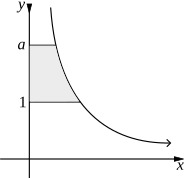
Consider the region bounded by the hyperbola  \(y=\dfrac{1}{x}\),  the \(y\)-axis and the lines  \(y=1\)  and  \(y=a\)  for  \(a>1\).

Find the volume of the solid of revolution formed when the region is rotated about the \(y\)-axis.   (2 marks)

--- 7 WORK AREA LINES (style=lined) ---

Show Answers Only

\(\pi\left(1-\dfrac{1}{a}\right)\ \text{u}^3\)

Show Worked Solution

\(y=\dfrac{1}{x} \ \Rightarrow \ x^2=\dfrac{1}{y^2}\)

\(V\) \(=\pi \displaystyle \int_1^a x^2\, dy\)
  \(=\pi \displaystyle \int_1^a y^{-2}\, d y\)
  \(=-\pi\left[y^{-1}\right]_1^a\)
  \(=-\pi\left(\dfrac{1}{a}-1\right)\)
  \(=\pi\left(1-\dfrac{1}{a}\right)\ \text{u}^3\)

Filed Under: Further Area and Solids of Revolution, Further Areas and Solids of Revolution Tagged With: Band 3, smc-1039-40-Other Graphs, smc-1039-61-y-axis Rotation, smc-7294-30-\(\large y\)-axis Rotation, smc-7294-70-Other Graphs

Calculus, EXT1 C3 2025 HSC 6 MC

Given that \(a\) is a non-zero constant, which of the following integrals is equal to zero?

  1. \(\displaystyle \int_{-a}^a x\, \cos ^{-1}(x) d x\)
  2. \(\displaystyle\int_{-a}^a x^2\, \cos ^{-1}(x) d x\)
  3. \(\displaystyle\int_{-a}^a x\, \tan ^{-1}(x) d x\)
  4. \(\displaystyle\int_{-a}^a x^2\, \tan ^{-1}(x) d x\)
Show Answers Only

\(D\)

Show Worked Solution

\(\text{Since the limits are symmetrical about 0:}\)

\(\text{Integral will equal zero if function is odd.}\)

\(\text{Consider option D:}\)

\(f(x)=x^2\, \tan^{-1}(x)\)

\(f(-x)=(-x)^2\, \tan^{-1}(-x)=-x^2\, \tan ^{-1}(x)=-f(x)\ \text{(odd)}\)

\(\Rightarrow D\)

♦ Mean mark 47%.

Filed Under: Further Area and Solids of Revolution, Further Areas and Solids of Revolution Tagged With: Band 5, smc-1039-20-Trig Function, smc-1039-50-Area, smc-7294-10-Area, smc-7294-55-Trig Function

Calculus, EXT1 C3 2024 HSC 12b

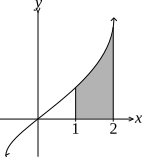
The region, \(R\), is bounded by the function, \(y=x^3\), the \(x\)-axis and the lines  \(x=1\)  and  \(x=2\).

What is the volume of the solid of revolution obtained when the region \(R\) is rotated about the \(x\)-axis?   (3 marks)

--- 6 WORK AREA LINES (style=lined) ---

Show Answers Only

\(V=\dfrac{127 \pi}{7} \ \ \text{u}^3\)

Show Worked Solution

  \(V\) \(=\pi \displaystyle \int_1^2 y^2\, d x\)
    \(=\pi \displaystyle \int_1^2 x^6\,d x\)
    \(=\pi\left[\dfrac{x^7}{7}\right]_1^2\)
    \(=\pi\left(\dfrac{2^7-1}{7}\right)\)
    \(=\dfrac{127 \pi}{7} \ \ \text{u}^3\)

Filed Under: Further Area and Solids of Revolution, Further Areas and Solids of Revolution Tagged With: Band 3, smc-1039-10-Polynomial, smc-1039-60-x-axis Rotation, smc-7294-20-\(\large x\)-axis Rotation, smc-7294-50-Polynomial

Calculus, EXT1 C3 2024 HSC 11g

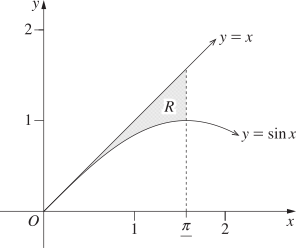
The region, \(R\), is bounded by the curves  \(y=\sin x, y=x\)  and the line  \(x=\dfrac{\pi}{2}\)  as shown in the diagram.
 

Find the area of the region \(R\).   (3 marks)

--- 6 WORK AREA LINES (style=lined) ---

Show Answers Only

\(\dfrac{\pi^2}{8}-1\ \ \text{u}^2\)

Show Worked Solution

  \(R\) \(=\displaystyle{\int}_0^{\frac{\pi}{2}} x-\sin x \, d x\)
    \(=\left[\dfrac{x^2}{2}+\cos x\right]_0^{\frac{\pi}{2}}\)
    \(=\left[\left(\dfrac{\pi^2}{8}+\cos \dfrac{\pi}{2}\right)-(0+\cos 0)\right]\)
    \(=\dfrac{\pi^2}{8}-1\ \ \text{u}^2\)

Filed Under: Further Area and Solids of Revolution, Further Areas and Solids of Revolution Tagged With: Band 3, smc-1039-50-Area, smc-7294-10-Area

Calculus, EXT1 C3 2024 HSC 2 MC

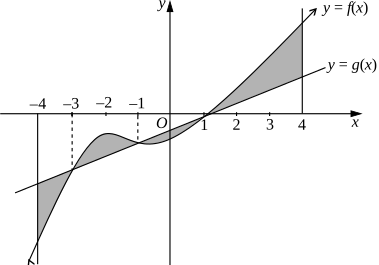
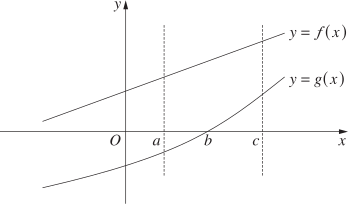
Consider the functions  \(y=f(x)\)  and  \(y=g(x)\), and the regions shaded in the diagram below. 
 

Which of the following gives the total area of the shaded regions?

  1. \(\displaystyle \int_{-4}^4 f(x)-g(x)\,d x\)
  2. \(\displaystyle \left|\int_{-4}^4 f(x)-g(x)\,d x\right|\)
  3. \(\displaystyle \int_{-4}^{-3} f(x)-g(x)\,d x+\int_{-3}^{-1} f(x)-g(x)\,d x+\int_{-1}^1 f(x)-g(x)\,d x+\int_1^4 f(x)-g(x)\,d x \)
  4. \(\displaystyle - \int_{-4}^{-3} f(x)-g(x)\,d x+\int_{-3}^{-1} f(x)-g(x)\,d x-\int_{-1}^1 f(x)-g(x)\,d x+\int_1^4 f(x)-g(x)\,d x\)
Show Answers Only

\(D\)

Show Worked Solution

\(\text{Intervals where}\ f(x) \gt g(x)\ \ \Rightarrow\ \text{Positive area values}\)

\(\text{Intervals where}\ g(x) \gt f(x)\ \ \Rightarrow\ \text{Negative area values}\)

\(\Rightarrow D\)

Filed Under: Further Area and Solids of Revolution, Further Areas and Solids of Revolution Tagged With: Band 3, smc-1039-50-Area, smc-7294-10-Area

Calculus, EXT1 C3 2022 SPEC1 10

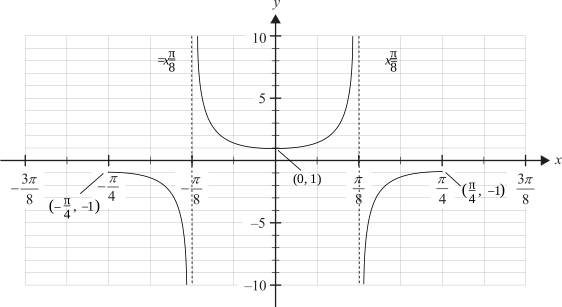
Let `f(x)=\sec (4 x)`.

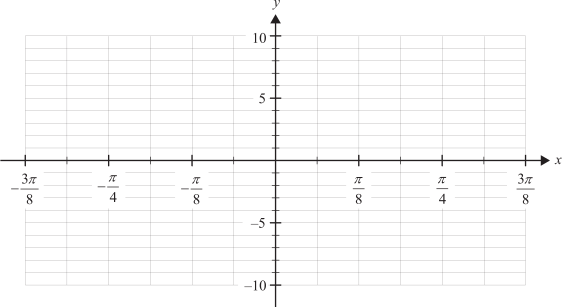
  1. Sketch the graph of `f` for `x \in\left[-\frac{\pi}{4}, \frac{\pi}{4}\right]` on the set of axes below. Label any asymptotes with their equations and label any turning points and the endpoints with their coordinates.   (3 marks)


  2. The graph of  `y=f(x)` for `x \in\left[-\frac{\pi}{24}, \frac{\pi}{48}\right]` is rotated about the `x`-axis to form a solid of revolution.
    Find the volume of this solid. Give your answer in the form `\frac{(a-\sqrt{b}) \pi}{c}`, where `a`, `b`, `c in R`.   (3 marks)
Show Answers Only

a.  
       

b.   `\frac{(3-\sqrt{3}) \pi}{6}`

Show Worked Solution

a.      


♦ Mean mark (a) 49%.
b.    `V` `=\pi \int_{-\frac{\pi}{24}}^{\frac{\pi}{48}} \sec ^2(4 x)\ dx`
    `=\frac{\pi}{4}[\tan (4 x)]_{-\frac{\pi}{24}}^{\frac{\pi}{48}}`
    `=\frac{\pi}{4} \tan \left(\frac{\pi}{12}\right)-\frac{\pi}{4} \tan \left(-\frac{\pi}{6}\right)`
    `=\frac{\pi}{4} \tan \left(\frac{\pi}{3}-\frac{\pi}{4}\right)-\frac{\pi}{4} \xx -\frac{1}{\sqrt{3}}`
    `=\frac{\pi}{4} \left(\frac{sqrt3-1}{1+sqrt3} xx \frac{1-sqrt3}{1-sqrt3}\right)+\frac{\pi}{4sqrt3}`
    `=\frac{\pi}{4} \left(\frac{sqrt3-3-1+sqrt3}{-2}\right)+\frac{\pi}{4sqrt3}`
    `=\frac{\pi}{4}(2-\sqrt{3}) +\frac{\pi}{4sqrt3}`
    `=\frac{\pi(2 \sqrt{3}-3+1)}{4 \sqrt{3}}`
    `=\frac{(6-2 \sqrt{3}) \pi}{12}`
    `=\frac{(3-\sqrt{3}) \pi}{6}`

♦ Mean mark (b) 55%.

Filed Under: Further Area and Solids of Revolution, Further Areas and Solids of Revolution Tagged With: Band 5, smc-1039-20-Trig Function, smc-1039-60-x-axis Rotation, smc-7294-20-\(\large x\)-axis Rotation, smc-7294-55-Trig Function

Calculus, EXT1 C3 2023 HSC 12e

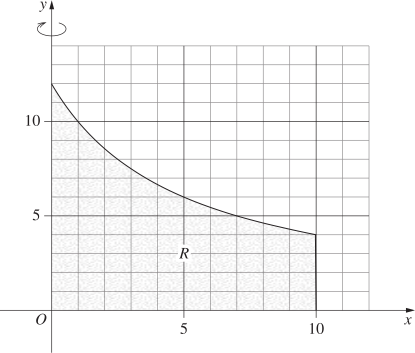
The region, \(R\), bounded by the hyperbola  \(y=\dfrac{60}{x+5}\), the line \(x=10\) and the coordinate axes is shown.
 

Find the volume of the solid of revolution formed when the region \(R\) is rotated about the \(y\)-axis. Leave your answer in exact form.  (4 marks)

--- 8 WORK AREA LINES (style=lined) ---

Show Answers Only

\(V=1200 \pi-600\pi\ \ln3 \ \ \text{u}^3\)

Show Worked Solution

\(y=\dfrac{60}{x+5}\ \ \Rightarrow\ \ x=\dfrac{60}{y}-5 \)

♦ Mean mark 49%.
\(V\) \(=\pi \displaystyle \int_4^{12} x^2\ dy + \pi r^2h\)  
  \(=\pi \displaystyle \int_4^{12} \Big{(} \dfrac{60}{y}-5 \Big{)}^2 \ dy + \pi \times 10^2 \times 4 \)  
  \(=\ 25\pi \displaystyle \int_4^{12} \Big{(} \dfrac{12}{y}-1 \Big{)}^2 \ dy + 400\pi \)  
  \(=\ 25\pi \displaystyle \int_4^{12} \Big{(} \dfrac{144}{y^2}-\dfrac{24}{y} + 1 \Big{)} \ dy + 400\pi \)  
  \(=\ 25\pi \Big{[} \dfrac{-144}{y}- 24 \ln y + y\Big{]}_4^{12} + 400\pi \)  
  \(=\ 25\pi \Big{[} (-12-24 \ln 12 +12)-(-36-24 \ln 4+4)\Big{]} + 400\pi \)  
  \(=\ 25\pi (24 \ln 4-24 \ln 12+32) + 400\pi \)  
  \(=600 \pi\ \ln(3^{-1}) + 800 \pi + 400 \pi \)  
  \(=1200 \pi-600\pi\ \ln3 \ \ \text{u}^3\)  

Filed Under: Further Area and Solids of Revolution, Further Areas and Solids of Revolution Tagged With: Band 5, smc-1039-40-Other Graphs, smc-1039-61-y-axis Rotation, smc-7294-30-\(\large y\)-axis Rotation, smc-7294-70-Other Graphs

Calculus, EXT1 C3 2023 HSC 4 MC

The diagram shows the graphs of the functions \(f(x)\) and \(g(x)\).
 

It is known that

\begin{aligned} & \int_a^c f(x) d x=10 \\ & \int_a^b g(x) d x=-2 \\ & \int_b^c g(x) d x=3 .\end{aligned}

What is the area between the curves  \(y=f(x)\)  and  \(y=g(x)\)  between \(x=a\) and \(x=c\) ?

  1. 5
  2. 7
  3. 9
  4. 11
Show Answers Only

\(C\)

Show Worked Solution
\(A\) \[= \int_a^c f(x)\ dx-\int_b^c g(x)\ dx+\Big{|}\int_a^b g(x)\ dx\Big{|} \]  
  \(= 10-3+|-2| \)  
  \(=9\)  

 
\(\Rightarrow C\)

Filed Under: Further Area and Solids of Revolution, Further Areas and Solids of Revolution Tagged With: Band 4, smc-1039-50-Area, smc-7294-10-Area

Calculus, EXT1 C3 2022 HSC 13b

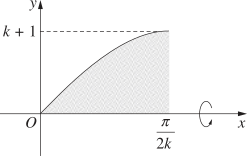
A solid of revolution is to be found by rotating the region bounded by the `x`-axis and the curve  `y=(k+1) \sin (k x)`, where  `k>0`, between  `x=0`  and  `x=\frac{\pi}{2 k}`  about the `x`-axis.


Find the value of `k` for which the volume is `pi^2`.  (3 marks)

--- 8 WORK AREA LINES (style=lined) ---

Show Answers Only

`k=1`

Show Worked Solution

`y=(k+1) \sin (k x)`

`V` `=pi int_0^((pi)/(2k)) (k+1)^2sin^(2)(kx)\ dx`  
  `=pi(k+1)^2 int_0^((pi)/(2k)) 1/2[1-cos(2kx)]\ dx`  
  `=(pi/2)(k+1)^2[x-(sin(2kx))/(2k)]_0^((pi)/(2k)) `  
  `=(pi/2)(k+1)^2[(pi/(2k)- sin(pi)/(2k))-(0-sin0/(2k))]`  
  `=(pi/2)(k+1)^2(pi/(2k))`  
  `=pi^2/(4k)(k+1)^2`  

 
`text{Given}\ \ V=pi^2:`

`pi^2/(4k)(k+1)^2` `=pi^2`  
`(k+1)^2` `=4k`  
`k^2+2k+1` `=4k`  
`k^2-2k+1` `=0`  
`(k-1)^2` `=0`  

 
`:.k=1`

Filed Under: Further Area and Solids of Revolution, Further Areas and Solids of Revolution Tagged With: Band 4, smc-1039-20-Trig Function, smc-1039-60-x-axis Rotation, smc-7294-20-\(\large x\)-axis Rotation, smc-7294-55-Trig Function

Calculus, EXT1 C3 2021 SPEC1 4

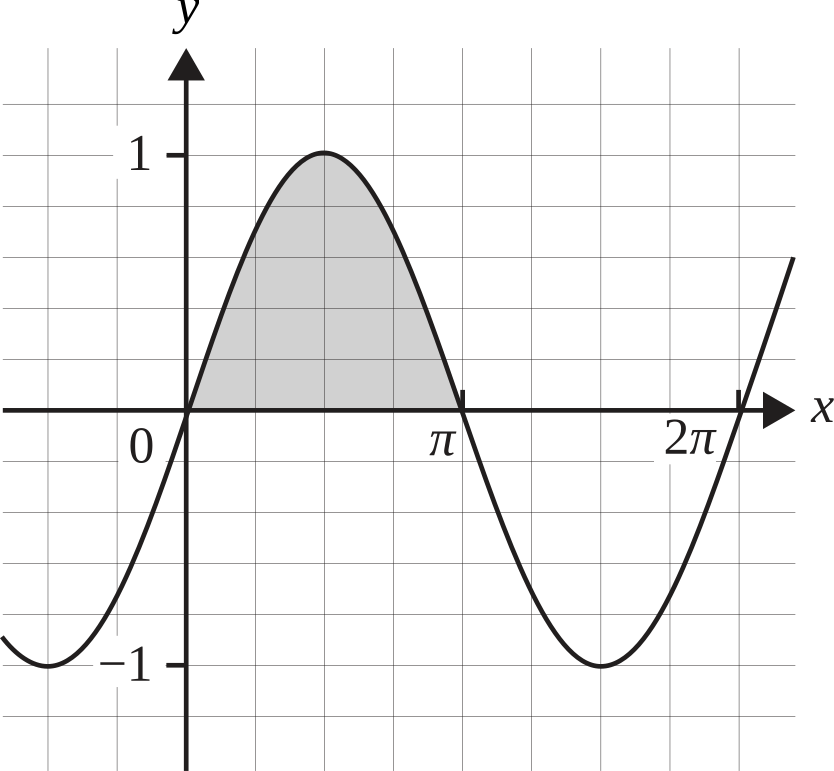
The shaded region in the diagram below is bounded by the graph of  `y = sin(x)`  and the `x`-axis between the first two non-negative `x`-intercepts of the curve, that is interval  `[0, pi]`.  The shaded region is rotated about the `x`-axis to form a solid of revolution.


Find the volume, `V_s` of the solid formed.  (3 marks)

Show Answers Only

`(pi^2)/2\ text(u)³`

Show Worked Solution
  `V_s` `= pi int_0^pi sin^2(x)\ dx`
    `= pi int_0^pi 1/2(1 – cos(2x))\ dx`
    `= pi/2 int_0^pi 1 – cos(2x)\ dx`
    `= pi/2 [x – 1/2 sin(2x)]_0^pi`
    `= pi/2[pi – 1/2 sin(2pi) – (0 – 1/2 sin 0)]`
    `= (pi^2)/2\ text(u)³`

Filed Under: Further Area and Solids of Revolution, Further Areas and Solids of Revolution Tagged With: Band 4, smc-1039-20-Trig Function, smc-1039-60-x-axis Rotation, smc-7294-20-\(\large x\)-axis Rotation, smc-7294-55-Trig Function

Calculus, EXT1 C3 2021 HSC 13c

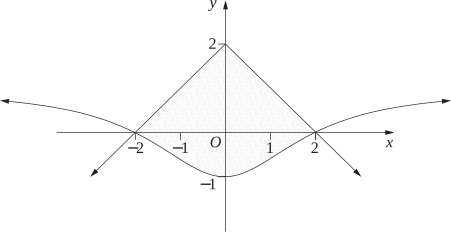
The region enclosed by  `y = 2 - |x|`  and  `y = 1 - 8/(4 + x^2)`  is shaded in the diagram.
 

Find the exact value of the area of the shaded region.  (3 marks)

Show Answers Only

`2pi\ text(u²)`

Show Worked Solution
`A` `= text(Area of)\ Delta + 2|int_0^2 1 – 8/(4 + x^2)\ dx|`
  `= 1/2 xx 4 xx 2 + 2|[x – 4 tan^(-1)\ x/2]_0^2|`
  `= 4 + 2|(2 – 4tan^(-1)1) – 0|`
  `= 4 + 2|2 – (4pi)/4|`
  `= 4 + 2(pi – 2)`
  `= 2pi\ text(u²)`

Filed Under: Further Area and Solids of Revolution, Further Areas and Solids of Revolution Tagged With: Band 4, smc-1039-50-Area, smc-7294-10-Area

Calculus, EXT1 C3 2021 HSC 13a

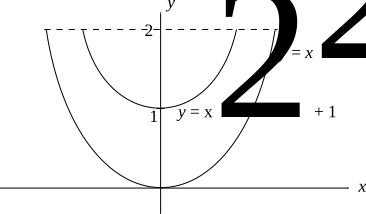
A 2-metre-high sculpture is to be made out of concrete. The sculpture is formed by rotating the region between  `y = x^2, y = x^2 + 1`  and  `y = 2`  around the `y`-axis.


Find the volume of concrete needed to make the sculpture.  (3 marks)

--- 6 WORK AREA LINES (style=lined) ---

Show Answers Only

`(3pi)/2\ text(u³)`

Show Worked Solution

`V` `= pi int_0^2 y\ dy-pi int_1^2 y-1\ dy`
  `= pi [(y^2)/2]_0^2-pi [(y^2)/2-y]_1^2`
  `= pi(2-0)-pi[(2-2)-(1/2-1)]`
  `= 2pi-pi(1/2)`
  `= (3pi)/2\ text(u³)`

Filed Under: Further Area and Solids of Revolution, Further Areas and Solids of Revolution Tagged With: Band 4, smc-1039-10-Polynomial, smc-1039-61-y-axis Rotation, smc-7294-30-\(\large y\)-axis Rotation, smc-7294-50-Polynomial

Calculus, EXT1 C3 2020 HSC 13b

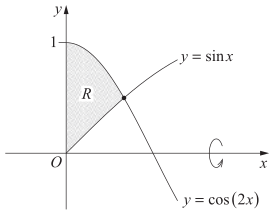
The region `R` is bounded by the `y`-axis, the graph of  `y = cos(2x)`  and the graph of  `y = sin x`, as shown in the diagram.
 

Find the volume of the solid of revolution formed when the region `R` is rotated about the `x`-axis.  (4 marks)

--- 8 WORK AREA LINES (style=lined) ---

Show Answers Only

`(3sqrt3 pi)/16\ text(u)³`

Show Worked Solution

`text(Find intersection:)`

Mean mark 53%.

`sin x = cos 2x`

`sin x = 1 – 2sin^2 x`

`2sin^2 x + sinx – 1` `= 0`
`(2 sinx – 1)(sinx + 1)` `= 0`
`sin x` `= 1/2` `text(or)` `sin x` `= −1`
`x` `= pi/6`   `x` `= (3pi)/2`


`V` `= pi int_0^(pi/6) (cos 2x)^2\ dx – pi int_0^(pi/6)(sin x)^2\ dx`
  `= pi int_0^(pi/6) cos^2 2x – sin^2 x\ dx`
  `= pi int_0^(pi/6) 1/2 (1 + cos 4x) – 1/2 (1 – cos 2x)\ dx`
  `= pi/2 int_0^(pi/6) cos 4x + cos 2x\ dx`
  `= pi/2 [1/4 sin 4x + 1/2 sin 2x]_0^(pi/6)`
  `= pi/8 [sin\ (2pi)/3 + 2sin\ pi/3]`
  `= pi/8 (sqrt3/2 + 2 xx sqrt3/2)`
  `= (3sqrt3 pi)/16\ text(u)³`

Filed Under: Further Area and Solids of Revolution, Further Areas and Solids of Revolution Tagged With: Band 4, smc-1039-20-Trig Function, smc-1039-60-x-axis Rotation, smc-7294-20-\(\large x\)-axis Rotation, smc-7294-55-Trig Function

Calculus, EXT1 C3 EQ-Bank 15

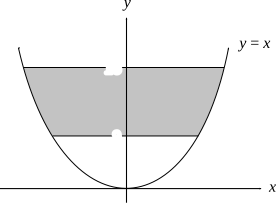
  1. Sketch the region bounded by the curve  `y = x^2`  and the lines  `y = 16`  and  `y = 9`.   (1 mark)

    --- 8 WORK AREA LINES (style=lined) ---

  2. Calculate the area of this region.   (3 marks)

    --- 6 WORK AREA LINES (style=lined) ---

Show Answers Only

 a.    
         

b.    `148/3 \ text(u)^2`

Show Worked Solution
a.    


b.    `text(Areas either side of)\ ytext(-axis are equal.)`

`y = x^2\ \ =>\ \ x = sqrty`

`A` `= 2 int_9^16 x\ dy`
  `= 2 int_9^16 sqrty\ dy`
  `= 2[2/3 y^(3/2)]_9^16`
  `= 4/3[(sqrt16)^3 – (sqrt9)^3]`
  `= 4/3[64 – 27]`
  `= 148/3 \ text(u²)`

Filed Under: Further Area and Solids of Revolution, Further Areas and Solids of Revolution Tagged With: Band 3, Band 4, smc-1039-50-Area, smc-7294-10-Area

Calculus, EXT1 C3 2019 SPEC1-N 9

i.  Show that  `tan((5pi)/(12)) = sqrt3 + 2`.   (2 marks)

--- 5 WORK AREA LINES (style=lined) ---

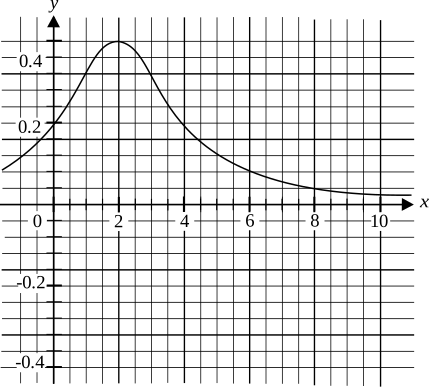
ii. 
       
 
Hence, find the area bounded by the graph of  `f(x) = (2)/(x^2 - 4x + 8)`  shown above, the `x`-axis and the lines  `x = 0`  and  `x = 2 sqrt3 +6`.   (4 marks)

--- 6 WORK AREA LINES (style=lined) ---

Show Answers Only
  1. `text(Proof (See Worked Solution))`
  2. `(2pi)/(3)`
Show Worked Solution

i.    `text(Method 1:)`

`tan \ (5pi)/(12)` `= tan ((pi)/(4) + (pi)/(6))`
  `= (tan \ (pi)/(4) + tan\ (pi)/(6))/(1 – tan \ (pi)/(4) · tan \ (pi)/(6))`
  `= (1 + (1)/(sqrt3))/(1 – (1)/(sqrt3))`
  `= (sqrt3+1)/(sqrt3-1) xx (sqrt3+1)/(sqrt3+1)`
  `= (3+ 2 sqrt3 + 1)/(3 – 1)`
  `= sqrt3 +2`

  
`text(Method 2:)`

`tan \ (5pi)/(6)` `= (2tan \ (5pi)/(12))/(1 – tan^2 \ (5pi)/(12))`
`- 1/sqrt3` `=(2tan \ (5pi)/(12))/(1 – tan^2 \ (5pi)/(12))`
`-2 sqrt3 tan \ (5pi)/(12)` `= 1 – tan^2 \ (5pi)/(12)`


`tan^2 \ (5pi)/(12) – 2 sqrt(3) tan \ (5pi)/(12) – 1 = 0`

`tan \ (5pi)/(12)` `= (2 sqrt3 ± sqrt(12 + 4))/(2)`
  `= sqrt3 + 2 \ \ \ (tan theta > 0)`


ii.   `text(Area)` `= int_0 ^(2 sqrt3 + 6) \ (2)/(x^2 – 4x + 8)\ dx`
  `= int_0 ^(2 sqrt3 + 6) \ (2)/((x -2)^2 + 2^2)`
  `= [tan^-1 ((x – 2)/(2))]_0 ^(2 sqrt3 + 6)`
  `= tan^-1 (sqrt3 + 2) – tan^-1 (-1)`
  `= (5pi)/(12) – (-(pi)/(4))`
  `= (2pi)/(3)`

Filed Under: Further Area and Solids of Revolution, Further Areas and Solids of Revolution Tagged With: Band 4, Band 5, smc-1039-50-Area, smc-7294-10-Area

Calculus, EXT1 C3 EQ-Bank 22

Find the volume of the solid of revolution formed when the graph of  `y = sqrt((1 + 2x)/(1 + x^2))`  is rotated about the `x`-axis over the interval  `[0,1]`.   (3 marks)

--- 9 WORK AREA LINES (style=lined) ---
Show Answers Only

`pi(pi/4 + ln2)\ \ text(u³)`

Show Worked Solution
`V` `= pi int_0^1 (1 + 2x)/(1 + x^2)\ dx`
  `= pi int_0^1 1/(1 + x^2)\ dx + pi int_0^1 (2x)/(1 + x^2)\ dx`
  `= pi [tan^(−1)(x)]_0^1 + pi [ln(1 + x^2)]_0^1`
  `= pi(tan^(−1)1 – tan^(−1)0) + pi(ln2 – ln1)`
  `= pi(pi/4) + pi(ln2)`
  `= pi(pi/4 + ln2)\ \ text(u³)`

Filed Under: Further Area and Solids of Revolution, Further Areas and Solids of Revolution Tagged With: Band 4, smc-1039-40-Other Graphs, smc-1039-60-x-axis Rotation, smc-7294-20-\(\large x\)-axis Rotation, smc-7294-70-Other Graphs

Calculus, EXT1 C3 EQ-Bank 21

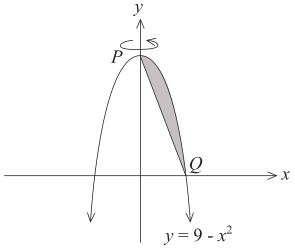
The parabola with equation  `y = 9-x^2`  cuts the `y`-axis at `P(0,9)` and the `x`-axis at `Q(3,0)`.

Find the exact volume of the solid of revolution formed when the area between the line `PQ` and the parabola is rotated about the `y`-axis.   (4 marks)

--- 12 WORK AREA LINES (style=lined) ---

Show Answers Only

`(27pi)/2\ text(units³)`

Show Worked Solution

`text(Equation of)\ PQ:`

`m = −3,\ \ ytext(-intercept) = 9`

`y = 9-3x`
 

`text(Rotating about the)\ ytext(-axis:)`

`x_1^(\ 2)` `= 9-y\ \ \ text{(parabola)}`
`y` `= 9-3x_2\ \ \ (text{line}\ PQ)`
`3x_2` `= 9-y`
`x_2` `= 3-y/3`
`x_2^(\ 2)` `= (3-y/3)^2`


`V` `= pi int_0^9 x_1^(\ 2)-x_2^(\ 2)\ dy`
  `= pi int_0^9 9-y-(3-y/3)^2\ dy`
  `= pi int_0^9 9-y-(9-2y + (y^2)/9)\ dy`
  `= pi int_0^9 y-(y^2)/9\ dy`
  `= pi [(y^2)/2-(y^3)/27]_0^9`
  `= pi(81/2-27)`
  `= (27pi)/2\ text(units³)`

Filed Under: Further Area and Solids of Revolution, Further Areas and Solids of Revolution Tagged With: Band 4, smc-1039-10-Polynomial, smc-1039-61-y-axis Rotation, smc-7294-30-\(\large y\)-axis Rotation, smc-7294-50-Polynomial

Calculus, EXT1* C3 2019 HSC 13d

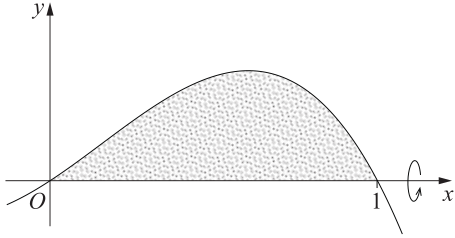
The diagram shows the region bounded by the curve  `y = x - x^3`, and the `x`-axis between  `x = 0`  and  `x = 1`. The region is rotated about the `x`-axis to form a solid.


Find the exact value of the volume of the solid formed.  (3 marks)

Show Answers Only

`(8 pi)/105\ text(u³)`

Show Worked Solution
`V` `= pi int_0^1 (x – x^3)^2 dx`
  `= pi int_0^1 x^2 – 2x^4 + x^6\ dx`
  `= pi [x^3/3 – 2/5 x^5 + 1/7 x^7]_0^1`
  `= pi(1/3 – 2/5 + 1/7)`
  `= (8 pi)/105\ text(u³)`

Filed Under: Further Area and Solids of Revolution, Further Areas and Solids of Revolution Tagged With: Band 4, smc-1039-10-Polynomial, smc-1039-60-x-axis Rotation, smc-7294-20-\(\large x\)-axis Rotation, smc-7294-50-Polynomial

Calculus, EXT1 C3 EQ-Bank 23

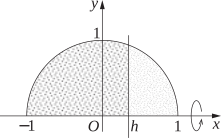
The region enclosed by the semicircle  `y = sqrt(1-x^2)`  and the `x`-axis is to be divided into two pieces by the line  `x = h`, when  `0 <= h <1`.
 

The two pieces are rotated about the `x`-axis to form solids of revolution. The value of `h` is chosen so that the volumes of the solids are in the ratio `2 : 1`.

Show that `h` satisfies the equation  `3h^3-9h + 2 = 0`.   (3 marks)

--- 9 WORK AREA LINES (style=lined) ---
Show Answers Only

`text(Show Worked Solution)`

Show Worked Solution

`text(Volume of smaller solid)`

`= pi int_h^1 (sqrt(1-x^2))^2\ dx`

`= pi int_h^1 1-x^2\ dx`

`= pi[x-(x^3)/3]_h^1`

`= pi[(1-1/3)-(h-(h^3)/3)]`

`= pi(2/3-h + (h^3)/3)`

 
`text(S)text(ince smaller solid is)\ 1/3\ text(volume of sphere:)`

`pi(2/3-h + (h^3)/3)` `= 1/3 xx 4/3 · pi · 1^3`
`(h^3)/3-h + 2/3` `= 4/9`
`3h^3-9h + 6` `= 4`
`:. 3h^3-9h + 2` `= 0\ \ text(… as required)`

Filed Under: Further Area and Solids of Revolution, Further Areas and Solids of Revolution Tagged With: Band 4, smc-1039-30-(Semi) Circle, smc-1039-60-x-axis Rotation, smc-7294-20-\(\large x\)-axis Rotation, smc-7294-60-(Semi) Circle

Calculus, EXT1* C3 2018 HSC 14b

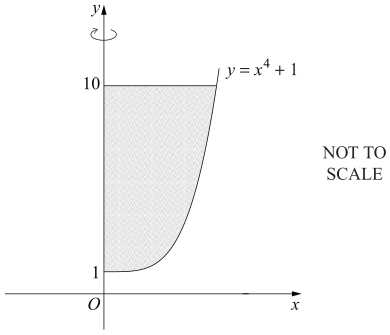
The shaded region shown in the diagram is bounded by the curve  `y = x^4 + 1`, the `y`-axis and the line  `y = 10`.


Find the volume of the solid of revolution formed when the shaded region is rotated about the `y`-axis.  (3 marks)

--- 6 WORK AREA LINES (style=lined) ---
Show Answers Only

`18 pi\ text(units²)`

Show Worked Solution

`y = x^4 + 1`

`x^4 = y – 1`

`x^2 = +- (y – 1)^(1/2)`

`text(When)\ \ x = 0,\ \ y = 1`

`=> x^2 = (y – 1)^(1/2)`
 

`:.\ text(Volume)` `= pi int_1^10 x^2\ dy`
  `= pi int_1^10 (y – 1)^(1/2)\ dy`
  `= pi xx 2/3 [(y – 1)^(3/2)]_1^10`
  `= (2 pi)/3 [9^(3/2) – 0]`
  `= (2 pi)/3 (27)`
  `= 18 pi\ \ text(units²)`

Filed Under: Further Area and Solids of Revolution, Further Areas and Solids of Revolution, Volumes of Solids of Rotation Tagged With: Band 4, smc-1039-10-Polynomial, smc-1039-61-y-axis Rotation, smc-7294-30-\(\large y\)-axis Rotation, smc-7294-50-Polynomial

Calculus, EXT1* C3 2017 HSC 12b

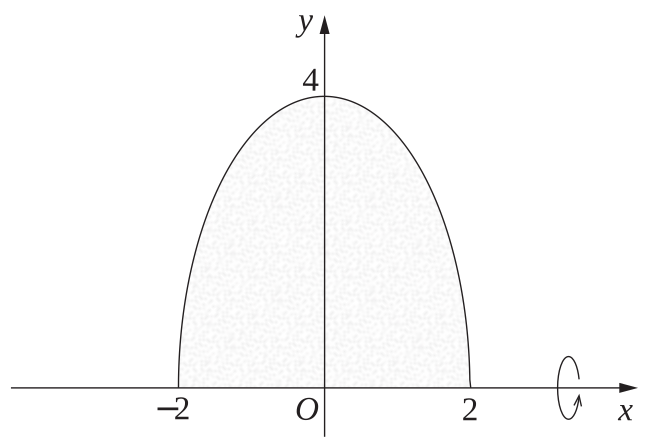
The diagram shows the region bounded by  `y = sqrt (16 - 4x^2)`  and the `x`-axis.


The region is rotated about the `x`-axis to form a solid.

Find the exact volume of the solid formed.  (3 marks)

Show Answers Only

`(128 pi)/3\ text(u³)`

Show Worked Solution
`y` `= sqrt (16 – 4x^2)`
`V` `= pi int_(-2)^2 y^2\ dx`
  `= 2 pi int_0^2 16 – 4x^2\ dx`
  `= 2 pi [16x – 4/3 x^3]_0^2`
  `= 2 pi [(16 ⋅ 2 – 4/3 2^3)-0]`
  `= 2 pi (64/3)`
  `= (128 pi)/3\ text(u³)`

Filed Under: Further Area and Solids of Revolution, Further Areas and Solids of Revolution, Volumes of Solids of Rotation Tagged With: Band 3, smc-1039-40-Other Graphs, smc-1039-60-x-axis Rotation, smc-7294-20-\(\large x\)-axis Rotation, smc-7294-70-Other Graphs

Calculus, EXT1* C3 2016 HSC 15a

The diagram shows two curves  `C_1` and `C_2.` The curve `C_1` is the semicircle  `x^2 + y^2 = 4, \ -2 <= x <= 0.` The curve `C_2` has equation  `x^2/9 + y^2/4 = 1, \ 0 <= x <= 3.`
 

hsc-2016-15a
 

An egg is modelled by rotating the curves about the `x`-axis to form a solid of revolution.

Find the exact value of the volume of the solid of revolution.  (4 marks)

--- 10 WORK AREA LINES (style=lined) ---
Show Answers Only

`(40 pi)/3\ text(u³)`

Show Worked Solution

`text(Consider)\ \ C_1,`

`V_1` `= pi int_-2^0 y^2\ dx`
  `= pi int_-2^0 4 – x^2\ dx`
  `= pi [4x – x^3/3]_-2^0`
  `= pi [0 – (-8 + 8/3)]`
  `= (16 pi)/3\ u³`


`text(Consider)\ \ C_2`

`x^2/9 + y^2/4` `= 1`
`y^2` `= 4 – (4x^2)/9`


`V_2` `= pi int_0^3 4 – (4x^2)/9\ dx`
  `= pi [4x – (4x^3)/27]_0^3`
  `= pi [(12 – (4 · 3^3)/27) – 0]`
  `= 8 pi\ text(u³)`


`text(Volume)` `= V_1 + V_2`
  `= (16 pi)/3 + 8 pi`
  `= (40 pi)/3\ text(u³)`

Filed Under: Further Area and Solids of Revolution, Further Areas and Solids of Revolution, Volumes of Solids of Rotation Tagged With: Band 5, smc-1039-30-(Semi) Circle, smc-1039-40-Other Graphs, smc-1039-60-x-axis Rotation, smc-7294-20-\(\large x\)-axis Rotation, smc-7294-60-(Semi) Circle, smc-7294-70-Other Graphs

Calculus, EXT1* C3 2004 HSC 4c

2004 4c

In the diagram, the shaded region is bounded by the curve  `y = 2 sec x`, the coordinate axes and the line  `x = pi/3`. The shaded region is rotated about the `x`-axis.

Calculate the exact volume of the solid of revolution formed.  (3 marks)

--- 6 WORK AREA LINES (style=lined) ---
Show Answers Only

`4sqrt3\ pi\ \ text(u³)`

Show Worked Solution
`y` `= 2 sec x`
`:. y^2` `= 4 sec^2 x`


`V` `= pi int_0^(pi/3) y^2\ dx`
  `= pi int_0^(pi/3) 4 sec^2 x\ dx`
  `= 4pi int_0^(pi/3) sec^2 x\ dx`
  `= 4pi[tan x]_0^(pi/3)`
  `= 4pi(tan\ pi/3 − tan 0)`
  `= 4pi(sqrt3 − 0)`
  `= 4sqrt3\ pi\ \ text(u³)`

Filed Under: Further Area and Solids of Revolution, Further Areas and Solids of Revolution, Volumes of Solids of Rotation Tagged With: Band 4, smc-1039-20-Trig Function, smc-1039-60-x-axis Rotation, smc-7294-20-\(\large x\)-axis Rotation, smc-7294-55-Trig Function

Calculus, EXT1* C3 2007 HSC 3a

Find the volume of the solid of revolution formed when the region bounded by the curve  `y = 1/(sqrt(9 + x^2))`, the `x`-axis, the `y`-axis and the line  `x = 3`, is rotated about the `x`-axis.  (3 marks)

--- 6 WORK AREA LINES (style=lined) ---
Show Answers Only

`(pi^2)/(12)\ \ text(u³)`

Show Worked Solution

`y = 1/(sqrt(9 + x^2))`

`:.\ text(Volume)` `= pi int_0^3 y^2\ dx`
  `= pi int_0^3 (1/(sqrt(9 + x^2)))^2\ dx`
  `= pi int_0^3 1/(9 + x^2)\ dx`
  `= pi [1/3 tan^(−1)\ x/3]_0^3`
  `= pi [1/3 tan^(−1)\ 1 − 1/3 tan^(−1)\ 0]`
  `= pi [(1/3 xx pi/4) − 0]`
  `= (pi^2)/(12)\ \ text(u³)`

Filed Under: 11. Integration EXT1, Further Area and Solids of Revolution, Further Areas and Solids of Revolution, Inverse Trig Functions EXT1 Tagged With: Band 4, smc-1039-40-Other Graphs, smc-1039-60-x-axis Rotation, smc-7294-20-\(\large x\)-axis Rotation, smc-7294-70-Other Graphs

Calculus, EXT1 C3 2005 HSC 5a

Find the exact value of the volume of the solid of revolution formed when the region bounded by the curve  `y = sin 2x`, the `x`-axis and the line  `x = pi/8`  is rotated about the `x`-axis.  (3 marks)

--- 8 WORK AREA LINES (style=lined) ---
Show Answers Only

`pi/16 (pi – 2)\ \ \ text(u³)`

Show Worked Solution
`y` `= sin 2x`
`y^2` `= sin^2 2x` 

 
`text(Using:)\ \ sin^2 x= 1/2 (1 – cos 2x)`

COMMENT: Michael Wells (1st in state Ext2) would derive this formula in his working from the `sin^2x+cos^2=1` identity in ~5 seconds every time he used it in an exam.
  

`:. V` `=pi int_0^(pi/8) y^2 \ dx`
  `= pi int_0^(pi/8) sin^2 2x \ dx`
  `= pi/2 int_0^(pi/8) 1 – cos\ 4x\ dx`
  `= pi/2 [x – 1/4 sin\ 4x]_0^(pi/8)`
  `= pi/2 [(pi/8 – 1/4 sin\ pi/2) – 0]`
  `= pi/2 (pi/8 – 1/4)`
  `= pi/2 ((pi – 2)/8)`
  `= pi/16 (pi – 2)\ \ \ text(u³)`

Filed Under: 11. Integration EXT1, Further Area and Solids of Revolution, Further Areas and Solids of Revolution Tagged With: Band 4, smc-1039-20-Trig Function, smc-1039-60-x-axis Rotation, smc-7294-20-\(\large x\)-axis Rotation, smc-7294-55-Trig Function

Calculus, EXT1* C3 2007 HSC 9a

2007 9a
  

The shaded region in the diagram is bounded by the curve  `y = x^2 + 1`, the `x`-axis, and the lines  `x = 0`  and  `x = 1.`

Find the volume of the solid of revolution formed when the shaded region is rotated about the `x`-axis.  (3 marks)

Show Answers Only

`(28 pi)/15\ \ text(u³)`

Show Worked Solution
`V` `= pi int_0^1 y^2\ dx`
  `= pi int_0^1 (x^2 + 1)^2\ dx`
  `= pi int_0^1 x^4 + 2x^2 + 1\ dx`
  `= pi [1/5 x^5 + 2/3 x^3 + x]_0^1`
  `= pi[(1/5 + 2/3 + 1) – 0]`
  `= pi [3/15 + 10/15 + 1]`
  `= (28 pi)/15\ \ text(u³)`

Filed Under: Further Area and Solids of Revolution, Further Areas and Solids of Revolution, Volumes of Solids of Rotation Tagged With: Band 3, Band 4, HSC, smc-1039-10-Polynomial, smc-1039-60-x-axis Rotation, smc-7294-20-\(\large x\)-axis Rotation, smc-7294-50-Polynomial

Calculus, EXT1* C3 2015 HSC 16b

A bowl is formed by rotating the curve  `y = 8 log_e (x - 1)`  about the `y`-axis for  `0 <= y <= 6.`
 

2015 16b
 

Find the volume of the bowl. Give your answer correct to 1 decimal place.  (3 marks)

--- 8 WORK AREA LINES (style=lined) ---
Show Answers Only

`118.7\ text(u³)`

Show Worked Solution
♦ Mean mark 38%.
`y` `=8 log_e (x – 1)`
`y/8` `=log_e (x – 1)`
`e^(y/8)` `=x – 1`
`x` `=e^(y/8) + 1`
`x^2` `=(e^(y/8) + 1)^2`
  `=(e^(y/8))^2 + 2e^(y/8) + 1`
  `=e^(y/4) + 2e^(y/8) + 1`


`V` `= pi int_0^6 x^2\ dy`
  `= pi int_0^6 (e^(y/4) + 2e^(y/8) + 1)\ dy`
  `= pi [4e^(y/4) + 16e^(y/8) + y]_0^6`
  `= pi [(4e^(6/4) + 16e^(6/8) + 6) – (4e^0 + 16e^0 + 0)]`
  `= pi [(4e^1.5 + 16e^0.75 + 6) – (4 + 16)]`
  `= pi [4e^1.5 + 16e^0.75 – 14]`
  `= 118.748…`
  `= 118.7\ \ text{(to 1 d.p.)}`

 
`:.\ text(Volume of the bowl is 118.7 u³.)`

Filed Under: Applied Calculus (L&E), Further Area and Solids of Revolution, Further Areas and Solids of Revolution, Volumes of Solids of Rotation Tagged With: Band 5, smc-1039-40-Other Graphs, smc-1039-61-y-axis Rotation, smc-7294-30-\(\large y\)-axis Rotation, smc-7294-70-Other Graphs

Calculus, EXT1* C3 2006 HSC 4b

2006 4b

In the diagram, the shaded region is bounded by the parabola  `y = x^2 + 1`, the `y`-axis and the line  `y = 5`.

Find the volume of the solid formed when the shaded region is rotated about the `y`-axis.  (3 marks)

--- 6 WORK AREA LINES (style=lined) ---
Show Answers Only

`8 pi\ \ text(u³)`

Show Worked Solution

`y = x^2 + 1`

`x^2 = y – 1`

`V` `= pi int_1^5 x^2 \ dy`
  `= pi int_1^5 y-1 \ dy`
  `= pi [y^2/2 – y]_1^5`
  `= pi[(25/2 – 5) – (1/2 – 1)]`
  `= pi[15/2 – (-1/2)]`
  `= 8 pi\ \ text(u³)`

Filed Under: Further Area and Solids of Revolution, Further Areas and Solids of Revolution, Volumes of Solids of Rotation Tagged With: Band 3, Band 4, smc-1039-10-Polynomial, smc-1039-61-y-axis Rotation, smc-7294-30-\(\large y\)-axis Rotation, smc-7294-50-Polynomial

Calculus, EXT1* C3 2005 HSC 6c

2005 6c
 

The graphs of the curves  `y = x^2`  and  `y = 12 - 2x^2`  are shown in the diagram.

  1. Find the points of intersection of the two curves.  (1 mark)

    --- 4 WORK AREA LINES (style=lined) ---
  2. The shaded region between the curves and the `y`-axis is rotated about the `y`-axis. By splitting the shaded region into two parts, or otherwise, find the volume of the solid formed.  (3 marks)

    --- 6 WORK AREA LINES (style=lined) ---
Show Answers Only

a.    `text{(2, 4), (–2, 4)`

b.    `24pi\ \ text(u³)`

Show Worked Solution
a.    `y` `= x^2` `\ …\ (1)`
  `y` `= 12 − 2x^2` `\ …\ (2)`


`text(Substitute)\ \ y = x^2\ \ text(into)\ (2)`

`x^2` `= 12 − 2x^2`
`3x^2 − 12` `= 0`
`3(x^2 − 4)` `= 0`
`x` `= ±2`
`text(When)` `\ x = 2,` `\ y = 4`
`text(When)` `\ x = text(−2),` `\ y = 4`

 
`:.\ text{Intersection at (2, 4), (−2, 4)}`
 

b.  `text{In (1),}\ \ x^2=y`

`text{In (2),}\ \ \ y` `= 12 − 2x^2`
`2x^2` `= 12 − y`
`x^2` `= (12 − y)/2`
  `= 6 − 1/2y`

 
`:.\ text(Volume)`

`= pi int_0^4 y\ dy + pi int_4^12 6 − 1/2y\ dy`
`= pi[y^2/2]_0^4 + pi[6y − y^2/4]_4^12`
`= pi[16/2 − 0] + pi[(6 xx 12 − 12^2/4) − (6 xx 4 − 4^2/4)]`
`= 8pi + pi[36 − 20]`
`= 8pi + 16pi`
`= 24pi\ \ text(u³)`

Filed Under: Further Area and Solids of Revolution, Further Areas and Solids of Revolution, Volumes of Solids of Rotation Tagged With: Band 3, Band 4, smc-1039-10-Polynomial, smc-1039-61-y-axis Rotation, smc-7294-30-\(\large y\)-axis Rotation, smc-7294-50-Polynomial

Calculus, EXT1* C3 2008 HSC 6c

The graph of  `y = 5/(x - 2)`  is shown below.
 

2008 6c
 

The shaded region in the diagram is bounded by the curve  `y = 5/(x - 2)`, the  `x`-axis and the lines  `x = 3`  and  `x = 6`.

Find the volume of the solid of revolution formed when the shaded region is rotated about the  `x`-axis.  (3 marks)

--- 6 WORK AREA LINES (style=lined) ---
Show Answers Only

`(75pi)/4\ text(u³)`

Show Worked Solution
`y` `= 5/(x – 2)`
`V` `= pi int_3^6 y^2\ dx`
  `= pi int_3^6 (5/(x – 2))^2\ dx`
  `= 25 pi int_3^6 1/((x – 2)^2)\ dx`
  `= 25 pi [(-1)/(x – 2)]_3^6`
  `= 25 pi [-1/4 – (-1)]`
  `=25 pi [3/4]`
  `= (75pi)/4\ text(u³)`

Filed Under: Further Area and Solids of Revolution, Further Areas and Solids of Revolution, Volumes of Solids of Rotation Tagged With: Band 4, smc-1039-40-Other Graphs, smc-1039-60-x-axis Rotation, smc-7294-20-\(\large x\)-axis Rotation, smc-7294-70-Other Graphs

Calculus, EXT1 C3 2014 HSC 12b

The region bounded by  `y = cos 4x`  and the  `x`-axis, between  `x = 0`  and  `x = pi/8`, is rotated about the  `x`-axis to form a solid.   
 

2014 12b
 

Find the volume of the solid.   (3 marks)

Show Answers Only

`(pi^2)/16\ \ text(u³)`

Show Worked Solution
COMMENT: The identities `cos 2theta=` `cos^2 theta-sin^2 theta =` ` 2cos^2 theta-1=1-2sin^2 theta`  are tested every year – know them. 
`V` `= pi int_0^(pi/8) y^2\ dx`
  `= pi int_0^(pi/8) cos^2 4x\ dx`
  `= pi int_0^(pi/8) 1/2 (cos 8x + 1)\ dx`
  `= pi/2 [1/8 sin 8x + x]_0^(pi/8)`
  `= pi/2 [(1/8 sin pi + pi/8)] – 0]`
  `= (pi^2)/16\ \ text(u³)`

Filed Under: 11. Integration EXT1, Further Area and Solids of Revolution, Further Areas and Solids of Revolution Tagged With: Band 4, smc-1039-20-Trig Function, smc-1039-60-x-axis Rotation, smc-7294-20-\(\large x\)-axis Rotation, smc-7294-55-Trig Function

Calculus, EXT1* C3 2014 HSC 14c

The region bounded by the curve  `y = 1 + sqrtx`  and the  `x`-axis between  `x = 0`  and  `x = 4`  is rotated about the  `x`-axis to form a solid.
 

2014 14c
 

Find the volume of the solid.   (3 marks) 

--- 6 WORK AREA LINES (style=lined) ---
Show Answers Only

`(68 pi)/3\ text(u³)`

Show Worked Solution

`y = 1 + sqrtx`

`V` `= pi int_0^4 y^2\ dx`
  `= pi int_0^4 (1 + sqrtx)^2\ dx`
  `= pi int_0^4 (1 + 2 sqrtx + x)\ dx`
  `= pi [x + 4/3 x^(3/2) + 1/2 x^2]_0^4`
  `= pi [(4 + 4/3 xx 4^(3/2) + 1/2 xx 4^2)\ – 0]`
  `= pi (4 + 32/3 + 8)`
  `= (68 pi)/3\ text(u³)`

Filed Under: Further Area and Solids of Revolution, Further Areas and Solids of Revolution, Volumes of Solids of Rotation Tagged With: Band 4, smc-1039-40-Other Graphs, smc-1039-60-x-axis Rotation, smc-7294-20-\(\large x\)-axis Rotation, smc-7294-70-Other Graphs

Calculus, EXT1 C3 2013 HSC 12b

The region bounded by the graph  `y = 3 sin\ x/2`  and the  `x`-axis between  `x = 0`  and  `x = (3pi)/2`  is rotated about the  `x`-axis to form a solid.  
 

2013 12b
 

Find the exact volume of the solid.   (3 marks)

--- 6 WORK AREA LINES (style=lined) ---
Show Answers Only

`(9pi)/2 ((3pi)/2 + 1) text(u³)`

Show Worked Solution
`y` `= 3 sin\ x/2`
`y^2` `= 9 sin^2\ x/2`

 
`text(Using:)\ \ sin^2x= 1/2 (1 – cos 2x)`
 

`:. V` `= pi int_0^((3pi)/2) 9 sin^2\ x/2\ dx`
  `= (9pi)/2 int_0^((3pi)/2) (1\ – cosx)\ dx`
  `= (9pi)/2 [x\ – sinx]_0^((3pi)/2)`
  `= (9pi)/2 [((3pi)/2\ – sin\ (3pi)/2)\ – 0]`
  `= (9pi)/2 ((3pi)/2 + 1)\ text(u³)`

Filed Under: 11. Integration EXT1, Further Area and Solids of Revolution, Further Areas and Solids of Revolution Tagged With: Band 4, smc-1039-20-Trig Function, smc-1039-60-x-axis Rotation, smc-7294-20-\(\large x\)-axis Rotation, smc-7294-55-Trig Function

Calculus, EXT1* C3 2009 HSC 6a

The diagram shows the region bounded by the curve  `y = sec x`, the lines  `x = pi/3`  and  `x = -pi/3`,  and the  `x`-axis. 
 

2009 6a
 

The region is rotated about the   `x`-axis. Find the volume of the solid of revolution formed.   (3 marks)

Show Answers Only

 `2 sqrt 3 pi\ text(u³)`

Show Worked Solution
`V` `= pi int_(-pi/3)^(pi/3) y^2\ dx`
  `= pi int_(-pi/3)^(pi/3) sec^2x\ dx`
  `= pi [tanx]_(-pi/3)^(pi/3)`
  `= pi[tan(pi/3) – tan(-pi/3)]`
  `= pi [sqrt3\ – (-sqrt3)]`
  `= 2 sqrt3 pi\ text(u³)`

Filed Under: Further Area and Solids of Revolution, Further Areas and Solids of Revolution, Volumes of Solids of Rotation Tagged With: Band 4, smc-1039-20-Trig Function, smc-1039-60-x-axis Rotation, smc-7294-20-\(\large x\)-axis Rotation, smc-7294-55-Trig Function

Calculus, EXT1* C3 2010 HSC 10b

The circle  `x^2 + y^2 = r^2`  has radius `r` and centre `O`. The circle meets the positive `x`-axis at `B`. The point `A` is on the interval `OB`. A vertical line through `A` meets the circle at `P`. Let  `theta = /_OPA`.
  

2010 10b1

  1. The shaded region bounded by the arc `PB` and the intervals `AB` and `AP` is rotated about the `x`-axis. Show that the volume, `V`, formed is given by
  2. `V = (pi r^3)/3 (2-3 sin theta + sin^3 theta)`   (3 marks)

    --- 8 WORK AREA LINES (style=lined) ---
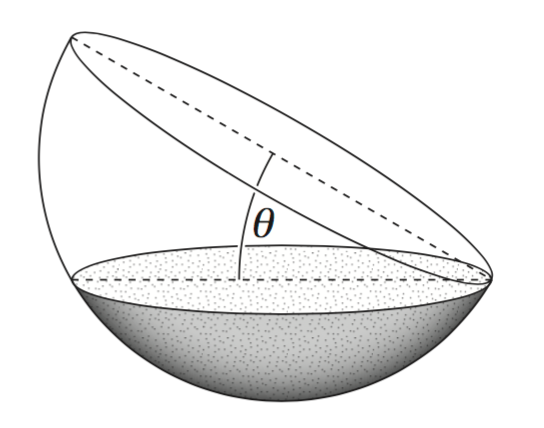
  3. A container is in the shape of a hemisphere of radius `r` metres. The container is initially horizontal and full of water. The container is then tilted at an angle of `theta` to the horizontal so that some water spills out. 

    1. Find `theta` so that the depth of water remaining is one half of the original depth.   (1 mark)

      --- 4 WORK AREA LINES (style=lined) ---
    2. What fraction of the original volume is left in the container?   (2 marks)

      --- 6 WORK AREA LINES (style=lined) ---
Show Answers Only

a.    `text(Proof)  text{(See Worked Solutions)}`

b.i.  `theta = pi/6\ text(radians)`

b.ii. `5/16`

Show Worked Solution

a.    `text(Show that)\ V = (pir^3)/3 (2-3sin theta + sin^3 theta)`

♦♦♦ Mean mark (i) 16%.
MARKER’S COMMENT: A common error was to integrate `r^2` to `1/3 r^3` instead of `r^2 x` (note that `r` is a constant).  
`sin theta` `= (OA)/r`
`:.\ OA` `= r sin theta`
`=> A` `= (r sin theta, 0),\ \ \ \ B = (r,0)`


`:.V` `= pi int_(rsintheta)^r y^2\ dx`
  `= pi int_(rsintheta)^r (r^2-x^2)\ dx\ \ \ \ text{(using}\ x^2+y^2=r^2text{)}`
  `= pi [r^2 x-(x^3)/3]_(rsintheta)^r`
  `= pi [(r^3-r^3/3)-(r^3 sin theta-(r^3 sin^3 theta)/3)]`
  `= pi ((2r^3)/3-r^3 sin theta + (r^3 sin^3 theta)/3)`
  `= (pir^3)/3 (2-3 sin theta + sin^3 theta)\ \ \ text(… as required)`


b.i. `text(Depth of water remaining) = 1/2 xx text(original depth:)`

`r-r sin theta` `=1/2 r`
`r (1-sin theta)` `= 1/2 r`
`1-sin theta` `= 1/2`
`sin theta` `= 1/2`
`:.\ theta` `= pi/6\ text(radians)`


 MARKER’S COMMENT: Previous parts of a question should always be at the front and centre of a student’s mind and direct their strategy.
b.ii.    `text(Original Volume)` `= 1/2 xx 4/3 pi r^3`
    `= 2/3 pi r^3`


`text(New Volume)` `= (pi r^3)/3 [2-3 sin(pi/6) + sin^3(pi/6)]`
  `= (pir^3)/3 [2-(3 xx 1/2) + (1/2)^3]`
  `= (pi r^3)/3 [2-3/2 + 1/8]`
  `= (pir^3)/3 (5/8)`
  `= (5 pi r^3)/24`


`:.\ text(Fraction of original volume left)`

`= ((5pir^3)/24)/(2/3 pi r^3)`

`= 5/24 xx 3/2`

`= 5/16`

Filed Under: Circular Measure, Exact Trig Ratios and Other Identities, Further Area and Solids of Revolution, Further Areas and Solids of Revolution, Volumes of Solids of Rotation Tagged With: Band 6, smc-1039-30-(Semi) Circle, smc-1039-60-x-axis Rotation, smc-7294-20-\(\large x\)-axis Rotation, smc-7294-60-(Semi) Circle

Calculus, EXT1* C3 2012 HSC 14b

The diagram shows the region bounded by  `y = 3/((x+2)^2)`, the `x`-axis, the  `y`-axis,  and the line  `x = 1`.  
 

2012 14b
 

The region is rotated about the  `x`-axis to form a solid.

Find the volume of the solid.  (3 marks)

--- 8 WORK AREA LINES (style=lined) ---
Show Answers Only

 `(19pi)/72\ text(u³)`

Show Worked Solution
MARKER’S COMMENT: Most students omitted the `dx` when stating the definite integral in this question!
`V` `= pi int_0^1 y^2\ dx`
  `= pi int_0^1 (3/((x+2)^2))^2\ dx`
  `= pi int_0^1 9/((x+2)^4)\ dx`
  `= 9pi int_0^1 (x + 2)^-4\ dx`
  `= 9pi  [-1/3 (x + 2)^-3]_0^1`
  `= 9pi  [(-1/3 xx 1/(3^3))\ – (-1/3 xx 1/(2^3))]`
  `= 9 pi [-1/81 + 1/24]`
  `= 9 pi (19/648)`
  `= (19pi)/72\ text(u³)`


`:.\ text(Volume of the solid is)\ (19pi)/72\ text(u³)`.

Filed Under: Further Area and Solids of Revolution, Further Areas and Solids of Revolution, Volumes of Solids of Rotation Tagged With: Band 4, smc-1039-40-Other Graphs, smc-1039-60-x-axis Rotation, smc-7294-20-\(\large x\)-axis Rotation, smc-7294-70-Other Graphs

Calculus, EXT1* C3 2011 HSC 8b

The diagram shows the region enclosed by the parabola  `y = x^2`, the  `y`-axis and the line  `y = h`, where  `h > 0`. This region is rotated about the  `y`-axis to form a solid called a paraboloid. The point  `C`  is the intersection of  `y = x^2` and  `y = h`.

The point  `H`  has coordinates  `(0, h)`.
 

2011 8b

  1. Find the exact volume of the paraboloid in terms of  `h`.    (2 marks)

    --- 5 WORK AREA LINES (style=lined) ---

  2. A cylinder has radius  `HC`  and height  `h`.    


    What is the ratio of the volume of the paraboloid to the volume of the cylinder?   (1 mark)

    --- 8 WORK AREA LINES (style=lined) ---

Show Answers Only

a.    `(pi h^2)/2\ text(u³)`

b.    `1:2`

Show Worked Solution
IMPORTANT: Most common errors: 1-use the correct axis, and 2-check the limits!
a.     `V` `= pi int_0^h x^2\ dy`
    `= pi int_0^h y\ dy`
    `= pi [1/2 y^2]_0^h`
    `= pi (1/2 h^2)`
    `= (pi h^2)/2 \ text(u³)`

 
`:.\ text(The volume of the paraboloid is)\  (pi h^2)/2\ text(u³)`
 

b.    `text(Radius of cylinder)\ (r) = HC`

`text(Find)\ x text(-coordinate of)\ C:`

♦♦ Mean mark of 24%.
`text(When)\ y` `=h`
`=> x^2` `= h`
`x` `= sqrt h`
`:. r` `= sqrth`


`text(Volume of cylinder)` `= pi r^2 h`
  `= pi (sqrth)^2 h`
  `= pi h^2`

 
`:.\ text(Volume of paraboloid : volume of cylinder)`

`= (pi h^2)/2 : pi h^2`

`= 1:2`

Filed Under: Further Area and Solids of Revolution, Further Areas and Solids of Revolution, Volumes of Solids of Rotation Tagged With: Band 4, Band 6, smc-1039-10-Polynomial, smc-1039-61-y-axis Rotation, smc-7294-30-\(\large y\)-axis Rotation, smc-7294-50-Polynomial

Calculus, EXT1* C3 2013 HSC 15b

The region bounded by the  `x`-axis, the  `y`-axis and the parabola  `y = (x-2)^2`  is rotated about the  `y`-axis to form a solid.
 

2013 15b
 

Find the volume of the solid.   (4 marks)

--- 8 WORK AREA LINES (style=lined) ---

Show Answers Only

 `text(Volume) = (8 pi)/3\ text(u³)`

Show Worked Solution

`text(S)text(ince rotation about the)\ y text(-axis,)`

♦ Mean mark 39%.
`(x -2)^2` `= y`
`x\-2` ` = ± y^(1/2)`
`x ` `= 2 +- y^(1/2)`

 
`text(When)\ \ x=0,\ y=4`

`:. x = 2-y^(1/2)`

`:.\ text(Volume)` `= pi int_0^4 x^2 dy`
  `= pi int_0^4 (2-y^{1/2})^2 dy`
  `= pi int_0^4 (4-4 y^{1/2} + y) dy`
  `= pi [4y-(4 xx 2/3 xx y^(3/2)) + (1/2 y^2)]_0^4`
  `= pi [4y-8/3 y^(3/2) + 1/2 y^2]_0^4`
  `= pi [(4 xx 4)-(8/3 xx 4^(3/2)) + (1/2 xx 4^2)]` 
  `= pi [16\-64/3 + 8]`
  `= (8 pi)/3\ text(u³)`

Filed Under: Further Area and Solids of Revolution, Further Areas and Solids of Revolution, Volumes of Solids of Rotation Tagged With: Band 5, smc-1039-10-Polynomial, smc-1039-61-y-axis Rotation, smc-7294-30-\(\large y\)-axis Rotation, smc-7294-50-Polynomial

Copyright © 2014–2026 SmarterEd.com.au · Log in