SmarterEd

Aussie Maths & Science Teachers: Save your time with SmarterEd

  • Login
  • Get Help
  • About

Mechanics, EXT2 M1 2025 HSC 15b

A particle moves in simple harmonic motion about the origin with amplitude \(A\), and it completes two cycles per second. When it is \(\dfrac{1}{4}\) metres from the origin, its speed is half its maximum speed.

Find the maximum positive acceleration of the particle during its motion.   (4 marks)

--- 12 WORK AREA LINES (style=lined) ---

Show Answers Only

\(a_{\text{max}}=\dfrac{8 \pi^2}{\sqrt{3}}\)

Show Worked Solution

\(v^2=-n^2\left(x^2-A^2\right)\)

\(\operatorname{Period}\ (T)=\dfrac{1}{2} \ \Rightarrow \ \dfrac{2 \pi}{n}=\dfrac{1}{2} \ \Rightarrow \ n=4 \pi\)

\(\text{Max velocity occurs at}\ \  x=0:\)

   \(v_{\text{max}}^2=-(4 \pi)^2\left(0-A^2\right)=16 \pi^2 A^2\)

   \(v_{\text{max}}=\sqrt{16 \pi^2 A^2}=4 \pi A\)
 

\(\text{At} \ \ x=\dfrac{1}{4}, \ v=\dfrac{1}{2} \times 4 \pi A=2 \pi A\)

\((2 \pi A)^2\) \(=-(4 \pi)^2\left(\dfrac{1}{16}-A^2\right)\)
\(\dfrac{A^2}{4}\) \(=A^2-\dfrac{1}{16}\)
\(\dfrac{3 A^2}{4}\) \(=\dfrac{1}{16}\)
\(A^2\) \(=\dfrac{1}{12}\)
\(A\) \(=\dfrac{1}{\sqrt{12}}\)


\(\text{Max positive acceleration occurs at} \ \ x=-\dfrac{1}{\sqrt{12}}:\)

\(a_{\text{max}}=-n^2 x=-(4 \pi)^2 \times-\dfrac{1}{\sqrt{12}}=\dfrac{8 \pi^2}{\sqrt{3}}\)

Filed Under: Simple Harmonic Motion, Simple Harmonic Motion Tagged With: Band 5, Period and Cetre, smc-1059-20-Amplitude/Period, smc-1059-30-Max Speed/Acceleration, smc-7438-20-Amplitude/Period, smc-7438-30-Max Speed/Acceleration

Mechanics, EXT2 M1 2025 HSC 4 MC

A particle in simple harmonic motion has speed \(v \ \text{ms}^{-1}\), given by  \(v^2=-x^2+2 x+8\)  where \(x\) is the displacement from the origin in metres.

What is the amplitude of the motion?

  1. 1 m
  2. 3 m
  3. 6 m
  4. 9 m
Show Answers Only

\(B\)

Show Worked Solution

\(\text{Using} \ \ v^2=n^2\left(a^2-(x-c)^2\right):\)

\(v^2\) \(=-x^2+2 x+8\)
  \(=9-\left(x^2-2 x+1\right)\)
  \(=9-(x-1)^2\)

 
\(\therefore a^2 = 9\ \ \Rightarrow\ \ a=3\)

\(\Rightarrow B\)

Filed Under: Simple Harmonic Motion, Simple Harmonic Motion Tagged With: Band 3, Period and Cetre, smc-1059-20-Amplitude/Period, smc-1059-25-Non-origin Centre, smc-7438-20-Amplitude/Period, smc-7438-25-Non-origin Centre

Mechanics, EXT2 M1 2024 HSC 5 MC

A particle is moving in simple harmonic motion with period 10 seconds and an amplitude of 8 m . The particle starts at the central point of motion and is initially moving to the left with a speed of \(V\) m s\(^{-1}\), where  \(V>0\).

What will be the position and velocity of the particle after 7.5 seconds?

  1. At the central point of motion with a velocity of \(V \text{ m s} ^{-1}\)
  2. At the central point of motion with a velocity of \(-V \text{ m s} ^{-1}\)
  3. 8 m to the left of the central point of motion with a velocity of \(0 \text{ m s} ^{-1}\)
  4. 8 m to the right of the central point of motion with a velocity of \(0 \text{ m s} ^{-1}\)
Show Answers Only

\(D\)

Show Worked Solution

\(T=\dfrac{2\pi}{n}=10\ \ \Rightarrow\ \ n=\dfrac{\pi}{5}\)

\(x\) \(=-8 \sin\Big(\dfrac{\pi}{5}t\Big) \)  
\(\dot{x}\) \(=-8 \cos\Big(\dfrac{\pi}{5}t\Big) \)  

 
\(\text{At}\ \ t=7.5:\)

\(x\) \(=-8 \sin\Big(\dfrac{\pi}{5}t\Big)=-8 \)  
\(\dot{x}\) \(=-8 \cos\Big(\dfrac{\pi}{5}t\Big)=0 \)  

\(\Rightarrow D\)

Filed Under: Simple Harmonic Motion, Simple Harmonic Motion Tagged With: Band 4, Period and Cetre, smc-1059-20-Amplitude/Period, smc-7438-20-Amplitude/Period

Mechanics, EXT2 M1 2024 HSC 13b

A particle is moving in simple harmonic motion, described by  \(\ddot{x}=-4(x+1)\).

When the particle passes through the origin, the speed of the particle is 4 m s\(^{-1}\).

What distance does the particle travel during a full period of its motion?   (3 marks)

--- 9 WORK AREA LINES (style=lined) ---

Show Answers Only

\(4 \sqrt{5} \text{ units }\)

Show Worked Solution

  \(\ddot{x}\) \(=-4(x+1)\)
  \(\dfrac{d}{dx}\left(\dfrac{1}{2} v^2\right)\) \(=-4 x-4\)
  \(\dfrac{1}{2} v^2\) \(=\displaystyle \int-4 x-4\, d x\)
  \(\dfrac{1}{2} v^2\) \(=-2 x^2-4 x+c\)
  \(v^2\) \(=-4 x^2-8 x+2c\)

 
\(\text {When } x=0, \quad v=4\ \ \Rightarrow \ c=8\)

\(v^2=-4 x^2-8 x+16\)

\(\text {Find } x \text { when } v=0:\)

\(-4 x^2-8 x+16\) \(=0\)  
\(x^2+2 x-4\) \(=0\)  

 
\(\Rightarrow\ x=\dfrac{-2 \pm \sqrt{2^2+4 \cdot 1 \cdot 4}}{2}=-1 \pm \sqrt{5}\)

\(\Rightarrow\ \text{Amplitude}=\sqrt{5}\)

\(\therefore \text {Distance travelled in full period }=4 \sqrt{5} \text{ units }\)

Filed Under: Simple Harmonic Motion, Simple Harmonic Motion Tagged With: Band 4, Period and Cetre, smc-1059-20-Amplitude/Period, smc-1059-50-Distance Travelled, smc-7438-20-Amplitude/Period, smc-7438-50-Distance Travelled

Mechanics, EXT2 M1 2023 HSC 6 MC

Which of the following functions does NOT describe simple harmonic motion?

  1. \(x=\cos ^2 t-\sin 2 t\)
  2. \(x=\sin 4 t+4 \cos 2 t\)
  3. \(x=2 \sin 3 t-4 \cos 3 t+5\)
  4. \(x=4 \cos \left(2 t+\dfrac{\pi}{2}\right)+5 \sin \left(2 t-\dfrac{\pi}{4}\right)\)
Show Answers Only

\(B\)

Show Worked Solution

\(\text{By trial and error}\)

\(\text{Option}\ A:\)

\(x=\cos^2t-\sin\,2t=\dfrac{1}{2}\cos\,2t+\dfrac{1}{2}-\sin\,2t \)

\(\dot x=-\sin\,2t-2\cos\,2t \)

♦♦ Mean mark 34%.
\(\ddot x\) \(=-2\cos\,2t+4\sin\,2t\)  
  \(=-4\Big(\dfrac{1}{2}\cos\,2t-\sin\,2t\Big) \)  
  \(=-4\Big(x-\dfrac{1}{2}\Big) \ \ \ \text{(SHM)}\)  

 
\(\text{Similarly, options}\ C\ \text{and}\ D\ \text{can be differentiated to show} \)

\(\ddot x=-n^2(x-c) \)
 

\(\text{Consider option}\ B:\)

\(x=\sin\,4t+4\cos\,2t\)

\(\dot x=4\cos\,4t-8\sin\,2t\)

\(\ddot x\) \(=-16\sin\,4t-16\cos\,2t\)  
  \(= -16(\sin\,4t-\cos\,2t)\ \ \ \ \text{(not SHM)} \)  

 
\(\Rightarrow B\)

Filed Under: Simple Harmonic Motion, Simple Harmonic Motion Tagged With: Band 5, smc-1059-10-Prove/Identify SHM, smc-7438-10-Prove/Identify SHM

Mechanics, EXT2 M1 2023 HSC 14b

The point \(P\) is 4 metres to the right of the origin \(O\) on a straight line.

A particle is released from rest at \(P\) and moves along the straight line in simple harmonic motion about \(O\), with period \(8 \pi\) seconds.

After \(2 \pi\) seconds, another particle is released from rest at \(P\) and also moves along this straight line in simple harmonic motion about \(O\), with period \(8 \pi\) seconds.

Find when and where the two particles first collide.  (3 marks)

--- 10 WORK AREA LINES (style=lined) ---

Show Answers Only

\(\text{Collision time:}\ \ t=5\pi \ \text{seconds} \)

\(\text{Collision position:}\ \ -2\sqrt2 \ \text{m   (or}\ \ 2\sqrt2\ \text{m to left of origin}) \)

Show Worked Solution

\(\text{Particle is at rest at point}\ P\ \text{and moving in SHM} \)

\(\Rightarrow P\ \text{is at extremity of motion} \)

\(\text{Period}\ = 8\pi = \dfrac{2\pi}{n}\ \Rightarrow \ n=\dfrac{1}{4} \)

\(\text{Amplitude}\ =4 \)

\(\text{Particle 1:}\)

\(x_1=a\,\cos(nt)=4\,\cos\,\dfrac{t}{4} \)

\(\text{Particle 2:}\)

\(x_2\) \(=4\,\cos\,\Big(\dfrac{t-2\pi}{4}\Big) \)  
  \(=4\,\cos\,\Big(\dfrac{2\pi-t}{4}\Big) \)  
  \(=4\,\cos\,\Big(\dfrac{\pi}{2}-\dfrac{t}{4}\Big) \)  
  \(=4\,\sin\,\Big(\dfrac{t}{4}\Big) \)  

 
\(\text{Collision when}\ \ x_1=x_2: \)

\(4\,\sin\,\Big(\dfrac{t}{4}\Big) \) \(=4\,\cos\,\Big(\dfrac{t}{4}\Big) \)  
\(\tan\,\Big(\dfrac{t}{4}\Big) \) \(=1\)  
\(\dfrac{t}{4}\) \(=\dfrac{\pi}{4}, \dfrac{5\pi}{4} \)  
\(t\) \(=\pi, 5\pi, … \)  

 
\(\text{1st collision occurs at}\ \ t=5\pi \ \text{seconds}\ \ (t\geq 2\pi)\)

\(\text{Position of collision}\)

\(\text{Find}\ x_1\ \text{when}\ t=5\pi : \)

\(x_1=4\,\cos\,\dfrac{5\pi}{4}=-\dfrac{4}{\sqrt2} = -2\sqrt2 \ \text{m}\ \ (\text{or}\ 2\sqrt2\ \text{m to left of origin}) \)

♦ Mean mark 39%.

Filed Under: Simple Harmonic Motion, Simple Harmonic Motion Tagged With: Band 5, smc-1059-70-Collisions, smc-7438-70-Collisions

Mechanics, EXT2 M1 2023 HSC 11e

A particle moves in simple harmonic motion described by the equation

\( \ddot{x}=-9(x-4) . \)

Find the period and the central point of motion.   (2 marks)

--- 5 WORK AREA LINES (style=lined) ---

Show Answers Only

\(\text{Period}\ = \dfrac{2 \pi}{3} \)

\(\text{Centre of Motion:}\ x=4 \) 

Show Worked Solution

\( \ddot{x}=-9(x-4) \)

\( \Rightarrow\ n=3,\ \ c=4 \)

\(\text{Period}\ = \dfrac{2 \pi}{3} \)

\(\text{Centre of Motion:}\ x=4 \) 

Filed Under: Simple Harmonic Motion, Simple Harmonic Motion Tagged With: Band 3, Period and Cetre, smc-1059-20-Amplitude/Period, smc-1059-25-Non-origin Centre, smc-7438-20-Amplitude/Period, smc-7438-25-Non-origin Centre

Mechanics, EXT2 M1 2022 HSC 15b

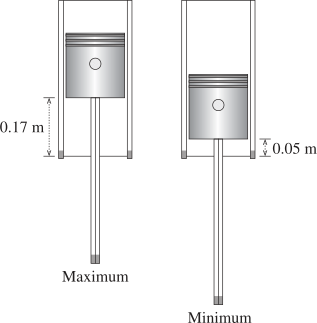
The diagrams show two positions of a single piston in the cylinder chamber of a motorcycle. The piston moves vertically, in simple harmonic motion, between a maximum height of 0.17 metres and a minimum height of 0.05 metres.


The mass of the piston is 0.8 kg. The piston completes 40 cycles per second.

What is the resultant force on the piston, in newtons, that produces the maximum acceleration of the piston? Give your answer correct to the nearest newton.  (3 marks)

--- 5 WORK AREA LINES (style=lined) ---

Show Answers Only

`text{3032 N}`

Show Worked Solution

`text{Using}\ \ ddotx=-n^2(x-b)`

`text{Centre of motion}\ (b) = 0.11`

`text{Amplitude}\ (a) = (0.17-0.05)/2=0.06\ text{m}`

`text{Period}\ (T) = 1/40=0.025\ text{sec}`

`n=(2pi)/T=80pi`

`:.ddotx=-(80pi)^2(x-0.11)`


♦ Mean mark 50%.

`ddotx_(max)\ text{occurs when}\ x=0.17\ text{or}\ 0.05`

`ddotx_(max)` `=-(80pi)^2(0.17-0.11)`  
  `=384pi^2\ text{m s}^(-2)`  


`:.F_(max)` `=mddotx`  
  `=0.8xx384pi^2`  
  `=3031.942…`  
  `=3032\ text{N (to 0 d.p.)}`  

Filed Under: Simple Harmonic Motion, Simple Harmonic Motion Tagged With: Band 5, Period and Cetre, smc-1059-20-Amplitude/Period, smc-1059-90-Real World Modelling, smc-7438-20-Amplitude/Period, smc-7438-90-Real World Modelling

Mechanics, EXT2 M1 2021 HSC 13d

An object is moving in simple harmonic motion along the `x`-axis. The acceleration of the object is given by  `overset¨x = – 4 (x - 3)`  where `x` is its displacement from the origin, measured in metres, after `t` seconds.

Initially, the object is 5.5 metres to the right of the origin and moving towards the origin. The object has a speed of 8 m s`\ ^(-1)` as it passes through the origin.

  1. Between which two values of `x` is the particle oscillating?  (2 marks)

    --- 6 WORK AREA LINES (style=lined) ---

  2. Find the first value of `t` for which  `x = 0`,  giving the answer correct to 2 decimal places.  (2 marks)

    --- 6 WORK AREA LINES (style=lined) ---

Show Answers Only
  1. `x = -2\ \ text(and)\ \ x = 8`
  2. `0.58\ text(seconds)`
Show Worked Solution

i.   `overset¨x = -4 (x – 3)`

♦ Mean mark 47%.
`d/(dx)(1/2 v^2)` `= -4x + 12`
`1/2 v^2` `= -2x^2 + 12x + c`

 
`v = 8\ \ text(when)\ \ x = 0:`

`1/2 xx 8^2 = c \ => \ c = 32`

`1/2 v^2 = -2x^2 + 12x + 32`
 

`text(Find)\ \ x\ \ text(when)\ \ v = 0:`

`-2x^2 + 12x + 32` `= 0`
`x^2 – 6x – 16` `= 0`
`(x – 8)(x + 2)` `= 0`


`:.\ text(Particle oscillates between)\ \ x = -2\ \ text(and)\ \ x = 8`


ii.   `overset¨x = -4 (x – 3) \ => \ n = 2`

♦♦ Mean mark 24%.

`text(Amplitude = 5,  Centre of motion at)\ \ x = 3`

`x = 5 cos(2t + alpha) + 3`
 

`text(When)\ \ t = 0, x = 5.5:`

`5.5` `= 5cos alpha + 3`
`cos alpha` `= 1/2`
`alpha` `= pi/3`

  
`:. x = 5 cos(2t + pi/3) + 3`
  

`text(Find)\ \ t\ \ text(when)\ \ x= 0:`

`cos(2t + pi/3)` `= -3/5`
`2t + pi/3` `= 2.214…`
`t` `= 1/2(2.214… – pi/3)`
  `= 0.58\ text(seconds)\ \ text{(2 d.p.)}`

Filed Under: Simple Harmonic Motion, Simple Harmonic Motion Tagged With: Band 5, Band 6, Period and Cetre, smc-1059-20-Amplitude/Period, smc-7438-20-Amplitude/Period

Mechanics, EXT2 M1 2020 HSC 13a

A particle is undergoing simple harmonic motion with period `frac{pi}{3}`. The central point of motion of the particle is at  `x = sqrt(3)`.  When  `t = 0`  the particle has its maximum displacement of `2 sqrt(3)` from the central point of motion.

Find an equation for the displacement, `x`, of the particle in terms of `t`.    (3 marks)

Show Answers Only

`x = 2 sqrt(3) cos (6t) + sqrt(3)`

Show Worked Solution
`text{Period}` `= frac{pi}{3}`
`frac{2 pi}{n}` `= frac{pi}{3}`
`n` `= 6`

 
`text{Amplitude} = 2 sqrt(3)`

`text{Centre of motion} = sqrt(3)`

`text{S} text{ince maximum displacement at}\ \ t = 0:`

`x = 2 sqrt(3) cos (6t) + sqrt(3)`

Filed Under: Simple Harmonic Motion, Simple Harmonic Motion Tagged With: Band 4, smc-1059-10-Prove/Identify SHM, smc-1059-25-Non-origin Centre, smc-7438-10-Prove/Identify SHM, smc-7438-25-Non-origin Centre

Mechanics, EXT2 M1 2020 HSC 5 MC

A particle undergoing simple harmonic motion has a maximum acceleration of 6 m/s2 and a maximum velocity of 4 m/s.
 
What is the period of the motion?

  1. `pi`
  2. `frac{2pi}{3}`
  3. `3pi`
  4. `frac{4pi}{3}`
Show Answers Only

`D`

Show Worked Solution

`ddotx = -n^2  x`

Mean mark 57%.

`text{Find} \ n :`

`ddotx_text{max} =  6 \ \ text{occurs when} \ \ x = – a`

`6 = n^2 a\ …\ (1)`
 

`v^2 = n^2 (a^2 – x^2)`

`v_text{max} = 4 \ \ text{occurs when} \ \ x = 0`

`4^2` `= n^2 (a^2-0)`  
`16` `= n^2  a^2`  
`4` `= n a\ …\ (2)`  

 
`text{Substitute} \ \ na = 4 \ \ text{from (2) into (1):}`

`6` `= 4n`
`n` `= frac{3}{2}`

 
`therefore \ text{Period} = frac{2pi}{n} = frac{4pi}{3}`

`=> \ D`

Filed Under: Simple Harmonic Motion, Simple Harmonic Motion Tagged With: Band 4, Period and Cetre, smc-1059-20-Amplitude/Period, smc-7438-20-Amplitude/Period

Mechanics, EXT2* M1 2019 HSC 12b

A particle is moving along the `x`-axis in simple harmonic motion. The position of the particle is given by

`x = sqrt 2 cos 3t + sqrt 6 sin 3t,` for  `t >= 0` 

  1. Write  `x`  in the form  `R cos(3t - alpha)`, where  `R > 0`  and  `0 < alpha < pi/2`.  (2 marks)

    --- 6 WORK AREA LINES (style=lined) ---

  2. Find the two values for  `x`  where the particle comes to rest.   (1 mark)

    --- 2 WORK AREA LINES (style=lined) ---

  3. When is the first time that the speed of the particle is equal to half of its maximum speed?  (2 marks)

    --- 8 WORK AREA LINES (style=lined) ---

Show Answers Only
  1. `x = 2 sqrt 2 cos (3t – pi/3)`
  2. `2 sqrt 2 or -2 sqrt 2`
  3. `t = pi/18`
Show Worked Solution

i.    `x = sqrt 2 cos 3t + sqrt 6 sin 3t`

`R cos (3t – alpha) = R cos alpha cos 3t + R sin alpha sin 3t`

`=> R cos alpha = sqrt 2`

`=> R sin alpha = sqrt 6`

`R^2 cos^2 alpha + R^2 sin^2 alpha` `= 2 + 6`
`R^2 (cos^2 alpha + sin^2 alpha)` `= 8`
`R` `=2sqrt2`


`2 sqrt 2 cos alpha` `= sqrt 2`
`cos alpha` `= 1/2`
`alpha` `= pi/3`

 
`:. x = 2 sqrt 2 cos (3t – pi/3)`

♦ Mean mark part (ii) 46%.


ii.    `text(At the extremities of the amplitude,)`
 

`text(the particle stops and reverses.)`

`:. v = 0\ \ text(when)\ \ x = 2 sqrt 2 or -2 sqrt 2`


iii.   `x = 2 sqrt 2 cos (3t – pi/3)`

♦ Mean mark part (iii) 49%.

`(dx)/(dt) = -6 sqrt 2 sin(3t – pi/3)`

 
`text(Max speed) = 6 sqrt 2`

`text(Find)\ \ t\ \ text(when)\ \ (dx)/(dt) = +-3 sqrt 2`

`-6 sqrt 2 sin (3t – pi/3)` `= 3 sqrt 2`
`sin(3t – pi/3)` `= -1/2`
`3t – pi/3` `= -pi/6`
`3t` `= pi/6`
`t` `= pi/18`


`-6 sqrt 2 sin (3t – pi/3)` `= -3 sqrt 2`
`sin(3t – pi/3)` `= 1/2`
`3t – pi/3` `= pi/6`
`3t` `= pi/2`
`t` `= pi/6`

 
`:. t = pi/18\ text{(1st time)}`

Filed Under: Simple Harmonic Motion, Simple Harmonic Motion Tagged With: Band 4, Band 5, smc-1059-30-Max Speed/Acceleration, smc-1059-40-At Rest/Endpoints, smc-1059-80-Auxiliary Angles, smc-7438-30-Max Speed/Acceleration, smc-7438-40-At Rest/Endpoints, smc-7438-80-Auxiliary Angles

Mechanics, EXT2* M1 2019 HSC 5 MC

A particle starts from rest, 2 metres to the right of the origin, and moves along the `x`-axis in simple harmonic motion with a period of 2 seconds.

Which equation could represent the motion of the particle?

A.     `x = 2cos pi t`

B.     `x = 2 cos 2t`

C.     `x = 2 + 2 sin pi t`

D.     `x = 2 + 2 sin 2t`

Show Answers Only

`A`

Show Worked Solution
`text(Period)` `= 2`
`(2 pi)/n` `= 2`
`n` `= pi`

 
`:.\ text(Eliminate B and D)`

♦ Mean mark 49%.
 

`text(Particle starts at rest,)`

`(dx)/(dt) = 0\ \ text(when)\ \ t = 0`

`text(Consider A:)`

`(dx)/(dt) = -2pi sin (pi xx 0) = 0`

`text(Consider C:)`

`(dx)/(dt) = 2 pi cos (pi xx 0) = 2pi`

 
`=>  A`

Filed Under: Simple Harmonic Motion, Simple Harmonic Motion Tagged With: Band 5, Period and Cetre, smc-1059-20-Amplitude/Period, smc-7438-20-Amplitude/Period

Mechanics, EXT2* M1 2018 HSC 10 MC

A particle is moving in simple harmonic motion. The displacement of the particle is  `x`  and its velocity, `v`, is given by the equation  `v^2 = n^2 (2kx - x^2)`, where `n` and `k` are constants.

The particle is initially at  `x = k`.

Which function, in terms of time `t`, could represent the motion of the particle?

A.     `x = k cos (nt)`

B.     `x = k sin (nt) + k`

C.     `x = 2k cos (nt) - k`

D.     `x = 2k sin (nt) + k`

Show Answers Only

`B`

Show Worked Solution

`text(Completing the square):`

♦♦ Mean mark 33%.

`v^2 = n^2(2kx-x^2)`

    `=n^2(k^2-(x^2-2kx+k^2))`

    `=n^2(k^2-(x-k)^2)`
 

`:.\ text(The centre of motion is)\ \ x = k,\ text(amplitude) = k,`

`⇒  B`

Filed Under: Simple Harmonic Motion, Simple Harmonic Motion, Simple Harmonic Motion EXT1 Tagged With: Band 5, smc-1059-10-Prove/Identify SHM, smc-7438-10-Prove/Identify SHM

Mechanics, EXT2* M1 2017 HSC 13a

A particle is moving along the `x`-axis in simple harmonic motion centred at the origin.

When  `x = 2`  the velocity of the particle is 4.

When  `x = 5`  the velocity of the particle is 3.

Find the period of the motion.  (3 marks)

--- 8 WORK AREA LINES (style=lined) ---

Show Answers Only

`2sqrt3pi`

Show Worked Solution

`text(S)text(ince motion centred at origin,)`

♦ Mean mark 42%.
`{:d/(dx):}^(1/2 v^2)` `= −n^2x`
`1/2 v^2`  `= int −n^2x\ dx`
  `= −1/2n^2x^2 + c`
 `v^2` `= c-n^2x^2`


`text(When)\ v = 4, x = 2`

`16 = c-4n^2\ …\ (1)`

`text(When)\ v = 3, x = 5`

`9 = c-25n^2\ …\ (2)`

`text(Subtract)\ (1)-(2)`

`7` `= 21n^2`
`n^2` `= 1/3`
`n` `= 1/sqrt3`

 
`:.\ text(Period)= (2pi)/n= 2sqrt3 pi`

Filed Under: Simple Harmonic Motion, Simple Harmonic Motion, Simple Harmonic Motion EXT1 Tagged With: Band 5, Period and Cetre, smc-1059-20-Amplitude/Period, smc-7438-20-Amplitude/Period

Mechanics, EXT2* M1 2016 HSC 13a

The tide can be modelled using simple harmonic motion.

At a particular location, the high tide is 9 metres and the low tide is 1 metre.

At this location the tide completes 2 full periods every 25 hours.

Let `t` be the time in hours after the first high tide today.

  1. Explain why the tide can be modelled by the function  `x = 5 + 4cos ((4pi)/25 t)`.   (2 marks)

    --- 6 WORK AREA LINES (style=lined) ---

  2. The first high tide tomorrow is at 2 am.
  3. What is the earliest time tomorrow at which the tide is increasing at the fastest rate?   (2 marks)
Show Answers Only

a.    `text(See Worked Solutions)`

b.    `11:22:30\ text(am)`

Show Worked Solution

a.    `text(High tide = 9m,  Low tide = 1 m)`

`A = (9-1)/2 = 4\ text(m)`

`\text{Since}\ \ T = 25/2:`

`(2 pi)/n= 25/2\ \ =>\ \ n=(4 pi)/25`

`text(Centre of motion) = 5`

`text(S) text(ince high tide occurs at)\ \ t = 0,`

`x= 5 + 4 cos (nt)= 5 + 4 cos ((4 pi)/25 t)`
 

b.    `x = 5 + 4 cos ((4 pi)/25 t)`

`(dx)/(dt)` `= -4 · (4 pi)/25 *sin ((4 pi)/25 t)`
  `= -(16 pi)/25 *sin ((4 pi)/25 t)`

 
`text(Tide increases at maximum rate when)\ \ sin ((4 pi)/25 t) = -1:`

`(4 pi)/25 t= (3 pi)/2\ \ =>\ \ t=75/8= 9\ text(hours 22.5 minutes)`

`:.\ text(Earliest time is)\ 11:22:30\ text(am)`

Filed Under: Simple Harmonic Motion, Simple Harmonic Motion, Simple Harmonic Motion EXT1 Tagged With: Band 4, Band 5, smc-1059-25-Non-origin Centre, smc-1059-30-Max Speed/Acceleration, smc-1059-90-Real World Modelling, smc-7438-25-Non-origin Centre, smc-7438-30-Max Speed/Acceleration, smc-7438-90-Real World Modelling

Mechanics, EXT2* M1 2016 HSC 7 MC

The displacement `x` of a particle at time `t` is given by

`x = 5 sin 4t + 12 cos 4t`.

What is the maximum velocity of the particle?

  1. `13`
  2. `28`
  3. `52`
  4. `68`
Show Answers Only

`C`

Show Worked Solution

`x = 5 sin 4t + 12 cos 4t`

`(dx)/(dt) = 20 cos 4t – 48 sin 4t`

 `=>\ text(Can be written in the form:)`

`A cos (4t + alpha),\ text(where)`

`A` `= sqrt (20^2 + 48^2)`
  `= 52`

 
`:. text(Max)\ v = 52\ text(ms)^-1`

`=>   C`

Filed Under: 5. Trig Ratios EXT1, Other Motion EXT1, Simple Harmonic Motion, Simple Harmonic Motion, Simple Harmonic Motion EXT1 Tagged With: Band 4, smc-1059-30-Max Speed/Acceleration, smc-1059-80-Auxiliary Angles, smc-7438-30-Max Speed/Acceleration, smc-7438-80-Auxiliary Angles

Mechanics, EXT2* M1 2004 HSC 7a

The rise and fall of the tide is assumed to be simple harmonic, with the time between successive high tides being 12.5 hours. A ship is to sail from a wharf to the harbour entrance and then out to sea. On the morning the ship is to sail, high tide at the wharf occurs at 2 am. The water depths at the wharf at high tide and low tide are 10 metres and 4 metres respectively.

  1. Show that the water depth, `y` metres, at the wharf is given by
  2.    `y = 7 + 3 cos\ ((4pit)/(25))`, where `t` is the number of hours after high tide.   (2 marks)

    --- 8 WORK AREA LINES (style=lined) ---

  3. An overhead power cable obstructs the ship’s exit from the wharf. The ship can only leave if the water depth at the wharf is 8.5 metres or less. Show that the earliest possible time that the ship can leave the wharf is 4:05 am.   (2 marks)

    --- 8 WORK AREA LINES (style=lined) ---

  4. At the harbour entrance, the difference between the water level at high tide and low tide is also 6 metres. However, tides at the harbour entrance occur 1 hour earlier than at the wharf. In order for the ship to be able to sail through the shallow harbour entrance, the water level must be at least 2 metres above the low tide level.
  5. The ship takes 20 minutes to sail from the wharf to the harbour entrance and it must be out to sea by 7 am. What is the latest time the ship can leave the wharf?   (2 marks)

    --- 8 WORK AREA LINES (style=lined) ---

Show Answers Only

a.    `text{Proof (See Worked Solutions)}`

b.    `text{Proof (See Worked Solutions)}`

c.    `4:28\ text(am)`

Show Worked Solution

a.    `text(Period)`

`(2pi)/n=12.5\ \ =>\ \ n=(4pi)/25`

`text{Amplitude}\ (a) = 1/2(10-4)= 3`

 
`y=10\ \ \text{at}\ \ t=0\ \text{(low tide):`

`=>\ text(Motion centres around)\ \ x = 7`

`:. y= 7+acos(nt)= 7 + 3 cos((4pit)/(25))\ \ …\ text(as required.)`
 

b.    
        Calculus in the Physical, EXT1 2004 HSC 7a Answer

`text(Find)\ t\ text(when)\ \ y = 8.5:`

`7 + 3cos((4pit)/25)` `= 8.5`
`3cos((4pit)/25)` `= 1.5`
`cos((4pit)/25)` `= 1/2`
`(4pit)/25` `=pi/3`
`t` `=(25pi)/(3 xx 4pi)=2 1/12= 2\ text(hrs 5 mins)`

 
`:.\ text(Earliest time a ship can leave is 4:05 am  … as required.)`
 

c.    `text(2 metres above low tide = 6 m)`

`text(Find)\ t\ text(when)\ y = 6:`

`7 + 3cos((4pit)/(25))` `=6`
`3cos((4pit)/(25))` `= -1`
`cos((4pit)/(25))` `= -1/3`
`(4pit)/25` `= 1.9106…`
`:.t` `= (25 xx 1.9106…)/(4pi)= 3.801…= 3\ text{hr 48 min  (nearest min)}`


`text(Harbour entrance depth of 6 m occurs when)\ \ t = 2\ text(hr 48 min.)`

`:.\ text(Given 20 mins sailing time, the latest the ship can)`

`text(leave the wharf is at)\ \ t = 2\ text(hr 28 min, or 4:28 am.)`

Filed Under: Simple Harmonic Motion, Simple Harmonic Motion, Simple Harmonic Motion EXT1 Tagged With: Band 4, Band 5, Band 6, smc-1059-25-Non-origin Centre, smc-1059-90-Real World Modelling, smc-7438-25-Non-origin Centre, smc-7438-90-Real World Modelling

Mechanics, EXT2* M1 2007 HSC 6a

A particle moves in a straight line. Its displacement, `x` metres, after `t` seconds is given by

`x = sqrt3\ sin\ 2t − cos\ 2t + 3`.

  1. Prove that the particle is moving in simple harmonic motion about  `x = 3`  by showing that   `ddot x = -4(x − 3)`.  (2 marks)

    --- 6 WORK AREA LINES (style=lined) ---

  2. What is the period of the motion?  (1 mark)

    --- 2 WORK AREA LINES (style=lined) ---

  3. Express the velocity of the particle in the form  `dotx = A\ cos\ (2t − α)`, where  `α`  is in radians.  (2 marks)

    --- 6 WORK AREA LINES (style=lined) ---

  4. Hence, or otherwise, find all times within the first  `pi`  seconds when the particle is moving at `2` metres per second in either direction.  (2 marks)

    --- 8 WORK AREA LINES (style=lined) ---

Show Answers Only

a.    `text{Proof (See Worked Solutions.)}`

b.    `pi\ text(seconds)`

c.    `dot x = 4\ cos\ (2t − pi/6)`

d.    `t = pi/4, (5pi)/12, (3pi)/4, (11pi)/12\ text(seconds.)`

Show Worked Solution

a.   `text(Show)\ \ ddot x = -4(x − 3)`

`x` `= sqrt3\ sin\ 2t − cos\ 2t + 3`
`dot x` `= 2sqrt3\ cos\ 2t + 2\ sin\ 2t`
`ddot x` `= -4sqrt3\ sin\2t + 4\ cos\ 2t`
  `= -4(sqrt3\ sin\ 2t − cos\ 2t)`
  `= -4(sqrt3\ sin\ 2t − cos\ 2t + 3 − 3)`
  `= -4(x − 3)\ \ …text(as required)`


b.  `text(Period)\ = (2pi)/n`

`n^2 = 4 ⇒ n = 2\ \ text{(part (i))}`

`:.\ text(Period)` `= (2pi)/2`
  `= pi\ \ text(seconds)`


c.  `text(Write)\ \ dot x = 2sqrt3\ cos\ 2t + 2\ sin\ 2t`

`text(in form)\ \ \ A\ cos\ (2t − α)`

`A(cos\ 2t\ cos\ α + sin\ 2t\ sin\ α)` `= 2sqrt3\ cos\ 2t + 2\ sin\ 2t`
`cos\ 2t\ cos\ α + sin\ 2t\ sin\ α` `= (2sqrt3)/A\ cos\ 2t + 2/A\ sin\ 2t`
`⇒ cos\ α` `= (2sqrt3)/A`
`⇒ sin\ α` `= 2/A`
`((2sqrt3)/A)^2 + (2/A)^2` `= 1`
`(2sqrt3)^2 + 2^2` `= A^2`
`:.A` `= sqrt16`
  `= 4`


`:.cos\ α` `= (2sqrt3)/4 = sqrt3/2`
`α` `= pi/6`

`:. dot x = 4\ cos\ (2t − pi/6)`


d.  `text(Find)\ \ t\ \ text(when)\ \ dot x = ±2`

`text(If)\ \ dot x = 2`

`4\ cos\ (2t − pi/6)` `= 2`
`cos\ (2t − pi/6)` `= 1/2`
`2t − pi/6` `= pi/3, 2pi − pi/3`
`2t` `= pi/2, (11pi)/6`
`t` `= pi/4, (11pi)/12`


`text(If)\ \ dot x = -2`

`cos\ (2t − pi/6)` `= – 1/2`
`2t − pi/6` `= (2pi)/3, (4pi)/3`
`2t` `= (5pi)/6, (3pi)/2`
`t` `= (5pi)/12, (3pi)/4`


`:.t = pi/4, (5pi)/12, (3pi)/4, (11pi)/12\ \ text(seconds.)`

Filed Under: Simple Harmonic Motion, Simple Harmonic Motion, Simple Harmonic Motion EXT1 Tagged With: Band 4, Band 5, Period and Cetre, smc-1059-10-Prove/Identify SHM, smc-1059-20-Amplitude/Period, smc-1059-80-Auxiliary Angles, smc-7438-10-Prove/Identify SHM, smc-7438-20-Amplitude/Period, smc-7438-80-Auxiliary Angles

Mechanics, EXT2* M1 2006 HSC 4b

A particle is undergoing simple harmonic motion on the `x`-axis about the origin. It is initially at its extreme positive position. The amplitude of the motion is 18 and the particle returns to its initial position every 5 seconds.

  1. Write down an equation for the position of the particle at time  `t`  seconds.  (2 marks)

    --- 4 WORK AREA LINES (style=lined) ---

  2. How long does the particle take to move from a rest position to the point halfway between that rest position and the equilibrium position?  (3 marks)

    --- 5 WORK AREA LINES (style=lined) ---

Show Answers Only

a.    `x = 18 cos ((2 pi)/5 t)`

b.    `5/6\ \ text(seconds)`

Show Worked Solution

a.   `text{Amplitude (A)} = 18`

♦♦♦ “Very poorly” answered (exact data unavailable).

`text(Period) = (2 pi)/n = 5`

`5n` `= 2 pi`
`n` `= (2 pi)/5`


`text(Using)\ \ x` `= A cos n t`
`x` `= 18 cos ((2 pi)/5 t)`


b.   `text(When)\ \ t= 0,\ \ \ x = 18`

`text(Find)\ \ t\ \ text(when)\ \ x = 9`

`9` `= 18 cos ((2 pi)/5 t)`
`cos ((2 pi)/5 t)` `= 1/2`
`(2 pi)/5 t` `= pi/3`
`t` `= (5 pi)/(3 xx 2 pi)`
  `= 5/6\ \ text(seconds)`


`:.\ text(It takes the particle)\ \  5/6\ \ text(seconds to move from)`

`text(rest position and half way to equilibrium.)`

Filed Under: Simple Harmonic Motion, Simple Harmonic Motion, Simple Harmonic Motion EXT1 Tagged With: Band 5, Band 6, Period and Cetre, smc-1059-20-Amplitude/Period, smc-7438-20-Amplitude/Period

Mechanics, EXT2* M1 2005 HSC 5c

A particle moves in a straight line and its position at time  `t`  is given by

`x = 5 + sqrt 3 sin3t - cos 3t.`

  1. Express  `sqrt 3 sin3t − cos 3t`  in the form  `R sin(3t - alpha)`  where  `alpha`  is in radians.  (2 marks)

    --- 6 WORK AREA LINES (style=lined) ---

  2. The particle is undergoing simple harmonic motion. Find the amplitude and the centre of the motion.  (2 marks)

    --- 3 WORK AREA LINES (style=lined) ---

  3. When does the particle first reach its maximum speed after time  `t = 0`?  (1 mark)

    --- 5 WORK AREA LINES (style=lined) ---

Show Answers Only

a.    `2 sin ( 3t – pi/6)`

b.    `text(Amplitude) = 2\ text(units),\ \ \ text(Centre of the motion at)\ \ x = 5`

c.    `pi/18`

Show Worked Solution

a.    `x = 5 + sqrt 3 sin 3t – cos 3t`

`sqrt 3 sin 3t – cos 3t` `= R sin (3t – alpha)`
  `= R sin 3t cos alpha – R cos 3t sin alpha`

 
`=> R cos alpha = sqrt 3\ \ \ \ \ R sin alpha = 1`

`R^2 = sqrt 3^2 + 1^2 = 4`

`R = 2`

`=> 2 cos alpha` `= sqrt3`
`cos alpha` `= (sqrt3)/2`
`alpha` `= pi/6`

 
`:.\ 2 sin ( 3t – pi/6) = sqrt 3 sin 3t – cos 3t`


b.    `x` `= 5 + sqrt 3 sin 3t – cos 3t`
  `= 5 + 2 sin (3t – pi/6)`

 
`text(Amplitude) = 2\ text(units)`

`text(Centre of motion at)\ \ x = 5`


c.    `text(Solution 1)`

`x = 5 + 2 sin (3t – pi/6)`

`dot x = 6 cos (3t – pi/6)`

 
`text(Maximum speed occurs when)`

`cos (3t – pi/6)` `= 1`
`3t – pi/6` `= 0`
`3t` `= pi/6`
`t` `= pi/18`

 
`text(Solution 2)`

`text(Maximum speed occurs at the)`

`text(centre of motion,)\ \ x = 5`

`5 + 2 sin (3t – pi/6)` `= 5`
`2 sin (3t – pi/6)` `= 0`
`sin (3t – pi/6)` `= 0`
`3t – pi/6` `= 0`
`t` `= pi/18`

Filed Under: Simple Harmonic Motion, Simple Harmonic Motion, Simple Harmonic Motion EXT1 Tagged With: Band 4, Band 5, Period and Cetre, smc-1059-20-Amplitude/Period, smc-1059-30-Max Speed/Acceleration, smc-1059-80-Auxiliary Angles, smc-7438-20-Amplitude/Period, smc-7438-30-Max Speed/Acceleration, smc-7438-80-Auxiliary Angles

Mechanics, EXT2* M1 2015 HSC 13a

A particle is moving along the `x`-axis in simple harmonic motion. The displacement of the particle is `x` metres and its velocity is `v` ms`\ ^(–1)`. The parabola below shows `v^2` as a function of `x`.
 

2015 13a

  1. For what value(s) of `x` is the particle at rest?   (1 mark)

    --- 2 WORK AREA LINES (style=lined) ---

  2. What is the maximum speed of the particle?   (1 mark)

    --- 3 WORK AREA LINES (style=lined) ---

  3. The velocity `v` of the particle is given by the equation
  4. `v^2 = n^2(a^2-(x-c)^2)`  where `a`, `c` and `n` are positive constants.
  5. What are the values of `a`, `c` and `n`?   (3 marks)

    --- 8 WORK AREA LINES (style=lined) ---

Show Answers Only

a.    `3\ text(or)\ 7`

b.    `V = sqrt11\ text(m/s)`

c.    `a = 2, c = 5, n = (sqrt11)/2`

Show Worked Solution

a.    `text(Particle is at rest when)\ v^2 = 0`

`:. x = 3\ \ text(or)\ \ 7`
 

b.    `text(Maximum speed occurs when)`

`v^2` `= 11`
`v` `= sqrt11\ text(m/s)`


c.    `v^2 = n^2(a^2-(x-c)^2)`

♦ Mean mark 41%.

`text(Amplitude) = 2\ \ =>\ \ a = 2`

`text(Centre of motion when)\ x = 5\ \ =>\ \ c = 5`

`text(S)text(ince)\ \ v^2 = 11\ \ text(when)\ \ x = 5`

`11` `= n^2(2^2-(5-5)^2)`
`11` `= 4n^2`
`n^2` `= 11/4`
`:.n`  `= sqrt11/2`

Filed Under: Simple Harmonic Motion, Simple Harmonic Motion, Simple Harmonic Motion EXT1 Tagged With: Band 3, Band 4, Band 5, Period and Cetre, smc-1059-10-Prove/Identify SHM, smc-1059-20-Amplitude/Period, smc-1059-25-Non-origin Centre, smc-1059-30-Max Speed/Acceleration, smc-1059-40-At Rest/Endpoints, smc-7438-10-Prove/Identify SHM, smc-7438-20-Amplitude/Period, smc-7438-25-Non-origin Centre, smc-7438-30-Max Speed/Acceleration, smc-7438-40-At Rest/Endpoints

Mechanics, EXT2* M1 2015 HSC 9 MC

Two particles oscillate horizontally. The displacement of the first is given by  `x = 3\ sin\ 4t`  and the displacement of the second is given by  `x = a\ sin\ nt`. In one oscillation, the second particle covers twice the distance of the first particle, but in half the time.

What are the values of `a` and `n`?

  1. `a = 1.5,\ \ n = 2`
  2. `a = 1.5, \ \ n = 8`
  3. `a = 6,\ \ n = 2`
  4. `a = 6, \ \ n = 8`
Show Answers Only

`D`

Show Worked Solution
`x_1` `= 3\ sin\ 4t`
`x_2` `= a\ sin\ nt`


`x_2\ text(has twice the amplitude of)\ x_1`

`:. a = 2 xx 3 = 6`

`x_2\ text(has a period)\ (T)\ text(that is half of)\ x_1`

`T(x_1)` `= (2 pi)/n = (2pi)/4`
`:.T(x_2)` `= 1/2 xx (2 pi)/4 = (2pi)/8`
`:.n` `= 8`

 
`=> D`

Filed Under: Simple Harmonic Motion, Simple Harmonic Motion, Simple Harmonic Motion EXT1 Tagged With: Band 4, Period and Cetre, smc-1059-20-Amplitude/Period, smc-7438-20-Amplitude/Period

Mechanics, EXT2* M1 2008 HSC 5b

A particle is moving in simple harmonic motion in a straight line. Its maximum speed is 2 ms–1 and its maximum acceleration is  6 ms–2.

Find the amplitude and the period of the motion.   (3 marks)

--- 7 WORK AREA LINES (style=lined) ---

Show Answers Only

`A=2/3\ text(m)`

`T=(2pi)/3\ text(sec).`

Show Worked Solution

`text(Equations of SHM)`

`x` `= A sin nt`
`dot x` `= An cos nt`
`ddot x` `= – An^2 sin nt`


`text(Given max speed)\ = 2\ text(ms)^(-1)`

`text(and)\ \ \ -1 <= cos nt <= 1`

`=> An = 2\ \ \ \ \ …\ (1)`

`text(Given)\ \ ddot x \ \ text{(max)} = 6`

`=>An^2 = 6\ \ \ \ \ …\ (2)`


`text(Substitute)\ \ n=2/A\ \ text{from (1) into (2)}`

`A * (2/A)^2` `= 6`
`4/A` `= 6`
`A` `= 2/3`


`text(Substitute)\ \ A = 2/3\ \ text(into)\ (1)`

`2/3 n` `= 2`
`n` `= 3`

 
`text(Period) = (2pi)/n = (2pi)/3\ text(sec)`

 
`:.\ text(Motion has an amplitude of)\ \ 2/3 text(m)`

`text(and a period of)\ \ (2pi)/3\ text(sec.)`

Filed Under: Simple Harmonic Motion, Simple Harmonic Motion, Simple Harmonic Motion EXT1 Tagged With: Band 5, Period and Cetre, smc-1059-20-Amplitude/Period, smc-7438-20-Amplitude/Period

Mechanics, EXT2* M1 2014 HSC 12a

 A particle is moving in simple harmonic motion about the origin, with displacement `x` metres. The displacement is given by  `x = 2 sin 3t`, where `t` is time in seconds. The motion starts when  `t = 0`.

  1. What is the total distance travelled by the particle when it first returns to the origin?   (1 mark)

    --- 4 WORK AREA LINES (style=lined) ---

  2. What is the acceleration of the particle when it is first at rest?    (2 marks)

    --- 6 WORK AREA LINES (style=lined) ---

Show Answers Only

a.    `4\ text(m)`

b.    `-18\ text(m/s²)`

Show Worked Solution
a.     `x = 2 sin 3t`

 
`text(At)\ \ t = 0,\ x = 0`

`text(Amplitude) = 2`

`:.\ text(Distance travelled)`

`= 2 xx text(amplitude)`

`= 4\ text(m)`


b.     `x` `= 2 sin 3t`
  `v` `= 6 cos 3t` 
  `ddot x` `= -18 sin 3t`

 
`text(Particle first comes to rest when)\ v = 0`

`6 cos 3t` `= 0`
`cos 3t` `= 0`
`3t` `= pi/2`
`t` `= pi/6`

 
`text(When)\ \  t = pi/6`

`ddot x` `= -18 * sin (3 xx pi/6)`
  `= -18 sin (pi/2)`
  `= -18\ text(m/s²)`

Filed Under: Simple Harmonic Motion, Simple Harmonic Motion, Simple Harmonic Motion EXT1 Tagged With: Band 4, smc-1059-40-At Rest/Endpoints, smc-1059-50-Distance Travelled, smc-7438-40-At Rest/Endpoints, smc-7438-50-Distance Travelled

Mechanics, EXT2* M1 2014 HSC 7 MC

A particle is moving in simple harmonic motion with period 6 and amplitude 5.

Which is a possible expression for the velocity, `v`, of the particle?

  1. `v = (5pi)/3 cos (pi/3 t)`
  2. `v = 5 cos (pi/3 t)`
  3. `v = (5pi)/6 cos (pi/6 t)`
  4. `v = 5 cos (pi/6 t)`
Show Answers Only

`A`

Show Worked Solution

`text(By Elimination:)`

`text(General form is)\ \x = a sin (nt)`

♦ Mean mark 43%
COMMENT: Elimination can be a very effective and time efficient strategy for solving MC questions.

`text(Period) = 6\ text{(given)}`

`=> (2pi)/n` `= 6`
`n` `= pi/3`

 
`:.\ text(Cannot be)\ C\ text(or)\ D`


`text(Using)\ \ x = int v\ dt`

`text(Consider answer)\ B`

`x` `= 5 xx 3/pi sin (pi/3 t) + c`
  `text(Amplitude) = 15/pi`

 
`:.\ text(Cannot be)\ B`


`text(Consider answer)\ A`

`x` `= (5pi)/3 xx 3/pi sin (pi/3 t) + c`
  `= 5 sin (pi/3 t) + c`
 `:.\ text(Amplitude) = 5`

 
`=>  A`

Filed Under: Simple Harmonic Motion, Simple Harmonic Motion, Simple Harmonic Motion EXT1 Tagged With: Band 5, smc-1059-10-Prove/Identify SHM, smc-7438-10-Prove/Identify SHM

Mechanics, EXT2* M1 2009 HSC 5a

The equation of motion for a particle moving in simple harmonic motion is given by

`(d^2x)/(dt^2) = -n^2x`

where  `n`  is a positive constant,  `x`  is the displacement of the particle and  `t`  is time.  

  1. Show that the square of the velocity of the particle is given by
     
         `v^2 = n^2 (a^2\ - x^2)`


    where  `v = (dx)/(dt)`  and  `a`  is the amplitude of the motion.   (3 marks)

    --- 6 WORK AREA LINES (style=lined) ---

  2. Find the maximum speed of the particle.     (1 mark)

    --- 3 WORK AREA LINES (style=lined) ---

  3. Find the maximum acceleration of the particle.    (1 mark)

    --- 2 WORK AREA LINES (style=lined) ---

  4. The particle is initially at the origin. Write down a formula for  `x`  as a function of  `t`, and hence find the first time that the particle’s speed is half its maximum speed.   (2 marks)

    --- 5 WORK AREA LINES (style=lined) ---

Show Answers Only

a.    `text(Proof)\ \ text{(See Worked Solutions)}`

b.    `na`

c.     `n^2 a`

d.    `pi/(3n)`

Show Worked Solution
a.    `text(Show)\ \ v^2 = n^2 (a^2\ – x^2)`

`(d^2x)/(dt^2) = -n^2x`

`d/(dx) (1/2 v^2)` `= -n^2 x`
`1/2 v^2` `= int -n^2x\ dx`
  `= (-n^2 x^2)/2 + c`
`v^2` `= -n^2 x^2 + c`

 
`text(When)\ \ v = 0,\ \ x = a`

`0` `= -n^2a + c`
`c` `= n^2 a^2`
`:.\ v^2` `= -n^2 x^2 + n^2 a^2`
  `= n^2 (a^2\ – x^2)\ \ text(… as required)`


b.     `text(Max speed when)\ \ x = 0`
`v^2` `= n^2 (a^2\ – 0)`
  `= n^2 a^2`
`:.v_text(max)` `= na`


c.     `(d^2x)/(dt^2)\ \ text(is maximum at limits)\ \ (x = +-a)`
`(d^2x)/(dt^2)` `= |n^2 (a)|`
  `= n^2 a`


d.     `x` `= a sin nt`
  `dot x` `= an cos nt`


`text(Find)\ \ t\ \ text(when)\ \ dot x = (na)/2`

`(na)/2` `= an cos nt`
`cos nt` `= 1/2`
`nt` `= pi/3`
`:.t` `= pi/(3n)`

Filed Under: Simple Harmonic Motion, Simple Harmonic Motion, Simple Harmonic Motion EXT1 Tagged With: Band 4, Band 5, smc-1059-10-Prove/Identify SHM, smc-1059-30-Max Speed/Acceleration, smc-7438-10-Prove/Identify SHM, smc-7438-30-Max Speed/Acceleration

Mechanics, EXT2* M1 2013 HSC 12e

A particle moves along a straight line. The displacement of the particle from the origin is `x`, and its velocity is `v`. The particle is moving so that  `v^2 + 9x^2 = k`, where `k` is a constant.

Show that the particle moves in simple harmonic motion with period  `(2pi)/3`.   (2 marks)

--- 5 WORK AREA LINES (style=lined) ---

Show Answers Only

`text(Proof)\ \ text{(See Worked Solutions)}`

Show Worked Solution
`v^2 + 9x^2` `= k`
`v^2` `= k\ – 9x^2`
`1/2 v^2` `= 1/2k\ – 9/2 x^2`


`text(For SHM,)\ \ ddot x = -n^2x`

`ddot x` `= d/(dx) (1/2v^2)`
  `= -9x`
  `= -3^2 x \ \ \ text(… as required)`


`text(Period)\ (T)\ text(of SHM) = (2pi)/n`

`text(Here,)\ \ n=3`

`:.T= (2pi)/3\ \ \ text(… as required)`

Filed Under: Simple Harmonic Motion, Simple Harmonic Motion, Simple Harmonic Motion EXT1 Tagged With: Band 4, Period and Cetre, smc-1059-10-Prove/Identify SHM, smc-1059-20-Amplitude/Period, smc-7438-10-Prove/Identify SHM, smc-7438-20-Amplitude/Period

Mechanics, EXT2* M1 2010 HSC 4a

A particle is moving in simple harmonic motion along the `x`-axis. 

Its velocity `v`, at `x`, is given by  `v^2 = 24 − 8x − 2x^2`. 

  1. Find all values of `x` for which the particle is at rest.   (1 mark)

    --- 4 WORK AREA LINES (style=lined) ---

  2. Find an expression for the acceleration of the particle, in terms of `x`.   (1 mark)

    --- 2 WORK AREA LINES (style=lined) ---

  3. Find the maximum speed of the particle.    (2 marks)

    --- 6 WORK AREA LINES (style=lined) ---

Show Answers Only

a.    `x = –6\ \ text(or)\ \ 2`

b.    `-4\ – 2x`

c.    `4 sqrt 2`

Show Worked Solution
a.     `v^2 = 24\ – 8x\ – 2x^2`

`text(Find)\ \ x\ \ text(when)\ \ v=0`

`24 – 8x – 2x^2` `= 0`
`x^2 + 4x – 12` `= 0`
`(x + 6)(x – 2)` `= 0`
`x= -6\ \ text(or)\ \ 2`


`:.\ text(Particle at rest when)\ \ x = –6\ \ text(or)\ \ 2`


b.     `ddot x` `= d/(dx) (1/2 v^2)`
    `= d/(dx) (12 – 4x – x^2)`
    `= -4 – 2x`


c.    `text(Solution 1)`

`text(Max speed when)\ \ ddot x = 0`

`-4 – 2x` `= 0`
`2x` `= -4`
`x` `= -2`

`text(At)\ \ x = -2`

MARKER’S COMMENT: While most students found `x=-2` correctly, too many made errors substituting this back in or failed to finish the answer by taking the square root. BE CAREFUL! .
`v^2` `= 24 – 8(–2) – 2(–2)^2`
  `= 24 + 16 – 8`
  `= 32`
`v` `= +- sqrt32`
  `= +- 4 sqrt2`

`:.\ text(Maximum speed is)\ \ 4 sqrt2`


`text(Alternate Answer)`

`text(Maximum speed occurs when)`

`x = (-6+2)/2 = –2`

`text(At)\ \ x = –2`

`v^2` `= 32\ \ \ text{(see working above)}`
`v` `= +- 4 sqrt 2`


`:.\ text(Maximum speed is)\ 4sqrt2`

Filed Under: Simple Harmonic Motion, Simple Harmonic Motion, Simple Harmonic Motion EXT1 Tagged With: Band 3, Band 4, smc-1059-30-Max Speed/Acceleration, smc-1059-40-At Rest/Endpoints, smc-7438-30-Max Speed/Acceleration, smc-7438-40-At Rest/Endpoints

Mechanics, EXT2* M1 2011 HSC 3a

The equation of motion for a particle undergoing simple harmonic motion is 

 `(d^2x)/(dt^2) = -n^2 x`,

where `x` is the displacement of the particle from the origin at time `t`, and `n` is a positive constant.

  1. Verify that  `x = A cos nt + B sin nt`, where `A` and `B` are constants, is a solution of the equation of motion.    (1 mark)

    --- 5 WORK AREA LINES (style=lined) ---

  2. The particle is initially at the origin and moving with velocity `2n`. 


    Find the values of `A` and `B` in the solution  `x = A cos nt + B sin nt`.    (2 marks)

    --- 6 WORK AREA LINES (style=lined) ---

  3. When is the particle first at its greatest distance from the origin?   (1 mark)

    --- 5 WORK AREA LINES (style=lined) ---

  4. What is the total distance the particle travels between  `t = 0`  and  `t = (2pi)/n`?   (1 mark)

    --- 6 WORK AREA LINES (style=lined) ---

Show Answers Only

a.    `text(Proof)\ \ text{(See Worked Solutions)}`

b.    `A = 0,\ B = 2`

c.    `t = pi/(2n)`

d.    `text(8 units)`

Show Worked Solution
a.   `x` `= A cos nt + B sin nt`
  `(dx)/(dt)` `=-An sin nt + Bn cos nt`
  `(d^2x)/(dt^2)` `=-An^2 cos nt\-Bn^2 sin nt`
    `= -n^2 (A cos nt + B sin nt)`
    `= -n^2 x\ \ \ text(… as required)`


b.    `text(At)\ \ t=0, \ x=0, \ v=2n:`

`x` `= Acosnt + Bsinnt`
`0` `= A cos 0 + B sin 0`
`:.A` `= 0`

  
`text(Using)\ \ (dx)/(dt) = Bn cos nt`

`2n` `= Bn cos 0`
`Bn` `= 2n`
`:.B` `= 2`
♦♦ Mean mark part (iii) 47%
 

c.    `text(Max distance from origin when)\ (dx)/(dt) = 0`

`(dx)/(dt)` `= 2n cos nt`
`0` `= 2n cos nt`
`cos nt` `= 0`
`nt` `= pi/2,\ (3pi)/2,\ (5pi)/2`
`t` `= pi/(2n),\ (3pi)/(2n), …`


`:.\ text(Particle is first at greatest distance from)\ O\ text(when)\ t = pi/(2n).`


d.    `text(Solution 1)`

`text(Find the distance travelled from)\ \ t=0\ \→\ \ t=(2pi)/n`

`text{(i.e. 1 full period)}`

♦♦ Mean mark 22%
MARKER’S COMMENT: Many students found the displacement at `t` rather than the distance travelled.

`text(S)text(ince)\ \ x=2 sin (nt)`

`=> text(Amplitude)=2`

`:.\ text(Distance travelled)=4 xx2=8\ text(units)`


`text(Solution 2)`

`text(At)\ t = 0,\ x = 0`

`text(At)\ t= pi/(2n), \ x=2 sin (n xx pi/(2n)) = 2`

`text(At)\ t` `= (3pi)/(2n)\ \ \ text{(i.e. the next time}\ \ (dx)/(dt) = 0 text{)}`
`x` `= 2 sin (n xx (3pi)/(2n)) = -2`

 
`text(At)\ t= (2pi)/n,\ \ x=2 sin (n xx (2pi)/n) = 0`

  
`:.\ text(Total distance travelled) = = 2 + 4 + 2= 8\ \ text(units)`

Filed Under: Simple Harmonic Motion, Simple Harmonic Motion, Simple Harmonic Motion EXT1 Tagged With: Band 4, Band 5, Band 6, smc-1059-10-Prove/Identify SHM, smc-1059-50-Distance Travelled, smc-7438-10-Prove/Identify SHM, smc-7438-50-Distance Travelled

Mechanics, EXT2* M1 2012 HSC 13c

A particle is moving in a straight line according to the equation

`x = 5 + 6 cos 2t + 8 sin 2t`, 

where `x` is the displacement in metres and `t` is the time in seconds.

  1. Prove that the particle is moving in simple harmonic motion by showing that `x`  satisfies an equation of the form  `ddot x = -n^2 (x\ - c)`.  (2 marks)

    --- 6 WORK AREA LINES (style=lined) ---

  2. When is the displacement of the particle zero for the first time?    (3 marks)

    --- 8 WORK AREA LINES (style=lined) ---

Show Answers Only

a.    `text(Proof)\ \ text{(See Worked Solutions)}`

b.    `1.5\ text(seconds)\ text{(1 d.p.)}`

Show Worked Solution

a.    `text(Prove)\ ddot x = -n^2(x\ – c)`

`x` `= 5 + 6 cos 2t + 8 sin 2t`
`dot x` `= -12 sin 2t + 16 cos 2t`
`ddot x` `= – 24 cos 2t\ – 32 sin 2t`
  `= -4 (6 cos 2t + 8 sin 2t)`
  `= -2^2 (5 + 6 cos 2t + 8 sin 2t\ – 5)`
  `= -2^2 (x\ – 5)\ \ \ text(… as required)`


b.    `text(Find)\ \ t\ \ text(when)\ \ x=0\ \ text(for 1st time:)`

♦ Mean mark 42%.
IMPORTANT: The critical insight required to solve `x=0` is to realise that the cosine of the difference between 2 angles, i.e. `cos (2t- theta)`, applies.
`5 + 6 cos 2t + 8 sin 2t` `= 0`
`6 cos 2t + 8 sin 2t` `= -5`
`6/10 cos 2t+ 8/10 sin 2t` `=-1/2`


 Calculus in the Physical World, EXT1 2012 HSC 13c Answer

`=>cos theta=6/10\ \ text(and)\ \ sin theta=8/10`
`cos 2t cos theta+sin 2t sin theta` `=- 1/2`
`cos(2t\ – theta)` `= – 1/2`

`text(S)text(ince)\ \ cos\ pi/3 = 1/2\ \ text(and)\ cos\ text(is negative)`

`text(in the 2nd and 3rd quadrants,)`

`=>2t\ – theta = pi\ – pi/3,\ pi + pi/3`


`text(We need the 1st time)\ \ x = 0`

`text(S)text(ince)\ \ cos theta` `= 6/10`
`theta` `= 0.9273…`


`:.\ 2t\ – 0.9273…` `= (2pi)/3`
`2t` `= (2pi)/3 + 0.9273…`
`t` `= 1/2 ((2pi)/3 + 0.9273…)`
  `= 1.5108…`
  `= 1.5\ text(seconds)\ text{(1 d.p.)}`

Filed Under: Simple Harmonic Motion, Simple Harmonic Motion, Simple Harmonic Motion EXT1 Tagged With: Band 3, Band 5, smc-1059-10-Prove/Identify SHM, smc-1059-25-Non-origin Centre, smc-1059-80-Auxiliary Angles, smc-7438-10-Prove/Identify SHM, smc-7438-25-Non-origin Centre, smc-7438-80-Auxiliary Angles

Mechanics, EXT2* M1 2012 HSC 6 MC

A particle is moving in simple harmonic motion with displacement `x`. Its velocity `v` is given by

 `v^2 = 16(9 − x^2)`.

 What is the amplitude, `A`, and the period, `T`, of the motion? 

  1. `A = 3\ \ \ text(and)\ \ \ T = pi/2` 
  2. `A = 3\ \ \ text(and)\ \ \ T = pi/4` 
  3. `A = 4\ \ \ text(and)\ \ \ T = pi/3` 
  4. `A = 4\ \ \ text(and)\ \ \ T = (2pi)/3` 
Show Answers Only

`A`

Show Worked Solution

`v^2 = 16(9 – x^2)`

`text(Find amplitude and period of motion)`

`v^2` `= n^2(A^2 – x^2)`
`A^2` `= 9`
`:.\ A` `=3,\ \ \ (A > 0)`
`n^2` `= 16`
`n` `=4,\ \ \ (n>0)`
`:. T` `= (2pi)/n`
  `= pi/2`

 
`=>  A`

Filed Under: Simple Harmonic Motion, Simple Harmonic Motion, Simple Harmonic Motion EXT1 Tagged With: Band 4, Period and Cetre, smc-1059-20-Amplitude/Period, smc-7438-20-Amplitude/Period

Copyright © 2014–2026 SmarterEd.com.au · Log in