SmarterEd

Aussie Maths & Science Teachers: Save your time with SmarterEd

  • Login
  • Get Help
  • About

HMS, HIC 2012 HSC 23

How is epidemiology used to improve the health of Australians? Provide examples.   (6 marks)

--- 18 WORK AREA LINES (style=lined) ---

Show Answers Only
  • Epidemiology identifies disease patterns within populations, enabling targeted health interventions. This occurs because health authorities analyse mortality, morbidity, incidence and prevalence data from Australia’s Health reports to understand disease distribution across different demographic groups.
  • For instance, epidemiological studies revealed high cardiovascular disease rates among middle-aged men in specific socioeconomic areas. This led to targeted prevention campaigns focusing on diet modification, smoking cessation and exercise programs in these communities. As a result, cardiovascular mortality rates have declined by over 80% since the 1980s, demonstrating epidemiology’s effectiveness in guiding interventions.
  • Epidemiology tracks infectious disease outbreaks, allowing rapid public health responses. When COVID-19 emerged, epidemiological surveillance enabled contact tracing, isolation protocols and containment strategies across Australia. This process prevented wider community transmission in many instances, particularly in rural and remote areas.
  • Cancer screening programs resulted from epidemiological research identifying at-risk populations and optimal screening ages. Consequently, breast cancer screening targets women aged 50-74, while bowel cancer screening focuses on adults over 50. These programs demonstrate how epidemiological evidence guides resource allocation, policy development and preventive healthcare delivery nationwide.
Show Worked Solution
  • Epidemiology identifies disease patterns within populations, enabling targeted health interventions. This occurs because health authorities analyse mortality, morbidity, incidence and prevalence data from Australia’s Health reports to understand disease distribution across different demographic groups.
  • For instance, epidemiological studies revealed high cardiovascular disease rates among middle-aged men in specific socioeconomic areas. This led to targeted prevention campaigns focusing on diet modification, smoking cessation and exercise programs in these communities. As a result, cardiovascular mortality rates have declined by over 80% since the 1980s, demonstrating epidemiology’s effectiveness in guiding interventions.
  • Epidemiology tracks infectious disease outbreaks, allowing rapid public health responses. When COVID-19 emerged, epidemiological surveillance enabled contact tracing, isolation protocols and containment strategies across Australia. This process prevented wider community transmission in many instances, particularly in rural and remote areas.
  • Cancer screening programs resulted from epidemiological research identifying at-risk populations and optimal screening ages. Consequently, breast cancer screening targets women aged 50-74, while bowel cancer screening focuses on adults over 50. These programs demonstrate how epidemiological evidence guides resource allocation, policy development and preventive healthcare delivery nationwide.

Filed Under: Health status of Australians Tagged With: Band 4, smc-5504-05-Epidemiology

HMS, HIC 2012 HSC 1 MC

Which condition is currently the leading cause of mortality in Australia?

  1. Asthma
  2. Lung cancer
  3. Breast cancer
  4. Cardiovascular disease
Show Answers Only

\(D\)

Show Worked Solution
  • D is correct: Cardiovascular disease remains Australia’s leading cause of death.

Other Options:

  • A is incorrect: Asthma causes relatively few deaths annually.
  • B is incorrect: Major cause but not the leading one.
  • C is incorrect: Significant but affects only females primarily.

Filed Under: Health status of Australians Tagged With: Band 3, smc-5504-10-Mortality

HMS, HIC 2013 HSC 21

Outline TWO indicators of morbidity. Include examples in your answer.   (3 marks)

--- 7 WORK AREA LINES (style=lined) ---

Show Answers Only
  • Prevalence measures the proportion of a population with a specific condition at a particular time. For example, the prevalence of chronic conditions like diabetes shows how many people currently live with the disease.
  • Incidence measures the number of new cases developing within a specific time period. For example, cancer incidence tracks how many people are newly diagnosed each year.
  • Both indicators enable healthcare planners to understand disease patterns and allocate appropriate resources.
Show Worked Solution
  • Prevalence measures the proportion of a population with a specific condition at a particular time. For example, the prevalence of chronic conditions like diabetes shows how many people currently live with the disease.
  • Incidence measures the number of new cases developing within a specific time period. For example, cancer incidence tracks how many people are newly diagnosed each year.
  • Both indicators enable healthcare planners to understand disease patterns and allocate appropriate resources.

Filed Under: Health status of Australians Tagged With: Band 4, smc-5504-20-Morbidity, smc-5504-50-Incidence/prevalence

HMS, HIC 2013 HSC 2 MC

Which of the following measures is NOT used to determine the health status of the population?

  1. Mortality
  2. Morbidity
  3. Quality of life
  4. Life expectancy
Show Answers Only

\(C\)

Show Worked Solution
  • C is correct: Quality of life is subjective measure, not epidemiological indicator.

Other Options:

  • A is incorrect: Mortality is key health status measurement tool.
  • B is incorrect: Morbidity measures illness levels in populations effectively.
  • D is incorrect: Life expectancy is standard health status indicator.

Filed Under: Health status of Australians Tagged With: Band 2, smc-5504-05-Epidemiology

HMS, HIC 2014 HSC 3 MC

What is the purpose of epidemiology?

  1. To identify causes and patterns of disease in a population
  2. To track hospital admission rates and ambulance response times
  3. To determine how health care budgets are managed by governments
  4. To monitor prescription medicines being administered by doctors to their patients
Show Answers Only

\(A\)

Show Worked Solution
  • A is correct: Epidemiology studies disease causes and patterns in populations.

Other Options:

  • B is incorrect: Hospital tracking is health service monitoring not epidemiology.
  • C is incorrect: Budget management is health economics not epidemiology.
  • D is incorrect: Prescription monitoring is pharmaceutical surveillance not epidemiology.

Filed Under: Health status of Australians Tagged With: Band 2, smc-5504-05-Epidemiology

HMS, HIC 2014 HSC 1 MC

Which of the following terms describes the level of illness in a given population?

  1. Mortality
  2. Morbidity
  3. Prevalence
  4. Health status
Show Answers Only

\(B\)

Show Worked Solution
  • B is correct: Morbidity refers to the level of illness in a population.

Other Options:

  • A is incorrect: Mortality refers to death rates not illness levels.
  • C is incorrect: Prevalence measures existing cases not overall illness levels.
  • D is incorrect: Health status is broader than just illness levels.

Filed Under: Health status of Australians Tagged With: Band 4, smc-5504-20-Morbidity

HMS, HIC 2015 HSC 17 MC

Which combination of factors is most likely to account for the difference in life expectancy of females and males in Australia today?

  1. Males are less likely to engage in unsafe behaviours and less likely to visit a doctor regularly.
  2. Females are less likely to engage in unsafe behaviours and more likely to visit a doctor regularly.
  3. Males are more likely to work in lower risk occupations and more likely to participate in organised physical activity.
  4. Females are more likely to work in lower risk occupations and less likely to participate in organised physical activity.
Show Answers Only

\(B\)

Show Worked Solution
  • B is correct: Females have safer behaviours and better health-seeking patterns.

Other Options:

  • A is incorrect: Males are more likely to engage in unsafe behaviours.
  • C is incorrect: Males work in higher risk occupations generally.
  • D is incorrect: Females are more likely to seek medical care.

Filed Under: Biomedical and Health Behaviours, Health status of Australians Tagged With: Band 3, smc-5806-10-Health behaviours

HMS, HIC 2015 HSC 15 MC

The graph shows the mortality rate (1992-2010) for a preventable chronic disease in Australia.
 

Which of the following is most likely to be the preventable chronic disease represented in the graph?

  1. Obesity
  2. Lung cancer
  3. Type 2 diabetes
  4. Colorectal cancer
Show Answers Only

\(B\)

Show Worked Solution
  • B is correct: Lung cancer shows declining mortality with higher male rates.

Note: Historical data remains educationally relevant for teaching epidemiological interpretation skills and understanding public health trends.

Other Options:

  • A is incorrect: Obesity mortality rates are generally increasing not declining.
  • C is incorrect: Type 2 diabetes mortality shows different gender patterns.
  • D is incorrect: Colorectal cancer has less pronounced gender differences.

♦♦ Mean mark 54%.

Filed Under: Health status of Australians Tagged With: Band 5, smc-5504-05-Epidemiology

HMS, HIC 2017 HSC 21

  1. Outline the measures of epidemiology.   (3 marks)

    --- 8 WORK AREA LINES (style=lined) ---

  2. Describe the limitations of epidemiology.   (4 marks)

    --- 10 WORK AREA LINES (style=lined) ---

Show Answers Only

a.   Measures of epidemiology

  • Mortality measures death rates within populations over specific time periods.
  • Morbidity measures illness and disease rates, including incidence and prevalence.
  • Infant mortality measures deaths of children under one year per 1,000 live births.
  • Life expectancy measures average expected lifespan based on current death rates.
  • Incidence measures new cases of disease occurring during specific time periods.
  • Prevalence measures total cases of disease existing at particular points in time.

b.    Epidemiology limitations

  • Epidemiology provides statistical patterns but cannot explain underlying causes of health behaviours.
  • Data collection may be incomplete or inaccurate, particularly in remote communities.
  • Emergency situations can prevent adequate data gathering and timely analysis.
  • Epidemiology focuses on population trends rather than individual health experiences.
  • Rapid health changes may make data outdated before analysis is completed.
  • Cultural and social factors influencing health are not captured by statistical measures.
  • Epidemiology cannot account for quality of life or subjective wellbeing indicators.
Show Worked Solution

a.   Measures of epidemiology

  • Mortality measures death rates within populations over specific time periods.
  • Morbidity measures illness and disease rates, including incidence and prevalence.
  • Infant mortality measures deaths of children under one year per 1,000 live births.
  • Life expectancy measures average expected lifespan based on current death rates.
  • Incidence measures new cases of disease occurring during specific time periods.
  • Prevalence measures total cases of disease existing at particular points in time.

b.    Epidemiology limitations

  • Epidemiology provides statistical patterns but cannot explain underlying causes of health behaviours.
  • Data collection may be incomplete or inaccurate, particularly in remote communities.
  • Emergency situations can prevent adequate data gathering and timely analysis.
  • Epidemiology focuses on population trends rather than individual health experiences.
  • Rapid health changes may make data outdated before analysis is completed.
  • Cultural and social factors influencing health are not captured by statistical measures.
  • Epidemiology cannot account for quality of life or subjective wellbeing indicators.

♦♦ Mean mark 53%.

Filed Under: Health status of Australians Tagged With: Band 4, Band 5, smc-5504-05-Epidemiology

HMS, HIC 2018 HSC 7 MC

A limitation of epidemiology as a measure of health status is that it

  1. is rarely used by health professionals and policymakers.
  2. only produces information on the mortality of a population.
  3. does not explain the sociocultural risk factors that contribute to negative health behaviours.
  4. identifies broad trends only, without reference to accurate data regarding illness and disease.
Show Answers Only

\(C\)

Show Worked Solution

  • C is correct: Epidemiology shows patterns but doesn’t explain underlying sociocultural causes of behaviours.

Other Options:

  • A is incorrect: Epidemiology is widely used by health professionals for policy decisions.
  • B is incorrect: Epidemiology covers morbidity, incidence, and prevalence, not just mortality.
  • D is incorrect: Epidemiology provides accurate statistical data on illness and disease patterns.

Filed Under: Health status of Australians Tagged With: Band 4, smc-5504-05-Epidemiology

HMS, HIC 2019 HSC 18 MC

Which of the following identifies epidemiology trends in Australia over the past ten years?

  Increased Decreased No change
A.   Adults who smoke daily Immunisation rates for
children
Lung cancer incidence
B. Immunisation rates for
children
Incidence of heart
attacks
Lung cancer incidence
C. Incidence of heart
attacks
Elective surgery waiting
time
Life expectancy
D. Life expectancy Adults who smoke daily Immunisation rates for
children
Show Answers Only

\(B\)

Show Worked Solution

  • B is correct: Immunisation rates increased, heart attacks decreased, lung cancer incidence unchanged.

Other Options:

  • A is incorrect: Immunisation rates have increased, not decreased over ten years.
  • C is incorrect: Heart attacks have decreased, not increased in recent years.
  • D is incorrect: Life expectancy has increased, not remained unchanged over time.

♦♦♦♦♦ Mean mark 25%.

Filed Under: Health status of Australians Tagged With: Band 6, smc-5504-05-Epidemiology

HMS, HIC 2020 HSC 2 MC

Which of the following identifies the measures of epidemiology?

  1. Diversity, life expectancy, morbidity, quality of life
  2. Infant mortality, life expectancy, morbidity, mortality
  3. Health status, incidence of disease, morbidity, mortality
  4. Infant mortality, mortality, prevalence of disease, quality of life
Show Answers Only

\(B\)

Show Worked Solution
  • B is correct: All four are standard epidemiological measures of population health.

Other Options:

  • A is incorrect: Diversity and quality of life not epidemiological measures.
  • C is incorrect: Health status and incidence too general or specific.
  • D is incorrect: Quality of life not an epidemiological measure.

Filed Under: Health status of Australians Tagged With: Band 2, smc-5504-05-Epidemiology

HMS, HIC 2021 HSC 6 MC

For which of the following has there been an increasing mortality rate for both men and women over the past 10 years in Australia?

  1. Lung cancer
  2. Coronary heart disease
  3. Cerebrovascular disease
  4. Dementia and Alzheimer's disease
Show Answers Only

\(D\)

Show Worked Solution
  • D is correct: Dementia/Alzheimer’s mortality rates increasing due to ageing population.

Other Options:

  • A is incorrect: Lung cancer mortality rates generally declining.
  • B is incorrect: Coronary heart disease mortality decreasing over time.
  • C is incorrect: Cerebrovascular disease mortality rates stable or declining.

♦ Mean mark 46%.

Filed Under: Health status of Australians Tagged With: Band 5, smc-5504-10-Mortality

HMS, HIC 2021 HSC 1 MC

Which of the following describes the trend in life expectancy at birth in Australia over the last 10 years?

  1. Stable
  2. Increasing
  3. Decreasing
  4. No clear trend
Show Answers Only

\(B\)

Show Worked Solution
  • B is correct: Life expectancy has shown consistent upward trend over the decade.

Other Options:

  • A is incorrect: Shows gradual but measurable increases.
  • C is incorrect: Opposite direction to actual trend.
  • D is incorrect: Clear pattern exists in data.

Filed Under: Health status of Australians Tagged With: Band 3, smc-5504-05-Epidemiology

HMS, HIC 2023 HSC 21

Describe how does ONE organisation use epidemiological data in Australia?   (3 marks)

--- 7 WORK AREA LINES (style=lined) ---

Show Answers Only

Sample Answer – other answers possible

  • The Cancer Council analyses cancer incidence and mortality rates across Australian populations. The organisation examines demographic patterns including age groups, gender differences and geographical variations in cancer occurrence. This data reveals specific cancer trends and high-risk population segments.
  • Cancer Council produces research reports documenting cancer statistics, survival rates and screening programme effectiveness. These publications guide prevention campaigns and inform healthcare policy development for cancer services.

Show Worked Solution

Sample Answer – other answers possible

  • The Cancer Council analyses cancer incidence and mortality rates across Australian populations. The organisation examines demographic patterns including age groups, gender differences and geographical variations in cancer occurrence. This data reveals specific cancer trends and high-risk population segments.
  • Cancer Council produces research reports documenting cancer statistics, survival rates and screening programme effectiveness. These publications guide prevention campaigns and inform healthcare policy development for cancer services.

Filed Under: Health status of Australians Tagged With: Band 3, smc-5504-05-Epidemiology

HMS, HIC 2023 HSC 1 MC

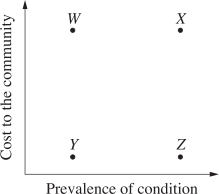
Four health conditions \(W, X, Y\) and \(Z\) currently affecting Australians, are plotted on the following graph.
 

Which of these conditions is most likely to be identified as the greatest health priority issue in Australia?

  1. \(W\)
  2. \(X\)
  3. \(Y\)
  4. \(Z\)
Show Answers Only

\(B\)

Show Worked Solution
  • B is correct: \(X\) represents the ideal health priority as it has a high prevalence and high cost to the community.

Other Options:

  • A is incorrect: \(W\rightarrow\) Lower prevalence despite high cost means fewer people affected.
  • C is incorrect: \(Y\rightarrow\) Both low prevalence and low cost make it the lowest priority of the options.
  • D is incorrect: \(Z\rightarrow\) High prevalence but lower cost to community, making it less of a priority.

Filed Under: Health status of Australians Tagged With: Band 3, smc-5504-50-Incidence/prevalence

HMS, HIC 2024 HSC 1 MC

An epidemiologist is researching injury-related disability data in the current Australian
population.

Which epidemiological measure is the researcher likely to be using?

  1. Mortality
  2. Morbidity
  3. Infant mortality
  4. Life expectancy
Show Answers Only

\(B\)

Show Worked Solution
  • B is correct: Study of morbidity rates, as these measure the prevalence of disease, disorder, injury or disability in a population.

Other Options:

  • A is incorrect: Mortality measures death rates, not disability.
  • C is incorrect: Infant mortality specifically measures deaths in children under one year of age.
  • D is incorrect: Life expectancy measures average length of life, not disability conditions.

Filed Under: Health status of Australians Tagged With: Band 3, smc-5504-20-Morbidity

HMS, HIC EQ-Bank 029

Explain the prevalence of diabetes in Aboriginal and Torres Strait Islander communities and outline TWO possible determinants contributing to this health issue.   (4 marks)

--- 10 WORK AREA LINES (style=lined) ---

Show Answers Only

*Cause-and-effect language that directly addresses the “Explain” keyword is bolded in the answer below.

  • Aboriginal and Torres Strait Islander adults have approximately twice the diabetes rate of non-Indigenous Australians (7.9% vs 4.1%).

Determinant 1

  • Limited access to affordable fresh food in remote communities results in ATSI Peoples buying processed foods high in sugar and fat.
  • This dietary pattern directly causes insulin resistance and weight gain, which leads to Type 2 diabetes development.
  • As a result, diabetes incidence rises significantly in these communities.

Determinant 2

  • Historical dispossession from traditional lands resulted in loss of traditional hunting/gathering practices and native food sources.
  • This disruption caused a shift from nutrient-rich bush foods to Western processed diets.
  • Additionally, cultural barriers in healthcare prevent early diabetes screening and management, allowing the disease to develop undetected and untreated.

Show Worked Solution

*Cause-and-effect language that directly addresses the “Explain” keyword is bolded in the answer below.

  • Aboriginal and Torres Strait Islander adults have approximately twice the diabetes rate of non-Indigenous Australians (7.9% vs 4.1%).

Determinant 1

  • Limited access to affordable fresh food in remote communities results in ATSI Peoples buying processed foods high in sugar and fat.
  • This dietary pattern directly causes insulin resistance and weight gain, which leads to Type 2 diabetes development.
  • As a result, diabetes incidence rises significantly in these communities.

Determinant 2

  • Historical dispossession from traditional lands resulted in loss of traditional hunting/gathering practices and native food sources.
  • This disruption caused a shift from nutrient-rich bush foods to Western processed diets.
  • Additionally, cultural barriers in healthcare prevent early diabetes screening and management, allowing the disease to develop undetected and untreated.

Filed Under: Health status of Australians Tagged With: Band 4, smc-5504-50-Incidence/prevalence, smc-5504-60-Indigenous/TSI health, smc-5504-70-Health Reports

HMS, HIC EQ-Bank 028

Discuss how THREE epidemiological measures are used to explain the health status of Aboriginal and Torres Strait Islander peoples in Australia.

In your response, include specific examples from health reports to illustrate the role of these measures.   (5 marks)

--- 15 WORK AREA LINES (style=lined) ---

Show Answers Only

*PEEL – Solution is structured using the PEEL method; [P] Identify the point, [E] expand on the point with a link to question asked, [Ev] apply evidence/examples, [L] linking sentence back to question.

Mortality rates

  • [P] Mortality rates are used to identify inequities in Aboriginal and Torres Strait Islander health status.
  • [E] This measure shows progress and ongoing inequities.
  • [Ev] Australia’s Health 2024 reports cardiovascular deaths fell 22% for Indigenous Peoples, yet remain higher than non-Indigenous rates.
  • [L] This creates evidence of success and challenges requiring continued focus.

Infant mortality rates

  • [P] Infant mortality rates provide insight into maternal health services, living conditions and healthcare access.
  • [E] Infant mortality rates have improved from 6.9 to 5.4 per 1,000 births but are still nearly double non-Indigenous rates of 3.1 per 1,000 births.
  • [Ev] While indicating healthcare access, remote data collection is extremely challenging and can be incomplete.
  • [L] Despite limitations, this measure is an important determinant of maternal and child health programs.

Prevalence of disease

  • [P] Prevalence measures the proportion of a population affected by specific conditions.
  • [E] This reveals chronic conditions requiring programs, although undiagnosed cases affect the accuracy of statistics.
  • [Ev] For example, the prevalence of diabetes among Indigenous adults (7.9%) is almost double the rate of non-Indigenous Australians (4.1%).
  • [L] This highlights areas requiring intervention programs and reveals the impact of social determinants of health, including food security and healthcare access in remote communities.

Show Worked Solution

*PEEL – Solution is structured using the PEEL method; [P] Identify the point, [E] expand on the point with a link to question asked, [Ev] apply evidence/examples, [L] linking sentence back to question.

Mortality rates

  • [P] Mortality rates are used to identify inequities in Aboriginal and Torres Strait Islander health status.
  • [E] This measure shows progress and ongoing inequities.
  • [Ev] Australia’s Health 2024 reports cardiovascular deaths fell 22% for Indigenous Peoples, yet remain higher than non-Indigenous rates.
  • [L] This creates evidence of success and challenges requiring continued focus.

Infant mortality rates

  • [P] Infant mortality rates provide insight into maternal health services, living conditions and healthcare access.
  • [E] Infant mortality rates have improved from 6.9 to 5.4 per 1,000 births but are still nearly double non-Indigenous rates of 3.1 per 1,000 births.
  • [Ev] While indicating healthcare access, remote data collection is extremely challenging and can be incomplete.
  • [L] Despite limitations, this measure is an important determinant of maternal and child health programs.

Prevalence of disease

  • [P] Prevalence measures the proportion of a population affected by specific conditions.
  • [E] This reveals chronic conditions requiring programs, although undiagnosed cases affect the accuracy of statistics.
  • [Ev] For example, the prevalence of diabetes among Indigenous adults (7.9%) is almost double the rate of non-Indigenous Australians (4.1%).
  • [L] This highlights areas requiring intervention programs and reveals the impact of social determinants of health, including food security and healthcare access in remote communities.

Filed Under: Health status of Australians Tagged With: Band 4, Band 5, smc-5504-05-Epidemiology, smc-5504-20-Morbidity, smc-5504-50-Incidence/prevalence, smc-5504-60-Indigenous/TSI health, smc-5504-70-Health Reports

HMS, HIC EQ-Bank 021 MC

The graph below shows rates of hospitalisation for asthma in Australia from 2010 to 2022.

Which statement best explains how this data represents morbidity in the Australian population?

  1. It demonstrates the prevalence of asthma in Australia.
  2. It indicates the mortality rate associated with asthma.
  3. It shows the burden of illness caused by asthma requiring hospital care.
  4. It reflects the incidence of new asthma cases diagnosed each year.
Show Answers Only

\( C\)

Show Worked Solution
  • C is correct because hospitalisation rates are a measure of morbidity, showing the burden of illness severe enough to require hospital treatment.

Other options:

  • A is incorrect as prevalence refers to all existing cases, not just those requiring hospitalisation.
  • B is incorrect as the data shows illness (morbidity) not deaths (mortality).
  • D is incorrect as hospitalisations don’t necessarily represent new diagnoses but could include existing cases that are worsening.

Filed Under: Health status of Australians Tagged With: Band 4, smc-5504-20-Morbidity

HMS, HIC EQ-Bank 027

How is morbidity data used to assess the health status of Australians? In your answer, outline TWO limitations of using this data.   (5 marks)

--- 15 WORK AREA LINES (style=lined) ---

Show Answers Only

*Cause-and-effect language that directly addresses the “How” keyword is bolded in the answer below.

  • Morbidity data collection begins when healthcare services record illness frequency, duration and severity.
  • This then flows to health authorities who analyse disease patterns which leads to identification of priority health issues.
  • As a result, resources target areas with the highest burden.
  • For example, when hospital data shows high cardiovascular rates in Western Sydney, this causes targeted prevention programs there.
  • This demonstrates how data directly shapes interventions.

Limitations:

  • Limited healthcare access creates gaps. This happens when remote or disadvantaged populations avoid medical care. Which leads to unrecorded illnesses. Consequently, data underestimates true burden because it only captures those accessing services.
  • Missing contextual information affects programs. When data focuses only on disease counts, it fails to capture social determinants like poverty. This causes surface-level interventions. As a result, programs miss root causes because data collection excludes social context.

Show Worked Solution

*Cause-and-effect language that directly addresses the “How” keyword is bolded in the answer below.

  • Morbidity data collection begins when healthcare services record illness frequency, duration and severity.
  • This then flows to health authorities who analyse disease patterns which leads to identification of priority health issues.
  • As a result, resources target areas with the highest burden.
  • For example, when hospital data shows high cardiovascular rates in Western Sydney, this causes targeted prevention programs there.
  • This demonstrates how data directly shapes interventions.

Limitations:

  • Limited healthcare access creates gaps. This happens when remote or disadvantaged populations avoid medical care. Which leads to unrecorded illnesses. Consequently, data underestimates true burden because it only captures those accessing services.
  • Missing contextual information affects programs. When data focuses only on disease counts, it fails to capture social determinants like poverty. This causes surface-level interventions. As a result, programs miss root causes because data collection excludes social context.

Filed Under: Health status of Australians Tagged With: Band 5, smc-5504-20-Morbidity

HMS, HIC EQ-Bank 020 MC

Researchers are comparing the health status of two regions in Australia using the data below:

\begin{align*}
\begin{array}{|l|l|l|}
\hline
\rule{0pt}{2.5ex}\textbf{Measure}\rule[-1ex]{0pt}{0pt}& \textbf{Region X} & \textbf{Region Y}\\
\hline
\rule{0pt}{2.5ex}\text{Infant mortality rate (per 1,000 live births)}\rule[-1ex]{0pt}{0pt}&\text{4.1}&\text{3.2}\\
\hline
\rule{0pt}{2.5ex}\text{Life expectancy at birth}\rule[-1ex]{0pt}{0pt}& \text{82.3}& \text{84.1}\\
\hline
\rule{0pt}{2.5ex}\text{Prevalence of diabetes (%)}\rule[-1ex]{0pt}{0pt}&\text{5.6}&\text{4.8}\\
\hline
\rule{0pt}{2.5ex}\text{Hospital admissions for respiratory conditions (per 100,000)}\rule[-1ex]{0pt}{0pt}&\text{1,520}&\text{1,320}\\
\hline
\end{array}
\end{align*}

Based on these epidemiological measures, which statement is most accurate?

  1. Region X has better overall health outcomes than Region Y.
  2. Region Y has better overall health outcomes than Region X.
  3. The data shows mixed results with no clear pattern of better health outcomes.
  4. The measures used are insufficient to compare health outcomes between regions.
Show Answers Only

\( B\)

Show Worked Solution
  • B is correct because all four measures indicate better health in Region Y: lower infant mortality, higher life expectancy, lower diabetes prevalence, and fewer hospital admissions for respiratory conditions.

\(\Rightarrow B\)

Filed Under: Health status of Australians Tagged With: Band 5, smc-5504-05-Epidemiology

HMS, HIC EQ-Bank 026

Explain the difference between the prevalence and incidence of a disease and how each contributes to our understanding of the health status of Australians.   (4 marks)

--- 10 WORK AREA LINES (style=lined) ---

Show Answers Only

  • Prevalence measures the total number of existing cases of a disease or condition in a population at a specific point in time, helping us understand the burden of chronic conditions like diabetes.
  • Incidence measures new cases that develop during a specific time period, allowing health authorities to track emerging health issues or the effectiveness of prevention strategies.
  • Together, these measures provide complementary insights into the magnitude and progression of health conditions across Australian populations.

Show Worked Solution
  • Prevalence measures the total number of existing cases of a disease or condition in a population at a specific point in time, helping us understand the burden of chronic conditions like diabetes.
  • Incidence measures new cases that develop during a specific time period, allowing health authorities to track emerging health issues or the effectiveness of prevention strategies.
  • Together, these measures provide complementary insights into the magnitude and progression of health conditions across Australian populations.

Filed Under: Health status of Australians Tagged With: Band 4, smc-5504-50-Incidence/prevalence

HMS, HIC EQ-Bank 019 MC

The table below shows data for a particular health condition in Australia:

\begin{align*}
\begin{array}{|l|l|l|l|}
\hline
\rule{0pt}{2.5ex}\textbf{Year}\rule[-1ex]{0pt}{0pt}& \textbf{Existing Cases} & \textbf{Population}& \textbf{New Cases}\\
\hline
\rule{0pt}{2.5ex}\text{2020}\rule[-1ex]{0pt}{0pt}&\text{50,000}&\text{10,000,000}&\text{5,000}\\
\hline
\rule{0pt}{2.5ex}\text{2021}\rule[-1ex]{0pt}{0pt}& \text{54,000}& \text{10,200,000}& \text{5,200}\\
\hline
\end{array}
\end{align*}

What was the prevalence rate (per 100,000 people) of this condition in 2021?

  1. 51.0
  2. 529.4
  3. 5,200
  4. 54,000
Show Answers Only

\( B\)

Show Worked Solution
  • Prevalence rate = (Number of existing cases ÷ Population) × 100,000 = (54,000 ÷ 10,200,000) × 100,000 = 529.4 per 100,000

\(\Rightarrow B\)

Filed Under: Health status of Australians Tagged With: Band 4, smc-5504-50-Incidence/prevalence

HMS, HIC EQ-Bank 025

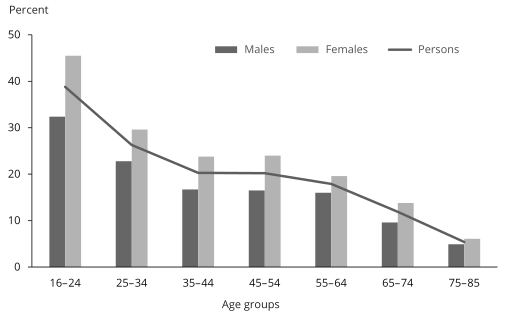
The graph below shows the prevalence of 12-month mental disorders (i.e. had a mental disorder in the past 12 months) by age group and gender in Australia for 2020-2022.


Identify two key trends in the prevalence of mental disorders shown in the graph and explain possible reasons for these patterns.   (4 marks)

--- 10 WORK AREA LINES (style=lined) ---

Show Answers Only

Trend 1

  • Females consistently show higher prevalence of mental disorders across all age groups compared to males, with the largest gender gap in the 16-24 age group (46% vs 32%).

Trend 2

  • Mental disorder prevalence decreases significantly with age for both genders, declining from approximately 39% in 16-24 year-olds to 6% in 75-85 year-olds.

Reasons for higher female prevalence

  • Hormonal influences during reproductive years, greater likelihood of reporting mental health symptoms, and increased exposure to social pressures including social media impacts.

Reasons for age-related decline

  • Older adults develop better coping mechanisms over time, generational differences in mental health recognition and reporting, and potential survivor bias where those with severe mental health issues may not reach older ages.

Show Worked Solution

Trend 1

  • Females consistently show higher prevalence of mental disorders across all age groups compared to males, with the largest gender gap in the 16-24 age group (46% vs 32%).

Trend 2

  • Mental disorder prevalence decreases significantly with age for both genders, declining from approximately 39% in 16-24 year-olds to 6% in 75-85 year-olds.

Reasons for higher female prevalence

  • Hormonal influences during reproductive years, greater likelihood of reporting mental health symptoms, and increased exposure to social pressures including social media impacts.

Reasons for age-related decline

  • Older adults develop better coping mechanisms over time, generational differences in mental health recognition and reporting, and potential survivor bias where those with severe mental health issues may not reach older ages.

Filed Under: Health status of Australians Tagged With: Band 4, smc-5504-05-Epidemiology, smc-5504-70-Health Reports

HMS, HIC EQ-Bank 024

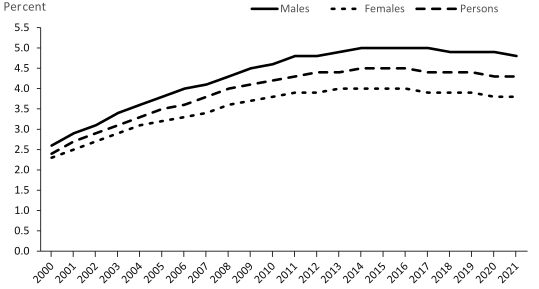
The graph below shows the prevalence of diabetes (type 1, type 2 and other diabetes excluding gestational diabetes) in Australia from 2000-2021.
 

Analyse the trends and discuss what these patterns suggest about the health status of Australians.   (8 marks)

--- 22 WORK AREA LINES (style=lined) ---

Show Answers Only

*PEEL – Solution is structured using an adjusted PEEL method; [P] Identify components and their relationship, [E] explain the interaction/influence between them, [Ev] provide evidence showing the relationship in action, [L] linking sentence back to question.

  • [P] Rising diabetes prevalence (2000-2013) connects directly to lifestyle changes and demographics.
  • [E] This trend directly influences the population’s health through increased obesity rates interacting with sedentary behaviours.
  • [Ev] The graph shows prevalence climbing steadily as these risk factors combine.
  • [L] This establishes a cause-effect pattern revealing deteriorating health behaviours among Australians.
     
  • [P] The plateau after 2013 relates to intervention effectiveness.
  • [E] The relationship between prevention programs and prevalence rates shows stabilisation occurring when awareness campaigns interact with early screening.
  • [Ev] These elements combine to produce the flattening trend visible from 2013-2021.
  • [L] This interaction demonstrates that targeted health strategies can influence disease patterns.
      
  • [P] Gender disparity reveals different risk profiles between males and females.
  • [E] Males’ consistently higher rates result from the combination of poorer health behaviours and reduced healthcare engagement.
  • [Ev] The 1% gap demonstrates how lifestyle factors function through the interaction of diet, exercise and medical check-ups.
  • [L] This dynamic shows that gender-specific approaches are important to address health issues.
     
  • [P] Sustained high prevalence indicates a continuing systemic issue despite stabilisation.
  • [E] This trend reveals that ongoing healthcare demands are operating on multiple levels – managing existing cases while preventing new ones.
  • [Ev] High rates persisting means that, in practice, resources remain stretched.
  • [L] This fact reveals how chronic disease remains a defining feature of Australia’s health status.

Show Worked Solution

*PEEL – Solution is structured using an adjusted PEEL method; [P] Identify components and their relationship, [E] explain the interaction/influence between them, [Ev] provide evidence showing the relationship in action, [L] linking sentence back to question.

  • [P] Rising diabetes prevalence (2000-2013) connects directly to lifestyle changes and demographics.
  • [E] This trend directly influences the population’s health through increased obesity rates interacting with sedentary behaviours.
  • [Ev] The graph shows prevalence climbing steadily as these risk factors combine.
  • [L] This establishes a cause-effect pattern revealing deteriorating health behaviours among Australians.
     
  • [P] The plateau after 2013 relates to intervention effectiveness.
  • [E] The relationship between prevention programs and prevalence rates shows stabilisation occurring when awareness campaigns interact with early screening.
  • [Ev] These elements combine to produce the flattening trend visible from 2013-2021.
  • [L] This interaction demonstrates that targeted health strategies can influence disease patterns.
      
  • [P] Gender disparity reveals different risk profiles between males and females.
  • [E] Males’ consistently higher rates result from the combination of poorer health behaviours and reduced healthcare engagement.
  • [Ev] The 1% gap demonstrates how lifestyle factors function through the interaction of diet, exercise and medical check-ups.
  • [L] This dynamic shows that gender-specific approaches are important to address health issues.
     
  • [P] Sustained high prevalence indicates a continuing systemic issue despite stabilisation.
  • [E] This trend reveals that ongoing healthcare demands are operating on multiple levels – managing existing cases while preventing new ones.
  • [Ev] High rates persisting means that, in practice, resources remain stretched.
  • [L] This fact reveals how chronic disease remains a defining feature of Australia’s health status.

Filed Under: Health status of Australians Tagged With: Band 4, Band 5, smc-5504-05-Epidemiology, smc-5504-70-Health Reports

HMS, HIC EQ-Bank 023

Explain how epidemiological data on mortality rates can be used to identify priority health issues in Australia.   (5 marks)

--- 10 WORK AREA LINES (style=lined) ---

Show Answers Only

*PEEL – Solution is structured using an adjusted PEEL method to show cause and effect: [P] State the cause/factor [E] Show how it causes the effect [Ev] Evidence demonstrating why/how [L] Reinforce the causal relationship.

  • [P] Mortality data identifies leading causes of death.
  • [E] This causes health authorities to allocate resources to high-fatality conditions.
  • [Ev] For example, because data shows cardiovascular disease and cancers kill the most Australians, it follows that funding should be increased for cardiac units and cancer research.
  • [L] This direct link between death statistics and resource allocation ensures targeted health interventions.
     
  • [P] Age-standardised rates enable population comparisons.
  • [E] This leads to identification of at-risk groups needing specific programs.
  • [Ev] As a result, when data reveals Indigenous Australians have higher diabetes mortality, culturally-specific prevention programs are developed.
  • [L] This relationship results in evidence-based health policies addressing population disparities.
     
  • [P] Premature mortality measures highlight youth deaths.
  • [E] This causes prioritisation of conditions affecting younger populations.
  • [Ev] Premature mortality measures like potential years of life lost (PYLL) data shows suicide and road accidents are major causes of early death, leading to youth mental health initiatives and road safety campaigns.
  • [L] This demonstrates why mortality analysis drives prevention strategies beyond just total death counts.

Show Worked Solution

*PEEL – Solution is structured using an adjusted PEEL method to show cause and effect: [P] State the cause/factor [E] Show how it causes the effect [Ev] Evidence demonstrating why/how [L] Reinforce the causal relationship.

  • [P] Mortality data identifies leading causes of death.
  • [E] This causes health authorities to allocate resources to high-fatality conditions.
  • [Ev] For example, because data shows cardiovascular disease and cancers kill the most Australians, it follows that funding should be increased for cardiac units and cancer research.
  • [L] This direct link between death statistics and resource allocation ensures targeted health interventions.
     
  • [P] Age-standardised rates enable population comparisons.
  • [E] This leads to identification of at-risk groups needing specific programs.
  • [Ev] As a result, when data reveals Indigenous Australians have higher diabetes mortality, culturally-specific prevention programs are developed.
  • [L] This relationship results in evidence-based health policies addressing population disparities.
     
  • [P] Premature mortality measures highlight youth deaths.
  • [E] This causes prioritisation of conditions affecting younger populations.
  • [Ev] Premature mortality measures like potential years of life lost (PYLL) data shows suicide and road accidents are major causes of early death, leading to youth mental health initiatives and road safety campaigns.
  • [L] This demonstrates why mortality analysis drives prevention strategies beyond just total death counts.

Filed Under: Health status of Australians Tagged With: Band 4, Band 5, smc-5504-05-Epidemiology, smc-5504-10-Mortality

HMS, HIC EQ-Bank 010

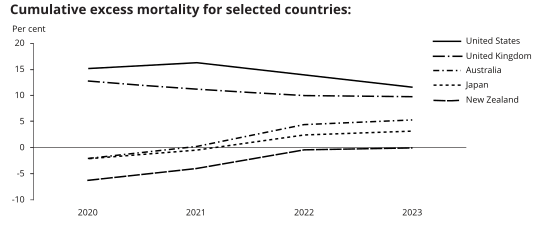
Describe what excess mortality data reveals about the impact of COVID-19 on Australia compared to other countries.   (3 marks)

--- 8 WORK AREA LINES (style=lined) ---

Show Answers Only
  • Australia experienced fewer deaths than expected in 2020, followed by increasing excess deaths in 2021-2023.
  • This increase occurs as the COVID-19 pandemic took hold and spread throughout the world.
  • When compared internationally, Australia had one of the lowest excess mortality rates among countries with available data, significantly lower than the United States and United Kingdom, although higher than Japan and New Zealand.
  • This international comparison suggests Australia’s pandemic response was relatively effective at minimising deaths compared to many other developed nations, though not as successful as some other Asian countries.
Show Worked Solution
  • Australia experienced fewer deaths than expected in 2020, followed by increasing excess deaths in 2021-2023.
  • This increase occurs as the COVID-19 pandemic took hold and spread throughout the world.
  • When compared internationally, Australia’s excess mortality rate was significantly lower than the United States and United Kingdom, although higher than Japan and New Zealand.
  • This international comparison suggests Australia’s pandemic response was relatively effective at minimising deaths compared to many other developed nations, though not as successful as some other Asian countries.

Filed Under: Health status of Australians Tagged With: Band 4, smc-5504-10-Mortality

HMS, HIC EQ-Bank 009

Australia's Health 2024 report published findings that

  • 5-year relative survival rates for cancer have improved from 53% in 1990-1994 to 71% in 2015-2019.
  • This improvement is particularly notable in specific cancers such as prostate cancer, which saw survival rates rise from 66% to 96%, and breast cancer in females which increased from 78% to 92%.

Outline TWO reasons for these improved statistics and explain how these they affect survival rates?   (5 marks)

--- 15 WORK AREA LINES (style=lined) ---

Show Answers Only

*Cause-and-effect language that directly addresses the “Explain” keyword is bolded in the answer below.

Early Detection:

  • Earlier detection through screening programs creates better survival outcomes.
  • First, programs like BreastScreen Australia identify cancers at Stage 1 or 2, which enables immediate treatment.
  • This leads to surgical removal while tumours are small and localised. As a result, 5-year survival rates increase because cancer hasn’t spread to other organs.
  • For example, breast cancer detected through screening has 99% survival at Stage 1, demonstrating how early detection directly improves outcomes.

Improved cancer treatments:

  • Advanced treatment technologies improve survival through connected steps.
  • Initially, genetic testing identifies cancer mutations, which causes doctors to prescribe targeted therapies. This then leads to cancer cells being destroyed precisely while protecting healthy tissue.
  • Consequently, patients experience fewer side effects and stronger responses. This results in extended survival because treatments attack cancer’s specific weaknesses.

Detection and Improved Treatment combining:

  • These factors work together – when screening detects cancer early and targeted treatments are applied, this combination causes dramatic improvements like prostate cancer’s rise to 96% survival.
Show Worked Solution

*Cause-and-effect language that directly addresses the “Explain” keyword is bolded in the answer below.

Early Detection:

  • Earlier detection through screening programs creates better survival outcomes.
  • First, programs like BreastScreen Australia identify cancers at Stage 1 or 2, which enables immediate treatment.
  • This leads to surgical removal while tumours are small and localised. As a result, 5-year survival rates increase because cancer hasn’t spread to other organs.
  • For example, breast cancer detected through screening has 99% survival at Stage 1, demonstrating how early detection directly improves outcomes.

Improved cancer treatments:

  • Advanced treatment technologies improve survival through connected steps.
  • Initially, genetic testing identifies cancer mutations, which causes doctors to prescribe targeted therapies. This then leads to cancer cells being destroyed precisely while protecting healthy tissue.
  • Consequently, patients experience fewer side effects and stronger responses. This results in extended survival because treatments attack cancer’s specific weaknesses.

Detection and Improved Treatment combining:

  • These factors work together – when screening detects cancer early and targeted treatments are applied, this combination causes dramatic improvements like prostate cancer’s rise to 96% survival.

Filed Under: Health status of Australians Tagged With: Band 4, smc-5504-10-Mortality, smc-5504-70-Health Reports

HMS, HIC EQ-Bank 008

Explain how epidemiologists use both incidence and prevalence data when monitoring a chronic disease such as diabetes in Australia.   (4 marks)

--- 10 WORK AREA LINES (style=lined) ---

Show Answers Only

*PEEL – Solution is structured using an adjusted PEEL method to show cause and effect: [P] State the cause/factor [E] Show how it causes the effect [Ev] Evidence demonstrating why/how [L] Reinforce the causal relationship.

  • [P] Epidemiologists collect incidence data to track new diabetes cases.
  • [E] This leads to identifying emerging patterns and at-risk groups.
  • [Ev] This occurs because incidence shows how many people develop diabetes each year, revealing if rates are increasing in specific populations like young adults.
  • [L] This relationship results in targeted prevention programs for high-risk groups.
     
  • [P] Prevalence data provides total diabetes numbers.
  • [E] This causes accurate healthcare planning and resource allocation.
  • [Ev] The reason for this is prevalence shows everyone currently living with diabetes, enabling calculation of insulin supplies and specialist services needed .
  • [L] This demonstrates why prevalence directly influences healthcare budget decisions.
     
  • [P] Combining both data types creates comprehensive monitoring.
  • [E] This enables evaluation of intervention effectiveness.
  • [Ev] This works by comparing whether prevention programs reduce new cases (incidence) while managing existing cases (prevalence).
  • [L] These elements work together to show if Australia’s diabetes strategies succeed.
Show Worked Solution

*PEEL – Solution is structured using an adjusted PEEL method to show cause and effect: [P] State the cause/factor [E] Show how it causes the effect [Ev] Evidence demonstrating why/how [L] Reinforce the causal relationship.

  • [P] Epidemiologists collect incidence data to track new diabetes cases.
  • [E] This leads to identifying emerging patterns and at-risk groups.
  • [Ev] This occurs because incidence shows how many people develop diabetes each year, revealing if rates are increasing in specific populations like young adults.
  • [L] This relationship results in targeted prevention programs for high-risk groups.
     
  • [P] Prevalence data provides total diabetes numbers.
  • [E] This causes accurate healthcare planning and resource allocation.
  • [Ev] The reason for this is prevalence shows everyone currently living with diabetes, enabling calculation of insulin supplies and specialist services needed .
  • [L] This demonstrates why prevalence directly influences healthcare budget decisions.
     
  • [P] Combining both data types creates comprehensive monitoring.
  • [E] This enables evaluation of intervention effectiveness.
  • [Ev] This works by comparing whether prevention programs reduce new cases (incidence) while managing existing cases (prevalence).
  • [L] These elements work together to show if Australia’s diabetes strategies succeed.

Filed Under: Health status of Australians Tagged With: Band 4, smc-5504-05-Epidemiology, smc-5504-50-Incidence/prevalence

HMS, HIC EQ-Bank 007

Australia's Health 2024 report states that 

"Over the last century there have been substantial decreases in child and infant mortality rates, contributing to increases in overall life expectancy. For example, death rates for children under 5 declined by 97% between 1907 and 2022."

Outline how the decrease in infant mortality rates in Australia over the past century has contributed to increased life expectancy.   (2 marks)

--- 5 WORK AREA LINES (style=lined) ---

Show Answers Only
  • The significant decrease in infant mortality rates in Australia has contributed to increased life expectancy by reducing deaths in the early years of life.
  • As more children survive past their first year, the average life expectancy of the population increases because fewer lives are being cut short in infancy.
Show Worked Solution
  • The significant decrease in infant mortality rates in Australia has contributed to increased life expectancy by reducing deaths in the early years of life.
  • As more children survive past their first year, the average life expectancy of the population increases because fewer lives are being cut short in infancy.

Filed Under: Health status of Australians Tagged With: Band 3, smc-5504-30-Infant mortality, smc-5504-70-Health Reports

HMS, HIC EQ-Bank 008 MC

When examining infant mortality as a health indicator, which of the following statements is most accurate?

  1. It measures deaths of all children under 18 years per 1,000 population.
  2. It measures deaths among children aged under one year per 1,000 live births.
  3. It only accounts for deaths occurring during birth, not those occurring after hospital discharge.
  4. It is typically calculated as a percentage of all deaths in a country.
Show Answers Only

\(B\)

Show Worked Solution
  • B is correct. Infant mortality measures deaths among children aged under one year per 1,000 live births.

Other options:

  • Option A is incorrect as it refers to all children under 18, not just infants.
  • Option C is incorrect as infant mortality includes all deaths under 1 year, not just those during birth.
  • Option D is incorrect as infant mortality is calculated per 1,000 live births, not as a percentage of all deaths.

Filed Under: Health status of Australians Tagged With: Band 4, smc-5504-30-Infant mortality

HMS, HIC EQ-Bank 007 MC

A researcher wants to determine how many people are currently living with Type 2 diabetes in Australia. Which epidemiological measure would be most appropriate to use?

  1. Incidence
  2. Prevalence
  3. Morbidity
  4. Mortality
Show Answers Only

\(B\)

Show Worked Solution
  • B is correct as prevalence measures the total number or proportion of cases in a population at a given time (the existing cases).

Other options:

  • A is incorrect because incidence measures new cases over a period, not current cases.
  • C is incorrect as morbidity is a broader term referring to the state of illness, not specifically the count.
  • D is incorrect as mortality refers to death rates, not living cases.

Filed Under: Health status of Australians Tagged With: Band 4, smc-5504-05-Epidemiology

HMS, HIC 2022 HSC 3 MC

Which row in the table shows the current infant mortality and life expectancy trends in Australia?

\begin{align*}
\begin{array}{l}
\rule{0pt}{2.5ex} \ \rule[-1ex]{0pt}{0pt}& \\
\rule{0pt}{2.5ex}\quad\textbf{A.}\rule[-1ex]{0pt}{0pt}\\
\rule{0pt}{2.5ex}\quad\textbf{B.}\rule[-1ex]{0pt}{0pt}\\
\rule{0pt}{2.5ex}\quad\textbf{C.}\rule[-1ex]{0pt}{0pt}\\
\rule{0pt}{2.5ex}\quad\textbf{D.}\rule[-1ex]{0pt}{0pt}\\
\end{array}
\begin{array}{|c|c|}
\hline
\rule{0pt}{2.5ex}\textit{Infant Mortality}\rule[-1ex]{0pt}{0pt}& \textit{Life Expectancy} \\
\hline
\rule{0pt}{2.5ex}\text{Decreasing}\rule[-1ex]{0pt}{0pt}&\text{Increasing}\\
\hline
\rule{0pt}{2.5ex}\text{Decreasing}\rule[-1ex]{0pt}{0pt}& \text{Decreasing}\\
\hline
\rule{0pt}{2.5ex}\text{Increasing}\rule[-1ex]{0pt}{0pt}& \text{Stable} \\
\hline
\rule{0pt}{2.5ex}\text{Stable}\rule[-1ex]{0pt}{0pt}& \text{Increasing} \\
\hline
\end{array}
\end{align*}


Show Answers Only

\( A\)

Show Worked Solution

  • A is correct: Australia shows decreasing infant mortality rates and increasing life expectancy trends.

Other Options:

  • B is incorrect: Life expectancy continues to increase in Australia.
  • C is incorrect: Infant mortality is decreasing, not increasing.
  • D is incorrect: Infant mortality is decreasing, not stable.

Filed Under: Health status of Australians Tagged With: Band 3, smc-5504-30-Infant mortality

Copyright © 2014–2025 SmarterEd.com.au · Log in