SmarterEd

Aussie Maths & Science Teachers: Save your time with SmarterEd

  • Login
  • Get Help
  • About

HMS, BM EQ-Bank 859

Assess how an understanding of biomechanics can be applied to increase movement efficiency and performance in wheelchair racing.   (8 marks)

--- 24 WORK AREA LINES (style=lined) ---

Show Answers Only

Sample Answer

Judgment Statement

  • Biomechanical understanding proves highly effective for enhancing wheelchair racing performance.
  • Assessment based on force application efficiency and equipment optimisation capabilities.

Force Application Efficiency

  • Assessment reveals significant improvements when athletes apply biomechanical principles to pushing technique.
  • Wheelchair racers using tangential rim contact achieve superior force transfer compared to downward pushing.
  • Proper elbow positioning at optimal extension angles demonstrates strong power generation capabilities.
  • Upper body alignment with shoulders over push rim shows excellent mechanical advantage.
  • Results indicate substantial gains in both speed maintenance and endurance capacity.
  • Shoulder and wrist strain reduces considerably with biomechanically correct technique patterns.
  • This demonstrates high effectiveness in maximising propulsion while minimising injury risk.

Equipment Optimisation

  • Considerable improvements occur through biomechanically-informed equipment modifications and adjustments.
  • Lightweight frame materials produce measurable reductions in energy expenditure per stroke.
  • Aerodynamic positioning of athlete and chair achieves substantial drag force reduction.
  • Custom seat angles show optimal force transfer from trunk through arms.
  • Wheel camber adjustments demonstrate excellent stability during high-speed cornering.
  • Glove design modifications indicate strong grip efficiency without compromising release.
  • Equipment adaptations prove highly valuable in maximising individual athletic potential

Overall Assessment

  • On balance, biomechanical principles prove exceptionally valuable for wheelchair racing enhancement.
  • Both force application and equipment criteria show major improvements in performance outcomes.
  • When all factors are considered, athletes gain significant competitive advantages through proper application.
  • Overall assessment confirms biomechanics as essential knowledge for wheelchair racing success.
  • The results indicate continued refinements will yield further performance gains.
Show Worked Solution

Sample Answer

Judgment Statement

  • Biomechanical understanding proves highly effective for enhancing wheelchair racing performance.
  • Assessment based on force application efficiency and equipment optimisation capabilities.

Force Application Efficiency

  • Assessment reveals significant improvements when athletes apply biomechanical principles to pushing technique.
  • Wheelchair racers using tangential rim contact achieve superior force transfer compared to downward pushing.
  • Proper elbow positioning at optimal extension angles demonstrates strong power generation capabilities.
  • Upper body alignment with shoulders over push rim shows excellent mechanical advantage.
  • Results indicate substantial gains in both speed maintenance and endurance capacity.
  • Shoulder and wrist strain reduces considerably with biomechanically correct technique patterns.
  • This demonstrates high effectiveness in maximising propulsion while minimising injury risk.

Equipment Optimisation

  • Considerable improvements occur through biomechanically-informed equipment modifications and adjustments.
  • Lightweight frame materials produce measurable reductions in energy expenditure per stroke.
  • Aerodynamic positioning of athlete and chair achieves substantial drag force reduction.
  • Custom seat angles show optimal force transfer from trunk through arms.
  • Wheel camber adjustments demonstrate excellent stability during high-speed cornering.
  • Glove design modifications indicate strong grip efficiency without compromising release.
  • Equipment adaptations prove highly valuable in maximising individual athletic potential

Overall Assessment

  • On balance, biomechanical principles prove exceptionally valuable for wheelchair racing enhancement.
  • Both force application and equipment criteria show major improvements in performance outcomes.
  • When all factors are considered, athletes gain significant competitive advantages through proper application.
  • Overall assessment confirms biomechanics as essential knowledge for wheelchair racing success.
  • The results indicate continued refinements will yield further performance gains.

Filed Under: Safe and efficient movement Tagged With: Band 4, Band 5, smc-5522-15-Movement efficiency

HMS, BM EQ-Bank 858

Evaluate how biomechanical principles could be applied to improve movement efficiency for athletes with disabilities compared to able-bodied athletes. In your response, refer to specific adaptations and their effects.   (8 marks)

--- 28 WORK AREA LINES (style=lined) ---

Show Answers Only

Sample Answer

Evaluation Statement

  • Biomechanical adaptations prove highly effective for athletes with disabilities, often matching able-bodied performance.
  • Assessment based on force transfer efficiency, movement adaptation success, and performance outcomes.

Force Transfer and Energy Efficiency

  • Modern prosthetics demonstrate excellent energy return capabilities through biomechanical design.
  • Carbon fibre blades store and return substantial impact energy during ground impact.
  • Athletes require minimal additional muscle work to compensate for mechanical differences.
  • Evaluation reveals strong efficiency gains nearly matching able-bodied athlete mechanics.
  • Prosthetic alignment adjustments successfully optimise individual force transfer patterns.
  • Results indicate biomechanical adaptations achieve substantial movement efficiency.

Alternative Movement Patterns

  • Wheelchair propulsion shows remarkable effectiveness despite using different muscle groups.
  • Elite wheelchair racers reach 25 km/h using upper body power versus 21 km/h for marathon runners.
  • Tangential push angles maximise propulsion efficiency per stroke.
  • Assessment confirms alternative patterns rival traditional performance levels.
  • Specialised training effectively develops unique biomechanical advantages.
  • Performance proves adapted techniques compete effectively with able-bodied methods.

Equipment and Technique Integration

  • Racing wheelchair design demonstrates superior aerodynamic efficiency.
  • Three-wheeled configuration provides excellent stability while minimising resistance.
  • Cambered wheels enable optimal force application angles.
  • Evaluation shows equipment adaptations significantly enhance efficiency.
  • Integration proves highly effective maximising athletic potential.

Final Evaluation

  • Overall assessment demonstrates biomechanical principles prove highly valuable for disability sport.
  • Adaptations successfully enable competitive performance across disabilities.
  • While differences exist, optimised techniques effectively minimise performance gaps.
  • Technology and training create efficiency approaching able-bodied standards.
  • Therefore biomechanical knowledge transforms limitations into opportunities.
Show Worked Solution

Sample Answer

Evaluation Statement

  • Biomechanical adaptations prove highly effective for athletes with disabilities, often matching able-bodied performance.
  • Assessment based on force transfer efficiency, movement adaptation success, and performance outcomes.

Force Transfer and Energy Efficiency

  • Modern prosthetics demonstrate excellent energy return capabilities through biomechanical design.
  • Carbon fibre blades store and return substantial impact energy during ground impact.
  • Athletes require minimal additional muscle work to compensate for mechanical differences.
  • Evaluation reveals strong efficiency gains nearly matching able-bodied athlete mechanics.
  • Prosthetic alignment adjustments successfully optimise individual force transfer patterns.
  • Results indicate biomechanical adaptations achieve substantial movement efficiency.

Alternative Movement Patterns

  • Wheelchair propulsion shows remarkable effectiveness despite using different muscle groups.
  • Elite wheelchair racers reach 25 km/h using upper body power versus 21 km/h for marathon runners.
  • Tangential push angles maximise propulsion efficiency per stroke.
  • Assessment confirms alternative patterns rival traditional performance levels.
  • Specialised training effectively develops unique biomechanical advantages.
  • Performance proves adapted techniques compete effectively with able-bodied methods.

Equipment and Technique Integration

  • Racing wheelchair design demonstrates superior aerodynamic efficiency.
  • Three-wheeled configuration provides excellent stability while minimising resistance.
  • Cambered wheels enable optimal force application angles.
  • Evaluation shows equipment adaptations significantly enhance efficiency.
  • Integration proves highly effective maximising athletic potential.

Final Evaluation

  • Overall assessment demonstrates biomechanical principles prove highly valuable for disability sport.
  • Adaptations successfully enable competitive performance across disabilities.
  • While differences exist, optimised techniques effectively minimise performance gaps.
  • Technology and training create efficiency approaching able-bodied standards.
  • Therefore biomechanical knowledge transforms limitations into opportunities.

Filed Under: Safe and efficient movement Tagged With: Band 5, Band 6, smc-5522-15-Movement efficiency

HMS, BM EQ-Bank 857

Analyse how biomechanical principles related to efficient force absorption can be applied to reduce injury risk in sport. Provide specific examples in your response.   (8 marks)

--- 28 WORK AREA LINES (style=lined) ---

Show Answers Only

Sample Answer

Overview Statement

  • Force absorption efficiency depends on contact time, surface area and body positioning working together.
  • These components interact with equipment design and technique to create comprehensive injury prevention systems.

Component Relationship 1: Contact Time and Force Magnitude

  • Extended deceleration time directly reduces peak forces experienced during impact.
  • Basketball players who bend knees deeply when landing experience significantly lower joint forces.
  • Cricket fielders “giving” with catches transforms dangerous ball impacts into manageable forces.
  • The relationship reveals that time extension prevents acute ligament tears and cartilage damage.
  • Gymnasts rolling through landings demonstrates how gradual deceleration protects spine and ankles.
  • Gradual deceleration enables tissues to adapt rather than rupture under sudden loads.

Component Relationship 2: Surface Area and Protective Systems

  • Larger contact areas combine with protective equipment to distribute forces effectively across body.
  • Rugby players adopting wide tackle stances spread impact forces across multiple muscle groups.
  • Hockey shin guards amplify this effect by dramatically increasing the contact surface area.
  • This interaction shows how body positioning works with equipment design for protection.
  • Multiple contact points prevent concentrated stress that causes fractures and severe contusions.
  • Analysis reveals layered protection creates exponentially safer sporting environments than single methods.

Implications and Synthesis

  • Force absorption components form an integrated safety network throughout sporting activities.
  • The synthesis demonstrates combining extended time with increased area produces multiplicative safety benefits.
  • Therefore biomechanical education enables proactive injury prevention rather than reactive treatment.
  • The broader significance is knowledge transforms high-risk sports into controlled athletic performances.
Show Worked Solution

Sample Answer

Overview Statement

  • Force absorption efficiency depends on contact time, surface area and body positioning working together.
  • These components interact with equipment design and technique to create comprehensive injury prevention systems.

Component Relationship 1: Contact Time and Force Magnitude

  • Extended deceleration time directly reduces peak forces experienced during impact.
  • Basketball players who bend knees deeply when landing experience significantly lower joint forces.
  • Cricket fielders “giving” with catches transforms dangerous ball impacts into manageable forces.
  • The relationship reveals that time extension prevents acute ligament tears and cartilage damage.
  • Gymnasts rolling through landings demonstrates how gradual deceleration protects spine and ankles.
  • Gradual deceleration enables tissues to adapt rather than rupture under sudden loads.

Component Relationship 2: Surface Area and Protective Systems

  • Larger contact areas combine with protective equipment to distribute forces effectively across body.
  • Rugby players adopting wide tackle stances spread impact forces across multiple muscle groups.
  • Hockey shin guards amplify this effect by dramatically increasing the contact surface area.
  • This interaction shows how body positioning works with equipment design for protection.
  • Multiple contact points prevent concentrated stress that causes fractures and severe contusions.
  • Analysis reveals layered protection creates exponentially safer sporting environments than single methods.

Implications and Synthesis

  • Force absorption components form an integrated safety network throughout sporting activities.
  • The synthesis demonstrates combining extended time with increased area produces multiplicative safety benefits.
  • Therefore biomechanical education enables proactive injury prevention rather than reactive treatment.
  • The broader significance is knowledge transforms high-risk sports into controlled athletic performances.

Filed Under: Safe and efficient movement Tagged With: Band 4, Band 5, smc-5522-15-Movement efficiency

HMS, BM EQ-Bank 856

Explain how biomechanical principles can be applied to increase movement efficiency and reduce injury risk in athletes with prosthetic limbs.   (6 marks)

--- 18 WORK AREA LINES (style=lined) ---

Show Answers Only

Sample Answer

  • The prosthetic limb acts as a lever for residual muscles. This occurs because remaining muscles pull on the prosthetic attachment to create movement.
  • As a result, proper alignment maximises force transfer efficiency. This reduces energy expenditure during running or walking significantly.
  • Carbon fibre materials store energy during ground contact. This happens when the material compresses and then springs back.
  • Consequently, this elastic energy return reduces muscular effort needed. This enables athletes to maintain speed with less fatigue.
  • Prosthetic design adjusts the athlete’s centre of gravity. This is necessary because missing limb mass alters body balance.
  • Therefore, correct positioning prevents compensatory movements. This protects the spine and opposite limb from overuse injuries.
  • Custom sockets distribute pressure evenly across residual limb. This works by spreading forces over larger surface areas.
  • This prevents pressure sores and tissue breakdown. As a result, athletes can train longer without injury interruptions.
  • Gait analysis identifies movement asymmetries between limbs. This reveals uneven forces that could cause joint damage.
  • Subsequently, prosthetic adjustments normalise stride patterns. This reduces abnormal loading that causes wear injuries over time.
Show Worked Solution

Sample Answer

  • The prosthetic limb acts as a lever for residual muscles. This occurs because remaining muscles pull on the prosthetic attachment to create movement.
  • As a result, proper alignment maximises force transfer efficiency. This reduces energy expenditure during running or walking significantly.
  • Carbon fibre materials store energy during ground contact. This happens when the material compresses and then springs back.
  • Consequently, this elastic energy return reduces muscular effort needed. This enables athletes to maintain speed with less fatigue.
  • Prosthetic design adjusts the athlete’s centre of gravity. This is necessary because missing limb mass alters body balance.
  • Therefore, correct positioning prevents compensatory movements. This protects the spine and opposite limb from overuse injuries.
  • Custom sockets distribute pressure evenly across residual limb. This works by spreading forces over larger surface areas.
  • This prevents pressure sores and tissue breakdown. As a result, athletes can train longer without injury interruptions.
  • Gait analysis identifies movement asymmetries between limbs. This reveals uneven forces that could cause joint damage.
  • Subsequently, prosthetic adjustments normalise stride patterns. This reduces abnormal loading that causes wear injuries over time.

Filed Under: Safe and efficient movement Tagged With: Band 3, Band 4, smc-5522-15-Movement efficiency

HMS, BM EQ-Bank 855

Outline how the biomechanical principle of force application can improve movement efficiency for athletes with disabilities.   (4 marks)

--- 12 WORK AREA LINES (style=lined) ---

Show Answers Only

Sample Answer

  • Wheelchair athletes apply maximum force through arms to wheel rims, generating forward momentum and speed.
  • Athletes with prosthetic limbs develop remaining muscles (quadriceps, hamstrings) to transfer force through prosthetic devices effectively.
  • Force direction understanding helps para-athletes adjust movement patterns, reducing energy waste and maximising propulsion efficiency.
  • Specialised equipment design (custom wheelchairs, prosthetics) incorporates biomechanical principles to enhance force transfer from body to ground.
  • Technical modifications include optimising push angles in wheelchairs and adjusting prosthetic alignment for better force application.
  • Training adaptations focus on strengthening specific muscle groups to compensate for missing limbs or paralysed segments.
Show Worked Solution

Sample Answer

  • Wheelchair athletes apply maximum force through arms to wheel rims, generating forward momentum and speed.
  • Athletes with prosthetic limbs develop remaining muscles (quadriceps, hamstrings) to transfer force through prosthetic devices effectively.
  • Force direction understanding helps para-athletes adjust movement patterns, reducing energy waste and maximising propulsion efficiency.
  • Specialised equipment design (custom wheelchairs, prosthetics) incorporates biomechanical principles to enhance force transfer from body to ground.
  • Technical modifications include optimising push angles in wheelchairs and adjusting prosthetic alignment for better force application.
  • Training adaptations focus on strengthening specific muscle groups to compensate for missing limbs or paralysed segments.

Filed Under: Safe and efficient movement Tagged With: Band 3, smc-5522-15-Movement efficiency

HMS, BM EQ-Bank 854 MC

For a sprinter with a prosthetic lower limb, which biomechanical principle most directly contributes to movement efficiency?

  1. Using upper leg muscles to apply force to the prosthetic limb
  2. Generating rotational force through the prosthetic joint
  3. Decreasing the weight of the prosthetic to reduce momentum
  4. Widening the stance to create a more stable base of support
Show Answers Only

\(A\)

Show Worked Solution
  • A is correct: Upper leg muscles apply force to prosthetic device for forward propulsion.

Other Options:

  • B is incorrect: Prosthetic limbs prioritise linear force transfer, not rotational generation.
  • C is incorrect: Weight reduction alone doesn’t improve efficiency without proper force application.
  • D is incorrect: Wider stance reduces sprinting efficiency by limiting forward momentum.

Filed Under: Safe and efficient movement Tagged With: Band 5, smc-5522-15-Movement efficiency

HMS, BM EQ-Bank 853 MC

Which biomechanical adaptation would most effectively increase movement efficiency for a wheelchair athlete during racing?

  1. Developing lower body strength to increase power
  2. Applying force through the arms to the rim of the wheels
  3. Reducing the weight of the wheelchair to decrease resistance
  4. Using protective gloves to absorb impact from the wheels
Show Answers Only

\(B\)

Show Worked Solution
  • B is correct: Direct arm force application to wheel rims generates maximum propulsion efficiency.

Other Options:

  • A is incorrect: Wheelchair athletes rely on upper body strength, not lower body power.
  • C is incorrect: Weight reduction helps but isn’t a biomechanical principle of force application.
  • D is incorrect: Gloves provide protection, not biomechanical movement efficiency.

Filed Under: Safe and efficient movement Tagged With: Band 4, smc-5522-15-Movement efficiency

HMS, BM EQ-Bank 852

Evaluate how knowledge of biomechanical principles could be applied to develop a safe squatting technique for an elderly individual with reduced mobility. In your answer, refer to balance, stability, force, and movement efficiency.   (12 marks)

--- 28 WORK AREA LINES (style=lined) ---

Show Answers Only

Sample Answer

Evaluation Statement

  • Biomechanical principles prove highly effective for developing safe elderly squatting techniques.
  • Evaluation based on balance enhancement, stability control, force management and movement efficiency adaptations.

Balance Enhancement Through Support

  • Evidence strongly supports using assistive devices to expand base of support during squatting.
  • Chair arms or wall rails increase contact points from two to four, achieving excellent stability improvements.
  • Research shows significant fall reduction when elderly use support aids during squatting movements.
  • Balance modifications demonstrate superior effectiveness as they address the primary injury risk.
  • Support systems successfully compensate for age-related proprioceptive decline.
  • Assessment reveals this criterion fully meets safety requirements for elderly populations.

Force Distribution and Joint Protection

  • Neutral spine alignment proves moderately effective in protecting vulnerable structures.
  • Proper positioning distributes forces evenly along vertebrae rather than concentrating stress points.
  • Studies indicate substantial reduction in compression forces with correct technique.
  • Force management partially fulfils safety needs but shows limitations with severe arthritis.
  • Individual joint conditions affect the degree of protection achieved.
  • Evaluation indicates force principles adequately address most elderly joint concerns.

Movement Efficiency Adaptations

  • Reduced range of motion initially limits functional benefits but strongly enhances safety.
  • Starting with 45-degree knee flexion maintains control while building necessary strength.
  • Progressive depth increases over 8-12 weeks balance safety with functionality.
  • Efficiency modifications demonstrate good long-term outcomes despite slow initial progress.
  • Gradual adaptation satisfies both safety and independence goals.

Final Evaluation

  • Overall evaluation confirms biomechanical principles highly effective for elderly squatting safety.
  • Balance support emerges as the most critical factor, followed by force distribution.
  • While some limitations exist in severely compromised individuals, modifications successfully enable safe squatting for most elderly.
  • The comprehensive approach proves essential for maintaining functional independence with minimal injury risk.
Show Worked Solution

Sample Answer

Evaluation Statement

  • Biomechanical principles prove highly effective for developing safe elderly squatting techniques.
  • Evaluation based on balance enhancement, stability control, force management and movement efficiency adaptations.

Balance Enhancement Through Support

  • Evidence strongly supports using assistive devices to expand base of support during squatting.
  • Chair arms or wall rails increase contact points from two to four, achieving excellent stability improvements.
  • Research shows significant fall reduction when elderly use support aids during squatting movements.
  • Balance modifications demonstrate superior effectiveness as they address the primary injury risk.
  • Support systems successfully compensate for age-related proprioceptive decline.
  • Assessment reveals this criterion fully meets safety requirements for elderly populations.

Force Distribution and Joint Protection

  • Neutral spine alignment proves moderately effective in protecting vulnerable structures.
  • Proper positioning distributes forces evenly along vertebrae rather than concentrating stress points.
  • Studies indicate substantial reduction in compression forces with correct technique.
  • Force management partially fulfils safety needs but shows limitations with severe arthritis.
  • Individual joint conditions affect the degree of protection achieved.
  • Evaluation indicates force principles adequately address most elderly joint concerns.

Movement Efficiency Adaptations

  • Reduced range of motion initially limits functional benefits but strongly enhances safety.
  • Starting with 45-degree knee flexion maintains control while building necessary strength.
  • Progressive depth increases over 8-12 weeks balance safety with functionality.
  • Efficiency modifications demonstrate good long-term outcomes despite slow initial progress.
  • Gradual adaptation satisfies both safety and independence goals.

Final Evaluation

  • Overall evaluation confirms biomechanical principles highly effective for elderly squatting safety.
  • Balance support emerges as the most critical factor, followed by force distribution.
  • While some limitations exist in severely compromised individuals, modifications successfully enable safe squatting for most elderly.
  • The comprehensive approach proves essential for maintaining functional independence with minimal injury risk.

Filed Under: Safe and efficient movement Tagged With: Band 4, Band 5, Band 6, smc-5522-10-Safe movement

HMS, BM EQ-Bank 851

Analyse how an understanding of biomechanical principles related to force absorption can reduce injury risk during movement activities. Provide specific examples.   (8 marks)

--- 22 WORK AREA LINES (style=lined) ---

Show Answers Only

Sample Answer

Overview Statement

  • Force absorption principles interact with movement techniques and equipment design to reduce injury risk.
  • Key components include impact time, force distribution, and protective materials that work together to enhance safety.

Component Relationship 1: Impact Time and Force Magnitude

  • Extended contact time directly influences the peak forces experienced by body tissues.
  • When athletes bend joints during landing, this results in gradual deceleration over longer periods.
  • Basketball players flexing knees during rebounds enables force absorption through multiple joint angles.
  • This pattern shows that controlled movements prevent sudden impact damage to cartilage.
  • Gymnasts rolling through landings demonstrates how extended ground contact reduces stress fractures.
  • The significance is that proper technique transforms dangerous impacts into manageable forces.

Component Relationship 2: Surface Area and Force Distribution

  • Wider contact areas connect to reduced pressure on specific body parts during impact.
  • Force distribution depends on both body positioning and protective equipment design working together.
  • Rugby players adopting wide stances spreads tackle forces across multiple joints and muscles.
  • Protective padding amplifies this effect by increasing contact area significantly
  • Shin guards in soccer reveal how equipment combines with technique to protect vulnerable areas.
  • This relationship indicates multiple safety layers work as an integrated system.

Implications and Synthesis

  • These components form a comprehensive injury prevention approach when applied together.
  • Understanding these relationships enables athletes to modify techniques before injuries occur.
  • Consequently, combining proper biomechanics with equipment creates exponential safety benefits.
  • The broader implication is that biomechanical knowledge transforms high-risk activities into controlled movements.
  • Therefore, education about force absorption leads to long-term athlete health and performance.
Show Worked Solution

Sample Answer

Overview Statement

  • Force absorption principles interact with movement techniques and equipment design to reduce injury risk.
  • Key components include impact time, force distribution, and protective materials that work together to enhance safety.

Component Relationship 1: Impact Time and Force Magnitude

  • Extended contact time directly influences the peak forces experienced by body tissues.
  • When athletes bend joints during landing, this results in gradual deceleration over longer periods.
  • Basketball players flexing knees during rebounds enables force absorption through multiple joint angles.
  • This pattern shows that controlled movements prevent sudden impact damage to cartilage.
  • Gymnasts rolling through landings demonstrates how extended ground contact reduces stress fractures.
  • The significance is that proper technique transforms dangerous impacts into manageable forces.

Component Relationship 2: Surface Area and Force Distribution

  • Wider contact areas connect to reduced pressure on specific body parts during impact.
  • Force distribution depends on both body positioning and protective equipment design working together.
  • Rugby players adopting wide stances spreads tackle forces across multiple joints and muscles.
  • Protective padding amplifies this effect by increasing contact area significantly
  • Shin guards in soccer reveal how equipment combines with technique to protect vulnerable areas.
  • This relationship indicates multiple safety layers work as an integrated system.

Implications and Synthesis

  • These components form a comprehensive injury prevention approach when applied together.
  • Understanding these relationships enables athletes to modify techniques before injuries occur.
  • Consequently, combining proper biomechanics with equipment creates exponential safety benefits.
  • The broader implication is that biomechanical knowledge transforms high-risk activities into controlled movements.
  • Therefore, education about force absorption leads to long-term athlete health and performance.

Filed Under: Safe and efficient movement Tagged With: Band 4, Band 5, smc-5522-10-Safe movement

HMS, BM EQ-Bank 850

Describe how biomechanical principles can be applied to enhance safety when lifting a heavy object from the ground.   (5 marks)

--- 15 WORK AREA LINES (style=lined) ---

Show Answers Only

Sample Answer

  • Base of support – Position feet shoulder-width apart with one foot slightly forward. This wide stance provides stability and allows controlled weight shift during lifting.
  • Centre of gravity – Keep the object close to your body throughout the lift. This reduces the lever arm and minimises strain on the spine.
  • Force distribution – Bend at knees and hips rather than the waist. This engages powerful leg muscles (quadriceps, hamstrings, gluteals) instead of weaker back muscles.
  • Spinal alignment – Maintain a neutral spine by engaging core muscles. Straight back posture distributes forces evenly along vertebrae, preventing disc damage.
  • Movement control – Avoid twisting while lifting by pivoting with feet. Rotational forces combined with compression can damage ligaments and intervertebral discs.
  • Muscle activation – Contract abdominal muscles before lifting. This creates internal pressure that supports the spine like a natural weight belt.
  • Breathing technique – Exhale during the lifting phase. This maintains core stability while preventing dangerous blood pressure spikes.
Show Worked Solution

Sample Answer

  • Base of support – Position feet shoulder-width apart with one foot slightly forward. This wide stance provides stability and allows controlled weight shift during lifting.
  • Centre of gravity – Keep the object close to your body throughout the lift. This reduces the lever arm and minimises strain on the spine.
  • Force distribution – Bend at knees and hips rather than the waist. This engages powerful leg muscles (quadriceps, hamstrings, gluteals) instead of weaker back muscles.
  • Spinal alignment – Maintain a neutral spine by engaging core muscles. Straight back posture distributes forces evenly along vertebrae, preventing disc damage.
  • Movement control – Avoid twisting while lifting by pivoting with feet. Rotational forces combined with compression can damage ligaments and intervertebral discs.
  • Muscle activation – Contract abdominal muscles before lifting. This creates internal pressure that supports the spine like a natural weight belt.
  • Breathing technique – Exhale during the lifting phase. This maintains core stability while preventing dangerous blood pressure spikes.

Filed Under: Safe and efficient movement Tagged With: Band 3, Band 4, smc-5522-10-Safe movement

HMS, BM EQ-Bank 849

Explain how the biomechanical principle of force absorption enhances safety when landing from a jump.   (3 marks)

--- 9 WORK AREA LINES (style=lined) ---

Show Answers Only

Sample Answer

  • Bending knees upon landing increases absorption time. This occurs because joints flex gradually rather than stopping abruptly.
  • As a result, peak impact forces reduce significantly. This protects cartilage and ligaments from sudden damaging stress.
  • Quadriceps muscles lengthen while contracting during descent. This enables controlled deceleration which prevents jarring impacts on joints.
  • Simultaneously, ankles, knees and hips flex together. This distributes forces across multiple segments rather than one joint.
  • Therefore, no single joint bears excessive load. This reduces injury risk to bones, muscles and connective tissues.
Show Worked Solution

Sample Answer

  • Bending knees upon landing increases absorption time. This occurs because joints flex gradually rather than stopping abruptly.
  • As a result, peak impact forces reduce significantly. This protects cartilage and ligaments from sudden damaging stress.
  • Quadriceps muscles lengthen while contracting during descent. This enables controlled deceleration which prevents jarring impacts on joints.
  • Simultaneously, ankles, knees and hips flex together. This distributes forces across multiple segments rather than one joint.
  • Therefore, no single joint bears excessive load. This reduces injury risk to bones, muscles and connective tissues.

Filed Under: Safe and efficient movement Tagged With: Band 3, smc-5522-10-Safe movement

HMS, BM EQ-Bank 848 MC

Which biomechanical principle is demonstrated when a basketball player bends their knees when landing from a rebound?

  1. Increasing the speed of movement to maintain momentum
  2. Absorbing force over a larger distance to reduce impact
  3. Raising the centre of gravity to improve visibility
  4. Concentrating force on a small area to enhance control
Show Answers Only

\(B\)

Show Worked Solution
  • B is correct: Bending knees extends impact time and distance, reducing joint forces.

Other Options:

  • A is incorrect: Increasing speed during landing increases rather than reduces impact forces.
  • C is incorrect: Raising centre of gravity decreases stability during landing.
  • D is incorrect: Concentrating force on small areas increases injury risk.

Filed Under: Safe and efficient movement Tagged With: Band 3, smc-5522-10-Safe movement

HMS, BM EQ-Bank 847 MC

When lifting a heavy box from the floor, which application of biomechanical principles would MOST effectively reduce the risk of lower back injury?

  1. Keeping the knees straight and bending at the waist
  2. Holding the box far from the body to distribute weight evenly
  3. Positioning the feet close together for better balance
  4. Keeping the weight close to the body and bending at the knees
Show Answers Only

\(D\)

Show Worked Solution
  • D is correct: Close weight reduces lever arm on spine while bent knees engage stronger leg muscles.

Other Options:

  • A is incorrect: Straight knees and bent waist places dangerous stress on lower back.
  • B is incorrect: Far weight position increases lever arm and spinal torque significantly.
  • C is incorrect: Close feet reduce stability and increase risk of falling while lifting.

Filed Under: Safe and efficient movement Tagged With: Band 5, smc-5522-10-Safe movement

HMS, BM EQ-Bank 846 MC

During a walking activity, which biomechanical principle best explains why proper heel-to-toe foot placement reduces the risk of injury?

  1. It minimises the base of support
  2. It distributes force more evenly
  3. It increases the force of impact
  4. It raises the centre of gravity
Show Answers Only

\(B\)

Show Worked Solution
  • B is correct: Heel-to-toe placement distributes impact forces evenly, reducing stress on any single point

Other Options:

  • A is incorrect: Minimising base of support would decrease stability and increase injury risk.
  • C is incorrect: Increasing impact force would heighten rather than reduce injury risk.
  • D is incorrect: Raising centre of gravity decreases stability and increases fall risk.

Filed Under: Safe and efficient movement Tagged With: Band 4, smc-5522-10-Safe movement

HMS, BM EQ-Bank 845 MC

A student is learning to perform a squat correctly in physical education class. Which combination of biomechanical principles would most effectively enhance safety during this movement?

  1. Decreasing the base of support and raising the centre of gravity
  2. Maintaining a straight back and keeping the weight away from the body
  3. Widening the base of support and lowering the centre of gravity
  4. Bending the back and keeping the feet close together
Show Answers Only

\(C\)

Show Worked Solution
  • C is correct: Wider base of support and lower centre of gravity maximise stability and balance during squats.

Other Options:

  • A is incorrect: Decreasing base of support and raising centre of gravity reduces stability dangerously
  • B is incorrect: Keeping weight away from body creates excessive leverage on the lower back.
  • D is incorrect: Bending the back risks spinal injury and close feet reduce stability.

Filed Under: Safe and efficient movement Tagged With: Band 3, smc-5522-10-Safe movement

HMS, BM EQ-Bank 843

How do biomechanical principles related to balance and stability enhance safety and movement efficiency in gymnastics floor routines?   (5 marks)

--- 15 WORK AREA LINES (style=lined) ---

Show Answers Only

Sample Answer

Balance Control for Safety:

  • Gymnasts manipulate centre of gravity by shifting body weight relative to base of support. This process maintains balance during skill transitions.
  • By controlling centre position precisely, dangerous falls are prevented. This protection occurs through constant muscular adjustments and body awareness.
  • During handstands, vertical alignment is achieved by engaging shoulder and core muscles. This engagement creates rigid body positioning above hands.
  • Through proper alignment, stable positioning prevents sideways collapse. Improved stability results in reduced risk of wrist or shoulder injuries.

Stability for Movement Efficiency:

  • Gymnasts widen base of support by adjusting limb positions during transitions. Such adjustments create greater stability margins for movement.
  • Through increased stability, smoother connections between elements occur, reducing energy wasted on balance corrections.
  • Centre of gravity lowers by bending joints before difficult moves. This lowering enhances control during rotational elements.
  • Through better control, precise execution becomes possible. This precision minimises unnecessary compensatory movements throughout routine.

Force Absorption in Landings:

  • Joint flexion extends impact time by allowing gradual deceleration. This extension reduces peak forces on body tissues.
  • Through extended deceleration, cartilage remains protected from damage, enabling fluid routine flow without injury interruptions.
Show Worked Solution

Sample Answer

Balance Control for Safety:

  • Gymnasts manipulate centre of gravity by shifting body weight relative to base of support. This process maintains balance during skill transitions.
  • By controlling centre position precisely, dangerous falls are prevented. This protection occurs through constant muscular adjustments and body awareness.
  • During handstands, vertical alignment is achieved by engaging shoulder and core muscles. This engagement creates rigid body positioning above hands.
  • Through proper alignment, stable positioning prevents sideways collapse. Improved stability results in reduced risk of wrist or shoulder injuries.

Stability for Movement Efficiency:

  • Gymnasts widen base of support by adjusting limb positions during transitions. Such adjustments create greater stability margins for movement.
  • Through increased stability, smoother connections between elements occur, reducing energy wasted on balance corrections.
  • Centre of gravity lowers by bending joints before difficult moves. This lowering enhances control during rotational elements.
  • Through better control, precise execution becomes possible. This precision minimises unnecessary compensatory movements throughout routine.

Force Absorption in Landings:

  • Joint flexion extends impact time by allowing gradual deceleration. This extension reduces peak forces on body tissues.
  • Through extended deceleration, cartilage remains protected from damage, enabling fluid routine flow without injury interruptions.

Filed Under: Safe and efficient movement Tagged With: Band 4, Band 5, smc-5522-20-Human movement

HMS, BM EQ-Bank 842

Explain how the biomechanical principle of force is applied in a sprint start, making reference to the interrelationship between muscles, bones, and joints.   (4 marks)

--- 12 WORK AREA LINES (style=lined) ---

Show Answers Only

Sample Answer

  • In a sprint start, quadriceps and hamstrings contract forcefully. This occurs because muscles must overcome inertia.
  • As a result, these muscles pull on femur and tibia bones. This causes powerful extension at hip and knee joints.
  • Simultaneously, calf muscles contract to push through the ankle. This creates additional force against the blocks.
  • Consequently, Newton’s Third Law applies. The blocks exert equal reaction force that propels the athlete forward.
  • Arm muscles work together to drive shoulder rotation. This generates momentum because arms oppose leg movement.
  • Throughout this process, core muscles stabilise the torso. This enables efficient force transfer between body segments.
Show Worked Solution

Sample Answer

  • In a sprint start, quadriceps and hamstrings contract forcefully. This occurs because muscles must overcome inertia.
  • As a result, these muscles pull on femur and tibia bones. This causes powerful extension at hip and knee joints.
  • Simultaneously, calf muscles contract to push through the ankle. This creates additional force against the blocks.
  • Consequently, Newton’s Third Law applies. The blocks exert equal reaction force that propels the athlete forward.
  • Arm muscles work together to drive shoulder rotation. This generates momentum because arms oppose leg movement.
  • Throughout this process, core muscles stabilise the torso. This enables efficient force transfer between body segments.

Filed Under: Safe and efficient movement Tagged With: Band 3, smc-5522-20-Human movement

HMS, BM EQ-Bank 841 MC

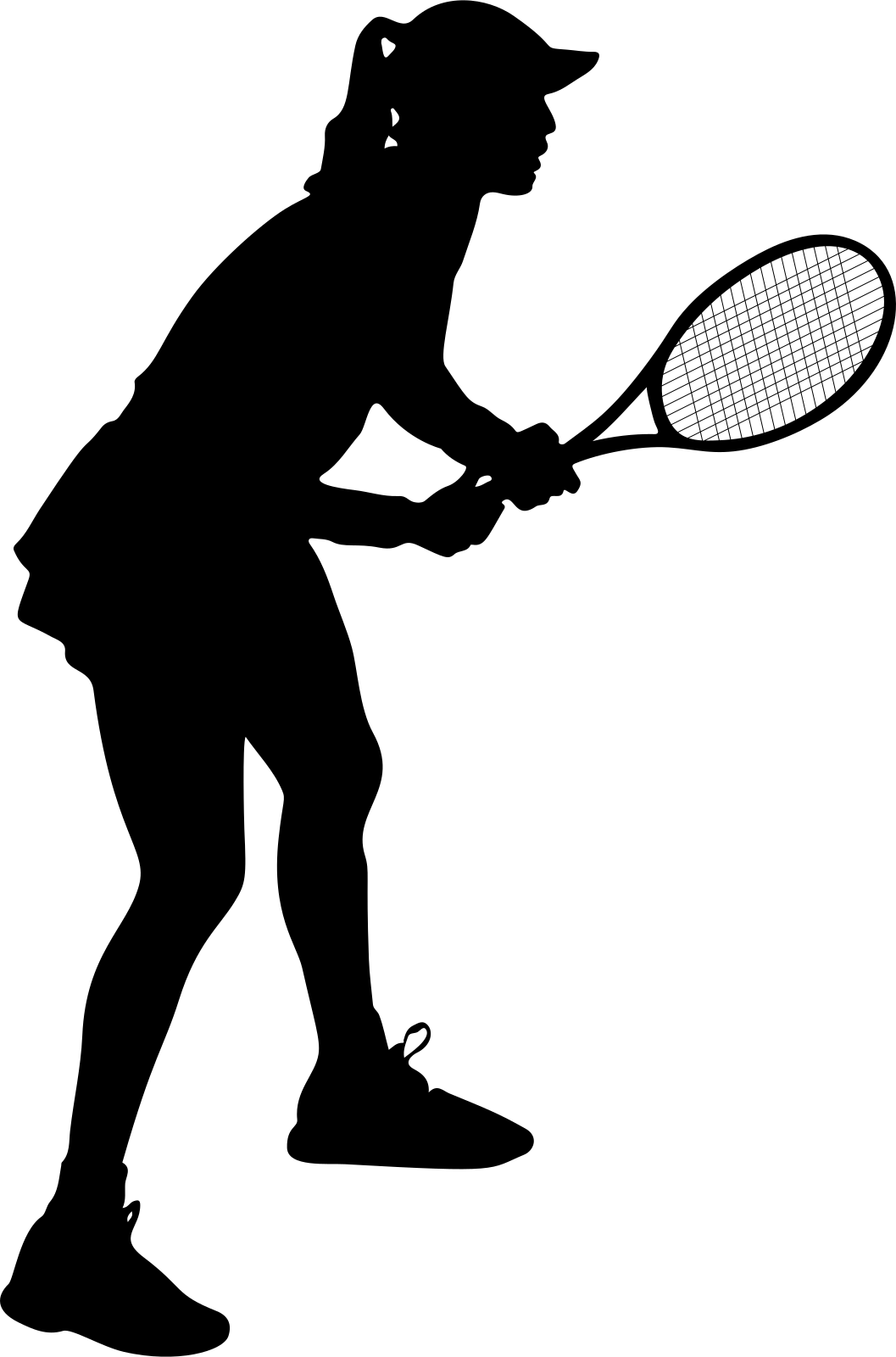
The image below shows a tennis player preparing to return a serve.

Which biomechanical principle is this player primarily using to optimise stability?

  1. Lowering the centre of gravity and widening the base of support
  2. Narrowing the base of support to increase agility
  3. Raising the centre of gravity to improve reaction time
  4. Increasing the line of gravity outside the base of support
Show Answers Only

\(A\)

Show Worked Solution
  • A is correct: Lowered centre of gravity and widened stance maximise stability for receiving serves.

Other Options:

  • B is incorrect: Narrowing base of support decreases stability needed for powerful returns.
  • C is incorrect: Raising centre of gravity reduces stability and balance.
  • D is incorrect: Line of gravity outside base of support causes instability and falling.

Filed Under: Safe and efficient movement Tagged With: Band 5, smc-5522-20-Human movement

HMS, BM EQ-Bank 840 MC

A swimmer is preparing for a new competition season. What would be the most effective technique to reduce drag and improve movement efficiency in freestyle?

  1. Keeping hands in a relaxed, open position during the pull phase
  2. Maintaining a high head position to see competitors during the race
  3. Keeping the body aligned with hips and legs high in the water
  4. Using a wider, more powerful kick to create more propulsion
Show Answers Only

\(C\)

Show Worked Solution
  • C is correct: Body alignment with hips and legs high creates streamlined position reducing drag

Other Options:

  • A is incorrect: Open hands increase resistance; slightly cupped position is more efficient
  • B is incorrect: High head position pushes hips down, increasing drag significantly
  • D is incorrect: Wider kick creates turbulence and drag despite generating more power

Filed Under: Safe and efficient movement Tagged With: Band 4, smc-5522-15-Movement efficiency, smc-5522-20-Human movement

HMS, BM EQ-Bank 51 MC

A swimmer needs to reduce drag force during freestyle. Which combination of biomechanical applications would be MOST effective for safe and efficient movement through water?

  1. Streamlined body position and high elbow recovery
  2. High head position and wide arm recovery
  3. Crossed leg kick and streamlined body position
  4. Wide arm recovery and crossed leg kick
Show Answers Only

\(A\)

Show Worked Solution
  • A is correct: Streamlined body reduces frontal resistance while high elbow recovery minimises drag.

Other Options:

  • B is incorrect: High head position increases drag and disrupts body alignment.
  • C is incorrect: Crossed legs create turbulence that negates streamlining benefits.
  • D is incorrect: Both wide arm recovery and crossed legs increase water resistance.

Filed Under: Fluid Mechanics and Force, Safe and efficient movement Tagged With: Band 4, smc-5522-20-Human movement, smc-5879-20-Fluid resistance

HMS, BM EQ-Bank 49

Explain how TWO biomechanical principles can be applied to improve movement efficiency for a person using a prosthetic leg.   (4 marks)

--- 10 WORK AREA LINES (style=lined) ---

Show Answers Only

Sample Answer – ANY 2 of the following:

Centre of gravity positioning:

  • Prosthetic alignment adjusts centre of gravity to compensate for missing mass. This occurs because proper positioning balances weight.
  • As a result, less muscular effort maintains balance. Therefore, users walk longer distances without fatigue.

Lever principles:

  • The prosthetic foot acts as a lever during push-off phase.
  • This works by creating mechanical advantage through optimal positioning.
  • Consequently, force transfer efficiency increases through the prosthetic, enabling reduced energy for forward progression.

Force absorption:

  • Carbon fibre springs absorb impact forces during heel strike.
  • This happens when material compresses on ground contact.
  • Following this, energy storage and return minimises jarring so that comfortable movement continues over extended periods.

Momentum conservation:

  • Lightweight prosthetic components maintain momentum between steps more effectively than heavier designs.
  • The reason for this is reduced mass requires less acceleration muscle force.
  • Subsequently, the swing phase uses less muscle effort, resulting in significantly improved walking endurance.
Show Worked Solution

Sample Answer – ANY 2 of the following:

Centre of gravity positioning:

  • Prosthetic alignment adjusts centre of gravity to compensate for missing mass. This occurs because proper positioning balances weight.
  • As a result, less muscular effort maintains balance. Therefore, users walk longer distances without fatigue.

Lever principles:

  • The prosthetic foot acts as a lever during push-off phase.
  • This works by creating mechanical advantage through optimal positioning.
  • Consequently, force transfer efficiency increases through the prosthetic, enabling reduced energy for forward progression.

Force absorption:

  • Carbon fibre springs absorb impact forces during heel strike.
  • This happens when material compresses on ground contact.
  • Following this, energy storage and return minimises jarring so that comfortable movement continues over extended periods.

Momentum conservation:

  • Lightweight prosthetic components maintain momentum between steps more effectively than heavier designs.
  • The reason for this is reduced mass requires less acceleration muscle force.
  • Subsequently, the swing phase uses less muscle effort, resulting in significantly improved walking endurance.

Filed Under: Safe and efficient movement Tagged With: Band 4, smc-5522-15-Movement efficiency

HMS, BM EQ-Bank 48 MC

Which adaptation would BEST improve movement efficiency for a person with limited lower limb mobility using a wheelchair?

  1. Increased arm length
  2. Higher seat position
  3. Forward tilted seat
  4. Lower center of gravity
Show Answers Only

\(D\)

Show Worked Solution
  • D is correct: Lower center of gravity improves stability and reduces energy needed for movement control.

Other Options:

  • A is incorrect: Longer reach doesn’t improve wheelchair propulsion efficiency.
  • B is incorrect: Higher seat position decreases stability and increases effort required.
  • C is incorrect: Forward tilt shifts weight forward, requiring more energy to maintain balance.

Filed Under: Safe and efficient movement Tagged With: Band 4, smc-5522-15-Movement efficiency

HMS, BM EQ-Bank 47 MC

For a person using crutches, which biomechanical principle is MOST important for energy efficient movement?

  1. Angular momentum
  2. Base of support
  3. Projectile motion
  4. Fluid resistance
Show Answers Only

\(B\)

Show Worked Solution
  • B is correct: A stable and appropriate base of support enables efficient force transfer and reduces energy expenditure

Other Options:

  • A is incorrect: Not primary principle in crutch gait efficiency
  • C is incorrect: No projectiles involved in crutch walking
  • D is incorrect: Not relevant to crutch-assisted movement

Filed Under: Safe and efficient movement Tagged With: Band 4, smc-5522-15-Movement efficiency

HMS, BM EQ-Bank 47

Explain how balance and stability principles contribute to safe lifting technique.   (4 marks)

--- 10 WORK AREA LINES (style=lined) ---

Show Answers Only

Sample Answer

  • A wide base of support with feet shoulder-width apart increases lateral stability during lifting.
  • Greater stability prevents sideways tipping when handling uneven loads, reducing the risk of dropping objects or falling.
  • Keeping the centre of gravity low by bending the knees maintains balance throughout the lift.
  • Low positioning allows controlled movement without sudden shifts that could cause back strain or loss of control.
  • Even weight distribution across both feet ensures balanced force transmission through the legs and spine.
  • Balanced distribution prevents asymmetrical loading that leads to muscle strain and joint stress on one side.
  • Engaging core muscles throughout the lift stabilises the spine and pelvis.
  • Strong muscular support creates a rigid trunk that prevents dangerous spinal flexion and maintains safe alignment during load transfer.
Show Worked Solution

Sample Answer

  • A wide base of support with feet shoulder-width apart increases lateral stability during lifting.
  • Greater stability prevents sideways tipping when handling uneven loads, reducing the risk of dropping objects or falling.
  • Keeping the centre of gravity low by bending the knees maintains balance throughout the lift.
  • Low positioning allows controlled movement without sudden shifts that could cause back strain or loss of control.
  • Even weight distribution across both feet ensures balanced force transmission through the legs and spine.
  • Balanced distribution prevents asymmetrical loading that leads to muscle strain and joint stress on one side.
  • Engaging core muscles throughout the lift stabilises the spine and pelvis.
  • Strong muscular support creates a rigid trunk that prevents dangerous spinal flexion and maintains safe alignment during load transfer.

Filed Under: Safe and efficient movement Tagged With: Band 4, smc-5522-10-Safe movement, smc-5522-20-Human movement

HMS, BM EQ-Bank 46

How does correct joint alignment help to prevent injury during weight-bearing activities.   (5 marks)

--- 18 WORK AREA LINES (style=lined) ---

Show Answers Only

Sample Answer

Force Distribution Through Joint Surfaces

  • Correct alignment positions bones so that weight-bearing forces spread evenly across entire joint surface.
  • This even distribution occurs because aligned bones create uniform contact between joint surfaces.
  • As a result, cartilage experiences balanced compression rather than concentrated pressure points, preventing localised wear and degradation of specific cartilage areas.
  • Misalignment creates high-stress zones which leads to damaged cartilage and eventual osteoarthritis.

Ligament and Tendon Protection

  • Proper joint positioning maintains ligaments and tendons within optimal length ranges by keeping anatomical relationships correct.
  • This positioning enables these structures to handle loads at appropriate angles.
  • Consequently, ligaments avoid overstretching which prevents tears and chronic laxity.
  • Correct alignment ensures tendons track smoothly through anatomical pathways by maintaining proper bone positions.
  • This smooth tracking prevents friction and inflammation from abnormal movement patterns.

Muscular Efficiency and Support

  • Joint alignment enables muscles to operate at ideal length-tension relationships through optimal positioning.
  • This positioning allows maximum force production while minimising energy expenditure.
  • As a result, efficient muscle function provides dynamic stabilisation during activities.
  • Well-aligned joints create balanced muscle activation where opposing groups share loads appropriately.
  • This balanced activation prevents single muscles from overworking which reduces strain injury risk.
  • Proper positioning eliminates compensatory movements thereby preventing cascade effects throughout kinetic chain.
Show Worked Solution

Sample Answer

Force Distribution Through Joint Surfaces

  • Correct alignment positions bones so that weight-bearing forces spread evenly across entire joint surface.
  • This even distribution occurs because aligned bones create uniform contact between joint surfaces.
  • As a result, cartilage experiences balanced compression rather than concentrated pressure points, preventing localised wear and degradation of specific cartilage areas.
  • Misalignment creates high-stress zones which leads to damaged cartilage and eventual osteoarthritis.

Ligament and Tendon Protection

  • Proper joint positioning maintains ligaments and tendons within optimal length ranges by keeping anatomical relationships correct.
  • This positioning enables these structures to handle loads at appropriate angles.
  • Consequently, ligaments avoid overstretching which prevents tears and chronic laxity.
  • Correct alignment ensures tendons track smoothly through anatomical pathways by maintaining proper bone positions.
  • This smooth tracking prevents friction and inflammation from abnormal movement patterns.

Muscular Efficiency and Support

  • Joint alignment enables muscles to operate at ideal length-tension relationships through optimal positioning.
  • This positioning allows maximum force production while minimising energy expenditure.
  • As a result, efficient muscle function provides dynamic stabilisation during activities.
  • Well-aligned joints create balanced muscle activation where opposing groups share loads appropriately.
  • This balanced activation prevents single muscles from overworking which reduces strain injury risk.
  • Proper positioning eliminates compensatory movements thereby preventing cascade effects throughout kinetic chain.

Filed Under: Safe and efficient movement Tagged With: Band 5, Band 6, smc-5522-10-Safe movement, smc-5522-20-Human movement

HMS, BM EQ-Bank 45

Compare the biomechanical principles involved in safe pushing versus pulling movements.   (5 marks)

--- 15 WORK AREA LINES (style=lined) ---

Show Answers Only

Sample Answer

Force Direction and Body Position

Similarities

  • Both movements require staggered stances to create stable base of support

Differences

  • Pushing directs force away from body requiring forward lean, while pulling brings force toward body needing backward lean.
  • Foot positioning varies
    • pushing uses rear leg drive with forward stance
    • pulling anchors through front leg in backward stance.

Muscle Activation Patterns

Similarities

  • Both require core muscle engagement for spinal stability and protection.

Differences

  • Pushing engages anterior muscles (pectorals, anterior deltoids, triceps) while pulling activates posterior muscles (latissimus dorsi, rhomboids, biceps).
  • Joint stress varies
    • pushing loads anterior shoulder structures
    • pulling stresses posterior shoulder and elbow differently

Centre of Gravity and Balance Requirements

Similarities

  • Pushing shifts centre of gravity forward beyond base of support, while pulling positions it behind force application point.
  • Fall risks differ
    • pushing risks forward falls if force releases suddenly
    • pulling risks backward falls
  • Spinal protection varies
    • pushing prevents hyperextension
    • pulling guards against excessive flexion
Show Worked Solution

Sample Answer

Force Direction and Body Position

Similarities

  • Both movements require staggered stances to create stable base of support

Differences

  • Pushing directs force away from body requiring forward lean, while pulling brings force toward body needing backward lean.
  • Foot positioning varies
    • pushing uses rear leg drive with forward stance
    • pulling anchors through front leg in backward stance.

Muscle Activation Patterns

Similarities

  • Both require core muscle engagement for spinal stability and protection.

Differences

  • Pushing engages anterior muscles (pectorals, anterior deltoids, triceps) while pulling activates posterior muscles (latissimus dorsi, rhomboids, biceps).
  • Joint stress varies
    • pushing loads anterior shoulder structures
    • pulling stresses posterior shoulder and elbow differently

Centre of Gravity and Balance Requirements

Similarities

  • Pushing shifts centre of gravity forward beyond base of support, while pulling positions it behind force application point.
  • Fall risks differ
    • pushing risks forward falls if force releases suddenly
    • pulling risks backward falls
  • Spinal protection varies
    • pushing prevents hyperextension
    • pulling guards against excessive flexion

Filed Under: Safe and efficient movement Tagged With: Band 4, Band 5, smc-5522-20-Human movement

HMS, BM EQ-Bank 44

Describe TWO ways muscle pairs work together to produce safe movement.   (3 marks)

--- 8 WORK AREA LINES (style=lined) ---

Show Answers Only

Sample Answer – ANY 2 of the following

Agonist/antagonist relationship controls movement speed 

  • When the agonist muscle contracts to create movement, the antagonist muscle relaxes in a controlled manner.
  • Coordinated action as described prevents jerky movements and allows precise control of speed, protecting joints from sudden impacts.

Co-contraction provides joint stability –

  • Both muscles in a pair contract simultaneously to stabilise a joint during movement.
  • Such co-activation creates muscular tension around the joint, preventing excessive movement that could damage ligaments, and maintaining safe joint alignment.

Balanced strength prevents muscle imbalances

  • Equal strength development in muscle pairs ensures forces are distributed evenly across joints.
  • This balance prevents one muscle from overpowering its partner, reducing strain on connective tissues and maintaining proper joint mechanics during movement.

Coordinated action produces smooth movement

  • Muscle pairs work in precise timing sequences, with one gradually activating as the other deactivates.
  • Transitioning smoothly between muscle contractions eliminates abrupt force changes that could tear muscle fibres or strain tendons.
Show Worked Solution

Agonist/antagonist relationship controls movement speed 

  • When the agonist muscle contracts to create movement, the antagonist muscle relaxes in a controlled manner.
  • Coordinated action as described prevents jerky movements and allows precise control of speed, protecting joints from sudden impacts.

Co-contraction provides joint stability –

  • Both muscles in a pair contract simultaneously to stabilise a joint during movement.
  • Such co-activation creates muscular tension around the joint, preventing excessive movement that could damage ligaments, and maintaining safe joint alignment.

Balanced strength prevents muscle imbalances

  • Equal strength development in muscle pairs ensures forces are distributed evenly across joints.
  • This balance prevents one muscle from overpowering its partner, reducing strain on connective tissues and maintaining proper joint mechanics during movement.

Coordinated action produces smooth movement

  • Muscle pairs work in precise timing sequences, with one gradually activating as the other deactivates.
  • Transitioning smoothly between muscle contractions eliminates abrupt force changes that could tear muscle fibres or strain tendons.

Filed Under: Safe and efficient movement, Skeletal and muscular systems Tagged With: Band 4, smc-5521-25-Muscle relationships, smc-5522-15-Movement efficiency, smc-5522-20-Human movement

HMS, BM EQ-Bank 43

Describe how biomechanical principles influence the safe execution of a landing from a jump.   (4 marks)

--- 10 WORK AREA LINES (style=lined) ---

Show Answers Only

Sample Answer

Force absorption 

  • Quadriceps, hamstrings and calf muscles contract eccentrically during landing.
  • This controlled lengthening prevents sudden joint compression and distributes forces.

Joint flexion 

  • Ankles, knees and hips bend simultaneously upon ground contact.
  • This flexion increases absorption time and transforms peak forces into manageable loads.

Base of support

  • Feet positioned shoulder-width apart provide lateral stability during landing.
  • This wider stance prevents sideways falling and enables balanced force distribution through both legs.

Centre of gravity

  • Deep knee bend lowers the body’s centre of gravity toward ground.
  • Athletes maintain better equilibrium when mass is positioned lower.
  • Positioning the body in this way enhances balance control reducing fall risk.
Show Worked Solution

Sample Answer

Force absorption 

  • Quadriceps, hamstrings and calf muscles contract eccentrically during landing.
  • This controlled lengthening prevents sudden joint compression and distributes forces.

Joint flexion 

  • Ankles, knees and hips bend simultaneously upon ground contact.
  • This flexion increases absorption time and transforms peak forces into manageable loads.

Base of support

  • Feet positioned shoulder-width apart provide lateral stability during landing.
  • This wider stance prevents sideways falling and enables balanced force distribution through both legs.

Centre of gravity

  • Deep knee bend lowers the body’s centre of gravity toward ground.
  • Athletes maintain better equilibrium when mass is positioned lower.
  • Positioning the body in this way enhances balance control reducing fall risk.

Filed Under: Safe and efficient movement Tagged With: Band 5, smc-5522-10-Safe movement, smc-5522-15-Movement efficiency, smc-5522-20-Human movement

HMS, BM EQ-Bank 42

Explain the relationship between force and safe movement when performing a pushing action.   (4 marks)

--- 10 WORK AREA LINES (style=lined) ---

Show Answers Only

Sample Answer

  • Applying force in line with the intended movement direction prevents twisting forces on the spine and joints.
  • This alignment reduces shear stress on vertebral discs and ligaments, preventing acute injuries during pushing.
  • A wide, staggered stance creates a stable base of support that allows force to transfer efficiently through the body.
  • Such stability prevents loss of balance and falling, which could cause impact injuries
  • Engaging large muscle groups like pectorals, deltoids and triceps distributes the pushing load across multiple areas.
  • Force distribution prevents any single muscle from overloading, reducing strain injuries.
  • Maintaining neutral spine position while pushing ensures forces travel through the strongest part of the vertebral column.
  • Proper posture prevents disc compression and muscle spasms common with poor technique.
Show Worked Solution

Sample Answer

  • Applying force in line with the intended movement direction prevents twisting forces on the spine and joints.
  • This alignment reduces shear stress on vertebral discs and ligaments, preventing acute injuries during pushing.
  • A wide, staggered stance creates a stable base of support that allows force to transfer efficiently through the body.
  • Such stability prevents loss of balance and falling, which could cause impact injuries
  • Engaging large muscle groups like pectorals, deltoids and triceps distributes the pushing load across multiple areas.
  • Force distribution prevents any single muscle from overloading, reducing strain injuries.
  • Maintaining neutral spine position while pushing ensures forces travel through the strongest part of the vertebral column.
  • Proper posture prevents disc compression and muscle spasms common with poor technique.

Filed Under: Safe and efficient movement Tagged With: Band 4, smc-5522-10-Safe movement, smc-5522-20-Human movement

HMS, BM EQ-Bank 41

Outline how the principle of stability relates to safe movement in a standing position.  (3 marks)

--- 6 WORK AREA LINES (style=lined) ---

Show Answers Only

Sample Answer

  • A wider base of support increases stability by creating a larger area for the body’s weight to be distributed.
  • This extended support base reduces the risk of falling when standing.
  • Keeping the centre of gravity low and within the base of support maintains balance.
  • Proper balance prevents dangerous tilting or loss of equilibrium.
  • Aligning body weight directly over the base ensures forces are distributed evenly through joints.
  • Even force distribution reduces strain on ankles, knees and hips during prolonged standing.
Show Worked Solution

Sample Answer

  • A wider base of support increases stability by creating a larger area for the body’s weight to be distributed.
  • This extended support base reduces the risk of falling when standing.
  • Keeping the centre of gravity low and within the base of support maintains balance.
  • Proper balance prevents dangerous tilting or loss of equilibrium.
  • Aligning body weight directly over the base ensures forces are distributed evenly through joints.
  • Even force distribution reduces strain on ankles, knees and hips during prolonged standing.

Filed Under: Safe and efficient movement Tagged With: Band 3, smc-5522-20-Human movement

HMS, BM EQ-Bank 40 MC

When lifting a heavy box, which force application ensures safest movement?

  1. Unilateral force through spine
  2. Rapid jerking motion
  3. Force directed through legs
  4. Twisted lifting position
Show Answers Only

\(C\)

Show Worked Solution
  • C is correct: Using leg muscles with straight back distributes force safely

Other Options:

  • A is incorrect: Dangerous spinal loading
  • B is incorrect: Unsafe rapid movement
  • D is incorrect: Unsafe spinal position

Filed Under: Safe and efficient movement Tagged With: Band 4, smc-5522-10-Safe movement

HMS, BM EQ-Bank 39 MC

In which movement does balance have the GREATEST impact on safe execution?

  1. Bench press
  2. Bicep curl
  3. Seated row
  4. Handstand
Show Answers Only

\(D\)

Show Worked Solution
  • D is correct: Handstand requires precise balance over center of gravity for safety

Other Options:

  • A is incorrect: Supported by bench, balance less critical
  • B is incorrect: Supported standing/seated position
  • C is incorrect: Fully supported seated position

Filed Under: Safe and efficient movement Tagged With: Band 3, smc-5522-20-Human movement

HMS, BM EQ-Bank 38 MC

During a squat, which biomechanical principle is MOST important for maintaining safety? 

  1. Fluid mechanics
  2. Base of support
  3. Projectile motion
  4. Angular momentum
Show Answers Only

\(B\)

Show Worked Solution
  • B is correct: Wider base of support increases stability and prevents falling during squats.

Other Options:

  • A is incorrect: Fluid mechanics applies to movement through water/air, not squatting
  • C is incorrect: No projectile motion occurs in stationary squats
  • D is incorrect: Angular momentum is not the primary safety principle in squatting

Filed Under: Safe and efficient movement Tagged With: Band 3, smc-5522-15-Movement efficiency

HMS, BM EQ-Bank 6 MC

When performing a heavy deadlift, which biomechanical principle is MOST important for preventing lower back injury?

  1. Maintaining neutral spine alignment
  2. Increasing lifting speed
  3. Narrowing the base of support
  4. Rotating the trunk during lift
Show Answers Only

\(A\)

Show Worked Solution
  • A is correct: Neutral spine distributes forces evenly along vertebrae, preventing injury

Other Options:

  • B is incorrect: Rapid lifting increases injury risk through uncontrolled forces
  • C is incorrect: Narrow base reduces stability and increases fall risk
  • D is incorrect: Trunk rotation during lifting can cause disc herniation

Filed Under: Safe and efficient movement Tagged With: Band 4, smc-5522-10-Safe movement, smc-5522-20-Human movement

Copyright © 2014–2025 SmarterEd.com.au · Log in