SmarterEd

Aussie Maths & Science Teachers: Save your time with SmarterEd

  • Login
  • Get Help
  • About

HMS, TIP 2025 HSC 31aii

How can an athlete ensure their training procedures are safe? In your answer, refer to ONE training method.  ( 5 marks)

--- 15 WORK AREA LINES (style=lined) ---

Show Answers Only

Training Method: Plyometrics

  • Athletes must complete comprehensive warm-ups before plyometric sessions. This occurs because muscles and connective tissues require increased temperature and blood flow before explosive movements to prevent strain injuries.
  • For example, performing 10 minutes of dynamic stretching and light jogging prepares joints for impact forces. This reduces injury risk during box jumps and depth jumps.
  • Proper landing technique ensures safety during plyometric exercises. This happens when athletes maintain correct body positioning with bent knees and controlled movements, which prevents excessive joint stress.
  • Progressive overload principles must be applied carefully. This means gradually increasing jump height and repetitions over weeks, allowing tissues to adapt without overuse injuries.
  • Training on appropriate surfaces like gym mats or grass protects joints from impact forces. Consequently, athletes avoid stress fractures and tendon damage during high-intensity explosive training.
Show Worked Solution

Training Method: Plyometrics

  • Athletes must complete comprehensive warm-ups before plyometric sessions. This occurs because muscles and connective tissues require increased temperature and blood flow before explosive movements to prevent strain injuries.
  • For example, performing 10 minutes of dynamic stretching and light jogging prepares joints for impact forces. This reduces injury risk during box jumps and depth jumps.
  • Proper landing technique ensures safety during plyometric exercises. This happens when athletes maintain correct body positioning with bent knees and controlled movements, which prevents excessive joint stress.
  • Progressive overload principles must be applied carefully. This means gradually increasing jump height and repetitions over weeks, allowing tissues to adapt without overuse injuries.
  • Training on appropriate surfaces like gym mats or grass protects joints from impact forces. Consequently, athletes avoid stress fractures and tendon damage during high-intensity explosive training.

Filed Under: Principles of training Tagged With: Band 3, Band 4, smc-5460-20-Sessions

HMS, TIP 2025 HSC 26

Analyse the relationship between training thresholds and TWO physiological adaptations. In your answer, provide examples of both aerobic and resistance training.  (8 marks)

--- 24 WORK AREA LINES (style=lined) ---

Show Answers Only

Overview Statement:

  • Training thresholds represent critical intensity levels that trigger specific physiological adaptations.
  • Understanding how aerobic and resistance thresholds connect to metabolic and muscular changes can open up pathways to enhanced athletic performance.

Aerobic Threshold and Cardiovascular Adaptations:

  • The aerobic training threshold occurs at approximately 70% of maximum heart rate. Training at this intensity influences fuel utilisation and cardiovascular function.
  • This causes the body to shift from primarily using fat to using carbohydrates for energy. For example, a marathon runner training at 70% max heart rate stimulates this metabolic adaptation.
  • The threshold also triggers increased stroke volume through enhanced left ventricle filling capacity. This relationship results in improved cardiac output and oxygen delivery to working muscles.
  • Consequently, athletes sustain effort over extended periods with greater efficiency. This shows that aerobic threshold training enables both metabolic and cardiovascular improvements for endurance performance.

Resistance Threshold and Muscular Adaptations:

  • Resistance training thresholds involve working at 70-85% of one-rep maximum with 6-12 repetitions. This intensity creates sufficient mechanical stress to stimulate muscle hypertrophy.
  • For instance, a weightlifter performing squats at 80% of 1RM bmicroscopic muscle fibre damage. This initiates increased protein synthesis and muscle repair processes.
  • The threshold works through progressive overload that leads to enlarged muscle fibres with increased actin and myosin filaments. As a result, greater force production capacity develops.
  • The significance is that athletes gain strength and power output essential for explosive movements.

Implications and Synthesis:

  • These thresholds work together as intensity markers that determine adaptation type. Aerobic thresholds influence metabolic and cardiovascular systems whilst resistance thresholds affect muscular structure.
  • Therefore, coaches must apply appropriate threshold intensities to achieve specific performance goals. This reveals that training success depends on understanding the precise relationship between intensity levels and resulting physiological changes.
Show Worked Solution

Overview Statement:

  • Training thresholds represent critical intensity levels that trigger specific physiological adaptations.
  • Understanding how aerobic and resistance thresholds connect to metabolic and muscular changes can open up pathways to enhanced athletic performance.

Aerobic Threshold and Cardiovascular Adaptations:

  • The aerobic training threshold occurs at approximately 70% of maximum heart rate. Training at this intensity influences fuel utilisation and cardiovascular function.
  • This causes the body to shift from primarily using fat to using carbohydrates for energy. For example, a marathon runner training at 70% max heart rate stimulates this metabolic adaptation.
  • The threshold also triggers increased stroke volume through enhanced left ventricle filling capacity. This relationship results in improved cardiac output and oxygen delivery to working muscles.
  • Consequently, athletes sustain effort over extended periods with greater efficiency. This shows that aerobic threshold training enables both metabolic and cardiovascular improvements for endurance performance.

Resistance Threshold and Muscular Adaptations:

  • Resistance training thresholds involve working at 70-85% of one-rep maximum with 6-12 repetitions. This intensity creates sufficient mechanical stress to stimulate muscle hypertrophy.
  • For instance, a weightlifter performing squats at 80% of 1RM bmicroscopic muscle fibre damage. This initiates increased protein synthesis and muscle repair processes.
  • The threshold works through progressive overload that leads to enlarged muscle fibres with increased actin and myosin filaments. As a result, greater force production capacity develops.
  • The significance is that athletes gain strength and power output essential for explosive movements.

Implications and Synthesis:

  • These thresholds work together as intensity markers that determine adaptation type. Aerobic thresholds influence metabolic and cardiovascular systems whilst resistance thresholds affect muscular structure.
  • Therefore, coaches must apply appropriate threshold intensities to achieve specific performance goals. This reveals that training success depends on understanding the precise relationship between intensity levels and resulting physiological changes.

♦♦ Mean mark 36%.

Filed Under: Physiological adaptations and improved performance, Principles of training Tagged With: Band 4, Band 5, Band 6, smc-5460-10-Thresholds, smc-5461-10-Cardio adaptations, smc-5461-30-Muscular adaptations

HMS, TIP 2025 HSC 18 MC

An elite athlete is training to enhance their muscular strength.

Which of the following approaches best demonstrates progressive overload for increased strength? (RM = repetition maximum)

  1. Adding exercises while performing four sets of eight repetitions at 60% of one RM
  2. Alternating between 80% and 90% of one RM weekly for three sets of 12 repetitions
  3. Starting with weights at 50% of one RM and gradually increasing the total repetitions each week repetitions each week 
  4. Adjusting the resistance from 80% to 90% of one RM, performing three to five sets of four to six repetitions
Show Answers Only

\(D\)

Show Worked Solution
  • D is correct: Progressive resistance increase (80% to 90% 1RM) with low reps (4-6) targets absolute strength development

Other Options:

  • A is incorrect: 60% 1RM with 8 reps develops muscular endurance, not maximal strength; adding exercises doesn’t increase load
  • B is incorrect: Alternating loads weekly lacks progressive overload; 12 reps targets endurance rather than strength
  • C is incorrect: Starting at 50% 1RM and increasing repetitions develops endurance, not strength; requires higher loads

♦♦ Mean mark 43%.

Filed Under: Principles of training Tagged With: Band 5, smc-5460-10-Thresholds

HMS, TIP EQ-Bank 248

A fitness instructor is designing training sessions for different client groups including recreational athletes, elderly participants, and competitive athletes. They need to determine the most effective warm-up and cool-down protocols for each group.

Assess the effectiveness of different warm-up and cool-down strategies for these three distinct populations, considering their specific needs and training goals.   (8 marks)

--- 25 WORK AREA LINES (style=lined) ---

Show Answers Only

Judgment Statement

  • Warm-up and cool-down strategies demonstrate varying effectiveness across different populations, with age-appropriate and goal-specific protocols proving most suitable.

Recreational Athletes

  • Moderate-intensity warm-ups lasting 10-15 minutes show high effectiveness through gradual cardiovascular preparation and injury prevention.
  • Evidence demonstrates that dynamic stretching combined with sport-specific movements produces optimal performance outcomes for this population.
  • Cool-down protocols involving light activity followed by static stretching prove highly effective for recovery and flexibility maintenance.
  • This population benefits from structured but flexible protocols accommodating varying fitness levels.

Elderly Participants

  • Extended warm-up periods of 15-20 minutes demonstrate excellent effectiveness due to slower physiological responses to exercise.
  • Research shows gentle range-of-motion exercises and prolonged cardiovascular preparation reduce injury risk substantially in older adults.
  • Extended cool-down periods prove essential, requiring gradual intensity reduction and comprehensive stretching for safe recovery.
  • Assessment reveals that conservative, individualised approaches show superior results compared to standard protocols.

Competitive Athletes

  • Intensive, sport-specific warm-up protocols demonstrate high effectiveness through targeted neuromuscular activation and performance optimisation.
  • Evidence indicates dynamic warm-ups incorporating movement patterns specific to their sport produce measurable performance improvements.
  • Structured cool-down protocols prove moderately effective, emphasising active recovery and strategic stretching for competition preparation.

Overall Assessment

  • Assessment shows population-specific protocols achieve superior results compared to generalised approaches across all groups.
  • Evidence demonstrates that tailored strategies optimise both safety and performance outcomes for diverse populations.
Show Worked Solution

Judgment Statement

  • Warm-up and cool-down strategies demonstrate varying effectiveness across different populations, with age-appropriate and goal-specific protocols proving most suitable.

Recreational Athletes

  • Moderate-intensity warm-ups lasting 10-15 minutes show high effectiveness through gradual cardiovascular preparation and injury prevention.
  • Evidence demonstrates that dynamic stretching combined with sport-specific movements produces optimal performance outcomes for this population.
  • Cool-down protocols involving light activity followed by static stretching prove highly effective for recovery and flexibility maintenance.
  • This population benefits from structured but flexible protocols accommodating varying fitness levels.

Elderly Participants

  • Extended warm-up periods of 15-20 minutes demonstrate excellent effectiveness due to slower physiological responses to exercise.
  • Research shows gentle range-of-motion exercises and prolonged cardiovascular preparation reduce injury risk substantially in older adults.
  • Extended cool-down periods prove essential, requiring gradual intensity reduction and comprehensive stretching for safe recovery.
  • Assessment reveals that conservative, individualised approaches show superior results compared to standard protocols.

Competitive Athletes

  • Intensive, sport-specific warm-up protocols demonstrate high effectiveness through targeted neuromuscular activation and performance optimisation.
  • Evidence indicates dynamic warm-ups incorporating movement patterns specific to their sport produce measurable performance improvements.
  • Structured cool-down protocols prove moderately effective, emphasising active recovery and strategic stretching for competition preparation.

Overall Assessment

  • Assessment shows population-specific protocols achieve superior results compared to generalised approaches across all groups.
  • Evidence demonstrates that tailored strategies optimise both safety and performance outcomes for diverse populations.

Filed Under: Principles of training Tagged With: Band 4, smc-5460-20-Sessions

HMS, TIP EQ-Bank 247

How do the warm-up requirements differ between aerobic training sessions and strength training sessions, and why are these differences necessary?   (4 marks)

--- 12 WORK AREA LINES (style=lined) ---

Show Answers Only
  • Aerobic training warm-ups focus on gradual cardiovascular activation through light jogging or cycling for 5-10 minutes.
  • This prepares the heart and circulatory system for sustained cardiovascular exercise demands.
  • Dynamic stretching follows to increase range of motion for running or cycling movements.
  • Strength training warm-ups include general cardiovascular activity plus movement-specific drills using light weights.
  • This activates target muscle groups and rehearses movement patterns before heavy resistance work.
  • The differences occur because aerobic training requires cardiovascular preparation while strength training demands neuromuscular activation and technique rehearsal.
  • Therefore each warm-up type addresses the specific physiological requirements of different training methods.
Show Worked Solution
  • Aerobic training warm-ups focus on gradual cardiovascular activation through light jogging or cycling for 5-10 minutes.
  • This prepares the heart and circulatory system for sustained cardiovascular exercise demands.
  • Dynamic stretching follows to increase range of motion for running or cycling movements.
  • Strength training warm-ups include general cardiovascular activity plus movement-specific drills using light weights.
  • This activates target muscle groups and rehearses movement patterns before heavy resistance work.
  • The differences occur because aerobic training requires cardiovascular preparation while strength training demands neuromuscular activation and technique rehearsal.
  • Therefore each warm-up type addresses the specific physiological requirements of different training methods.

Filed Under: Principles of training Tagged With: Band 3, smc-5460-20-Sessions

HMS, TIP EQ-Bank 246

Why are warm-up and cool-down components considered essential parts of every training session for both aerobic and strength training programs?   (3 marks)

--- 9 WORK AREA LINES (style=lined) ---

Show Answers Only
  • Warm-up components prepare the body for training by gradually increasing heart rate and muscle temperature.
  • This process reduces injury risk through improved joint mobility and muscle elasticity before intense exercise.
  • Warm-up activities enhance performance by activating the cardiovascular system and preparing muscles for training demands.
  • Cool-down components help gradually lower heart rate and prevent blood pooling in extremities after exercise.
  • This enables better recovery by promoting lactic acid removal and reducing muscle stiffness post-training.
Show Worked Solution
  • Warm-up components prepare the body for training by gradually increasing heart rate and muscle temperature.
  • This process reduces injury risk through improved joint mobility and muscle elasticity before intense exercise.
  • Warm-up activities enhance performance by activating the cardiovascular system and preparing muscles for training demands.
  • Cool-down components help gradually lower heart rate and prevent blood pooling in extremities after exercise.
  • This enables better recovery by promoting lactic acid removal and reducing muscle stiffness post-training.

Filed Under: Principles of training Tagged With: Band 2, smc-5460-20-Sessions

HMS, TIP EQ-Bank 245

Two athletes are following different approaches to training variety. Athlete A changes their training mode weekly, alternating between swimming, cycling and running for aerobic fitness. Athlete B maintains the same running mode but varies intensity, duration and training methods within each session.

Justify which approach to applying the variety principle would be more effective for developing comprehensive aerobic fitness in competitive athletes.   (6 marks)

--- 20 WORK AREA LINES (style=lined) ---

Show Answers Only

Position Statement

  • Athlete B’s approach proves more effective for developing comprehensive aerobic fitness through systematic variation within sport-specific training modes.

Training Specificity and Adaptation Benefits

  • Athlete B’s consistent running mode ensures sport-specific neuromuscular adaptations while maintaining movement pattern specificity.
  • Evidence demonstrates that varied intensities within single modes develop different energy systems more effectively than weekly activity changes.
  • Research shows intensity variation through intervals, fartlek and continuous methods targets aerobic threshold, VO2 max and lactate tolerance simultaneously.
  • This systematic approach enables progressive overload application while maintaining training specificity essential for competitive performance.
  • Studies indicate focused intensity manipulation creates superior cardiovascular adaptations compared to dispersed cross-training efforts.

Cross-Training Approach Limitations

  • Athlete A’s weekly mode changes limit specific physiological adaptations due to insufficient training stimulus duration per activity.
  • Different activities require varied movement patterns that may not transfer effectively to competitive requirements.
  • Research suggests frequent mode switching reduces training adaptation quality compared to structured intensity variation.

Reinforcement

  • While cross-training provides general fitness benefits, Athlete B’s systematic intensity variation optimises aerobic development more effectively.
  • Therefore structured variety within specific training modes proves superior for enhancing competitive athletic performance.
Show Worked Solution

Position Statement

  • Athlete B’s approach proves more effective for developing comprehensive aerobic fitness through systematic variation within sport-specific training modes.

Training Specificity and Adaptation Benefits

  • Athlete B’s consistent running mode ensures sport-specific neuromuscular adaptations while maintaining movement pattern specificity.
  • Evidence demonstrates that varied intensities within single modes develop different energy systems more effectively than weekly activity changes.
  • Research shows intensity variation through intervals, fartlek and continuous methods targets aerobic threshold, VO2 max and lactate tolerance simultaneously.
  • This systematic approach enables progressive overload application while maintaining training specificity essential for competitive performance.
  • Studies indicate focused intensity manipulation creates superior cardiovascular adaptations compared to dispersed cross-training efforts.

Cross-Training Approach Limitations

  • Athlete A’s weekly mode changes limit specific physiological adaptations due to insufficient training stimulus duration per activity.
  • Different activities require varied movement patterns that may not transfer effectively to competitive requirements.
  • Research suggests frequent mode switching reduces training adaptation quality compared to structured intensity variation.

Reinforcement

  • While cross-training provides general fitness benefits, Athlete B’s systematic intensity variation optimises aerobic development more effectively.
  • Therefore structured variety within specific training modes proves superior for enhancing competitive athletic performance.

Filed Under: Principles of training Tagged With: Band 4, smc-5460-15-Variety

HMS, TIP EQ-Bank 244

A triathlete has been following the same continuous aerobic training routine for 8 weeks, running 45 minutes at steady pace three times per week. They are experiencing training boredom and performance plateaus despite maintaining consistent effort levels.

Discuss how applying the variety principle to their aerobic training program would address these training issues and improve performance outcomes.   (4 marks)

--- 12 WORK AREA LINES (style=lined) ---

Show Answers Only

For Variety Benefits

  • [P] Applying variety principle addresses training boredom through diverse exercise modes and environments.
  • [E] This approach maintains athlete motivation by providing mental stimulation and preventing monotonous routines.
  • [Ev] Research demonstrates that varied training activities like swimming, cycling and different running terrains enhance psychological engagement.
  • [L] Therefore variety application successfully combats training staleness and maintains consistent effort levels.

Against Repetitive Training

  • [P] Consistent training routines create performance plateaus through complete physiological adaptation.
  • [E] The body stops responding to familiar stimuli, limiting further fitness improvements despite maintained effort.
  • [Ev] Evidence shows that introducing interval training, fartlek methods and circuit formats stimulates continued adaptation responses.
  • [L] Consequently varied training approaches prove essential for sustained performance development in endurance athletes.
Show Worked Solution

For Variety Benefits

  • [P] Applying variety principle addresses training boredom through diverse exercise modes and environments.
  • [E] This approach maintains athlete motivation by providing mental stimulation and preventing monotonous routines.
  • [Ev] Research demonstrates that varied training activities like swimming, cycling and different running terrains enhance psychological engagement.
  • [L] Therefore variety application successfully combats training staleness and maintains consistent effort levels.

Against Repetitive Training

  • [P] Consistent training routines create performance plateaus through complete physiological adaptation.
  • [E] The body stops responding to familiar stimuli, limiting further fitness improvements despite maintained effort.
  • [Ev] Evidence shows that introducing interval training, fartlek methods and circuit formats stimulates continued adaptation responses.
  • [L] Consequently varied training approaches prove essential for sustained performance development in endurance athletes.

Filed Under: Principles of training Tagged With: Band 3, smc-5460-15-Variety

HMS, TIP EQ-Bank 243

A football player has been using the same strength training routine for 12 weeks, performing identical exercises, sets and repetitions in each session. Their coach suggests applying the variety principle to improve training effectiveness.

Outline three different ways the variety principle could be applied to the football player's strength training program.   (3 marks)

--- 9 WORK AREA LINES (style=lined) ---

Show Answers Only
  • Equipment variety can be applied by alternating between free weights, fixed machines and elastic bands across different training sessions.
  • Exercise selection variety involves changing from bench press to push-ups or dumbbell flies to target chest muscles differently.
  • Session type variety includes incorporating supersets, drop sets or pyramid training methods instead of standard straight sets.
  • Training environment variety could involve outdoor training sessions, different gym locations or home-based body weight workouts.
  • These variety applications prevent training plateaus while maintaining athlete motivation and engagement.
Show Worked Solution
  • Equipment variety can be applied by alternating between free weights, fixed machines and elastic bands across different training sessions.
  • Exercise selection variety involves changing from bench press to push-ups or dumbbell flies to target chest muscles differently.
  • Session type variety includes incorporating supersets, drop sets or pyramid training methods instead of standard straight sets.
  • Training environment variety could involve outdoor training sessions, different gym locations or home-based body weight workouts.
  • These variety applications prevent training plateaus while maintaining athlete motivation and engagement.

Filed Under: Principles of training Tagged With: Band 2, smc-5460-15-Variety

HMS, TIP EQ-Bank 242

A powerlifter focuses on absolute strength development using 1-6 repetitions at maximum resistance, while a cyclist trains for strength endurance using 15-20 repetitions at moderate resistance. Both athletes are applying different strength training thresholds.

Compare the effectiveness of these different training thresholds for developing the specific strength qualities required by each athlete.   (4 marks)

--- 12 WORK AREA LINES (style=lined) ---

Show Answers Only

Similarities

  • Both training thresholds require progressive overload principles to achieve strength adaptations over time.
  • Each method stimulates muscle protein synthesis and strength development through resistance-based training stimulus.
  • Both approaches demand proper technique and recovery periods to prevent injury and optimise adaptation responses.

Differences

  • The powerlifter’s 1-6 repetition threshold develops maximal strength by recruiting maximum motor units for explosive power.
  • In contrast, the cyclist’s 15-20 repetition threshold targets muscular endurance through sustained muscle contractions and aerobic metabolism.
  • Powerlifting thresholds create neural adaptations for maximum force production, while cycling thresholds enhance capillary density for endurance performance.
  • Therefore threshold selection determines whether athletes develop explosive strength or sustained muscular endurance capacities.
Show Worked Solution

Similarities

  • Both training thresholds require progressive overload principles to achieve strength adaptations over time.
  • Each method stimulates muscle protein synthesis and strength development through resistance-based training stimulus.
  • Both approaches demand proper technique and recovery periods to prevent injury and optimise adaptation responses.

Differences

  • The powerlifter’s 1-6 repetition threshold develops maximal strength by recruiting maximum motor units for explosive power.
  • In contrast, the cyclist’s 15-20 repetition threshold targets muscular endurance through sustained muscle contractions and aerobic metabolism.
  • Powerlifting thresholds create neural adaptations for maximum force production, while cycling thresholds enhance capillary density for endurance performance.
  • Therefore threshold selection determines whether athletes develop explosive strength or sustained muscular endurance capacities.

Filed Under: Principles of training Tagged With: Band 4, smc-5460-10-Thresholds

HMS, TIP EQ-Bank 241

A 20-year-old athlete wants to train within their aerobic training zone to improve cardiovascular fitness. They calculate their maximum heart rate as 200 beats per minute and know that the aerobic threshold is approximately 70% of maximum heart rate.

Describe the characteristics of training at the aerobic threshold and what happens when the athlete exercises above this intensity level.   (3 marks)

--- 9 WORK AREA LINES (style=lined) ---

Show Answers Only
  • Training at aerobic threshold involves exercising at approximately 140 beats per minute for sustained periods.
  • Aerobic threshold represents the minimum intensity required to achieve cardiovascular training adaptations and improvements.
  • Athletes can maintain steady-state exercise at this level using primarily aerobic energy systems for fuel.
  • Exercising above aerobic threshold but below anaerobic threshold places athletes in the aerobic training zone.
  • Training above anaerobic threshold results in rapid lactate accumulation and inability to sustain exercise intensity.
Show Worked Solution
  • Training at aerobic threshold involves exercising at approximately 140 beats per minute for sustained periods.
  • Aerobic threshold represents the minimum intensity required to achieve cardiovascular training adaptations and improvements.
  • Athletes can maintain steady-state exercise at this level using primarily aerobic energy systems for fuel.
  • Exercising above aerobic threshold but below anaerobic threshold places athletes in the aerobic training zone.
  • Training above anaerobic threshold results in rapid lactate accumulation and inability to sustain exercise intensity.

Filed Under: Principles of training Tagged With: Band 2, smc-5460-10-Thresholds

HMS, TIP EQ-Bank 240

A cyclist has been following a progressive overload training program for 8 weeks, gradually increasing training duration from 30 minutes to 60 minutes per session. However, they decide to take a 4-week break from training due to work commitments.

Explain how the principle of reversibility would affect the physiological adaptations this cyclist has gained from their progressive overload training program.   (4 marks)

--- 12 WORK AREA LINES (style=lined) ---

Show Answers Only
  • Progressive overload training creates cardiovascular adaptations including increased stroke volume and enhanced oxygen delivery capacity.
  • The training stimulus causes improved VO2 max and greater muscular endurance for sustained cycling performance
  • When training ceases, the principle of reversibility begins as the body no longer receives adequate stimulus for adaptation maintenance.
  • This leads to decreased stroke volume and reduced oxygen uptake capacity within several weeks of inactivity.
  • Consequently the cyclist experiences declining cardiovascular efficiency and reduced endurance performance compared to their peak training condition.
Show Worked Solution
  • Progressive overload training creates cardiovascular adaptations including increased stroke volume and enhanced oxygen delivery capacity.
  • The training stimulus causes improved VO2 max and greater muscular endurance for sustained cycling performance
  • When training ceases, the principle of reversibility begins as the body no longer receives adequate stimulus for adaptation maintenance.
  • This leads to decreased stroke volume and reduced oxygen uptake capacity within several weeks of inactivity.
  • Consequently the cyclist experiences declining cardiovascular efficiency and reduced endurance performance compared to their peak training condition.

Filed Under: Principles of training Tagged With: Band 4, smc-5460-05-Adaptations

HMS, TIP 2012 HSC 27

How can THREE principles of training be applied to improve strength? Provide examples.   (6 marks)

--- 18 WORK AREA LINES (style=lined) ---

Show Answers Only
  • Progressive overload requires gradually increasing training demands to stimulate strength adaptations. This occurs when athletes systematically increase weight, repetitions or sets over time. For example, a weightlifter progressing from 60kg to 80kg bench press over eight weeks demonstrates progressive overload application. Without continuous progression, strength plateaus because muscles adapt to consistent loads.
  • Specificity ensures training matches the demands of the target activity or muscle group. This means exercises must replicate movement patterns and energy systems used in performance. For instance, a shot-putter performing explosive medicine ball throws creates specific adaptations for their competitive throwing technique. This principle results in targeted muscle fibre recruitment patterns.
  • Training thresholds establish minimum intensity levels required to stimulate strength improvements. This typically involves working at 70-85% of one repetition maximum for optimal strength gains. For example, a rugby player performing squats at 75% of maximum weight triggers the physiological adaptations necessary for increased muscular strength and power development. Below this threshold, minimal strength gains occur.
Show Worked Solution
  • Progressive overload requires gradually increasing training demands to stimulate strength adaptations. This occurs when athletes systematically increase weight, repetitions or sets over time. For example, a weightlifter progressing from 60kg to 80kg bench press over eight weeks demonstrates progressive overload application. Without continuous progression, strength plateaus because muscles adapt to consistent loads.
  • Specificity ensures training matches the demands of the target activity or muscle group. This means exercises must replicate movement patterns and energy systems used in performance. For instance, a shot-putter performing explosive medicine ball throws creates specific adaptations for their competitive throwing technique. This principle results in targeted muscle fibre recruitment patterns.
  • Training thresholds establish minimum intensity levels required to stimulate strength improvements. This typically involves working at 70-85% of one repetition maximum for optimal strength gains. For example, a rugby player performing squats at 75% of maximum weight triggers the physiological adaptations necessary for increased muscular strength and power development. Below this threshold, minimal strength gains occur.

Filed Under: Principles of training Tagged With: Band 4, smc-5460-05-Adaptations

HMS, TIP 2013 HSC 11 MC

Which principle of training refers to aligning training activities with the demands of a particular sport?

  1. Variety
  2. Specificity
  3. Reversibility
  4. Warm up and cool down
Show Answers Only

\(B\)

Show Worked Solution
  • B is correct: Specificity requires training to match sport-specific movement patterns.

Other Options:

  • A is incorrect: Variety prevents boredom, not sport-specific alignment.
  • C is incorrect: Reversibility refers to fitness loss without training.
  • D is incorrect: Warm-up/cool-down are preparation protocols, not alignment principles.

Filed Under: Principles of training Tagged With: Band 2, smc-5460-05-Adaptations

HMS, TIP 2014 HSC 20 MC

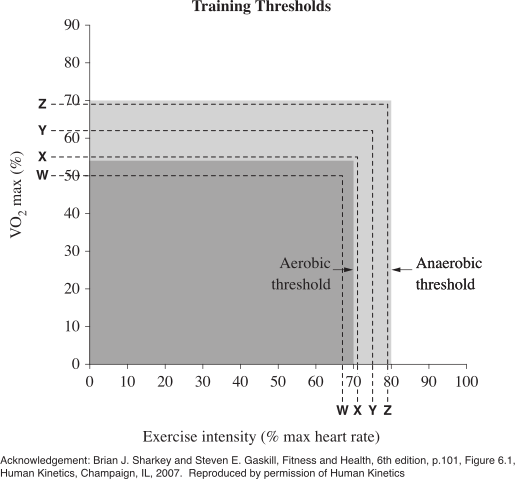
The graph shows training thresholds for aerobic and anaerobic conditioning.
 

Which exercise intensity indicates the greatest potential for gain in aerobic conditioning?

  1. W
  2. X
  3. Y
  4. Z
Show Answers Only

\(D\)

Show Worked Solution
  • D is correct: Zone Z is just below anaerobic threshold providing maximum aerobic benefit.

Other Options:

  • A is incorrect: Zone W is below aerobic threshold with minimal conditioning benefit.
  • B is incorrect: Zone X is at aerobic threshold but not optimal intensity.
  • C is incorrect: Zone Y provides some benefit but not maximum aerobic gain.

♦♦♦♦♦ Mean mark 13%.

Filed Under: Principles of training Tagged With: Band 6, smc-5460-10-Thresholds

HMS, TIP 2014 HSC 18 MC

The graph shows results of testing an athlete’s strength for competition. These strength levels were recorded at the start of training (Weeks 1–3), right before competition (Week 6) and after a break from training (Weeks 8–12).
 

Which principle of training has the athlete displayed from Weeks 6 to 12?

  1. Peaking
  2. Overload
  3. Reversibility
  4. Progressive overload
Show Answers Only

\(C\)

Show Worked Solution
  • C is correct: Strength decreased after training stopped demonstrating reversibility principle.

Other Options:

  • A is incorrect: Peaking involves planned performance optimization not fitness loss.
  • B is incorrect: Overload requires increasing training load not stopping training.
  • D is incorrect: Progressive overload involves gradual increases not decreases in performance.

Filed Under: Principles of training Tagged With: Band 3, smc-5460-05-Adaptations

HMS, TIP 2015 HSC 14 MC

Which of the following would be a suitable weight training plan for enhancing the performance of an endurance athlete?

  1. Low repetition numbers with long recovery periods between sets
  2. Low repetition numbers with short recovery periods between sets
  3. High repetition numbers with slow speed and long recovery periods between sets
  4. High repetition numbers with fast speed and short recovery periods between sets
Show Answers Only

\(D\)

Show Worked Solution
  • D is correct: High reps with fast speed and short recovery mimics endurance demands.

Other Options:

  • A is incorrect: Low reps and long recovery develops power not endurance.
  • B is incorrect: Low reps develops strength not muscular endurance.
  • C is incorrect: Slow speed and long recovery doesn’t match endurance specificity.

♦♦ Mean mark 47%.

Filed Under: Principles of training, Types of training and training methods Tagged With: Band 5, smc-5459-20-Strength, smc-5460-05-Adaptations

HMS, TIP 2015 HSC 12 MC

How could a coach use a circuit training program to develop the aerobic capacity and strength of her athletes?

  1. By increasing the time allowed for the circuit to be completed
  2. By increasing the resistance and the time at each of the stations
  3. By decreasing the time allowed for the circuit to be completed
  4. By decreasing the resistance and the time at each of the stations
Show Answers Only

\(B\)

Show Worked Solution
  • B is correct: Higher resistance builds strength while longer time develops aerobic capacity.

Other Options:

  • A is incorrect: More time doesn’t increase training intensity effectively.
  • C is incorrect: Less time reduces aerobic development opportunities.
  • D is incorrect: Lower resistance and time reduces both strength and aerobic benefits.

Filed Under: Principles of training, Types of training and training methods Tagged With: Band 4, smc-5459-10-Aerobic, smc-5459-20-Strength, smc-5460-05-Adaptations

HMS, TIP 2019 HSC 27

An athlete is participating in a 12-week aerobic training program.

Analyse how progressive overload and training thresholds can result in physiological adaptations for the athlete.   (8 marks)

--- 24 WORK AREA LINES (style=lined) ---

Show Answers Only

Overview Statement

  • Progressive overload and training thresholds interact to create systematic stress that triggers cardiovascular and respiratory adaptations over 12 weeks.

Component Relationship 1 – Progressive Overload and Cardiovascular Adaptations

  • Progressive overload involves gradually increasing training frequency, intensity, and duration throughout the program. This systematic increase places greater demands on the cardiovascular system each week.
  • As a result, the heart muscle strengthens and stroke volume increases significantly. The left ventricle enlarges to pump more blood per contraction.
  • Consequently, resting heart rate decreases as the heart becomes more efficient. Cardiac output improves during exercise, enabling enhanced oxygen delivery to working muscles.
  • This relationship demonstrates how progressive stress leads to superior cardiovascular function.

Component Relationship 2 – Training Thresholds and Respiratory Adaptations

  • Training thresholds ensure exercise intensity remains between aerobic and anaerobic zones throughout the program. This targeted intensity optimises oxygen utilisation without excessive lactate accumulation.
  • Therefore, respiratory muscles strengthen and lung capacity increases. Oxygen uptake improves as alveoli become more efficient at gas exchange.
  • This connection between threshold training and respiratory adaptation results in enhanced endurance capacity and delayed fatigue onset.

Implications and Synthesis

  • These interactions create a synergistic effect where cardiovascular and respiratory improvements work together.
  • The combined adaptations significantly enhance athletic performance and exercise tolerance.

Show Worked Solution

Overview Statement

  • Progressive overload and training thresholds interact to create systematic stress that triggers cardiovascular and respiratory adaptations over 12 weeks.

Component Relationship 1 – Progressive Overload and Cardiovascular Adaptations

  • Progressive overload involves gradually increasing training frequency, intensity, and duration throughout the program. This systematic increase places greater demands on the cardiovascular system each week.
  • As a result, the heart muscle strengthens and stroke volume increases significantly. The left ventricle enlarges to pump more blood per contraction.
  • Consequently, resting heart rate decreases as the heart becomes more efficient. Cardiac output improves during exercise, enabling enhanced oxygen delivery to working muscles.
  • This relationship demonstrates how progressive stress leads to superior cardiovascular function.

Component Relationship 2 – Training Thresholds and Respiratory Adaptations

  • Training thresholds ensure exercise intensity remains between aerobic and anaerobic zones throughout the program. This targeted intensity optimises oxygen utilisation without excessive lactate accumulation.
  • Therefore, respiratory muscles strengthen and lung capacity increases. Oxygen uptake improves as alveoli become more efficient at gas exchange.
  • This connection between threshold training and respiratory adaptation results in enhanced endurance capacity and delayed fatigue onset.

Implications and Synthesis

  • These interactions create a synergistic effect where cardiovascular and respiratory improvements work together.
  • The combined adaptations significantly enhance athletic performance and exercise tolerance.

♦♦♦♦ Mean mark 39%.

Filed Under: Physiological adaptations and improved performance, Principles of training Tagged With: Band 5, smc-5460-10-Thresholds, smc-5461-10-Cardio adaptations

HMS, TIP 2021 HSC 24

Describe how specificity and progressive overload can be applied to a strength training program in order to improve an athlete’s performance. Provide examples to support your answer.   (5 marks)

--- 15 WORK AREA LINES (style=lined) ---

Show Answers Only
  • Specificity involves targeting muscle groups and movement patterns directly related to the athlete’s sport requirements. A rugby player would focus on compound exercises like squats and deadlifts to develop leg and core strength needed for scrummaging and tackling. Training movements should mirror the biomechanical demands of competition. For instance, a basketball player would incorporate explosive jump squats to replicate jumping motions required for rebounding and shot blocking. This principle ensures training adaptations transfer effectively to sport-specific performance demands.
  • Progressive overload requires systematically increasing training stimulus to promote continued strength gains. Athletes can increase resistance, repetitions, sets, or training frequency over time. For example, a weightlifter might progress from bench pressing 80kg for 8 repetitions to 85kg for the same repetitions the following week. Alternatively, they could maintain 80kg but increase from 3 sets to 4 sets. This gradual increase challenges muscles beyond their current capacity, stimulating hypertrophy and strength development essential for improved athletic performance across all sporting contexts.
Show Worked Solution
  • Specificity involves targeting muscle groups and movement patterns directly related to the athlete’s sport requirements. A rugby player would focus on compound exercises like squats and deadlifts to develop leg and core strength needed for scrummaging and tackling. Training movements should mirror the biomechanical demands of competition. For instance, a basketball player would incorporate explosive jump squats to replicate jumping motions required for rebounding and shot blocking. This principle ensures training adaptations transfer effectively to sport-specific performance demands.
  • Progressive overload requires systematically increasing training stimulus to promote continued strength gains. Athletes can increase resistance, repetitions, sets, or training frequency over time. For example, a weightlifter might progress from bench pressing 80kg for 8 repetitions to 85kg for the same repetitions the following week. Alternatively, they could maintain 80kg but increase from 3 sets to 4 sets. This gradual increase challenges muscles beyond their current capacity, stimulating hypertrophy and strength development essential for improved athletic performance across all sporting contexts.

Filed Under: Principles of training Tagged With: Band 4, smc-5460-05-Adaptations

HMS, TIP 2022 HSC 17 MC

The table shows the physiological adaptations an athlete has experienced as a result of an 8 -week training program.

\begin{array} {|l||l|}
\hline
\rule{0pt}{2.5ex}\textbf{Physiological adaptation}\rule[-1ex]{0pt}{0pt} & \textbf{Effect} \\ 
\hline
\rule{0pt}{2.5ex}\text{Stroke volume}\rule[-1ex]{0pt}{0pt} & \text{Increased}\\
\hline
\rule{0pt}{2.5ex}\text{Cardiac output}\rule[-1ex]{0pt}{0pt} & \text{Increased}\\
\hline
\rule{0pt}{2.5ex}\text{Resting heart rate}\rule[-1ex]{0pt}{0pt} & \text{Decreased}\\
\hline
\rule{0pt}{2.5ex}\text{Fast twitch muscle fibre size}\rule[-1ex]{0pt}{0pt} & \text{Increased}\\ 
\hline
\end{array}

Which of the following identifies the principles of training most likely to have been applied in the training program to produce these adaptations?

  1. Specificity, progressive overload, variety
  2. Variety, reversibility, warm up and cool down
  3. Specificity, progressive overload, training thresholds
  4. Warm up and cool down, progressive overload, training thresholds
Show Answers Only

\( C \)

Show Worked Solution

  • C is correct: Cardiovascular and strength adaptations require specific, progressive training at appropriate thresholds.

Other Options:

  • A is incorrect: Variety wouldn’t produce such specific targeted adaptations.
  • B is incorrect: Reversibility explains fitness loss, not gains shown.
  • D is incorrect: Warm-up/cool-down don’t drive physiological adaptations.

Filed Under: Principles of training Tagged With: Band 4, smc-5460-05-Adaptations, smc-5460-10-Thresholds

HMS, TIP 2022 HSC 15 MC

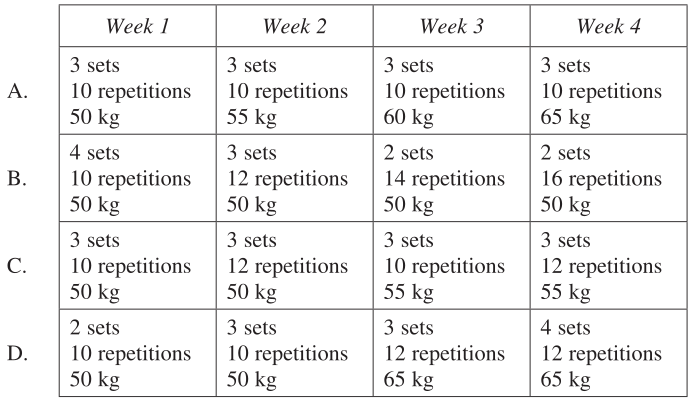
An athlete is aiming to maximise their muscular strength when performing a bench press.

Which row in the table represents the most effective four week application of progressive overload?

Show Answers Only

\( A \)

Show Worked Solution
  • A is correct: Systematic weight increases with consistent volume optimises strength development.

Other Options:

  • B is incorrect: No weight progression; increasing reps reduces strength focus.
  • C is incorrect: Inconsistent progression pattern doesn’t optimise strength gains.
  • D is incorrect: Erratic volume changes and sudden weight jumps.

♦♦ Mean mark 52%.

Filed Under: Principles of training Tagged With: Band 5, smc-5460-10-Thresholds

HMS, TIP 2024 HSC 9 MC

Which of the following is a recommended strategy to minimise reversibility for an athlete following a knee injury?

  1. Eliminating all forms of exercise while setting realistic goals
  2. Increasing rest days and maintaining psychological wellbeing
  3. Remaining active and gradually increasing intensity upon returning to training
  4. Suddenly increasing the intensity of each session to compensate for the reduced time spent training
Show Answers Only

\(C\)

Show Worked Solution
  • C is correct: Gradual activity resumption and progressive intensity increases effectively minimise fitness loss (reversibility) after injury.

Other Options:

  • A is incorrect: Complete inactivity accelerates deconditioning.
  • B is incorrect: Excess rest contributes to deconditioning.
  • D is incorrect: This approach risks re-injury and overtraining.

Filed Under: Principles of training Tagged With: Band 3, smc-5460-05-Adaptations

HMS, TIP 2024 HSC 2 MC

A coach develops a resistance training program where the weight load to be lifted is at 15−20 repetition maximum (15−20 RM).

By following the program's repetition maximum, what is the primary focus the coach is aiming to improve?

  1. Endurance
  2. Hypertrophy
  3. Power
  4. Strength
Show Answers Only

\(A\)

Show Worked Solution
  • A is correct: Primarily targets muscular endurance. Rep range too high for maximum strength or power development.

Other Options:

  • B is incorrect: Hypertrophy training typically uses 8-12 RM.
  • C is incorrect: Power training typically uses 1-5 RM with explosive movements.
  • D is incorrect: Strength training typically uses 1-6 RM.

♦ Mean mark 55%.

Filed Under: Principles of training Tagged With: Band 5, smc-5460-05-Adaptations

Copyright © 2014–2026 SmarterEd.com.au · Log in