SmarterEd

Aussie Maths & Science Teachers: Save your time with SmarterEd

  • Login
  • Get Help
  • About

Bivariate Data, SM-Bank 016

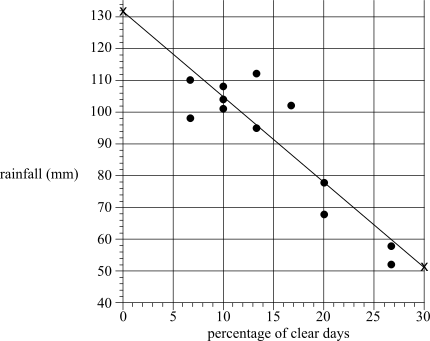
The scatterplot below shows the rainfall (in mm) and the percentage of clear days for each month of 2023. 
 

An equation of the line of best fit for this data set is

\(\textit{rainfall}\ = 131-2.68 \times\ \textit{percentage of clear days} \)

  1. Using coordinates at the graph extremities or otherwise, draw this line on the scatterplot.  (2 marks)

    --- 2 WORK AREA LINES (style=lined) ---

  2. Describe this association in terms of strength and direction.  (1 mark)

    --- 2 WORK AREA LINES (style=lined) ---

Show Answers Only

i.   
       

ii.    \(\text{Strength: moderate (data points are moderately close to the LOBF)}\)

\(\text{Direction: negative (as percentage of clear days ↑, rainfall ↓)}\)

Show Worked Solution

i.    \(\text{Calculate values at the limits of the graph:}\)

\((0, 131)\ \ \Rightarrow \ \ y \text{-intercept}\ = 131 \)

\( (30, 50.6)\ \ \Rightarrow \ \text{At}\ x=30, \ y=131-2.68 \times 30 = 50.6 \)
 

ii.    \(\text{Strength: moderate (data points are moderately close to the LOBF)}\)

\(\text{Direction: negative (as percentage of clear days ↑, rainfall ↓)}\)
Filed Under: Bivariate Data Tagged With: num-title-ct-coreb, smc-5022-25-Draw LOBF, smc-5022-30-Correlation

Bivariate Data, SM-Bank 015

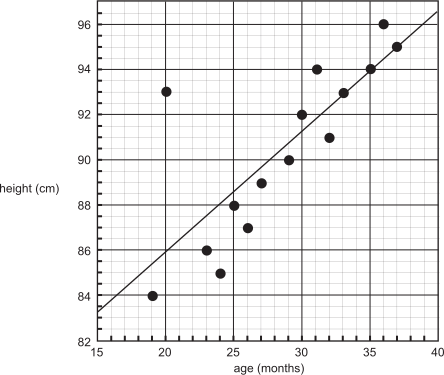
The heights (in cm) and ages (in months) of a random sample of 15 boys have been plotted in the scatterplot below.

A line of best fit has been fitted to the data.


  1. State the independent variable in the graph.   (1 mark)

    --- 1 WORK AREA LINES (style=lined) ---

  2. Describe this association in terms of strength and direction.   (2 marks)

    --- 2 WORK AREA LINES (style=lined) ---

  3. Determine the gradient of the line of best fit, giving your answer correct to one decimal place.   (2 marks)
  4. --- 5 WORK AREA LINES (style=lined) ---

Show Answers Only

i.    \(\text{Independent variable: age (months)}\)

ii.    \(\text{Association: strong and positive}\)

iii.   \(0.5\)

Show Worked Solution

i.    \(\text{Independent variable}\ \ \Rightarrow\ \ x\text{-axis variable} \)

\(\text{age (months)}\)
 

ii.    \(\text{Association:} \)

\(\text{Strength: strong (data points are tightly gathered to the LOBF)}\)

\(\text{Direction: positive (as age ↑, height ↑)}\)
 

iii.   \(\text{LOBF passes through (15, 83.25) and (35, 94)} \)

\(\text{Gradient}\ = \dfrac{y_2-y_1}{x_2-x_1} = \dfrac{94-83.25}{35-15} = 0.5375 = 0.5\ \text{(1 d.p.)} \)

Filed Under: Bivariate Data Tagged With: num-title-ct-coreb, smc-5022-30-Correlation, smc-5022-80-(In)Dependent variables

Bivariate Data, SM-Bank 014

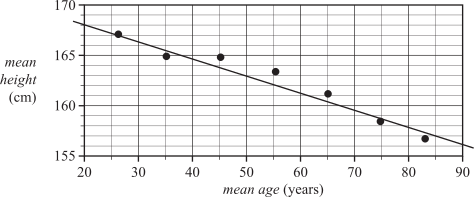
The scatterplot below displays the mean age, in years, and the mean height, in centimetres, of 648 women from seven different age groups.

In an initial analysis of the data, a line of best fit is drawn, as shown.


  1. Describe this association in terms of strength and direction.   (2 marks)

    --- 2 WORK AREA LINES (style=lined) ---

  2. Determine the mean height predicted for a group of 65 year old women.   (1 mark)
  3. --- 1 WORK AREA LINES (style=lined) ---

Show Answers Only

i.    \(\text{Association: strong and negative}\)

ii.   \(\text{Predicted height = 160.5 cm}\)

Show Worked Solution

i.    \(\text{Association:} \)

\(\text{Strength: strong (data points are tightly gathered to the LOBF)}\)

\(\text{Direction: negative (as mean age ↑, mean height ↓)}\)
 

ii.   \(\text{Mean age = 65}\ \ \Rightarrow \ \ \text{Predicted height = 160.5 cm}\)

Filed Under: Bivariate Data Tagged With: num-title-ct-coreb, smc-5022-20-Scatterplot from table, smc-5022-30-Correlation

Bivariate Data, SM-Bank 013

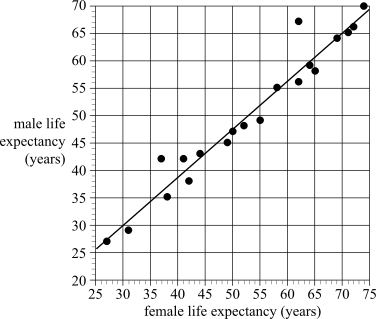
The scatterplot below plots male life expectancy (male) against female life expectancy (female) in 1950 for a number of countries.

A line of best fit has been fitted to the scatterplot as shown.
 

  1. State the dependent variable in the graph.   (1 mark)

    --- 1 WORK AREA LINES (style=lined) ---

  2. Determine the age at which males and females have the same life expectancy.   (1 mark)
  3. --- 2 WORK AREA LINES (style=lined) ---

Show Answers Only

i.    \(\text{Male life expectancy}\)

ii.   \(\text{Life expectancy the same at 30 years of age.}\)

Show Worked Solution

i.    \(\text{Dependent variable}\ \ \Rightarrow \ \ y \text{-axis variable} \)

\(\text{Male life expectancy}\) 
 

ii.   \(\text{Life expectancy the same at 30 years of age.}\)

Filed Under: Bivariate Data Tagged With: num-title-ct-coreb, smc-5022-10-Line of best fit graphs, smc-5022-80-(In)Dependent variables

Bivariate Data, SM-Bank 012

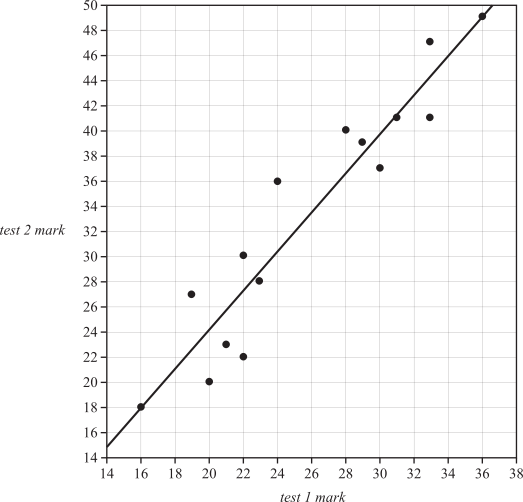
A teacher analysed the class marks of 15 students who sat two tests.

The test 1 mark and test 2 mark, all whole number values, are shown in the scatterplot below.

A line of best fit has been fitted to the scatterplot.
 

  1. If a student scored 34 in the first test, what is their expected mark in the second test.   (1 mark)

    --- 1 WORK AREA LINES (style=lined) ---

  2. The line of best fit shows the predicted test 2 mark for each student based on their test 1 mark.
  3. Determine the number of students whose actual test 2 mark was within two marks of that predicted.   (1 mark)

    --- 2 WORK AREA LINES (style=lined) ---

Show Answers Only

i.    \(46\)

ii.   \(\text{5 values are within 1 grid height (measured vertically), or 2 marks,}\)

\(\text{from the LOBF.}\)

Show Worked Solution

i.    \(\text{1st test mark = 34}\ \ \Rightarrow\ \ \text{2nd test mark = 46} \)
 

ii.   \(\text{5 values are within 1 grid height (measured vertically), or 2 marks,}\)

\(\text{from the LOBF.}\)

Filed Under: Bivariate Data Tagged With: num-title-ct-coreb, smc-5022-10-Line of best fit graphs

Bivariate Data, SM-Bank 011

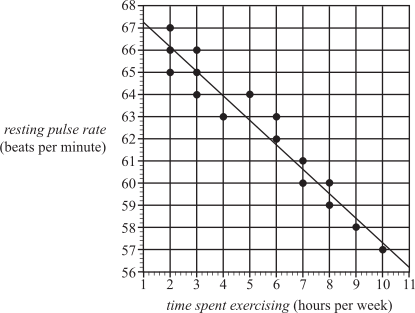
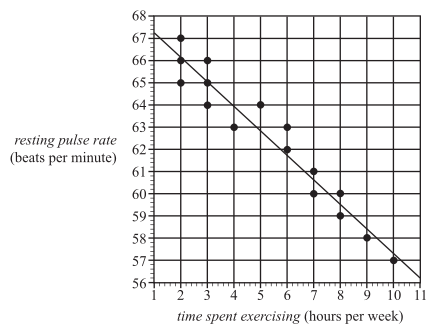
The scatterplot below displays the resting pulse rate, in beats per minute, and the time spent exercising, in hours per week, of 16 students.

A line of best fit has been fitted to the data.
 

  1. If a student spends 8 hours exercising per week, determine the resting pulse rate predicted by the line of best fit.   (1 mark)

    --- 1 WORK AREA LINES (style=lined) ---

  2. Provide TWO descriptions of the association between the variables time spent exercising and resting pulse rate.   (2 marks)

    --- 5 WORK AREA LINES (style=lined) ---

Show Answers Only

i.    \(\text{8 hours exercising}\ \ \Rightarrow\ \ \text{pulse rate = 59.5} \)

ii.   \(\text{Association should include two of the following:} \)

\(\text{Linear (straight line)}\)

\(\text{Negative (as time spent exercising ↑, resting pulse rate ↓)}\)
\(\text{Strong (data points are found tightly around the LOBF)}\)
Show Worked Solution

i.    \(\text{8 hours exercising}\ \ \Rightarrow\ \ \text{pulse rate = 59.5} \)
 

ii.   \(\text{Association should include two of the following:} \)

\(\text{Linear (straight line)}\)
\(\text{Negative (as time spent exercising ↑, resting pulse rate ↓)}\)

\(\text{Strong (data points are found tightly around the LOBF)}\)

Filed Under: Bivariate Data Tagged With: num-title-ct-coreb, smc-5022-10-Line of best fit graphs, smc-5022-30-Correlation

Bivariate Data, SM-Bank 010

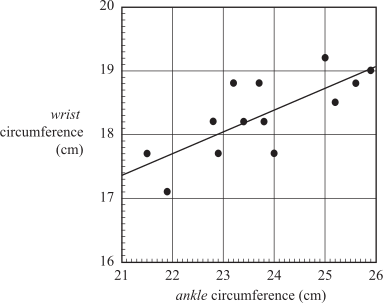
The scatterplot below shows the wrist circumference and ankle circumference, both in centimetres, of 13 people.

A line of best fit been drawn with ankle circumference as the independent variable.
 

  1. If a person has a wrist circumference of 18.5 centimetres, estimate the ankle circumference that is predicted by the line of best fit.   (1 mark)

    --- 1 WORK AREA LINES (style=lined) ---

  2. Explain why the \(y\)-intercept of this graph has no meaning in this context.   (1 mark)

    --- 2 WORK AREA LINES (style=lined) ---

Show Answers Only

i.    \(\text{18.5 cm wrist}\ \ \Rightarrow \ \ \text{Ankle circumference ≈ 24.5 cm}\)

ii.    \(y \text{-intercept occurs when ankle circumference = 0 cm, which is}\)

\(\text{meaningless in this context.}\)

Show Worked Solution

i.    \(\text{18.5 cm wrist}\ \ \Rightarrow \ \ \text{Ankle circumference ≈ 24.5 cm}\)
 

ii.    \(y \text{-intercept occurs when ankle circumference = 0 cm, which is}\)

\(\text{meaningless in this context.}\)

Filed Under: Bivariate Data Tagged With: num-title-ct-coreb, smc-5022-10-Line of best fit graphs, smc-5022-60-Limitations

Bivariate Data, SM-Bank 009

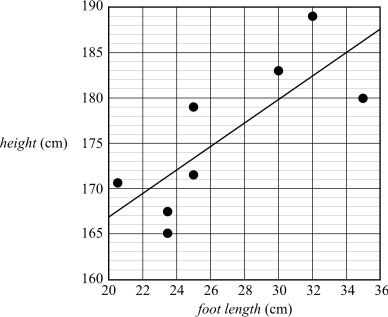
The height (in cm) and foot length (in cm) for each of eight Year 12 students were recorded and displayed in the scatterplot below.

A line of best fit has been fitted to the data as shown.
 

  1. Determine the predicted foot size of a student who is 176 centimetres tall.   (1 mark)

    --- 1 WORK AREA LINES (style=lined) ---

  2. Calculate the gradient of the line of best fit, giving your answer correct to two decimal places.   (2 marks)

    --- 4 WORK AREA LINES (style=lined) ---

  3. What is the equation of the line of best fit?   (2 marks)

    --- 5 WORK AREA LINES (style=lined) ---

Show Answers Only

i.    \(\text{Height 176 cm}\ \ \Rightarrow\ \ \text{Foot length = 27 cm} \)

ii.    \(1.29 \)

iii.    \(\textit{height}\ = 141.2 + 1.29 \times \textit{foot length} \)

Show Worked Solution

i.    \(\text{Height 176 cm}\ \ \Rightarrow\ \ \text{Foot length = 27 cm} \)
 

ii.    \(\text{LOBF passes through (20, 167) and (34, 185):}\)

\(\text{Gradient}\ = \dfrac{y_2-y_1}{x_2-x_1} = \dfrac{185-167}{34-20} = \dfrac{18}{14} = 1.285… = 1.29 \)
 

iii.   \(\text{Equation}\ \ \Rightarrow \ \ \text{Gradient = 1.29, passes through (20, 167)} \)

\(y-y_1 \) \(=m(x-x_1) \)  
\(y-167\) \(=1.29(x-20) \)  
\(y\) \(=1.29x + 141.2\)  

 
\(\textit{height}\ = 141.2 + 1.29 \times \textit{foot length} \)

Filed Under: Bivariate Data Tagged With: num-title-ct-coreb, smc-5022-10-Line of best fit graphs, smc-5022-28-LOBF equations

Bivariate Data, SM-Bank 008 MC

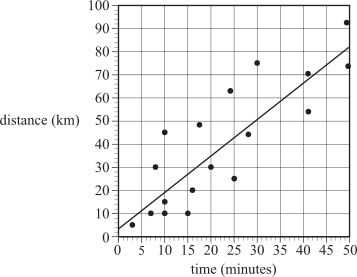
A line of best fit has been fitted to the scatterplot above to enable distance, in kilometres, to be predicted from time, in minutes.

The equation of this line is closest to

  1. distance `= 3.5 + 1.6 ×`time
  2. time `= 3.5 + 1.6 ×`distance
  3. distance `= 1.6 + 3.5 ×`time
  4. time `= 1.8 + 3.5 ×`distance
Show Answers Only

`A`

Show Worked Solution

`text{Line passes through  (0, 3.5) and (50, 82)`

\(\text{Gradient}\ = \dfrac{y_2-y_1}{x_2-x_1} \approx \dfrac{82-3.5}{50-0} \approx 1.57 \)
 

`text{Distance is the dependent variable}\ (y)\ \text{and the}`

`y text(-intercept is approximately 3.5.)`

`=> A`

Filed Under: Bivariate Data Tagged With: num-title-ct-coreb, smc-5022-28-LOBF equations

Bivariate Data, SM-Bank 007 MC

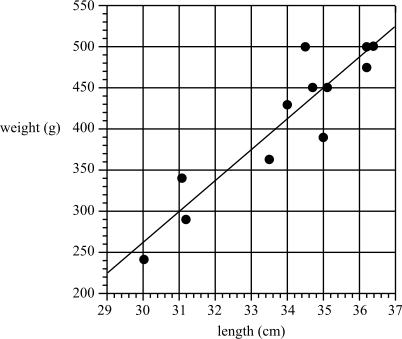
Dr Chris measures the weights (in grams) and lengths (in cm) of 12 baby pythons.

The results were recorded and plotted in the scatterplot below. The line of best fit that enables the weight of the pythons to be predicted from their length has also been plotted.
 

The line of best fit predicts that the weight, in grams, of a python of length 30 cm would be closest to

  1. `240`
  2. `252`
  3. `262`
  4. `274`
Show Answers Only

`C`

Show Worked Solution

`text{The line of best fit crosses the 30cm length (on the}`

`xtext{-axis) at approx 262.}`

`=>C`

Filed Under: Bivariate Data Tagged With: num-title-ct-coreb, smc-5022-10-Line of best fit graphs

Bivariate Data, SM-Bank 006

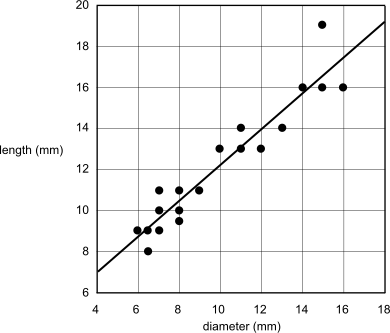
The lengths and diameters, in millimetres, of a sample of jellyfish selected were recorded and displayed in the scatterplot below.

A line of best fit for this data is shown.
 

  1. Determine the expected length of a jellyfish with a diameter of 12 millimetres.   (1 mark)

    --- 1 WORK AREA LINES (style=lined) ---

  2. Determine the expected diameter of a jellyfish with a length of 16 millimetres.   (1 mark)

    --- 1 WORK AREA LINES (style=lined) ---

Show Answers Only

i.    \(\text{A diameter of 12 mm (x-axis)}\ \ \Rightarrow \ \ \text{length 14 mm}\)

ii.    \(\text{Length of 16 mm (y-axis)}\ \ \Rightarrow \ \ \text{diameter 14.4 mm (approx)}\)

Show Worked Solution

i.    \(\text{A diameter of 12 mm (x-axis)}\ \ \Rightarrow \ \ \text{length 14 mm}\)

ii.    \(\text{Length of 16 mm (y-axis)}\ \ \Rightarrow \ \ \text{diameter 14.4 mm (approx)}\)

Filed Under: Bivariate Data Tagged With: num-title-ct-coreb, smc-5022-10-Line of best fit graphs

Bivariate Data, SM-Bank 005

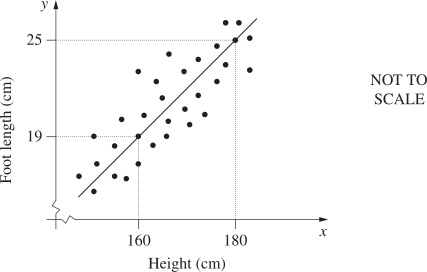
Each member of a group of males had his height and foot length measured and recorded. The results were graphed and a line of fit drawn.
 

  1. Why does the value of the `y`-intercept have no meaning in this situation?  (1 mark)

    --- 2 WORK AREA LINES (style=lined) ---

  2. George is 10 cm taller than his brother Harry. Use the line of fit to estimate the difference in their foot lengths.  (1 mark)

    --- 2 WORK AREA LINES (style=lined) ---

Show Answers Only
  1. `text(The y-intercept occurs when)\ x = 0.\ text(It has`
    `text(no meaning to have a height of 0 cm.)`
  2. `text(A 10 cm height difference means George should)`
    `text(have a 3 cm longer foot.)`
Show Worked Solution

i.  `text(The y-intercept occurs when)\ x = 0.\ text(It has)`

`text(no meaning to have a height of 0 cm.)`


ii.  `text(A 20 cm height difference results in a foot length)`

`text(difference of 6 cm.)`

`:.\ text(A 10 cm height difference means George should)`

`text(have a 3 cm longer foot.)`

Filed Under: Bivariate Data Tagged With: num-title-ct-coreb, smc-5022-10-Line of best fit graphs, smc-5022-60-Limitations

Bivariate Data, SM-Bank 004

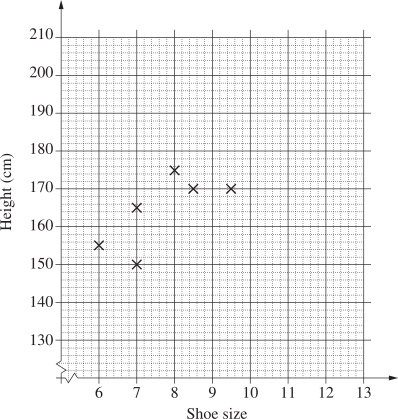
The shoe size and height of ten students were recorded.

\begin{array} {|l|c|c|}
\hline \rule{0pt}{2.5ex} \text{Shoe size} \rule[-1ex]{0pt}{0pt} & \text{6} & \text{7} & \text{7} & \text{8} & \text{8.5} & \text{9.5} & \text{10} & \text{11} & \text{12} & \text{12} \\
\hline \rule{0pt}{2.5ex} \text{Height} \rule[-1ex]{0pt}{0pt} & \text{155} & \text{150} & \text{165} & \text{175} & \text{170} & \text{170} & \text{190} & \text{185} & \text{200} & \text{195} \\
\hline
\end{array}

  1. Complete the scatter plot AND draw a line of best fit by eye.  (2 marks)
     
     
  2. Use the line of best fit to estimate the height difference between a student who wears a size 7.5 shoe and one who wears a size 9 shoe.  (1 mark)

    --- 2 WORK AREA LINES (style=lined) ---

Show Answers Only
  1. `text(See Worked Solutions.)`
  2. `text{13 cm (or close given LOBF drawn)}`
Show Worked Solution

i.    
     

ii.    `text{Shoe size 7.5 gives a height estimate of 162 cm (see graph)}`

`text{Shoe size 9 gives a height estimate of 175 cm (see graph)}`

`:.\ text(Height difference)` `= 175-162`
  `= 13\ text{cm  (or close given LOBF drawn)}`

Filed Under: Bivariate Data Tagged With: num-title-ct-coreb, smc-5022-10-Line of best fit graphs, smc-5022-20-Scatterplot from table, smc-5022-25-Draw LOBF

Bivariate Data, SM-Bank 003

Ahmed collected data on the age (`a`) and height (`h`) of males aged 11 to 16 years.

He created a scatterplot of the data and constructed a line of best fit to model the relationship between the age and height of males.
 

  1. Determine the gradient of the line of best fit shown on the graph.   (1 mark)

    --- 2 WORK AREA LINES (style=lined) ---

  2. Determine the equation of the line of best fit shown on the graph.  (2 marks)

    --- 5 WORK AREA LINES (style=lined) ---

  3. Use the line of best fit to predict the height of a typical 17-year-old male.   (1 mark)

    --- 1 WORK AREA LINES (style=lined) ---

  4. Why would this model not be useful for predicting the height of a typical 45-year-old male?   (1 mark)

    --- 2 WORK AREA LINES (style=lined) ---

Show Answers Only
  1. `text(Gradient = 6)`
  2. `h = 6a + 80`
  3. `text(182 cm)`
  4. `text(People slow and eventually stop growing)`
  5.  

    `text(after they become adults.)`

Show Worked Solution

i.    `text{Gradient}\ =(176-146)/(16-11)=30/5=6`
 

ii.   `text{Gradient = 6,  Passes through (11, 146)}`

`y-y_1` `=m(x-x_1)`
`h-146` `=6(a-11)`
`:. h` `=6a-66+146`
  `=6a + 80`
♦♦ Mean marks of 38% and 25% respectively for parts (i)-(ii).
COMMENT: Choose extreme points for calculating gradient.

 
iii.
   `text{Substitue}\ \ a=17\ \ \text{into equation from part (ii):}`

`h=(6 xx 17) +80=182`

`:.\ text{A typical 17 year old is expected to be 182cm.}`
  

iv.    `text(People slow and eventually stop growing)`
  `text(after they become adults.)`

Filed Under: Bivariate Data Tagged With: num-title-ct-coreb, smc-5022-28-LOBF equations, smc-5022-40-Gradient, smc-5022-60-Limitations

Bivariate Data, SM-Bank 002

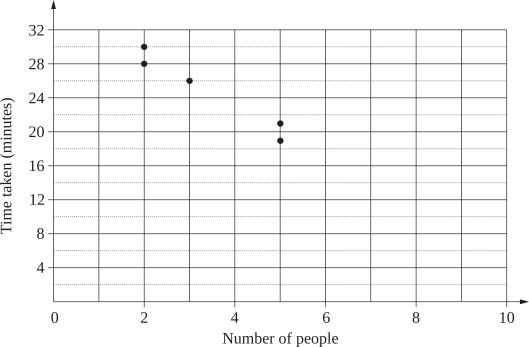
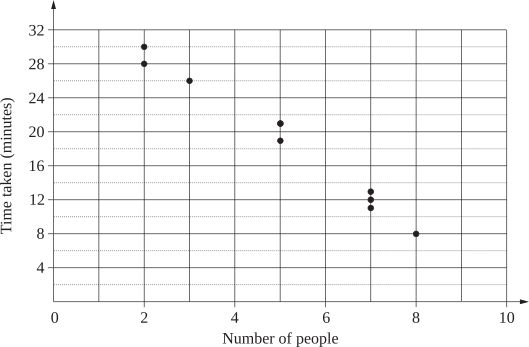
People are placed into groups to complete a puzzle. There are 9 different groups.

The table shows the number of people in each group and the amount of time, in minutes, for each group to complete the puzzle.

\begin{array} {|l|c|c|c|c|c|c|c|c|c|}
\hline
\rule{0pt}{2.5ex} \text{Number of people} \rule[-1ex]{0pt}{0pt} & 2 & 2 & 3 & 5 & 5 & 7 & 7 & 7 & 8 \\
\hline
\rule{0pt}{2.5ex} \text{Time taken (min)} \rule[-1ex]{0pt}{0pt} & 28 & 30 & 26 & 19 & 21 & 12 & 13 & 11 & 8 \\
\hline
\end{array}

  1. Complete the scatterplot by adding the last four points from the table.  (1 mark)
     
       
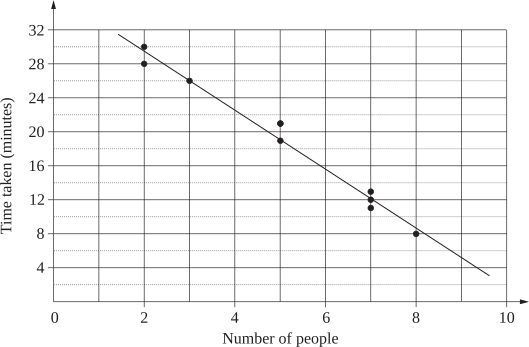
  2. Add a line of best fit by eye to the graph in part (a).  (1 mark)

    --- 0 WORK AREA LINES (style=lined) ---

  3. The graph in part (a) shows the association between the time to complete the puzzle and the number of people in the group.
  4. Identify the form (linear or non-linear), the direction and the strength of the association.  (2 marks)

    --- 3 WORK AREA LINES (style=lined) ---

Show Answers Only

a.

b.


c.    `text(Form: linear)

`text{Direction: negative}`

`text{Strength: strong}`

Show Worked Solution

a.

b.


c.    `text{Form: linear (i.e. straight line)}`

`text{Direction: negative}`

`text{Strength: strong}`

Filed Under: Bivariate Data Tagged With: num-title-ct-coreb, smc-5022-20-Scatterplot from table, smc-5022-25-Draw LOBF, smc-5022-30-Correlation

Bivariate Data, SM-Bank 001

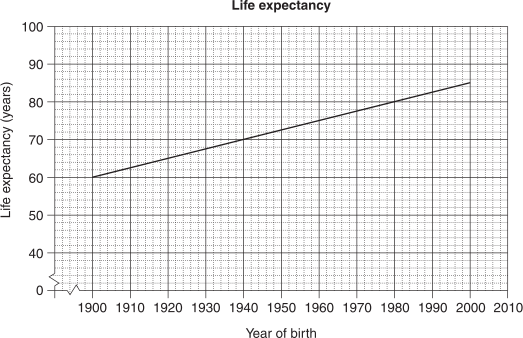
The graph shows a line of best fit describing the life expectancy of people born between 1900 and 2000.


  1. According to the graph, what is the life expectancy of a person born in 1932?  (1 mark)

    --- 1 WORK AREA LINES (style=lined) ---

  2. Determine the value of the gradient of the line of best fit.  (2 marks)

    --- 4 WORK AREA LINES (style=lined) ---

Show Answers Only
  1. \(\text{68 years}\)
  2. \(0.25\)
Show Worked Solution

i.    \(\text{68 years}\)

ii.    \(\text{Using (1900,60), (1980,80):}\)

\(\text{Gradient}\) \(= \dfrac{y_2-y_1}{x_2-x_1}\)
  \(= \dfrac{80-60}{1980-1900}\)
  \(= 0.25\)

Filed Under: Bivariate Data Tagged With: num-title-ct-coreb, smc-5022-10-Line of best fit graphs, smc-5022-40-Gradient

Statistics, STD1 S3 2023 HSC 19

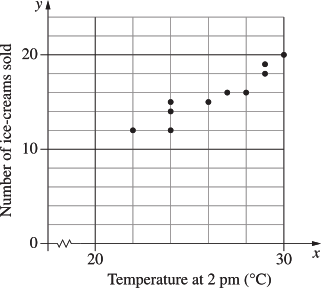
The scatterplot shows the number of ice-creams sold, \(y\), at a shop over a ten-day period, and the temperature recorded at 2 pm on each of these days.
 

  1. The data are modelled by the equation of the line of best fit given below.

\(y=0.936 x-8.929\), where \(x\) is the temperature.

  1. Sam used a particular temperature with this equation and predicted that 23 ice-creams would be sold.
  2. What was the temperature used by Sam, to the nearest degree?  (2 marks)

    --- 4 WORK AREA LINES (style=lined) ---

  3. In using the equation to make the prediction in part (a), was Sam interpolating or extrapolating? Justify your answer.  (2 marks)

    --- 3 WORK AREA LINES (style=lined) ---

Show Answers Only

a.    \(34^{\circ}\text{ (nearest degree)}\)

b.    \(\text{See worked solutions}\)

Show Worked Solution

a.             \(y\) \(=0.936x-8.929\)
\(23\) \(=0.936x-8.929\)
\(0.936x\) \(=23+8.929\)
\(x\) \(=\dfrac{31.921}{0.936}\)
  \(=34.112\ldots ^{\circ}\)
  \(= 34^{\circ}\text{ (nearest degree)}\)

♦♦ Mean mark (a) 31%.

b.     \(\text{Sam is extrapolating as 34°C is outside the range of data}\)

\(\text{points shown on the graph (i.e. temp between 0 and 30°C).}\)


♦♦ Mean mark (b) 33%.

Filed Under: Bivariate Data, S3 Further Statistical Analysis (Y12) Tagged With: Band 5, num-title-ct-coreb, num-title-qs-hsc, smc-1113-10-Line of Best Fit, smc-5022-10-Line of best fit graphs, smc-5022-28-LOBF equations, smc-5022-70-Inter/extrapolating

Statistics, STD1 S3 2022 HSC 23

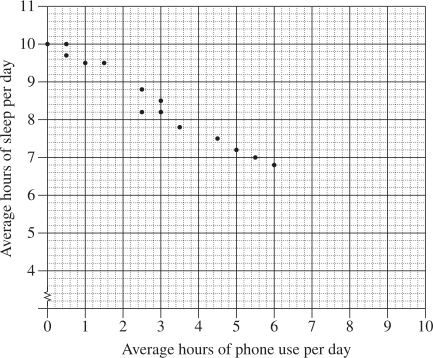
A teacher surveyed the students in her Year 8 class to investigate the relationship between the average number of hours of phone use per day and the average number of hours of sleep per day.

The results are shown on the scatterplot below.
 

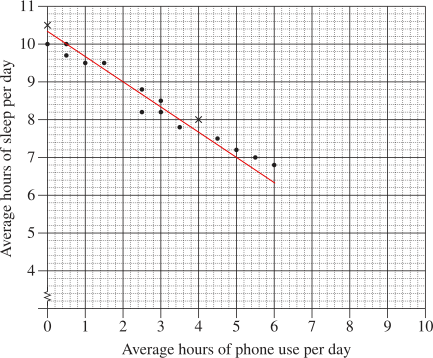
  1. The data for two new students, Alinta and Birrani, are shown in the table below. Plot their results on the scatterplot.  (2 marks)

\begin{array} {|l|c|c|}
\hline
  & \textit{Average hours of} & \textit{Average hours of} \\ & \textit{phone use per day} & \textit{sleep per day} \\
\hline
\rule{0pt}{2.5ex} \text{Alinta} \rule[-1ex]{0pt}{0pt} & 4 & 8 \\
\hline
\rule{0pt}{2.5ex} \text{Birrani} \rule[-1ex]{0pt}{0pt} & 0 & 10.5 \\
\hline
\end{array}

  1. By first fitting the line of best fit by eye on the scatterplot, estimate the average number of hours of sleep per day for a student who uses the phone for an average of 2 hours per day.  (2 marks)

    --- 2 WORK AREA LINES (style=lined) ---

Show Answers Only
  1.  
  2. 9 hours (see LOBF in diagram above)
Show Worked Solution

a.     \(\text{New data points are marks with a × on the diagram below.}\)
 

b.   \(\text{9 hours (see LOBF in diagram above)}\)

Filed Under: Bivariate Data, S3 Further Statistical Analysis (Y12) Tagged With: Band 4, num-title-ct-coreb, num-title-qs-hsc, smc-1113-10-Line of Best Fit, smc-1113-20-Scatterplot from Table, smc-5022-10-Line of best fit graphs, smc-5022-20-Scatterplot from table

Statistics, STD1 S3 2020 HSC 22

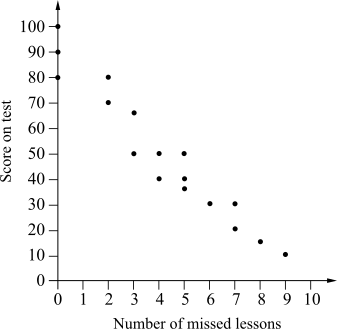
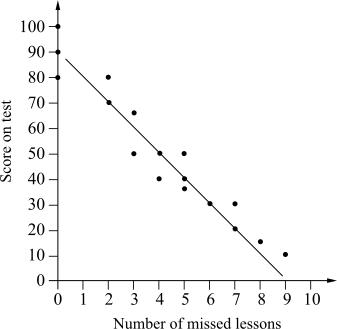
A group of students sat a test at the end of term. The number of lessons each student missed during the term and their score on the test are shown on the scatterplot.


  1. Describe the strength and direction of the linear association observed in this dataset.  (2 marks)

    --- 5 WORK AREA LINES (style=lined) ---

  2. Calculate the range of the test scores for the students who missed no lessons.  (1 mark)

    --- 1 WORK AREA LINES (style=lined) ---

  3. Draw a line of the best fit in the scatterplot above.  (1 mark)
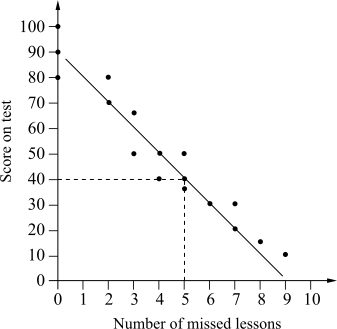
  4. Meg did not sit the test. She missed five lessons.


    Use the line of the best fit drawn in part (c) to estimate Meg's score on this test. (1 mark)

    --- 1 WORK AREA LINES (style=lined) ---

  5. John also did not sit the test and he missed 16 lessons.


    Is it appropriate to use the line of the best fit to estimate his score on the test? Briefly explain your answer. (1 mark)

    --- 2 WORK AREA LINES (style=lined) ---

Show Answers Only

a.    \(\text{Strength : strong}\)

\(\text{Direction : negative} \)

b.    \(\text{Range}\ = \text{high}-\text{low}\ = 100-80=20\)
 

c.   

d. 


e.    \(\text{John’s missed days are too extreme and the LOBF is not}\)

\(\text{appropriate. The model would estimate a negative score for}\)

\(\text{John which is impossible.}\)

Show Worked Solution

a.    \(\text{Strength : strong}\)

\(\text{Direction : negative} \)

♦ Mean mark (a) 45%.
♦♦ Mean mark (b) 31%.

b.    \(\text{Range}\ = \text{high}-\text{low}\ = 100-80=20\)
 

c.   

d. 


\(\therefore\ \text{Meg’s estimated score = 40}\)
 

e.    \(\text{John’s missed days are too extreme and the LOBF is not}\)

\(\text{appropriate. The model would estimate a negative score for}\)

\(\text{John which is impossible.}\)

♦ Mean mark (e) 38%.

Filed Under: Bivariate Data, S3 Further Statistical Analysis (Y12) Tagged With: Band 4, Band 5, num-title-ct-coreb, num-title-qs-hsc, smc-1113-10-Line of Best Fit, smc-1113-60-Limitations, smc-5022-10-Line of best fit graphs, smc-5022-25-Draw LOBF, smc-5022-30-Correlation, smc-5022-60-Limitations

Statistics, STD1 S3 2020 HSC 4 MC

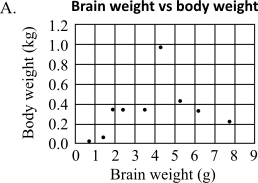
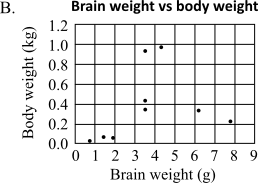
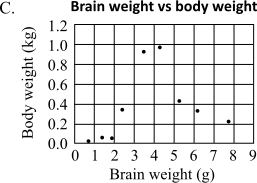
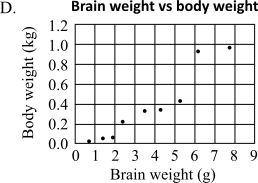
The table shows the average brain weight (in grams) and average body weight (in kilograms) of nine different mammals.

\begin{array} {|l|c|c|c|c|c|c|c|c|}
\hline
\rule{0pt}{2.5ex} \textit{Brain weight (g)} \rule[-1ex]{0pt}{0pt} & 0.7 & 0.4 & 1.9 & 2.4 & 3.5 & 4.3 & 5.3 & 6.2 & 7.8 \\
\hline
\rule{0pt}{2.5ex} \textit{Body weight (kg)} \rule[-1ex]{0pt}{0pt} & 0.02 &0.06 & 0.05 & 0.34 & 0.93 & 0.97 & 0.43 & 0.33 & 0.22 \\
\hline
\end{array}

Which of the following is the correct scatterplot for this dataset?


Show Answers Only

`C`

Show Worked Solution

`text{Consider data point} \ (1.9, 0.05)`

`→ \ text{Eliminate} \ A \ text{(too high)}`

`→ \ text{Eliminate} \ D \ text{(should be below 2nd data point)}`
 

`text{Consider data point} \ (2.4, 0.34)`

`→ \ text{Eliminate} \ B \ text{(not on graph)}` 

`=> \ C`

Filed Under: Bivariate Data, S3 Further Statistical Analysis (Y12) Tagged With: Band 4, num-title-ct-coreb, num-title-qs-hsc, smc-1113-20-Scatterplot from Table, smc-5022-20-Scatterplot from table

Statistics, STD2 S4 2017 HSC 12 MC

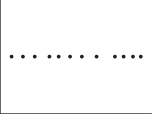
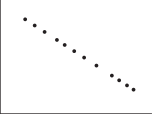
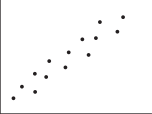
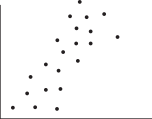
Which of the data sets graphed below has the largest positive correlation coefficient value?
 

A.      B.     
C.      D.     
Show Answers Only

\(C\)

Show Worked Solution

\(\text{Largest positive correlation occurs when both variables move}\)

\(\text{in tandem. The tighter the linear relationship, the higher the}\)

\(\text{correlation.}\)

\(\Rightarrow C\)

\(\text{(Note that B is negatively correlated)}\)

Filed Under: Bivariate Data, Bivariate Data Analysis (Y12), Correlation / Body Measurements, S3 Further Statistical Analysis (Y12), S4 Bivariate Data Analysis (Y12) Tagged With: Band 3, common-content, num-title-ct-coreb, num-title-qs-hsc, smc-1001-30-Correlation, smc-1113-30-Correlation, smc-5022-30-Correlation, smc-785-30-Correlation

Algebra, STD2 A2 2017 HSC 3 MC

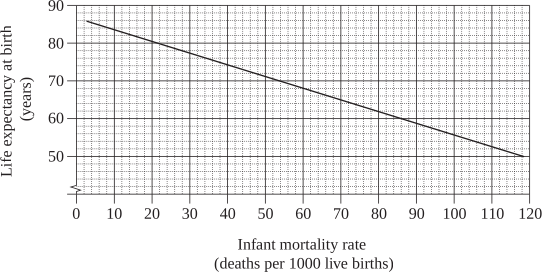
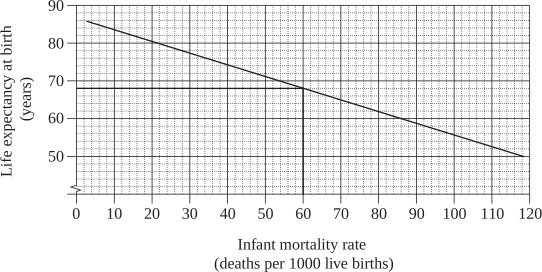
The graph shows the relationship between infant mortality rate (deaths per 1000 live births) and life expectancy at birth (in years) for different countries.
 

What is the life expectancy at birth in a country which has an infant mortality rate of 60?

  1. 68 years
  2. 69 years
  3. 86 years
  4. 88 years
Show Answers Only

\(A\)

Show Worked Solution

\(\text{When infant mortality rate is 60, life expectancy}\)

\(\text{at birth is 68 years (see below).}\)
 

\(\Rightarrow A\)

Filed Under: Applications: Currency, Fuel and Other Problems (Std 1), Applications: Currency, Fuel and Other Problems (Std 2), Applications: Currency, Fuel and Other Problems (Std2-2027), Bivariate Data, Life Expectancy, Linear Applications, S3 Further Statistical Analysis (Y12), S4 Bivariate Data Analysis (Y12) Tagged With: Band 3, common-content, num-title-ct-coreb, num-title-qs-hsc, smc-1001-10-Line of Best Fit, smc-1113-10-Line of Best Fit, smc-1119-30-Other Linear Applications, smc-5022-10-Line of best fit graphs, smc-6256-30-Other Linear Applications, smc-785-10-Line of Best Fit, smc-793-30-Other Linear Applications

Statistics, STD2 S4 2007 HSC 9 MC

Which of the following would be most likely to have a positive correlation?

  1. The population of a town and the number of schools in that town
  2. The price of petrol per litre and the number of litres of petrol sold
  3. The hours training for a marathon and the time taken to complete the marathon
  4. The number of dogs per household and the number of televisions per household
Show Answers Only

\(A\)

Show Worked Solution

\(\text{Positive correlation means that as one variable increases,}\)

\(\text{the other tends to increase also.}\)

\(\Rightarrow A\)

Filed Under: Bivariate Data, Bivariate Data Analysis (Y12), Correlation / Body Measurements, S3 Further Statistical Analysis (Y12), S4 Bivariate Data Analysis (Y12) Tagged With: Band 4, common-content, num-title-ct-coreb, num-title-qs-hsc, smc-1001-30-Correlation, smc-1113-30-Correlation, smc-5022-35-Causality, smc-785-30-Correlation

Statistics, STD2 S4 2008 HSC 12 MC

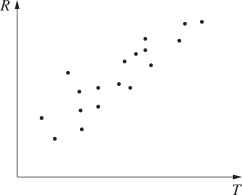
A scatterplot is shown.
 

Which of the following best describes the correlation between  \(R\)  and  \(T\)?

  1. Positive
  2. Negative 
  3. Positively skewed
  4. Negatively skewed
Show Answers Only

\(A\)

Show Worked Solution

\(\text{Correlation is positive.}\)

\(\text{NB. The skew does not directly relate to correlation.}\)

\(\Rightarrow  A\)

Filed Under: Bivariate Data, Bivariate Data Analysis (Y12), Correlation / Body Measurements, S3 Further Statistical Analysis (Y12), S4 Bivariate Data Analysis (Y12) Tagged With: Band 4, common-content, num-title-ct-coreb, num-title-qs-hsc, smc-1001-30-Correlation, smc-1113-30-Correlation, smc-5022-30-Correlation, smc-785-30-Correlation

Statistics, STD2 S4 2009 HSC 28b

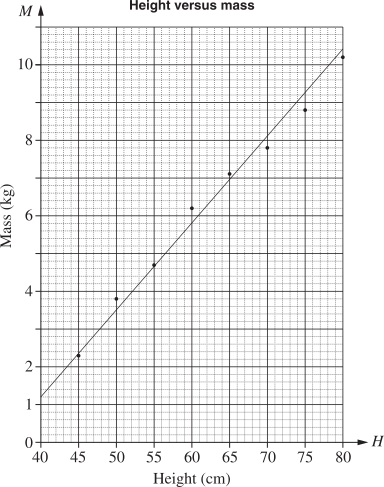
The height and mass of a child are measured and recorded over its first two years. 

\begin{array} {|l|c|c|}
\hline \rule{0pt}{2.5ex} \text{Height (cm), } H \rule[-1ex]{0pt}{0pt} & \text{45} & \text{50} & \text{55} & \text{60} & \text{65} & \text{70} & \text{75} & \text{80} \\
\hline \rule{0pt}{2.5ex} \text{Mass (kg), } M \rule[-1ex]{0pt}{0pt} & \text{2.3} & \text{3.8} & \text{4.7} & \text{6.2} & \text{7.1} & \text{7.8} & \text{8.8} & \text{10.2} \\
\hline
\end{array}

This information is displayed in a scatter graph. 
 

  1. Describe the correlation between the height and mass of this child, as shown in the graph.   (1 mark)

    --- 2 WORK AREA LINES (style=lined) ---

  2. A line of best fit has been drawn on the graph.


    Find the equation of this line.   (2 marks)

    --- 4 WORK AREA LINES (style=lined) ---

Show Answers Only
  1. `text(The correlation between height and)`


    `text(mass is positive and strong.)`

  2. `M = 0.23H-8`
Show Worked Solution

i.  `text(The correlation between height and)`

♦ Mean mark 48%. 

`text(mass is positive and strong.)`


ii.  `text(Using)\ \ P_1(40, 1.2)\ \ text(and)\ \ P_2(80, 10.4)`

♦♦♦ Mean mark 18%. 
MARKER’S COMMENT: Many students had difficulty due to the fact the horizontal axis started at `H= text(40cm)` and not the origin.
`text(Gradient)` `= (y_2-y_1)/(x_2-x_1)`
  `= (10.4-1.2)/(80-40)`
  `= 9.2/40`
  `= 0.23`


`text(Line passes through)\ \ P_1(40, 1.2)`

`text(Using)\ \ \ y-y_1` `= m(x-x_1)`
`y-1.2` `= 0.23(x-40)`
`y-1.2` `= 0.23x-9.2`
`y` `= 0.23x-8`

 
`:. text(Equation of the line is)\ \ M = 0.23H-8`

Filed Under: Bivariate Data, Bivariate Data Analysis (Y12), Life Expectancy, Other Linear Modelling, S3 Further Statistical Analysis (Y12), S4 Bivariate Data Analysis (Y12) Tagged With: Band 5, Band 6, common-content, num-title-ct-coreb, num-title-qs-hsc, smc-1001-10-Line of Best Fit, smc-1001-30-Correlation, smc-1113-10-Line of Best Fit, smc-1113-30-Correlation, smc-5022-28-LOBF equations, smc-5022-30-Correlation, smc-785-10-Line of Best Fit, smc-785-30-Correlation

Statistics, STD2 S4 2012 HSC 11 MC

Which of the following relationships would most likely show a negative correlation?

  1. The population of a town and the number of hospitals in that town. 
  2. The hours spent training for a race and the time taken to complete the race. 
  3. The price per litre of petrol and the number of people riding bicycles to work. 
  4. The number of pets per household and the number of computers per household. 
Show Answers Only

\(B\)

Show Worked Solution

\(\text{Increased hours training should reduce the time}\)

\(\text{to complete a race.}\)

\(\Rightarrow B\)

♦ Mean mark 43%.

Filed Under: Bivariate Data, Bivariate Data Analysis (Y12), Correlation / Body Measurements, S3 Further Statistical Analysis (Y12), S4 Bivariate Data Analysis (Y12) Tagged With: Band 5, common-content, num-title-ct-coreb, num-title-qs-hsc, smc-1001-30-Correlation, smc-1113-30-Correlation, smc-5022-30-Correlation, smc-5022-35-Causality, smc-785-30-Correlation

Copyright © 2014–2025 SmarterEd.com.au · Log in