SmarterEd

Aussie Maths & Science Teachers: Save your time with SmarterEd

  • Login
  • Get Help
  • About

v1 Algebra, STD2 A2 2011 HSC 23b

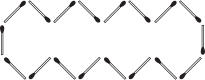
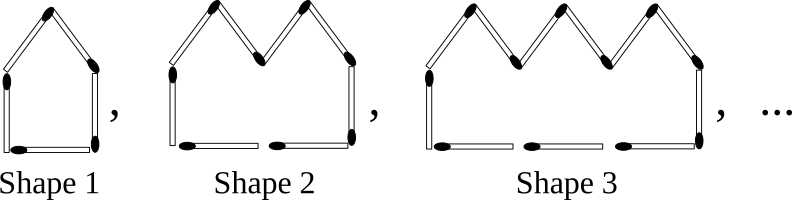
Sticks were used to create the following pattern. 
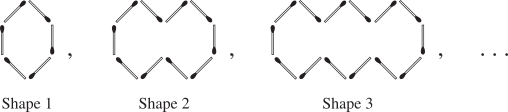
  

The number of sticks used is recorded in the table.

\begin{array} {|l|c|}
\hline
\rule{0pt}{2.5ex} \text{Shape $(S)$} \rule[-1ex]{0pt}{0pt} & \;\;\; 1 \;\;\; & \;\;\; 2 \;\;\; & \;\;\; 3 \;\;\; \\
\hline
\rule{0pt}{2.5ex} \text{Number of sticks $(N)$}\; \rule[-1ex]{0pt}{0pt} & \;\;\; 6 \;\;\; & \;\;\; 10 \;\;\; & \;\;\; 14 \;\;\; \\
\hline
\end{array}

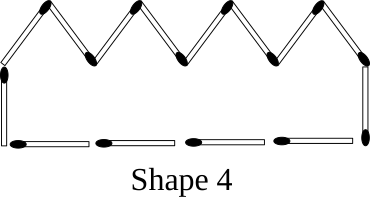
  1. Draw Shape 4 of this pattern.  (1 mark)

    --- 3 WORK AREA LINES (style=blank) ---

  2. How many sticks would be required for Shape 128?    (1 mark)

    --- 3 WORK AREA LINES (style=lined) ---

  3. Is it possible to create a shape in this pattern using exactly 609 sticks?


    Show suitable calculations to support your answer.    (2 marks)

    --- 5 WORK AREA LINES (style=lined) ---

Show Answers Only
  1. \(\text{See Worked Solutions.}\)
  2. \(514\)
  3. \(\text{No (See worked solution)}\)
Show Worked Solution

  i.    \(\text{Shape 4 is shown below:}\)

ii.    \(\text{Since}\ \ N=2+4S\)

♦ Mean mark 48%.
MARKER’S COMMENT: Students should attempt to find a “rule” in such questions, and use this formula to solve the question, as per the Worked Solution.  
\(\text{If }S\) \(=128\)
\(N\) \(=2+(4\times 128)\)
  \(=514\)


iii.    \(609\) \(=2+4S\)
  \(4S\) \(=607\)
  \(S\) \(=151.75\)

    
\(\text{Since}\ S\ \text{is not a whole number, 609 sticks}\)

\(\text{will not create a shape in this pattern.}\)

Filed Under: Linear Equations and Basic Graphs (Std 2-X) Tagged With: Band 1, Band 4, Band 5, smc-5240-40-Patterns

CORE, FUR2 2020 VCAA 7

Samuel owns a printing machine.

The printing machine is depreciated in value by Samuel using flat rate depreciation.

The value of the machine, in dollars, after `n` years, `Vn` , can be modelled by the recurrence relation

`V_0 = 120\ 000, qquad V_(n+1) = V_n-15\ 000`

  1. By what amount, in dollars, does the value of the machine decrease each year?   (1 mark)

    --- 1 WORK AREA LINES (style=lined) ---

  2. Showing recursive calculations, determine the value of the machine, in dollars, after two years.   (1 mark)

    --- 2 WORK AREA LINES (style=lined) ---

  3. What annual flat rate percentage of depreciation is used by Samuel?   (1 mark)

    --- 2 WORK AREA LINES (style=lined) ---

  4. The value of the machine, in dollars, after `n` years, `V_n`, could also be determined using a rule of the form `V_n = a + bn`.


    Write down this rule for `V_n`.   (1 mark)

    --- 2 WORK AREA LINES (style=lined) ---

Show Answers Only
  1. `$15\ 000`
  2. `$90\ 000`
  3. `12.5%`
  4. `V_n = 120\ 000-15\ 000n, n = 0, 1, 2, …`
Show Worked Solution

a. `$15\ 000`
  

b.   `V_1` `= 120\ 000-15\ 000 = $105\ 000`
  `V_2` `= 105\ 000-15\ 000 = $90\ 000`


c.   `text(Flat rate percentage` `= (15\ 000)/ (120\ 000) xx 100`
    `= 12.5 text(%)`


♦ Mean mark part d. 44%.

d.  `V_n = 120\ 000-15\ 000n, \ n = 0, 1, 2, …`

Filed Under: Depreciation, Recursion - Financial Tagged With: Band 1, Band 2, Band 4, smc-602-50-Recurrence relation, smc-717-50-Depreciation (SL)

Complex Numbers, EXT2 N1 2019 HSC 11a

Let  `z = 1 + 3i`  and  `w = 2 - i`.

  1. Find  `z + bar w`.  (1 mark)

    --- 2 WORK AREA LINES (style=lined) ---

  2. Express  `z/w`  in the form  `x + iy`, where  `x` and  `y`  are real numbers.  (2 marks)

    --- 4 WORK AREA LINES (style=lined) ---

Show Answers Only
  1. `3 + 4i`
  2. `-1/5 + 7/5 i`
Show Worked Solution

i.   `z = 1 + 3i`

`w = 2 – i \ => \ bar w = 2 + i`

`z + bar w` `= 1 + 3i + 2 + i`
  `= 3 + 4i`


ii.    `z/w` `= (1 + 3i)/(2 – i) xx (2 + i)/(2 + i)`
    `= ((1 + 3i)(2 + i))/(2^2 – i^2)`
    `= (2 + i + 6i + 3i^2)/5`
    `= (-1 + 7i)/5`
    `= -1/5 + 7/5 i`

Filed Under: Arithmetic of Complex Numbers Tagged With: Band 1, Band 2, smc-1048-10-Basic Arithmetic

GRAPHS, FUR1 2018 VCAA 02 MC

Steven is a wedding photographer.

He charges his clients a fixed fee of $500, plus $250 per hour of photography.

The equation that represents the total amount, `$C`, Steven charges, for `t` hours of photography is

  1.  `C = 250t`
  2.  `C = 500t`
  3.  `C = 750t`
  4.  `C = 500 + 250t`
  5.  `C = 250 + 500t`
Show Answers Only

`D`

Show Worked Solution

`C = 500 + 250t`

`=> D`

Filed Under: Linear relationships Tagged With: Band 1

Graphs, EXT2 2018 HSC 12b

A curve has equation  `x^2 + xy + y^2 = 3`.

  1. Use implicit differentiation to show that  `dy/dx = −(2x + y)/(x + 2y)`.  (2 marks)
  2. Hence, or otherwise, find the coordinates of the points on the curve where  `dy/dx = 0`.  (2 marks)
Show Answers Only
  1. `text(See Worked Solutions)`
  2. `(1,−2)\ \ text(and)\ \ (−1,2).`
Show Worked Solution

i.   `x^2 + xy + y^2 = 3`

♦ Mean mark 98%!

`2x + y + x · dy/dx + 2y · dy/dx=0`

`dy/dx(x + 2y)` `= −2x – y`
`:. dy/dx` `= −(2x + y)/(x + 2y)\ \ \ text(… as required)`


ii.   `text(When)\ \ dy/dx = 0,`

`−(2x + y)/(x + 2y)` `= 0`
`-2x-y` `=0`
`y` `= −2x\ \ \ \ (text(*))`


`text(Substituting into)\ \ x^2 + xy + y^2 = 3`

`x^2 + x(−2x) + (−2x)^2` `= 3`
`x^2 – 2x^2 + 4x^2` `= 3`
`3x^2` `= 3`
`x` `= +-1`
`y` `= +-2\ \ \ \ (text(*))`

 
`:.\ text(Coordinates are)\ \ (1,−2)\ \ text(and)\ \ (−1,2).`

Filed Under: Implicit Differentiation Tagged With: Band 1, Band 3

Complex Numbers, EXT2 N1 2018 HSC 11a

Let  `z = 2 + 3i`  and  `w = 1 - i.`

  1. Find  `zw`.  (1 mark)

    --- 3 WORK AREA LINES (style=lined) ---

  2. Express  `barz  - 2/w`  in the form  `x + iy`, where `x` and `y` are real numbers.  (2 marks)

    --- 3 WORK AREA LINES (style=lined) ---

Show Answers Only
  1. `5 + i`
  2. `1 – 4i`
Show Worked Solution

i.   `z = 2 + 3iqquadw = 1 – i`

♦ Mean mark part (i) 97!%.

`zw` `= (2 + 3i)(1 – i)`
  `= 2 – 2i + 3i – 3i^2`
  `= 2 + i + 3`
  `= 5 + i`


ii.    `barz – 2/w` `= 2 – 3i – 2/(1 – i)`
    `= 2 – 3i – (2(1 – i))/((1 – i)(1 + i))`
    `= 2 – 3i – (1 + i)`
    `= 1 – 4i`

Filed Under: Arithmetic and Complex Numbers, Arithmetic of Complex Numbers Tagged With: Band 1, Band 2, smc-1048-10-Basic Arithmetic

Functions, EXT1 F2 2018 HSC 11a

Consider the polynomial  `P(x) = x^3-2x^2-5x + 6`.

  1. Show that  `x = 1`  is a zero of  `P(x)`.  (1 mark)

    --- 2 WORK AREA LINES (style=lined) ---

  2. Find the other zeros.  (2 marks)

    --- 5 WORK AREA LINES (style=lined) ---

Show Answers Only
  1. `text(See Worked Solution)`
  2. `x = -2 and x = 3`
Show Worked Solution

i.   `P(1) = 1-2-5 + 6 = 0`

`:. x=1\ \ text(is a zero)`


ii.   `text{Using part (i)} \ => (x-1)\ text{is a factor of}\ P(x)`

`P(x) = (x-1)*Q(x)`
 

`text(By long division:)`

`P(x)` `= (x-1) (x^2-x-6)`
  `= (x-1) (x-3) (x + 2)`

 
`:.\ text(Other zeroes are:)`

`x = -2 and x = 3`

Filed Under: Polynomials, Remainder and Factor Theorems (Ext1), Roots, Remainders and Factors Tagged With: Band 1, Band 3, num-title-ct-patha, num-title-qs-hsc, smc-1031-10-Factor Theorem, smc-4242-10-Factor Theorem

Measurement, STD2 M1 2017 HSC 26a

Electricity costs $0.27 per kWh.

How much does 20 kWh cost?  (1 mark)

--- 1 WORK AREA LINES (style=lined) ---

Show Answers Only

`$5.40`

Show Worked Solution
`text(C)text(ost)` `= 20 xx $0.27`
  `= $5.40`

Filed Under: Energy and Mass (Std 2), FS Resources Tagged With: Band 1, smc-799-20-Electricity

Graphs, MET1 2016 VCAA 5

Let  `f : (0, ∞) → R`, where  `f(x) = log_e(x)`  and  `g: R → R`, where  `g (x) = x^2 + 1`.

  1.   i. Find the rule for `h`, where  `h(x) = f (g(x))`.   (1 mark)

    --- 2 WORK AREA LINES (style=lined) ---

    ii. State the domain and range of `h`.   (2 marks)

    --- 3 WORK AREA LINES (style=lined) ---

  2. iii. Show that  `h(x) + h(-x) = f ((g(x))^2 )`.   (2 marks)

    --- 6 WORK AREA LINES (style=lined) ---

  3. iv. Find the coordinates of the stationary point of `h` and state its nature.   (2 marks)

    --- 5 WORK AREA LINES (style=lined) ---


  4. Let  `k: (-∞, 0] → R`  where  `k (x) = log_e(x^2 + 1)`.
  5.  i. Find the rule for  `k^(-1)`.   (2 marks)

    --- 7 WORK AREA LINES (style=lined) ---

  6. ii. State the domain and range of  `k^(-1)`.   (2 marks)

    --- 2 WORK AREA LINES (style=lined) ---

Show Answers Only
  1.   i. `log_e(x^2 + 1)`
  2.  ii. `[0,∞)`
  3. iii. `text(See Worked Solutions)`
  4. iv. `(0, 0)`
  5.  i. `-sqrt(e^x-1)`
  6. ii. `text(Domain)\ (k) = (-∞,0]`
  7.    `text(Range)\ (k) = [0,∞)`
Show Worked Solution
a.i.    `h(x)` `= f(x^2 + 1)`
    `= log_e(x^2 + 1)`


a.ii.   `text(Domain)\ (h) =\ text(Domain)\ (g) = R`

♦♦ Mean mark part (a)(ii) 30%.
  `text(For)\ x ∈ R` `-> x^2 + 1 >= 1`
  `-> log_e(x^2 + 1) >= 0`

`:.\ text(Range)\ (h) = [0,∞)`


MARKER’S COMMENT: Many students were unsure of how to present their working in this question. Note the layout in the solution.
a.iii.   `text(LHS)` `= h(x) + h(−x)`
    `= log_e(x^2 _ 1) + log_e((-x)^2 + 1)`
    `= log_e(x^2 + 1) + log_e(x^2 + 1)`
    `= 2log_e(x^2 + 1)`


`text(RHS)` `= f((x^2 + 1)^2)`
  `= 2log_e(x^2 + 1)`


`:. h(x) + h(-x) = f((g(x))^2)\ \ text(… as required)`


a.iv.   `text(Stationary points when)\ \ h^{prime}(x) = 0`

♦ Mean mark part (a)(iv) 41%.
MARKER’S COMMENT: Solving a fraction is zero

   `text(Using Chain Rule:)`

`h^{prime}(x)` `= (2x)/(x^2 + 1)`

`:.\ text(S.P. when)\ \ x=0`


`text(Find nature using 1st derivative test:)`

`:.\ text{Minimum stationary point at (0, 0)}.`


b.i.   `text(Let)\ \ y = k(x)`

♦ Mean mark (b)(i) 49%.
MARKER’s COMMENT: Many students failed to consider the restrictions on the domain in `k(x)` and only select the negative root.

  `text(Inverse: swap)\ x ↔ y`

`x` `= log_e(y^2 + 1)`
`e^x` `= y^2 + 1`
`y^2` `= e^x-1`
`y` `= ±sqrt(e^x-1)`


`text(But range)\ \ (k^(-1)) =\ text(domain)\ (k)`

`:.k^(-1)(x) =-sqrt(e^x-1)`

♦ Mean mark part (b)(ii) 44%.


b.ii.   `text(Range)\ (k^(-1)) =\ text(Domain)\ (k) = (-∞,0]`

  `text(Domain)\ (k^(-1)) =\ text(Range)\ (k) = [0,∞)`

Filed Under: Functional Equations, Logs and Exponential Functions Tagged With: Band 1, Band 4, Band 5, smc-633-20-Log/Exponential, smc-642-10-(f o g)(x), smc-642-30-[ f(x) ]^2

Geometry, NAP-B1-01

Which piece is missing from this puzzle?


Show Answers Only

Show Worked Solution

Filed Under: 2D-3D Shapes Tagged With: Band 1, smc-704-20-3D objects

Geometry, NAP-C1-02

The shelf in Kylie's kitchen looks like this.


What item on the shelf is between sauce and stock?

`text(rice)` `text(tomatoes)` `text(soup)` `text(pasta)`


Show Answers Only

`text(rice)`

Show Worked Solution

`text(rice)`

Filed Under: Location, Maps and Directions Tagged With: Band 1, smc-705-15-Location

Statistics, NAP-C1-01

Some students voted for their favourite African animal.

How many students voted for Lion?

`8` `10` `12` `13`


Show Answers Only

`12`

Show Worked Solution

`12`

Filed Under: Data and Interpretation Tagged With: Band 1, smc-713-30-Tally chart

Number and Algebra, NAP-E1-04

Some ink is covering the next number on this number line.

What number is under the ink?

`103` `104` `105` `1003`


Show Answers Only

`104`

Show Worked Solution

`104`

Filed Under: Number and Place Tagged With: Band 1, smc-708-70-Number lines

Geometry, NAP-E1-03

Seamus drew a picture of his street.


Which building is between Ms. Isa and Shore Apts?

 
`text(Mr. Goth)`
 
`text(Flats 1)`
 
`text(Flats 2)`
 
`text(Shore Apts)`
Show Answers Only

`text(Flats 1)`

Show Worked Solution

`text(Flats 1)`

Filed Under: Location, Maps and Directions Tagged With: Band 1, smc-705-15-Location

Statistics and Probability, NAP-E1-02

Each student in a class voted for their favourite sport.


How many students voted for League?

`4` `5` `6` `7`


Show Answers Only

`5`

Show Worked Solution

`5`

Filed Under: Uncategorized Tagged With: Band 1

Geometry, NAP-D1-01

Which of these pictures shows a cylinder?


Show Answers Only

Show Worked Solution

Filed Under: 2D-3D Shapes Tagged With: Band 1, smc-704-20-3D objects

Number and Algebra, NAP-E1-01

Which of these is equal to  `6 + 5`?

`5 + 6` `5 xx 3` `5 ÷ 6` `5 - 3`


Show Answers Only

`5 + 6`

Show Worked Solution

`5 + 6`

Filed Under: Number and Place Tagged With: Band 1, smc-708-10-Addition, smc-708-50-Combination of Operators

Geometry, NAP-G1-03

This is a map of a fun park.

Which ride is furthest away from the entrance?

`text(Merry Go-Round)` `text(Water Slide)` `text(Roller Coaster)` `text(Dodgem Cars)`


Show Answers Only

`text(Dodgem Cars)`

Show Worked Solution

`text(Dodgem Cars)`

Filed Under: Location, Maps and Directions Tagged With: Band 1, smc-705-20-Maps and directions

Number and Algebra, NAP-G1-05

Ian had some hoops. He created the images below and had 3 hoops left over.

How many hoops does Ian have in total?

`7` `23` `34` `35`


Show Answers Only

`23`

Show Worked Solution

`text(Four groups have 5 hoops each with 3 left over.)`

`:.\ text(Ian has 23 hoops.)`

Filed Under: Solving Problems - Add/Subtract Tagged With: Band 1, smc-710-10-Addition, smc-710-30-2-digit calculations

Number and Algebra, NAP-G1-04

Brandy is counting down by twos.

38, 36, 34, 32, 30, ?

Which number comes next?

`10` `18` `28` `32`


Show Answers Only

`28`

Show Worked Solution

`text(Next number)\ =30-2=28`

Filed Under: Patterns Tagged With: Band 1, smc-711-10-Number sequences

Number and Algebra, NAP-F1-04 SA

Some of the numbers on this number chart are missing.

What number should be in the  `?`  square?

Show Answers Only

`43`

Show Worked Solution

`43`

Filed Under: Number and Place Tagged With: Band 1, smc-708-60-Place Value

Number and Algebra, NAP-F1-01

Barry used these beads to show a number.

What number did he show?

`546` `564` `465` `645`


Show Answers Only

`564`

Show Worked Solution

`564`

Filed Under: Number and Place Tagged With: Band 1, smc-708-60-Place Value

Geometry, NAP-G1-02

The target below has 4 holes.

Which hole is second closest to the centre of the target?

`text(A)` `text(B)` `text(C)` `text(D)`


Show Answers Only

`text(B)`

Show Worked Solution

`text(B)`

Filed Under: Location, Maps and Directions Tagged With: Band 1, smc-705-15-Location

Measurement, NAP-G1-01

Which christmas tree is the tallest?


Show Answers Only

Show Worked Solution

Filed Under: Length, Area and Capacity Tagged With: Band 1, smc-706-10-Length

Number and Algebra, NAP-H1-06

Stella drew a picture of her fish tank.

Which fish is third from the top of the tank?


Show Answers Only

Show Worked Solution

Filed Under: Uncategorized Tagged With: Band 1, smc-3016-45-Order, smc-708-45-Order

Statistics, NAP-H1-04

Che's hockey team played 3 games.

The number of goals his team scored in each game is shown in the tally below.

The team scored 6 goals in Game 1.

What was the total number of goals scored by the team in all three games?

`9` `17` `20` `23`


Show Answers Only

`23\ text(goals)`

Show Worked Solution
`text(Total goals)` `=6+8+9`
  `=23`

Filed Under: Data and Interpretation Tagged With: Band 1, smc-713-30-Tally chart

Number and Algebra, NAP-H1-01

Here are some chopsticks.

Which of these shows one way to work out the total number of chopsticks?

`2 + 2 + 2 + 2` `2 + 4` `4 + 4 + 4 + 4`


Show Answers Only

`2 + 2 + 2 + 2`

Show Worked Solution

`2 + 2 + 2 + 2`

Filed Under: Number and Place Tagged With: Band 1, smc-708-10-Addition

Number and Algebra, NAP-H1-02

Charlie is counting down by 3, starting at 17.

His numbers are: 17, 14, 11, 8, …

What number should he write next?

`5` `6` `11` `17`


Show Answers Only

`5`

Show Worked Solution

`8 – 3 = 5`

Filed Under: Patterns Tagged With: Band 1, smc-711-10-Number sequences

Statistics, NAP-I1-04

The graph below shows the number of students that use different ways to get to school.


Which statement is true?

 
More students walk to school than ride a skateboard.
 
Less students ride in a car to school than ride a bike.
 
The most common way to get to school is by car.
 
The most common way to get to school is by bus.
Show Answers Only

`text(The most common way to get to school is by bus.)`

Show Worked Solution

`text(The most common way to get to school)`

`text(is by bus.)`

Filed Under: Data and Interpretation Tagged With: Band 1, smc-713-20-Column graph

Measurement, NAP-I1-02

Malcolm and Barnaby were measuring their screwdrivers using paddle pop sticks.


Which of these statements is true?

 
Malcolm's screwdriver is longer than Barnaby's screwdriver.
 
Malcolm's screwdriver is shorter than Barnaby's screwdriver.
 
Malcolm's screwdriver is the same length as Barnaby's screwdriver.
Show Answers Only

`text(Malcolm’s screwdriver is shorter)`

`text(than Barnaby’s screwdriver.)`

Show Worked Solution

`text(Malcolm’s screwdriver is 3 paddlepop sticks long.)`

`text(Barnaby’s screwdriver is 3.5 paddlepop sticks long.)`

`:.\ text(Malcolm’s screwdriver is shorter than)`

`text(Barnaby’s screwdriver.)`

Filed Under: Length, Area and Capacity Tagged With: Band 1, smc-706-10-Length

Statistics, NAP-I1-01

A year 3 class is split into four colour groups.

Which group has the most stars?


Show Answers Only

Show Worked Solution

Filed Under: Data and Interpretation Tagged With: Band 1, smc-713-10-Picture graph

S&A, EXT1 2016 HSC 1 MC

Which sum is equal to  `sum_(k = 1)^20 (2k + 1)`?

  1. `1 + 2 + 3 + 4 + … + 20`
  2. `1 + 3 + 5 + 7 + … + 41`
  3. `3 + 4 + 5 + 6 + … + 20`
  4. `3 + 5 + 7 + 9 + … + 41`
Show Answers Only

 `D`

Show Worked Solution

`sum_(k = 1)^20 (2k + 1)`

`= 3 + 5 + 7 + … + 41`

`=>   D`

Filed Under: 7. Induction and Other Series EXT1 Tagged With: Band 1

Conics, EXT2 2016 HSC 12a

The diagram shows an ellipse.

ext2-hsc-2016-12a

  1. Write an equation for the ellipse.  (1 mark)
  2. Find the eccentricity of the ellipse.  (1 mark)
  3. Write the coordinates of the foci of the ellipse.  (1 mark)
  4. Write the equations of the directrices of the ellipse.  (1 mark)
Show Answers Only
  1. `(x^2)/9 + (y^2)/4 = 1`
  2. `sqrt5/3`
  3. `(−sqrt5,0)\ text(and)\ (sqrt5,0)`
  4. `x = −(9sqrt5)/5\ text(and)\ x = (9sqrt5)/5`
Show Worked Solution

i.   `(x^2)/9 + (y^2)/4 = 1`


ii.    `4` `= 9(1 – e^2)`
  `9e^2` `= 5`
  `e^2` `= 5/9`
  `:. e` `= sqrt5/3`


iii.   `text(Foci are)`

`(−sqrt5,0)\ text(and)\ (sqrt5,0)`


iv.   `text(Ellipse directrices:)`

`x = −(9sqrt5)/5\ \ text(and)\ \ x = (9sqrt5)/5`

Filed Under: Ellipse Tagged With: Band 1, Band 2, Band 3

Complex Numbers, EXT2 N1 2016 HSC 11a

Let  `z = sqrt 3 - i.`

  1.  Express  `z`  in modulus-argument form.  (2 marks)

    --- 5 WORK AREA LINES (style=lined) ---

  2.  Show that  `z^6`  is real.  (1 mark)

    --- 2 WORK AREA LINES (style=lined) ---

  3.  Find a positive integer `n` such that  `z^n`  is purely imaginary.  (1 mark)

    --- 5 WORK AREA LINES (style=lined) ---

Show Answers Only
  1. `z = sqrt3 – i = 2 text(cis)((−pi)/6)`
  2. `text(Proof)\ \ text{(See Worked Solutions)}`
  3. `n = 3`
Show Worked Solution

i.   `z = sqrt3 – i`

`|\ z\ | = sqrt((sqrt3)^2 + 1^2) = 2`

`:. z = sqrt3 – i` `= 2(sqrt3/2 – 1/2 i)`
  `= 2(cos(− pi/6) + isin(− pi/6))`
  `= 2 text(cis)(− pi/6)`


ii.    `z^6` `= 2^6(cos(− pi/6) + isin(− pi/6))^6`
    `= 64\ text(cis)(−pi)quadquadtext{(by De Moivre)}`
    `= −64`

 
`:. z^6\ text(is real.)`


iii.   `z^n = 2^n (cos(−(npi)/6) + isin(−(npi)/6))`

`z^n\ text(is purely imaginary when:)`

`cos(−(npi)/6)=0`

`text(Or more generally,)`

`(npi)/6` `= pi/2 + kpi`
`n` `= 6k + 3,quad(k ∈ ZZ)`
`:.n` `=3,\ \ (n>0)`

Filed Under: Argand Diagrams and Mod/Arg form, Arithmetic and Complex Numbers, Powers and Roots Tagged With: Band 1, Band 2, Band 3

Probability, 2UA 2016 HSC 2 MC

In a raffle, `30` tickets are sold and there is one prize to be won.

What is the probability that someone buying `6` tickets wins the prize?

(A)  `1/30`

(B)  `1/6`

(C)  `1/5`

(D)  `1/4`

Show Answers Only

`C`

Show Worked Solution

`P(W) = 6/30 = 1/5`

`=>  C`

Filed Under: 3. Probability Tagged With: Band 1, M/C

GRAPHS, FUR2 2009 VCAA 2

Luggage over 20 kg in weight is called excess luggage.

Fair Go Airlines charges for transporting excess luggage.

The charges for some excess luggage weights are shown in Table 2.

GRAPHS, FUR2 2009 VCAA 21

  1. Complete this graph by plotting the charge for excess luggage weight of 10 kg. Mark this point with a cross (×).  (1 mark)

    GRAPHS, FUR2 2009 VCAA 22

  2. A graph of the charge against (excess luggage weight)² is to be constructed.


    Fill in the missing (excess luggage weight)² value in Table 3 and plot this point with a cross (×) on the graph below.  (1 mark)

    GRAPHS, FUR2 2009 VCAA 23

GRAPHS, FUR2 2009 VCAA 24

  1. The graph above can be used to find the value of `k` in the equation below.


          charge = `k` × (excess luggage weight)²


    Find `k`.  (1 mark)

  2. Calculate the charge for transporting 12 kg of excess luggage.


    Write your answer in dollars correct to the nearest cent.  (1 mark)

Show Answers Only
  1.  
    GRAPHS, FUR2 2009 VCAA 2 Answer
  2.  
    GRAPHS, FUR2 2009 VCAA 2 Answer1
    GRAPHS, FUR2 2009 VCAA 2 Anwer2
  3. `0.45`
  4. `$64.80`
Show Worked Solution
a.   

GRAPHS, FUR2 2009 VCAA 2 Answer


b.    GRAPHS, FUR2 2009 VCAA 2 Answer1

GRAPHS, FUR2 2009 VCAA 2 Anwer2


c.   `text(Using the point)\ (100,45),`

`45` `= k xx 100`
`:. k` `= 0.45`


d.   `text(Charge for 12 kg excess)`

`= 0.45 xx 12^2`

`= $64.80`

Filed Under: Non-linear Relationships Tagged With: Band 1, Band 3, Band 4

NETWORKS, FUR1 2008 VCAA 1 MC

Steel water pipes connect five points underground.

The directed graph below shows the directions of the flow of water through these pipes between these points. 


networks-fur1-2008-vcaa-1-mc
 

The directed graph shows that water can flow from

A.   point 1 to point 2.

B.   point 1 to point 4.

C.   point 4 to point 1.

D.   point 4 to point 2.

E.   point 5 to point 2.

Show Answers Only

`=> C`

Show Worked Solution

`=> C`

Filed Under: Flow Problems Tagged With: Band 1, smc-625-30-Reachability

NETWORKS, FUR1 2012 VCAA 1 MC

The sum of the degrees of all the vertices in the graph above is

  1. `6`
  2. `8`
  3. `9`
  4. `11`
  5. `12`
Show Answers Only

`E`

Show Worked Solution
`text(Total Degrees)` `=1+3+2+2+2+2`  
  `=12`  

 
`rArr E`

Filed Under: Basic Concepts Tagged With: Band 1, smc-626-20-Degrees of Vertices

NETWORKS, FUR2 2014 VCAA 1

Four members of a train club, Andrew, Brianna, Charlie and Devi, have joined one or more interest groups for electric, steam, diesel or miniature trains.

The edges of the bipartite graph below show the interest groups that these four train club members have joined.


NETWORKS, FUR2 2014 VCAA 1
 

  1. How many of these four members have joined the steam trains interest group?   (1 mark)

    --- 1 WORK AREA LINES (style=lined) ---

  2. Which interest group have both Brianna and Charlie joined?   (1 mark)

    --- 1 WORK AREA LINES (style=lined) ---

Show Answers Only
  1. `2`
  2. `text(Miniature trains)`
Show Worked Solution

a.   `2`

b.   `text(Miniature trains.)`

Filed Under: Matching Problems Tagged With: Band 1, smc-623-20-Other Matching

MATRICES, FUR1 2008 VCAA 1 MC

If `[(1, 0), (0, 1)] + [(3, 7), (8, d)] = [(4, 7), (8, 11)]` then `d` is equal to

A.  `– 11`

B.  `– 10`

C.       `7`

D.     `10`

E.     `11`

Show Answers Only

`D`

Show Worked Solution
`1 + d` `= 11`
`:. d` `= 10`

`=>   D`

Filed Under: Matrix Calculations Tagged With: Band 1, smc-616-10-Basic Calculations

MATRICES, FUR1 2012 VCAA 1 MC

`2 xx [(2,8), (4, -1), (3,5)] -[(3,7), (4,2), (2,3)] quad text (equals)`

  1. `[(1,1), (0,-3), (4,2)]`
  2. `[(-2,2), (0,-6), (2,4)]`
  3. `[(1,9), (12,0), (8,13)]`
  4. `[(1,9), (4,-4), (4,7)]`
  5. `[(-1,1), (0,-3), (1,2)]`
Show Answers Only

`D`

Show Worked Solution

`2 xx [(2,8),(4,−1),(3,5)] – [(3,7),(4,2),(2,3)]`

`= [(4,16),(8,−2),(6,10)] – [(3,7),(4,2),(2,3)]`

`= [(1,9),(4,−4),(4,7)]`

`rArr D`

Filed Under: Matrix Calculations Tagged With: Band 1, M/C, smc-616-10-Basic Calculations

MATRICES, FUR1 2007 VCAA 1 MC

The matrix sum `[(0, -4), (2, 5)] + [(5, 4), (-2, 2)]` is equal to
 

A.   `[(5, 0), (0, 7)]` B.   `[(0, 0), (0, 7)]`
   
C.   `[(5, -4), (0, 7)]` D.   `[(0, 5, -4,4), (2, -2, 5, 2)]`
   
E.   `[(0, -4, 5, 4), (2, 5, -2, 2)]`  
Show Answers Only

`A`

Show Worked Solution

`[(0,−4),(2,5)] + [(5,4),(−2,2)]`

`= [(0 + 5,−4 + 4),(2 + −2,5 + 2)]`

`= [(5,0),(0,7)]`

`=>  A`

Filed Under: Matrix Calculations Tagged With: Band 1, smc-616-10-Basic Calculations

GRAPHS, FUR1 2011 VCAA 1-2 MC

The charges for posting letters that weigh 100 g or less are shown in the graph below.

Part 1

The charge for posting a 35 g letter is

A.   `$0.40`

B.   `$0.60`

C.   `$0.90`

D.   `$1.50`

E.   `$2.00`


Part 2

Two letters are posted.

The total postage charge cannot be

A.   `$0.80`

B.   `$1.20`

C.   `$1.40`

D.   `$2.10`

E.   `$3.00`

Show Answers Only

`text (Part 1:)\ B`

`text (Part 2:)\ C`

Show Worked Solution

`text(Part 1)`

`text(From the graph)`

`text(C) text(ost for 35g letter) = $0.60`

`=>  B`


`text(Part 2)`

`text(Charges are  $0.40, $0.60, $0.90, and $1.50)`

`text(Consider A,)`

`$0.40 xx 2 = $0.80\ \ \ text{(Not A)}`

`text(Similarly, B, D and E can be shown to be)`

`text(combinations of 2 other charges.)`

`text(Only C isn’t a possible combination of 2 charges.)`

`=>  C`

Filed Under: Graph Applications Tagged With: Band 1, Band 4

GRAPHS, FUR1 2012 VCAA 2 MC

At a convenience store, one doughnut costs $2.40 and one drink costs $3.00.

A customer purchased five doughnuts and a number of drinks at a total cost of $24.00.

The number of drinks purchased was

A.     `4`

B.     `5`

C.     `6`

D.     `9`

E.   `10`

Show Answers Only

`A`

Show Worked Solution

 `text(Let)\  x = text(number of drinks)`

`5 xx 2.40 + 3x` `= 24`
`3x` `= 12`
`:. x` `= 4`

`=>  A`

Filed Under: Linear relationships Tagged With: Band 1

Graphs, MET2 2015 VCAA 1 MC

Let `f: R -> R,\ f(x) = 2sin(3x) - 3.`

The period and range of this function are respectively

  1. `text(period) = (2 pi)/3 and text(range) = text{[−5, −1]}`
  2. `text(period) = (2 pi)/3 and text(range) = text{[−2, 2]}`
  3. `text(period) = pi/3 and text(range) = text{[−1, 5]}`
  4. `text(period) = 3 pi and text(range) = text{[−1, 5]}`
  5. `text(period) = 3 pi and text(range) = text{[−2, 2]}`
Show Answers Only

`A`

Show Worked Solution

`text(Range:)\ [−3 – 2, −3 + 2]`

`= [−5,−1]`

`text(Period) = (2pi)/n = (2pi)/3`

`=>   A`

Filed Under: Trig Graphing Tagged With: Band 1, smc-2757-10-Sin, smc-2757-30-Find period, smc-2757-35-Find range

Complex Numbers, EXT2 N1 2015 HSC 11b

Consider the complex numbers  `z = -sqrt 3 + i`  and  `w = 3 (cos\ pi/7 + i sin\ pi/7).`

  1. Evaluate  `|\ z\ |.`   (1 mark)

    --- 1 WORK AREA LINES (style=lined) ---

  2. Evaluate  `text(arg)(z).`   (1 mark)

    --- 2 WORK AREA LINES (style=lined) ---

  3. Find the argument of  `z/w.`   (1 mark)

    --- 2 WORK AREA LINES (style=lined) ---

Show Answers Only
  1. `2`
  2. `(5 pi)/6`
  3. `(29 pi)/42`
Show Worked Solution
i.   `|\ z\ |` `= sqrt ((-sqrt3)^2 + 1^2)`
  `= 2`


ii.   `text(arg)\ (z) ­=` `tan^-1 (1- sqrt 3)`
`­=` `pi – pi/6`
`­=` `(5 pi)/6`


iii.   `text(arg) (z/w) ­=` `text(arg)\ z – text(arg)\ w`
`­=` `(5 pi)/6 – pi/7`
`­=` `(29 pi)/42`

Filed Under: Argand Diagrams and Mod/Arg form, Geometry and Complex Numbers (vectors) Tagged With: Band 1, Band 3, Band 4, smc-1049-40-Mod/Arg arithmetic

Complex Numbers, EXT2 N1 2015 HSC 11a

Express  `(4 + 3i)/(2 - i)`  in the form  `x + iy`, where  `x`  and  `y`  are real.  (2 marks)

Show Answers Only

`1 + 2i`

Show Worked Solution
`(4 + 3i)/(2 – i) ­` `=(4 + 3i)/(2 – i) xx (2 + i)/(2 + i)`
  `=(8 + 4i + 6i – 3)/(4 + 1)`
  `=(5 + 10i)/5`
  `=1 + 2i`

Filed Under: Arithmetic and Complex Numbers, Arithmetic of Complex Numbers Tagged With: Band 1, smc-1048-10-Basic Arithmetic

Complex Numbers, EXT2 N1 2012 HSC 1 MC

Let  `z = 5 − i`  and  `w = 2 + 3i`.

What is the value of  `2z + barw`?

  1. `12 + i`
  2. `12 + 2i`
  3. `12 − 4i`
  4. `12 − 5i` 
Show Answers Only

`D`

Show Worked Solution
`2z + barw` `= 2(5 − i) + 2 − 3i`
  `= 10 − 2i + 2 − 3i`
  `= 12 − 5i`

 
`=>D`

Filed Under: Arithmetic and Complex Numbers, Arithmetic of Complex Numbers Tagged With: Band 1, smc-1048-10-Basic Arithmetic

Complex Numbers, EXT2 N1 2010 HSC 2b

  1. Express  `-sqrt3 − i`  in modulus–argument form.  (2 marks)

    --- 5 WORK AREA LINES (style=lined) ---

  2. Show that  `(-sqrt3 − i)^6`  is a real number.  (2 marks)

    --- 4 WORK AREA LINES (style=lined) ---

Show Answers Only
  1. `2text(cis)(-(5pi)/6)`
  2. `-64`
Show Worked Solution
i.    `|-sqrt3 − i\ |` `=sqrt((-sqrt3)^2+sqrt((-1)^2))`
    `=2`

Complex Numbers, EXT2 2010 HSC 2b 

`text(From the graph)`

`text{arg}(-sqrt3-i)=- (5pi)/6\ \ \ \ text{(for}\  –pi<theta<pi text{)}`

`:.-sqrt3 − i= 2text(cis)(-(5pi)/6)`


`text{Alternative Solution (to find the argument)}`

`-sqrt3-i` `= 2(- sqrt3/2 − 1/2 i)`
  `=2text(cis)(-(5pi)/6)`


ii.   `(-sqrt3 − i)^6` `= [2text(cis)(-(5pi)/6)]^6`
    `=2^6[cos((-5pi)/6 xx6) +i sin((-5 pi)/6 xx6)]\ \ \ \ text{(De Moivre)}`
    `= 2^6[cos(-5pi) + i sin(-5pi)]`
    `= 64(-1 + 0i)`
    `= -64`

Filed Under: Argand Diagrams and Mod/Arg form, Arithmetic and Complex Numbers, Geometry and Complex Numbers (vectors) Tagged With: Band 1, Band 3, smc-1049-20-Cartesian to Mod/Arg

Complex Numbers, EXT2 N2 2011 HSC 2b

On the Argand diagram, the complex numbers  `0, 1 + i sqrt 3 , sqrt 3 + i`  and  `z`  form a rhombus.


  1. Find  `z`  in the form  `a + ib`, where  `a`  and  `b`  are real numbers.  (1 mark)

    --- 2 WORK AREA LINES (style=lined) ---

  2. An interior angle, `theta`, of the rhombus is marked on the diagram.


    Find the value of `theta.`  (2 marks)

    --- 4 WORK AREA LINES (style=lined) ---

Show Answers Only
  1. `(1 + sqrt 3) + i(1 + sqrt 3)`
  2. `(5 pi)/6`
Show Worked Solution
i.   `z` `= 1 + i sqrt 3 + sqrt 3 + i`
  `= (1 + sqrt 3) + i (1 + sqrt 3)`


ii.   `text(arg)\ z = tan^-1 ((1 + sqrt 3)/(1 + sqrt 3)) = pi/4`

`text(arg)\ (sqrt 3 + i) = tan^-1 (1/sqrt 3) = pi/6`

`text(Difference) = pi/4 – pi/6 = pi/12`
 

`=>\ text(Opposite angles of a rhombus are equal)`

`=>\ text(The diagonals of a rhombus bisect the angles)`

`:.theta` `= pi – 2 xx pi/12`
  `= (5 pi)/6\ \ text{(angle sum of triangle)`

Filed Under: Geometrical Implications of Complex Numbers, Geometry and Complex Numbers (vectors) Tagged With: Band 1, Band 3, smc-1052-30-Quadrilaterals

Complex Numbers, EXT2 N1 2011 HSC 2a

Let  `w = 2 - 3i`  and  `z = 3 + 4i.`

  1.  Find  `bar w + z.`   (1 mark)

    --- 2 WORK AREA LINES (style=lined) ---

  2.  Find  `|\ w\ |.`   (1 mark)

    --- 2 WORK AREA LINES (style=lined) ---

  3.  Express  `w/z`  in the form  `a + ib`, where  `a`  and  `b`  are real numbers.   (2 marks)

    --- 4 WORK AREA LINES (style=lined) ---

Show Answers Only
  1. `5 + 7i`
  2. `sqrt13`
  3. `-6/25 -17/25 i`
Show Worked Solution

i.   `w = 2 – 3i,\ \ z = 3 + 4i,\ \ bar w = 2 + 3i`

`bar w + z` `= 2 + 3i + 3 + 4i`
  `= 5 + 7i`


ii.   `|\ w\ |` `= sqrt (2^2 + 3^2)`
  `= sqrt 13`


 iii.   `w/z` `= (2 – 3i)/(3 + 4i) xx (3 – 4i)/(3 – 4i)`
  `= (6 – 8i – 9i – 12)/(9 + 16)`
  `= (-6 – 17i)/25`
  `= -6/25 -17/25 i`

Filed Under: Arithmetic and Complex Numbers, Arithmetic of Complex Numbers, Geometry and Complex Numbers (vectors) Tagged With: Band 1, Band 2, smc-1048-10-Basic Arithmetic

Calculus, EXT2 C1 2012 HSC 11c

By completing the square, find  `int (dx)/(x^2 + 4x + 5)`.  (2 marks)

Show Answers Only

`tan^(−1)\ (x + 2) + c`

Show Worked Solution
`int (dx)/(x^2 + 4x + 5)` `= int (dx)/(x^2 + 4x + 4 + 1)`
  `= int (dx)/((x + 2)^2 + 1)`
  ` = tan^(−1)\ (x + 2) + c`

Filed Under: Trig Integrals, Trig Integration Tagged With: Band 1, smc-1193-15-tan

Complex Numbers, EXT2 N1 2013 HSC 11a

Let  `z = 2- i sqrt 3`  and  `w = 1 + i sqrt 3.`

  1. Find  `z + bar w.`  (1 mark)
  2. Express `w` in modulus–argument form.  (2 marks)
  3. Write `w^24` in its simplest form.  (2 marks)
Show Answers Only
  1. `3 – i\ 2 sqrt 3`
  2. `2 text(cis) pi/3`
  3. `2^24`
Show Worked Solution

i.    `z = 2 – i sqrt 3\ ,\ \ w = 1 + i sqrt 3`

`bar w = 1 – i sqrt 3`

`z + bar w` `= 2 – i sqrt 3 + 1 – i sqrt 3`
  `= 3 – i\ 2 sqrt 3`


ii.   `|\ w\ |` `=sqrt(1^2 + (sqrt3)^2)=2`
 `:.w` `= 2 (1/2 + i sqrt 3/2)`
  `=2(cos\ pi/3 + i sin\ pi/3)`
  `= 2 text(cis) pi/3`
MARKER’S COMMENT: The directive “in its simplest form” required students to convert `text(cis)\ 8pi` to 1.


iii.   `w^24` `= 2^24 text(cis)\ (24 xx pi/3)`
  `= 2^24\ text(cis) \ 8 pi`
  `= 2^24`

Filed Under: Arithmetic and Complex Numbers, Geometry and Complex Numbers (vectors), Powers and Roots Tagged With: Band 1, Band 2, smc-1049-20-Cartesian to Mod/Arg, smc-1049-50-Powers

Financial Maths, 2ADV M1 2015 HSC 3 MC

The first three terms of an arithmetic series are  3, 7  and 11.

What is the 15th term of this series?

  1. `59`
  2. `63`
  3. `465`
  4. `495`
Show Answers Only

`A`

Show Worked Solution

`3, 7, 11, …`

`T_1 = 3`

`T_2 = 7`

`=> text(AP where)\ a = 3, d = 7-3 = 4`

`T_n` `= a + (n-1) d`
`T_15` `= 3 + (15-1) 4`
  `= 59`

`=> A`

Filed Under: Arithmetic Series, Arithmetic Series (Y12) Tagged With: Band 1, smc-1005-10-Find Term, smc-1005-60-Calculations Only

GEOMETRY, FUR1 2009 VCAA 1 MC

GEOMETRY, FUR1 2009 VCAA 1 MC
 

The two triangles, `ABC` and `FGH`, are similar.

The length `GH` is

A.   `14\ text(cm)`

B.   `24\ text(cm)`

C.   `26\ text(cm)`

D.   `28\ text(cm)`

E.   `32\ text(cm)`

Show Answers Only

`D`

Show Worked Solution

`Delta ABC\ text(|||)\ Delta FGH`

`:. (GH)/(BC)` `=(GF)/(BA)`
`(GH)/(14)` `=(24)/(12)`
`:.GH` `= 28 \ text(cm)`

 
`=>  D`

Filed Under: Similarity and Scale Tagged With: Band 1, smc-606-10-Similarity

CORE, FUR1 2012 VCAA 1-2 MC

The following bar chart shows the distribution of wind directions recorded at a weather station at 9.00 am on each of 214 days in 2011.
 

Part 1

According to the bar chart, the most frequently observed wind direction was

A.  south-east.

B.  south.

C.  south-west.

D.  west.

E.  north-west.

 
Part 2

According to the bar chart, the percentage of the 214 days on which the wind direction was observed to be east or south-east is closest to

A.  `10text(%)`

B.  `16text(%)`

C.  `25text(%)`

D.  `33text(%)`

E.  `35text(%)`

Show Answers Only

`text(Part 1:)\ E`

`text(Part 2:)\ B`

Show Worked Solution

`text(Part 1)`

`text{North-west (highest bar)}`

`=>E`


`text(Part 2)`

`text (# Days with East or South East wind)`

`= 10 + 25`

`= 35`

`:.\ text(% Days)` `= 35/text (Total Days) xx 100` 
  `= 35/214 xx 100`
  `= 16.355…text(%)`

`=> B`

Filed Under: Graphs - Histograms and Other Tagged With: Band 1, Band 4, smc-644-30-Bar Charts

Plane Geometry, EXT1 2014 HSC 1 MC

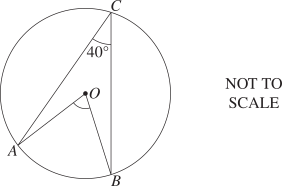
The points \(A\), \(B\) and \(C\) lie on a circle with centre \(O\), as shown in the diagram.

The size of \(\angle ACB\) is 40°.

 What is the size of \(\angle AOB\)?

  1. \(20^{\circ}\)
  2. \(40^{\circ}\)
  3. \(70^{\circ}\)
  4. \(80^{\circ}\)
Show Answers Only

\(D\)

Show Worked Solution

\(\angle AOB = 2 \times 40 = 80^{\circ}\)

\(\text{(angles at centre and circumference on arc}\ AB\text{)}\) 

\(\Rightarrow D\)

Filed Under: 2. Plane Geometry EXT1, Circle Geometry Tagged With: Band 1, num-title-ct-patha, num-title-qs-hsc, smc-4240-10-Angles on arcs

Combinatorics, EXT1 A1 2011 HSC 2e

Alex’s playlist consists of 40 different songs that can be arranged in any order.  

  1. How many arrangements are there for the 40 songs?    (1 mark)

    --- 1 WORK AREA LINES (style=lined) ---

  2. Alex decides that she wants to play her three favourite songs first, in any order.
  3. How many arrangements of the 40 songs are now possible?   (1 mark)

    --- 2 WORK AREA LINES (style=lined) ---

Show Answers Only
  1. `40!`
  2. `6 xx 37!`
Show Worked Solution
i.    `#\ text(Arrangements) = 40!`


ii.    `#\ text(Arrangements)` `= 3! xx 37!`
    `= 6 xx 37!`

Filed Under: Permutations and Combinations (Ext1), Permutations and Combinations EXT1 Tagged With: Band 1, Band 4, smc-1082-10-Ordered Combinations, smc-1082-20-Unordered Combinations

Financial Maths, STD2 F1 2010 HSC 23d

Warrick has a net income of $590 per week. He has created a budget to help manage his money.

       2010 23d

  1. Find the value of `X`, the amount that Warrick allocates towards electricity each week.    (1 mark)

    --- 1 WORK AREA LINES (style=lined) ---

  2. Warrick has an unexpectedly high telephone and internet bill. For the last three weeks, he has put aside his savings as well as his telephone and internet money to pay the bill.


    How much money has he put aside altogether to pay the bill?    (1 mark)

    --- 2 WORK AREA LINES (style=lined) ---

  3. The bill for the telephone and internet is $620. It is due in two weeks time. Warrick realises he has not put aside enough money to pay the bill.


    How could Warrick reallocate non-essential funds in his budget so he has enough money to pay the bill? Justify your answer with suitable reasons and calculations.   (3 marks)

    --- 6 WORK AREA LINES (style=lined) ---

Show Answers Only
  1. `$25`
  2. `text(Warwick has put aside $240 to pay the bill.)`
  3. `text(Warwick could reallocate funds for Entertainment and`
  4.  

    `text(Clothes and Gifts to pay the bill.)`

Show Worked Solution
i.    `X` `= 590 ` `-(175 + 45 + 10 + 15 + 90`
      `+ 40 + 30 + 70 + 50 + 40)`
    `= 590-565`
    `= $25`


ii.    `text(Weekly Amount)` `= 40 + 40`
    `= 80`
`text{Total (3 weeks)}` `= 3 xx 80`
  `= 240`

 
`:.\ text(Warwick has put aside $240 to pay the bill.)`


(iii)   `text(Amount required less amount put aside)`
  `= 620\-240`
  `= $380`

 
`text(Extra 2 weeks of savings and telephone)`

`= 2 xx (40 + 40)`

`= $160`
 

`:.\ text(Funds to be reallocated)`

`= 380\-160`

`= 220\ text(over 2 weeks)`

`= $110\ text(per week)`
 

`text(Non essential items are Entertainment)`

`text(and Clothes and Gifts)`

`text(Amount)` `= 70 + 50`
  `= $120\ text(per week)`


`:.\ text(Warwick could reallocate funds for Entertainment)`

`text(and Clothes and Gifts to pay the bill.)`

Filed Under: Budgeting (Std2-2027), Earning Money and Budgeting (Std 1), Earning Money and Budgeting (Std 2), FM1 - Earning money Tagged With: Band 1, Band 3, Band 4, smc-1126-30-Budgeting, smc-6279-10-Personal Budget, smc-810-30-Budgeting

Algebra, STD2 A2 2011 HSC 23b

Sticks were used to create the following pattern. 

The number of sticks used is recorded in the table.

\begin{array} {|l|c|}
\hline
\rule{0pt}{2.5ex} \text{Shape $(S)$} \rule[-1ex]{0pt}{0pt} & \;\;\; 1 \;\;\; & \;\;\; 2 \;\;\; & \;\;\; 3 \;\;\; \\
\hline
\rule{0pt}{2.5ex} \text{Number of sticks $(N)$}\; \rule[-1ex]{0pt}{0pt} & \;\;\; 5 \;\;\; & \;\;\; 8 \;\;\; & \;\;\; 11 \;\;\; \\
\hline
\end{array}

  1. Draw Shape 4 of this pattern.  (1 mark)

    --- 4 WORK AREA LINES (style=lined) ---

  2. How many sticks would be required for Shape 100?    (1 mark)

    --- 3 WORK AREA LINES (style=lined) ---

  3. Is it possible to create a shape in this pattern using exactly 543 sticks?


    Show suitable calculations to support your answer.    (2 marks)

    --- 5 WORK AREA LINES (style=lined) ---

Show Answers Only
  1. `text(See Worked Solutions.)`
  2. `302`
  3. `text(No)`
Show Worked Solution

  i.     `text(Shape 4 is shown below:)`

ii.     `text(S)text(ince)\ \ N=2+3S`

♦ Mean mark 48%.
MARKER’S COMMENT: Students should attempt to find a “rule” in such questions, and use this formula to solve the question, as per the Worked Solution.  
`text(If)\ \ S` `=100`,
`N` `=2+(3xx100)`
  `=302`


iii.    `543` `=2+3S`
  `3S` `=541`
  `S` `=180 1/3`


`text(S)text(ince S is not a whole number, 543 sticks)`

`text(will not create a figure.)`

Filed Under: AM1 - Algebra (Prelim), Linear Equations and Basic Graphs (Std 1), Linear Equations and Basic Graphs (Std 2) Tagged With: Band 1, Band 4, Band 5, smc-1118-30-Patterns, smc-792-30-Patterns

  • 1
  • 2
  • Next Page »

Copyright © 2014–2025 SmarterEd.com.au · Log in