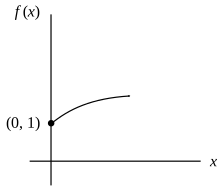
The graphs of \(y=f(x)\) and \(y=g(x)\) are sketched on the same set of axes below.
Which of the following could be the graph of \(y=(g \circ f)(x)\) ?
Aussie Maths & Science Teachers: Save your time with SmarterEd
The graphs of \(y=f(x)\) and \(y=g(x)\) are sketched on the same set of axes below.
Which of the following could be the graph of \(y=(g \circ f)(x)\) ?
\(C\)
\(\text{Consider possible functions for each graph.}\)
\(y=f(x) \ \Rightarrow \ y=-x\)
\(y=g(x) \ \Rightarrow \ y=x(x+1)(x-1)(x-2)\)
\(\text{By CAS, sketch \(g(f(x))\) using the possible functions given above.}\)
\(\Rightarrow C\)
Consider \(f: R \rightarrow R, f(x)=2 x^2+x-1\) and \(g: R \rightarrow R, g(x)=\sin (x)\).
The inequality \((f \circ g)(x)>0\) is satisfied when
\(C\)
\(f(g(x))=2 \sin ^2(x)+\sin (x)-1\)
\(\text{Let} \ \ a=\sin (x)\)
\(f(g(x))=2 a^2+a-1\)
\(\text {Solve simultaneously for \(a\) (by CAS):}\)
\(2 a^2+a-1>0\ …\ (1)\)
\(-1 \leqslant a \leqslant 1\ …\ (2)\)
\(\therefore \frac{1}{2}<a \leqslant 1\)
\(\Rightarrow C\)
Consider the functions \(f\) and \(g\), where \begin{aligned} --- 2 WORK AREA LINES (style=lined) --- --- 3 WORK AREA LINES (style=lined) --- --- 4 WORK AREA LINES (style=lined) --- a. \([-9, \infty)\) b. \(f\circ g(x)=x-9, \text{Domain}\ [0, \infty)\) c. \((-\infty, -3)\cap (3, \infty)\) a. \(\text{Range}\ \rightarrow\ [-9, \infty)\) \(g(x)=\sqrt{x} \ \rightarrow x\ \text{must be }\geq 0\) \(\therefore\ \text{Domain}\ f\circ g(x) \text{ is }[0, \infty)\) \(\text{For }g\circ h(x)\ \text{to exist}\ h(x)\geq 0\) \(x\text{-intercepts for }h(x)\ \text{are } x=-3, 3\) \(\text{and }h(x)\ \text{is positive for } x\leq -3\ \text{and }x\geq 3\) \(\therefore\ \text{Maximal domain} = (-\infty, -3)\cap (3, \infty)\)
& f: R \rightarrow R, f(x)=x^2-9 \\
& g:[0, \infty) \rightarrow R, g(x)=\sqrt{x}
\end{aligned}
b.
\(f\circ g(x)\)
\(=(g(x))^2-9\)
\(=(\sqrt{x})^2-9\)
\(=x-9\)
c.
\(g\circ h(x)\)
\(=\sqrt{h(x)}\)
\(=\sqrt{x^2-9}\)
Let \(f:R \rightarrow R, f(x)=x(x-2)(x+1)\). Part of the graph of \(f\) is shown below.
--- 2 WORK AREA LINES (style=lined) ---
--- 3 WORK AREA LINES (style=lined) ---
--- 4 WORK AREA LINES (style=lined) ---
--- 2 WORK AREA LINES (style=lined) ---
--- 9 WORK AREA LINES (style=lined) ---
a. \((-1, 0), (0, 0), (2, 0)\)
b. \(\Bigg(\dfrac{1-\sqrt{7}}{3}, \dfrac{2(7\sqrt{7}-10}{27}\Bigg), \Bigg(\dfrac{1+\sqrt{7}}{3}, \dfrac{-2(7\sqrt{7}-10}{27}\Bigg)\)
c.i. \(x=2,\ \text{or}\ x=\dfrac{-1\pm \sqrt{5}}{2}\)
c.ii. \(\text{Let }a=\dfrac{-1-\sqrt{5}}{2}\ \text{and }b=\dfrac{-1+\sqrt{5}}{2}\)
\(\text{Then}\ A=\displaystyle\int_a^b (x-2)(x^2+x-1)\,dx+\displaystyle\int_b^2 -(x-2)(x^2+x-1)\,dx\)
c.iii. \(5.95\)
d. \(\text{1st case }\rightarrow \ a=\dfrac{2\sqrt{7}+1}{3}, b=\dfrac{1-\sqrt{7}}{3}\)
\(\text{2nd case }\rightarrow \ a=\dfrac{-2\sqrt{7}+1}{3}, b=\dfrac{1+\sqrt{7}}{3}\)
a. \((-1, 0), (0, 0), (2, 0)\)
b. \(\text{Using CAS solve for}\ x:\)
\(\dfrac{d}{dx}(x(x-2)(x+1))=0\)
\(\therefore\ x=\dfrac{1-\sqrt{7}}{3}\ \text{and }x=\dfrac{1+\sqrt{7}}{3}\)
\(\text{Substitute }x\ \text{values into }f(x)\ \text{using CAS to get}\ y\ \text{values}\)
\(\text{The stationary points of }f\ \text{are}:\)
\(\Bigg(\dfrac{1-\sqrt{7}}{3}, \dfrac{2(7\sqrt{7}-10}{27}\Bigg), \Bigg(\dfrac{1+\sqrt{7}}{3}, \dfrac{-2(7\sqrt{7}-10}{27}\Bigg)\)
ci \(\text{Given }f(x)=g(x)\)
| \(x(x-2)(x+1)\) | \(=x-2\) |
| \(x(x-2)(x+1)(x-2)\) | \(=0\) |
| \((x-2)(x(x+1)-1)\) | \(=0\) |
| \((x-2)(x^2+x-1)\) | \(=0\) |
\(\therefore\ \text{Using CAS: } \)
\(x=2,\ \text{or}\ x=\dfrac{-1\pm \sqrt{5}}{2}\)
cii \(\text{Area of bounded region:}\)
\(\text{Let }a=\dfrac{-1-\sqrt{5}}{2}\ \text{and }b=\dfrac{-1+\sqrt{5}}{2}\)
\(\text{Then}\ A=\displaystyle\int_a^b (x-2)(x^2+x-1)\,dx+\displaystyle\int_b^2 -(x-2)(x^2+x-1)\,dx\)
| ciii | \(\text{Solve the integral in c.ii above using CAS:}\) |
| \(\text{Total area}=5.946045..\approx 5.95\) |
d. \(\text{Method 1 – Equating coefficients}\)
\((x-a)(x-b)^2=x(x-2)(x+1)+k\)
\(x^3-2bx^2-ax^2+b^2x+2abx-ab^2=x^3-x^2-2x+k\)
\((x^3-(a+2b)x^2+(2ab+b^2)x-ab^2=x^3-x^2-2x+k\)
\(\therefore\ -(a+2b)=-1\ \to\ a=1-2b …(1)\)
\(2ab+b^2=-2\ \ …(2)\)
\(\text{Substitute (1) into (2) and solve for }b.\)
| \(2b(1-2b)+b^2\) | \(=-2\) |
| \(3b^2-2b-2\) | \(=0\) |
| \(b\) | \(=\dfrac{1\pm \sqrt{7}}{3}\) |
| \(\text{When }b\) | \(=\dfrac{1+\sqrt{7}}{3}\) |
| \(a\) | \(=1-2\Bigg(\dfrac{1+\sqrt{7}}{3}\Bigg)=\dfrac{-2\sqrt{7}+1}{3}\) |
| \(\text{When }b\) | \(=\dfrac{1-\sqrt{7}}{3}\) |
| \(a\) | \(=1-2\Bigg(\dfrac{1-\sqrt{7}}{3}\Bigg)=\dfrac{2\sqrt{7}+1}{3}\) |
\(\text{Method 2 – Using transformations}\)
\(\text{The squared factor in }(x-a)(x-b)^2=x(x-2)(x+1)+k,\)
\(\text{shows that the turning point is on the }x\ \text{axis}.\)
\(\therefore\ \text{Lowering }f(x)\ \text{by }\dfrac{2(7\sqrt{7}-10)}{27}\ \text{and raising }f(x)\ \text{by }\dfrac{2(7\sqrt{7}+10)}{27}\)
\(\text{will give the 2 possible sets of values for }a\ \text{and}\ b.\)
\(\text{1st case – lowering using CAS solve }h(x) =0\ \rightarrow\ h(x)=f(x)-\dfrac{2(7\sqrt{7}-10)}{27}\)
\(\therefore\ x-\text{intercepts}\rightarrow \ a=\dfrac{2\sqrt{7}+1}{3}, b=\dfrac{1-\sqrt{7}}{3}\)
\(\text{2nd case – raising using CAS solve }h(x) =0\ \rightarrow\ h(x)=f(x)+\dfrac{2(7\sqrt{7}+10)}{27}\)
\(\therefore\ x-\text{intercepts}\rightarrow \ a=\dfrac{-2\sqrt{7}+1}{3}, b=\dfrac{1+\sqrt{7}}{3}\)
Let \(f(x)=\log_{e}\Bigg(x+\dfrac{1}{\sqrt{2}}\Bigg)\).
Let \(g(x)=\sin(x)\) where \(x\in (-\infty, 5)\).
The largest interval of \(x\) values for which \((f\circ g)(x)\) and \((g\circ f)(x)\) both exist is
\(A\)
\(f(x)=\log_e\Bigg(x+\dfrac{1}{\sqrt{2}}\Bigg)\ \text{and }g(x)=\sin(x)\ \text{for}\ x\in (-\infty, 5)\)
\(1.\ \ (f \circ g)(x)=\log_e\Bigg(\sin(x)+\dfrac{1}{\sqrt{2}}\Bigg)\)
| \(\to\ \) | \(\sin(x)+\dfrac{1}{\sqrt{2}}\) | \(>0\) |
| \(\sin(x)\) | \(>-\dfrac{1}{\sqrt{2}}\) | |
| \(\therefore\ x\) | \(\in\Bigg(-\dfrac{\pi}{4}, \dfrac{5\pi}{4}\Bigg)\cup \Bigg(-\dfrac{9\pi}{4}, -\dfrac{9\pi}{4}\Bigg)\cup\dots\ = \Bigg(-\dfrac{\pi}{4}+2\pi k, \dfrac{5\pi}{4}+2\pi k\Bigg)\) |
\(2.\ \ (g \circ f)(x)=\sin\Bigg(\log_e\Bigg(x+\dfrac{1}{\sqrt{2}}\Bigg)\Bigg)\)
| \(\to\ \) | \(\log_e\Bigg(x+\dfrac{1}{\sqrt{2}}\Bigg)\) | \(<5\) |
| \(x\) | \(=e^5-\dfrac{1}{\sqrt{2}}\) | |
| \(\therefore\ x\) | \(\in \bigg(-\dfrac{1}{\sqrt{2}},e^5-\dfrac{1}{\sqrt{2}}\Bigg)\) |
\(\text{Largest interval of }x\ \text{for which both }(f \circ g)(x)\ \text{and }(g \circ f)(x)\text{ exist is:}\)
\(\Bigg(-\dfrac{\pi}{4}+2\pi k, \dfrac{5\pi}{4}+2\pi k\Bigg)\cap \bigg(-\dfrac{1}{\sqrt{2}},e^5-\dfrac{1}{\sqrt{2}}\Bigg)\)
\(=\bigg(-\dfrac{1}{\sqrt{2}}, \dfrac{5\pi}{4}\Bigg)\)
\(\Rightarrow A\)
Let `f` and `g` be functions such that `f(-1)=4, \ f(2)=5, \ g(-1)=2, \ g(2)=7` and `g(4)=6`.
The value of `g(f(-1))` is
`D`
`f(-1)=4`
`g(f(-1)) = g(4) = 6`
`=>D`
Let `g(x) = x + 2` and `f(x) = x^2 - 4`
If `h` is the composite function given by `h : [–5, –1) to R, h(x) = f(g(x))`, then the range of `h` is
`E`
| `h(x)` | `= (x + 2)^2 – 4` |
| `= x^2 + 4x` |
`text{By CAS, graph} \ \ y = x^2 + 4x , \ x∈ [–5, –1)`
`text{Min at} \ (–2, –4)`
`text{Max at} \ (–5, 5)`
`:. \ text{Range of} \ h(x) ∈ [–4, 5]`
`=> E`
Let `f(x) = -x^2 + x + 4` and `g(x) = x^2-2`.
--- 4 WORK AREA LINES (style=lined) ---
| a. `f(3)` | `= -3^2 + 3 + 4` |
| `= -2` |
| `g(f(3))` | `= g(-2)` |
| `= (-2)^2-2` | |
| `= 2` |
| b. `f(g(x))` | `= -(x^2-2)^2 + (x^2-2) + 4` |
| `= -(x^4-4x^2 + 4) + x^2 + 2` | |
| `= -x^4 + 5x^2-2` |
Let `f` and `g` be two functions such that `f(x) = 2x` and `g(x + 2) = 3x + 1`.
The function `f (g(x))` is
`D`
| `g(x + 2)` | `= 3x + 1` |
| `g((x – 2) + 2)` | `= 3(x – 2) + 1` |
| `g(x)` | `= 3x – 5` |
| `f(x)` | `= 2x` |
| `f(g(x))` | `= 2(3x – 5)` |
| `= 6x – 10` |
`=> D`
Let `f` and `g` be functions such that `f (2) = 5`, `f (3) = 4`, `g(2) = 5`, `g(3) = 2` and `g(4) = 1`.
The value of `f (g(3))` is
`D`
| `f(g(3))` | `=f(2)` |
| `=5` |
`=> D`
Let `f: [0, oo) -> R,\ f(x) = sqrt(x + 1)`.
--- 1 WORK AREA LINES (style=lined) ---
--- 4 WORK AREA LINES (style=lined) ---
--- 2 WORK AREA LINES (style=lined) ---
a. `text(Sketch of)\ \ f(x):`
`:.\ text(Range)\ \ (f) = [1, oo)`
b.i. `text(Sketch)\ \ g(x) = (x + 1) (x + 3)`
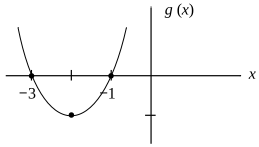
`text(Domain of)\ \ f(x)=[0,oo)`
`text(Find domain of)\ \ g(x)\ \ text(such that Range)\ (g) = [0, oo)`
`text(Graphically, this occurs when)\ \ g(x)\ \ text(has domain:)`
`=> x ∈ (–oo, –3] ∪ [–1,oo)`
`:. c = -3`
b.ii. `text(Range)\ g(x) = [0, oo) = text(Domain)\ \ f(x)`
`:.\ text(Range)\ \ f(g(x)) = [1, oo)`
c. `text(Range)\ h(x) = [3, oo)`
| `f(3)` | `= sqrt (3 + 1)` |
| `= sqrt 4` | |
| `= 2` |
`:.\ text(Range)\ \ f(h(x)) = [2, oo)`
Let `g(x) = x^2 + 2x - 3 and f(x) = e^(2x + 3).`
Then `f(g(x))` is given by
`D`
`text(Solution 1)`
`text(Define)\ \ f(x) and g(x)\ \ text(on CAS)`
`f(g(x)) = e^(2x^2 + 4x – 3)`
`=> D`
`text(Solution 2)`
| `f(g(x))` | `=e^(2 xx (x^2 + 2x – 3)+3)` |
| `= e^(2x^2 + 4x – 3)` |
`=>D`
Let `f : (0, ∞) → R`, where `f(x) = log_e(x)` and `g: R → R`, where `g (x) = x^2 + 1`.
--- 2 WORK AREA LINES (style=lined) ---
ii. State the domain and range of `h`. (2 marks)
--- 3 WORK AREA LINES (style=lined) ---
--- 6 WORK AREA LINES (style=lined) ---
--- 5 WORK AREA LINES (style=lined) ---
--- 7 WORK AREA LINES (style=lined) ---
--- 2 WORK AREA LINES (style=lined) ---
| a.i. | `h(x)` | `= f(x^2 + 1)` |
| `= log_e(x^2 + 1)` |
a.ii. `text(Domain)\ (h) =\ text(Domain)\ (g) = R`
| `text(For)\ x ∈ R` | `-> x^2 + 1 >= 1` |
| `-> log_e(x^2 + 1) >= 0` |
`:.\ text(Range)\ (h) = [0,∞)`
| a.iii. | `text(LHS)` | `= h(x) + h(−x)` |
| `= log_e(x^2 _ 1) + log_e((-x)^2 + 1)` | ||
| `= log_e(x^2 + 1) + log_e(x^2 + 1)` | ||
| `= 2log_e(x^2 + 1)` |
| `text(RHS)` | `= f((x^2 + 1)^2)` |
| `= 2log_e(x^2 + 1)` |
`:. h(x) + h(-x) = f((g(x))^2)\ \ text(… as required)`
a.iv. `text(Stationary points when)\ \ h^{prime}(x) = 0`
`text(Using Chain Rule:)`
| `h^{prime}(x)` | `= (2x)/(x^2 + 1)` |
`:.\ text(S.P. when)\ \ x=0`
`text(Find nature using 1st derivative test:)`
`:.\ text{Minimum stationary point at (0, 0)}.`
b.i. `text(Let)\ \ y = k(x)`
`text(Inverse: swap)\ x ↔ y`
| `x` | `= log_e(y^2 + 1)` |
| `e^x` | `= y^2 + 1` |
| `y^2` | `= e^x-1` |
| `y` | `= ±sqrt(e^x-1)` |
`text(But range)\ \ (k^(-1)) =\ text(domain)\ (k)`
`:.k^(-1)(x) =-sqrt(e^x-1)`
b.ii. `text(Range)\ (k^(-1)) =\ text(Domain)\ (k) = (-∞,0]`
`text(Domain)\ (k^(-1)) =\ text(Range)\ (k) = [0,∞)`
If `f(x) = 1/2e^(3x) and g(x) = log_e(2x) + 3` then `g (f(x))` is equal to
`D`
`text(Define)\ \ f(x)= 1/2e^(3x), \ g(x)= log_e(2x) + 3`
| `g(f(x))` | `= log_e(2 xx 1/2e^(3x)) + 3` |
| `=log_e e^(3x) + 3` | |
| `=3x + 3` | |
| `= 3 (x + 1)` |
`=> D`
Let `f(x) = x^2 + 1 and g(x) = 2x + 1.` Write down the rule of `f(g(x)).` (1 mark)
`(2x + 1)^2 + 1`
| `f (g(x))` | `=f(2x+1)` |
| `= (2x + 1)^2 + 1` |
Let `f: R -> R,\ \ f(x) = e^(2x)-1`.
--- 5 WORK AREA LINES (style=lined) ---
--- 0 WORK AREA LINES (style=lined) ---
--- 5 WORK AREA LINES (style=lined) ---
a. `text(Let)\ \ y = f(x)`
`text(For Inverse, swap)\ x ↔ y`
| `x` | `= e^(2y)-1` |
| `x + 1` | `= e^(2y)` |
| `2y` | `= log_e(x + 1)` |
| `y` | `= 1/2 log_e(x + 1)` |
| `text(Domain)(f^(-1))` | `=\ text(Range)\ (f)` |
| `= (-1,∞)` |
`:. f^(-1)(x) = 1/2log_e(x + 1),quadx ∈ (-1,∞)`
b. `f(f^(-1)(x)) = x`
`text(Domain is)\ \ (-1, oo)`
| c. | `-f^(-1)(2x)` | `= -1/2 ln(2x + 1)` |
| `:. f(-f^(-1)(2x))` | `= e^(-log_e(2x + 1))-1` | |
| `=(2x+1)^-1-1` | ||
| `= 1/(2x + 1)-1` | ||
| `= (-2x)/(2x + 1)` |
If the function `f` has the rule `f(x) = sqrt (x^2-9)` and the function `g` has the rule `g(x) = x + 5`
--- 4 WORK AREA LINES (style=lined) ---
| a. | `f(g(x))` | `= sqrt {(x + 5)^2-9}` |
| `= sqrt (x^2 + 10x + 16)` | ||
| `= sqrt {(x + 2) (x + 8)}` |
`:. c = 2, d = 8 or c = 8, d = 2`
b. `text(Find)\ x\ text(such that:)`
`(x+2)(x+8) >= 0`
`(x + 2) (x + 8) >= 0\ \ text(when)`
`x <= -8 or x >= -2`
`:.\ text(Maximal domain is:)`
`x in (– oo, – 8] uu [– 2, oo)`