SmarterEd

Aussie Maths & Science Teachers: Save your time with SmarterEd

  • Login
  • Get Help
  • About

Measurement, STD2 M1 2019 HSC 24

Amanda uses 80 kilocalories of energy per kilometre while she is running.

She eats a burger that contains 2180 kilojoules of energy. How many kilometres will she need to run to use up all the energy from the burger? Give your answer correct to one decimal place. (1 kilocalorie = 4.184 kilojoules)  (2 marks)

--- 4 WORK AREA LINES (style=lined) ---
Show Answers Only

`6.5\ text{km  (1 d.p.)}`

Show Worked Solution
`text(Kilocalories in burger)` `= 2180/4.184`
  `~~ 521.032…`

 
`:.\ text(Kilometres required to run)`

`= 521.032/80`

`= 6.51…`

`= 6.5\ text{km  (1 d.p.)}`

Filed Under: Energy and Mass (Std 2) Tagged With: Band 3, smc-799-10-Calories/Joules

Financial Maths, 2ADV M1 2019 HSC 11d

What is the limiting sum of the following geometric series?

`2000 - 1200 + 720 - 432…`  (2 marks)

Show Answers Only

`1250`

Show Worked Solution

`text(GP): \ r = T_2/T_1 = (-1200)/2000 = -3/5`

`|\ r\ | <  1`

`S_oo` `= a/(1 – r)`
  `= 2000/(1 + 3/5)`
  `= 1250`

Filed Under: Geometric Series (Y12) Tagged With: Band 3, smc-1006-40-Limiting Sum, smc-1006-70-Calculations Only

Calculus, 2ADV C1 2019 HSC 11c

Differentiate  `(2x + 1)/(x + 5)`.  (2 marks)

--- 5 WORK AREA LINES (style=lined) ---

Show Answers Only

`9/(x + 5)^2`

Show Worked Solution

`text(Using quotient rule:)`

`u=2x+1,`     `v=x+5`  
`u^{′} = 2,`     `v^{′} = 1`  
     
`y^{′}` `= (u^{′} v-v^{′} u)/v^2`
  `= (2(x + 5)-(2x + 1))/(x + 5)^2`
  `= (2x + 10-2x-1)/(x + 5)^2`
  `= 9/(x + 5)^2`

Filed Under: Standard Differentiation (Adv-2027), Standard Differentiation (Y11) Tagged With: Band 3, smc-1069-10-Quotient Rule, smc-6436-10-Quotient Rule

Financial Maths, STD2 F1 2019 HSC 7 MC

Julia earns $28 per hour. Her hourly pay rate increases by 2%.

How much will she earn for a 4-hour shift with this increase?

  1. $2.24
  2. $28.56
  3. $112
  4. $114.24
Show Answers Only

`D`

Show Worked Solution
`text(Hourly rate)` `= 28 xx 1.02`
  `= $28.56`


`:.\ text(Shift earnings)` `= 4 xx 28.56`
  `= $114.24`

`=> D`

Filed Under: Earning and Spending Money, Earning Money and Budgeting (Std 2), Tax and Percentage Increase/Decrease (Std 1), Tax and Percentage Increase/Decrease (Std 2), Ways of Earning (Std1-2027), Ways of Earning (Std2-2027) Tagged With: Band 3, num-title-ct-corea, num-title-qs-hsc, smc-1125-30-% Increase/Decrease, smc-1126-10-Wages, smc-4331-10-Wages, smc-4331-70-% increase/decrease, smc-6276-10-Wages/Salaries, smc-6515-10-Wages/Salaries, smc-810-10-Wages, smc-831-30-% Increase/Decrease

Financial Maths, STD2 F1 2019 HSC 6 MC

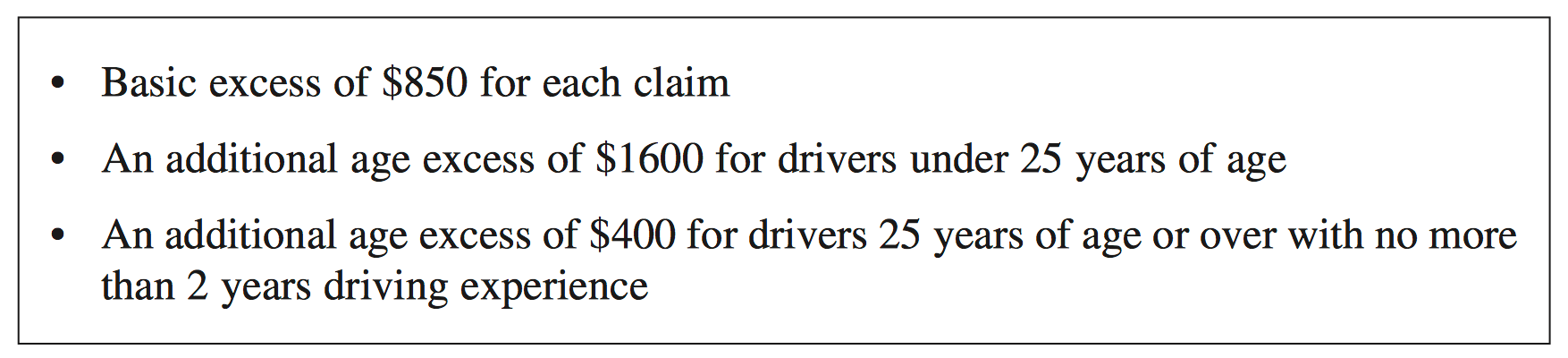
Mary is 18 years old and has just purchased comprehensive motor vehicle insurance. The following excesses apply to claims for at-fault motor vehicle accidents.

 
How much would Mary be required to pay as excess if she made a claim as the driver at fault in a car accident?

  1. $1600
  2. $850 + $400
  3. $850 + $1600
  4. $850 + $1600 + $400
Show Answers Only

`C`

Show Worked Solution

`text(Mary’s excess = 850 + 1600)`

`text{($400 does not apply as Mary is under 25.)}`

`=> C`

Filed Under: Earning Money and Budgeting (Std 1), Earning Money and Budgeting (Std 2), Purchasing Goods (Std1-2027), Purchasing Goods (Std2-2027) Tagged With: Band 3, smc-1126-40-Insurance, smc-6278-20-Stamp Duty/Insurance, smc-6517-20-Stamp Duty/Insurance, smc-810-40-Insurance

Measurement, STD2 M7 2019 HSC 2 MC

Sugar is sold in four different sized packets.

Which is the best buy?

  1.  100 g for $0.40
  2.  500 g for $1.65
  3.  1 kg for $3.50
  4.  2 kg for $6.90
Show Answers Only

`B`

Show Worked Solution

`text(Price per kilogram:)`

`100\ text(g) -> 10 xx 0.40 = $4.00`

`500\ text(g) -> 2 xx 1.65 = $3.30`

`1\ text(kg) -> $3.50`

`2\ text(kg) -> 6.90 ÷ 2 = $3.45`

`=> B`

Filed Under: Rates (Std2) Tagged With: Band 3, smc-805-50-Best Buys

Statistics, STD2 S4 2019 HSC 23

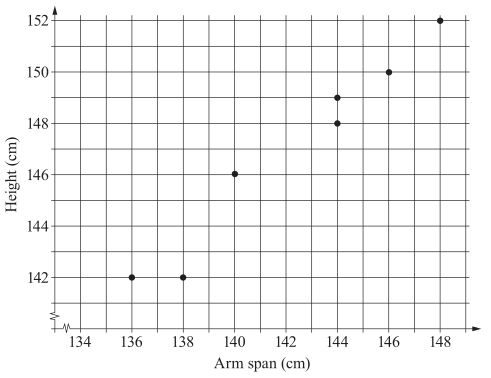
A set of bivariate data is collected by measuring the height and arm span of seven children. The graph shows a scatterplot of these measurements.


  1. Calculate Pearson's correlation coefficient for the data, correct to two decimal places.  (1 mark)

    --- 1 WORK AREA LINES (style=lined) ---

  2. Identify the direction and the strength of the linear association between height and arm span.  (1 mark)

    --- 2 WORK AREA LINES (style=lined) ---

  3. The equation of the least-squares regression line is shown.
     
               Height = 0.866 × (arm span) + 23.7
     
    A child has an arm span of 143 cm.


    Calculate the predicted height for this child using the equation of the least-squares regression line.  (1 mark)

    --- 1 WORK AREA LINES (style=lined) ---

Show Answers Only
  1. `0.98\ \ (text(2 d.p.))`
  2. `text(Direction: positive)`
    `text(Strength: strong)`
  3. `147.538\ text(cm)`
Show Worked Solution

a.   `text{Use  “A + Bx”  function (fx-82 calc):}`

♦ Mean mark 40%.
COMMENT: Issues here? YouTube has short and excellent help videos – search your calculator model and topic – eg. “fx-82 correlation” .

`r` `= 0.9811…`
  `= 0.98\ \ (text(2 d.p.))`


b.   `text(Direction: positive)`

`text(Strength: strong)`


c.    `text(Height)` `= 0.866 xx 143 + 23.7`
    `= 147.538\ text(cm)`

Filed Under: Bivariate Data Analysis (Y12), S4 Bivariate Data Analysis (Y12) Tagged With: Band 3, Band 4, Band 5, common-content, smc-1001-30-Correlation, smc-1001-40-Pearson's, smc-1001-70-Calculator (Stats Mode), smc-785-30-Correlation, smc-785-40-Pearson's, smc-785-70-Calculator (Stats Mode)

Measurement, STD2 M7 2019 HSC 18

Andrew, Brandon and Cosmo are the first three batters in the school cricket team. In a recent match, Andrew scored 30 runs, Brandon scored 25 runs and Cosmo scored 40 runs.

  1. What is the ratio of Andrew's to Brandon's to Cosmo's runs scored, in simplest form?  (2 marks)

    --- 4 WORK AREA LINES (style=lined) ---
  2. In this match, the ratio of the total number of runs scored by Andrew, Brandon and Cosmo to the total number of runs scored by the whole team is `19:36`.
  3. How many runs were scored by the whole team?  (2 marks)

    --- 4 WORK AREA LINES (style=lined) ---

Show Answers Only
  1. `6:5:8`
  2. `180\ text(runs)`
Show Worked Solution
a.    `A:B:C` `= 30:25:40`
    `= 6:5:8`


b.    `text(Total runs by)\ A,B,C` `= 30 + 25 + 40`
    `= 95`


`text(Let)\ R` `=\ text(team runs)`
`R/95` `= 36/19`
`:. R` `= (36 xx 95)/19`
  `= 180\ text(runs)`

Filed Under: Ratio and Scale (Std2) Tagged With: Band 3, Band 4, smc-1187-10-Ratio (2 part), smc-1187-20-Ratio (3 part)

Functions, 2ADV F1 2019 HSC 2 MC

What values of  `x`  satisfy  `4-3x <= 12`?

  1. `x <= -16/3`
  2. `x >= -16/3`
  3. `x <= -8/3`
  4. `x >= -8/3`
Show Answers Only

`D`

Show Worked Solution
`4-3x` `<= 12`
`-3x` `<= 8`
`x` `>= -8/3` 

 
`=>  D`

Filed Under: Further Functions and Relations (Y11), Inequalities, Linear Functions (Adv-2027) Tagged With: Band 3, num-title-ct-pathb, num-title-qs-hsc, smc-4385-10-Linear, smc-6214-08-Inequalities, smc-987-20-Inequalities

Functions, 2ADV F1 2019 HSC 1 MC

What is the value of  `pi^10`  to two significant figures?

  1. `9.36 xx 10^4`
  2. `9.4 xx 10^4`
  3. `9.36 xx 10^5`
  4. `9.4 xx 10^5`
Show Answers Only

`B`

Show Worked Solution
`pi^10` `= 93648.04…`
  `= 9.4 xx 10^4`

`=>  B`

Filed Under: Algebraic Techniques (Adv-2027), Algebraic Techniques (Y11) Tagged With: Band 3, smc-6213-60-Rounding, smc-983-10-Rounding

Vectors, EXT1 V1 SM-Bank 9

The diagram shows a projectile fired at an angle  `theta`  to the horizontal from the origin `O` with initial velocity  `V\ text(ms)^(−1)`.
 

The position vector for the projectile is given by
 

`qquad underset~s(t) = Vtcosthetaunderset~i + (Vtsintheta - 1/2 g t^2)underset~j`     (DO NOT prove this)
 

where `g` is the acceleration due to gravity.

  1.  Show the horizontal range of the projectile is

    `qquad (V^2sin2theta)/g`  (2 marks)

    --- 5 WORK AREA LINES (style=lined) ---

The projectile is fired so that  `theta = pi/3`.

  1.  State whether the projectile is travelling upwards or downwards when

    `qquad t = (2V)/(sqrt3g)`  (1 mark)

    --- 5 WORK AREA LINES (style=lined) ---

Show Answers Only
  1. `text(See Worked Solutions)`
  2. `text(Downwards – See Worked Solutions)`
Show Worked Solution

i.   `text(Time of flight when)`

`underset~j\ text(component of)\ underset~v = 0`

`Vtsintheta – 1/2 g t^2` `= 0`
`t(Vsintheta – 1/2 g t)` `= 0`
`1/2g t` `= Vsintheta`
`t` `= (2Vsintheta)/g`

 
`text(Range) \ => \ underset~i\ text(component of)\ underset~s`

`text(when) \ \ t = (2Vsintheta)/g`

`text(Range)` `= V · ((2Vsintheta)/g) · costheta`
  `= (V^2)/g · 2sinthetacostheta`
  `= (V^2sin2theta)/g`


ii.   `text(Time of flight) = (2Vsin\ pi/3)/g = (sqrt3 V)/g`

`text(S)text(ince parabolic path is symmetrical,)`

`=>\ text(Upwards if)\ \ t < (sqrt3 V)/(2g)`

`=>\ text(Downwards if)\ \ t > (sqrt3 V)/(2g)`

`:. \ text(At)\ \ t = (2V)/(sqrt3 g), text(travelling downwards)`

`text(as) \ \ 2/sqrt3 · V/g > sqrt3/2 · V/g`

Filed Under: Vectors and Projectile Motion (Ext1) Tagged With: Band 3, Band 5, smc-1087-10-Range

Vectors, EXT1 V1 SM-Bank 6

A cricketer hits a ball at time  `t = 0`  seconds from an origin `O` at ground level across a level playing field.

The position vector  `underset ~s(t)`, from `O`, of the ball after `t` seconds is given by
 
  `qquad underset ~s(t) = 15t underset ~i + (15 sqrt 3 t - 4.9t^2)underset ~j`,
 
where,  `underset ~i`  is a unit vector in the forward direction, `underset ~j`  is a unit vector vertically up and displacement components are measured in metres.

  1. Find the initial velocity of the ball and the initial angle, in degrees, of its trajectory to the horizontal.  (2 marks)

    --- 5 WORK AREA LINES (style=lined) ---

  2. Find the maximum height reached by the ball, giving your answer in metres, correct to two decimal places.  (2 marks)

    --- 4 WORK AREA LINES (style=lined) ---
  3. Find the time of flight of the ball. Give your answer in seconds, correct to three decimal places.  (1 mark)

    --- 2 WORK AREA LINES (style=lined) ---

  4. Find the range of the ball in metres, correct to one decimal place.  (1 mark)

    --- 2 WORK AREA LINES (style=lined) ---

  5. A fielder, more than 40 m from `O`, catches the ball at a height of 2 m above the ground.


    How far horizontally from `O` is the fielder when the ball is caught? Give your answer in metres, correct to one decimal place.  (2 marks)

    --- 5 WORK AREA LINES (style=lined) ---

Show Answers Only
  1. `underset ~v (0) = 15 underset ~i + 15 sqrt 3 underset ~j`


    `theta = pi/3 = 60^@`

  2. `34.44\ text(m)`
  3. `5.302\ text(s)`
  4. `79.5\ text(m)`
  5. `78.4\ text(m)`
Show Worked Solution

a.   `underset ~v (t) = underset ~ dot s (t) = 15 underset ~i + (15 sqrt 3 – 9.8t)underset ~j`

`text(Initial velocity occurs when)\ \ t=0:`

`:. underset ~v (0) = 15 underset ~i + 15 sqrt 3 underset ~j`
 

`text(Let)\ \ theta = text(Initial trajectory,)`

`tan theta` `=(15sqrt3)/15`  
  `=sqrt3`  
`:. theta` `=pi/3\ \ text(or)\ \ 60^@`  


b.  `text(Max height)\ =>underset~j\ \ text(component of)\ \ underset ~v=0.`

`15 sqrt 3 – 9.8t` `=0`
`t` `=(15 sqrt 3)/9.8`
  `=2.651…`

 
`text(Find max height when)\ \ t = 2.651…`

`:.\ text(Max height)` `= 15 sqrt 3 xx 2.651 – 4.9 xx (2.651)^2`
  `~~ 34.44\ text(m)`


c.   `text(Ball travels in symmetrical parabolic path.)`

`:.\ text(Total time of flight)`

`= 2 xx (15 sqrt 3)/9.8`

`= (15 sqrt 3)/4.9`

`~~ 5.302\ text(s)`
 

d.  `text(Range)\ =>underset~i\ \ text(component of)\ \ underset~s(t)\ \ text(when)\ \ t= (15 sqrt 3)/4.9`

`:.\ text(Range)` `= 15 xx (15 sqrt 3)/4.9`
  `= (225 sqrt 3)/4.9`
  `~~ 79.5\ text(m)`


e.
   `text(Find)\ t\ text(when height of ball = 2 m:)`

`15 sqrt 3 t – 4.9t^2` `=2`  
`4.9t^2 – 15 sqrt 3 t + 2` `=0`  


  `t=(15 sqrt 3 +- sqrt ((15 sqrt 3)^2 – 4 xx 4.9 xx2))/(2 xx 4.9)`  
     

`t ~~ 0.078131\ \ text(or)\ \ t ~~ 5.22406`

 
`text(When)\ \ t=0.0781,`

`x= 15 xx 0.0781 = 1.17\ text(m)\ \ text{(no solution →}\ x<40 text{)}`
 

 `text(When)\ \ t=5.2241,`

`x=15 xx 5.2241 = 78.4\ text(m)`
 

`:.\ text(Ball is caught 78.4 m horizontally from)\ O.`

Filed Under: Vectors and Projectile Motion (Ext1) Tagged With: Band 3, Band 4, Band 5, smc-1087-10-Range, smc-1087-20-Maximum Height, smc-1087-30-Time of Flight, smc-1087-40-Initial Angle

Statistics, EXT1 S1 2012 MET2 3

Steve and Jess are two students who have agreed to take part in a psychology experiment. Each has to answer several sets of multiple-choice questions. Each set has the same number of questions, `n`, where `n` is a number greater than 20. For each question there are four possible options A, B, C or D, of which only one is correct.

  1. Steve decides to guess the answer to every question, so that for each question he chooses A, B, C or D at random.


    Let the random variable `X` be the number of questions that Steve answers correctly in a particular set.

    1. What is the probability that Steve will answer the first three questions of this set correctly?  (1 mark)

      --- 1 WORK AREA LINES (style=lined) ---

    2. Use the fact that the variance of `X` is `75/16` to show that the value of `n` is 25.  (1 mark)

      --- 2 WORK AREA LINES (style=lined) ---

  1. The probability that Jess will answer any question correctly, independently of her answer to any other question, is  `p\ (p > 0)`. Let the random variable `Y` be the number of questions that Jess answers correctly in any set of 25.

    If   `P(Y > 23) = 6 xx P(Y = 25)`, show that the value of  `p=5/6`.  (2 marks)

    --- 5 WORK AREA LINES (style=lined) ---

Show Answers Only

a.i.  `1/64`

a.ii.  `text(See Worked Solutions)`

b.  `text(See Worked Solutions)`

Show Worked Solution
a.i.    `Ptext{(3 correct in a row)}` `= (1/4)^3`
    `= 1/64`


a.ii.    `text(Var)(X)` `= np(1 – p)`
  `75/16` `= n(1/4)(3/4)`
  `75` `= 3n`
  `:. n` `= 25`


b.   `Y ∼\ text(Bin)(25,p)`

♦♦♦ Mean mark part (c) 19%.
`P(Y > 23)` `= 6xx P(Y = 25)`
`P(Y = 24) + P(Y = 25)` `= 6xx P(Y = 25)`
`P(Y = 24)` `= 5xx P(Y = 25)`
`((25),(24))p^24(1 – p)^1` `= 5p^25`
`25p^24(1 – p)` `= 5p^25`
`25p^24-25p^25-5p^25` `=0`
`25p^24-30p^25` `=0`
`5p^24(5 – 6p)` `= 0`

 
`:. p = 5/6,\ \ (p>0)\ \ text(… as required)`

Filed Under: Statistics and Binomial Distributions (Ext1) Tagged With: Band 3, Band 4, Band 6, smc-1199-30-Find n/p given E(X)/Var(X)

Functions, 2ADV F2 EQ-Bank 9

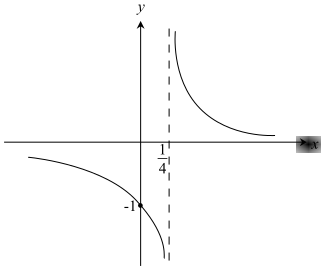
Consider the function  `f(x) = 1/(4x - 1)`.

  1. Find the domain of  `f(x)`.  (1 mark)

    --- 1 WORK AREA LINES (style=lined) ---

  2. Sketch  `f(x)`, showing all asymptotes and intercepts?  (2 marks)

    --- 8 WORK AREA LINES (style=lined) ---

Show Answers Only
  1. `{text(all real)\ x,  x!=1/4}`
  2.   
Show Worked Solution
i.    `4x – 1` `!= 0`
  `x` `!= 1/4`

 
`:.\ text(Domain:)\ {text(all real)\ x,  x!=1/4}`


ii.   `text(When)\ \ x = 0, \ y = −1`

`text(As)\ \ x -> ∞, \ y -> 0^+`

`text(As)\ \ x -> −∞, \ y -> 0^−`

Filed Under: Non-Calculus Graphing (Y12), Reciprocal Functions (Adv-2027) Tagged With: Band 3, Band 4, smc-1009-10-Quotient Function, smc-6382-30-Sketch Graph

Functions, 2ADV’ F2 2012 HSC 13b

  1. Find the horizontal asymptote of the graph  `y=(2x^2)/(x^2 + 9)`.   (1 mark)

    --- 1 WORK AREA LINES (style=lined) ---

  2. Without the use of calculus, sketch the graph  `y=(2x^2)/(x^2 + 9)`, showing the asymptote found in part (i).    (2 marks)

    --- 8 WORK AREA LINES (style=lined) ---

Show Answers Only
  1. `text(Horizontal asymptote at)\ y = 2`
  2.  
    Geometry and Calculus, EXT1 2012 HSC 13b Answer
Show Worked Solution
i.    `y` `= (2x^2)/(x^2 +9)`
    `= 2/(1 + 9/(x^2))`


`text(As)\ \ x -> oo,\ y ->2`

`text(As)\ \ x -> – oo,\ y -> 2`

`:.\ text(Horizontal asymptote at)\ y = 2`


ii.    `text(At)\ \ x = 0,\ y = 0`

`f(x) = (2x^2)/(x^2 + 9) >= 0\ text(for all)\ x`

`f(–x) = (2(–x)^2)/((–x)^2 + 9) = (2x^2)/(x^2 + 9) = f(x)`

`text(S)text(ince)\ \ f(x) = f(–x) \ \ =>\ text(EVEN function)`

Geometry and Calculus, EXT1 2012 HSC 13b Answer

Filed Under: Non-Calculus Graphing (Y12) Tagged With: Band 3, Band 4, smc-1009-10-Quotient Function, smc-1009-60-Even Functions

Calculus, EXT1 C3 2015 SPEC2 12

Find  `y`  given  `dy/dx = 1 - y/3`  and  `y = 4`  when  `x = 2`.   (2 marks)

--- 6 WORK AREA LINES (style=lined) ---

Show Answers Only

`y= 3 + e^((2 – x)/3)`

Show Worked Solution
`(dy)/(dx)` `= (3 – y)/3`
`(dx)/(dy)` `= 3/(3 – y)`
`x` `= int 3/(3 – y)\ dy`
`x/3` `= -ln |3 – y| + c`

 
`text(Given)\ \ y=4\ \ text(when)\ \ x=2:`

`2/3= -ln|-1| + c`

`c=2/3`
 

` x/3` `=-ln |3 – y| +2/3`
`ln|3-y|` `= (2-x)/3`
`3-y` `= ±e^((2 – x)/3)`
`:. y` `= 3 + e^((2 – x)/3)`

Filed Under: Equations and Slope Fields Tagged With: Band 3, smc-1197-20-Differential Equations, smc-1197-40-dy/dx = f(y)

Vectors, EXT2 V1 2014 SPEC1 1

Consider the vector  `underset ~a = sqrt 3 underset ~i - underset ~j - sqrt 2 underset ~k`, where  `underset ~i, underset ~j`  and  `underset ~k`  are unit vectors in the positive directions of the `x, y` and `z` axes respectively.

  1.  Find the unit vector in the direction of  `underset ~a`.  (1 mark)

    --- 2 WORK AREA LINES (style=lined) ---

  2.  Find the acute angle that  `underset ~a`  makes with the positive direction of the `x`-axis.  (2 marks)

    --- 4 WORK AREA LINES (style=lined) ---

  3.  The vector  `underset ~b = 2 sqrt 3 underset ~i + m underset ~j - 5 underset ~k`.


     Given that  `underset ~b`  is perpendicular to  `underset ~a,` find the value of `m`.  (2 marks)

    --- 2 WORK AREA LINES (style=lined) ---
Show Answers Only
  1. `1/sqrt 6 (sqrt 3 underset ~i – underset ~j – sqrt 2 underset ~k)`
  2. `theta = 45^@`
  3. `m = 6 + 5 sqrt 2`
Show Worked Solution
i.    `|underset ~a|` `= sqrt((sqrt 3)^2 + (-1)^2 + (-sqrt 2)^2)`
    `= sqrt 6`
`:. hat underset ~a` `= underset ~a/|underset ~a|`
  `= 1/sqrt 6 (sqrt 3 underset ~i – underset ~j – sqrt 2 underset ~k)`


Mean mark part (b) 51%.

ii.    `underset ~a ⋅ underset ~i` `= sqrt 3 xx 1 = sqrt 3`
  `underset ~a ⋅ underset ~i` `= |underset ~a||underset ~i| cos theta`
    `= sqrt 6 cos theta`
  `sqrt 3` `= sqrt 6 cos theta`
`cos theta` `= 1/sqrt 2`
`:. theta` `= pi/4 = 45^@`


iii.   `underset ~a ⋅ underset ~b = sqrt 3 (2 sqrt 3) + (-1)(m) + (-sqrt 2)(-5) = 0`

`6 – m + 5 sqrt 2` `=0`  
`:. m` `=6 + 5 sqrt 2`  

Filed Under: Basic Concepts and Arithmetic Tagged With: Band 3, Band 4, smc-1195-20-Angles Between Vectors, smc-1195-30-Perpendicular Vectors, smc-1195-40-Unit Vectors and Projections

Vectors, EXT2 V1 2013 SPEC1 3

The coordinates of three points are  `A\ ((– 1), (2), (4)), \ B\ ((1), (0), (5)) and C\ ((3), (5), (2)).`

  1. Find  `vec (AB).`  (1 mark)

    --- 2 WORK AREA LINES (style=lined) ---
  2. The points `A, B` and `C` are the vertices of a triangle. 


    Prove that the triangle has a right angle at `A.`  (2 marks)

    --- 4 WORK AREA LINES (style=lined) ---
  3. Find the length of the hypotenuse of the triangle.  (1 mark)

    --- 5 WORK AREA LINES (style=lined) ---
Show Answers Only
  1. `2underset~i – 2underset~j + underset~k`
  2. `text(Proof)\ \ text{(See Worked Solutions)}`
  3. `sqrt 38`
Show Worked Solution
i.   `vec(AB)` `=(1 – −1)underset~i + (0 – 2)underset~j + (5 – 4)underset~k`
    `= 2underset~i – 2underset~j + underset~k`


ii.    `overset(->)(AC)` `= (3 – −1)underset~i + (5 – 2)underset~j + (2 – 4)underset~k`
    `= 4underset~i + 3underset~j – 2underset~k`


`overset(->)(AB) · overset(->)(AC)` `= 2 xx 4 + (−2) xx 3 + 1 xx (−2)`
  `= 8 – 6 – 2`
  `= 0`

 
`=>  overset(->)(AB) ⊥ overset(->)(AC)`

`:. DeltaABC\ text(has a right angle at)\ A.`
 

iii.    `overset(->)(BC)` `= (3 – 1)underset~i + (5 – 0)underset~j + (2 – 5)underset~k`
    `= 2underset~i + 5underset~j – 3underset~k`


`|overset(->)(BC)|` `= sqrt(2^2 + 5^2 + (−3)^2)`
  `= sqrt(4 + 25 + 9)`
  `= sqrt38`

Filed Under: Basic Concepts and Arithmetic Tagged With: Band 3, Band 4, smc-1195-10-Basic Calculations, smc-1195-30-Perpendicular Vectors

Vectors, EXT2 V1 SM-Bank 12

Two vectors are given by  `underset ~a = 4 underset ~i + m underset ~j - 3 underset ~k`  and  `underset ~b = −2 underset ~i + n underset ~j - underset ~k`, where  `m`, `n in R^+`.

If  `|\ underset ~a\ | = 10`  and  `underset ~a`  is perpendicular to  `underset ~b`, then find `m` and `n`.   (2 marks)

--- 6 WORK AREA LINES (style=lined) ---
Show Answers Only

`m=5sqrt3, \ n=sqrt3/3`

Show Worked Solution

`text(Using)\ \ |\ underset ~a\ | = 10:`

`10` `= sqrt(4^2 + m^2 + (-3)^2)`
`100` `=m^2 +25`
`m` `= 5sqrt3`

 
`text(S)text(ince)\ \ underset ~a _|_ underset ~b :`

`underset ~a ⋅ underset ~b` `= 0`
`0` `=4 xx (−2) + mn + (−3) xx (−1)`
`0` `= mn-5`
`n` `=5/(5sqrt3)`
  `=sqrt3/3`


Filed Under: Basic Concepts and Arithmetic Tagged With: Band 3, smc-1195-10-Basic Calculations, smc-1195-30-Perpendicular Vectors

Vectors, EXT2 V1 SM-Bank 5

Find the value(s) of  `m`  so that the vectors  `underset~a = 2underset~i + m underset~j - 3underset~k`  and  `underset~b = m^2underset~i - underset~j + underset~k`  are perpendicular.   (2 marks)

Show Answers Only

`m = 3/2, quad m = -1`

Show Worked Solution

`underset ~a ⊥ underset ~b\ \ =>\ \ underset ~a ⋅ underset ~b=0`

`underset ~a ⋅ underset ~b` `= 2m^2 + m(-1) + (-3)(1)`
`0` `= 2m^2 – m – 3`
`0` `= (2m – 3)(m + 1)`

 
`:. m = 3/2, quad m = -1`

Filed Under: Basic Concepts and Arithmetic Tagged With: Band 3, smc-1195-30-Perpendicular Vectors

Vectors, EXT2 V1 SM-Bank 4

Consider the three vectors

`underset ~a = underset ~i - underset ~j + 2underset ~k,\ underset ~b = underset ~i + 2 underset ~j + m underset ~k`  and  `underset ~c = underset ~i + underset ~j - underset ~k`, where  `m in R.`

  1. Find the value(s) of `m` for which  `|\ underset ~b\ | = 2 sqrt 3.`  (2 marks)
  2. Find the value of `m` such that  `underset ~a`  is perpendicular to  `underset ~b.`  (1 mark)
Show Answers Only
  1. `+- sqrt 7`
  2. `1/2`
Show Worked Solution
i.    `|underset~b|` `= sqrt(1^2 + 2^2 + m^2)` `= 2sqrt3`
    `1 + 4 + m^2` `= 4 xx 3`
    `m^2` `= 7`
    `m` `= ±sqrt7`


ii.    `underset~a * underset~b` `= 1 xx 1 + (−1) xx 2 + 2 xx m`  
  `0` `= 1 – 2 + 2m\ \ ( underset~a ⊥ underset~b)`  
  `2m` `= 1`  
  `m` `= 1/2`  

Filed Under: Basic Concepts and Arithmetic Tagged With: Band 3, smc-1195-10-Basic Calculations, smc-1195-30-Perpendicular Vectors

Vectors, EXT2 V1 2013 SPEC2 14 MC

The distance from the origin to the point  `P(7,−1,5sqrt2)`  is

A.   `7sqrt2`

B.   `10`

C.   `6 + 5sqrt2`

D.   `100`

Show Answers Only

`B`

Show Worked Solution
`d` `= sqrt((7 – 0)^2 + (−1 – 0)^2 + (5sqrt2 – 0)^2)`
  `= sqrt(49 + 1 + 25 xx 2)`
  `= 10`

 
`=> B`

Filed Under: Basic Concepts and Arithmetic Tagged With: Band 3, smc-1195-10-Basic Calculations

Vectors, EXT2 V1 2012 SPEC2 16 MC

The distance between the points  `P(−2 ,4, 3)`  and  `Q(1, −2, 1)`  is

A.   `7`

B.   `sqrt 21`

C.   `sqrt 31`

D.   `49`

Show Answers Only

`A`

Show Worked Solution
`d` `= sqrt((-2 – 1)^2 + (4 – (-2))^2 + (3 – 1)^2)`
  `= sqrt(9 + 36 + 4)`
  `= 7`

 
`=> A`

Filed Under: Basic Concepts and Arithmetic Tagged With: Band 3, smc-1195-10-Basic Calculations

Vectors, EXT2 V1 2011 SPEC2 12 MC

The angle between the vectors  `3underset~i + 6underset~j - 2underset~k`  and  `2underset~i - 2underset~j + underset~k`, correct to the nearest tenth of a degree, is

A.       2.0°

B.     91.0°

C.   112.4°

D.   121.3°

Show Answers Only

`C`

Show Worked Solution

`|3underset~i + 6underset~j – 2underset~k| = sqrt(9 + 36 + 4) = sqrt49 = 7`

`|2underset~i – 2underset~j + underset~k| = sqrt(4 + 4 + 1) = sqrt9 = 3`

`(3underset~i + 6underset~j – 2underset~k) * (2underset~i – 2underset~j + underset~k)`

`= 3 xx 2 + 6 xx (−2) + (−2) xx 1`

`= 6 – 12 – 2`

`= -8`
  

`costheta` `= ((3tildei + 6tildej – 2tildek).(2tildei – 2tildej + tildek))/(|\ 3tildei + 6tildej – 2tildek\ ||\ 2tildei – 2tildej + tildek\ |)`
  `= −8/21`
`:. theta` `= cos^(−1)(−8/12)`
  `~~ 112.4^@`

 
`=> C`

Filed Under: Basic Concepts and Arithmetic Tagged With: Band 3, smc-1195-20-Angles Between Vectors

Functions, EXT1 F1 EQ-Bank 13

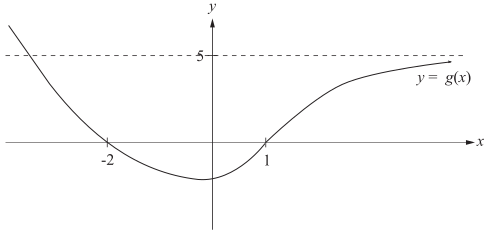
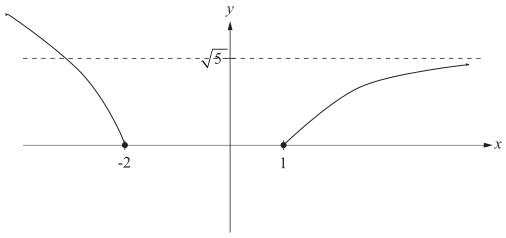
The diagram shows the graph of the function `g(x).`


Draw a half page graph of  `y = sqrt(g(x)),` showing any asymptotes and stating its domain and range.  (2 marks)

Show Answers Only

Show Worked Solution

`text(Domain:)\ {x <= −2 \ ∪\  x >= 1}`

`text(Range:)\ {y >= 0}`

Filed Under: Reflections and Harder Graphs (Ext1) Tagged With: Band 3, smc-1072-20-y = root f(x); y^2 = f(x)

Functions, EXT1 F1 SM-Bank 12

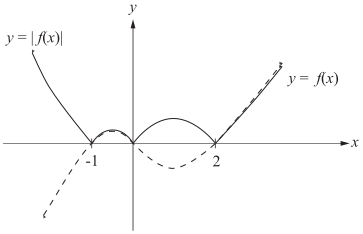
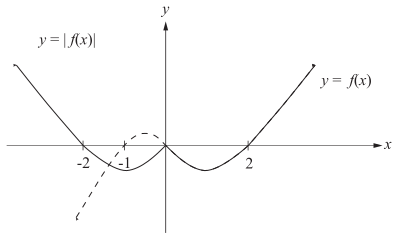
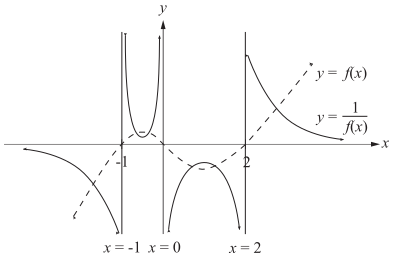
Given  `f(x) = x^3 - x^2 - 2x`, without calculus sketch a separate half page graph of the following functions, showing all asymptotes and intercepts.

  1.   `y = |\ f(x)\ |`  (1 mark)

    --- 8 WORK AREA LINES (style=lined) ---
  2.   `y = f(|x|)`  (2 marks)

    --- 8 WORK AREA LINES (style=lined) ---
  3.    `y = 1/(f(x))`  (2 marks)

    --- 10 WORK AREA LINES (style=lined) ---

Show Answers Only
  1.  
  2.   
  3.   
Show Worked Solution
i.    `f(x)` `= x^3 – x^2 – 2x`
    `= x(x^2 – x – 2)`
    `= x(x – 2)(x + 1)`


ii.   

 
`y = f(|x|)\ text(is a reflection of)\ y = f(x)\ text(for)\ x > 0`

`text(is the)\ ytext(-axis.)`


iii.

Filed Under: Reflections and Harder Graphs (Ext1) Tagged With: Band 3, Band 4, smc-1072-10-y = 1 / f(x), smc-1072-30-y = | f(x) |; y = f( |x| )

Functions, EXT1 F1 EQ-Bank 11

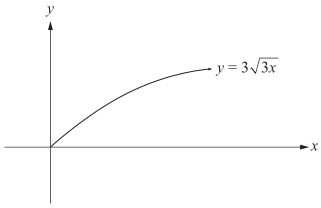
  1. Find the function described by the following parametric equations


        `x = 3t^2` 


        `y = 9t, \ \ t > 0`  (1 mark)

    --- 4 WORK AREA LINES (style=lined) ---
  2. Sketch the function.  (1 mark)

    --- 6 WORK AREA LINES (style=lined) ---
Show Answers Only
  1. `y = 3sqrt(3x), (t > 0)`
  2.   
Show Worked Solution

i.   `y = 9t \ \ => \ \ t = y/9`

`x` `= 3t^2`
`x` `= 3 · (y/9)^2`
`x` `= y^2/27`
`y^2` `= 27x`
`y` `= 3sqrt(3x), \ \ (t > 0)`

 
ii. 

Filed Under: Parametric Functions (Ext1) Tagged With: Band 3, smc-1034-20-Other Functions

Functions, EXT1 F1 SM-Bank 9

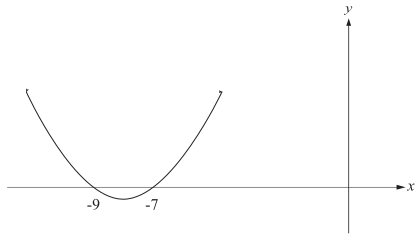
  1. Sketch the graph of the function described by the parametric equations


          `x = 4t - 7`


          `y = 2t^2 + t`  (2 marks)

    --- 8 WORK AREA LINES (style=lined) ---
  2. State the domain and range of the function.  (1 mark)

    --- 2 WORK AREA LINES (style=lined) ---

Show Answers Only
  1.  
  2. `text(Domain:  all)\ x`
    `text(Range)\ {y: −1/8 <= y < ∞}`
Show Worked Solution

i.   `x = 4t – 7 \ \ => \ \ t = (x + 7)/4`

`y` `= 2t^2 + t`
`y` `= 2((x + 7)/4)^2 + ((x + 7)/4)`
`16y` `= 2(x + 7)^2 + 4(x + 7)`
`16y` `= 2x^2 + 28x + 98 + 4x + 28`
`16y` `= 2x^2 + 32x + 126`
`8y` `= x^2 + 16x + 63`
`y` `= 1/8(x + 7)(x + 9)`

 
`=>\ text(Equation is a concave up quadratic with)`

`text(zeros at)\ \ x = −9\ text(and)\ \ x = −7.`


ii.   `text(Axis at)\ \ x = −8`

`:.\ y_text(min)` `= 1/8(−1)(1)`
  `= −1/8`

 
`text(Domain: all)\ x`

`text(Range:)\ −1/8 <= y < ∞`

Filed Under: Parametric Functions (Ext1) Tagged With: Band 3, Band 4, smc-1035-10-Quadratic

Functions, EXT1 F1 EQ-Bank 10

An equation can be expressed in the parametric form

`x = 2costheta - 1`

`y = 2 + 2sintheta`

  1.  Express the equation in Cartesian form.  (2 marks)

    --- 4 WORK AREA LINES (style=lined) ---
  2.  Sketch the graph.  (1 mark)

    --- 6 WORK AREA LINES (style=lined) ---

Show Answers Only
  1. `(x + 1)^2 + (y – 2)^2 = 4`
  2.    
Show Worked Solution
i.    `2costheta` `= x + 1`
  `costheta` `= (x + 1)/2`
`2sintheta` `= y – 2`
`sintheta` `= (y – 2)/2`

 
`text(Using)\ \ cos^2theta + sin^2 = 1:`

`((x + 1)/2)^2 + ((y – 2)/2)^2` `= 1`
`(x + 1)^2 + (y – 2)^2` `= 4`


ii.  `text{Sketch circle with centre (−1, 2),  radius = 2}`
 

Filed Under: Parametric Functions (Ext1) Tagged With: Band 3, smc-1035-20-Circles

Functions, EXT1 F1 SM-Bank 8

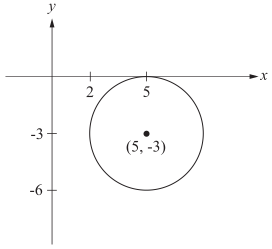
A circle has the equation  `x^2 - 10x + y^2 + 6y +25 = 0`

  1.  Express the circle in parametric form.  (2 marks)

    --- 4 WORK AREA LINES (style=lined) ---
  2.  Sketch the circle.  (1 mark)

    --- 8 WORK AREA LINES (style=lined) ---
Show Answers Only
  1. `x = 5 + 3costheta`
    `y = −3 + 3sintheta`
  2.   
Show Worked Solution
i.    `x^2 – 10x + y^2 + 6y+25` `= 0`
  `(x – 5)^2 + (y + 3)^2 – 9` `= 0`
  `(x – 5)^2 + (y + 3)^2` `= 9`

 
`=>\ text{Circle centre (5, −3),  radius 3}`
 

`:.\ text(Parametric form is:)`

`x = 5 + 3costheta`

`y = −3 + 3sintheta`


ii.  

Filed Under: Parametric Functions (Ext1) Tagged With: Band 3, smc-1035-20-Circles, smc-1035-40-Cartesian to Parametric

Functions, 2ADV F2 SM-Bank 5 MC

The point  `P\ text{(4, −3)}`  lies on the graph of a function  `f(x)`. The graph of  `f(x)`  is translated four units vertically up and then reflected in the `y`-axis.

The coordinates of the final image of `P` are

  1. `(-4, 1)`
  2. `(-4, 3)`
  3. `(0, -3)`
  4. `(4, -6)`
Show Answers Only

`A`

Show Worked Solution

`text(1st transformation:)`

`P(4,−3)\ ->\ (4,1)`
 

`text(2nd transformation:)`

`(4,1)\ ->\ (-4,1)`
 

`=>   A`

Filed Under: Graph Transformations (Adv-2027), Transformations (Y12) Tagged With: Band 3, smc-1008-50-Other Functions, smc-1008-70-Combinations, smc-6408-25-Other Functions, smc-6408-60-Combinations

Financial Maths, 2ADV M1 SM-Bank 7

Joe buys a tractor under a buy-back scheme. This scheme gives Joe the right to sell the tractor back to the dealer.

The recurrence relation below can be used to calculate the price Joe sells the tractor back to the dealer `(P_n)`, after `n` years
 

`qquad\ \ \ P_0 = 56\ 000,qquadP_n = P_(n - 1) - 7000`
  

  1. Write the general rule to find the value of  `P_n`  in terms of  `n`.  (1 mark)

    --- 2 WORK AREA LINES (style=lined) ---
  2. After how many years will the dealer offer to buy back Joe's tractor at half of its original value.  (1 mark)

    --- 2 WORK AREA LINES (style=lined) ---
Show Answers Only

i.  `P_n = 56\ 000 – 7000n`

ii.  `4\ text(years)`

Show Worked Solution
i.    `P_1` `= P_0 – 7000`
  `P_2` `= P_0 – 7000 – 7000`
    `= 56\ 000 – 7000 xx 2`
  `vdots`  
  `P_n`  `= 56\ 000 – 7000n` 


ii.    `text(Half original value)` `= 56\ 000 ÷ 2=$28\ 000`


`text(Find)\ \ n\ \ text(such that:)`

`28\ 000` `= 56\ 000 – 7000n`
`7000n` `= 28\ 000`
`:. n` `= 4\ text(years)`

Filed Under: Arithmetic Series (Y12) Tagged With: Band 3, smc-1005-50-Recursion

Financial Maths, 2ADV M1 SM-Bank 6

Julie deposits some money into a savings account that will pay compound interest every month.

The balance of Julie’s account, in dollars, after `n` months, `V_n` , can be modelled by the recurrence relation shown below.
 

`V_0 = 12\ 000, qquad V_(n + 1) = 1.0062\ V_n`
 

  1.  Recursion can be used to calculate the balance of the account after one month.


    1. Write down a calculation to show that the balance in the account after one month, `V_1`, is  $12 074.40. (1 mark)

      --- 2 WORK AREA LINES (style=lined) ---
    2. After how many months will the balance of Julie’s account first exceed $12 300  (1 mark)

      --- 2 WORK AREA LINES (style=lined) ---
  2.  A rule of the form  `V_n = a xx b^n`  can be used to determine the balance of Julie's account after `n` months.

    1. Complete this rule for Julie’s investment after `n` months by writing the appropriate numbers in the boxes provided below. (1 mark)
       
balance = 
 
 × 
 
 n


    1. What would be the value of `n` if Julie wanted to determine the value of her investment after three years?  (1 mark)

      --- 1 WORK AREA LINES (style=lined) ---
Show Answers Only

a.i.   `text(Proof)\ \ text{(See Worked Solutions)}`

a.ii.  `4\ text(months)`

b.i  `text(balance) = 12\ 000 xx 1.0062^n`

b.ii.  `36`

Show Worked Solution
a.i.   `V_1` `= 1.0062 xx V_0`
    `= 1.0062 xx 12000`
    `= $12\ 074.40\ text(… as required.)`


a.ii.   `V_2` `= 1.0062 xx 12\ 074.40 = 12\ 149.26`
  `V_3` `= 1.0062 xx 12\ 149.26 = 12\ 224.59`
  `V_4` `= 1.0062 xx 12\ 224.59 = 12\ 300.38`

 
`:.\ text(After 4 months)`

 
b.i.
  `text(balance) = 12\ 000 xx 1.0062^n`

 
b.ii.
  `n = 12 xx 3 = 36`

Filed Under: Geometric Series (Y12) Tagged With: Band 3, Band 4, smc-1006-60-Recursion

Financial Maths, 2ADV M1 SM-Bank 1 MC

On day 1, Vikki spends 90 minutes on a training program.

On each following day, she spends 10 minutes less on the training program than she did the day before.

Let  `t_n`  be the number of minutes that Vikki spends on the training program on day  `n`.

A recursive equation that can be used to model this situation for  `1 ≤ n ≤ 10`  is

A.   `t_(n + 1) = 0.90t_n` `t_1 = 90`
B.   `t_(n + 1) = 1.10 t_n` `t_1 = 90`
C.   `t_(n + 1) = 1 - 10 t_n` `t_1 = 90`
D.   `t_(n + 1) = t_n - 10` `t_1 = 90`


Show Answers Only

`D`

Show Worked Solution

`text(Difference equation where each term is 10 minutes)`

`text(less than the preceding term.)`

`∴\ text(Equation)\ \ \t_(n+1) = t_n-10, \ \ t_1 = 90`

`=>  D`

Filed Under: Arithmetic Series (Y12) Tagged With: Band 3, smc-1005-50-Recursion

Trigonometry, 2ADV T2 SM-Bank 43

Find the exact value of

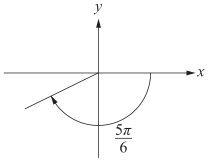
`cot(-(5pi)/6)`.   (2 marks)

--- 5 WORK AREA LINES (style=lined) ---

Show Answers Only

`sqrt3`

Show Worked Solution

`cot(-(5pi)/6)` `= 1/(tan(-(5pi)/6))`
  `= 1/tan(pi/6)`
  `= 1/(1/sqrt3)`
  `= sqrt3`

Filed Under: Exact Trig Ratios (Adv-2027), Exact Trig Ratios (Y11) Tagged With: Band 3, smc-6411-40-cosec/sec/cot, smc-979-40-cosec/sec/cot

Trigonometry, 2ADV T2 SM-Bank 41

Prove that

`(secx + tanx)(secx - tanx) = 1`.  (2 marks)

--- 4 WORK AREA LINES (style=lined) ---

Show Answers Only

`text(See Worked Solutions)`

Show Worked Solution
`text(LHS)` `= (secx + tanx)(secx – tanx)`
  `= sec^2x – tan^2x`
  `= 1/(cos^2x) – (sin^2 x)/(cos^2 x)`
  `= (1 – sin^2 x)/(cos^2 x)`
  `= (cos^2 x)/(cos^2 x)`
  `= 1`
  `=\ text(RHS)`

Filed Under: Trig Identities and Harder Equations (Adv-2027), Trig Identities and Harder Equations (Y11) Tagged With: Band 3, smc-1189-20-Prove Identity, smc-6412-20-Prove Identity

Functions, 2ADV F1 SM-Bank 33

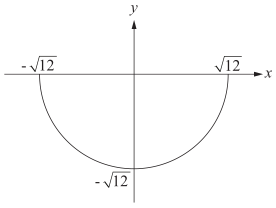
  1.  State the domain and range of  `y = -sqrt(12-x^2)`.   (2 marks)

    --- 2 WORK AREA LINES (style=lined) ---

  2.  Sketch the graph.  (1 mark)

    --- 8 WORK AREA LINES (style=lined) ---

Show Answers Only

i.  `text(Domain:)\ -sqrt12<=x<= sqrt12`

`text(Range:)\ -sqrt12<=y<= 0`

ii.   

Show Worked Solution

i.   `y = -sqrt(12-x^2)`

`text(Domain:)\ -sqrt12<=x<= sqrt12`

`text(Range:)\ -sqrt12<=y<= 0`
 

ii.  

Filed Under: Further Functions and Relations (Y11), Other Functions and Relations (Adv-2027) Tagged With: Band 3, smc-6218-50-Circles/Semicircles, smc-987-40-Square-Root Functions

Functions, 2ADV F1 SM-Bank 30

Given  `f(x) = sqrtx`  and  `g(x) = 25 - x^2`

  1. Find  `g(f(x))`.  (1 mark)

    --- 2 WORK AREA LINES (style=lined) ---

  2. Find the domain and range of  `f(g(x))`.  (2 marks)

    --- 3 WORK AREA LINES (style=lined) ---

Show Answers Only
  1. `25 – x`
  2. `text(Domain:)\ −5<= x <= 5`


    `text(Range:)\ 0<=y<= 5`

Show Worked Solution
i.    `g(f(x))` `= 25 – (f(x))^2`
    `= 25 – (sqrtx)^2`
    `= 25 – x`


ii.    `f(g(x))` `= sqrt(g(x))`
    `= sqrt(25 – x^2)`

 
`:.\ text(Domain:)\ −5<= x <= 5`

`:.\ text(Range:)\ 0<=y<= 5`

Filed Under: Composite Functions (Adv-2027), Composite Functions (Y11) Tagged With: Band 3, Band 4, smc-6216-20-Quadratics, smc-6216-30-Other Functions, smc-6216-40-Domain/Range, smc-986-20-Quadratic, smc-986-30-Other, smc-986-40-Domain/Range

Trigonometry, 2ADV T3 SM-Bank 15

The graphs of  `y = cos (x) and y = a sin (x)`,  where `a` is a real constant, have a point of intersection at  `x = pi/3.`

  1. Find the value of `a`.  (2 marks)

    --- 4 WORK AREA LINES (style=lined) ---

  2. Find the  `x`-coordinate of the other point of intersection of the two graphs, given  `0<=x<= 2 pi`  (1 mark)

    --- 2 WORK AREA LINES (style=lined) ---

Show Answers Only
  1. `1/sqrt 3`
  2. `(4 pi)/3`
Show Worked Solution

i.   `text(Intersection occurs when)\ \ x=pi/3,`

`a sin(pi/3)` `= cos (pi/3)`
`tan(pi/3)` `= 1/a`
`sqrt 3` `=1/a`
`:. a` `=1/sqrt3`


ii.   `tan (x)` `= sqrt 3`
  `x` `= pi/3, (4 pi)/3, 2pi+ pi/3, …`
  `:. x` `= (4 pi)/3\ \ \ (0<= x<= 2 pi)`

Filed Under: Trig Applications (Y12) Tagged With: Band 3, Band 5, smc-1188-30-Other Applications

Trigonometry, 2ADV T3 SM-Bank 14

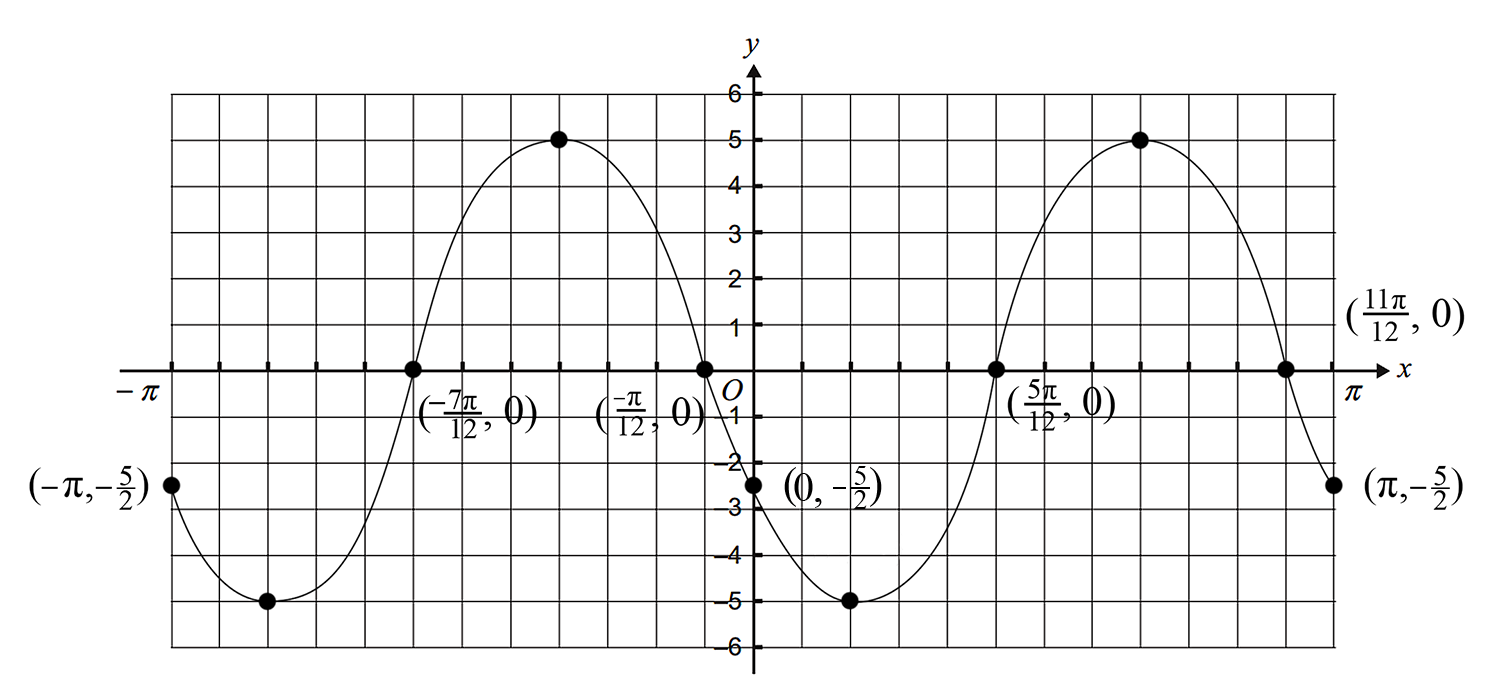
For the function  `f(x) = 5 cos (2 (x + pi/3)),\ \ \ -pi<=x<=pi`

  1. Write down the amplitude and period of the function  (2 marks)

    --- 4 WORK AREA LINES (style=lined) ---

  2. Sketch the graph of the function  `f(x)`  on the set of axes below. Label axes intercepts with their coordinates.


    Label endpoints of the graph with their coordinates.  (3 marks)

VCAA 2006 meth 4b

--- 0 WORK AREA LINES (style=lined) ---

Show Answers Only
  1. `text(Amplitude) = 5;\ \ \ text(Period) = pi`
  2.  
Show Worked Solution

a.   `text(Amplitude) = 5`

`text(Period) = (2 pi)/2 = pi`


b.   `text(Shift)\ \ y = 5 cos (2x)\ \ text(left)\ \ pi/3\ \ text(units).`

`text(Period) = pi`

`text(Endpoints are)\ \ (-pi, -5/2) and (pi,-5/2)`

Filed Under: Trig Graphs (Y12) Tagged With: Band 3, Band 5, smc-977-20-cos

Trigonometry, 2ADV T3 SM-Bank 10

The population of wombats in a particular location varies according to the rule  `n(t) = 1200 + 400 cos ((pi t)/3)`, where `n` is the number of wombats and `t` is the number of months after 1 March 2018.

  1. Find the period and amplitude of the function `n`.  (2 marks)

    --- 4 WORK AREA LINES (style=lined) ---

  2. Find the maximum and minimum populations of wombats in this location.  (2 marks)

    --- 3 WORK AREA LINES (style=lined) ---

  3. Find  `n(10)`.  (1 mark)

    --- 2 WORK AREA LINES (style=lined) ---

  4. Over the 12 months from 1 March 2018, find the fraction of time when the population of wombats in this location was less than  `n(10)`.  (2 marks)

    --- 4 WORK AREA LINES (style=lined) ---

Show Answers Only
  1. `text(Period) = text(6 months);\ text(Amplitude) = 400`
  2. `text(Max) = 1600;\ text(Min) = 800`
  3. `1000`
  4. `1/3`
Show Worked Solution

i.   `text(Period) = (2pi)/n = (2pi)/(pi/3) = 6\ text(months)`

`text(A)text(mplitude) = 400`
 

ii.   `text(Max:)\ 1200 + 400 = 1600\ text(wombats)`

`text(Min:)\ 1200 – 400 = 800\ text(wombats)`
 

iii.    `n(10)` `=1200 + 400 cos ((10 pi)/3)`
    `=1200 + 400 cos ((2 pi)/3)`
    `=1200-400 xx 1/2`
    `= 1000\ text(wombats)`


iv.  `text(Find)\ \ t\ \ text(when)\ \ n(t)=1000`

`1000` `=1200 + 400 cos((pit)/3)`  
`cos((pit)/3)` `=- 1/2`  
`(pit)/3` `=(2pi)/3, (4pi)/3, (8pi)/3, (10pi)/3, … `  
`t` `=2,4,8,10`  

 
`text(S)text(ince)\ \ n(0)=1600,`

`=> n(t)\ \ text(drops below 1000 between)\ \ t=2\ \ text(and)\ \ t=4,`

`text(and between)\ \ t=8\ \ text(and)\ \ t=10.`
 

`:.\ text(Fraction)` `= (2 + 2)/12`
  `= 1/3\ \ text(year)`

Filed Under: Trig Applications (Y12) Tagged With: Band 3, Band 4, Band 5, smc-1188-10-Population

Trigonometry, 2ADV T3 SM-Bank 9

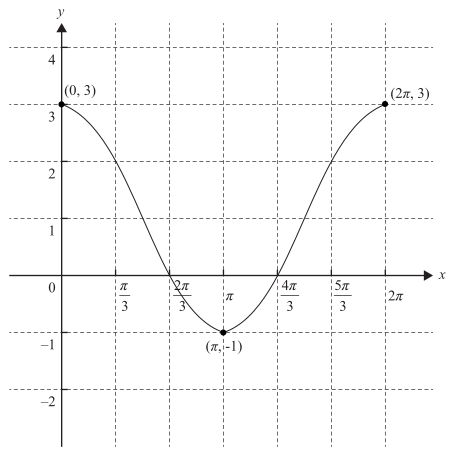
Let   `f(x) = 2cos(x) + 1`  for  `0<=x<=2pi`.

  1. Solve the equation  `2cos(x) + 1 = 0`  for  `0 <= x <= 2pi`.  (2 marks)

    --- 4 WORK AREA LINES (style=lined) ---

  2. Sketch the graph of the function  `f(x)`  on the axes below. Label the endpoints and local minimum point with their coordinates.  (3 marks)


--- 0 WORK AREA LINES (style=lined) ---

Show Answers Only
  1. `(2pi)/3, (4pi)/3`
  2.  
Show Worked Solution
i. `2cos(x) + 1` `= 0`
  `cos(x)` `= −1/2`

`=> cos\ pi/3 = 1/2\ text(and cos is negative)`

`text(in 2nd/3rd quadrant)`

`:.x` `= pi – pi/3, pi + pi/3`
  `= (2pi)/3, (4pi)/3`


ii.   

Filed Under: Trig Graphs (Y12) Tagged With: Band 3, Band 4, smc-977-20-cos

Trigonometry, 2ADV T3 SM-Bank 3 MC

Let  `f (x) = 5sin(2x) - 1`.

The period and range of this function are respectively

  1. `π\ text(and)\ [−1, 4]`
  2. `2π\ text(and)\ [−1, 5]`
  3. `π\ text(and)\ [−6, 4]`
  4. `2π\ text(and)\ [−6, 4]`
Show Answers Only

`C`

Show Worked Solution

`text(Period) = (2pi)/2 = pi`

`text(Range)` `= [−1 – 5, −1 + 5]`
  `= [−6 ,4]`

 
`=> C`

Filed Under: Trig Graphs (Y12) Tagged With: Band 3, smc-977-10-sin

Trigonometry, 2ADV T3 SM-Bank 2 MC

Let   `f(x) = 1 - 2 cos ({pi x}/2).`

The period and range of this function are respectively

  1. `4 and [−2, 2]`
  2. `4 and [−1, 3]`
  3. `1 and [−1, 3]`
  4. `4 pi and [−2, 2]`
Show Answers Only

`B`

Show Worked Solution
`text(Period)` `= (2 pi)/n = (2pi)/(pi/2)=4`
   

`text(Amplitude = 2)`

`text{Graph centre line (median):}\ \ y=1.`

`:.\ text(Range)` `= [1 – 2, quad 1 + 2]`
  `= [−1, 3]`

`=>   B`

Filed Under: Trig Graphs (Y12) Tagged With: Band 3, smc-977-20-cos

Trigonometry, 2ADV T3 SM-Bank 1 MC

`f(x) = 2sin(3x) - 3`

The period and range of this function are respectively

  1. `text(period) = (2 pi)/3 and text(range) = text{[−5, −1]}`
  2. `text(period) = (2 pi)/3 and text(range) = text{[−2, 2]}`
  3. `text(period) = pi/3 and text(range) = text{[−1, 5]}`
  4. `text(period) = 3 pi and text(range) = text{[−1, 5]}`
Show Answers Only

`A`

Show Worked Solution

`text(Range:)\ [−3 -2, −3 + 2]`

`= [−5,−1]`

`text(Period) = (2pi)/n = (2pi)/3`

`=>   A`

Filed Under: Trig Graphs (Y12) Tagged With: Band 3, smc-977-10-sin

Networks, STD2 N3 SM-Bank 38 MC

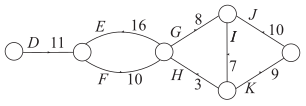
Identify the critical path through this network.


  1. `DEGJ`
  2. `DFHK`
  3. `DFGIK`
  4. `DEGIK`
Show Answers Only

`=> D`

Show Worked Solution

`text(Critical Path is the longest)`

`:. DEGIK`

`=> D`

Filed Under: Critical Paths Tagged With: Band 3, smc-916-20-Forward Scanning

Networks, STD2 N3 SM-Bank 45

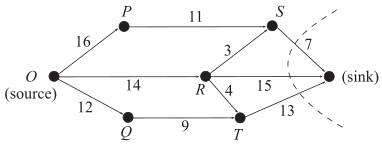
An oil pipeline network is drawn below that shows the flow capacity of oil pipelines in kilolitres per hour.


A cut is shown.

  1. What is the capacity of the cut.  (1 mark)

    --- 1 WORK AREA LINES (style=lined) ---

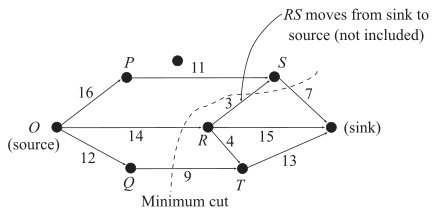
  2. Calculate the minimum cut of this network?  (2 marks)

    --- 3 WORK AREA LINES (style=lined) ---

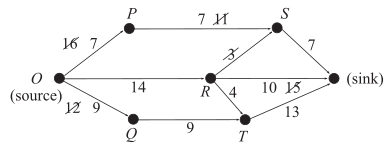
  3. Copy the network diagram, showing the maximum flow capacity of the network by labelling the flow of each edge.  (2 marks)

    --- 8 WORK AREA LINES (style=lined) ---

Show Answers Only
  1. `35`
  2. `text(See Worked Solutions)`
  3.  
Show Worked Solution
i.    `text(Capacity of cut)` `= 7 + 15 + 13`
    `= 35\ text(kL/h)`


ii. 

♦♦ COMMENT: Be very careful! RS is not included as it goes from sink to source.


`text(Minimum cut)` `= 7 + 14 + 9`
  `= 30\ text(kL/h)`


iii.   

Filed Under: Flow Networks and Minimum Cuts Tagged With: Band 3, Band 5, smc-915-10-Min Cut/Max Flow, smc-915-20-Cut Capacity, smc-915-30-Flow Capacity

Calculus, SPEC2 2012 VCAA 3

A car accelerates from rest. Its speed after `T` seconds is `V\ text(ms)^(−1)`, where

`V = 17 tan^(−1)((pi T)/6), T >= 0`

  1. Write down the limiting speed of the car as  `T -> oo`.   (1 mark)

    --- 1 WORK AREA LINES (style=lined) ---

  2. Calculate, correct to the nearest `0.1\ text(ms)^(−2)`, the acceleration of the car when  `T = 10`.   (1 mark)

    --- 2 WORK AREA LINES (style=lined) ---

  3. Calculate, correct to the nearest second, the time it takes for the car to accelerate from rest to `25\ text(ms)^(−1)`.   (2 marks)

    --- 4 WORK AREA LINES (style=lined) ---

After accelerating to `25\text(ms)^(−1)`, the car stays at this speed for 120 seconds and then begins to decelerate while braking. The speed of the car  `t`  seconds after the brakes are first applied is `v\ text(ms)^(−1)` where

`(dv)/(dt) =-1/100 (145-2t),`

until the car comes to rest.

  1. i.  Find `v` in terms of `t`.   (2 marks)

    --- 3 WORK AREA LINES (style=lined) ---

  2. ii. Find the time, in seconds, taken for the car to come to rest while braking.   (2 marks)

    --- 3 WORK AREA LINES (style=lined) ---

  3. i.  Write down the expressions for the distance travelled by the car during each of the three stages of its motion.   (2 marks)

    --- 4 WORK AREA LINES (style=lined) ---

  4. ii. Find the total distance travelled from when the car starts to accelerate to when it comes to rest.


        Give your answer in metres correct to the nearest metre.   (1 mark)

    --- 3 WORK AREA LINES (style=lined) ---

Show Answers Only
  1. `(17 pi)/2`
  2. `0.3`
  3. `19\ text(s)`
  4. i.  `V = t^2/100-(145 t)/100 + 25`
  5. ii. `t_1 = 20\ text(s)`
  6. i.  `d_1 = int_0^19 17 tan^(-1) ((pi T)/6)\ dT`


        `d_2 = 25 xx 120`


        `d_3 = int_0^20 -1/100 [145 t-t^2] + 25\ dt`

  7. ii. `3637\ text(m)`
Show Worked Solution

a.   `text(As)\ \ T->oo,\ \ tan^(-1)((piT)/6)->pi/2`

  `:.underset (T->oo) (limV)` `= (17 pi)/2`


b.  `(dV)/(dt)= (102 pi)/(36 + pi^2 T^2),\ \ \ text{(by CAS)}`
 

`text(When)\ \ T=10:`

`(dV)/(dt)` `= (102 pi)/(36 + 100 pi^2)`
  `~~ 0.3`

 
c.
   `text(Find)\ \ T\ \ text(when)\ \ V=25:`

  `17 tan^(-1) ((pi T)/6)` `=25 `
  `T` `= 18.995\ \ \ text{(by CAS)}`
    `~~ 19\ text(seconds)`


d.i.    `v` `= -1/100 int_0^t 145-2t\ dt`
  `v` `= -1/100 [145 t-t^2] + c`

 
`text(When)\ \ t=0, \ v=25:`

`=> c=25`

`:. v= -1/100 [145 t-t^2] + 25`
 

d.ii.  `text(Find)\ \ t\ \ text(when)\ \ v=0:`

`-1/100[145t-t^2] + 25=0`

`:. t=20\ text(seconds)\ \ \ text{(by CAS)}`


e.i.   `text(Stage 1: car travels from rest to 25 m/s)`

`d_1 = int_0^19 17 tan^(-1) ((pi T)/6)\ dT`
  

`text(Stage 2: car travels at 25 m/s for 120 seconds)`

`d_2` `= 25 xx 120`
  `= 3000`

 
`text(Stage 3: car decelerates for 20 seconds`

`d_3 = int_0^20 -1/100 [145 t-t^2] + 25\ dt`


e.ii.    `d_1` `~~ 400.131`
  `d_2` `= 3000`
  `d_3` `= 236.6`


`text(Total distance)` `= d_1 + d_2 + d_3`
  `~~ 3637\ text(m)`

Filed Under: Motion (SM) Tagged With: Band 3, Band 4, Band 5, smc-1159-10-Motion as f(t)

Complex Numbers, SPEC2 2012 VCAA 2

  1.  Given that  `cos(pi/12) = (sqrt (sqrt 3 + 2))/2`, show that  `sin(pi/12) = (sqrt (2-sqrt 3))/2`.   (2 marks)

    --- 5 WORK AREA LINES (style=lined) ---

  2. Express  `z_1 = (sqrt(sqrt3 + 2))/2 + i(sqrt(2-sqrt3))/2`  in polar form.   (1 mark)

    --- 2 WORK AREA LINES (style=lined) ---

  3. i.  Write down  `z_1^4`  in polar form.   (1 mark)

    --- 2 WORK AREA LINES (style=lined) ---

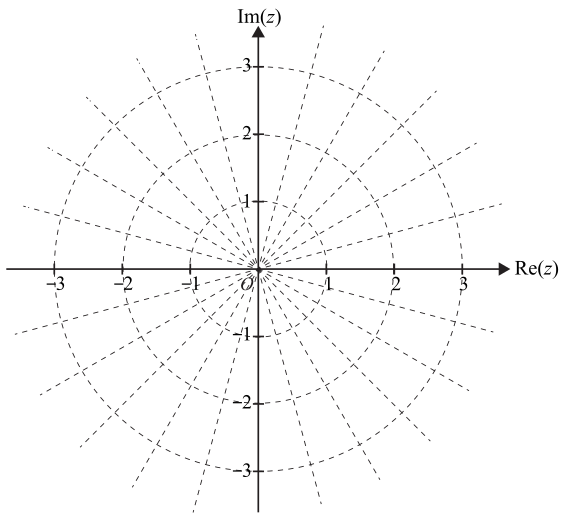
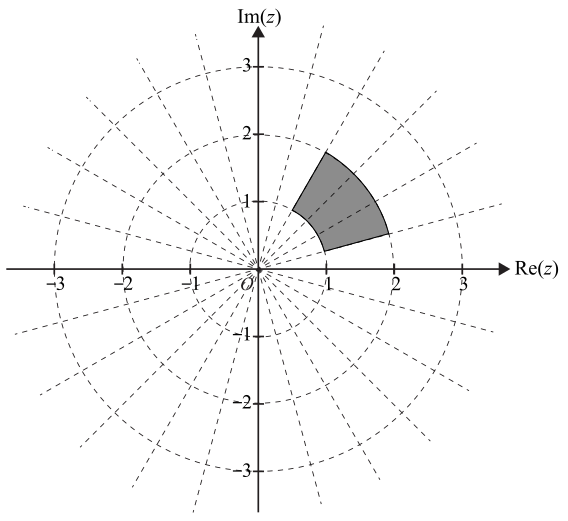
  4. ii. On the Argand diagram below, shade the region defined by

`{z: text(Arg)(z_1) <= text(Arg)(z) <= text(Arg)(z_1^4)} ∩ {z: 1 <= |\ z\ | <= 2}, z ∈ C`.   (2 marks)

--- 0 WORK AREA LINES (style=lined) ---


  1.  Find the area of the shaded region in part c.   (2 marks) 

    --- 5 WORK AREA LINES (style=lined) ---

  2. i.  Find the value(s) of `n` such that  `text(Re)(z_1^n) = 0`, where  `z_1 = (sqrt(sqrt3 + 2))/2 + i(sqrt(2-sqrt3))/2`.   (3 marks)

    --- 6 WORK AREA LINES (style=lined) ---

  3. ii. Find  `z_1^n`  for the value(s) of `n` found in part i.   (1 mark)

    --- 2 WORK AREA LINES (style=lined) ---

Show Answers Only
  1. `text(See Worked Solutions.)`
  2. i.  `z_1 = text(cis) pi/12`


    ii.  `z_1^4 = text(cis) pi/3`

  3. `text(See Worked Solutions.)`
  4. `(3pi)/8`
  5. i.  `n = (2k + 1)6`


    ii.  `z_1^n = ±i\ text(for)\ k ∈ Z`

Show Worked Solution
a.    `cos^2(pi/12) + sin^2(pi/12)` `= 1`
  `sin^2(pi/12)` `= 1-(sqrt 3 + 2)/4`
    `= (2-sqrt 3)/4`

 
`:. sin (pi/12) = sqrt(2-sqrt 3)/2,\ \ \ (sin (pi/12) > 0)`


b.i.    `z_1` `= cos(pi/12) + i sin (pi/12)`
    `= text(cis)(pi/12)`


b.ii.    `z_1^4` `= 1^4 text(cis) ((4 pi)/12)`
    `= text(cis)(pi/3)`


c.   


d.  `text(Area of large sector)`

Mean mark 51%.

`=theta/(2pi) xx pi r^2`

`=(pi/3-pi/12)/(2pi) xx pi xx 2^2`

`=pi/2`
  

`text(Area of small sector)`

`=1/2 xx pi/4 xx 1`

`=pi/8`

 
`:.\ text(Area shaded)`

`= pi/2-pi/8`

`= (3 pi)/8`
 

♦ Mean mark (e)(i) 34%.

e.i.    `z_1^n` `= 1^n text(cis) ((n pi)/12)`
  `text(Re)(z_1^n)` `= cos((n pi)/12) = 0`
  `(n pi)/12` `=cos^(-1)0 +2pik,\ \ \ k in ZZ`
  `(n pi)/12` `= pi/2 + k pi`
  `n` `= 6 + 12k,\ \ \ k in ZZ`


e.ii.  `text(When)\ \ n=(6 + 12k):`

♦ Mean mark (e)(ii) 36%.

  `z_1^n` `= 1^(6 + 12k) text(cis) (((6 + 12k)pi)/12), quad k in ZZ`
    `= i xx sin (((6 + 12k)pi)/12)`
    `= i xx sin (pi/2 + k pi)`

 
`text(If)\ \ k=0  or text(even,)\ \ z_1^n=i`

`text(If)\ \ k\ text(is odd,)\ \ z_1^n=-i`

`:. z_1^n = +-i,\ \ \ k in ZZ`

Filed Under: Geometry and Complex Numbers (SM), Mod/Arg Form and Argand Diagrams (SM) Tagged With: Band 3, Band 4, Band 5, smc-1173-30-Sketch regions, smc-2597-20-Cartesian to Mod/Arg, smc-2597-60-Argand diagrams

Vectors, SPEC2 2012 VCAA 16 MC

The distance between the points  `P(−2 ,4, 3)`  and  `Q(1, −2, 1)`  is

A.   `7`

B.   `sqrt 21`

C.   `sqrt 31`

D.   `11`

E.   `49`

Show Answers Only

`A`

Show Worked Solution
`d` `= sqrt((-2 – 1)^2 + (4 – (-2))^2 + (3 – 1)^2)`
  `= sqrt(9 + 36 + 4)`
  `= 7`

 
`=> A`

Filed Under: Basic Concepts and Calculations Tagged With: Band 3, smc-1176-10-Distance between points

Vectors, SPEC2 2012 VCAA 15 MC

The vectors  `underset~a = 2underset~i + m underset~j - 3underset~k`  and  `underset~b = m^2underset~i - underset~j + underset~k`  are perpendicular for

  1. `m = −2/3`  and  `m = 1`
  2. `m = −3/2`  and  `m = 1`
  3. `m = 2/3`  and  `m = −1`
  4. `m = 3/2`  and  `m = −1`
  5. `m = 3`  and  `m = −1`
Show Answers Only

`D`

Show Worked Solution

`underset ~a ⊥ underset ~b\ \ =>\ \ underset ~a ⋅ underset ~b=0`

`underset ~a ⋅ underset ~b` `= 2m^2 + m(-1) + (-3)(1)`
`0` `= 2m^2 – m – 3`
`0` `= (2m – 3)(m + 1)`

 
`:. m = 3/2, quad m = -1`

`=> D`

Filed Under: Basic Concepts and Calculations Tagged With: Band 3, smc-1176-30-Perpendicular vectors

Mechanics, SPEC2 2011 VCAA 21 MC

A constant force of magnitude  `F`  newtons accelerates a particle of mass 2 kg in a straight line from rest to 12 ms`\ ^(−1)` over a distance of 16 m.

It follows that

  1. `F` = 4.5
  2. `F` = 9.0
  3. `F` = 12.0
  4. `F` = 18.0
  5. `F` = 19.6
Show Answers Only

`B`

Show Worked Solution

`u = 0, \ v = 12, \ s = 16`

`v^2` `= u^2 + 2as`
`144` `= 0 + 32a`
`a` `= 9/2\ \ \ text{(by CAS)}`


`:. F` `= 2(9/2)`
  `= 9`

 
`=> B`

Filed Under: Force, Momentum and Motion (SM) Tagged With: Band 3, smc-1174-10-Force and motion

Vectors, SPEC2 2011 VCAA 12 MC

The angle between the vectors  `3underset~i + 6underset~j - 2underset~k`  and  `2underset~i - 2underset~j + underset~k`, correct to the nearest tenth of a degree, is

A.       2.0°

B.     91.0°

C.   112.4°

D.   121.3°

E.   124.9°

Show Answers Only

`C`

Show Worked Solution

`|3underset~i + 6underset~j – 2underset~k| = sqrt(9 + 36 + 4) = sqrt49 = 7`

`|2underset~i – 2underset~j + underset~k| = sqrt(4 + 4 + 1) = sqrt9 = 3`

`(3underset~i + 6underset~j – 2underset~k) * (2underset~i – 2underset~j + underset~k)`

`= 3 xx 2 + 6 xx (−2) + (−2) xx 1`

`= 6 – 12 – 2`

`= -8\ \ text{(do calculations on CAS)}`
  

`costheta` `= ((3tildei + 6tildej – 2tildek).(2tildei – 2tildej + tildek))/(|\ 3tildei + 6tildej – 2tildek\ ||\ 2tildei – 2tildej + tildek\ |)`
  `= −8/21`
`:. theta` `= cos^(−1)(−8/12)`
  `~~ 112.4^@`

 
`=> C`

Filed Under: Basic Concepts and Calculations Tagged With: Band 3, smc-1176-20-Angle between vectors

Trigonometry, SPEC2 2011 VCAA 9 MC

The number of distinct solutions of the equation

`xsin(x)sec(2x) = 0, \ x ∈ [0,2pi]`  is

  1. 3
  2. 4
  3. 5
  4. 6
  5. 7
Show Answers Only

`A`

Show Worked Solution
`xsin(x)sec(2x)` `= (xsin(x))/(cos(2x))=0`

 
`text(Find)\ \ x\ \ text(that satisfies:)`

`x = 0\ \ text(or)\ \ sin(x) = 0\ \ text(and)\ \ cos(2x) != 0`

`:. x = 0, \ pi\ \ text(or)\ \ 2pi`

`=> A`

Filed Under: Trigonometry (SM) Tagged With: Band 3, smc-1150-10-Solve equations

Graphs, SPEC2 2011 VCAA 3 MC

The implied domain of the function with rule  `f(x) = b + cos^(−1)(ax)`  where  `a > 0`  is

A.   `(−pi/a,pi/a)`

B.   `[−1,1]`

C.   `[−pi/a,pi/a]`

D.   `(−1/a,1/a)`

E.   `[−1/a,1/a]`

Show Answers Only

`E`

Show Worked Solution

`−1 <= ax <= 1,\ \ a > 0`

`−1/a <= x <= 1/a`

`=> E`

Filed Under: Inverse Trig Functions (SM) Tagged With: Band 3, smc-1153-20-arccos

Algebra, SPEC2 2011 VCAA 2 MC

A circle with centre  `(a,−2)`  and radius 5 units has equation

`x^2 - 6x + y^2 + 4y = b`  where `a` and `b` are real constants.

The values of `a` and `b` are respectively

A.   −3 and 38

B.   3 and 12

C.   −3 and −8

D.   −3 and 0

E.   3 and 18

Show Answers Only

`B`

Show Worked Solution
`x^2 – 6x + y^2 + 4y` `=b`
`x^2 – 6x + 3^2 – 9 + y^2 + 4y + 2^2 – 4` `= b`
`(x – 3)^2 + (y + 2)^2 – 13` `= b`
`(x – 3)^2 + (y + 2)^2` `= b + 13`

 
`:. a=3`

`:. b+13=25\ \ =>\ \ b=12`

`=> B`

Filed Under: Partial Fractions, Quotient and Other Functions (SM) Tagged With: Band 3, smc-1154-40-Circle

Calculus, SPEC1 2011 VCAA 10

Consider the relation  `y log_e (x) = e^(2y) + 3x - 4.`

Evaluate  `(dy)/(dx)`  at the point  `(1, 0).`  (4 marks)

Show Answers Only

`-3/2`

Show Worked Solution

`y log_e x = e^(2y) + 3x – 4`

`text(Using implicit differentiation:)`

`d/(dx)(y ln(x))` `= d/(dx)(e^(2y)) + d/(dx)(3x) – d/(dx)(4)`
`dy/dx*ln(x) + y(1/x)` `= 2e^(2y)*dy/dx + 3`

 
`text(At)\ \ (1,0):`

`dy/dx xx ln1 + 0` `= 2 e^0 * dy/dx+ 3`
`2*dy/dx` `= -3`
`:. dy/dx` `=- 3/2`

Filed Under: Tangents and Curve Sketching Tagged With: Band 3, smc-1182-10-Find gradient, smc-1182-50-Implicit functions

Vectors, SPEC1 2011 VCAA 9

Consider the three vectors

`underset ~a = underset ~i - underset ~j + 2underset ~k,\ underset ~b = underset ~i + 2 underset ~j + m underset ~k`  and  `underset ~c = underset ~i + underset ~j - underset ~k`, where `m in R.`

  1. Find the value(s) of `m` for which  `|\ underset ~b\ | = 2 sqrt 3.`  (2 marks)

    --- 4 WORK AREA LINES (style=lined) ---

  2. Find the value of `m` such that  `underset ~a`  is perpendicular to  `underset ~b.`  (1 mark)

    --- 4 WORK AREA LINES (style=lined) ---

  3. i.  Calculate  `3 underset ~c - underset ~a.`  (1 mark)

    --- 3 WORK AREA LINES (style=lined) ---

  4. ii. Hence find a value of `m` such that  `underset ~a, underset ~b`  and  `underset ~c`  are linearly dependent.  (1 mark)

    --- 4 WORK AREA LINES (style=lined) ---

Show Answers Only

  1. `+- sqrt 7`
  2. `1/2`
  3. i.  `2 tilde i + 4 tilde j – 5 tilde k`
  4. ii. `-5/2`

Show Worked Solution

a.    `|underset~b|` `= sqrt(1^2 + 2^2 + m^2)` `= 2sqrt3`
    `1 + 4 + m^2` `= 4 xx 3`
    `m^2` `= 7`
    `m` `= ±sqrt7`


b.    `underset~a * underset~b` `= 1 xx 1 + (−1) xx 2 + 2 xx m`  
  `0` `= 1 – 2 + 2m\ \ ( underset~a ⊥ underset~b)`  
  `2m` `= 1`  
  `m` `= 1/2`  


c.i.   `3 underset ~c – underset ~a`

`=3underset~i – underset~i + 3underset~j + underset~j -3underset~k – 2underset~k`

`=2underset~i + 4underset~j-5underset~k`


c.ii.   `text(Linear dependence)\ \ =>\ \ 3underset~c – underset~a = t underset~b,\ \ t in RR`

`2 tilde i + 4 tilde j – 5 tilde k= t (tilde i + 2 tilde j + m tilde k)`

`=> t = 2 and tm = -5,`

`:. m=-5/2`

Filed Under: Basic Concepts and Calculations Tagged With: Band 3, Band 4, smc-1176-30-Perpendicular vectors, smc-1176-50-Linear dependence

Graphs, SPEC2 2012 VCAA 4 MC

The domain and range of the function with rule  `f(x) = arccos(2x - 1) + pi/2`  are respectively

A.   `[−2,0]`  and  `[0,pi]`

B.   `[−2,0]`  and  `[pi/2,(3pi)/2]`

C.   `[0,1]`  and  `[0,pi]`

D.   `[0,1]`  and  `[pi/2,(3pi)/2]`

E.   `[0,pi]`  and  `[0,1]`

Show Answers Only

`D`

Show Worked Solution

`text(Domain:)`

`-1 <= 2x – 1 <= 1`

`0 <= 2x <= 2`

`0 <= x <= 1`

`text(Range:)`

`0 <= cos^(-1) (2x – 1) <= pi`

`pi/2 <= cos^(_1) (2x – 1) + pi/2 <= (3 pi)/2`

 
`=> D`

Filed Under: Inverse Trig Functions (SM) Tagged With: Band 3, smc-1153-20-arccos

Graphs, SPEC2 2012 VCAA 1 MC

The graph with equation  `y = 1/(2x^2 - x - 6)` has asymptotes given by

A.  `x = -3/2,\ x = 2 and y = 1`

B.   `x = -3/2 and x = 2`  only

C.   `x = 3/2,\ x = -2 and y = 0`

D.   `x = -3/2,\ x = 2 and y = 0`

E.   `x = 3/2 and x = -2`  only

Show Answers Only

`D`

Show Worked Solution
`y` `=1/(2x^2 – x – 6)`  
  `=1/((2x + 3)(x – 2))`  


`:.\ text(Asymptotes:)`   `x = 2`
  `x = -3/2`
  `y = 0`

 
`=> D`

Filed Under: Partial Fractions, Quotient and Other Functions (SM) Tagged With: Band 3, smc-1154-10-Quotient functions/Asymptotes

  • « Previous Page
  • 1
  • …
  • 32
  • 33
  • 34
  • 35
  • 36
  • …
  • 57
  • Next Page »

Copyright © 2014–2025 SmarterEd.com.au · Log in