SmarterEd

Aussie Maths & Science Teachers: Save your time with SmarterEd

  • Login
  • Get Help
  • About

CORE, FUR2 2013 VCAA 2

The development index for each country is a whole number between 0 and 100.

The dot plot below displays the values of the development index for each of the 28 countries that has a high development index.
 

CORE, FUR2 2013 VCAA 21 
 

  1. Using the information in the dot plot, determine each of the following.  (1 mark)

    --- 0 WORK AREA LINES (style=lined) ---


    Core, FUR2 2013 VCAA 2_2   
     

  2. Write down an appropriate calculation and use it to explain why the country with a development index of 70 is an outlier for this group of countries.  (2 marks)

    --- 5 WORK AREA LINES (style=lined) ---

Show Answers Only

  1. `text(Mode = 78,  Range = 9)`
  2. `text(See Worked Solutions)`

Show Worked Solution

a.   `text(Mode = 78)`

`text(Range = 79 − 70 = 9)`


b.   `text(An outlier occurs if a data point is below)`

`Q_1 − 1.5 xx IQR`


`Q_1 = 75, \ \ Q_3 = 78, and IQR = 78-75=3`

`:. Q_1 − 1.5 xx IQR` `= 75 − 1.5 xx 3`
  `= 70.5`


`:. 70\ text{is an outlier  (70 < 70.5)}`

Filed Under: Graphs - Histograms and Other Tagged With: Band 3, Band 4, smc-468-40-Median Mode and Range, smc-468-50-IQR / Outliers, smc-644-10-Dot Plots

CORE, FUR2 2013 VCAA 1

A development index is used as a measure of the standard of living in a country.

The bar chart below displays the development index for 153 countries in four categories: low, medium, high and very high.
 

CORE, FUR2 2013 VCAA 1

  1. How many of these countries have a very high development index?   (1 mark)

    --- 1 WORK AREA LINES (style=lined) ---

  2. What percentage of the 153 countries has either a low or medium development index?
  3. Write your answer, correct to the nearest percentage.   (1 mark)

    --- 3 WORK AREA LINES (style=lined) ---

Show Answers Only
  1. `31`
  2. `text(61%)`
Show Worked Solution

a.   `31\ \ text{(from graph)}`


b.   `text(Number of countries with low or high index)`

`=45 + 49 = 94`

`:.\ text(Percentage)` `=94/153 xx 100text(%)`
  `=61.43…`
  `=61 text(%)\ \ text{(nearest %)}`

Filed Under: Graphs - Histograms and Other Tagged With: Band 2, Band 3, smc-644-30-Bar Charts

CORE, FUR2 2015 VCAA 5

The time series plot below displays the life expectancy, in years, of people living in Australia and the United Kingdom (UK) for each year from 1920 to 2010.
 

Core, FUR2 2015 VCAA 51

  1. By how much did life expectancy in Australia increase during the period 1920 to 2010?
  2. Write your answer correct to the nearest year.   (1 mark)

    --- 2 WORK AREA LINES (style=lined) ---

  3. In 1975, the life expectancies in Australia and the UK were very similar.
  4. From 1975, the gap between the life expectancies in the two countries increased, with people in Australia having a longer life expectancy than people in the UK.
  5. To investigate the difference in life expectancies, least squares regression lines were fitted to the data for both Australia and the UK for the period 1975 to 2010.
  6. The results are shown below. 

  Core, FUR2 2015 VCAA 52

  1. The equations of the least squares regression lines are as follows.
`text(Australia:)\ \ \ ` `text(life expectancy) = – 451.7 + 0.2657 xx text(year)`
`text(UK:)` `text(life expectancy) = – 350.4 + 0.2143 xx text(year)` 


  1. Use these equations to predict the difference between the life expectancies of Australia and the UK in 2030.
  2. Give your answer correct to the nearest year.   (2 marks)

    --- 4 WORK AREA LINES (style=lined) ---
  3. Explain why this prediction may be of limited reliability.   (1 mark)

    --- 3 WORK AREA LINES (style=lined) ---

Show Answers Only
  1. `text(22 years)`
    1. `3\ text(years)`
    2. `text(The year 2030 is outside the available range)`


      `text(of data and therefore its predictions may)`


      `text(become unreliable.)`

Show Worked Solution

a.   `text{The increase in life expectancy (1920 – 2010)}`

`=82-60`

`=22\ text(years)`


b.i.    `text{Life expectancy (Aust)}` `= −451.7 + 0.2657× 2030`
    `= 87.67…\ text(years)`
     
  `text{Life expectancy (UK)}` `= −350.4 + 0.2143× 2030`
    `=84.62…\ text(years)`


`:.\ text(Difference)` `= 87.67…-84.62…`
  `= 3\ text(years)\ \ \ text{(nearest year)}`
♦ Mean mark 45%.
MARKER’S COMMENT: Relate answers directly to the limitations of the given statistical data rather than future events in (b)(ii).


b.ii.   `text(The year 2030 is outside the available range)`

  `\ text(of data and therefore its predictions may)`

  `\ text(become unreliable.)`

Filed Under: Correlation and Regression Tagged With: Band 3, Band 4, Band 5, smc-265-60-Extrapolation / Interpolation

CORE, FUR2 2015 VCAA 3

The scatterplot below plots male life expectancy (male) against female life expectancy (female) in 1950 for a number of countries. A least squares regression line has been fitted to the scatterplot as shown.


The slope of this least squares regression line is 0.88

  1. Interpret the slope in terms of the variables male life expectancy and female life expectancy.  (1 mark)

    --- 3 WORK AREA LINES (style=lined) ---

The equation of this least squares regression line is

male = 3.6 + 0.88 × female

  1. In a particular country in 1950, female life expectancy was 35 years.


    Use the equation to predict male life expectancy for that country.  (1 mark)

    --- 2 WORK AREA LINES (style=lined) ---

  2. The coefficient of determination is 0.95


    Interpret the coefficient of determination in terms of male life expectancy and female life expectancy.  (1 mark)

    --- 4 WORK AREA LINES (style=lined) ---

Show Answers Only
  1. `text(A slope of 0.88 means that for each year that a)`
    `text(female lives longer in a particular country, a male)`
    `text(in that country, on average, will tend to live 0.88)`
    `text(of a year longer.)`
  2. `34.4\ text(years)`
  3. `text(This figure means that 95% of the variability in)`
    `text(the male life expectancy can be explained by the)`
    `text(variation in female life expectancy.)`
Show Worked Solution

a.   `text(A slope of 0.88 means that for each year)`

♦ Mean mark 40%.
MARKER’S COMMENT: Many students did not describe the slope, despite being specifically asked about it!

`text(that a female lives longer in a particular)`

`text(country, a male in that country, on average,)`

`text(will tend to live 0.88 of a year longer.)`


b.   `text(Male life expectancy)`

`=3.6 + 0.88 xx 35`

`=34.4\ text(years)`


c.   `text(This figure means that 95% of the variability)`

MARKER’S COMMENT: A common error: use of `r^2 = 90.25 text(%)` as the basis of the interpretation.

`text(in the male life expectancy can be explained)`

`text(by the variation in female life expectancy.)`


Filed Under: Correlation and Regression Tagged With: Band 3, Band 4, Band 5, smc-265-10-r / r^2 and Association, smc-265-40-Interpret Gradient

CORE, FUR2 2015 VCAA 2

The parallel boxplots below compare the distribution of life expectancy for 183 countries for the years 1953, 1973 and 1993.
 

Core, FUR2 2015 VCAA 2

  1. Describe the shape of the distribution of life expectancy for 1973.   (1 mark)

    --- 2 WORK AREA LINES (style=lined) ---

  2. Explain why life expectancy for these countries is associated with the year. Refer to specific statistical values in your answer.   (2 marks)

    --- 5 WORK AREA LINES (style=lined) ---

Show Answers Only
  1. `text(Negatively skewed)`
  2. `text(There is a positive correlation between the median of life)`
    `text(expectancy and the year.)`
Show Worked Solution

a.   `text(Negatively skewed with no outliers. The extended left)`

`text(line from the box clearly indicates negative skew.)`
 

b.   `text(The medians in each boxplot are approximately,)`

♦ Mean mark 45%.
MARKER’S COMMENT: Means are typically not discernible from a box plot (unless the data is perfectly symmetrical) and shouldn’t be referred to.
`1953` `\ \ \ 51`
`1973` `\ \ \ 63`
`1993` `\ \ \ 69`


`:.\ text(The chart shows a positive correlation between the)`

`text(median of life expectancy and the year.)`

Filed Under: Graphs - Stem/Leaf and Boxplots Tagged With: Band 3, Band 5, smc-643-20-Parallel Box-Plots, smc-643-70-Distribution Description

CORE, FUR2 2015 VCAA 1

The histogram below shows the distribution of life expectancy of people for 183 countries.
 

CORE, FUR2 2015 VCAA 1 

  1. For this distribution, the modal interval is  ___________  (1 mark)

    --- 0 WORK AREA LINES (style=lined) ---

  2. In how many of these countries is life expectancy less than 55 years?  (1 mark)

    --- 2 WORK AREA LINES (style=lined) ---

  3. In what percentage of these 183 countries is life expectancy between 75 and 80 years?
  4. Write your answer correct to one decimal place.  (1 mark)

    --- 3 WORK AREA LINES (style=lined) ---

Show Answers Only

  1. `text(70 – 75)`
  2. `14`
  3. `text(16.4%)`

Show Worked Solution

a.   `text(70 – 75)`

MARKER’S COMMENT: 40% of students answered this basic question incorrectly.


b.   `text(Adding up the first 2 columns,)`

`5 + 9 = 14\ text(countries)`


c.   `text(% Countries with life expectancy between 75-80)`

MARKER’S COMMENT: Answers of 16% or an unrounded figure received no marks.

`= text(Number of 75-80 countries)/text(Total countries)`

`=30/183 xx 100text(%)`

`=16.39…`

`=16.4text{%  (to 1 d.p.)}`

Filed Under: Graphs - Histograms and Other Tagged With: Band 3, Band 4, smc-644-20-Histograms

NETWORKS, FUR1 2015 VCAA 3 MC

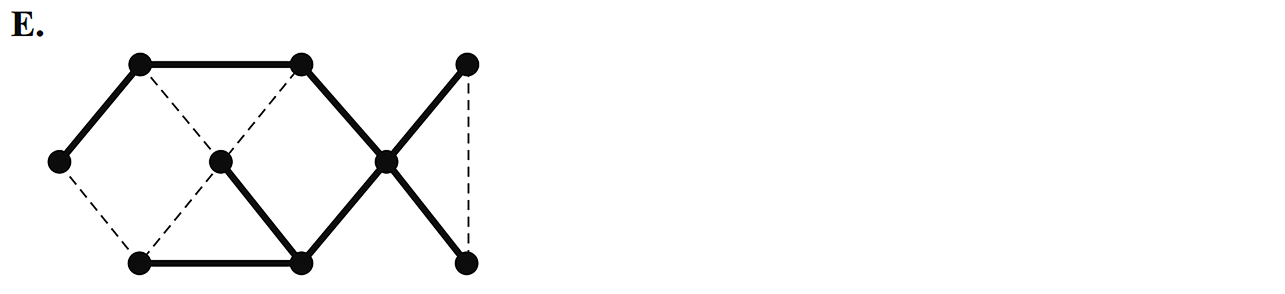
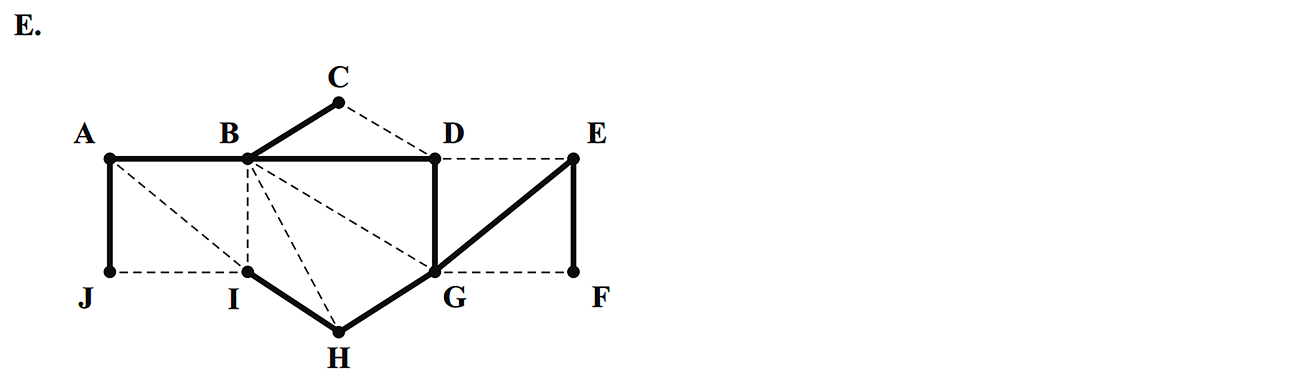
The plan shows the layout of a section of pipes, drawn in bold lines, that supplies water to nine houses in a new estate.
 

NETWORKS, FUR1 2015 VCAA 3 MC
 

Which one of the following types of graph could be used to represent the layout of water pipe connections to the water supply and these houses?

A.   a bipartite graph

B.   a complete graph

C.   a loop

D.   a Hamiltonian path

E.   a tree

Show Answers Only

`E`

Show Worked Solution

`=> E`

Filed Under: Basic Concepts Tagged With: Band 3, smc-626-10-Definitions

NETWORKS, FUR1 2015 VCAA 2 MC

A planar graph has five vertices and six faces.

The number of edges is

  1. `3`
  2. `6`
  3. `9`
  4. `11`
  5. `13`
Show Answers Only

`C`

Show Worked Solution
`v + f` `= e + 2`
`5 + 6` `= e + 2`
`:. e` `= 9`

 
`=> C`

Filed Under: Basic Concepts Tagged With: Band 3, smc-626-40-Euler's Formula

MATRICES, FUR1 2015 VCAA 2 MC

Four matrices are shown below.

`W = [(3),(6),(2)]`     `X = [(4,1,5),(2,0,6)]`     `Y = [(7,1)]`     `Z = [(8,5,0),(1,9,3),(4,2,7)]`

Which one of the following matrix products is not defined?

  1. `W × Y`
  2. `X × W`
  3. `Y × X`
  4. `Z × W`
  5. `Z × Y`
Show Answers Only

`E`

Show Worked Solution

`text(The matrix product in)\ E\ text(is undefined as the number)`

`text(of columns in)\ Z\ text(does not match the number of)`

`text(rows in)\ Y.`

`=> E`

Filed Under: Matrix Calculations Tagged With: Band 3, M/C

MATRICES, FUR1 2015 VCAA 1 MC

Matrix `B` below shows the number of photography (`P`), art (`A`) and cooking (`C`) books owned by Steven (`S`), Trevor (`T`), Ursula (`U`), Veronica (`V`) and William (`W`).

`{:(qquadqquadqquadPquadAquadC),(B = [(8,5,4),(1,4,5),(3,3,4),(4,2,2),(1,4,1)]{:(S),(T),(U),(V),(W):}):}`


The element in row `i` and column `j` of matrix `B` is `b_(ij)`.

The element `b_32` is the number of

A.   art books owned by Trevor.

B.   art books owned by Ursula.

C.   art books owned by Veronica.

D.   cooking books owned by Ursula.

E.   cooking books owned by Trevor.

Show Answers Only

`B`

Show Worked Solution

`=> B`

Filed Under: Matrix Calculations Tagged With: Band 3, M/C

GRAPHS, FUR1 2015 VCAA 3 MC

A local supermarket delivers groceries that are ordered online by its customers.

The graph below is used to determine the delivery fee from the amount spent by the customer.

GRAPHS, FUR1 2015 VCAA 3 MC

The delivery fee for an online customer who spends $250 on groceries is

A.   `$3.00`

B.   `$4.50`

C.   `$6.00`

D.   `$7.50`

E.   `$9.00`

Show Answers Only

`C`

Show Worked Solution

`text(From graph, noting that an open circle is)`

`text(exclusive and a closed circle is inclusive.)`

`=> C`

Filed Under: Graph Applications Tagged With: Band 3

GRAPHS, FUR1 2015 VCAA 2 MC

A point that satisfies the inequality  `3x - 2y ≥ 12`  is

A.   `(1, 5)`

B.   `(2, 4)`

C.   `(3, 3)`

D.   `(4, 2)`

E.   `(5, 1)` 

Show Answers Only

`E`

Show Worked Solution

`text(Test the coordinates of each option to find)`

`text(one that satisfies the equation.)`

`text(Consider)\ E,`

`text{Substitute (5, 1) in to the equation,}`

`3x-2y` `>=12`
`3(5) – 2(1)` `>=12`
`13` `>=12\ \ \ text{(correct)}`

`=> E`

Filed Under: Linear Programming Tagged With: Band 3

GRAPHS, FUR1 2015 VCAA 1 MC

A camera is accidentally dropped from the top of a tower that is 96 m high.

The graph below shows how the height of the camera above the ground, in metres, changes with time, in seconds.

GRAPHS, FUR1 2015 VCAA 1 MC

From the moment it was dropped, the time that it takes for the camera to hit the ground, in seconds, is closest to

A.   `4.2`

B.   `4.4`

C.   `4.9`

D.   `6.0`

E.   `9.6`

Show Answers Only

`B`

Show Worked Solution

`text(From graph)`

`=> B`

Filed Under: Graph Applications Tagged With: Band 3

Financial Maths, 2ADV M1 SM-Bank 3 MC

The first three terms of a geometric sequence are 

`0.125, 0.25, 0.5`

The fourth term in this sequence would be

  1. `0.625`
  2. `0.75`
  3. `0.875`
  4. `1`
Show Answers Only

`D`

Show Worked Solution

`text(GP sequence is  0.125, 0.25, 0.5)`

`a` `=0.125`
`r` `=t_(2)/t_(1)=0.25/0.125=2`
`T_4` `=ar^3`
  `=0.125 xx 2^3`
  `=1`

`=> D`

Filed Under: Geometric Series, Geometric Series (Y12) Tagged With: Band 3, smc-1006-10-Find Term

Financial Maths, 2ADV M1 SM-Bank 1 MC

The first three terms of a geometric sequence are  `6, x, 54.`

A possible value of  `x`  is

  1. `9`
  2. `15`
  3. `18`
  4. `24`
Show Answers Only

`C`

Show Worked Solution

`text(S)text(ince the sequence is geometric,)`

`r` `=x/6=54/x`
`x^2` `=54 xx 6`
  `=324`
`:.x` `=18`

`rArr C`

Filed Under: Geometric Series, Geometric Series (Y12) Tagged With: Band 3, smc-1006-10-Find Term, smc-1006-70-Calculations Only

GRAPHS, FUR1 2010 VCAA 7 MC

Bruce and John both work in a factory. They assemble bicycles and scooters.

It takes 45 minutes to assemble a bicycle and 15 minutes to assemble a scooter.

Bruce assembled 7 bicycles and 8 scooters.

In the same time, John assembled 6 bicycles and a number of scooters.

The number of scooters that John assembled is

A.     `3`

B.     `6`

C.    `11`

D.    `13`

E.    `31`

Show Answers Only

`C`

Show Worked Solution

`text(Let)\ \ x = text(number of scooters John assembled.)`

`text(S)text(ince the time is the same for Bruce and John,)`

`7  xx45 + 8  xx 15` `= 6 xx 45 + 15x`
`435` `= 270 + 15x`
`15x` `= 165`
`x` `= 11`

`:.\ text (11 scooters assembled by John.)`

`=>  C`

Filed Under: Linear relationships Tagged With: Band 3

GRAPHS, FUR1 2010 VCAA 1-2 MC

The volume of water that is stored in a tank over a 24-hour period is shown in the graph below.

Part 1

What is the difference in the volume of water (in litres) in the tank between 8 am and 6 pm?

A.     `50`

B.   `100`

C.   `120`

D.   `200`

E.   `400`


Part 2

The rate of increase in the volume of water in the tank (in litres/hour) between 8 am and 10 am is

A.     `37.5`

B.     `50`

C.     `75`

D.   `125`

E.   `150`

Show Answers Only

`text(Part 1:)\ B`

`text(Part 2:)\ C`

Show Worked Solution

`text(Part 1)`

`text(From the graph)`

`text(Volume difference)` `= 300 – 200`
  `= 100\ text(L)`

`=>  B`


`text(Part 2)`

`text(Rate of increase)` `= (450 – 300)/ (10 – 8)`
  `= 75\ text(L/hr)`

`=>  C`

Filed Under: Graph Applications Tagged With: Band 3, Band 4

GRAPHS, FUR1 2011 VCAA 6 MC

A newsagent has four thick magazines and four thin magazines.

The magazines are stacked one by one into a pile.

The thick magazines are all placed in the bottom part of the file, and the thin magazines are all placed in the top part of the pile.

A graph indicates the changing height of the pile of magazines as each magazine is added to the pile could be


Show Answers Only

`D`

Show Worked Solution

`text(The first 4 magazines increase height in a linear)`

`text(way with a relatively steeper gradient, and the)`

`text(next 4 thin magazines also increase height in a)`

`text(linear fashion but at a lesser gradient.)`

`=>  D`

Filed Under: Graph Applications Tagged With: Band 3

GRAPHS, FUR1 2012 VCAA 3 MC

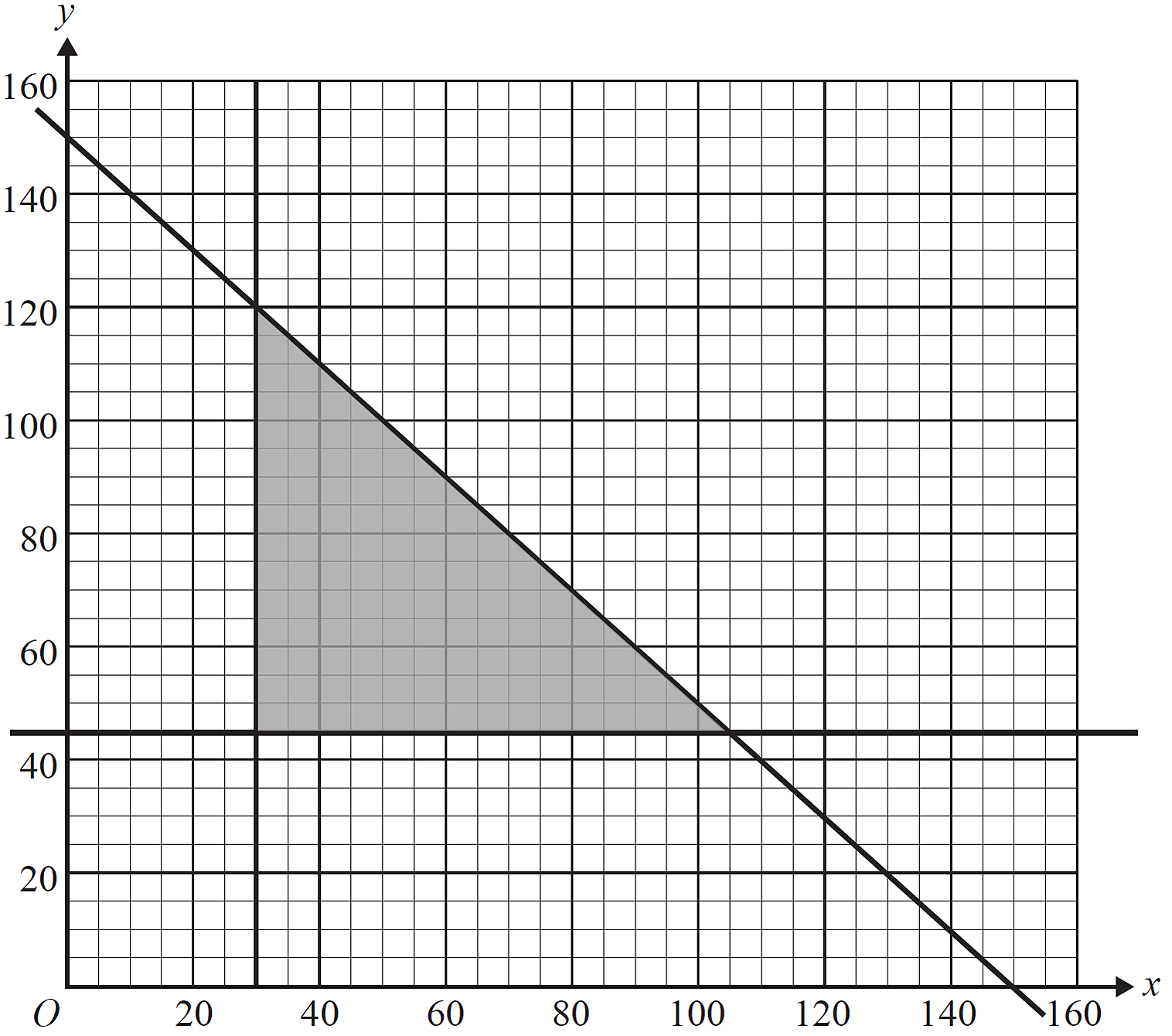
The shaded area in the graph above represents the feasible region for a linear programming problem.

The minimum value of the objective  `P = 2x - y`  for this feasible region is

A.   `– 7`

B.    `0`

C.    `1`

D.    `2`

E.    `3`

Show Answers Only

`D`

Show Worked Solution

 `P = 2x – y\ …\ (1)`

`text(Substituting the boundary points into)\ \ (1),`

`text(At)\ (4, 5),\ \ P` `= 2 (4) – 5`
  `= 3`
`text(At)\ (6, 4),\ \ P` `= 2 (6) – 4`
  `= 8`
`text(At)\ (6, 1),\ \ P` `= 2 (6) – 1`
  `= 11`
`text(At)\ (3, 4),\ \ P` `= 2 (3) – 4`
  `= 2`

`:. P_(min)=2`

`=>  D`

Filed Under: Linear Programming Tagged With: Band 3

GRAPHS, FUR1 2013 VCAA 4 MC

The Blue Caps cricket club has different prices for its junior and senior subscriptions.

The total cost for two junior subscriptions and one senior subscription is $225.

The cost of a senior subscription is three times the cost of a junior subscription.

The cost of a senior subscription is

A.     `$45`

B.     `$75`

C.     `$90`

D.   `$135`

E.   `$180`

Show Answers Only

`D`

Show Worked Solution

`text (Let cost for juniors) = x`

`text (Let cost for seniors) = y`

`2x + y` `= 225\ …\ \ (1)`
`y` `= 3x\ …\ \ (2)`

`text(Substitute)\ (2)\ \ text(into)\ \ (1)`

`2x + 3x` `= 225`
`5x` `= 225`
`x` `= 45`


`text(Substitute)\ \ x = 45\ \ text(into)\ \ (2)`

`y` `= 3 xx 45`
  `= 135`

`:.\ text(Senior subscription) = $135`

`=>   D`

Filed Under: Linear relationships Tagged With: Band 3

GRAPHS, FUR1 2013 VCAA 3 MC

A full tank holds 2000 litres of water.

Water is pumped out of the tank at a constant rate.

The graph below shows how the volume of water in the tank, `V`, changes with time, `t`.

The constant rate, in litres per minute, at which the water is being pumped out of the tank is

A.       `0.8`

B.       `2.0`

C.     `12.5`

D.     `80.0`

E.   `160.0`

Show Answers Only

`C`

Show Worked Solution

`text(2000 litres are pumped out in 160 mins.)`

COMMENT: The rate could also be calculated as the gradient of the graph.
`:.\ text(Rate)` `= 2000 / 160`
  `= 12.5\ text(L/min)`

`=>   C`

Filed Under: Graph Applications Tagged With: Band 3

GEOMETRY, FUR1 2015 VCAA 3 MC

The lengths of the sides of a triangle are 3 cm, 6 cm and 5 cm, as shown below.
 

GEO & TRIG, FUR1 2015 VCAA 3 MC
 

The angle, `x`, can be found using

A.   `cos(x) = (3^2 + 6^2 - 5^2)/(2 xx 3 xx 6)`

B.   `cos(x) = (3^2 + 6^2 + 5^2)/(2 xx 3 xx 6)`

C.   `cos(x) = (3^2 + 5^2 - 6^2)/(2 xx 3 xx 6)`

D.   `cos(x) = 3/5`

E.   `cos(x) = 3/6`

Show Answers Only

`A`

Show Worked Solution

`text(Using the cosine rule:)`

`cosx = (3^2 + 6^2 – 5^2)/(2 xx 3 xx 6)`

`=> A`

Filed Under: Non-Right-Angled Trig Tagged With: Band 3, smc-3589-20-Cosine rule

GEOMETRY, FUR1 2015 VCAA 1 MC

The top of a table is in the shape of a trapezium, as shown below.

GEO & TRIG, FUR1 2015 VCAA 1 MC

The area of the tabletop, in square centimetres, is

A.          `200`

B.          `260`

C.        `4200`

D.        `4800`

E.   `288\ 000` 

Show Answers Only

`C`

Show Worked Solution
`text(Area)` `=1/2h(a+b)`
  `= 1/2xx 60(60 + 80)`
  `= 4200`

`=> C`

Filed Under: Perimeter, Area and Volume Tagged With: Band 3

CORE*, FUR1 2015 VCAA 3 MC

The closing price of a share on Wednesday was $160.

The closing price of the same share on Thursday was 3% less than its closing price on Wednesday.

The closing price of the same share on Friday was 4.5% more than its closing price on Thursday.

The closing price of the share on Friday is closest to

A.   $157.38

B.   $161.98

C.   $162.18

D.   $162.40

E.   $172.22

Show Answers Only

`C`

Show Worked Solution
`text{Closing price (Fri)}` `= 160 xx 0.97 xx 1.045`
  `=$162.184`

`=> C`

Filed Under: Interest Rates and Investing Tagged With: Band 3, smc-604-40-% Increase/Decrease

CORE*, FUR1 2015 VCAA 1 MC

Fong’s gas bill is $368.40. If he pays this bill on time, it will be reduced by 5%.

In this case, the bill would be reduced by

  1. $1.84
  2. $5.00
  3. $18.42
  4. $184.20
  5. $349.98
Show Answers Only

`C`

Show Worked Solution

`5text(%) xx $368.40 = $18.42`

`=> C`

Filed Under: Interest Rates and Investing Tagged With: Band 3, smc-604-40-% Increase/Decrease

PATTERNS, FUR1 2015 VCAA 5 MC

A family bought a country property.

At the end of the first year, there were two thistles per hectare on the property.

At the end of the second year, there were six thistles per hectare on the property.

At the end of the third year, there were 18 thistles per hectare on the property.

Assume the number of thistles per hectare continues to follow a geometric pattern of growth.

At the end of the seventh year, the number of thistles per hectare is expected to be

A.     `972`

B.   `1458`

C.   `2916`

D.   `4374`

E.   `8748` 

Show Answers Only

`B`

Show Worked Solution
`text(GP where)\ \ \ a` `=2, and`
`r` `= t_2/t_1=6/2=3`
`t_7` `= ar^6`
  `= 2 xx 3^6`
  `= 1458`

`=> B`

Filed Under: APs and GPs - MC Tagged With: Band 3

Calculus, SPEC2 2014 VCAA 11 MC

Let  `(dy)/(dx) = x^3 - xy`  and  `y = 2`  when  `x = 1`.

Using Euler’s method with a step size of 0.1, the approximation to  `y`  when  `x = 1.1`  is

A.   0.9

B.   1.0

C.   1.1

D.   1.9

E.   2.1

Show Answers Only

`D`

Show Worked Solution

`text(When)\ \ x=1,\ \ y=2.`

`text(Using Euler when)\ \ x=1.1`

`y(1.1)` `~~ 2 + 0.1 xx (1^3 – 1 xx 2)`
  `= 1.9`

 
`=> D`

Filed Under: Euler, Pseudocode and Slope Fields Tagged With: Band 3, smc-1183-10-Euler method

CORE*, FUR1 2007 VCAA 1 MC

An agent charged $20 commission for selling a rare book for $500.

What percentage of the selling price is the commission?

A.    4%

B.    5%

C.  20%

D.  25%

E.  40%

Show Answers Only

`A`

Show Worked Solution
`text(Commission)`  `= 20/500` 
  `= 0.04` 
  `= 4text (%)`

`=>   A`

Filed Under: Interest Rates and Investing Tagged With: Band 3, smc-604-40-% Increase/Decrease

CORE*, FUR1 2010 VCAA 4 MC

The price of a one-way airfare between two cities varies each day according to demand.

• On Monday the price is $160.
• The price on Tuesday is 25% greater than the price on Monday.
• The price on Wednesday is 10% less than the price on Tuesday.
• The price on Thursday is 25% less than the price on Wednesday.
• The price on Friday is 20% greater than the price on Thursday.
• The Saturday price is the same as the Friday price.

The price on Saturday is

A.   $150

B.   $162

C.   $176

D.   $288

E.   $330

Show Answers Only

`B`

Show Worked Solution
`text{Price (Tue)}` `= 160 xx text(125%)`
  `= 200`
`text{Price (Wed)}` `= 200 xx 90text(%)`
  `= 180`
`text{Price (Thu)}` `= 180 xx 75text(%)`
  `=135`
`text{Price (Fri)}` `= 135 xx 120 text(%)`
  `= 162`


`text(Saturday price is same as Friday.)`

`=> B`

Filed Under: Interest Rates and Investing Tagged With: Band 3, smc-604-40-% Increase/Decrease

CORE*, FUR1 2010 VCAA 3 MC

Peter received a quote from the Artificial Grass Company for his new front lawn.

The quote is for $1880 plus a Goods and Services Tax (GST) of 10%.

The final amount that Peter pays for the new front lawn is

A.     $188

B.   $1880

C.   $1890

D.   $1899

E.   $2068

Show Answers Only

`E`

Show Worked Solution
`text(GST)` `= 1880 xx text(10%)`
  `= 188`


`:.\ text(Total amount)` `= 1880 + 188`
  `= $2068`

`=>  E`

Filed Under: Taxation and Other Tagged With: Band 3, smc-605-10-GST

CORE*, FUR1 2010 VCAA 2 MC

$6000 is invested in an account that earns simple interest at the rate of 3.5% per annum.

The total interest earned in the first four years is

A.     `$70`

B.     `$84`

C.   `$210`

D.   `$840`

E.   `$885`

Show Answers Only

`D`

Show Worked Solution

`P = 6000,\ \ r = 3.5,\ \ T = 4`

`I` `= (PrT) / 100`
`I` `= {(6000) (3.5) (4)} / 100`
  `= 840`

 
`=>  D`

Filed Under: Interest Rates and Investing Tagged With: Band 3, smc-604-10-Simple interest

CORE*, FUR1 2010 VCAA 1 MC

Sally purchased an electronic game machine on hire purchase. She paid $140 deposit and then $25.50 per month for two years.

The total amount that Sally paid is

A.   $191

B.   $446

C.   $612

D.   $740

E.   $752

Show Answers Only

`E`

Show Worked Solution
`text(Total paid)` `= 140 + 25.50 xx 2 xx12`
  `= $752`

`=>E`

Filed Under: Borrowing and Loans Tagged With: Band 3, smc-603-30-Hire purchase

CORE*, FUR1 2015 VCAA 2 MC

The second term of a Fibonacci-related sequence is 36 and the third term is 72.

The first term of this sequence is

  1. `2`
  2. `6`
  3. `18`
  4. `36`
  5. `108`
Show Answers Only

`D`

Show Worked Solution

`text(A Fibonacci sequence takes the form)`

`t_3` `=t_2+t_1`
`:. t_1` `= t_3 – t_2`
  `= 72 – 36`
  `= 36`

 
`=> D`

Filed Under: Difference Equations - MC, Recursion - General Tagged With: Band 3, smc-714-30-RR (Fibonacci)

CORE, FUR1 2015 VCAA 11 MC

A log transformation is used to linearise the relationship between the weight of a mouse, in grams, and its age, in weeks.

When a least squares regression line is fitted to the transformed data, its equation is

`text(weight) = – 7 + 30 log_10(text(age))`

This equation predicts that a mouse aged five weeks has a weight, in grams, that is closest to

A.     `14`

B.     `21`

C.     `23`

D.     `41`

E.   `143`

Show Answers Only

`A`

Show Worked Solution
`text(Weight)` `= – 7 + 30log_10 5`
  `= 13.969…`

`=> A`

Filed Under: Correlation and Regression Tagged With: Band 3, smc-265-70-Linearise - log10

CORE, FUR1 2015 VCAA 2 MC

For an ordered set of data containing an odd number of values, the middle value is always

A.   the mean.

B.   the median.

C.   the mode.

D.   the mean and the median.

E.   the mean, the median and the mode.

Show Answers Only

`B`

Show Worked Solution

`=> B`

Filed Under: Summary Statistics Tagged With: Band 3, smc-468-20-Mean, smc-468-40-Median Mode and Range

CORE*, FUR1 2006 VCAA 3-4 MC

The following information relates to Parts 1 and 2.

A farmer plans to breed sheep to sell.

In the first year she starts with 50 breeding sheep.

During the first year, the sheep numbers increase by 84%.

At the end of the first year, the farmer sells 40 sheep.

Part 1

How many sheep does she have at the start of the second year?

A.     2

B.   42

C.   52

D.   84

E.   92


Part 2

If  `S_n`  is the number of sheep at the start of year `n`, a difference equation that can be used to model the growth in sheep numbers over time is

A.   `S_(n+1) = 1.84S_n - 40` `\ \ \ \ \ text(where)\ \ S_1 = 50`  
B.   `S_(n+1) = 0.84S_n - 50` `\ \ \ \ \ text(where)\ \ S_1 = 40`  
C.   `S_(n+1) = 0.84S_n - 40` `\ \ \ \ \ text(where)\ \ S_1 = 50`  
D.   `S_(n+1) = 0.16S_n - 50` `\ \ \ \ \ text(where)\ \ S_1 = 40`  
E.   `S_(n+1) = 0.16S_n - 40` `\ \ \ \ \ text(where)\ \ S_1 = 50`  
Show Answers Only

`text (Part 1:)\ C`

`text (Part 2:)\ A`

Show Worked Solution

`text (Part 1)`

`text(Number at the start of the 2nd year)`

`=50 + (84text(%) xx 50) – 40`

`=52`

`rArr C`


`text (Part 2)`

`text(If sheep numbers increase by 84% from the start of)`

`text(each year, and 40 sheep are then sold,)`

`S_(n+1)` `=S_n + 0.84S_n – 40`
  `=1.84 S_n – 40`

`rArr A`

Filed Under: Difference Equations - MC, Recursion - General Tagged With: Band 3, smc-714-25-RR (combination), smc-714-50-Find term(s), smc-714-60-Identify RR

PATTERNS, FUR1 2006 VCAA 2 MC

The first three terms of a geometric sequence are  `6, x, 54.`

A possible value of `x` is

A.     `9`

B.   `15`

C.   `18`

D.   `24`

E.   `30`

Show Answers Only

`C`

Show Worked Solution

`text(S)text(ince the sequence is geometric,)`

`r` `=x/6=54/x`
`x^2` `=54 xx 6`
  `=324`
`:.x` `=18`

`rArr C`

Filed Under: APs and GPs - MC Tagged With: Band 3

CORE, FUR1 2006 VCAA 5-6 MC

The distribution of test marks obtained by a large group of students is displayed in the percentage frequency histogram below.
 

Part 1

The pass mark on the test was 30 marks.

The percentage of students who passed the test is

A.     `7text(%)`

B.   `22text(%)`

C.   `50text(%)`

D.   `78text(%)`

E.   `87text(%)`


Part 2

The median mark lies between

A.   `35 and 40`

B.   `40 and 45`

C.   `45 and 50`

D.   `50 and 55`

E.   `55 and 60`

Show Answers Only

`text (Part 1:)\ D`

`text (Part 2:)\ B`

Show Worked Solution

`text (Part 1)`

`text(Adding up the percentage bars above 30)`

`=7+11+14+16+18+12`

`=78text(%)`

`rArr D`


`text (Part 2)`

`text(Adding up the percentage bars from the left,)`

`text(the 50th and 51st percentile lie in the 40–45)`

`text(mark interval.)`

`rArr B`

Filed Under: Graphs - Histograms and Other, Summary Statistics Tagged With: Band 3, Band 4, smc-468-40-Median Mode and Range, smc-644-20-Histograms

CORE, FUR1 2006 VCAA 1-3 MC

The back-to-back ordered stemplot below shows the distribution of maximum temperatures (in °Celsius) of two towns, Beachside and Flattown, over 21 days in January.


Part 1

The variables

temperature (°Celsius), and

town (Beachside or Flattown), are

A.   both categorical variables.

B.   both numerical variables.

C.   categorical and numerical variables respectively.

D.   numerical and categorical variables respectively.

E.   neither categorical nor numerical variables.


Part 2

For Beachside, the range of maximum temperatures is

A.     `3°text(C)`

B.   `23°text(C)`

C.   `32°text(C)`

D.   `33°text(C)`

E.   `38°text(C)`


Part 3

The distribution of maximum temperatures for Flattown is best described as

A.   negatively skewed.

B.   positively skewed.

C.   positively skewed with outliers.

D.   approximately symmetric.

E.   approximately symmetric with outliers.

Show Answers Only

`text (Part 1:)\ D`

`text (Part 2:)\ B`

`text (Part 3:)\ E`

Show Worked Solution

`text (Part 1)`

`text(Temperature is numerical,)`

`text(Town is categorical.)`

`rArr D`


`text (Part 2)`

`text(Beachside’s maximum temperature range)`

`=38-15`

`=23°text(C)`

`rArr B`


`text (Part 3)`

`IQR\ text{(Beachside)}`  `=Q_3 – Q_1`
  `=40-33`
  `=7`
`Q_1 – 1.5 xx IQR` `=33 – 1.5 xx7`
  `=22.5°text(C)`

 
`:.\ text(Flattown’s maximum temperature readings of)`

`text(18° and 19° are outliers.)`

`rArr E`

Filed Under: Graphs - Stem/Leaf and Boxplots Tagged With: Band 3, Band 4, smc-643-50-Back-to-Back Stem and Leaf, smc-643-70-Distribution Description

PATTERNS, FUR1 2007 VCAA 6 MC

In the first three layers of a stack of soup cans there are 20 cans in the first layer, 19 cans in the second layer and 18 cans in the third layer.

This pattern of stacking cans in layers continues.

The maximum number of cans that can be stacked in this way is

A.   `190`

B.   `210`

C.   `220`

D.   `380`

E.   `590`

Show Answers Only

`B`

Show Worked Solution

`20, 19, 18, …, 2,1`

`text(AP where)\ \ \ a=20, l=1 and n=20`

`S_n` `=n/2(a+l)`
`:.S_20` `=20/2 (20+1)`
  `=210`

`rArr B`

Filed Under: APs and GPs - MC Tagged With: Band 3

CORE*, FUR1 2007 VCAA 3 MC

 The difference equation

`t_(n+1) = at_n + 6 quad text (where) quad t_1 = 5` 

generates the sequence

`5, 21, 69, 213\ …`

The value of `a` is

A.   – 1

B.     3

C.     4

D.   15

E.   16


Show Answers Only

`B`

Show Worked Solution
`t_2` `=a t_1 +6`
`:. 21` `=5a + 6`
`a` `=3`

 
`rArr B`

Filed Under: Difference Equations - MC, Recursion - General Tagged With: Band 3, smc-714-25-RR (combination)

PATTERNS, FUR1 2007 VCAA 2 MC

The yearly membership of a club follows an arithmetic sequence.

In the club’s first year it had 15 members.

In its third year it had 29 members.

How many members will the club have in the fourth year?

A.     `8`

B.   `22`

C.   `36`

D.   `43`

E.   `57` 

Show Answers Only

`C`

Show Worked Solution

`d=(29-15)/2=7`

`T_4` `=a+3d`
  `=15+3 xx 7`
  `=36`

`rArr C`

Filed Under: APs and GPs - MC Tagged With: Band 3

CORE, FUR1 2007 VCAA 1-2 MC

The dot plot below shows the distribution of the number of bedrooms in each of 21 apartments advertised for sale in a new high-rise apartment block.


Part 1

The mode of this distribution is

A.   `1`

B.   `2`

C.   `3`

D.   `7`

E.   `8`


Part 2

The median of this distribution is

A.   `1`

B.   `2`

C.   `3`

D.   `4`

E.   `5`

Show Answers Only

`text (Part 1:)\ A`

`text (Part 2:)\ B`

Show Worked Solution

`text (Part 1)`

`rArr A`


`text (Part 2)`

 `text(The median of 21 data points is the 11th value.)`

`:.\ text(Median) = 2`

`rArr B`

Filed Under: Graphs - Histograms and Other, Summary Statistics Tagged With: Band 2, Band 3, smc-468-40-Median Mode and Range, smc-644-10-Dot Plots

CORE*, FUR1 2008 VCAA 1 MC

A sequence is generated by a first-order linear difference equation. 

The first four terms of this sequence are 1, 3, 7, 15.

The next term in the sequence is

A.   17 

B.   19

C.   22

D.   23

E.   31

Show Answers Only

`E`

Show Worked Solution

`1,3,7,15\ ...`

`text(Sequence has the pattern,)`

`Τ_(n+1)=2T_n+1`

`:. T_5` `= 2 xx T_4 +1`
  `=2 xx 15 +1`
  `=31`

  
`=>E`

Filed Under: Difference Equations - MC, Recursion - General Tagged With: Band 3

CORE*, FUR1 2008 VCAA 7 MC

The sequence  `12, 15, 27, 42, 69, 111 …`  can best be described as

A.  fibonacci-related

B.  arithmetic with  `d > 1`

C.  arithmetic with  `d < 1`

D.  geometric with  `r > 1`

E.  geometric with  `r < 1`


Show Answers Only

`A`

Show Worked Solution

`12, 15, 27, 42, 69, 111\ …`

`T_3 = T_1 + T_2`

`T_4 = T_3 + T_2`

`=>  A`

Filed Under: APs and GPs - MC, Difference Equations - MC, Recursion - General Tagged With: Band 3, smc-714-60-Identify RR

PATTERNS, FUR1 2008 VCAA 3 MC

The values of the first seven terms of a geometric sequence are plotted on the graph above.
Values of  `a`  and  `r`  that could apply to this sequence are respectively

(A)   `a=90` `\ \ \ \ r= – 0.9` 
(B)   `a=100` `\ \ \ \ r= – 0.9`  
(C)   `a=100` `\ \ \ \ r= – 0.8`
(D)   `a=100` `\ \ \ \ r=0.8`  
(E)   `a=90` `\ \ \ \ r=0.9`  
Show Answers Only

`B`

Show Worked Solution

`text(By elimination,)`

`T_1=a=100`

`text(Eliminate A and E.)`


`T_2=ar` `=-90`
`:.100r` `=-90`
`r`  `=-0.90`

`text(Eliminate C and D.)`

`=>  B`

Filed Under: APs and GPs - MC Tagged With: Band 3

Probability, MET2 2015 VCAA 14 MC

Consider the following discrete probability distribution for the random variable `X.`
 

VCAA 2015 14mc 

 
The mean of this distribution is

  1. `2`
  2. `3`
  3. `7/2`
  4. `11/3`
  5. `4`
Show Answers Only

`D`

Show Worked Solution

`text(Find)\ p:`

`p + 2p + 3p + 4p + 5p` `= 1`
`:. p` `= 1/15`


`text(E)(X)` `= 1 xx p + 2(2p) + 3(3p) + 4(4p) + 5(5p)`
  `= 55p`
  `= 55 xx (1/15)`
  `= 11/3`

`=>   D`

Filed Under: Probability Distribution Tables Tagged With: Band 3, smc-732-20-E(X) / Mean

Calculus, MET2 2015 VCAA 4 MC

Consider the tangent to the graph of  `y = x^2`  at the point  `(2, 4).`

Which of the following points lies on this tangent?

A.   `text{(1, −4)}`

B.   `(3, 8)`

C.   `text{(−2, 6)}`

D.   `(1, 8)`

E.   `text{(4, −4)}`

Show Answers Only

`B`

Show Worked Solution

`text(Find equation of tangent line)`

`text(at)\ x = 2:`

`y = 4x – 4qquadtext([CAS: tangentLine) (x^2,x,2)]`

`(3,8)\ \ text(is on)\ y = 4x – 4`

`=>   B`

Filed Under: Tangents and Normals Tagged With: Band 3, smc-634-10-Polynomial, smc-634-50-Find tangent given curve

Algebra, MET2 2014 VCAA 9 MC

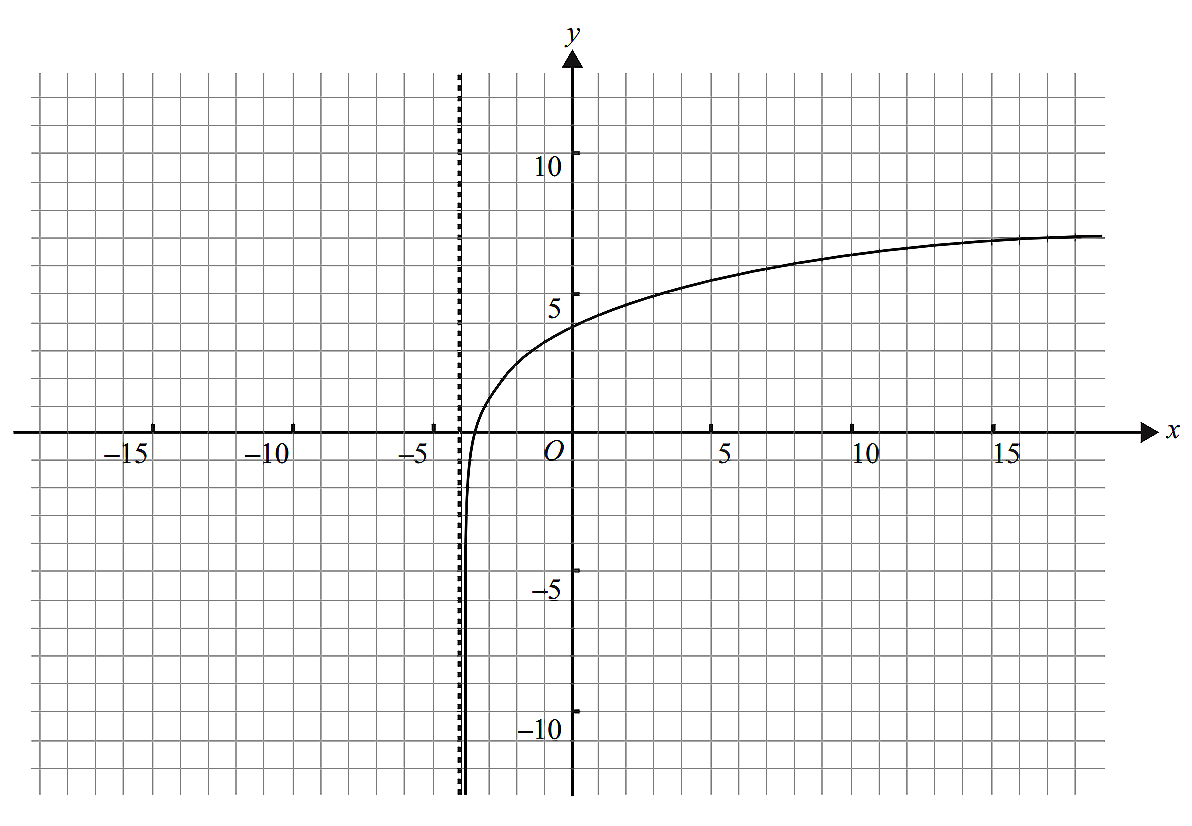
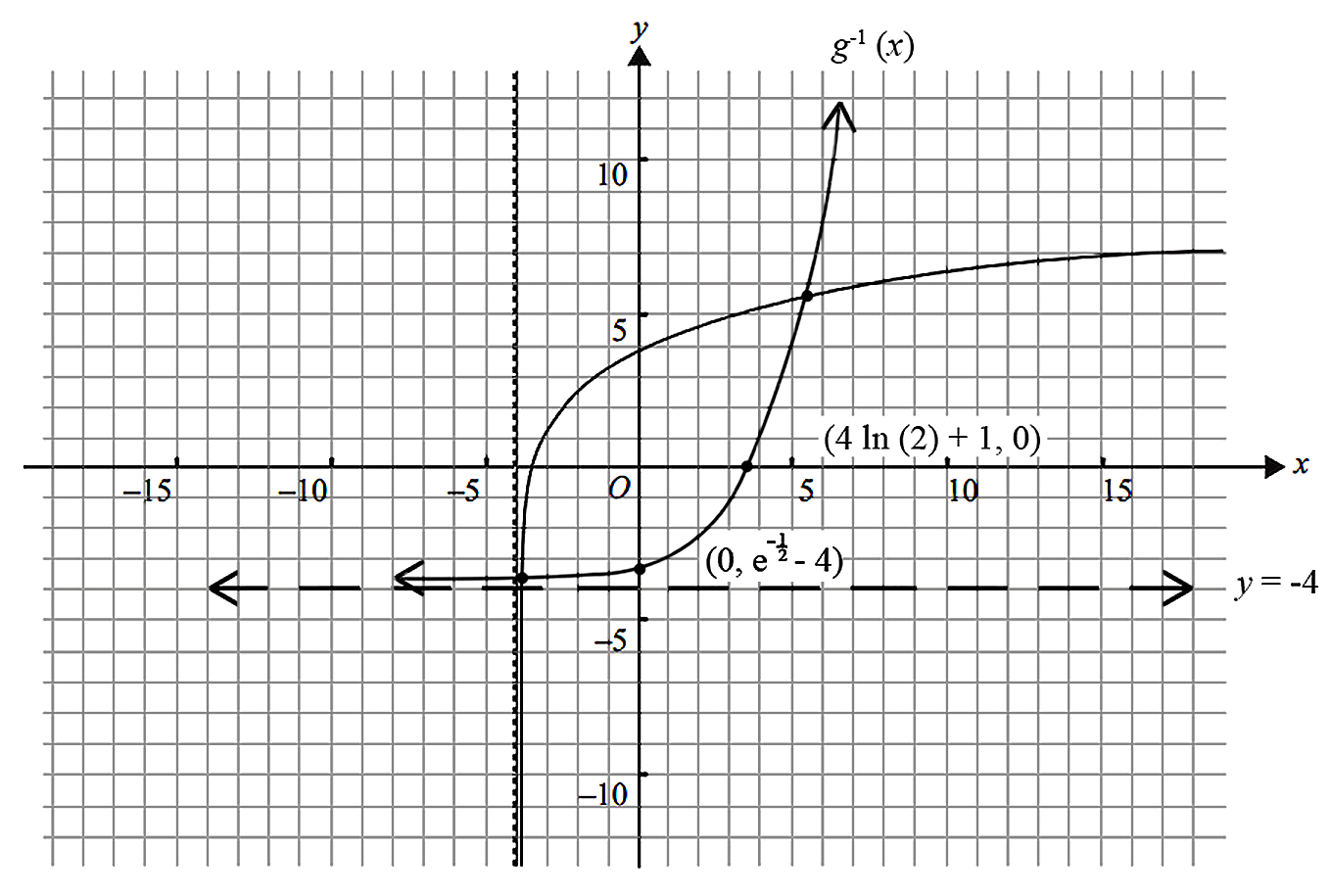
The inverse of the function  `f: R^+ -> R,\ f(x) = 1/sqrt x + 4`  is

A.    `f^-1: (4, oo) -> R` `f^-1(x) = 1/(x - 4)^2`
B.    `f^-1: R^+ -> R` `f^-1(x) = 1/x^2 + 4`
C.    `f^-1: R^+ -> R` `f^-1(x) = (x + 4)^2`
D.    `f^-1:\ text{(−4, ∞)} -> R`        `f^-1(x) = 1/(x + 4)^2`
E.    `f^-1:\ text{(−∞, 4)} -> R` `f^-1(x) = 1/(x - 4)^2`
Show Answers Only

`A`

Show Worked Solution

`text(Let)\ \ y = f(x)`

`text(Inverse: swap)\ x ↔ y`

`x` `= 1/sqrty + 4`
`x – 4` `= 1/sqrty`
`sqrty` `= 1/(x – 4)`
`y` `= 1/((x – 4)^2) = f^(−1)(x)`


`text(Domain)(f^(−1)) = text(Range)\ (f) = (4,∞)`

`=>   A`

Filed Under: Polynomial and Other Functions Tagged With: Band 3, smc-5205-20-Square root, smc-633-30-Square root

Graphs, MET2 2014 VCAA 2 MC

The linear function  `f: D -> R, f (x) = 4 - x`  has range  `text{[−2, 6)}`.

The domain `D` of the function is

  1. `text{[−2, 6)}`
  2. `text{(−2, 2]}`
  3. `R`
  4. `text{(−2, 6]}`
  5. `text{[−6, 2]}`
Show Answers Only

`D`

Show Worked Solution

met2-2014-vcaa-2-mc-answer

`:. D = (−2,6)`

`=>   D`

Filed Under: Coordinate Geometry Tagged With: Band 3, smc-727-40-Domain/Range

Graphs, MET2 2014 VCAA 1 MC

The point `P\ text{(4, −3)}` lies on the graph of a function  `f`. The graph of  `f` is translated four units vertically up and then reflected in the `y`-axis.

The coordinates of the final image of `P` are

  1. `text{(−4, 1)}`
  2. `text{(−4, 3)}`
  3. `text{(0, −3)}`
  4. `text{(4, −6)}`
  5. `text{(−4, −1)}`
Show Answers Only

`A`

Show Worked Solution

`text(Using mapping notation:)`

`P(4,−3)\ {:(y + 4),(vec(quad(1)quad)):}\ (4,1)\ {:(−x),(vec(\ (2)\ )):}\ pprime(−4,1)`

`=>   A`

Filed Under: Transformations Tagged With: Band 3, smc-753-40-Combinations

MATRICES, FUR1 2014 VCAA 2 MC

`y - z` `= 8`
`5x - y` `= 0`
`x + z` `= 4`

  
The system of three simultaneous linear equations above can be written in matrix form as

A. `[[0,1,-1],[0,5,-1],[1,0,1]][[x],[y],[z]]=[[8],[0],[4]]` B. `[[0,1,-1],[5,-1,0],[1,0,1]][[x],[y],[z]]=[[8],[0],[4]]`
       
C. `[[1,-1],[5,-1],[1,1]][[x],[y],[z]]=[[8],[0],[4]]` D. `[[0,5,1],[1,-1,0],[-1,0,1]][[x],[y],[z]]=[[8],[0],[4]]`
       
E. `[[0,5,0],[-1,-1,0],[1,1,0]][[x],[y],[z]]=[[8],[0],[4]]`    
Show Answers Only

`B`

Show Worked Solution

`=>B`

Filed Under: Simultaneous Equations Tagged With: Band 3, smc-617-20-SE to Matrix

Calculus, EXT1 C1 2008 HSC 4a

A turkey is taken from the refrigerator. Its temperature is  5°C when it is placed in an oven preheated to  190°C.

Its temperature,  `T`° C, after  `t`  hours in the oven satisfies the equation

`(dT)/(dt) = -k(T − 190)`.

  1. Show that  `T = 190 - 185e^(-kt)`  satisfies both this equation and the initial condition.  (2 marks)

    --- 5 WORK AREA LINES (style=lined) ---

  2. The turkey is placed into the oven at 9 am. At 10 am the turkey reaches a temperature of  29°C. The turkey will be cooked when it reaches a temperature of 80°C.


    At what time (to the nearest minute) will it be cooked?  (3 marks)

    --- 10 WORK AREA LINES (style=lined) ---

Show Answers Only
  1. `text(See Worked Solutions)`
  2. `12:44\ text(pm)`
Show Worked Solution
i.    `T` `= 190 − 185e^(-kt)`
   `(dT)/(dt)` `= -k xx -185e^(-kt)`
    `= -k(190 − 185e^(-kt) − 190)`
    `= -k(T − 190)`

 
`:.T = 190 − 185e^(-kt)\ text(satisfies equation.)`
 

`text(When)\ \ t = 0,`

`T` `= 190 − 185e^0`
  `= 5°`

 
`:.\ text(Initial conditions are satisfied.)`
 

ii.   `text(When)\ \ t = 1,\ T = 29`

`29` `= 190 − 185e^(-k)`
`185e^(-k)` `= 161`
`e^(-k)` `= 161/185`
`-k` `= ln\ 161/185`
`:.k` `= -ln\ 161/185`
  `= 0.1389…`


`text(Find)\ \  t\ \ text(when)\ \ T = 80 :`

`80` `= 190 − 185e^(-kt)`
`185e^(-kt)` `= 110`
`e^(-kt)` `= 110/185`
`-kt` `= ln\ 110/185`
`:.t=` `= ln\ 110/185 -: -0.1389…`
  `= 3.741…`
  `= 3\ text(hours)\ 44\ text{mins (nearest minute)}`

 
`:.\ text(The turkey will be cooked at 12:44 pm.)`

Filed Under: Exponential Growth and Decay EXT1, Modified Growth and Decay Tagged With: Band 3, Band 4, smc-1080-10-Cooling

Calculus, EXT1* C1 2004 HSC 7b

At the beginning of 1991 Australia’s population was 17 million. At the beginning of 2004 the population was 20 million.

Assume that the population `P` is increasing exponentially and satisfies an equation of the form  `P = Ae^(kt)`, where  `A`  and  `k`  are constants, and  `t`  is measured in years from the beginning of 1991.

  1. Show that  `P = Ae^(kt)`  satisfies  `(dP)/(dt) =kP`.  (1 mark)

    --- 2 WORK AREA LINES (style=lined) ---

  2. What is the value of  `A`?  (1 mark)

    --- 2 WORK AREA LINES (style=lined) ---

  3. Find the value of  `k`.  (2 marks)

    --- 6 WORK AREA LINES (style=lined) ---

  4. Predict the year during which Australia’s population will reach 30 million.  (2 marks)

    --- 8 WORK AREA LINES (style=lined) ---

Show Answers Only
  1. `kP`
  2. `1.7 × 10^7`
  3. `0.013\ \ text(to 3 decimal places.)`
  4. `2036`
Show Worked Solution
i.   `P` `= Ae^(kt)`
  `(dP)/(dt)` `= kAe^(kt)`
    `= kP`


ii.  `P = Ae^(kt)`

`text(When)\ \ t = 0, \ P = 1.7 × 10^7`

`1.7 × 10^7` `= Ae^0`
`1.7 × 10^7`  `= A xx 1` 
`:. A` `= 1.7 × 10^7` 


iii.  `P = 1.7 × 10^7e^(kt)`

`text(When)\ t = 13, \ P = 2 × 10^7`

`2 × 10^7` `= 1.7 × 10^7e^(13k)`
`(2 × 10^7)/(1.7 × 10^7)` `= e^(13k)`
`ln (2/(1.7))` `= ln e^(13k)`
  `= 13k`
`:.k` `= 1/13 ln (2/(1.7))`
  `= 0.0125…`
  `= 0.013\ \ \ text{(to 3 d.p.)}`


iv.  `P` `= 1.7 × 10^7e^(kt)`

`text(Find)\ \ t\ \ text(when)\ \ P = 3 × 10^7,`

MARKER’S COMMENT: Many students had the correct calculations but didn’t answer the question by identifying the exact year and lost a valuable mark.
`3 × 10^7` `= 1.7 × 10^7e^(kt)`
`(3 × 10^7)/(1.7 × 10^7)` `= e^(kt)`
`ln (3/(1.7))` `= ln e^(kt)`
`ln (3/(1.7))` `= kt ln e`
  `= kt`
`:.t` `= (ln (3/(1.7)))/k`
 

`= (ln(3/(1.7)))/(0.0125…)`

  `= 45.433…`
  `= 45.4\ \ text{years    (to 1 d.p.)}`


`:.\ text(The population will reach 30 million in 2036.)`

Filed Under: Exponential growth and decay, Standard Growth and Decay Tagged With: Band 3, Band 4, smc-1081-10-Growth, smc-1081-40-Population

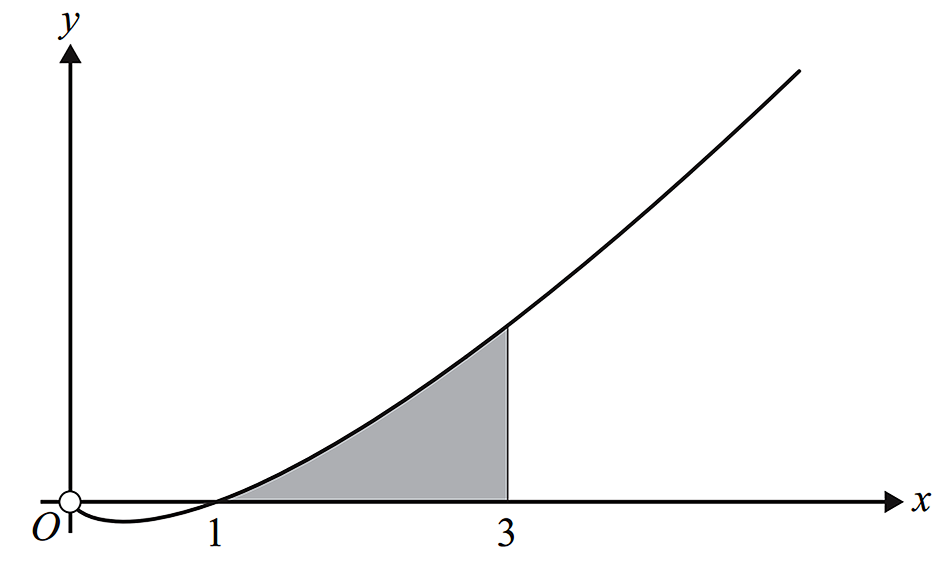
Plane Geometry, 2UA 2004 HSC 6b


The diagram shows a right-angled triangle  `ABC`  with  `∠ABC = 90^@`. The point  `M`  is the midpoint of  `AC`, and  `Y`  is the point where the perpendicular to  `AC`  at  `M`  meets  `BC`.

  1. Show that  `ΔAYM ≡ ΔCYM`.  (2 marks)
  2. Suppose that it is also given that  `AY`  bisects  `∠BAC`. Find the size of  `∠YCM`  and hence find the exact ratio  `MY : AC`.  (3 marks) 


Show Answers Only
  1. `text(Proof)\ \ text{(See Worked Solutions)}`
  2. `1 : 2sqrt3`
Show Worked Solution
(i)    Plane Geometry, 2UA 2004 HSC 6b Answer

`text(In)\ ΔAYM\ text(and)\ ΔCYM`

MARKER’S COMMENT: Markers strongly recommend that students copy the diagram in geometry questions and label it along with the workings of their solution.
`∠AMY` `= ∠CMY = 90^@\ \ \ (MY ⊥ AC)`
`AM` `=CM\ \ \ text{(given)}`
`YM\ text(is common)`


`:.ΔAYM ≡ ΔCYM\ \ text{(SAS)}`


(ii)  `text(Let)\ \ /_BAC = 2 theta`

`∠YAB = ∠YAM = theta\ \ \ \ (AY\ text(bisects)\ ∠BAC)`

`∠YAM` `= ∠YCM=theta` `\ \ \ text{(corresponding angles of}`
    `\ \ \ text{congruent triangles)}`
`:.∠YAB= ∠ YAM = ∠YCM=theta` 


♦♦ Very few students answered this part correctly.
MARKER’S COMMENT: Students who began by making `∠BAC=2theta` were the most successful.

`text(In)\ \ ΔABC,`

`∠ABC + ∠BAC + ∠YCM` `= 180^@`
`:.90^@ +2theta+theta` `= 180^@`
`3theta` `= 90^@`
`:.theta` `= 30^@`

`text(In)\ \ Delta MYC,`

`:.tan 30^@` `= (MY)/(MC)`
`(MY)/(MC)` `= 1/sqrt3`
`(MY)/(2MC)` `=1/(2 sqrt3)`
`(MY)/(AC)` `= 1/(2sqrt3)\ \ \ text{(given}\ \ AC=2MC text{)}`
`:.MY : AC` `= 1 : 2sqrt3.`

Filed Under: 2. Plane Geometry Tagged With: Band 3, Band 4, Band 5

Calculus, 2ADV C3 2004 HSC 5b

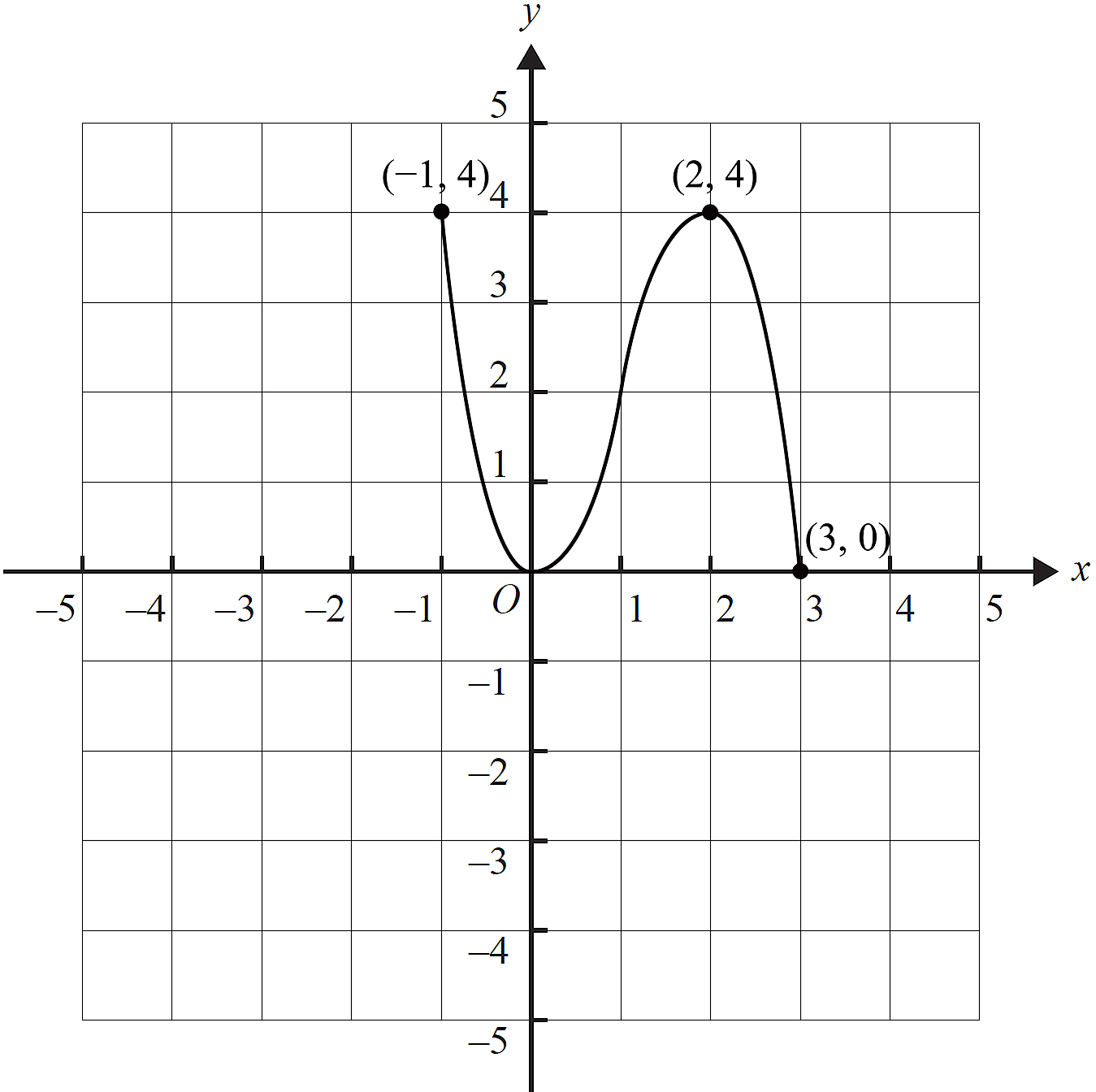
A particle moves along a straight line so that its displacement, `x` metres, from a fixed point `O` is given by  `x = 1 + 3 cos 2t`, where  `t`  is measured in seconds.

  1. What is the initial displacement of the particle?  (1 mark)

    --- 2 WORK AREA LINES (style=lined) ---

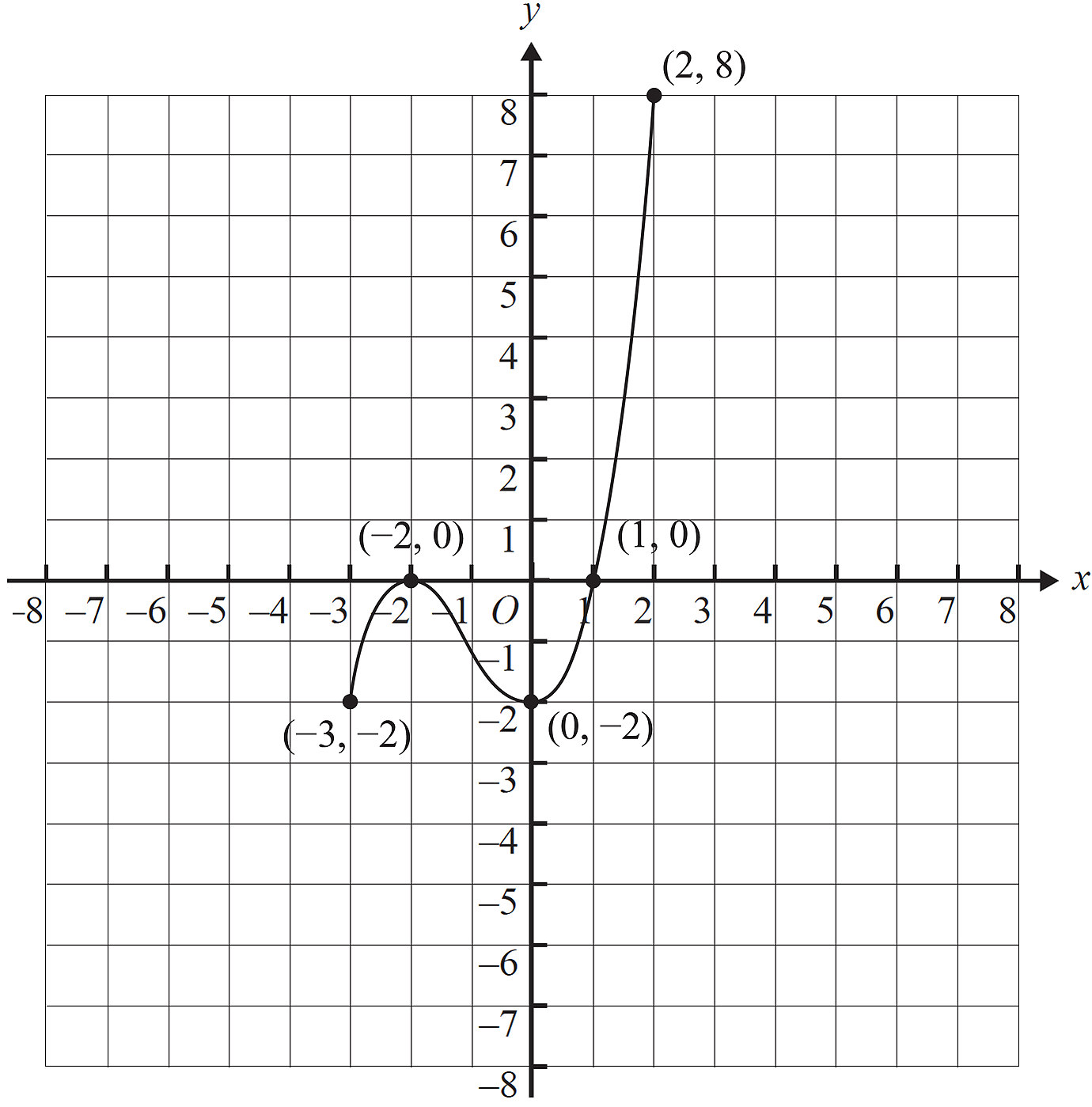
  2. Sketch the graph of  `x`  as a function of  `t`  for  `0 ≤ t ≤ pi`.  (2 marks)

    --- 8 WORK AREA LINES (style=lined) ---

  3. Hence, or otherwise, find when AND where the particle first comes to rest after  `t = 0`.  (2 marks)

    --- 4 WORK AREA LINES (style=lined) ---

  4. Find a time when the particle reaches its greatest magnitude of velocity. What is this velocity?  (2 marks)

    --- 4 WORK AREA LINES (style=lined) ---
Show Answers Only
  1. `text(4 m to the right of)\ O.`
  2. `text(See Worked Solutions)`
  3. `t = pi/2\ text(seconds, 2 m to the left of)\ O.`
  4. `text(6 m s)^(−1)`
Show Worked Solution

i.   `x = 1 + 3 cos 2t`

`text(When)\ \ t = 0,`

`x` `= 1 + 3 cos 0`
  `= 1 + 3`
  `= 4`


`:.\ text(Initial displacement is 4 m to the right of)\ O.`


 ii.  `text(Period)\ = (2pi)/n = (2pi)/2 = pi`

`text(Considering the range)`

`-1` `<=cos 2t<=1`
`-3` `<=3cos 2t<=3`
`-2` `<=1 + 3 cos 2t<=4`


 Calculus in the Physical World, 2UA 2004 HSC 5b


iii.   `x` `= 1 + 3 cos 2t`
  `:.v` `= −6 sin 2t`


`text(The particle comes to rest when)\ \ v=0`

`-6 sin 2t` `= 0`
`sin 2t` `= 0`
`2t` `= 0, pi, 2pi…`
`t` `= 0, pi/2, pi…`


`:.\ text(After)\ \ t=0, text(particle first comes to rest when)`

`t = pi/2\ text(seconds.)`

`text(When)\ t = pi/2,`

`x` `= 1 + 3 cos 2(pi/2)`
  `= 1 + 3 cos pi`
  `= 1 + 3(−1)`
  `= −2`


`:.\ text(Particle first comes to rest at 2 m to the left of)\ O.`


iv.  `x = 1 + 3 cos 2t`

`v` `= -6 sin 2t`
`a` `= -12 cos 2t`
   

`text(MAX occurs when)\ \ a=0`

`−12 cos 2t` `= 0`
`cos 2t` `= 0`
`2t` `= pi/2, (3pi)/2, …`
`t` `= pi/4, (3pi)/4, …`

 
`:.\ text(Maximum at)\ \ t=pi/4,\ \ (3pi)/4, …\ text(seconds,)`


`text(When)\ \ t = pi/4\ text(seconds,)`

`v` `= -6 sin 2(pi/4)`
  `= -6 sin(pi/2)`
  `= −6`

 
`:.\ text(Maximum is 6 m s)^(−1).`

Filed Under: Motion, Rates of Change (Y12) Tagged With: Band 3, Band 4, Band 5, smc-1091-10-Motion, smc-1091-40-Trig Function

Financial Maths, 2ADV M1 2004 HSC 5a

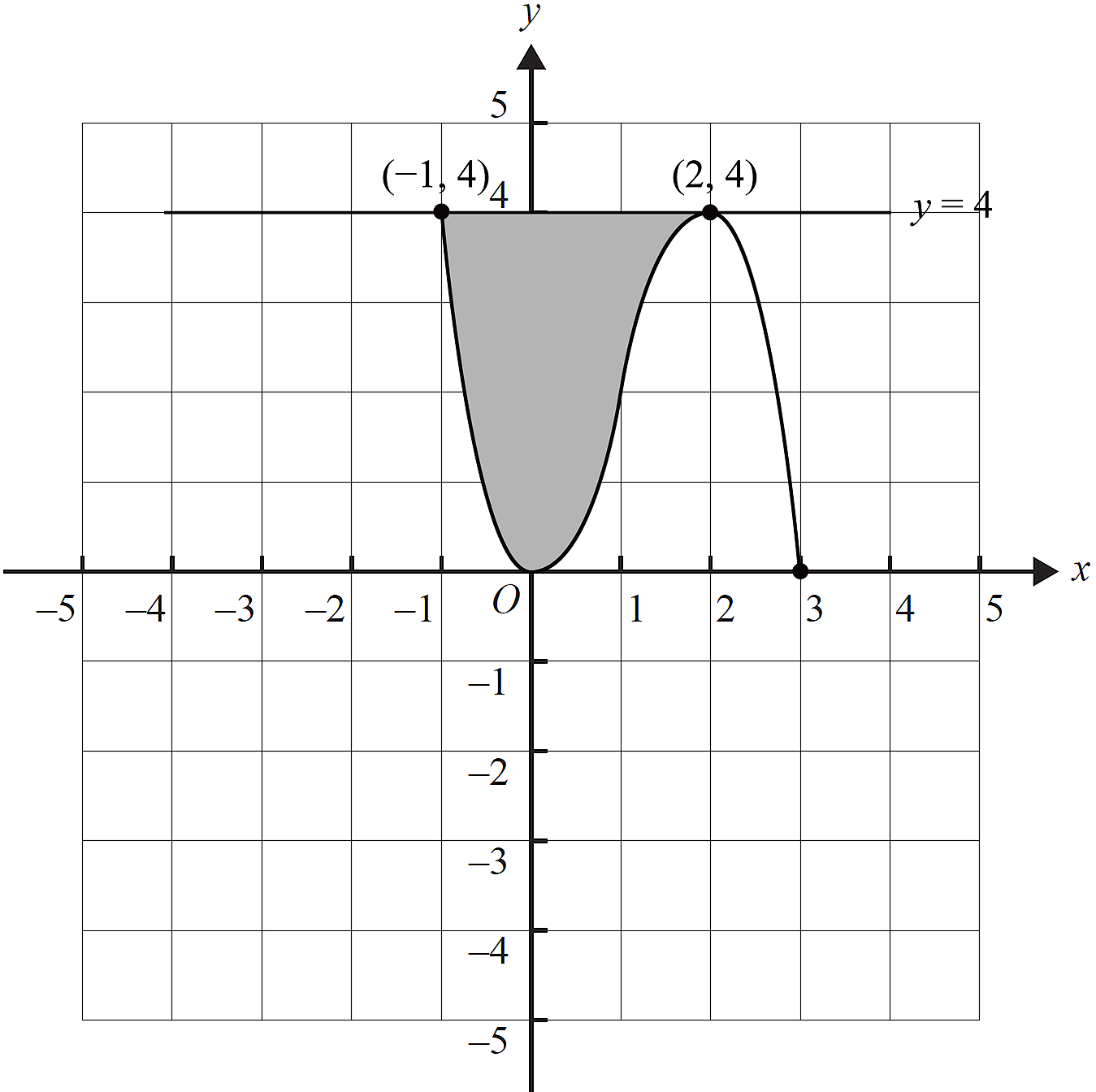
Clare is learning to drive. Her first lesson is 30 minutes long. Her second lesson is 35 minutes long. Each subsequent lesson is 5 minutes longer than the lesson before.

  1. How long will Clare’s twenty-first lesson be?  (1 mark)

    --- 2 WORK AREA LINES (style=lined) ---

  2. How many hours of lessons will Clare have completed after her twenty-first lesson?  (2 marks)

    --- 5 WORK AREA LINES (style=lined) ---

  3. During which lesson will Clare have completed a total of 50 hours of driving lessons?  (2 marks)

    --- 4 WORK AREA LINES (style=lined) ---
Show Answers Only
  1. `text(130 minutes)`
  2. `28\ text(hours)`
  3. `text(30th lesson)`
Show Worked Solution

i.   `30, 35, 40, …`

`=>\ text(AP where)\ \ a = 30,\ \ d = 5`

`T_n` `= a + (n − 1) d`
`T_(21)` `= 30 + 20(5)`
  `= 30 + 100`
  `= 130`


`:.\ text(Clare’s twenty-first lesson will be 130)`

`text(minutes long.)`


ii.  `text(Find)\ \ S_21\ \ text(given)\ \ a = 30, \ d = 5`

`S_n` `= n/2[2a + (n − 1)d]`
`:.S_21` `= 21/2[2(30) + 20 × 5]`
  `= 21/2[60 + 100]`
  `= 21/2 × 160`
  `= 1680\ text(minutes)`
  `= 28\ text(hours.)`


(iii)  `text(50 hours)` `= 50 × 60`
  `= 3000\ text(minutes)`


`text(Find)\ \ n,\ \ text(given)\ \ a = 30, \ d = 5, \ S_n = 3000`

`S_n` `= n/2[2a + (n − 1)d]`
`:. 3000` `= n/2[2(30) + (n − 1)5]`
`6000` `= n[60 + 5n − 5]`
`6000` `= n[55 + 5n]`
`6000` `= 55n + 5n^2`
`5n^2 + 55n − 6000` `= 0`
`n^2 + 11n − 1200` `= 0`
`:.n` `= (−11 ± sqrt((11)^2 − 4(1)(−1200)))/(2(1))`
  `= (−11 ± sqrt(121 + 4800))/(2)`
  `= (−11 ± sqrt4921)/2`
  `= 29.5749…\ \ \ (n> 0)`


`:.\ text(Clare completes 50 hours of lessons during)`

`text(her 30th lesson.)`

Filed Under: Arithmetic Series, Arithmetic Series (Y12) Tagged With: Band 3, Band 4, smc-1005-10-Find Term, smc-1005-20-Find Sum

Calculus, MET2 2012 VCAA 15 MC

If  `f prime (x) = 3x^2 - 4`, which one of the following graphs could represent the graph of  `y = f (x)`?

VCAA 2012 15mc

VCAA 2012 15mci

VCAA 2012 15mcii

Show Answers Only

`B`

Show Worked Solution

`f prime (x) = 3x^2 – 4`

`:. f(x)\ text(is a cubic with two stationary points.)`

`=>   B`

Filed Under: Standard Integration, The Derivative Function and its Graph Tagged With: Band 3, smc-2830-10-Find f(x) given f'(x), smc-749-30-Find f(x) given f'(x)

Probability, MET2 2012 VCAA 12 MC

Demelza is a badminton player. If she wins a game, the probability that she will win the next game is 0.7. If she loses a game, the probability that she will lose the next game is 0.6. Demelza has just won a game.

The probability that she will win exactly one of her next two games is

A.   `0.33`

B.   `0.35`

C.   `0.42`

D.   `0.49`

E.   `0.82`

Show Answers Only

`A`

Show Worked Solution

`text(After a win in game 1,)`

`text{Pr(exactly one of next two)}`

`= text(Pr)(WWL) + text(Pr)(WLW)`

`= 1 xx 0.7 xx 0.3 + 1 xx 0.3 xx 0.4`

`= 0.33`

`=>   A`

Filed Under: Uncategorized Tagged With: Band 3

CORE*, FUR2 2014 VCAA 1

The adult membership fee for a cricket club is $150.

Junior members are offered a discount of $30 off the adult membership fee.

  1. Write down the discount for junior members as a percentage of the adult membership fee.   (1 mark)

    --- 2 WORK AREA LINES (style=lined) ---
Adult members of the cricket club pay $15 per match in addition to the membership fee of $150.

  1. If an adult member played 12 matches, what is the total this member would pay to the cricket club?   (1 mark)

    --- 3 WORK AREA LINES (style=lined) ---

If a member does not pay the membership fee by the due date, the club will charge simple interest at the rate of 5% per month until the fee is paid.

Michael paid the $150 membership fee exactly two months after the due date.

  1. Calculate, in dollars, the interest that Michael will be charged.   (1 mark)

    --- 2 WORK AREA LINES (style=lined) ---
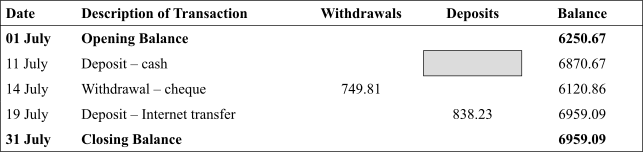
The cricket club received a statement of the transactions in its savings account for the month of January 2014.

The statement is shown below.

     BUSINESS, FUR2 2014 VCAA 1

    1. Calculate the amount of the withdrawal on 17 January 2014.   (1 mark)

      --- 2 WORK AREA LINES (style=lined) ---
    2. Interest for this account is calculated on the minimum balance for the month and added to the account on the last day of the month.
    3. What is the annual rate of interest for this account?  Write your answer, correct to one decimal place.   (1 mark)

      --- 3 WORK AREA LINES (style=lined) ---
  1.  

Show Answers Only

  1. `text(20%)`
  2. `$330`
  3. `$15`
    1. `$17\ 000`
    2. `3.5`

Show Worked Solution

a.   `text(Discount for junior members)`

`= 30/150 xx 100text(%)`

`= 20text(%)`

  
b.   `text(Match Payments)= 12 xx 15=$180`

`:.\ text(Total paid to the club)` `= 150 + 180`
  `= $330`


c.    `I` `= (PrT)/100`
    `= (150 xx 5 xx 2)/100`
    `= $15`


d.i.   `text(Withdrawal on 17 Jan)`

`= 59\ 700-42\ 700`

`= $17\ 000`
    

d.ii.   `text(Minimum Jan balance) = $42\ 700`

`47\ 200 xx r xx 1/12` `= 125.12`
`:. r` `= (125.12 xx 12)/(42\ 700)`
  `= 0.0351…`

  
`:.\ text(Annual interest rate) = 3.5text(%)`

Filed Under: Interest Rates and Investing Tagged With: Band 2, Band 3, Band 4, smc-604-10-Simple interest, smc-604-40-% Increase/Decrease, smc-604-80-Bank Statement

  • « Previous Page
  • 1
  • …
  • 45
  • 46
  • 47
  • 48
  • 49
  • …
  • 57
  • Next Page »

Copyright © 2014–2025 SmarterEd.com.au · Log in