SmarterEd

Aussie Maths & Science Teachers: Save your time with SmarterEd

  • Login
  • Get Help
  • About

Calculus, 2ADV C3 2021 HSC 26

A particle is shot vertically upwards from a point 100 metres above ground level.

The position of the particle, `y` metres above the ground after `t` seconds, is given by

`y(t) =-5t^2 + 70t + 100`.
  

  1. Find the maximum height above ground level reached by the particle.   (2 marks)

    --- 4 WORK AREA LINES (style=lined) ---

  2. Find the velocity of the particle, in metres per second, immediately before it hits the ground, leaving your answer in the form  `asqrtb`,  where  `a`  and  `b`  are integers.   (3 marks)

    --- 6 WORK AREA LINES (style=lined) ---
Show Answers Only

a.    `345\ text(m)`

b.    `-20sqrt69\ text(m/s)`

Show Worked Solution

a.    `y(t) = -5t^2 + 70t + 100`

`y^(prime)(t) = -10t + 70`

`y^(primeprime)(t) = -10`

`text(Max height occurs when)\ \ y^(prime)(t) = 0:`  

`-10t + 70` `= 0`
`10t` `= 70`
`t` `= 7`


`:.\ text(Max height)\ ` `= -5(7)^2 + 70 xx 7 + 100`
  `= 345\ text(m)`

  
b. 
 `text(Particle hits ground when)\ \ y = 0:`

♦ Mean mark (b) 38%.
`0` `= -5t^2 + 70t + 100`
`0` `= t^2-14t-20`

 
`text(Using quadratic formula:)`
  

`t` `= (14 +- sqrt(14^2 + 4*20))/2`
  `= (14 + sqrt(276))/2\ \ \ (t > 0)`
  `= 7 + sqrt69`


`:. text(Velocity)\ (y^(prime)(t))` `= -10(7 + sqrt69) + 70`
  `= -10sqrt69\ text(m/s)`

 
`:.\ \ a=-10 and b=69`

Filed Under: Rates of Change, Rates of Change Tagged With: Band 4, Band 5, smc-1091-10-Motion, smc-1091-50-Other Function, smc-7135-10-Motion

Calculus, 2ADV C4 2019 HSC 14a

A particle is moving along a straight line. The particle is initially at rest. The acceleration of the particle at time  `t`  seconds is given by  `a = e^(2t)-4`, where  `t >= 0`.

Find an expression, in terms of  `t`, for the velocity of the particle.   (2 marks)

--- 5 WORK AREA LINES (style=lined) ---

Show Answers Only

`v = 1/2e^(2t)-4t-1/2`

Show Worked Solution

`a = (dv)/(dt) = e^(2t)-4`

`v` `= int e^(2t)-4\ dt`
  `= 1/2 e^(2t)-4t + c`

  
 `text(When)\ t = 0,\ v = 0`

`0 = 1/2 e^0-0 + c`

`c = -1/2`

`:. v = 1/2e^(2t)-4t-1/2`

Filed Under: Other Integration Applications, Rates of Change Tagged With: Band 4, smc-1091-10-Motion, smc-1091-30-Log/Exp Function, smc-1213-10-Motion, smc-7135-10-Motion

Calculus, 2ADV C3 2004 HSC 5b

A particle moves along a straight line so that its displacement, `x` metres, from a fixed point `O` is given by  `x = 1 + 3 cos 2t`, where  `t`  is measured in seconds.

  1. What is the initial displacement of the particle?   (1 mark)

    --- 2 WORK AREA LINES (style=lined) ---

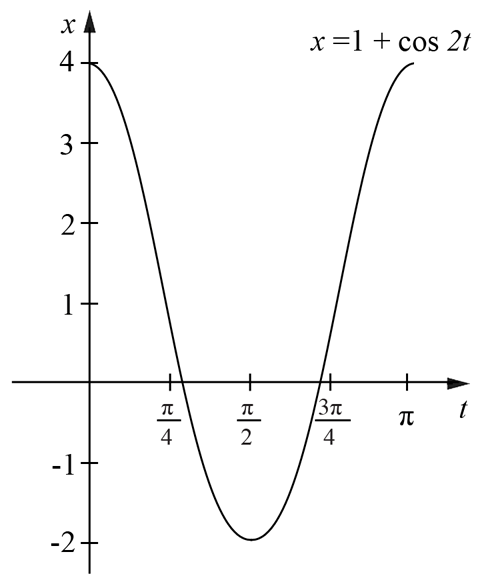
  2. Sketch the graph of  `x`  as a function of  `t`  for  `0 ≤ t ≤ pi`.   (2 marks)

    --- 8 WORK AREA LINES (style=lined) ---

  3. Hence, or otherwise, find when AND where the particle first comes to rest after  `t = 0`.   (2 marks)

    --- 4 WORK AREA LINES (style=lined) ---

  4. Find a time when the particle reaches its greatest magnitude of velocity. What is this velocity?   (2 marks)

    --- 4 WORK AREA LINES (style=lined) ---

Show Answers Only

a.    `text(4 m to the right of)\ O.`

b.    `text(See Worked Solutions)`

c.     `t = pi/2\ text(seconds, 2 m to the left of)\ O.`

d.    `text(6 m s)^(−1)`

Show Worked Solution

a.    `x = 1 + 3 cos 2t`

`text(When)\ \ t = 0,`

`x` `= 1 + 3 cos 0`
  `= 1 + 3= 4`

  
`:.\ text(Initial displacement is 4 m to the right of)\ O.`
  

b.    `text(Period)\ = (2pi)/n = (2pi)/2 = pi`

`text(Considering the range)`

`-1` `<=cos 2t<=1`
`-3` `<=3cos 2t<=3`
`-2` `<=1 + 3 cos 2t<=4`


 Calculus in the Physical World, 2UA 2004 HSC 5b


c.      `x` `= 1 + 3 cos 2t`
  `:.v` `= -6 sin 2t`

  
`text(The particle comes to rest when)\ \ v=0`

`-6 sin 2t` `= 0`
`sin 2t` `= 0`
`2t` `= 0, pi, 2pi…`
`t` `= 0, pi/2, pi…`

  
`:.\ text(After)\ \ t=0, text(particle first comes to rest when)`

`t = pi/2\ text(seconds.)`

`text(When)\ t = pi/2,`

`x` `= 1 + 3 cos 2(pi/2)`
  `= 1 + 3 cos pi`
  `= 1 + 3(−1)`
  `= −2`

  
`:.\ text(Particle first comes to rest at 2 m to the left of)\ O.`
  

d.    `x = 1 + 3 cos 2t`

`v` `= -6 sin 2t`
`a` `= -12 cos 2t`

  
`text(MAX occurs when)\ \ a=0`
  

`-12 cos 2t` `= 0`
`cos 2t` `= 0`
`2t` `= pi/2, (3pi)/2, …`
`t` `= pi/4, (3pi)/4, …`

 
`:.\ text(Maximum at)\ \ t=pi/4,\ \ (3pi)/4, …\ text(seconds,)`

  
`text(When)\ \ t = pi/4\ text(seconds,)`

`v` `= -6 sin 2(pi/4)`
  `= -6 sin(pi/2)`
  `= -6`

   
`:.\ text(Maximum is 6 m s)^(−1).`

Filed Under: Motion, Rates of Change, Rates of Change Tagged With: Band 3, Band 4, Band 5, smc-1091-10-Motion, smc-1091-40-Trig Function, smc-7135-10-Motion

Calculus, 2ADV C4 2009 HSC 7a

The acceleration of a particle is given by

`a=8e^(-2t)+3e^(-t)`,

where  `x`  is the displacement in metres and  `t`  is the time in seconds.

Initially its velocity is  `-6\ text(ms)^(-1)` and its displacement is 5 m.

  1. Show that the displacement of the particle is given by
  2. `qquad  x=2e^(-2t)+3e^-t+t`.   (2 marks) 

    --- 5 WORK AREA LINES (style=lined) ---

  3. Find the time when the particle comes to rest.   (3 marks)

    --- 7 WORK AREA LINES (style=lined) ---

  4. Find the displacement  when the particle comes to rest.   (1 mark)

    --- 3 WORK AREA LINES (style=lined) ---

Show Answers Only

a.    `text{Proof  (See Worked Solutions)}`

b.    `ln4\ text(seconds)`

c.    `7/8+ln4\ \ text(units)`

Show Worked Solution

a.    `text(Show)\ \ x=2e^(-2t)+3e^-t+t`

`a=8e^(-2t)+3e^-t\ \ text{(given)}`

`v=int a\ dt=-4e^(-2t)-3e^-t+c_1`

`text(When)\ t=0,  v=-6\ \ text{(given)}`

`-6` `=-4e^0-3e^0+c_1`
`-6` `=-7+c_1`
`c_1` `=1`

 
`:. v=-4e^(-2t)-3e^-t+1`
 

`x` `=int v\ dt`
  `=int(-4e^(-2t)-3e^-t+1)\ dt`
  `=2e^(-2t)+3e^-t+t+c_2`

 
`text(When)\ \ t=0,\ x=5\ \ text{(given)}`

`5` `=2e^0+3e^0+c_2`
`c_2` `=0`

 
`:.\ x=2e^(-2t)+3e^-t+t\ \ text(… as required)`

  
b.
   `text(Particle comes to rest when)\ \ v=0`

`text(i.e.)\ \ -4e^(-2t)-3e^-t+1=0`

`text(Let)\ X=e^-t\ \ \ \ =>X^2=e^(-2t)`

`-4X^2-3X+1` `=0`
`4X^2+3X-1` `=0`
`(4X-1)(X+1)` `=0`

 
 `:.\ \ X=1/4\ \ text(or)\ \ X=-1`

`text(When)\ \ X=1/4:`

`e^-t` `=1/4`
`lne^-t` `=ln(1/4)`
`-t` `=ln(1/4)`
`t` `=-ln(1/4)=ln(1/4)^-1=ln4`

 
`text(When)\ \ X=-1:`

`e^-t=-1\ \ text{(no solution)}`
 

`:.\ text(The particle comes to rest when)\ t=ln4\ text(seconds)`
  

c.    `text(Find)\ \ x\ \ text(when)\ \ t=ln4 :`

`x=2e^(-2t)+3e^-t+t`

`\ \ =2e^(-2ln4)+3e^-ln4+ln4`

`\ \ =2(e^ln4)^-2+3(e^ln4)^-1+ln4`

`\ \ =2xx4^-2+3xx4^-1+ln4`

`\ \ =2/16+3/4+ln4`

`\ \ =7/8+ln4`

ALGEBRA TIP: Helpful identity  `e^lnx=x`. Easily provable as follows:
`e^ln2=x`
`\ =>lne^ln2=lnx\ `
`\ => ln2=lnx\ `
`\ =>x=2`.

Filed Under: Motion, Other Integration Applications, Rates of Change Tagged With: Band 3, Band 4, Band 5, smc-1091-10-Motion, smc-1091-30-Log/Exp Function, smc-1213-10-Motion, smc-7135-10-Motion

Calculus, 2ADV C3 2011 HSC 7b

The velocity of a particle moving along the `x`-axis is given by

`v=8-8e^(-2t)`,

where `t` is the time in seconds and `x` is the displacement in metres.

  1. Show that the particle is initially at rest.   (1 mark)

    --- 1 WORK AREA LINES (style=lined) ---

  2. Show that the acceleration of the particle is always positive.   (1 mark)

    --- 2 WORK AREA LINES (style=lined) ---

  3. Explain why the particle is moving in the positive direction for all  `t>0`.   (2 marks)

    --- 5 WORK AREA LINES (style=lined) ---

  4. As  `t->oo`, the velocity of the particle approaches a constant.


    Find the value of this constant.   (1 mark) 

    --- 2 WORK AREA LINES (style=lined) ---

  5. Sketch the graph of the particle's velocity as a function of time.   (2 marks)

    --- 8 WORK AREA LINES (style=lined) ---

Show Answers Only

a.    `text{Proof (See Worked Solutions)}`

b.    `text{Proof (See Worked Solutions)}`

c.    `text(See Worked Solutions.)`

d.    `8\ text(m/s)`

e.    `text(See sketch in Worked Solutions)`

Show Worked Solution

a.    `text(Initial velocity when)\ \ t=0`

`v=8-8e^0=0\ text(m/s)`

`:.\ text(Particle is initially at rest.)`


MARKER’S COMMENT: Students whose working showed `e^(-2t)` as `1/e^(2t)`, tended to score highly in this question.

b.    `a=d/(dt) (v)=-2xx-8e^(-2t)=16e^(-2t)`

`text(S)text(ince)\  e^(-2t)=1/e^(2t)>0\ text(for all)\  t`.

`=>\ a=16e^(-2t)=16/e^(2t)>0\ text(for all)\  t`.
 

`:.\ text(Acceleration is positive for all)\ \ t>0`.
 

c.    `text{S}text{ince the particle is initially at rest, and ALWAYS}`

♦♦♦ Mean mark (c) 22%
COMMENT: Students found part (iii) the most challenging part of this question by far.

`text{has a positive acceleration.`
 

`:.\ text(It moves in a positive direction for all)\ t`.
 

d.    `text(As)\ t->oo`,  `e^(-2t)=1/e^(2t)->0`

`=>8/e^(2t)->0\  text(and)`

`=>v=8-8/e^(2t)->8\ text(m/s)`
 

`:.\ text(As)\ \ t->oo,\ text(velocity approaches 8 m/s.)`


IMPORTANT: Use previous parts to inform this diagram. i.e. clearly show velocity was zero at  `t=0`  and the asymptote at  `v=8`. 
e.    

Calculus in the Physical World, 2UA 2011 HSC 7b Answer

Filed Under: Motion, Rates of Change, Rates of Change Tagged With: Band 3, Band 4, Band 5, Band 6, smc-1091-10-Motion, smc-1091-30-Log/Exp Function, smc-7135-10-Motion

Copyright © 2014–2026 SmarterEd.com.au · Log in