SmarterEd

Aussie Maths & Science Teachers: Save your time with SmarterEd

  • Login
  • Get Help
  • About

HMS, TIP 2012 HSC 28

Describe the different recovery strategies used by athletes to improve performance. Provide examples.   (8 marks)

--- 24 WORK AREA LINES (style=lined) ---

Show Answers Only

Physiological recovery strategies

  • Physiological recovery strategies target the body’s physical systems to remove metabolic waste products and restore energy stores.
  • Cool-down activities involving light jogging and stretching help maintain blood circulation while gradually reducing heart rate and body temperature.
  • For example, swimmers perform easy laps after intensive training sessions to prevent blood pooling in muscles.

Thermal recovery strategies

  • Hydrotherapy utilises water-based treatments to enhance recovery through temperature manipulation and hydrostatic pressure.
  • Ice baths reduce muscle inflammation and soreness following intense exercise by constricting blood vessels.
  • Contrast showers alternating hot and cold water promote blood circulation and reduce swelling.
  • Pool recovery sessions in warm water aid muscle relaxation and joint mobility.

Psychological recovery strategies

  • Psychological recovery strategies focus on mental restoration and stress reduction after demanding training or competition.
  • Progressive muscle relaxation techniques help athletes release physical tension while calming the nervous system.
  • Meditation and deep breathing exercises reduce anxiety levels and promote mental clarity.
  • Visualisation techniques allow athletes to mentally rehearse successful performance while physically resting.

Nutritional recovery strategies

  • Nutritional recovery strategies involve optimal fluid and nutrient replacement to support physiological processes.
  • Consuming carbohydrates within 30 minutes post-exercise rapidly replenishes glycogen stores in muscles and liver.
  • Protein intake supports muscle repair processes and adaptation.
  • Adequate hydration maintains cellular function and temperature regulation during recovery periods.
Show Worked Solution

Physiological recovery strategies

  • Physiological recovery strategies target the body’s physical systems to remove metabolic waste products and restore energy stores.
  • Cool-down activities involving light jogging and stretching help maintain blood circulation while gradually reducing heart rate and body temperature.
  • For example, swimmers perform easy laps after intensive training sessions to prevent blood pooling in muscles.

Thermal recovery strategies

  • Hydrotherapy utilises water-based treatments to enhance recovery through temperature manipulation and hydrostatic pressure.
  • Ice baths reduce muscle inflammation and soreness following intense exercise by constricting blood vessels.
  • Contrast showers alternating hot and cold water promote blood circulation and reduce swelling.
  • Pool recovery sessions in warm water aid muscle relaxation and joint mobility.

Psychological recovery strategies

  • Psychological recovery strategies focus on mental restoration and stress reduction after demanding training or competition.
  • Progressive muscle relaxation techniques help athletes release physical tension while calming the nervous system.
  • Meditation and deep breathing exercises reduce anxiety levels and promote mental clarity.
  • Visualisation techniques allow athletes to mentally rehearse successful performance while physically resting.

Nutritional recovery strategies

  • Nutritional recovery strategies involve optimal fluid and nutrient replacement to support physiological processes.
  • Consuming carbohydrates within 30 minutes post-exercise rapidly replenishes glycogen stores in muscles and liver.
  • Protein intake supports muscle repair processes and adaptation.
  • Adequate hydration maintains cellular function and temperature regulation during recovery periods.

Filed Under: Recovery strategies Tagged With: Band 4, smc-5470-05-Physiological, smc-5470-10-Psychological, smc-5470-15-Nutritional, smc-5470-20-Thermal

HMS, TIP 2012 HSC 27

How can THREE principles of training be applied to improve strength? Provide examples.   (6 marks)

--- 18 WORK AREA LINES (style=lined) ---

Show Answers Only
  • Progressive overload requires gradually increasing training demands to stimulate strength adaptations. This occurs when athletes systematically increase weight, repetitions or sets over time. For example, a weightlifter progressing from 60kg to 80kg bench press over eight weeks demonstrates progressive overload application. Without continuous progression, strength plateaus because muscles adapt to consistent loads.
  • Specificity ensures training matches the demands of the target activity or muscle group. This means exercises must replicate movement patterns and energy systems used in performance. For instance, a shot-putter performing explosive medicine ball throws creates specific adaptations for their competitive throwing technique. This principle results in targeted muscle fibre recruitment patterns.
  • Training thresholds establish minimum intensity levels required to stimulate strength improvements. This typically involves working at 70-85% of one repetition maximum for optimal strength gains. For example, a rugby player performing squats at 75% of maximum weight triggers the physiological adaptations necessary for increased muscular strength and power development. Below this threshold, minimal strength gains occur.
Show Worked Solution
  • Progressive overload requires gradually increasing training demands to stimulate strength adaptations. This occurs when athletes systematically increase weight, repetitions or sets over time. For example, a weightlifter progressing from 60kg to 80kg bench press over eight weeks demonstrates progressive overload application. Without continuous progression, strength plateaus because muscles adapt to consistent loads.
  • Specificity ensures training matches the demands of the target activity or muscle group. This means exercises must replicate movement patterns and energy systems used in performance. For instance, a shot-putter performing explosive medicine ball throws creates specific adaptations for their competitive throwing technique. This principle results in targeted muscle fibre recruitment patterns.
  • Training thresholds establish minimum intensity levels required to stimulate strength improvements. This typically involves working at 70-85% of one repetition maximum for optimal strength gains. For example, a rugby player performing squats at 75% of maximum weight triggers the physiological adaptations necessary for increased muscular strength and power development. Below this threshold, minimal strength gains occur.

Filed Under: Principles of training Tagged With: Band 4, smc-5460-05-Adaptations

HMS, HAG 2012 HSC 24

Explain the roles of individuals, communities and governments in addressing the health inequities experienced by ONE group other than Aboriginal and Torres Strait Islander peoples.   (8 marks)

--- 24 WORK AREA LINES (style=lined) ---

Show Answers Only

Socioeconomically disadvantaged people experience significant health inequities requiring coordinated responses.

  • Individual roles involve pursuing education and employment opportunities, which leads to improved income and health outcomes. Disadvantaged individuals can access community health services, resulting in better preventive care. This occurs when people develop health literacy skills and seek appropriate medical attention early.
  • Community organisations provide essential support services that bridge healthcare gaps. For example, community health centres offer bulk-billing services in low-income areas, ensuring affordable healthcare access. Food banks and community kitchens address nutritional needs, while employment training programs create pathways to economic stability.
  • Government interventions target systemic inequities through policy and funding. Medicare provides universal healthcare coverage, removing financial barriers to medical treatment. Centrelink payments ensure basic income support, enabling disadvantaged families to meet essential needs. Public housing programs address accommodation security, which directly impacts health outcomes.
  • Collaborative approaches prove most effective when all three levels work together. This integration results in comprehensive support addressing multiple determinants of health simultaneously.
Show Worked Solution

Socioeconomically disadvantaged people experience significant health inequities requiring coordinated responses.

  • Individual roles involve pursuing education and employment opportunities, which leads to improved income and health outcomes. Disadvantaged individuals can access community health services, resulting in better preventive care. This occurs when people develop health literacy skills and seek appropriate medical attention early.
  • Community organisations provide essential support services that bridge healthcare gaps. For example, community health centres offer bulk-billing services in low-income areas, ensuring affordable healthcare access. Food banks and community kitchens address nutritional needs, while employment training programs create pathways to economic stability.
  • Government interventions target systemic inequities through policy and funding. Medicare provides universal healthcare coverage, removing financial barriers to medical treatment. Centrelink payments ensure basic income support, enabling disadvantaged families to meet essential needs. Public housing programs address accommodation security, which directly impacts health outcomes.
  • Collaborative approaches prove most effective when all three levels work together. This integration results in comprehensive support addressing multiple determinants of health simultaneously.

♦♦ Mean mark 46%.

Filed Under: Groups Experiencing Inequities Tagged With: Band 4, Band 5, smc-5475-25-Vulnerable groups

HMS, HIC 2012 HSC 23

How is epidemiology used to improve the health of Australians? Provide examples.   (6 marks)

--- 18 WORK AREA LINES (style=lined) ---

Show Answers Only
  • Epidemiology identifies disease patterns within populations, enabling targeted health interventions. This occurs because health authorities analyse mortality, morbidity, incidence and prevalence data from Australia’s Health reports to understand disease distribution across different demographic groups.
  • For instance, epidemiological studies revealed high cardiovascular disease rates among middle-aged men in specific socioeconomic areas. This led to targeted prevention campaigns focusing on diet modification, smoking cessation and exercise programs in these communities. As a result, cardiovascular mortality rates have declined by over 80% since the 1980s, demonstrating epidemiology’s effectiveness in guiding interventions.
  • Epidemiology tracks infectious disease outbreaks, allowing rapid public health responses. When COVID-19 emerged, epidemiological surveillance enabled contact tracing, isolation protocols and containment strategies across Australia. This process prevented wider community transmission in many instances, particularly in rural and remote areas.
  • Cancer screening programs resulted from epidemiological research identifying at-risk populations and optimal screening ages. Consequently, breast cancer screening targets women aged 50-74, while bowel cancer screening focuses on adults over 50. These programs demonstrate how epidemiological evidence guides resource allocation, policy development and preventive healthcare delivery nationwide.
Show Worked Solution
  • Epidemiology identifies disease patterns within populations, enabling targeted health interventions. This occurs because health authorities analyse mortality, morbidity, incidence and prevalence data from Australia’s Health reports to understand disease distribution across different demographic groups.
  • For instance, epidemiological studies revealed high cardiovascular disease rates among middle-aged men in specific socioeconomic areas. This led to targeted prevention campaigns focusing on diet modification, smoking cessation and exercise programs in these communities. As a result, cardiovascular mortality rates have declined by over 80% since the 1980s, demonstrating epidemiology’s effectiveness in guiding interventions.
  • Epidemiology tracks infectious disease outbreaks, allowing rapid public health responses. When COVID-19 emerged, epidemiological surveillance enabled contact tracing, isolation protocols and containment strategies across Australia. This process prevented wider community transmission in many instances, particularly in rural and remote areas.
  • Cancer screening programs resulted from epidemiological research identifying at-risk populations and optimal screening ages. Consequently, breast cancer screening targets women aged 50-74, while bowel cancer screening focuses on adults over 50. These programs demonstrate how epidemiological evidence guides resource allocation, policy development and preventive healthcare delivery nationwide.

Filed Under: Health status of Australians Tagged With: Band 4, smc-5504-05-Epidemiology

HMS, HAG 2012 HSC 22

Outline THREE types of carer or volunteer organisations available to help meet the needs of Australia’s ageing population.   (3 marks)

--- 9 WORK AREA LINES (style=lined) ---

Show Answers Only
  • Community health centres provide nursing services, physiotherapy and health monitoring for elderly people remaining in their homes. These centres offer coordinated care and liaison with other health professionals.
  • Meals on Wheels delivers nutritious meals directly to elderly residents who cannot prepare food independently. This service ensures proper nutrition while enabling seniors to maintain independence at home.
  • Home care services provide domestic assistance including cleaning, shopping and personal care such as bathing and dressing. These volunteers help elderly people manage daily activities safely.
Show Worked Solution
  • Community health centres provide nursing services, physiotherapy and health monitoring for elderly people remaining in their homes. These centres offer coordinated care and liaison with other health professionals.
  • Meals on Wheels delivers nutritious meals directly to elderly residents who cannot prepare food independently. This service ensures proper nutrition while enabling seniors to maintain independence at home.
  • Home care services provide domestic assistance including cleaning, shopping and personal care such as bathing and dressing. These volunteers help elderly people manage daily activities safely.

Filed Under: Impact of an Ageing Population Tagged With: Band 4, smc-5478-05-Healthy ageing

HMS, HAG 2012 HSC 21

Describe the advantages of Medicare for Australian citizens.   (3 marks)

--- 9 WORK AREA LINES (style=lined) ---

Show Answers Only
  • Medicare provides universal healthcare coverage ensuring all Australian citizens receive subsidised medical services. Bulk billing options mean patients pay nothing for consultations with participating doctors. Medicare covers GP visits, specialist consultations and diagnostic tests at reduced costs.
  • Public hospital treatment is provided free of charge for Australian citizens. This removes financial barriers to accessing necessary medical care. Medicare includes pharmaceutical benefits through PBS, making prescription medications affordable regardless of economic circumstances.
Show Worked Solution
  • Medicare provides universal healthcare coverage ensuring all Australian citizens receive subsidised medical services. Bulk billing options mean patients pay nothing for consultations with participating doctors. Medicare covers GP visits, specialist consultations and diagnostic tests at reduced costs.
  • Public hospital treatment is provided free of charge for Australian citizens. This removes financial barriers to accessing necessary medical care. Medicare includes pharmaceutical benefits through PBS, making prescription medications affordable regardless of economic circumstances.

Filed Under: Healthcare expenditure Tagged With: Band 4, smc-5482-15-Medicare

HMS, TIP 2012 HSC 20 MC

Which physiological adaptations occur in athletes when regularly training at submaximal levels to improve their aerobic performance?

  1. Increased cardiac output, decreased stroke volume and muscle atrophy
  2. Increased cardiac output, increased lung capacity and muscle hypertrophy
  3. Decreased resting heart rate, decreased haemoglobin levels and increased oxygen uptake
  4. Decreased resting heart rate, increased stroke volume and increased haemoglobin levels
Show Answers Only

\(D\)

Show Worked Solution
  • D is correct: Aerobic training decreases resting heart rate, increases stroke volume and haemoglobin.

Other Options:

  • A is incorrect: Stroke volume increases with aerobic training, not decreases.
  • B is incorrect: Aerobic training causes muscle adaptations, not significant hypertrophy.
  • C is incorrect: Haemoglobin levels increase with aerobic training, not decrease.

Filed Under: Physiological adaptations and improved performance Tagged With: Band 4, smc-5461-10-Cardio adaptations

HMS, TIP 2012 HSC 19 MC

Which psychological performance strategy are athletes using if they are able to perceive themselves winning an event before the event has taken place?

  1. Meditation
  2. Goal-setting
  3. Visualisation
  4. Mental rehearsal
Show Answers Only

\(C\)

Show Worked Solution
  • C is correct: Visualisation involves creating mental images of successful performance outcomes.

Other Options:

  • A is incorrect: Meditation focuses on mindfulness and relaxation, not imagery.
  • B is incorrect: Goal-setting establishes targets, not mental imagery of success.
  • D is incorrect: Mental rehearsal practices technique, not outcome visualisation.

Filed Under: Psychological strategies Tagged With: Band 4, smc-5464-30-Performance psych

HMS, BM 2012 HSC 17 MC

Athletes are filmed executing a skill. They then watch the film and correct their techniques based upon what they observed.

What type of feedback is this?

  1. Internal and concurrent
  2. External and concurrent
  3. Internal and delayed
  4. External and delayed
Show Answers Only

\(D\)

Show Worked Solution
  • D is correct: Video feedback is external (from outside source) and delayed (after performance).

Other Options:

  • A is incorrect: Video feedback comes from external source, not internal feelings.
  • B is incorrect: Watching film occurs after performance, not concurrently.
  • C is incorrect: Video feedback is external, not internal sensory information.

Filed Under: Stages of learning Tagged With: Band 4, smc-5921-70-Concurrent/delayed, smc-5921-90-Identify type of feedback

HMS, TIP 2012 HSC 16 MC

What is increased by an athlete’s use of creatine supplementation?

  1. Phosphocreatine stores and muscle glycogen
  2. Phosphocreatine stores and the ability to resynthesise ATP
  3. Haemoglobin concentration in the blood and muscle glycogen
  4. The ability to break down lactic acid and to resynthesise ATP
Show Answers Only

\(B\)

Show Worked Solution
  • B is correct: Creatine increases phosphocreatine stores and ATP resynthesis capacity.

Other Options:

  • A is incorrect: Creatine doesn’t affect muscle glycogen storage.
  • C is incorrect: Creatine doesn’t influence haemoglobin concentration or glycogen.
  • D is incorrect: Creatine doesn’t affect lactic acid breakdown mechanisms.

Filed Under: Supplementation and performance Tagged With: Band 4, smc-5468-20-Caffeine/creatine

HMS, BM 2012 HSC 14 MC

What type of skill is a defensive player performing when executing a tackle during a game?

  1. Closed and self-paced
  2. Closed and externally paced
  3. Open and externally paced
  4. Open and self-paced
Show Answers Only

\(C\)

Show Worked Solution
  • C is correct: Tackling is open (unpredictable environment) and externally paced (opponent timing).

Other Options:

  • A is incorrect: Tackling involves unpredictable opponents, not closed predictable environment.
  • B is incorrect: Tackling is open skill due to changing game conditions.
  • D is incorrect: Tackle timing depends on opponent movements, not self-pacing.

Filed Under: Characteristics of skills Tagged With: Band 4, smc-5922-10-Open/Closed, smc-5922-40-Self and externally paced

HMS, BM 2012 HSC 11 MC

Which of the following is a feature of the associative stage of skill acquisition?

  1. Focusing on strategic play
  2. Understanding the processes related to the skill
  3. Sequencing and performing the skill instinctively
  4. Experiencing repeated success with a decreasing number of errors
Show Answers Only

\(D\)

Show Worked Solution
  • D is correct: Associative stage features practice refinement with fewer errors.

Other Options:

  • A is incorrect: Strategic focus occurs in autonomous stage.
  • B is incorrect: Understanding processes characterises cognitive stage.
  • C is incorrect: Instinctive performance describes autonomous stage.

Filed Under: Stages of learning Tagged With: Band 4, smc-5921-20-Associative

HMS, HAG 2012 HSC 9 MC

What action has been taken to reduce the impact of an ageing population on the health care system in Australia?

  1. Increasing the Medicare levy for older people
  2. Reducing funding available to carers of older people
  3. Encouraging older people to remain in the work force
  4. Decreasing access to the health system for older people
Show Answers Only

\(C\)

Show Worked Solution
  • C is correct: Encouraging workforce participation reduces healthcare system burden.

Other Options:

  • A is incorrect: Medicare levy increases would worsen healthcare access.
  • B is incorrect: Reducing carer funding increases healthcare system pressure.
  • D is incorrect: Restricting access contradicts healthcare equity principles.

Filed Under: Impact of an Ageing Population Tagged With: Band 4, smc-5478-15-Opportunities/challenges, smc-5478-20-Current/future challenges

HMS, HAG 2012 HSC 3 MC

What is the most likely reason for the increase in the number of people seeking alternative health care approaches in Australia?

  1. Greater availability of alternative health care in public hospitals
  2. Greater clinical effectiveness of alternative health care methods
  3. Increased provision of Medicare subsidies for alternative approaches to health care
  4. Increased acceptance of alternative medicine by the community and medical practitioners
Show Answers Only

\(D\)

Show Worked Solution
  • D is correct: Growing community and medical acceptance drives increased alternative healthcare use.

Other Options:

  • A is incorrect: Alternative healthcare rarely available in public hospitals.
  • B is incorrect: Clinical effectiveness remains debated for many approaches.
  • C is incorrect: Medicare provides limited subsidies for alternative healthcare.

Filed Under: Complementary Healthcare Tagged With: Band 4, smc-5489-25-Products/services

HMS, HAG 2012 HSC 2 MC

Who has primary responsibility for providing health care services such as public hospitals and mental health facilities?

  1. State governments
  2. Local governments
  3. Federal government
  4. Non-government organisations
Show Answers Only

\(A\)

Show Worked Solution
  • A is correct: State governments have primary responsibility for public hospitals and mental health facilities.

Other Options:

  • B is incorrect: Local governments have limited health responsibilities.
  • C is incorrect: Federal government funds but doesn’t directly operate hospitals.
  • D is incorrect: NGOs supplement but don’t have primary responsibility.

Filed Under: Govt and Non-Govt responsibilities Tagged With: Band 4, smc-5480-05-Government roles

HMS, HAG 2013 HSC 33a

Explain TWO factors that contribute to health inequities in different population groups.   (8 marks)

--- 24 WORK AREA LINES (style=lined) ---

Show Answers Only
  • Health inequities arise from complex interactions between social, economic and environmental factors that systematically disadvantage certain population groups through unequal access to health-promoting resources.
  • Socioeconomic disadvantage creates health inequities by limiting access to essential health-promoting resources and opportunities. Low income levels restrict access to nutritious foods, safe housing and quality healthcare services that are necessary for optimal health outcomes. Educational limitations reduce health literacy and decision-making capacity, leading to poor health choices and delayed healthcare seeking. Employment instability generates chronic stress and prevents consistent healthcare access through insurance coverage. This results in higher rates of chronic diseases, mental health issues and premature mortality among disadvantaged populations compared to affluent groups.
  • Geographic isolation contributes to health inequities through reduced access to healthcare services and health-promoting infrastructure. Rural and remote communities experience significant barriers including limited healthcare facilities, specialist shortages and extensive travel requirements for medical care. Distance from services delays emergency treatment and prevents regular preventive healthcare access. Poor infrastructure limits access to clean water, sanitation systems and recreational facilities that support healthy lifestyles. These geographic barriers result in higher injury rates, unmanaged chronic conditions and reduced life expectancy compared to metropolitan populations.
  • Both factors interact to compound disadvantage, as socioeconomically disadvantaged groups are more likely to live in geographically isolated areas where healthcare access remains most limited.
Show Worked Solution
  • Health inequities arise from complex interactions between social, economic and environmental factors that systematically disadvantage certain population groups through unequal access to health-promoting resources.
  • Socioeconomic disadvantage creates health inequities by limiting access to essential health-promoting resources and opportunities. Low income levels restrict access to nutritious foods, safe housing and quality healthcare services that are necessary for optimal health outcomes. Educational limitations reduce health literacy and decision-making capacity, leading to poor health choices and delayed healthcare seeking. Employment instability generates chronic stress and prevents consistent healthcare access through insurance coverage. This results in higher rates of chronic diseases, mental health issues and premature mortality among disadvantaged populations compared to affluent groups.
  • Geographic isolation contributes to health inequities through reduced access to healthcare services and health-promoting infrastructure. Rural and remote communities experience significant barriers including limited healthcare facilities, specialist shortages and extensive travel requirements for medical care. Distance from services delays emergency treatment and prevents regular preventive healthcare access. Poor infrastructure limits access to clean water, sanitation systems and recreational facilities that support healthy lifestyles. These geographic barriers result in higher injury rates, unmanaged chronic conditions and reduced life expectancy compared to metropolitan populations.
  • Both factors interact to compound disadvantage, as socioeconomically disadvantaged groups are more likely to live in geographically isolated areas where healthcare access remains most limited.

♦♦ Mean mark 54%.

Filed Under: Groups Experiencing Inequities Tagged With: Band 4, Band 5, smc-5475-15-Inequity causes

HMS, TIP 2013 HSC 32b

Justify each of the elements that need to be considered when designing a training session.   (12 marks)

--- 28 WORK AREA LINES (style=lined) ---

Show Answers Only

Position Statement

  • Each training session element is essential for optimal athlete development because they systematically address safety, skill acquisition, physical adaptation and performance evaluation requirements.

Health and Safety Considerations

  • Health and safety considerations provide the fundamental foundation for all training activities by protecting athlete welfare and preventing injury occurrence.
  • Pre-session injury screening identifies existing limitations that require modification or exclusion from certain exercises.
  • Environmental assessments ensure appropriate conditions for safe training, including surface quality, weather conditions and equipment functionality.
  • Risk management protocols establish emergency procedures and first aid accessibility for immediate response.
  • Evidence demonstrates that systematic safety planning reduces training injuries by 40-60%, protecting athletes from setbacks that could compromise seasonal preparation and competitive readiness.
  • Without proper safety frameworks, training sessions become liability risks that potentially cause long-term athlete harm and program disruption.

Warm-up and Cool-down Protocols

  • Warm-up and cool-down protocols prepare the body physiologically and psychologically whilst facilitating optimal recovery processes between sessions.
  • Progressive warm-up activities increase core temperature, heart rate and joint mobility that enable safe transition to high-intensity training loads.
  • Neural activation exercises prepare the nervous system for complex movement patterns and skill execution demands.
  • Cool-down protocols facilitate lactate clearance, reduce muscle stiffness and promote parasympathetic recovery responses.
  • Research confirms that structured warm-ups reduce injury rates by 25-30% whilst effective cool-downs accelerate recovery between training sessions.

Skill Development Integration

  • Skill instruction and practice enable technique refinement and tactical understanding that directly transfer to competitive performance scenarios.
  • Progressive skill development ensures athletes master fundamental movements before advancing to sport-specific applications. 
  • This builds confidence and competence systematically through structured learning progressions.

Reinforcement

  • The evidence overwhelmingly supports comprehensive training session design because each element addresses specific physiological and psychological needs that combine to create optimal learning and adaptation environments for sustained athletic development and competitive success.
Show Worked Solution

Position Statement

  • Each training session element is essential for optimal athlete development because they systematically address safety, skill acquisition, physical adaptation and performance evaluation requirements.

Health and Safety Considerations

  • Health and safety considerations provide the fundamental foundation for all training activities by protecting athlete welfare and preventing injury occurrence.
  • Pre-session injury screening identifies existing limitations that require modification or exclusion from certain exercises.
  • Environmental assessments ensure appropriate conditions for safe training, including surface quality, weather conditions and equipment functionality.
  • Risk management protocols establish emergency procedures and first aid accessibility for immediate response.
  • Evidence demonstrates that systematic safety planning reduces training injuries by 40-60%, protecting athletes from setbacks that could compromise seasonal preparation and competitive readiness.
  • Without proper safety frameworks, training sessions become liability risks that potentially cause long-term athlete harm and program disruption.

Warm-up and Cool-down Protocols

  • Warm-up and cool-down protocols prepare the body physiologically and psychologically whilst facilitating optimal recovery processes between sessions.
  • Progressive warm-up activities increase core temperature, heart rate and joint mobility that enable safe transition to high-intensity training loads.
  • Neural activation exercises prepare the nervous system for complex movement patterns and skill execution demands.
  • Cool-down protocols facilitate lactate clearance, reduce muscle stiffness and promote parasympathetic recovery responses.
  • Research confirms that structured warm-ups reduce injury rates by 25-30% whilst effective cool-downs accelerate recovery between training sessions.

Skill Development Integration

  • Skill instruction and practice enable technique refinement and tactical understanding that directly transfer to competitive performance scenarios.
  • Progressive skill development ensures athletes master fundamental movements before advancing to sport-specific applications. 
  • This builds confidence and competence systematically through structured learning progressions.

Reinforcement

  • The evidence overwhelmingly supports comprehensive training session design because each element addresses specific physiological and psychological needs that combine to create optimal learning and adaptation environments for sustained athletic development and competitive success.

♦♦ Mean mark 51%.

Filed Under: Designing training sessions Tagged With: Band 4, Band 5, smc-5462-25-Integrated session design

HMS, TIP 2013 HSC 31a

How are skill and physical tests used to indicate an athlete's readiness to return to play after injury?   (8 marks)

--- 24 WORK AREA LINES (style=lined) ---

Show Answers Only
  • Skill and physical tests provide objective measures that ensure athletes have regained necessary capacities before resuming competitive participation safely.
  • Physical testing assesses whether injured body parts have recovered sufficient strength, flexibility and endurance. Strength testing compares the injured limb to the uninjured side, requiring 90-95% strength return before clearance. A footballer with hamstring injury must demonstrate equal strength between both legs through isokinetic testing. Range of motion assessments confirm full joint mobility has returned, preventing re-injury from compensatory movement patterns. Cardiovascular fitness tests verify the athlete can meet sport-specific demands without excessive fatigue that increases injury risk.
  • Skill testing evaluates whether technical abilities and decision-making capacities have returned to pre-injury levels. Sport-specific drills test coordination and timing that may be affected by injury or time away from training. A basketball player must demonstrate accurate shooting, dribbling and defensive movements at competition intensity. Reaction time tests ensure the athlete can respond appropriately to game situations, particularly important for contact sports where delayed reactions increase vulnerability.
  • Progressive testing protocols guide safe return by gradually increasing intensity and complexity. Athletes progress through controlled training environments before facing unpredictable competition scenarios. Functional movement screens identify compensatory patterns that could lead to secondary injuries.
  • Objective criteria remove subjective bias and ensure consistent standards across different practitioners and sports, protecting athlete welfare whilst maintaining competitive integrity.
Show Worked Solution
  • Skill and physical tests provide objective measures that ensure athletes have regained necessary capacities before resuming competitive participation safely.
  • Physical testing assesses whether injured body parts have recovered sufficient strength, flexibility and endurance. Strength testing compares the injured limb to the uninjured side, requiring 90-95% strength return before clearance. A footballer with hamstring injury must demonstrate equal strength between both legs through isokinetic testing. Range of motion assessments confirm full joint mobility has returned, preventing re-injury from compensatory movement patterns. Cardiovascular fitness tests verify the athlete can meet sport-specific demands without excessive fatigue that increases injury risk.
  • Skill testing evaluates whether technical abilities and decision-making capacities have returned to pre-injury levels. Sport-specific drills test coordination and timing that may be affected by injury or time away from training. A basketball player must demonstrate accurate shooting, dribbling and defensive movements at competition intensity. Reaction time tests ensure the athlete can respond appropriately to game situations, particularly important for contact sports where delayed reactions increase vulnerability.
  • Progressive testing protocols guide safe return by gradually increasing intensity and complexity. Athletes progress through controlled training environments before facing unpredictable competition scenarios. Functional movement screens identify compensatory patterns that could lead to secondary injuries.
  • Objective criteria remove subjective bias and ensure consistent standards across different practitioners and sports, protecting athlete welfare whilst maintaining competitive integrity.

♦♦ Mean mark 49%.

Filed Under: Management/prevention of injuries Tagged With: Band 4, Band 5, smc-5472-25-Rehab/return-to-play

HMS, HIC 2013 HSC 29b

How are young people's priorities and values influenced by aspects of their development?   (12 marks)

--- 28 WORK AREA LINES (style=lined) ---

Show Answers Only
  • Young people’s health priorities and values change dramatically during adolescence as a result of multiple developmental influences that shape their understanding and decision-making processes.
  • Physical development affects health priorities through changing body awareness and self-image concerns. Puberty creates heightened focus on appearance and peer acceptance, leading to increased emphasis on physical attractiveness over overall health. Growth spurts require increased nutritional needs, yet social pressures often result in poor dietary choices and disordered eating patterns. Sexual maturation introduces new health considerations including reproductive health education and risk-taking behaviours that previous generations faced differently.
  • Cognitive development enables more complex health reasoning but also creates overthinking and anxiety about health decisions. Abstract thinking capacity allows understanding of long-term health consequences, yet brain development patterns mean impulse control remains limited until mid-twenties. This results in contradictory behaviours where young people understand health risks but still engage in dangerous activities like substance use, reckless driving, or unprotected sexual behaviour.
  • Social development significantly influences health values through peer relationships and independence seeking behaviours. Peer acceptance becomes the primary concern, often overriding parental health teachings and family traditions. Social media exposure amplifies peer pressure and creates unrealistic health standards and body image expectations. The desire for independence leads to rejection of family health practices whilst developing personal health identity and autonomy.
  • Emotional development impacts health priorities through identity formation and self-worth struggles during adolescence. Mental health awareness increases significantly, yet emotional volatility makes consistent healthy choices difficult to maintain. Stress management becomes crucial as academic pressures, social expectations, and future uncertainties intensify.
  • Cultural and technological influences reshape health values compared to previous generations dramatically. Digital connectivity provides instant health information access but also exposes young people to misinformation and conflicting advice.
Show Worked Solution
  • Young people’s health priorities and values change dramatically during adolescence as a result of multiple developmental influences that shape their understanding and decision-making processes.
  • Physical development affects health priorities through changing body awareness and self-image concerns. Puberty creates heightened focus on appearance and peer acceptance, leading to increased emphasis on physical attractiveness over overall health. Growth spurts require increased nutritional needs, yet social pressures often result in poor dietary choices and disordered eating patterns. Sexual maturation introduces new health considerations including reproductive health education and risk-taking behaviours that previous generations faced differently.
  • Cognitive development enables more complex health reasoning but also creates overthinking and anxiety about health decisions. Abstract thinking capacity allows understanding of long-term health consequences, yet brain development patterns mean impulse control remains limited until mid-twenties. This results in contradictory behaviours where young people understand health risks but still engage in dangerous activities like substance use, reckless driving, or unprotected sexual behaviour.
  • Social development significantly influences health values through peer relationships and independence seeking behaviours. Peer acceptance becomes the primary concern, often overriding parental health teachings and family traditions. Social media exposure amplifies peer pressure and creates unrealistic health standards and body image expectations. The desire for independence leads to rejection of family health practices whilst developing personal health identity and autonomy.
  • Emotional development impacts health priorities through identity formation and self-worth struggles during adolescence. Mental health awareness increases significantly, yet emotional volatility makes consistent healthy choices difficult to maintain. Stress management becomes crucial as academic pressures, social expectations, and future uncertainties intensify.
  • Cultural and technological influences reshape health values compared to previous generations dramatically. Digital connectivity provides instant health information access but also exposes young people to misinformation and conflicting advice.

♦♦ Mean mark 49%.

Filed Under: Aspects of young people's lives Tagged With: Band 4, Band 5, smc-5507-10-Stages of development

HMS, TIP 2013 HSC 27

What are the advantages and disadvantages of protein supplementation and creatine supplementation for improved athletic performance?   (5 marks)

--- 15 WORK AREA LINES (style=lined) ---

Show Answers Only

Protein Supplementation:

  • Advantages: Protein supplements support muscle repair and growth following intense training sessions. They provide convenient, easily digestible amino acids for athletes with high protein requirements who struggle to meet needs through whole foods alone.
  • Disadvantages: Excessive protein intake can strain kidney function and cause digestive issues. Cost can be prohibitive, and whole food sources often provide superior nutritional profiles with additional vitamins and minerals.

Creatine Supplementation:

  • Advantages: Creatine enhances ATP-PCr energy system function, improving power output during repeated high-intensity efforts. Research demonstrates significant strength and muscle mass gains, particularly beneficial for explosive sports like sprinting and weightlifting.
  • Disadvantages: Initial water retention may cause temporary weight gain unsuitable for endurance athletes. Some individuals experience digestive discomfort, and long-term effects remain unclear despite generally accepted safety profiles.
Show Worked Solution

Protein Supplementation:

  • Advantages: Protein supplements support muscle repair and growth following intense training sessions. They provide convenient, easily digestible amino acids for athletes with high protein requirements who struggle to meet needs through whole foods alone.
  • Disadvantages: Excessive protein intake can strain kidney function and cause digestive issues. Cost can be prohibitive, and whole food sources often provide superior nutritional profiles with additional vitamins and minerals.

Creatine Supplementation:

  • Advantages: Creatine enhances ATP-PCr energy system function, improving power output during repeated high-intensity efforts. Research demonstrates significant strength and muscle mass gains, particularly beneficial for explosive sports like sprinting and weightlifting.
  • Disadvantages: Initial water retention may cause temporary weight gain unsuitable for endurance athletes. Some individuals experience digestive discomfort, and long-term effects remain unclear despite generally accepted safety profiles.

♦♦ Mean mark 50%.

Filed Under: Supplementation and performance Tagged With: Band 4, Band 5, smc-5468-15-Protein, smc-5468-20-Caffeine/creatine

HMS, BM 2013 HSC 26

Describe THREE characteristics of a learner that can influence his/her ability to learn a new skill.   (4 marks)

--- 12 WORK AREA LINES (style=lined) ---

Show Answers Only

Any THREE of the following:

  • Confidence refers to a learner’s belief in their ability to successfully perform a skill. High confidence encourages risk-taking and persistent practice, whilst low confidence may limit skill attempts and slow progression through learning stages.
  • Heredity involves inherited physical characteristics that influence performance potential. Factors like muscle fibre composition, somatotype, height and gender determine natural advantages for specific sports and create unchangeable performance ceilings that cannot be exceeded through training.
  • Ability encompasses how easily an individual learns, processes and implements new skills. This includes sense acuity, perception, reaction time and intelligence, which combine to enable rapid skill acquisition and successful refinement of movement patterns.
  • Personality develops from social interactions and learning experiences throughout life. Positive traits like motivation, dedication, cooperativeness and receptiveness to instruction create favourable learning environments that accelerate skill development and performance improvement in chosen activities.
  • Prior experience involves previous exposure to similar movement patterns or sports participation. Athletes with related experience can transfer existing skills to new situations, accelerating learning through familiar movement foundations and reducing time required for skill acquisition.
Show Worked Solution

Any THREE of the following:

  • Confidence refers to a learner’s belief in their ability to successfully perform a skill. High confidence encourages risk-taking and persistent practice, whilst low confidence may limit skill attempts and slow progression through learning stages.
  • Heredity involves inherited physical characteristics that influence performance potential. Factors like muscle fibre composition, somatotype, height and gender determine natural advantages for specific sports and create unchangeable performance ceilings that cannot be exceeded through training.
  • Ability encompasses how easily an individual learns, processes and implements new skills. This includes sense acuity, perception, reaction time and intelligence, which combine to enable rapid skill acquisition and successful refinement of movement patterns.
  • Personality develops from social interactions and learning experiences throughout life. Positive traits like motivation, dedication, cooperativeness and receptiveness to instruction create favourable learning environments that accelerate skill development and performance improvement in chosen activities.
  • Prior experience involves previous exposure to similar movement patterns or sports participation. Athletes with related experience can transfer existing skills to new situations, accelerating learning through familiar movement foundations and reducing time required for skill acquisition.

Filed Under: Characteristics of learners Tagged With: Band 4, smc-5534-05-Confidence, smc-5534-10-Heredity, smc-5534-15-Ability, smc-5534-20-Personality, smc-5534-25-Prior experience

HMS, TIP 2013 HSC 25

Describe the effect of stroke volume and cardiac output on aerobic performance.   (3 marks)

--- 9 WORK AREA LINES (style=lined) ---

Show Answers Only
  • Stroke volume is the amount of blood pumped from the heart per beat. Increased stroke volume delivers more oxygen-rich blood to working muscles during each heartbeat, improving aerobic capacity.
  • Cardiac output is the total blood volume pumped per minute, calculated by multiplying stroke volume and heart rate. Higher cardiac output increases oxygen delivery to muscles, enabling sustained aerobic activity.
  • Both adaptations result from aerobic training, allowing athletes to maintain higher exercise intensities for longer periods whilst reducing heart rate at submaximal workloads.
Show Worked Solution
  • Stroke volume is the amount of blood pumped from the heart per beat. Increased stroke volume delivers more oxygen-rich blood to working muscles during each heartbeat, improving aerobic capacity.
  • Cardiac output is the total blood volume pumped per minute, calculated by multiplying stroke volume and heart rate. Higher cardiac output increases oxygen delivery to muscles, enabling sustained aerobic activity.
  • Both adaptations result from aerobic training, allowing athletes to maintain higher exercise intensities for longer periods whilst reducing heart rate at submaximal workloads.

Filed Under: Physiological adaptations and improved performance Tagged With: Band 4, smc-5461-10-Cardio adaptations

HMS, HIC 2013 HSC 24

How do the five action areas of the Ottawa Charter address the principles of social justice? Include examples in your answer.   (8 marks)

--- 24 WORK AREA LINES (style=lined) ---

Show Answers Only
  • The Ottawa Charter action areas systematically address social justice principles by establishing equitable health opportunities and removing barriers to participation.
  • Developing Personal Skills promotes equity through accessible health education programs. Health literacy initiatives enable individuals from diverse backgrounds to make informed decisions. School-based nutrition education guarantees all students receive knowledge regardless of socioeconomic status, eliminating access barriers to health information.
  • Creating Supportive Environments facilitates participation by removing physical and social obstacles to healthy choices. Smoke-free public spaces safeguard everyone’s right to clean air, maintaining equitable health protection. Workplace safety regulations establish environments where all workers have equal access to safe conditions.
  • Strengthening Community Action empowers communities to participate in health decision-making processes. Community health committees allow local voices to influence health services, upholding participation rights. Indigenous communities leading health programs illustrates culturally appropriate participation. 
  • Reorienting Health Services addresses equity by adapting services to meet diverse population needs. Culturally responsive healthcare breaks down access barriers for multicultural communities. Mobile health services deliver access to remote areas, advancing geographical equity.
  • Building Healthy Public Policy generates systematic change that supports rights-based approaches to health. Anti-discrimination legislation maintains equal access to healthcare services, tackling structural inequities that limit participation.
Show Worked Solution
  • The Ottawa Charter action areas systematically address social justice principles by establishing equitable health opportunities and removing barriers to participation.
  • Developing Personal Skills promotes equity through accessible health education programs. Health literacy initiatives enable individuals from diverse backgrounds to make informed decisions. School-based nutrition education guarantees all students receive knowledge regardless of socioeconomic status, eliminating access barriers to health information.
  • Creating Supportive Environments facilitates participation by removing physical and social obstacles to healthy choices. Smoke-free public spaces safeguard everyone’s right to clean air, maintaining equitable health protection. Workplace safety regulations establish environments where all workers have equal access to safe conditions.
  • Strengthening Community Action empowers communities to participate in health decision-making processes. Community health committees allow local voices to influence health services, upholding participation rights. Indigenous communities leading health programs illustrates culturally appropriate participation. 
  • Reorienting Health Services addresses equity by adapting services to meet diverse population needs. Culturally responsive healthcare breaks down access barriers for multicultural communities. Mobile health services deliver access to remote areas, advancing geographical equity.
  • Building Healthy Public Policy generates systematic change that supports rights-based approaches to health. Anti-discrimination legislation maintains equal access to healthcare services, tackling structural inequities that limit participation.

Filed Under: Models of health promotion Tagged With: Band 4, smc-5515-10-Ottawa Charter

HMS, HAG 2013 HSC 23

Why is it important to prioritise particular health issues in Australia? Include examples in your answer.   (5 marks)

--- 15 WORK AREA LINES (style=lined) ---

Show Answers Only
  • Prioritising health issues ensures efficient resource allocation to areas with greatest impact on population health. Limited healthcare funding requires strategic distribution to maximise health outcomes across diverse community needs.
  • Addressing health inequities becomes possible through targeted interventions for disadvantaged groups. Aboriginal and Torres Strait Islander peoples experience significantly higher chronic disease rates, requiring focused programs and culturally appropriate services.
  • Prevention focus enables early intervention before conditions become severe and costly. Cardiovascular disease prevention through lifestyle programs costs less than treating heart attacks and strokes requiring emergency care.
  • Population burden guides priorities toward conditions affecting large numbers of Australians. Mental health conditions impact millions annually, justifying substantial investment in awareness campaigns, treatment services and community support programs.
  • Evidence-based planning ensures interventions target conditions with proven treatment methods and measurable outcomes, improving overall healthcare system effectiveness.
Show Worked Solution
  • Prioritising health issues ensures efficient resource allocation to areas with greatest impact on population health. Limited healthcare funding requires strategic distribution to maximise health outcomes across diverse community needs.
  • Addressing health inequities becomes possible through targeted interventions for disadvantaged groups. Aboriginal and Torres Strait Islander peoples experience significantly higher chronic disease rates, requiring focused programs and culturally appropriate services.
  • Prevention focus enables early intervention before conditions become severe and costly. Cardiovascular disease prevention through lifestyle programs costs less than treating heart attacks and strokes requiring emergency care.
  • Population burden guides priorities toward conditions affecting large numbers of Australians. Mental health conditions impact millions annually, justifying substantial investment in awareness campaigns, treatment services and community support programs.
  • Evidence-based planning ensures interventions target conditions with proven treatment methods and measurable outcomes, improving overall healthcare system effectiveness.

Filed Under: Healthcare expenditure Tagged With: Band 4, smc-5482-25-Sustainable healthcare

HMS, HAG 2013 HSC 22

What should consumers consider before choosing complementary and/or alternative health care approaches?   (4 marks)

--- 12 WORK AREA LINES (style=lined) ---

Show Answers Only
  • Consumers should evaluate practitioner qualifications and accreditation to ensure appropriate training and registration with recognised professional bodies. Unqualified practitioners may lack essential knowledge for safe treatment.
  • Evidence base and safety must be considered, as some approaches lack scientific research supporting effectiveness. Consumers should research potential side effects, particularly when combining treatments with conventional medicine.
  • Cost and insurance coverage requires assessment since many complementary therapies aren’t covered by Medicare or private health insurance. Treatment expenses may become financially burdensome.
  • Integration with conventional medicine should be discussed with existing healthcare providers to prevent dangerous interactions. Some treatments may interfere with prescribed medications or delay necessary medical interventions.
Show Worked Solution
  • Consumers should evaluate practitioner qualifications and accreditation to ensure appropriate training and registration with recognised professional bodies. Unqualified practitioners may lack essential knowledge for safe treatment.
  • Evidence base and safety must be considered, as some approaches lack scientific research supporting effectiveness. Consumers should research potential side effects, particularly when combining treatments with conventional medicine.
  • Cost and insurance coverage requires assessment since many complementary therapies aren’t covered by Medicare or private health insurance. Treatment expenses may become financially burdensome.
  • Integration with conventional medicine should be discussed with existing healthcare providers to prevent dangerous interactions. Some treatments may interfere with prescribed medications or delay necessary medical interventions.

Filed Under: Complementary Healthcare Tagged With: Band 4, smc-5489-25-Products/services

HMS, HIC 2013 HSC 21

Outline TWO indicators of morbidity. Include examples in your answer.   (3 marks)

--- 7 WORK AREA LINES (style=lined) ---

Show Answers Only
  • Prevalence measures the proportion of a population with a specific condition at a particular time. For example, the prevalence of chronic conditions like diabetes shows how many people currently live with the disease.
  • Incidence measures the number of new cases developing within a specific time period. For example, cancer incidence tracks how many people are newly diagnosed each year.
  • Both indicators enable healthcare planners to understand disease patterns and allocate appropriate resources.
Show Worked Solution
  • Prevalence measures the proportion of a population with a specific condition at a particular time. For example, the prevalence of chronic conditions like diabetes shows how many people currently live with the disease.
  • Incidence measures the number of new cases developing within a specific time period. For example, cancer incidence tracks how many people are newly diagnosed each year.
  • Both indicators enable healthcare planners to understand disease patterns and allocate appropriate resources.

Filed Under: Health status of Australians Tagged With: Band 4, smc-5504-20-Morbidity, smc-5504-50-Incidence/prevalence

Trigonometry, 2ADV T1 EQ-Bank 1

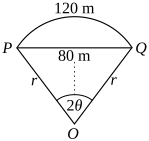
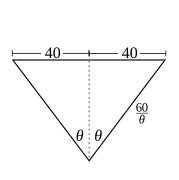
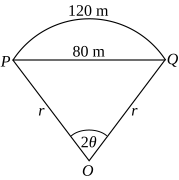
A discus throwing event is held at a field in the shape of a sector of a circle, centre \(O\), as shown in the diagram below.

Two officials are positioned at points \(P\) and \(Q\), which are 80 metres apart. The length of arc \(PQ\) is 120 metres.

The radius of the sector is \(r\) metres and the angle subtended at the centre of the arc is \(2\theta\) radians.
 

  1. Show that  \(\sin \theta=\dfrac{2 \theta}{3}\).   (2 marks)

    --- 5 WORK AREA LINES (style=lined) ---

  2. If  \(\theta=\dfrac{\pi}{3}\), find the exact area of the field.   (2 marks)

    --- 5 WORK AREA LINES (style=lined) ---

Show Answers Only

a.   \(\text{See Worked Solution.}\)

b.   \(A=\dfrac{10\ 800}{\pi}\ \text{u}^2\)

Show Worked Solution

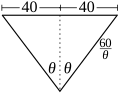
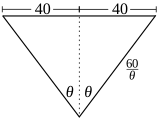
a.   \(\text{Consider arc} \ PQ:\)

\(\dfrac{2 \theta}{2 \pi} \times 2 \pi r\) \(=120\)
\(r\) \(=\dfrac{60}{\theta}\)

\(\sin \theta=\dfrac{40}{\frac{60}{\theta}}=40 \times \dfrac{\theta}{60}=\dfrac{2 \theta}{3}\)
 

b.     \(A\) \(=\dfrac{\frac{2 \pi}{3}}{2 \pi} \times \pi r^2\)
    \(=\dfrac{\pi}{3} \times\left(\dfrac{60}{\frac{\pi}{3}}\right)^2\)
    \(=\dfrac{\pi}{3} \times 3600 \times \dfrac{9}{\pi^2}\)
    \(=\dfrac{10\ 800}{\pi}\ \text{u}^2\)

Filed Under: Circular Measure (Adv-2027), Circular Measure (Y11) Tagged With: Band 4, Band 5, smc-6394-20-Area of Sector, smc-978-20-Area of Sector

HMS, BM 2013 HSC 19 MC

Who are part practice methods most appropriate for?

  1. Beginner athletes learning a new skill
  2. Beginner athletes applying a learned skill
  3. Experienced athletes solving a tactical problem
  4. Experienced athletes refining their kinaesthetic awareness
Show Answers Only

\(A\)

Show Worked Solution
  • A is correct: Part practice breaks complex skills into manageable components for beginners.

Other Options:

  • B is incorrect: Applying learned skills requires whole practice in context.
  • C is incorrect: Tactical problems need whole practice for decision-making integration.
  • D is incorrect: Kinaesthetic refinement requires whole movement patterns, not parts.

Filed Under: Practice methods Tagged With: Band 4, smc-5924-20-Whole/part

HMS, TIP 2013 HSC 17 MC

Which recovery strategy should an athlete choose immediately after sustaining a soft-tissue injury?

  1. Cryotherapy
  2. Deep tissue massage
  3. Relaxation
  4. Ultrasound
Show Answers Only

\(A\)

Show Worked Solution
  • A is correct: Cryotherapy reduces inflammation and pain immediately after injury.

Other Options:

  • B is incorrect: Deep massage may increase tissue damage in acute phase.
  • C is incorrect: Relaxation doesn’t address immediate physiological injury needs.
  • D is incorrect: Ultrasound used later in rehabilitation, not immediate treatment.

Filed Under: Recovery strategies Tagged With: Band 4, smc-5470-20-Thermal

HMS, BM 2013 HSC 12 MC

Which types of feedback are received by a runner who checks her time after crossing the finish line?

  1. Concurrent and knowledge of performance
  2. Concurrent and knowledge of results
  3. Delayed and knowledge of performance
  4. Delayed and knowledge of results
Show Answers Only

\(D\)

Show Worked Solution
  • D is correct: Time checking occurs after completion (delayed) showing outcome (results).

Other Options:

  • A is incorrect: Performance feedback relates to technique, not time outcome.
  • B is incorrect: Concurrent feedback occurs during performance, not after.
  • C is incorrect: Performance feedback concerns technique quality, not finishing time.

Filed Under: Stages of learning Tagged With: Band 4, smc-5921-90-Identify type of feedback

HMS, HAG 2013 HSC 10 MC

In Australia, men have a lower health status than women.

What is the most likely reason for this?

  1. Types of health care services available
  2. Unwillingness to seek medical assistance
  3. Heredity and lifestyle factors experienced in early life
  4. Lack of knowledge and understanding of health care services
Show Answers Only

\(B\)

Show Worked Solution
  • B is correct: Men typically delay seeking medical help for health issues.

Other Options:

  • A is incorrect: Healthcare services available equally to both genders.
  • C is incorrect: Heredity factors similar, lifestyle choices are behavioural responses.
  • D is incorrect: Knowledge access similar, willingness to use differs significantly.

Filed Under: Groups Experiencing Inequities Tagged With: Band 4, smc-5475-10-Determinants interaction

HMS, HAG 2013 HSC 5 MC

Ancillary cover in private health insurance can assist with which of the following costs?

  1. General practitioner fees
  2. Prescription and other medications
  3. Physiotherapy, dental services and optometry
  4. Treatment as a private patient in either a public or private hospital
Show Answers Only

\(C\)

Show Worked Solution
  • C is correct: Ancillary cover specifically includes allied health and dental services.

Other Options:

  • A is incorrect: GP fees covered by Medicare, not ancillary.
  • B is incorrect: Medications covered by PBS, not ancillary insurance.
  • D is incorrect: Hospital treatment covered by hospital cover, not ancillary.

Filed Under: Healthcare expenditure Tagged With: Band 4, smc-5482-20-Private insurance

HMS, HAG 2013 HSC 1 MC

What currently is the area of greatest health care expenditure in Australia?

  1. Research
  2. Hospitals
  3. Dental services
  4. Preventative health initiatives
Show Answers Only

\(B\)

Show Worked Solution
  • B is correct: Hospitals account for largest portion of Australian health spending.

Other Options:

  • A is incorrect: Research receives minimal health budget allocation.
  • C is incorrect: Dental services are small expenditure component.
  • D is incorrect: Prevention receives less funding than treatment.

Filed Under: Healthcare expenditure Tagged With: Band 4, smc-5482-10-Healthcare v prevention

HMS, TIP 2014 HSC 32b

Justify how each of the periodisation phases is used when planning a training year.   (12 marks)

--- 28 WORK AREA LINES (style=lined) ---

Show Answers Only

Position Statement

  • Each periodisation phase is essential for optimal athletic performance because they systematically develop, maintain and recover physiological capacities whilst preventing overtraining and ensuring peak competition readiness.

Pre-Season Foundation Building

  • Pre-season phase provides critical foundation for annual performance success by developing base fitness levels and fundamental skills required for competition demands.
  • Evidence demonstrates that athletes who complete comprehensive pre-season training show 25-30% greater performance improvements compared to those with inadequate preparation.
  • A rugby team’s pre-season focuses on aerobic conditioning, strength development and skill refinement over 12-16 weeks, incorporating progressive overload principles.
  • This systematic approach proves essential because it builds cardiovascular endurance, muscular strength and technical competency that supports intense competition periods.
  • Without adequate pre-season preparation, athletes face increased injury risk and poor early-season performance.
  • Research confirms that 80% of season-ending injuries occur in athletes with insufficient pre-season conditioning, demonstrating the phase’s protective value.

In-Season Performance Maintenance

  • In-season training maintains fitness levels whilst managing competition demands and fatigue accumulation through reduced training volumes and sport-specific focus.
  • Studies indicate that athletes lose 10-15% of fitness gains within 3-4 weeks without maintenance training.
  • A basketball player maintains strength twice weekly whilst emphasising tactical development and recovery between games, incorporating tapering before major competitions.
  • This approach ensures peak performance sustainability throughout the competitive period whilst preventing overtraining syndrome.
  • The phase balances training stress with competition stress, enabling consistent high-level performance when it matters most.
  • Strategic peaking during finals ensures athletes reach optimal condition at season’s end.

Off-Season Recovery Integration

  • Off-season phase facilitates complete physical and mental recovery whilst maintaining basic fitness through active rest and cross-training activities.
  • Athletes engage in alternative sports and reduced training loads, preventing burnout whilst preparing for the next training cycle.

Reinforcement

  • The evidence overwhelmingly supports systematic periodisation because each phase addresses specific physiological and psychological needs.
  • Research data confirms that periodised athletes achieve 15-25% greater performance gains than non-periodised training, justifying the structured approach’s implementation.
Show Worked Solution

Position Statement

  • Each periodisation phase is essential for optimal athletic performance because they systematically develop, maintain and recover physiological capacities whilst preventing overtraining and ensuring peak competition readiness.

Pre-Season Foundation Building

  • Pre-season phase provides critical foundation for annual performance success by developing base fitness levels and fundamental skills required for competition demands.
  • Evidence demonstrates that athletes who complete comprehensive pre-season training show 25-30% greater performance improvements compared to those with inadequate preparation.
  • A rugby team’s pre-season focuses on aerobic conditioning, strength development and skill refinement over 12-16 weeks, incorporating progressive overload principles.
  • This systematic approach proves essential because it builds cardiovascular endurance, muscular strength and technical competency that supports intense competition periods.
  • Without adequate pre-season preparation, athletes face increased injury risk and poor early-season performance.
  • Research confirms that 80% of season-ending injuries occur in athletes with insufficient pre-season conditioning, demonstrating the phase’s protective value.

In-Season Performance Maintenance

  • In-season training maintains fitness levels whilst managing competition demands and fatigue accumulation through reduced training volumes and sport-specific focus.
  • Studies indicate that athletes lose 10-15% of fitness gains within 3-4 weeks without maintenance training.
  • A basketball player maintains strength twice weekly whilst emphasising tactical development and recovery between games, incorporating tapering before major competitions.
  • This approach ensures peak performance sustainability throughout the competitive period whilst preventing overtraining syndrome.
  • The phase balances training stress with competition stress, enabling consistent high-level performance when it matters most.
  • Strategic peaking during finals ensures athletes reach optimal condition at season’s end.

Off-Season Recovery Integration

  • Off-season phase facilitates complete physical and mental recovery whilst maintaining basic fitness through active rest and cross-training activities.
  • Athletes engage in alternative sports and reduced training loads, preventing burnout whilst preparing for the next training cycle.

Reinforcement

  • The evidence overwhelmingly supports systematic periodisation because each phase addresses specific physiological and psychological needs.
  • Research data confirms that periodised athletes achieve 15-25% greater performance gains than non-periodised training, justifying the structured approach’s implementation.

♦♦ Mean mark 54%.

Filed Under: Individual vs group programs Tagged With: Band 4, Band 5, smc-5463-05-Competition phases

HMS, TIP 2014 HSC 32a

How do different types of training improve performance in various sports?   (8 marks)

--- 22 WORK AREA LINES (style=lined) ---

Show Answers Only
  • Different training types create specific physiological adaptations that enhance performance by targeting the precise energy systems and movement patterns required for each sport.
      
  • Aerobic training methods improve endurance performance by enhancing the cardiovascular system’s oxygen delivery capacity and muscular efficiency.
  • Continuous training develops aerobic capacity through sustained moderate-intensity exercise, enabling marathon runners to maintain pace over 42 kilometres.
  • This occurs because continuous training increases cardiac output, stroke volume and capillarisation.
  • Fartlek training combines speed variations with aerobic conditioning, allowing middle-distance athletes to handle race pace changes.
  • As a result, sports requiring sustained effort like cycling and swimming benefit from enhanced oxygen utilisation and delayed fatigue onset.
      
  • Anaerobic training methods target power and speed development by stressing the ATP-PCr and glycolytic energy systems.
  • Plyometric training produces explosive power through stretch-shortening cycles, enabling basketball players to jump higher and sprint faster.
  • This works by improving neuromuscular coordination and fast-twitch muscle fibre recruitment.
  • High Intensity Interval Training develops anaerobic capacity whilst maintaining aerobic benefits, making it ideal for sports like hockey requiring repeated high-intensity efforts.
  • Consequently, athletes develop greater power output and faster recovery between intense bursts.
      
  • Resistance training builds muscular strength and hypertrophy, creating force production improvements essential for contact sports.
  • This leads to enhanced tackle effectiveness in rugby and throwing distance in field events.
  • Therefore, matching training types to sport-specific energy demands and movement patterns optimises performance adaptations.
Show Worked Solution
  • Different training types create specific physiological adaptations that enhance performance by targeting the precise energy systems and movement patterns required for each sport.
      
  • Aerobic training methods improve endurance performance by enhancing the cardiovascular system’s oxygen delivery capacity and muscular efficiency.
  • Continuous training develops aerobic capacity through sustained moderate-intensity exercise, enabling marathon runners to maintain pace over 42 kilometres.
  • This occurs because continuous training increases cardiac output, stroke volume and capillarisation.
  • Fartlek training combines speed variations with aerobic conditioning, allowing middle-distance athletes to handle race pace changes.
  • As a result, sports requiring sustained effort like cycling and swimming benefit from enhanced oxygen utilisation and delayed fatigue onset.
      
  • Anaerobic training methods target power and speed development by stressing the ATP-PCr and glycolytic energy systems.
  • Plyometric training produces explosive power through stretch-shortening cycles, enabling basketball players to jump higher and sprint faster.
  • This works by improving neuromuscular coordination and fast-twitch muscle fibre recruitment.
  • High Intensity Interval Training develops anaerobic capacity whilst maintaining aerobic benefits, making it ideal for sports like hockey requiring repeated high-intensity efforts.
  • Consequently, athletes develop greater power output and faster recovery between intense bursts.
      
  • Resistance training builds muscular strength and hypertrophy, creating force production improvements essential for contact sports.
  • This leads to enhanced tackle effectiveness in rugby and throwing distance in field events.
  • Therefore, matching training types to sport-specific energy demands and movement patterns optimises performance adaptations.

Filed Under: Types of training and training methods Tagged With: Band 4, smc-5459-30-All phases

HMS, TIP 2014 HSC 31b

Justify the rehabilitation procedures used to manage specific sporting injuries.   (12 marks)

--- 28 WORK AREA LINES (style=lined) ---

Show Answers Only

Position Statement

  • Rehabilitation procedures are highly effective for managing sporting injuries because they systematically restore function and prevent re-injury through evidence-based protocols.

Progressive Mobilisation

  • Progressive mobilisation demonstrates exceptional value in early injury management by preventing muscle stiffness and scar tissue formation.
  • This process ensures controlled movement returns gradually, maintaining joint range whilst protecting healing tissues.
  • For example, a footballer with an ankle sprain begins with gentle passive movements within 48-72 hours, progressing to active movements as pain decreases.
  • Research shows early mobilisation reduces recovery time by up to 30% compared to complete immobilisation.
  • This approach proves highly effective because it maintains blood flow and prevents complications like muscle atrophy whilst maintaining proprioceptive function.

Graduated Exercise Programs

  • Graduated exercise produces measurable results by systematically rebuilding strength, flexibility and endurance through structured progression.
  • This method works by introducing increasingly challenging exercises that stimulate tissue adaptation without overwhelming healing structures.
  • A tennis player recovering from shoulder impingement follows a specific sequence: stretching to restore flexibility, strengthening exercises using resistance bands, then sport-specific movements like serving practice.
  • Evidence confirms this systematic approach reduces re-injury rates by 40-60%.
  • The effectiveness is demonstrated through controlled loading that rebuilds tissue tolerance whilst maintaining total body fitness throughout recovery.

Heat and Cold Therapy

  • Heat and cold therapy provides significant support for rehabilitation success by managing inflammation and promoting tissue healing.
  • Cold therapy immediately post-injury reduces swelling and pain, whilst heat therapy later in recovery increases blood flow and flexibility.
  • For instance, a rugby player with a hamstring strain uses ice for 48 hours, then heat packs before stretching.
  • This combination proves essential because it optimises healing conditions at each recovery stage.

Reinforcement

  • When all factors are considered, rehabilitation procedures provide superior outcomes because they address multiple recovery aspects simultaneously.
  • The evidence overwhelmingly supports their inclusion in injury management protocols, with faster return-to-sport times and reduced complication rates justifying their systematic implementation.
Show Worked Solution

Position Statement

  • Rehabilitation procedures are highly effective for managing sporting injuries because they systematically restore function and prevent re-injury through evidence-based protocols.

Progressive Mobilisation

  • Progressive mobilisation demonstrates exceptional value in early injury management by preventing muscle stiffness and scar tissue formation.
  • This process ensures controlled movement returns gradually, maintaining joint range whilst protecting healing tissues.
  • For example, a footballer with an ankle sprain begins with gentle passive movements within 48-72 hours, progressing to active movements as pain decreases.
  • Research shows early mobilisation reduces recovery time by up to 30% compared to complete immobilisation.
  • This approach proves highly effective because it maintains blood flow and prevents complications like muscle atrophy whilst maintaining proprioceptive function.

Graduated Exercise Programs

  • Graduated exercise produces measurable results by systematically rebuilding strength, flexibility and endurance through structured progression.
  • This method works by introducing increasingly challenging exercises that stimulate tissue adaptation without overwhelming healing structures.
  • A tennis player recovering from shoulder impingement follows a specific sequence: stretching to restore flexibility, strengthening exercises using resistance bands, then sport-specific movements like serving practice.
  • Evidence confirms this systematic approach reduces re-injury rates by 40-60%.
  • The effectiveness is demonstrated through controlled loading that rebuilds tissue tolerance whilst maintaining total body fitness throughout recovery.

Heat and Cold Therapy

  • Heat and cold therapy provides significant support for rehabilitation success by managing inflammation and promoting tissue healing.
  • Cold therapy immediately post-injury reduces swelling and pain, whilst heat therapy later in recovery increases blood flow and flexibility.
  • For instance, a rugby player with a hamstring strain uses ice for 48 hours, then heat packs before stretching.
  • This combination proves essential because it optimises healing conditions at each recovery stage.

Reinforcement

  • When all factors are considered, rehabilitation procedures provide superior outcomes because they address multiple recovery aspects simultaneously.
  • The evidence overwhelmingly supports their inclusion in injury management protocols, with faster return-to-sport times and reduced complication rates justifying their systematic implementation.

♦♦ Mean mark 46%.

Filed Under: Management/prevention of injuries Tagged With: Band 4, Band 5, smc-5472-25-Rehab/return-to-play

HMS, HIC 2014 HSC 29a

How does the health status of young people compare with that of other age groups in the Australian population?   (8 marks)

--- 24 WORK AREA LINES (style=lined) ---

Show Answers Only
  • Young people generally have the best health status of all age groups because they experience lower rates of chronic diseases and higher self-reported wellbeing. This occurs when comparing mortality and morbidity data across different age cohorts in Australian health reports.
  • Self-assessed health ratings demonstrate that young people report excellent or very good health more frequently than older populations. These positive perceptions result from fewer chronic conditions and greater physical capabilities. However, mental health issues create concerning trends specifically affecting this demographic.
  • Mortality patterns show injury and poisoning as leading causes of death for young people. This contrasts with older age groups where chronic diseases like cardiovascular disease and cancer predominate. The shift occurs because longer exposure to risk factors accumulates health problems over time.
  • Chronic disease prevalence increases significantly with age as lifestyle behaviours and environmental exposures compound over decades. For example, cardiovascular disease rarely affects young people but becomes the leading cause of death in those aged 45-64 years.
  • Mental health presents a notable exception where young people experience higher rates than some older groups. This trend reflects increased anxiety and depression particularly affecting females aged 16-24. Social media and academic pressures contribute to these concerning patterns.
  • Preventable conditions like dental disease and sexually transmitted infections disproportionately affect young people. These issues occur because risk-taking behaviours and limited health service engagement characterise this age group’s health-seeking patterns.
Show Worked Solution
  • Young people generally have the best health status of all age groups because they experience lower rates of chronic diseases and higher self-reported wellbeing. This occurs when comparing mortality and morbidity data across different age cohorts in Australian health reports.
  • Self-assessed health ratings demonstrate that young people report excellent or very good health more frequently than older populations. These positive perceptions result from fewer chronic conditions and greater physical capabilities. However, mental health issues create concerning trends specifically affecting this demographic.
  • Mortality patterns show injury and poisoning as leading causes of death for young people. This contrasts with older age groups where chronic diseases like cardiovascular disease and cancer predominate. The shift occurs because longer exposure to risk factors accumulates health problems over time.
  • Chronic disease prevalence increases significantly with age as lifestyle behaviours and environmental exposures compound over decades. For example, cardiovascular disease rarely affects young people but becomes the leading cause of death in those aged 45-64 years.
  • Mental health presents a notable exception where young people experience higher rates than some older groups. This trend reflects increased anxiety and depression particularly affecting females aged 16-24. Social media and academic pressures contribute to these concerning patterns.
  • Preventable conditions like dental disease and sexually transmitted infections disproportionately affect young people. These issues occur because risk-taking behaviours and limited health service engagement characterise this age group’s health-seeking patterns.

Filed Under: Health Status of Young People Tagged With: Band 4, Band 5, smc-5509-10-Health trends

HMS, BM 2014 HSC 27

Compare the two anaerobic energy systems.   (5 marks)

--- 15 WORK AREA LINES (style=lined) ---

Show Answers Only

ATP-PCr system and Glycolytic (Lactic Acid) system

Similarities:

  • Both systems operate without oxygen during anaerobic metabolism processes.
  • Both provide energy for high-intensity, short-duration explosive activities.
  • Both systems work together during power-based movements like sprinting.
  • Both use stored energy sources available within muscle tissue.
  • Both produce ATP for immediate muscular contraction requirements.

Differences:

  • ATP-PCr uses stored phosphocreatine whilst glycolytic system uses muscle glycogen and glucose.
  • ATP-PCr operates for 10-15 seconds maximum, glycolytic system functions 15 seconds to 2 minutes.
  • ATP-PCr produces ATP most rapidly but glycolytic system has greater total capacity.
  • ATP-PCr fatigues when phosphocreatine stores deplete, glycolytic fatigues from lactate accumulation.
  • ATP-PCr recovers completely in 2-3 minutes, glycolytic requires longer recovery periods.
  • ATP-PCr produces no fatiguing by-products, glycolytic creates lactate causing muscle burn.

Summary:

  • ATP-PCr provides immediate explosive power whilst glycolytic sustains high-intensity efforts for longer periods.
Show Worked Solution

ATP-PCr system and Glycolytic (Lactic Acid) system

Similarities:

  • Both systems operate without oxygen during anaerobic metabolism processes.
  • Both provide energy for high-intensity, short-duration explosive activities.
  • Both systems work together during power-based movements like sprinting.
  • Both use stored energy sources available within muscle tissue.
  • Both produce ATP for immediate muscular contraction requirements.

Differences:

  • ATP-PCr uses stored phosphocreatine whilst glycolytic system uses muscle glycogen and glucose.
  • ATP-PCr operates for 10-15 seconds maximum, glycolytic system functions 15 seconds to 2 minutes.
  • ATP-PCr produces ATP most rapidly but glycolytic system has greater total capacity.
  • ATP-PCr fatigues when phosphocreatine stores deplete, glycolytic fatigues from lactate accumulation.
  • ATP-PCr recovers completely in 2-3 minutes, glycolytic requires longer recovery periods.
  • ATP-PCr produces no fatiguing by-products, glycolytic creates lactate causing muscle burn.

Summary:

  • ATP-PCr provides immediate explosive power whilst glycolytic sustains high-intensity efforts for longer periods.

♦♦ Mean mark 54%.

Filed Under: Energy systems Tagged With: Band 4, Band 5, smc-5528-20-Duration/intensity/recovery

HMS, TIP 2014 HSC 26

How do anxiety and arousal differ in terms of their effect on athletic performance?   (4 marks)

--- 12 WORK AREA LINES (style=lined) ---

Show Answers Only
  • Anxiety is a psychological response involving fear and apprehension which creates negative emotional reactions. These feelings result in worry and distraction that typically impairs performance.
  • Arousal is physiological activation that prepares the body through increased heart rate which can enhance performance when at optimal levels.
  • Anxiety generally hinders performance because it creates tension and disrupts concentration. In contrast, optimal arousal enables peak performance by providing necessary energy.
  • Performance outcomes differ because anxiety decreases effectiveness whilst appropriate arousal facilitates improved execution during competition.
Show Worked Solution
  • Anxiety is a psychological response involving fear and apprehension which creates negative emotional reactions. These feelings result in worry and distraction that typically impairs performance.
  • Arousal is physiological activation that prepares the body through increased heart rate which can enhance performance when at optimal levels.
  • Anxiety generally hinders performance because it creates tension and disrupts concentration. In contrast, optimal arousal enables peak performance by providing necessary energy.
  • Performance outcomes differ because anxiety decreases effectiveness whilst appropriate arousal facilitates improved execution during competition.

Filed Under: Psychological strategies Tagged With: Band 4, smc-5464-15-Arousal optimisation, smc-5464-25-Anxiety control

HMS, HIC 2014 HSC 24

Explain why individuals, communities and governments should work in partnership on health promotion initiatives. Provide examples.   (8 marks)

--- 24 WORK AREA LINES (style=lined) ---

Show Answers Only
  • Partnerships are essential because they combine different expertise and resources that no single group possesses. Combined efforts create more comprehensive and effective health promotion strategies than isolated approaches.
  • Individual participation ensures that health promotion initiatives address real community needs and concerns. Strong connections mean programs are more likely to be accepted and sustained by target populations. For example, community members identifying local barriers to physical activity leads to more relevant solutions.
  • Community involvement provides local knowledge and cultural understanding that improves program effectiveness. Local input results in initiatives that respect community values and existing social networks. The Healthy Cities Illawarra program demonstrates how community participation creates locally relevant health promotion strategies.
  • Government partnership brings policy support, funding and regulatory power needed for large-scale change. Official backing enables comprehensive approaches that address structural determinants of health. For instance, anti-smoking campaigns combine government legislation with community education programs.
  • Resource sharing occurs when different partners contribute their unique strengths and capabilities. Collaborative arrangements create cost-effective solutions that maximise impact while minimising individual organisational burden. The outcome is sustainable programs that continue beyond initial funding periods.
  • Shared responsibility ensures that health promotion becomes embedded across multiple sectors rather than isolated initiatives. Multi-sector approaches generate broader community ownership and long-term commitment to health improvement goals.
Show Worked Solution
  • Partnerships are essential because they combine different expertise and resources that no single group possesses. Combined efforts create more comprehensive and effective health promotion strategies than isolated approaches.
  • Individual participation ensures that health promotion initiatives address real community needs and concerns. Strong connections mean programs are more likely to be accepted and sustained by target populations. For example, community members identifying local barriers to physical activity leads to more relevant solutions.
  • Community involvement provides local knowledge and cultural understanding that improves program effectiveness. Local input results in initiatives that respect community values and existing social networks. The Healthy Cities Illawarra program demonstrates how community participation creates locally relevant health promotion strategies.
  • Government partnership brings policy support, funding and regulatory power needed for large-scale change. Official backing enables comprehensive approaches that address structural determinants of health. For instance, anti-smoking campaigns combine government legislation with community education programs.
  • Resource sharing occurs when different partners contribute their unique strengths and capabilities. Collaborative arrangements create cost-effective solutions that maximise impact while minimising individual organisational burden. The outcome is sustainable programs that continue beyond initial funding periods.
  • Shared responsibility ensures that health promotion becomes embedded across multiple sectors rather than isolated initiatives. Multi-sector approaches generate broader community ownership and long-term commitment to health improvement goals.

♦♦ Mean mark 50%.

Filed Under: Models of health promotion Tagged With: Band 4, Band 5, smc-5515-15-Health partnerships, smc-5515-25-Health approaches

HMS, HAG 2014 HSC 23

Explain the nature and extent of health inequities within Australia for one group OTHER than Aboriginal and Torres Strait Islanders.   (5 marks)

--- 15 WORK AREA LINES (style=lined) ---

Show Answers Only
  • People in rural and remote areas experience significant health inequities because limited healthcare access and higher risk behaviours create poorer health outcomes compared to city residents.
  • Geographic isolation directly affects health service availability and emergency response times. This leads to higher mortality rates for preventable chronic diseases including cardiovascular disease. As a result, life expectancy is lower with increased suicide rates.
  • Limited specialist services occur because fewer medical professionals choose rural practice locations. This creates longer travel distances and delays in receiving appropriate treatment. Consequently, emergency medical situations have poorer outcomes than urban areas.
  • Higher risk behaviours develop due to social isolation and limited recreational opportunities. This results in increased smoking rates and alcohol consumption exceeding guidelines. The combination produces elevated rates of preventable chronic diseases.
  • Socioeconomic disadvantage contributes through lower average incomes and reduced educational opportunities. This interaction with geographic isolation generates compounded effects on mental health and wellbeing.
Show Worked Solution
  • People in rural and remote areas experience significant health inequities because limited healthcare access and higher risk behaviours create poorer health outcomes compared to city residents.
  • Geographic isolation directly affects health service availability and emergency response times. This leads to higher mortality rates for preventable chronic diseases including cardiovascular disease. As a result, life expectancy is lower with increased suicide rates.
  • Limited specialist services occur because fewer medical professionals choose rural practice locations. This creates longer travel distances and delays in receiving appropriate treatment. Consequently, emergency medical situations have poorer outcomes than urban areas.
  • Higher risk behaviours develop due to social isolation and limited recreational opportunities. This results in increased smoking rates and alcohol consumption exceeding guidelines. The combination produces elevated rates of preventable chronic diseases.
  • Socioeconomic disadvantage contributes through lower average incomes and reduced educational opportunities. This interaction with geographic isolation generates compounded effects on mental health and wellbeing.

Filed Under: Groups Experiencing Inequities Tagged With: Band 4, smc-5475-10-Determinants interaction, smc-5475-15-Inequity causes, smc-5475-25-Vulnerable groups

HMS, HAG 2014 HSC 22

What are the responsibilities of each of the three levels of government for the delivery of health services in Australia?   (4 marks)

--- 12 WORK AREA LINES (style=lined) ---

Show Answers Only
  • Commonwealth Government has primary responsibility for health policy development and major funding programs. They manage Medicare and the Pharmaceutical Benefits Scheme for all Australians. Commonwealth also oversees health legislation and operates repatriation hospitals for veterans.
  • State and Territory Governments are responsible for delivering most direct health services to communities. They operate public hospitals, mental health services, and ambulance services. States also manage dental health programs and many health promotion initiatives.
  • Local Government focuses on community-level health services and environmental health regulation. They operate early childhood health centres and sexual health clinics. Local councils also manage waste disposal and food safety regulations.
Show Worked Solution
  • Commonwealth Government has primary responsibility for health policy development and major funding programs. They manage Medicare and the Pharmaceutical Benefits Scheme for all Australians. Commonwealth also oversees health legislation and operates repatriation hospitals for veterans.
  • State and Territory Governments are responsible for delivering most direct health services to communities. They operate public hospitals, mental health services, and ambulance services. States also manage dental health programs and many health promotion initiatives.
  • Local Government focuses on community-level health services and environmental health regulation. They operate early childhood health centres and sexual health clinics. Local councils also manage waste disposal and food safety regulations.

Filed Under: Govt and Non-Govt responsibilities Tagged With: Band 4, smc-5480-05-Government roles

HMS, TIP 2014 HSC 19 MC

The table below shows an athlete’s adaptations from training that occurred over 14 weeks.

\begin{array}{|l|l|}
\hline \text{Adaptation} & \text{Result} \\
\hline \text{% slow-twitch muscle fibre} \quad & \text{Increase} \\
\hline \text{Aerobic capacity} & \text{Increase} \\
\hline \text{Number of capillaries} & \text{Increase} \\
\hline \text{Anaerobic capacity} & \text{No change} \\
\hline
\end{array}

Which is the most likely method of training to have been undertaken?

  1. Circuit training
  2. Fartlek training
  3. Resistance training
  4. Continuous training
Show Answers Only

\(D\)

Show Worked Solution
  • D is correct: Continuous training produces purely aerobic adaptations without anaerobic improvements.

Other Options:

  • A is incorrect: Circuit training would improve both aerobic and anaerobic capacity.
  • B is incorrect: Fartlek training would improve some anaerobic capacity due to intervals.
  • C is incorrect: Resistance training would primarily improve anaerobic not aerobic capacity.

Filed Under: Types of training and training methods Tagged With: Band 4, smc-5459-10-Aerobic

HMS, BM 2014 HSC 16 MC

Which of the following will occur when an endurance athlete competes in an event lasting two and a half hours?

  1. The metabolism of fat will decrease.
  2. Fat will be the only fuel source metabolised.
  3. The metabolism of protein will remain constant during the event.
  4. The metabolism of glycogen will decrease towards the end of the event.
Show Answers Only

\(D\)

Show Worked Solution
  • D is correct: Glycogen stores deplete during prolonged exercise reducing glycogen metabolism.

Other Options:

  • A is incorrect: Fat metabolism increases as glycogen stores become depleted.
  • B is incorrect: Multiple fuel sources are used not fat exclusively.
  • C is incorrect: Protein metabolism increases towards end of prolonged exercise.

Filed Under: Nutrition and energy systems Tagged With: Band 4, smc-5529-15-Anaerobic v aerobic, smc-5529-20-Micro/macro nutrients

HMS, BM 2014 HSC 15 MC

Which of the following would be suitable for enhancing the performance of an autonomous athlete?

  1. Self-paced and distributed practice
  2. Closed skills and delayed feedback
  3. Distributed practice and delayed feedback
  4. Concurrent feedback and tactical development
Show Answers Only

\(D\)

Show Worked Solution
  • D is correct: Autonomous athletes benefit from concurrent feedback for tactical adjustments.

Other Options:

  • A is incorrect: Doesn’t address the tactical needs of autonomous athletes.
  • B is incorrect: Delayed feedback timing isn’t optimal for tactical development.
  • C is incorrect: Delayed feedback less useful for real-time tactical enhancement.

Filed Under: Stages of learning Tagged With: Band 4, smc-5921-90-Identify type of feedback

HMS, TIP 2014 HSC 12 MC

What is cardiac output?

  1. The volume of blood ejected by the heart per minute
  2. The volume of blood sent to the lungs for oxygenation
  3. The volume of deoxygenated blood returning to the heart
  4. The volume of blood sent by the left ventricle of the heart during each contraction
Show Answers Only

\(A\)

Show Worked Solution
  • A is correct: Cardiac output is the total volume of blood pumped by the heart per minute.

Other Options:

  • B is incorrect: This describes pulmonary circulation not cardiac output.
  • C is incorrect: This describes venous return not cardiac output.
  • D is incorrect: This describes stroke volume not total cardiac output.

Filed Under: Physiological adaptations and improved performance Tagged With: Band 4, smc-5461-10-Cardio adaptations

HMS, HIC 2014 HSC 10 MC

For a health promotion strategy to be classified as strengthening community action, it must

  1. focus on a targeted health promotion for those most at risk.
  2. focus policy direction and public discussion on the health promotion strategy.
  3. facilitate participation from all government departments for the health promotion strategy.
  4. facilitate the funds and infrastructure for the health promotion strategy to be carried through successfully.
Show Answers Only

\(B\)

Show Worked Solution
  • B is correct: Strengthening community action involves empowering communities to influence policy direction.

Other Options:

  • A is incorrect: Targeting at-risk groups isn’t specific to community action.
  • C is incorrect: Government department participation isn’t community action focus.
  • D is incorrect: Providing funds relates more to creating supportive environments.

Filed Under: Models of health promotion Tagged With: Band 4, smc-5515-10-Ottawa Charter, smc-5515-15-Health partnerships, smc-5515-20-Policy legislation

HMS, HAG 2014 HSC 6 MC

How do Medicare and the Pharmaceutical Benefits Scheme support the principles of social justice?

  1. They are funded by the Australian government to supply health care services.
  2. They provide resources only to those most in need of health services and treatment.
  3. They allocate resources according to the needs of the population in order to promote equality of health outcomes.
  4. They empower individuals and communities to be involved in planning and decision making to achieve good health.
Show Answers Only

\(C\)

Show Worked Solution
  • C is correct: Medicare and PBS allocate resources based on need promoting equity.

Other Options:

  • A is incorrect: Government funding alone doesn’t explain social justice principles.
  • B is incorrect: These schemes serve all Australians not just those most in need.
  • D is incorrect: Medicare/PBS don’t directly involve community planning participation.

Filed Under: Healthcare expenditure, Healthcare System effectiveness Tagged With: Band 4, smc-5479-10-Access equity, smc-5482-15-Medicare, smc-5482-30-Commonwealth programs

HMS, HAG 2014 HSC 5 MC

Which of the following has contributed most to the declining prevalence of cardiovascular disease (CVD) in Australia?

  1. Improved community awareness and treatment of CVD
  2. Improved nutritional quality of food consumed by Australians
  3. Increased levels of organised sport participation and exercise by those at risk of CVD
  4. Increased numbers of alternative health professionals and volunteers working with those at risk of CVD
Show Answers Only

\(A\)

Show Worked Solution
  • A is correct: Community awareness and improved treatment have been primary factors.

Other Options:

  • B is incorrect: Nutrition improvements alone haven’t been the main contributor.
  • C is incorrect: Sport participation increases haven’t been the primary factor.
  • D is incorrect: Alternative health professionals aren’t the main reason for decline.

Filed Under: Chronic Conditions, Diseases and Injury Tagged With: Band 4, smc-5477-05-Cardiovascular disease, smc-5477-20-Protective factors

HMS, HIC 2014 HSC 4 MC

Which of the following is an example of reorienting health services as specified in the Ottawa Charter?

  1. Redirecting services from cure to prevention
  2. Redirecting services from private to public health care
  3. Allowing health service professionals to focus on curing ill health
  4. Supporting individuals to identify personal networks and services
Show Answers Only

\(A\)

Show Worked Solution
  • A is correct: Reorienting health services means shifting focus from treatment to prevention.

Other Options:

  • B is incorrect: Private/public shift isn’t reorienting health services concept.
  • C is incorrect: Focusing on cure contradicts reorienting towards prevention.
  • D is incorrect: Supporting networks relates to strengthening community action.

Filed Under: Models of health promotion Tagged With: Band 4, smc-5515-10-Ottawa Charter, smc-5515-25-Health approaches

HMS, HIC 2014 HSC 1 MC

Which of the following terms describes the level of illness in a given population?

  1. Mortality
  2. Morbidity
  3. Prevalence
  4. Health status
Show Answers Only

\(B\)

Show Worked Solution
  • B is correct: Morbidity refers to the level of illness in a population.

Other Options:

  • A is incorrect: Mortality refers to death rates not illness levels.
  • C is incorrect: Prevalence measures existing cases not overall illness levels.
  • D is incorrect: Health status is broader than just illness levels.

Filed Under: Health status of Australians Tagged With: Band 4, smc-5504-20-Morbidity

HMS, TIP 2015 HSC 19 MC

Which of the following graphs is most likely to represent an athlete's haemoglobin concentration while training at different altitudes for up to four weeks?


Show Answers Only

\(B\)

Show Worked Solution
  • B is correct: Haemoglobin increases at higher altitude as physiological adaptation.

Other Options:

  • A is incorrect: Altitude training increases not decreases haemoglobin levels.
  • C is incorrect: Body adapts to altitude by increasing haemoglobin concentration.
  • D is incorrect: Haemoglobin shows consistent increase not random fluctuation.

Filed Under: Physiological adaptations and improved performance Tagged With: Band 4, smc-5461-10-Cardio adaptations

HMS, HAG 2015 HSC 18 MC

The graph summarises historical and projected data for Australian health care expenditure and the Australian working population.
 

Which major health care issue does the graph predict?

  1. Funding for new and emerging medical technologies required by working Australians
  2. Funding for health care in an increasing ageing population
  3. Increasing demand for health care by the long-term unemployed
  4. Increasing prevalence of non-communicable disease in the Australian working population
Show Answers Only

\(B\)

Show Worked Solution
  • B is correct: Rising health costs with fewer workers indicates ageing population challenges.

Other Options:

  • A is incorrect: Graph shows broader expenditure trends not technology-specific costs.
  • C is incorrect: Focus is on ageing demographics not unemployment issues.
  • D is incorrect: Graph indicates demographic shifts not disease prevalence changes.

Filed Under: Impact of an Ageing Population Tagged With: Band 4, smc-5478-10-Data interpretation

HMS, TIP 2015 HSC 12 MC

How could a coach use a circuit training program to develop the aerobic capacity and strength of her athletes?

  1. By increasing the time allowed for the circuit to be completed
  2. By increasing the resistance and the time at each of the stations
  3. By decreasing the time allowed for the circuit to be completed
  4. By decreasing the resistance and the time at each of the stations
Show Answers Only

\(B\)

Show Worked Solution
  • B is correct: Higher resistance builds strength while longer time develops aerobic capacity.

Other Options:

  • A is incorrect: More time doesn’t increase training intensity effectively.
  • C is incorrect: Less time reduces aerobic development opportunities.
  • D is incorrect: Lower resistance and time reduces both strength and aerobic benefits.

Filed Under: Principles of training, Types of training and training methods Tagged With: Band 4, smc-5459-10-Aerobic, smc-5459-20-Strength, smc-5460-05-Adaptations

HMS, HIC 2015 HSC 11 MC

Which combination of factors has contributed most to a decreasing smoking rate in Australia?

  1. Taxation and increased prevalence of lung cancer
  2. Targeted legislation and health promotion campaigns
  3. Education programs and participation in organised sport
  4. Public perceptions of smoking and decreased access to tobacco products
Show Answers Only

\(B\)

Show Worked Solution
  • B is correct: Legislation and campaigns have been most effective strategies.

Other Options:

  • A is incorrect: Cancer prevalence alone doesn’t decrease smoking rates.
  • C is incorrect: Education and sport help but aren’t primary factors.
  • D is incorrect: Perceptions and access are results not main causes.

Filed Under: Models of health promotion Tagged With: Band 4, smc-5515-10-Ottawa Charter, smc-5515-15-Health partnerships

HMS, BM 2015 HSC 10 MC

What is the cause of fatigue for the alactacid (ATP-PCr) system?

  1. Lack of essential amino acids
  2. Lack of muscle glycogen stores
  3. Inability to re-synthesise phosphate creatine
  4. Inability to convert carbohydrates to glycogen
Show Answers Only

\(C\)

Show Worked Solution
  • C is correct: ATP-PCr system fatigues when PCr stores are depleted.

Note: The 2015 exam used “alactacid system” terminology from the 2012 PDHPE syllabus. In HMS, this is called the “ATP-PCr system.”

Other Options:

  • A is incorrect: Amino acids not used in ATP-PCr system.
  • B is incorrect: Glycogen relates to glycolytic system not ATP-PCr.
  • D is incorrect: Carbohydrate conversion unrelated to ATP-PCr fatigue.

Filed Under: Energy systems Tagged With: Band 4, smc-5528-30-Causes of fatigue

HMS, BM 2015 HSC 6 MC

What type of feedback occurs when an athlete receives a score at the conclusion of a gymnastics routine?

  1. Intrinsic
  2. Concurrent
  3. Knowledge of results
  4. Knowledge of performance
Show Answers Only

\(C\)

Show Worked Solution
  • C is correct: Score feedback represents knowledge of results about outcome.

Other Options:

  • A is incorrect: Intrinsic feedback comes from within the performer.
  • B is incorrect: Concurrent feedback occurs during the performance, not after.
  • D is incorrect: Knowledge of performance relates to technique, not scores.

Filed Under: Stages of learning Tagged With: Band 4, smc-5921-80-Knowledge of results/performance

HMS, BM 2015 HSC 2 MC

An individual is required to perform a discrete, open and externally paced skill.

Which of the following would meet this description?

  1. Putting in golf
  2. Running 800 m
  3. Throwing a discus
  4. Returning a tennis serve
Show Answers Only

\(D\)

Show Worked Solution
  • D is correct: Tennis serve return is discrete, open and externally paced.

Other Options:

  • A is incorrect: Golf putting is closed and self-paced skill.
  • B is incorrect: Running 800m is continuous rather than discrete.
  • C is incorrect: Discus throwing is closed and self-paced skill.

Filed Under: Characteristics of skills Tagged With: Band 4, smc-5922-10-Open/Closed, smc-5922-30-Discrete/Serial/Continuous, smc-5922-40-Self and externally paced

HMS, HAG 2015 HSC 33a

How can generalisations about Australians who experience health inequalities be challenged?   (8 marks)

--- 24 WORK AREA LINES (style=lined) ---

Show Answers Only
  • Generalisations about Australians experiencing health inequities can be challenged by using reliable health information and questioning what people assume about disadvantaged groups. The reason for this is that harmful stereotypes often oversimplify complex health determinants affecting disadvantaged groups.
  • This occurs when people question broad statements by examining reliable health data from sources like Australia’s Health reports. For instance, challenging assumptions about Aboriginal and Torres Strait Islander health requires understanding how colonisation impacts contribute to current health disparities rather than blaming individual lifestyle choices.
  • Consequently, promoting health literacy enables individuals to critically analyse media representations about disadvantaged groups. This leads to better understanding of how social determinants like education, employment and housing influence health outcomes more than personal behaviours.
  • The underlying reason is that involving affected communities in defining their own health challenges prevents others from making assumptions about them. Therefore, direct contact with affected populations helps break down misconceptions because personal experiences contradict stereotypical assumptions.
  • As a result, research methods that include disadvantaged groups in the process ensure they participate in health research rather than being passive subjects.
  • This demonstrates how combining evidence-based information with community involvement creates more accurate understandings of health inequity causes.
Show Worked Solution
  • Generalisations about Australians experiencing health inequities can be challenged by using reliable health information and questioning what people assume about disadvantaged groups. The reason for this is that harmful stereotypes often oversimplify complex health determinants affecting disadvantaged groups.
  • This occurs when people question broad statements by examining reliable health data from sources like Australia’s Health reports. For instance, challenging assumptions about Aboriginal and Torres Strait Islander health requires understanding how colonisation impacts contribute to current health disparities rather than blaming individual lifestyle choices.
  • Consequently, promoting health literacy enables individuals to critically analyse media representations about disadvantaged groups. This leads to better understanding of how social determinants like education, employment and housing influence health outcomes more than personal behaviours.
  • The underlying reason is that involving affected communities in defining their own health challenges prevents others from making assumptions about them. Therefore, direct contact with affected populations helps break down misconceptions because personal experiences contradict stereotypical assumptions.
  • As a result, research methods that include disadvantaged groups in the process ensure they participate in health research rather than being passive subjects.
  • This demonstrates how combining evidence-based information with community involvement creates more accurate understandings of health inequity causes.

♦♦♦♦ Mean mark 36%.

Filed Under: Groups Experiencing Inequities Tagged With: Band 4, Band 5, smc-5475-25-Vulnerable groups

HMS, TIP 2015 HSC 32a

How does planning for performance differ for elite and amateur athletes?   (8 marks)

--- 24 WORK AREA LINES (style=lined) ---

Show Answers Only
  • Planning for performance differs significantly between elite and amateur athletes due to varying time commitments, resource availability, and competitive demands. The underlying reason is that elite athletes operate as full-time professionals while amateur athletes balance training with work and family responsibilities.
  • Elite athletes require comprehensive yearly periodisation with multiple competition peaks because they compete internationally across extended seasons throughout the year. This leads to detailed planning incorporating pre-season conditioning, in-season maintenance and structured off-season recovery phases with specific mesocycles and microcycles. For instance, elite swimmers plan four-year cycles targeting major championships like Olympics or World Championships with precise tapering protocols.
  • Conversely, amateur athletes typically focus on single annual competition goals such as local championships or fun runs with simplified periodisation. This occurs because limited training time necessitates basic seasonal phases rather than complex mesocycles and detailed weekly microcycle planning.
  • Consequently, elite planning involves multidisciplinary teams including coaches, nutritionists, physiologists and sports psychologists which results in individualised programs addressing technical, physical and psychological development needs. However, amateur athletes often rely on generic training plans and self-coaching approaches due to financial constraints and accessibility limitations.
  • Therefore, elite athletes need much more detailed planning because they have higher performance goals and more resources available. This shows how planning complexity matches what each type of athlete is trying to achieve and what support they can access.
Show Worked Solution
  • Planning for performance differs significantly between elite and amateur athletes due to varying time commitments, resource availability, and competitive demands. The underlying reason is that elite athletes operate as full-time professionals while amateur athletes balance training with work and family responsibilities.
  • Elite athletes require comprehensive yearly periodisation with multiple competition peaks because they compete internationally across extended seasons throughout the year. This leads to detailed planning incorporating pre-season conditioning, in-season maintenance and structured off-season recovery phases with specific mesocycles and microcycles. For instance, elite swimmers plan four-year cycles targeting major championships like Olympics or World Championships with precise tapering protocols.
  • Conversely, amateur athletes typically focus on single annual competition goals such as local championships or fun runs with simplified periodisation. This occurs because limited training time necessitates basic seasonal phases rather than complex mesocycles and detailed weekly microcycle planning.
  • Consequently, elite planning involves multidisciplinary teams including coaches, nutritionists, physiologists and sports psychologists which results in individualised programs addressing technical, physical and psychological development needs. However, amateur athletes often rely on generic training plans and self-coaching approaches due to financial constraints and accessibility limitations.
  • Therefore, elite athletes need much more detailed planning because they have higher performance goals and more resources available. This shows how planning complexity matches what each type of athlete is trying to achieve and what support they can access.

♦♦ Mean mark 48%.

Filed Under: Individual vs group programs Tagged With: Band 4, Band 5, smc-5463-05-Competition phases

  • « Previous Page
  • 1
  • …
  • 8
  • 9
  • 10
  • 11
  • 12
  • …
  • 114
  • Next Page »

Copyright © 2014–2025 SmarterEd.com.au · Log in