The diagram shows a triangle `ABC` where `AC` = 25 cm, `BC` = 16 cm, `angle BAC` = 28° and angle `ABC` is obtuse.
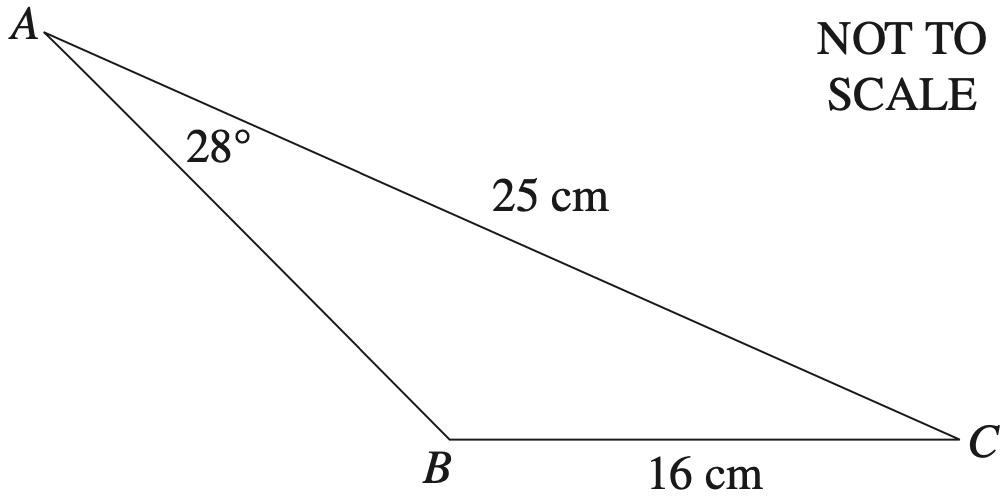
Find the size of the obtuse angle `ABC` correct to the nearest degree. (3 marks)
--- 6 WORK AREA LINES (style=lined) ---
Aussie Maths & Science Teachers: Save your time with SmarterEd
The diagram shows a triangle `ABC` where `AC` = 25 cm, `BC` = 16 cm, `angle BAC` = 28° and angle `ABC` is obtuse.
Find the size of the obtuse angle `ABC` correct to the nearest degree. (3 marks)
--- 6 WORK AREA LINES (style=lined) ---
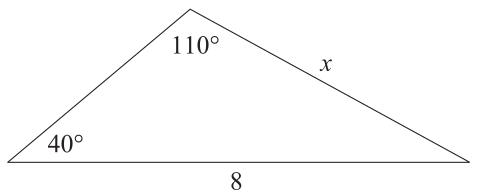
Using the sine rule, find the value of `x` correct to one decimal place. (2 marks)
--- 5 WORK AREA LINES (style=lined) ---
Determine all possible dimensions for triangle `ABC` given `AB = 6.2\ text(cm)`, `angleABC = 35°` and `AC = 4.1`.
Give all dimensions correct to one decimal place. (3 marks)
--- 10 WORK AREA LINES (style=lined) ---
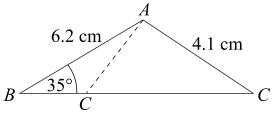
`text(Using the sine rule:)`
| `(sinangleACB)/6.2` | `= (sin35^@)/4.1` |
| `sinangleACB` | `= (6.2 xx sin35^@)/4.1= 0.8673…` |
| `angleACB` | `= 60.15…^@\ text(or)\ 119.84…^@` |
`text(If)\ \ angleACB = 60.15^@,`
`angleBAC = 180-(35 + 60.15) = 84.85^@`
| `(BC)/(sin84.85^@)` | `= 4.1/(sin35^@)` |
| `BC` | `= (4.1 xx sin84.85^@)/(sin35^@)=7.11… = 7.1\ text(cm)` |
`text(If)\ \ angleACB = 119.85^@,`
`angleBAC = 180-(35 + 119.85) = 25.15^@`
| `(BC)/(sin25.15)` | `= 4.1/(sin35^@)` |
| `BC` | `= (4.1 xx sin25.15^@)/(sin35^@) = 3.03… = 3.0\ text(cm)` |
`:.\ text(Possible dimensions are:)`
`text(7.1 cm, 6.2 cm, 4.1 cm or)`
`text(3.0 cm, 6.2 cm, 4.1 cm.)`
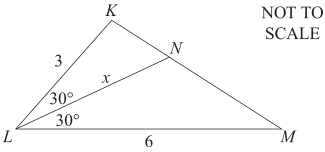
In `Delta KLM, KL` has length 3, `LM` has length 6 and `/_KLM` is 60°. The point `N` is chosen on side `KM` so that `LN` bisects `/_KLM`. The length `LN` is `x`.
--- 2 WORK AREA LINES (style=lined) ---
--- 5 WORK AREA LINES (style=lined) ---

Find the value of `theta` in the diagram. Give your answer to the nearest degree. (2 marks)
--- 5 WORK AREA LINES (style=lined) ---
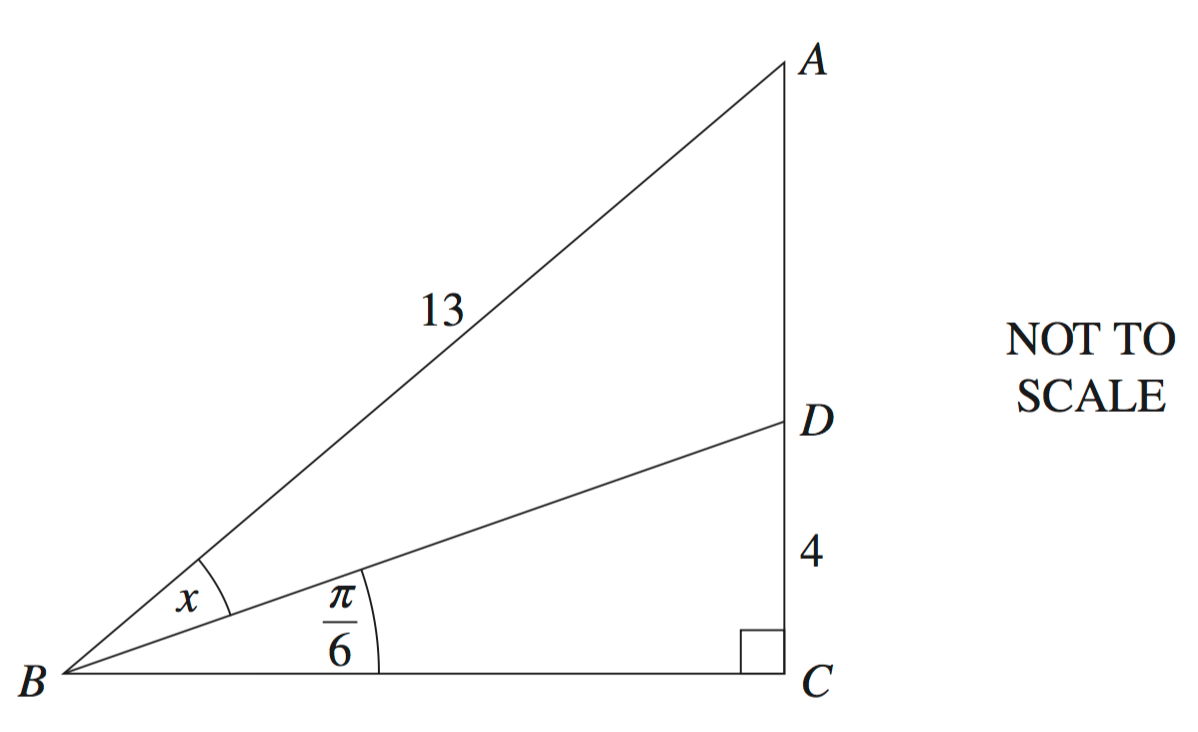
The right-angled triangle `ABC` has hypotenuse `AB = 13`. The point `D` is on `AC` such that `DC = 4`, `/_DBC = pi/6` and `/_ABD = x`.
Using the sine rule, or otherwise, find the exact value of `sin x`. (3 marks)
--- 9 WORK AREA LINES (style=lined) ---