SmarterEd

Aussie Maths & Science Teachers: Save your time with SmarterEd

  • Login
  • Get Help
  • About

v1 Measurement, STD2 M7 2023 HSC 26

Jo is constructing a concrete border around a rectangular vegetable patch, as shown. The border is 0.6 m wide.
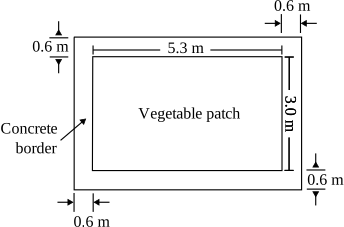
 

  1. Find the area of the border.   (2 marks)

    --- 4 WORK AREA LINES (style=lined) ---

  2. Jo is preparing concrete using a mix of gravel, sand, and cement in the ratio 5 : 3 : 2 by weight.
    Jo needs 2 tonnes of concrete in the correct ratio.
    Calculate how many 20 kg bags of cement Jo needs to buy.   (3 marks)

    --- 6 WORK AREA LINES (style=lined) ---
Show Answers Only
  1. `11.4\ \text{m}^2`
  2. `20\ \text{bags}`
Show Worked Solution

a.    `text{Area of outer rectangle} = 6.5 × 4.2 = 27.3\ \text{m}^2`

`text{Area of garden} = 5.3 × 3.0 = 15.9 \ text{m}^2`

`text{Area of border}` `= 27.3-15.9`  
  `=11.4\ text{m}^2`  


b.   `text{Ratio parts:} \ 5 + 3 + 2 = 10` parts

`text{Total concrete} = 2\ \text{tonnes} = 2000\ \text{kg}`

`text{Each part} = 2000 ÷ 10 = 200\ \text{kg}`

`text{Cement} = 2 \ text{parts} = 2 × 200 = 400\ \text{kg}`

`text{Bags of cement} = 400 ÷ 20 = 20`

`⇒ \ text{Jo needs 20 bags of cement.}`

Filed Under: Perimeter, Area and Volume (Std2-X) Tagged With: Band 4, smc-1187-20-Ratio (3 part), smc-798-10-Perimeter and Area

PHYSICS, M4 EQ-Bank 3 MC

Which of the following describes what happens to a circuit when more resistors are added in parallel?

  1. The total resistance increases and the total current decreases.
  2. The total current increases while the total resistance decreases.
  3. The voltage across each resistor increases.
  4. The total resistance remains unchanged.
Show Answers Only

\(B\)

Show Worked Solution
  • When resistors are connected in parallel, each new resistor provides an additional path for current to flow.
  • This increases the total current in the circuit because more charge can move through the circuit per unit of time.
  • At the same time, the total resistance of the circuit decreases because the overall opposition to current is reduced when multiple pathways are available. This is the opposite of what happens when resistors are added in series, where resistance increases.
  • The voltage across each resistor in a parallel circuit remains the same as the source voltage.

\(\Rightarrow B\)

Filed Under: Electric Circuits Tagged With: Band 4, smc-4284-20-Resistence in circuits, smc-4284-50-Parallel Circuits

PHYSICS, M4 EQ-Bank 2 MC

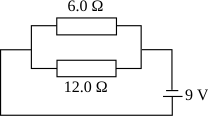
An electric circuit contains a 6.0 \(\Omega\) resistor and a 12.0 \(\Omega\) resistor connected in parallel. The circuit is powered by a 9.0 V battery.
 

What is the total current flowing through the circuit?

  1. 0.75 A
  2. 1.25 A
  3. 2.25 A
  4. 3.0 A
Show Answers Only

\(C\)

Show Worked Solution
  • The resistance in a parallel circuit is given by \(\dfrac{1}{R_T} = \dfrac{1}{R_1} + \dfrac{1}{R_2} \cdots \)
\(\dfrac{1}{R_T}\) \(=\dfrac{1}{6} + \dfrac{1}{12} = \dfrac{1}{4}\)  
\(R_T\) \(=4\ \Omega\)  
  •  Using  \(V=IR_T:\)
  • \(I=\dfrac{V}{R_T} = \dfrac{9}{4} = 2.25\ \text{A}\)

\(\Rightarrow C\)

Filed Under: Electric Circuits Tagged With: Band 4, smc-4284-10-V=IR, smc-4284-50-Parallel Circuits

Calculus, 2ADV C4 EQ-Bank 1

  1. Differentiate  \(y=x e^x\).   (2 marks)

    --- 5 WORK AREA LINES (style=lined) ---

  2. Hence, or otherwise, find \(\displaystyle \int_1^e x e^x d x\).   (2 marks)

    --- 6 WORK AREA LINES (style=lined) ---
Show Answers Only

a.  \(\dfrac{d y}{d x}=e^x+x e^x\)

b.  \(e^e(e-1)\)

Show Worked Solution

a.    \(y=x e^x\)

\(\dfrac{d y}{d x}=e^x+x e^x\)
 

b.    \(\text{Using part a.}\)

\(\displaystyle\int e^x+x e^x\, d x\) \(=x e^x+c\)
\(\displaystyle\int_1^e e^x\, d x+\int_1^e x e^x\, d x\) \(=\left[x e^x\right]_1^e\)
\(\displaystyle\int_1^e x e^x\, d x\) \(=\left[x e^x\right]_1^e-\left[e^x\right]_1^e\)
  \(=\left[e \cdot e^e-e\right]-\left[e^e-e\right]\)
  \(=e \cdot e^e-e^e\)
  \(=e^e(e-1)\)

Filed Under: L&E Integration (Adv-X) Tagged With: Band 4, Band 5, smc-1203-50-Diff then Integrate

PHYSICS, M4 EQ-Bank 1 MC

Two electric kettles have the following power ratings:

\begin{array} {|c|c|c|}
\hline
\rule{0pt}{2.5ex} \text{Kettle} \rule[-1ex]{0pt}{0pt} & \text{Voltage (V)} & \text{Power (W)}\\
\hline
\rule{0pt}{2.5ex} \text{A} \rule[-1ex]{0pt}{0pt} & \text{120} & \text{1800}\\
\hline
\rule{0pt}{2.5ex} \text{B} \rule[-1ex]{0pt}{0pt} & \text{240} & \text{2000} \\
\hline
\end{array}

A student compares the two devices.

Which of the following statements is most accurate?

  1. Kettle A draws more current than Kettle B.
  2. Kettle B must be more efficient because it operates at a higher voltage.
  3. Both kettles consume the same amount of electrical energy.
  4. Kettle A is suitable for standard Australian household outlets.
Show Answers Only

\(A\)

Show Worked Solution
  • Option \(A\) is correct: Using  \(I = \dfrac{P}{V}\)
  •    Kettle A, \(I_A = \dfrac{1800}{120} = 15\ \text{A}\)
  •    Kettle B, \(I_B = \dfrac{2000}{240} = 8.33\ \text{A}\)
  • Other options:
  • \(B\) is incorrect: Higher voltage does not automatically mean better efficiency. Efficiency depends on energy output vs input, not just voltage.
  • \(C\) is incorrect: Using  \(E= P \times t\), Kettle B (2000 W) uses more energy per second than Kettle A (1800 W).
  • \(D\) is incorrect: Australian household voltage is 240 V. Kettle A runs on 120 V  which is not suitable without a transformer.

Filed Under: Electric Circuits Tagged With: Band 4, smc-4284-30-Power

v1 Measurement, STD2 M1 2021 HSC 16

The surface area, `A`, of a sphere is given by the formula

`A = 4 pi r^2,`

where `r` is the radius of the sphere.

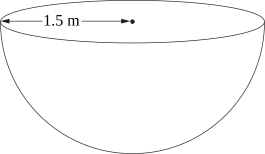
A satellite dish resembles the inner surface of the lower half of a sphere with a radius of 1.5 meters.


Find the surface area of the satellite dish in square metres, correct to one decimal place.   (2 marks)

--- 5 WORK AREA LINES (style=lined) ---

Show Answers Only

`14.1\ text{m}^2`

Show Worked Solution
`A` `= frac{1}{2} times 4 pi r^2`
  `= 2 pi r^2`
  `= 2 pi times (1.5)^2`
  `= 2 pi times 2.25`
  `= 14.137…`
  `= 14.1\ text{m}^2\ \text{(1 d.p.)}`

Filed Under: Perimeter, Area and Volume (Std2-X) Tagged With: Band 4, num-title-ct-pathb, num-title-qs-hsc, smc-4235-60-Spheres, smc-798-50-Volume (Circular Measure)

v1 Measurement, STD2 M1 2019 HSC 16

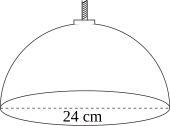
A decorative light fixture is in the shape of a hollow hemisphere with a diameter of 24 cm.
 

The inside of the fixture is to be coated with reflective paint.

What is the area to be painted on the inside surface? Give your answer correct to the nearest square centimetre.   (2 marks)

Show Answers Only

`905\ \text{cm}^2`

Show Worked Solution
`A` `= 2 pi r^2`
  `= 2 × pi × 12^2`
  `= 2 × pi × 144 = 905.0…`
  `≈ 905\ \text{cm}^2`

Filed Under: Perimeter, Area and Volume (Std2-X) Tagged With: Band 4, num-title-ct-pathb, num-title-qs-hsc, smc-4235-60-Spheres, smc-798-50-Volume (Circular Measure)

PHYSICS, M4 EQ-Bank 5 MC

A proton experiences a force of \(3.2 \times 10^{-15}\ \text{N}\) when placed between two charged parallel plates that are separated by 2 mm.

What is the potential difference between the plates?

  1. \(6.41 \times 10^{-22}\ \text{V}\)
  2. \(10.0\ \text{V}\)
  3. \(1.00 \times 10^{16}\ \text{V}\)
  4. \(40.0\ \text{V}\)
Show Answers Only

\(D\)

Show Worked Solution

\(F=qE=\dfrac{qV}{d}\)

Rearrange the equation to make \(V\) the subject:

\(V=\dfrac{Fd}{q}=\dfrac{3.2 \times 10^{-15} \times 2 \times 10^{-3}}{1.602 \times 10^{-19}} = 40.0\ \text{V}\)

 \(\Rightarrow D\)

Filed Under: Electrostatics Tagged With: Band 4, smc-4283-30-Forces on charges

PHYSICS, M4 EQ-Bank 7

Two parallel conducting plates are separated by a distance of 25 mm and are connected to a 150 V DC power supply. An electron is placed in the region between the plates.

Calculate the magnitude of the force acting on the electron.   (2 marks)

--- 5 WORK AREA LINES (style=lined) ---

Show Answers Only

\(9.6 \times 10^{-16}\ \text{N}\)

Show Worked Solution
\(F\) \(=qE\)  
  \(=\dfrac{qV}{d}\)  
  \(=\dfrac{1.602 \times 10^{-19} \times 150}{25 \times 10^{-3}}\)  
  \(= 9.6 \times 10^{-16}\ \text{N}\)  

Filed Under: Electrostatics Tagged With: Band 4, smc-4283-30-Forces on charges

PHYSICS, M4 EQ-Bank 6

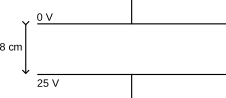
  1. The diagram below shows a pair of parallel conducting plates. Using appropriate field conventions, draw electric field lines between the plates to illustrate the direction and uniformity of the electric field in the region between them.   (2 marks)


--- 0 WORK AREA LINES (style=lined) ---

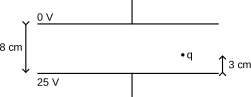
  1. The plates are separated by a distance of 8.0 cm, and a potential difference of 25 V is applied across them. Calculate the magnitude of the electric field in the region between the plates.   (1 mark)

--- 2 WORK AREA LINES (style=lined) ---

  1. A particle of mass \(3.2 \times 10^{-20}\) kg carrying a charge of \(+2.4 \times 10^{-18}\ \text{C}\) is placed in the electric field, at a point 3 cm above the lower plate.


    Determine the magnitude and direction of the acceleration experienced by the particle due to the field.   (3 marks)

--- 5 WORK AREA LINES (style=lined) ---

Show Answers Only

a.    
       
 
b.    
\(312.5\ \text{Vm}^{-1}\)

c.    \(2.34 \times 10^4\ \text{ms}^{-2},\ \text{up the page}\)

Show Worked Solution

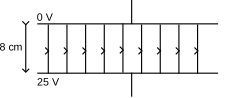
a.    
     

  • The electric field should be represented by vertical lines that are equally spaced and extend from the positively charged plate to the negatively charged plate, indicating a uniform field.

b.    \(E = \dfrac{V}{d} = \dfrac{25}{0.08} = 312.5\ \text{Vm}^{-1}\)
  

c.    \(F = qE = 2.4 \times 10^{-18} \times 312.5 = 7.5 \times 10^{-16}\ \text{N, up the page}\)

Calculate acceleration using  \(F=ma:\)

   \(a =\dfrac{F}{m} = \dfrac{7.5 \times 10^{-16}}{3.2 \times 10^{-20}} = 2.34 \times 10^4\ \text{ms}^{-2},\ \text{up the page}\)

Filed Under: Electrostatics Tagged With: Band 3, Band 4, smc-4283-10-Electric fields, smc-4283-30-Forces on charges

PHYSICS, M4 EQ-Bank 5

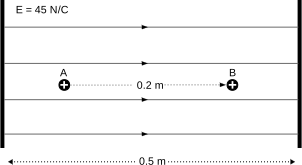
A positive test charge of +4.0 \(\mu\)C is placed between two parallel plates with a uniform electric field of 45 N/C. These plates are separated by 0.5 m, and the charge moves a distance of 0.2 m from point A to point B.
 

  1. Determine the magnitude and direction of the force on the charge.   (2 marks)

--- 3 WORK AREA LINES (style=lined) ---

  1. Find the potential difference between point A and point B.   (1 mark)

--- 2 WORK AREA LINES (style=lined) ---

  1. How much work does the electric field do on the charge during this movement?   (1 mark)

--- 2 WORK AREA LINES (style=lined) ---

Show Answers Only

a.    \( 1.8 \times 10^{-4}\ \text{N}\ \text{to the right}\)

b.    \(9\ \text{V}\)

c.    \(3.6 \times 10^{-5}\ \text{J}\)

Show Worked Solution

a.    \(F=qE = 4.0 \times 10^{-6} \times 45 = 1.8 \times 10^{-4}\ \text{N}\ \text{to the right}\)
 

b.    \(V = Ed = 45 \times 0.2 = 9\ \text{V}\)
 

c.    \(W= qEd = 4 \times 10^{-6} \times 45 \times 0.2 = 3.6 \times 10^{-5}\ \text{J}\)

Filed Under: Electrostatics Tagged With: Band 3, Band 4, smc-4283-10-Electric fields, smc-4283-30-Forces on charges, smc-4283-45-Work Done

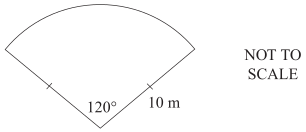
v1 Measurement, STD1 M1 2019 HSC 25

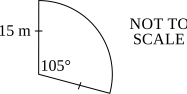
The diagram illustrates a sector formed by a central angle of 105°, taken from a circle with a radius of 15 metres.

What is the perimeter of the sector? Write your answer correct to 1 decimal place.  (3 marks)

Show Answers Only

`57.5\ \ (text(1 d. p.))`

Show Worked Solution
`text(Arc length)` `= 105/360 xx 2 xx pi xx 15`
  `= 27.49`


`:.\ text(Perimeter)` `= 27.49 + 2 xx 15`
  `= 57.49`
  `= 57.5\ \ (text(1 d. p.))`

Filed Under: Perimeter, Area and Volume (Std2-X) Tagged With: Band 4, smc-798-20-Perimeter and Area (Circular Measure)

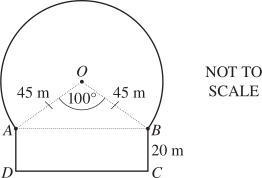
v1 Measurement, STD2 M1 2016 HSC 30c

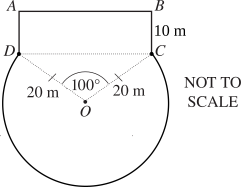
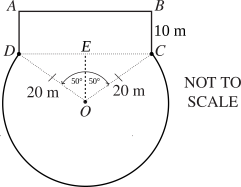
A landscape artist was commissioned to design a garden consisting of part of a circle, with centre `O`, and a rectangle, as shown in the diagram. The radius `OC` of the circle is 20 m, the width `BC` of the rectangle is 10 m, and `DOC` is 100°.
 

What is the area of the whole garden, correct to the nearest square metre?  (5 marks)

--- 12 WORK AREA LINES (style=lined) ---

Show Answers Only

`6281\ text{m²  (nearest m²)}`

Show Worked Solution

`text(In)\ \triangle ODC,`

`sin50^@` `= (ED)/20`
`ED` `= 20 \times \sin50^@`
  `= 34.472`
`:. DC` `= 2 \times 34.472 = 68.944\ \text{m}`


`cos50^@` `= (OE)/20`
`:. OE` `= 20 \times \cos50^@ = 28.925`


`text(Area of)\ \triangle ODC`

`= \frac{1}{2} \times 68.944 \times 28.925 = 997.12\ \text{m}^2`


`text(Area of rectangle ABCD)` `= 10 \times 68.944 = 689.44\ \text{m}^2`


`text(Area of major sector DOAC)`

`= \pi \times 20^2 \times \frac{260}{360} = 4594.58\ \text{m}^2`


`:.\ \text{Area of garden}`

`= 997.12 + 689.44 + 4594.58 = 6281.14`

`= 6281\ \text{m² (nearest m²)}`

Filed Under: Perimeter, Area and Volume (Std2-X) Tagged With: Band 4, num-title-ct-extension, num-title-qs-hsc, smc-798-20-Perimeter and Area (Circular Measure)

v1 Measurement, STD2 M1 2018 HSC 27c

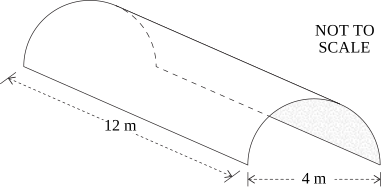
A farmer is designing a chicken coop with a roof shaped like half a cylinder, open at both ends. The structure has a diameter of 4 metres and a length of 12 metres.


The curved roof is to be made of aluminum sheets.

What area of aluminum sheets is required, to the nearest m²?  (2 marks)

--- 4 WORK AREA LINES (style=lined) ---

Show Answers Only

`75\ text(m²  (nearest m²))`

Show Worked Solution

`text(Flatten out the half cylinder,)`

`text(Width)` `= 1/2 xx text(circumference)`
  `= 1/2 xx pi xx 4`
  `= 6.283…`


`:.\ text(Sheeting required)` `= 12 xx 6.283…`
  `= 75.39…`
  `= 75\ text(m²  (nearest m²))`

Filed Under: Perimeter, Area and Volume (Std2-X) Tagged With: Band 4, num-title-ct-corea, num-title-qs-hsc, smc-4234-45-SA (cylinder), smc-798-25-Surface Area

v1 Measurement, STD2 M1 2015 HSC 28a

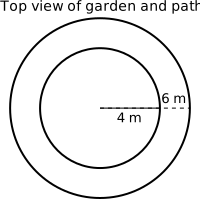
The diagram shows a circular garden bed with a circular path around it.
 

The radius of the entire structure (garden + path) is 6 m, and the radius of the inner garden is 4 m.

Calculate the area of the path. (1 mark)

--- 3 WORK AREA LINES (style=lined) ---

Show Answers Only

`≈ 62.83…\ text(m²)`

Show Worked Solution

`text(Area of path)`

`= pi(R^2 − r^2)`

`= pi(6^2 − 4^2)`

`= pi(36 − 16)`

`= 20pi\ \text(m²)`

`≈ 62.83…\ \text(m²)`

Filed Under: Perimeter, Area and Volume (Std2-X) Tagged With: Band 4, smc-1121-20-Perimeter and Area (Circular Measure), smc-798-20-Perimeter and Area (Circular Measure)

v1 Measurement, STD2 M1 2009 HSC 23c

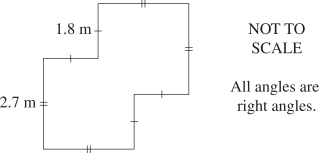
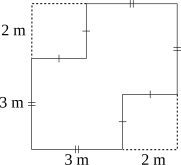
The diagram shows the shape and dimensions of a floor which is to be tiled.
 

  1. Find the area of the floor.   (2 marks)

    --- 5 WORK AREA LINES (style=lined) ---

  2. Tiles are sold in boxes. Each box holds one square metre of tiles and costs $60. When buying the tiles, 10% more tiles are needed, due to cutting and wastage.


    Find the total cost of the boxes of tiles required for the floor.   (2 marks)

    --- 4 WORK AREA LINES (style=lined) ---

Show Answers Only

i.    `17\ text(m²)`

ii.   `$1140`

Show Worked Solution
i.
`text(Area)` `=\ text(Area of big square – Area of 2 cut-out squares`
  `= (3 + 2) xx (3 + 2)\-2 xx (2 xx 2)`
  `= 25\-8`
  `= 17\ text(m²)`


ii. `text(Tiles required)` `= (17 +10 text{%}) xx 17`
    `= 18.7\ text(m²)`


 `=>\ text(19 boxes are needed)`

`:.\ text(Total cost of boxes)` `=19 xx $60`
  `= $1140`

Filed Under: Perimeter, Area and Volume (Std2-X) Tagged With: Band 4, num-title-ct-corea, num-title-qs-hsc, smc-1104-15-General rate problems, smc-1121-10-Perimeter and Area, smc-4234-10-Area (std), smc-798-10-Perimeter and Area, smc-805-60-Other rate problems

PHYSICS, M4 EQ-Bank 2 MC

During a dust storm on Mars, a research drone hovers between layers of charged dust clouds. The lower dust layer is at a potential of −80 MV relative to the upper layer, and the layers are 250 m apart. A tiny sensor on the drone accumulates a static charge of  \(q = 6 \times 10^{-12}\text{C.}\) 

What is the magnitude of the electric force acting on the charged sensor due to the electric field between the dust layers?

  1. \(1.92 \times 10^{-6}\ \text{N}\)
  2. \(3.84 \times 10^{-6}\ \text{N}\)
  3. \(5.76 \times 10^{-6}\ \text{N}\)
  4. \(1.28 \times 10^{-7}\ \text{N}\)
Show Answers Only

\(A\)

Show Worked Solution
\(F\) \(=\dfrac{qV}{d}\)  
  \(=\dfrac{6 \times 10^{-12} \times 80 \times 10^6}{250}\)  
  \(= 1.92 \times 10^{-6}\ \text{N}\)  

 
\(\Rightarrow A\)

Filed Under: Electrostatics Tagged With: Band 4, smc-4283-10-Electric fields, smc-4283-30-Forces on charges

PHYSICS, M4 EQ-Bank 1 MC

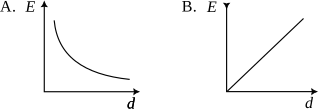
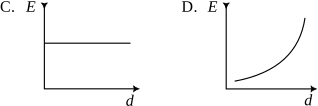
Which graph correctly shows how the electric field strength \((E)\) varies between two large, oppositely charged parallel plates connected to a constant voltage source?


Show Answers Only

\(C\)

Show Worked Solution
  • For uniform parallel plates, the electric field strength is given by:
  •       \(E=\dfrac{V}{d}\)​
  • But across the gap between the plates, the field is uniform — meaning \(E\) is constant at every point between the plates (not changing with position across the gap).

\(\Rightarrow C\)

Filed Under: Electrostatics Tagged With: Band 4, smc-4283-10-Electric fields

PHYSICS, M4 EQ-Bank 3

Two small identical conducting spheres are mounted on insulating stands, 50 cm apart. One sphere carries a charge \((q_1)\) of +0.5 nC, and the other carries a charge \((q_2)\) of −0.2 nC.

  1. Calculate the magnitude and direction of the electrostatic force between the two spheres at this distance. Use Coulomb’s law and clearly state whether the force is attractive or repulsive.   (3 marks)

--- 5 WORK AREA LINES (style=lined) ---

  1. The spheres are then briefly brought into contact, allowing charge to redistribute equally, and then separated again to a distance of 25 cm. What is the charge on each sphere now?   (1 mark)

--- 2 WORK AREA LINES (style=lined) ---

Show Answers Only

a.    \(3.60 \times 10^{-9}\ \text{N}\) towards each other.

b.    \(0.15\ \text{nC}\)

Show Worked Solution
a.    \(F\) \(=\dfrac{1}{4\pi\epsilon_0} \times \dfrac{q_1q_2}{r^2}\)
    \(=\dfrac{1}{4 \pi \times 8.854 \times 10^{-12}} \times \dfrac{0.5 \times 10^{-9} \times 0.2 \times 10^{-9}}{0.5^2}\)
    \(= 3.60 \times 10^{-9}\ \text{N}\ \ \text{towards each other}\)

 
b.    
After contact, charges redistribute equally because:

  • Conductors allow free movement of charge.
  • Identical spheres have equal capacity to hold charge.
  • They reach the same electric potential when touched.
  •    \(q_{\text{each}} = \dfrac{q_1q_2}{2} = \dfrac{0.5 +(-0.2)}{2} = 0.15\ \text{nC}\).

Filed Under: Electrostatics Tagged With: Band 4, Band 5, smc-4283-30-Forces on charges

PHYSICS, M4 EQ-Bank 2

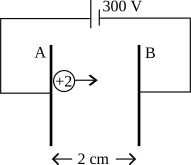
Two parallel metal plates are 2.0 cm apart and are connected to a 300 V DC power supply. An alpha particle (a helium nucleus, charge = +2, mass = \(6.64 \times 10^{-27}\)) is released from rest at the positive plate.
 

  1. Calculate the magnitude and direction of the electric field between the plates.   (2 marks)

--- 4 WORK AREA LINES (style=lined) ---

  1. Determine the final speed of the alpha particle as it reaches the negatively charged plate. Show all working.   (3 marks)

--- 6 WORK AREA LINES (style=lined) ---
Show Answers Only

a.    \(15000\ \text{Vm}^{-1}\) towards plate B.

b.    \(1.7 \times 10^{5}\ \text{ms}^{-1}\).

Show Worked Solution

a.    \(E=\dfrac{V}{d} = \dfrac{300}{0.02} = 15\,000\ \text{Vm}^{-1}\) towards plate B.
 

b.    Using  \(F=ma = qE\):

\(a = \dfrac{qE}{m} = \dfrac{2 \times 1.602 \times 10^{-19} \times 15\,000}{6.64 \times 10^{-27}} = 7.238 \times 10^{11}\ \text{ms}^{-2}\).

 
To determine the final speed of the alpha particle:

\(v^2\) \(=u^2 + 2as\)  
\(v\) \(= \sqrt{0^2 + 2 \times 7.238 \times 10^{11} \times 0.02}\)  
  \(= 1.7 \times 10^{5}\ \text{ms}^{-1}\).  

Filed Under: Electrostatics Tagged With: Band 3, Band 4, smc-4283-10-Electric fields, smc-4283-30-Forces on charges

v1 Measurement, STD2 M1 2023 HSC 24

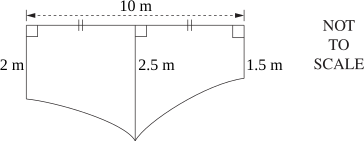
The diagram shows the cross-section of a wall across a creek. 


  1. Use two applications of the trapezoidal rule to estimate the area of the cross-section of the wall.  (2 marks)

    --- 4 WORK AREA LINES (style=lined) ---

  2. The wall has a uniform thickness of 0.9 m. The weight of 1 m³ of concrete is 3.52 tonnes.  
  3. How many tonnes of concrete are in the wall? Give the answer to two significant figures.  (3 marks)

    --- 6 WORK AREA LINES (style=lined) ---
Show Answers Only
  1. `21.25\ text{m}^2`
  2. `text{67 tonnes}`
Show Worked Solution

a.    `h=10.0/2=5`

`A` `~~h/2[2+1.5+2(2.5)]`  
  `~~5/2(8.5)`  
  `~~21.25\ text{m}^2`  

 
b.
   `V_text{wall}=21.25 xx 0.9=19.13\ text{m}^3`

`text{Mass of concrete}` `=19.13 xx 3.52`  
  `=67.33`  
  `=67\ text{tonnes (2 sig.fig.)}`  
♦ Mean mark (b) 46%.
 

Filed Under: Trapezoidal Rule (Std2-X) Tagged With: Band 4, Band 5, smc-799-30-Mass, smc-941-10-1-3 Approximations

v1 Measurement, STD2 M1 2021 HSC 12 MC

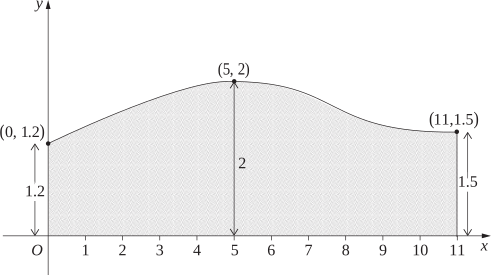
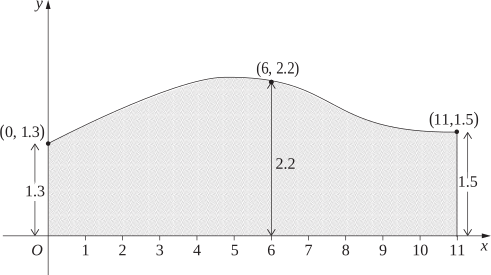
A block of land is represented by the shaded region on the number plane. All measurements are in kilometres. 
 

What is the approximate area of the land, in square kilometres, using two applications of the trapezoidal rule?

  1. 11.25
  2. 14.85
  3. 16.75
  4. 22.55
Show Answers Only

`C`

Show Worked Solution

Using two applications of the trapezoidal rule:

`\text{Area}` `≈ \frac{5}{2} (1.2 + 2 × 2 + 1.5)`
  `= 2.5 (1.2 + 4 + 1.5)`
  `= 2.5 × 6.7`
  `= 16.75 \ \text{km}^2`

`⇒ C`

Filed Under: Trapezoidal Rule (Std2-X) Tagged With: Band 4, smc-941-10-1-3 Approximations

PHYSICS, M4 EQ-Bank 1

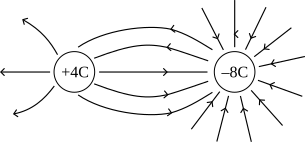
A positive charge of +4 C is placed near a negative charge of –8C, as shown in the diagram below. Draw the electric field lines that represent the interaction between these two charges.   (2 marks)


--- 0 WORK AREA LINES (style=lined) ---

Show Answers Only

Show Worked Solution

  • The density of the lines from the -8C charge are double that of the lines from the +4C charge
  • The direction of the field is from the positive charge to the negative charge.

Filed Under: Electrostatics Tagged With: Band 4, smc-4283-10-Electric fields

PHYSICS, M3 EQ-Bank 18

A metal rod of length 2.0 m has one end maintained at 100\(^{\circ}\)C and the other end at 20\(^{\circ}\)C. The rod has a cross-sectional area of 0.001 m\(^2\) and thermal conductivity  \(k\) = 50 W m\(^{-1}\) K\(^{-1}\).

  1. Calculate the rate of heat transfer through the rod.   (2 marks)

--- 4 WORK AREA LINES (style=lined) ---

  1. Explain the process by which heat is transferred through the metal rod.   (2 marks)

--- 4 WORK AREA LINES (style=lined) ---

  1. Suggest two ways the rate of heat transfer could be increased.   (2 marks)

--- 4 WORK AREA LINES (style=lined) ---

Show Answers Only

a.    \(2\ \text{Js}^{-1}\)

b.    Heat is transferred through the metal rod by conduction.

→ In this process, vibrating particles at the hot end transfer energy to adjacent cooler particles by collisions, causing the energy to move along the rod without the particles themselves moving significantly.

c.    Two ways to increase the rate of heat transfer:

  • Increase the temperature difference between the two ends of the material.
  • Use a material with higher thermal conductivity, such as copper instead of wood.

Other answers could include:

  • Increasing the cross-sectional area of the material or decreasing the distance the heat has to travel.
Show Worked Solution

a.    \(\dfrac{Q}{t} = \dfrac{kA\Delta T}{d} = \dfrac{50 \times 0.001 \times (100-20)}{2} = 2\ \text{Js}^{-1}\)
 

b.    Heat is transferred through the metal rod by conduction.

  • In this process, vibrating particles at the hot end transfer energy to adjacent cooler particles by collisions, causing the energy to move along the rod without the particles themselves moving significantly.

c.    Two ways to increase the rate of heat transfer:

  • Increase the temperature difference between the two ends of the material.
  • Use a material with higher thermal conductivity, such as copper instead of wood.

Other answers could include:

  • Increasing the cross-sectional area of the material or decreasing the distance the heat has to travel.

Filed Under: Thermodynamics Tagged With: Band 3, Band 4, smc-4282-35-Quantitative calcs, smc-4282-40-Energy transfer

PHYSICS, M3 EQ-Bank 17

A sealed container contains 2.0 kg of steam at 100\(^{\circ}\)C. The container is placed in a fridge and cooled until all the steam has condensed and the resulting water has cooled to 5\(^{\circ}\)C. Using the specific latent heat of vaporisation of water: 2.3 \(\times\) 10\(^6\) J kg\(^{-1}\),

  1. Calculate the energy removed during condensation.   (1 marks)

--- 2 WORK AREA LINES (style=lined) ---

  1. Calculate the total energy that must be removed from the container.   (2 mark)

--- 4 WORK AREA LINES (style=lined) ---

  1. Explain why steam burns are more dangerous than boiling water burns.   (2 mark)

--- 2 WORK AREA LINES (style=lined) ---

Show Answers Only

a.    \(4.6 \times 10^6\ \text{J}\)

b.    \(5.4 \times 10^6\ \text{J}\)

c.   Steam burns are more dangerous than boiling water burns as:

  • Steam contains additional energy in the form of latent heat from the phase change.
  • When steam condenses on the skin, it releases this latent heat of vaporisation, transferring more energy than boiling water at the same temperature, causing more severe tissue damage.
Show Worked Solution

a.    Using the specific latent heat of vaporisation:

\(Q = 2 \times 2.3 \times 10^6 = 4.6 \times 10^6\ \text{J}\)
 

b.    The heat energy lost to reduce the temperature of water from 100\(^{\circ}\)C to 5\(^{\circ}\)C:

\(Q=mc\Delta T = 2 \times 4.18 \times 10^3 \times (100-5) = 7.942 \times 10^5\ \text{J}\)

  • The total energy that must be removed from the container is the latent heat of vaporization and the energy require to cool the water down to 5\(^{\circ}\).
  •     \(E_T= 4.6 \times 10^6 + 7.942 \times 10^5 = 5.4 \times 10^6\ \text{J}\) 

c.   Steam burns are more dangerous than boiling water burns because:

  • Steam contains additional energy in the form of latent heat from the phase change.
  • When steam condenses on the skin, it releases this latent heat of vaporisation, transferring more energy than boiling water at the same temperature, causing more severe tissue damage.

Filed Under: Thermodynamics Tagged With: Band 4, Band 5, smc-4282-30-Q=mcΔt, smc-4282-35-Quantitative calcs, smc-4282-50-Latent heat

PHYSICS, M3 EQ-Bank 16

A student places 200 g of aluminium at 80\(^{\circ}\)C into 300 g of water at 20\(^{\circ}\)C, in an insulated container. Use the specific heat capacity of aluminium (897 J kg\(^{-1}\) K\(^{-1}\)) to calculate the final equilibrium temperature.   (3 marks)

--- 6 WORK AREA LINES (style=lined) ---
Show Answers Only

\(27.5^{\circ}\text{C}\)

Show Worked Solution
  • By the Conservation of Energy, heat lost by aluminium will be gained by the water.
  • Using  \(m_{\text{a}}c_{\text{a}}\Delta T_{\text{a}}=m_{\text{w}}c_{\text{w}}\Delta T_{\text{w}}\):
\(0.2 \times 897 \times (80-T_f)\) \(=0.3 \times 4.18 \times 10^3 \times (T_f-20)\)  
\(14\,352-179.4T_f\) \(=1254T_f-25\,080\)  
\(1433.4T_f\) \(=39\,432\)  
\(T_f\) \(=27.5^{\circ}\text{C}\)  

Filed Under: Thermodynamics Tagged With: Band 4, smc-4282-30-Q=mcΔt, smc-4282-35-Quantitative calcs, smc-4282-40-Energy transfer

PHYSICS, M3 EQ-Bank 14

A student performs an experiment to determine the specific heat capacity of aluminium.

She heats a 0.40 kg block of aluminium to 90\(^{\circ}\)C, then quickly places it into a beaker containing 0.60 kg of oil at an initial temperature of 25\(^{\circ}\)C. After some time, the final equilibrium temperature of the aluminium and the oil is found to be 32\(^{\circ}\)C. The student knows that the specific heat capacity of the oil is 2.00 \(\times\) 10\(^3\) J kg\(^{-1}\)\(^{\circ}\)C\(^{-1}\).

Use this data to calculate the specific heat capacity of aluminium.   (4 marks)

--- 8 WORK AREA LINES (style=lined) ---
Show Answers Only

\(362\ \text{J/kg}^{\circ}\text{C}\)

Show Worked Solution
  • The energy lost by the block of aluminium is gained by the oil.
  •    \(Q_{\text{oil}} = mc \Delta T = 0.60 \times 2.00 \times 10^3 \times (32-25) = 8400\ \text{J}\).
  •    \(c_{\text{Al}} = \dfrac{Q}{m\Delta t} = \dfrac{8400}{0.4 \times (90-32)} = 362\ \text{J/kg}^{\circ}\text{C}\)
  • The specific heat capacity of Aluminium is \(362\ \text{J/kg}^{\circ}\text{C}\).

Filed Under: Thermodynamics Tagged With: Band 4, Band 5, smc-4282-10-Specific heat capacity, smc-4282-30-Q=mcΔt, smc-4282-35-Quantitative calcs

PHYSICS, M3 EQ-Bank 13

Describe three different processes by which thermal energy can be transferred from an area of higher temperature to an area of lower temperature.   (3 marks)

--- 7 WORK AREA LINES (style=lined) ---
Show Answers Only
  • Thermal energy can be transferred from a region of higher temperature to a region of lower temperature through conduction, convection, and radiation.
  • Conduction occurs when heat is transferred through direct contact between particles in a solid. The particles with more kinetic energy vibrate and pass energy to neighbouring particles.
  • Convection happens in liquids and gases when warmer, less dense areas rise and cooler, denser areas sink. This movement creates a circulating current that transfers heat throughout the fluid.
  • Radiation involves the transfer of energy by electromagnetic waves, such as infrared radiation. It does not require a medium and can occur through a vacuum.
Show Worked Solution
  • Thermal energy can be transferred from a region of higher temperature to a region of lower temperature through conduction, convection, and radiation.
  • Conduction occurs when heat is transferred through direct contact between particles in a solid. The particles with more kinetic energy vibrate and pass energy to neighbouring particles.
  • Convection happens in liquids and gases when warmer, less dense areas rise and cooler, denser areas sink. This movement creates a circulating current that transfers heat throughout the fluid.
  • Radiation involves the transfer of energy by electromagnetic waves, such as infrared radiation. It does not require a medium and can occur through a vacuum.

Filed Under: Thermodynamics Tagged With: Band 4, smc-4282-40-Energy transfer

PHYSICS, M3 EQ-Bank 12

Define specific heat capacity and explain what it tells us about a substance.   (3 marks)

--- 7 WORK AREA LINES (style=lined) ---
Show Answers Only
  • Specific heat capacity is the amount of heat energy needed to raise the temperature of 1 unit of mass (usually 1 gram or 1 kilogram) of a substance by 1°C or 1 K.
  • It shows how easily a material’s temperature changes when heat is added or removed. Substances like water, with high specific heat capacity, absorb lots of heat with little temperature change.
  • Materials with low specific heat capacity heat up or cool down quickly, storing less thermal energy.
Show Worked Solution
  • Specific heat capacity is the amount of heat energy needed to raise the temperature of 1 unit of mass (usually 1 gram or 1 kilogram) of a substance by 1°C or 1 K.
  • It shows how easily a material’s temperature changes when heat is added or removed. Substances like water, with high specific heat capacity, absorb lots of heat with little temperature change.
  • Materials with low specific heat capacity heat up or cool down quickly, storing less thermal energy.

Filed Under: Thermodynamics Tagged With: Band 4, smc-4282-10-Specific heat capacity

PHYSICS, M3 EQ-Bank 11

An electric kettle is connected to a 24 V power supply and draws a constant current of 2.5 A. It is used to heat 200 mL of water in an insulated container. The water starts at 20.0 \(^{\circ}\)C.

  1. Calculate how many joules of heat energy are added to the water every second. Assume 100% efficiency in energy transfer.   (2 marks)

--- 4 WORK AREA LINES (style=lined) ---
  1. Determine how long it takes to raise the water’s temperature to 60.0 \(^{\circ}\)C.   (3 marks)

--- 6 WORK AREA LINES (style=lined) ---
Show Answers Only

a.    60 joules of energy are added to the water every second.

b.    557 seconds

Show Worked Solution

a.    Joules of heat energy per second is equivalent to the power of kettle.

\(P = IV = 2.5 \times 24 = 60\ \text{W}\)

  • 60 joules of energy are added to the water every second.

b.    The energy required to heat the water to 60.0 \(^{\circ}\)C:

\(Q= mc\Delta T = 200 \times 4.18 \times (60-20) = 33\,440\ \text{J}\)

\(t = \dfrac{Q}{P} = \dfrac{33\,440}{60} = 557\ \text{s}\)

Filed Under: Thermodynamics Tagged With: Band 4, smc-4282-30-Q=mcΔt, smc-4282-35-Quantitative calcs

v1 Measurement, STD2 M1 2013 HSC 15a*

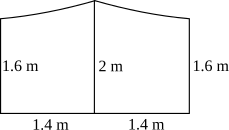
The diagram shows the front of a tent supported by three vertical poles. The poles are 1.4 m apart. The height of each outer pole is 1.6 m, and the height of the middle pole is 2 m. The roof hangs between the poles.

The front of the tent has area `A\ text(m²)`. 

  1. Use the trapezoidal rule to estimate `A`.    (2 marks)

    --- 4 WORK AREA LINES (style=lined) ---
  2. Explain whether the trapezoidal rule give a greater or smaller estimate of  `A`?  (1 mark)

    --- 2 WORK AREA LINES (style=lined) ---
Show Answers Only
  1. `5.04\ text(m²)`
  2. `text(The trapezoidal rule assumes a straight line between)`


    `text(all points and therefore would estimate a greater)`


    `text(area than the actual area of the tent front.)`

Show Worked Solution
i.    `A` `~~ h/2 [y_0 + 2y_1 + y_2]`
    `~~ 1.4/2 [1.6 + (2 xx 2) + 1.6]`
    `~~ 0.7 [7.2]`
    `~~ 5.04\ text(m²)`


ii.  `text(The trapezoidal rule assumes a straight line between)`

`text(all points and therefore would estimate a greater)`

`text(area than the actual area of the tent front.)`

Filed Under: Trapezoidal Rule (Std2-X) Tagged With: Band 4, Band 5, smc-941-10-1-3 Approximations

v1 Measurement, STD2 M1 2015 HSC 28c*

Three equally spaced cross-sectional areas of a vase are shown.


Use the Trapezoidal rule to find the approximate capacity of the vase in litres.  (3 marks)

--- 6 WORK AREA LINES (style=lined) ---
Show Answers Only

`3\ text(litres)`

Show Worked Solution

`text(Solution 1)`

`V` `≈ 15/2(35 + 170) + 15/2(170 + 25)`
  `≈ 15/2(205 + 195)`
  `≈ 3000\ text{mL   (1 cm³ = 1 mL)}`
  `~~3\ text(L)`

`text(Solution 2)`

`V` `≈ 15/2(35 + 2 xx 170 + 25)`
  `≈ 15/2(400)`
  `≈ 3000\ text{mL}`
  `~~3 \ text(L)`

Filed Under: Trapezoidal Rule (Std2-X) Tagged With: Band 4, smc-941-30-Volume

v1 Measurement, STD2 M7 2021 HSC 27

The price and the power consumption of two different models of air purifiers are shown.

\[ \begin{array}{|l|l|} \hline \text{Air Purifier X} & \text{Air Purifier Y} \\ \hline \text{Price: \$480} & \text{Price: \$462.40} \\ \hline \text{Power: 95 W} & \text{Power: 88 W} \\ \hline \end{array} \]

The average cost for electricity is 30c/kWh. A household runs an air purifier for an average of 10 hours a day.

  1. The annual cost of electricity for Air Purifier X for this household is \$104.03.
  2. For this household, what is the difference in the annual cost of electricity between Air Purifier X and Air Purifier Y? (2 marks)

    --- 4 WORK AREA LINES (style=lined) ---
  3. For this household, how many years will it take for the total cost of buying and using Air Purifier X to be equal to the cost of buying and using Air Purifier Y? (2 marks)

    --- 4 WORK AREA LINES (style=lined) ---
Show Answers Only
  1. `$7.66`
  2. `2.3\ \text{years}`
Show Worked Solution
a. `text{Annual power usage (Y)}` `= 88 \times 10 \times 365 = 321200\ \text{Wh}`
    `= 321.2\ \text{kWh}`
  `text{Annual cost (Y)}` `= 321.2 \times 0.30 = \$96.36`
  `text{Annual cost (X)}` `= 95 \times 10 \times 365 / 1000 \times 0.30 = \$104.03`
  `text{Difference}` `= 104.03-96.36 = \$7.66`
b. `text{Price difference}` `= 480-462.40 = \$17.60`
  `text{Years to equal total cost}` `= 17.60 / 7.66 ≈ 2.3\ \text{years}`

Filed Under: Energy and Mass (Std2-X) Tagged With: Band 4, Band 5, smc-1104-25-Energy, smc-799-20-Electricity, smc-805-20-Energy

PHYSICS, M3 EQ-Bank 4 MC

On a cold morning, a sealed football is left outside on the field. Players notice that it feels softer and doesn't bounce as well as it did the day before when it was warmer.

Which statement best explains this observation using thermodynamic principles?

  1. The lower external temperature reduces the internal energy of the air in the ball, decreasing gas pressure and making the ball less elastic.
  2. The cold causes the mass of the gas particles inside the ball to decrease, reducing pressure.
  3. The ball absorbs energy from the cold air, which increases the pressure inside.
  4. The kinetic energy of the gas particles increases in the cold, causing the ball to lose pressure.
Show Answers Only

\(A\)

Show Worked Solution
  • The ball feels softer and doesn’t bounce as well because the colder temperature reduces the internal energy of the gas particles inside.
  • A lower temperature means the particles have less average kinetic energy, so they move more slowly and collide with the inner walls of the ball with less force.
  • This results in a decrease in gas pressure, making the ball less firm and less elastic, so it doesn’t rebound as effectively.

\(\Rightarrow A\)

Filed Under: Thermodynamics Tagged With: Band 4, smc-4282-40-Energy transfer, smc-4282-55-Temp and Energy

PHYSICS, M3 EQ-Bank 9

A cold metal can is placed inside a small insulated box of warm air. The system is left undisturbed for 30 minutes.

Identify and account for the changes that will occur in the system using appropriate physics principles.   (2 marks)

--- 5 WORK AREA LINES (style=lined) ---
Show Answers Only
  • Heat transfers from the warm air to the cold can because of the temperature difference.
  • Both the can and the air change temperature until the two systems reach thermal equilibrium where they will be the same temperature.
Show Worked Solution
  • Heat transfers from the warm air to the cold can because of the temperature difference.
  • Both the can and the air change temperature until the two systems reach thermal equilibrium where they will be the same temperature.

Filed Under: Thermodynamics Tagged With: Band 4, smc-4282-40-Energy transfer

PHYSICS, M3 EQ-Bank 3 MC

A metal block with a mass of 500 g is heated and it absorbs 10 000 J of thermal energy. As a result, its temperature increases by 20.0\(^{\circ}\)C. Based on this information, what is the specific heat capacity of the metal?

  1. 1.00 J g\(^{-1 \circ}\)C\(^{-1}\)
  2. 1.00 kJ g\(^{-1 \circ}\)C\(^{-1}\)
  3. 1.00 J kg\(^{-1 \circ}\)C\(^{-1}\)
  4. 1000 J g\(^{-1 \circ}\)C\(^{-1}\)
Show Answers Only

\(A\)

Show Worked Solution
\(Q\) \(=mc\Delta t\)  
\(c\) \(=\dfrac{Q}{m \Delta t} =\dfrac{10\,000\ \text{J}}{500\ \text{g} \times 20^{\circ}\text{C}} = 1\ \text{J/g}^{\circ}\text{C}\)  

 
\(\Rightarrow A\)

Filed Under: Thermodynamics Tagged With: Band 4, smc-4282-30-Q=mcΔt, smc-4282-35-Quantitative calcs

HMS, BM EQ-Bank 983

Describe the factors that determine how much force an athlete can apply to sporting equipment.   (5 marks)

--- 15 WORK AREA LINES (style=lined) ---
Show Answers Only

Sample Answer

  • Body mass and muscle size influence force production capacity. Larger athletes typically possess greater muscle mass and longer limb levers. These physical characteristics provide mechanical advantages when interacting with equipment like bats, racquets or throwing implements.
  • Biomechanical technique determines force transfer efficiency from body to equipment. Optimal technique involves correct joint angles, movement sequencing and contact timing. Poor technique results in force dissipation and reduced equipment velocity regardless of athlete strength.
  • Muscle fibre composition affects instantaneous force generation. Fast-twitch fibres produce higher peak forces than slow-twitch fibres. Athletes with predominantly fast-twitch composition excel in explosive equipment-based activities like shot put or batting.
  • Training-induced adaptations modify force production capabilities. Strength training increases muscle size and improves nerve-muscle communication. Power training improves speed of force production, particularly important for rapid equipment acceleration.
  • Movement coordination involves sequential body segment activation from ground contact through equipment release. Effective patterns include leg drive, hip rotation, trunk flexion and arm extension. Each segment contributes to final force magnitude applied to equipment.
Show Worked Solution

Sample Answer

  • Body mass and muscle size influence force production capacity. Larger athletes typically possess greater muscle mass and longer limb levers. These physical characteristics provide mechanical advantages when interacting with equipment like bats, racquets or throwing implements.
  • Biomechanical technique determines force transfer efficiency from body to equipment. Optimal technique involves correct joint angles, movement sequencing and contact timing. Poor technique results in force dissipation and reduced equipment velocity regardless of athlete strength.
  • Muscle fibre composition affects instantaneous force generation. Fast-twitch fibres produce higher peak forces than slow-twitch fibres. Athletes with predominantly fast-twitch composition excel in explosive equipment-based activities like shot put or batting.
  • Training-induced adaptations modify force production capabilities. Strength training increases muscle size and improves nerve-muscle communication. Power training improves speed of force production, particularly important for rapid equipment acceleration.
  • Movement coordination involves sequential body segment activation from ground contact through equipment release. Effective patterns include leg drive, hip rotation, trunk flexion and arm extension. Each segment contributes to final force magnitude applied to equipment.

Filed Under: Fluid Mechanics and Force Tagged With: Band 4, Band 5, smc-5879-60-Force on an object

HMS, BM EQ-Bank 977

Explain the relationship between applied forces and reaction forces in athletic performance.   (5 marks)

--- 15 WORK AREA LINES (style=lined) ---
Show Answers Only

Sample Answer

  • Athletes generate applied forces through muscular contractions directed at external surfaces. This occurs because muscles transfer force through bones to contact points. As a result, sprinters push against the track with considerable force.
  • Newton’s Third Law creates equal and opposite reaction forces instantly. When athletes push down and backward, surfaces generate upward and forward forces of identical magnitude. This relationship ensures balanced force pairs.
  • Athletic movement results from reaction forces propelling bodies opposite to applied forces. The reason is athletes cannot move without external forces acting upon them. Therefore, ground reaction forces enable all running and jumping.
  • Performance directly correlates with force magnitude – stronger applied forces produce larger reaction forces. This leads to faster speeds as acceleration follows F=ma. Evidence shows elite sprinters generate forces exceeding three times bodyweight.
  • Optimal technique maximises useful reaction forces through proper force direction and timing. Consequently, athletes align forces efficiently to reduce energy waste. This explains why training emphasises force vector optimisation for performance gains.
Show Worked Solution

Sample Answer

  • Athletes generate applied forces through muscular contractions directed at external surfaces. This occurs because muscles transfer force through bones to contact points. As a result, sprinters push against the track with considerable force.
  • Newton’s Third Law creates equal and opposite reaction forces instantly. When athletes push down and backward, surfaces generate upward and forward forces of identical magnitude. This relationship ensures balanced force pairs.
  • Athletic movement results from reaction forces propelling bodies opposite to applied forces. The reason is athletes cannot move without external forces acting upon them. Therefore, ground reaction forces enable all running and jumping.
  • Performance directly correlates with force magnitude – stronger applied forces produce larger reaction forces. This leads to faster speeds as acceleration follows F=ma. Evidence shows elite sprinters generate forces exceeding three times bodyweight.
  • Optimal technique maximises useful reaction forces through proper force direction and timing. Consequently, athletes align forces efficiently to reduce energy waste. This explains why training emphasises force vector optimisation for performance gains.

Filed Under: Fluid Mechanics and Force Tagged With: Band 4, Band 5, smc-5879-40-Body applying force

HMS, BM EQ-Bank 976

Describe the biomechanical principles involved in effectively catching fast-moving objects.   (5 marks)

--- 15 WORK AREA LINES (style=lined) ---
Show Answers Only

Sample Answer

  • Impact force absorption involves the relationship between object momentum and catching distance. The formula F = ma/t shows that extended catching distance reduces peak forces. Athletes extend arms fully before contact then draw the object toward the body.
  • Multi-point contact distribution spreads forces across multiple body segments. Both hands create larger contact surface area while engaging multiple joints. Force distribution occurs through fingers, wrists, elbows, and shoulders rather than single-point concentration.
  • Progressive joint movement characterises the kinetic chain during catching. Movement flows from fingers through to trunk segments. Each joint bends in sequence with muscles lengthening under control to absorb energy.
  • Pre-contact positioning requires anticipatory movements before ball arrival. Athletes adopt wide stances with flexed knees for stability. Arms position at appropriate height with slight elbow flexion, ready for extension and subsequent catching motion.
  • Visual tracking and timing coordinates body movements with object trajectory. Eyes maintain focus throughout the flight path. Hand positioning adjusts continuously based on visual information, with grasping timed for optimal catching distance.
Show Worked Solution

Sample Answer

  • Impact force absorption involves the relationship between object momentum and catching distance. The formula F = ma/t shows that extended catching distance reduces peak forces. Athletes extend arms fully before contact then draw the object toward the body.
  • Multi-point contact distribution spreads forces across multiple body segments. Both hands create larger contact surface area while engaging multiple joints. Force distribution occurs through fingers, wrists, elbows, and shoulders rather than single-point concentration.
  • Progressive joint movement characterises the kinetic chain during catching. Movement flows from fingers through to trunk segments. Each joint bends in sequence with muscles lengthening under control to absorb energy.
  • Pre-contact positioning requires anticipatory movements before ball arrival. Athletes adopt wide stances with flexed knees for stability. Arms position at appropriate height with slight elbow flexion, ready for extension and subsequent catching motion.
  • Visual tracking and timing coordinates body movements with object trajectory. Eyes maintain focus throughout the flight path. Hand positioning adjusts continuously based on visual information, with grasping timed for optimal catching distance.

Filed Under: Fluid Mechanics and Force Tagged With: Band 4, Band 5, smc-5879-50-Body absorbing force

HMS, BM EQ-Bank 974

Describe how athletes in different sports utilise Magnus force to enhance their performance.   (5 marks)

--- 15 WORK AREA LINES (style=lined) ---

Show Answers Only

Sample Answer

Tennis – Topspin Applications

  • Players create topspin by brushing up the back of the ball during contact.
  • Topspin generates downward Magnus force that curves the ball’s flight path.
  • This allows harder shots to land within court boundaries while creating high, difficult bounces for opponents.

Cricket – Spin Bowling

  • Bowlers impart side-spin through wrist and finger actions during release.
  • The Magnus force creates lateral ball movement in flight, causing the ball to curve away from or towards batsmen.
  • Predicting ball placement becomes much harder for effective batting when spin is applied.

Soccer – Curved Free Kicks

  • Players strike the ball off-centre to create side-spin rotation.
  • Magnus force bends the ball’s path around defensive walls.
  • This enables shots that curve into goal areas that appear blocked from the initial kick angle.

Baseball – Breaking Pitches

  • Pitchers use various grips and release techniques to generate different spin directions.
  • The resulting Magnus force creates curveballs that drop and, sliders that move laterally.
  • Consequently batters have difficulty tracking ball movement and timing their swings.

Golf – Backspin Control

  • Golfers create backspin through downward club strikes that compress the ball.
  • Magnus force provides lift during flight and creates stopping power on landing.
  • This facilitates precise distance control and preventing ball roll on greens.
Show Worked Solution

Sample Answer

Tennis – Topspin Applications

  • Players create topspin by brushing up the back of the ball during contact.
  • Topspin generates downward Magnus force that curves the ball’s flight path.
  • This allows harder shots to land within court boundaries while creating high, difficult bounces for opponents.

Cricket – Spin Bowling

  • Bowlers impart side-spin through wrist and finger actions during release.
  • The Magnus force creates lateral ball movement in flight, causing the ball to curve away from or towards batsmen.
  • Predicting ball placement becomes much harder for effective batting when spin is applied.

Soccer – Curved Free Kicks

  • Players strike the ball off-centre to create side-spin rotation.
  • Magnus force bends the ball’s path around defensive walls.
  • This enables shots that curve into goal areas that appear blocked from the initial kick angle.

Baseball – Breaking Pitches

  • Pitchers use various grips and release techniques to generate different spin directions.
  • The resulting Magnus force creates curveballs that drop and, sliders that move laterally.
  • Consequently batters have difficulty tracking ball movement and timing their swings.

Golf – Backspin Control

  • Golfers create backspin through downward club strikes that compress the ball.
  • Magnus force provides lift during flight and creates stopping power on landing.
  • This facilitates precise distance control and preventing ball roll on greens.

Filed Under: Fluid Mechanics and Force Tagged With: Band 3, Band 4, smc-5879-30-Magnus force

HMS, BM EQ-Bank 971

Explain the techniques swimmers can use to minimise drag and maximise lift forces during competition.   (5 marks)

--- 15 WORK AREA LINES (style=lined) ---
Show Answers Only

Sample Answer

  • Swimmers maintain head-spine alignment with horizontal body position to reduce form drag. This works because streamlined positioning allows water to flow smoothly around body contours, which prevents turbulence formation. As a result, resistance decreases by up to 40% compared to poor alignment.
  • Core muscle engagement keeps hips elevated at the water surface. This technique prevents legs from sinking below the body line, thereby reducing frontal surface area exposed to water. Consequently, form drag decreases significantly while buoyancy enables more efficient stroke mechanics.
  • Tight, ankle-driven kicking with minimal knee flexion creates propulsion without excess drag. The reason for this is that small-amplitude kicks generate thrust while avoiding splash and turbulence. This coordination with arm strokes produces lift forces rather than just maintaining position.
  • Slightly cupped hand position during the catch phase maximises water displacement for propulsion. This occurs because the curved hand shape creates pressure differences between palm and back surfaces, resulting in lift forces. Therefore, swimmers achieve forward thrust more efficiently than with flat hands.
  • Compact limb positioning during gliding phases minimises form drag. By keeping arms and legs close to the centerline, swimmers reduce frontal area and prevent water from catching on extended limbs, which leads to smoother forward movement.
Show Worked Solution

Sample Answer

  • Swimmers maintain head-spine alignment with horizontal body position to reduce form drag. This works because streamlined positioning allows water to flow smoothly around body contours, which prevents turbulence formation. As a result, resistance decreases by up to 40% compared to poor alignment.
  • Core muscle engagement keeps hips elevated at the water surface. This technique prevents legs from sinking below the body line, thereby reducing frontal surface area exposed to water. Consequently, form drag decreases significantly while buoyancy enables more efficient stroke mechanics.
  • Tight, ankle-driven kicking with minimal knee flexion creates propulsion without excess drag. The reason for this is that small-amplitude kicks generate thrust while avoiding splash and turbulence. This coordination with arm strokes produces lift forces rather than just maintaining position.
  • Slightly cupped hand position during the catch phase maximises water displacement for propulsion. This occurs because the curved hand shape creates pressure differences between palm and back surfaces, resulting in lift forces. Therefore, swimmers achieve forward thrust more efficiently than with flat hands.
  • Compact limb positioning during gliding phases minimises form drag. By keeping arms and legs close to the centerline, swimmers reduce frontal area and prevent water from catching on extended limbs, which leads to smoother forward movement.

Filed Under: Fluid Mechanics and Force Tagged With: Band 3, Band 4, smc-5879-20-Fluid resistance

HMS, BM EQ-Bank 968

How does muscle-to-fat ratio affect flotation performance in competitive swimming?   (5 marks)

--- 15 WORK AREA LINES (style=lined) ---
Show Answers Only

Sample Answer

  • Higher muscle mass increases overall body density compared to fat tissue. This occurs because muscle tissue is approximately 18% denser than fat. Consequently swimmers with more muscle sink lower in the water. For example, a swimmer with 15% body fat floats more easily than one with 8% body fat.
  • Lower body fat percentage reduces natural buoyancy during swimming. As a result, swimmers must work harder to maintain horizontal body position, leading to increased energy expenditure. This creates greater drag as the body sits lower in the water.
  • The muscle-to-fat ratio directly affects swimming efficiency across different events. While sprinters benefit from higher muscle mass for power generation, this causes reduced flotation requiring more kick effort. Conversely, distance swimmers maintain higher fat percentages because improved flotation reduces energy costs over longer races.
  • Body position adjustments become necessary with different ratios. When muscle mass is high, swimmers must engage core muscles more actively to prevent leg drop. This compensation mechanism increases fatigue but enables maintenance of streamlined position.
  • Training adaptations can partially offset ratio disadvantages. Through specific technique work, muscular swimmers learn to optimise body position, thereby minimising the negative flotation effects while maintaining power advantages.
Show Worked Solution

Sample Answer

  • Higher muscle mass increases overall body density compared to fat tissue. This occurs because muscle tissue is approximately 18% denser than fat. Consequently swimmers with more muscle sink lower in the water. For example, a swimmer with 15% body fat floats more easily than one with 8% body fat.
  • Lower body fat percentage reduces natural buoyancy during swimming. As a result, swimmers must work harder to maintain horizontal body position, leading to increased energy expenditure. This creates greater drag as the body sits lower in the water.
  • The muscle-to-fat ratio directly affects swimming efficiency across different events. While sprinters benefit from higher muscle mass for power generation, this causes reduced flotation requiring more kick effort. Conversely, distance swimmers maintain higher fat percentages because improved flotation reduces energy costs over longer races.
  • Body position adjustments become necessary with different ratios. When muscle mass is high, swimmers must engage core muscles more actively to prevent leg drop. This compensation mechanism increases fatigue but enables maintenance of streamlined position.
  • Training adaptations can partially offset ratio disadvantages. Through specific technique work, muscular swimmers learn to optimise body position, thereby minimising the negative flotation effects while maintaining power advantages.

Filed Under: Fluid Mechanics and Force Tagged With: Band 3, Band 4, smc-5879-10-Flotation/Centre of Buoyancy

HMS, BM EQ-Bank 965 MC

A soccer player kicks a wet ball compared to a dry ball of the same size. According to biomechanical principles, what adjustment must the player make?

  1. Use the same force as the wet ball will travel further due to reduced friction
  2. Apply greater force because the increased mass requires more force for the same acceleration
  3. Reduce the applied force as the wet surface provides better contact with the foot
  4. Change the kicking technique entirely as mass has no effect on force requirements
Show Answers Only

\(B\)

Show Worked Solution
  • B is correct: Increased mass (from water absorption) requires greater force to achieve the same acceleration, following \(F=ma\).

Other Options:

  • A is incorrect: Greater mass actually requires more force; wet surface may increase, not decrease, friction.
  • C is incorrect: Wet surface doesn’t necessarily improve contact, and greater mass still requires more force.
  • D is incorrect: Mass directly affects force requirements according to Newton’s Second Law.

Filed Under: Fluid Mechanics and Force Tagged With: Band 4, smc-5879-60-Force on an object

HMS, BM EQ-Bank 964 MC

When catching a fast-moving cricket ball, a fielder should:

  1. Keep their hands rigid to provide a solid surface for the ball
  2. Catch the ball close to their body to minimise arm movement
  3. Extend their arm and draw it back toward their body during the catch
  4. Use only their fingertips to reduce the contact surface area
Show Answers Only

\(C\)

Show Worked Solution
  • C is correct: Extending the arm and drawing it back increases the distance over which force is absorbed, reducing impact.

Other Options:

  • A is incorrect: Rigid hands don’t absorb force effectively and may cause injury.
  • B is incorrect: Catching close to the body reduces absorption distance and increases impact.
  • D is incorrect: Fingertip catching concentrates force and increases injury risk.

Filed Under: Fluid Mechanics and Force Tagged With: Band 4, smc-5879-50-Body absorbing force

HMS, BM EQ-Bank 961 MC

When a basketball player jumps to shoot, their legs push down against the court surface. According to biomechanical principles, what enables the player to leave the ground?

  1. Applied forces from the legs create equal and opposite reaction forces from the court
  2. Internal forces generated by muscle contraction overcome gravity
  3. External forces from the court surface exceed the player's body weight
  4. Gravitational forces are temporarily suspended during the jumping motion
Show Answers Only

\(A\)

Show Worked Solution
  • A is correct: Applied forces from leg muscles create equal and opposite reaction forces from the court, following Newton’s Third Law, enabling upward movement.

Other Options:

  • B is incorrect: Internal forces alone cannot create upward movement without external reaction forces.
  • C is incorrect: Court forces are reactions to applied forces, not independent external forces.
  • D is incorrect: Gravity continues to act throughout the movement.

Filed Under: Fluid Mechanics and Force Tagged With: Band 4, smc-5879-40-Body applying force

HMS, BM EQ-Bank 959 MC

In tennis, when a player hits a topspin forehand, the ball curves downward during flight due to:

  1. Increased air density above the ball
  2. Gravitational forces acting more strongly on the spinning ball
  3. Reduced air pressure caused by the racquet's follow-through
  4. Magnus force created by the ball's rotation through air
Show Answers Only

\(D\)

Show Worked Solution
  • D is correct: Magnus force is created when a spinning object moves through fluid (air), causing pressure differences that curve the ball’s path.

Other Options:

  • A is incorrect: Air density remains constant; pressure differences are created by spin.
  • B is incorrect: Gravity acts equally on all objects regardless of spin.
  • C is incorrect: Racquet follow-through doesn’t create lasting pressure changes affecting ball flight.

Filed Under: Fluid Mechanics and Force Tagged With: Band 4, smc-5879-30-Magnus force

HMS, BM EQ-Bank 958 MC

Which technique would be most effective for a swimmer to reduce drag forces during their stroke?

  1. Keeping the body aligned and maintaining a streamlined position
  2. Increasing stroke rate to move through water faster
  3. Using a wider arm stroke to catch more water
  4. Breathing more frequently to maintain oxygen levels
Show Answers Only

\(A\)

Show Worked Solution
  • A is correct: Streamlined body alignment reduces drag by minimising resistance to water flow.

Other Options:

  • B is incorrect: Higher stroke rate doesn’t reduce drag forces, may actually increase them.
  • C is incorrect: Wider arm strokes create more drag, opposing efficient movement.
  • D is incorrect: Breathing frequency affects performance but not drag reduction directly.

Filed Under: Fluid Mechanics and Force Tagged With: Band 4, smc-5879-20-Fluid resistance

HMS, BM EQ-Bank 955 MC

A swimming coach notices that one athlete consistently floats with their legs sinking below the surface while another maintains a horizontal position easily. Which factor best explains this difference in flotation ability?

  1. The difference in lung capacity between the two swimmers
  2. The relationship between each swimmer's centre of gravity and centre of buoyancy
  3. The variation in water temperature during training sessions
  4. The difference in swimming stroke technique being used
Show Answers Only

\(B\)

Show Worked Solution
  • B is correct: Misaligned centre of gravity and centre of buoyancy causes rotation and leg sinking.

Other Options:

  • A is incorrect: Lung capacity has minimal effect.
  • C is incorrect: Temperature doesn’t affect flotation.
  • D is incorrect: Question describes floating, not swimming.

Filed Under: Fluid Mechanics and Force Tagged With: Band 4, smc-5879-10-Flotation/Centre of Buoyancy

v1 Measurement, STD2 M1 SM-Bank 7

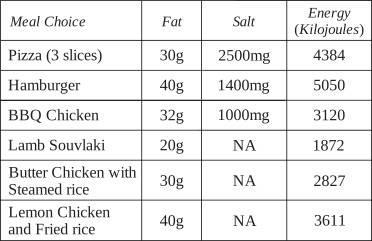
Ben and Lily select a meal each from the table below.

 
Ben chooses BBQ Chicken and Lily selects Butter Chicken with Steamed Rice.

After eating, Ben cycles and expends energy at 22 kJ/minute.

Lily does yoga and expends 10 kJ/minute.

Who will burn off their meal faster, and by how many minutes? (3 marks)

--- 6 WORK AREA LINES (style=lined) ---

Show Answers Only

`text(Ben will burn off his meal)`

`text(in 141 minutes less than Lily.)`

Show Worked Solution

`text(Ben’s energy intake = 3120)`

`text(Time to work off)` `= 3120/22`
  `≈ 142\ text(minutes)`


`text(Lily’s energy intake = 2827)`

`text(Time to work off)` `= 2827/10`
  `= 283\ text(minutes)`

`283-142 = 141\ text(minutes)`

`:.\ text(Ben will burn off his meal)`

`text(in 141 minutes less than Lily.)`

Filed Under: Energy and Mass (Std2-X) Tagged With: Band 4, smc-799-10-Calories/Joules

v1 Measurement, STD2 M7 2018 HSC 28c

A 900-watt air purifier runs for 2 hours per day at 60% power. Electricity costs $0.30 per kWh.

What is the total cost of running the air purifier for 150 days? (3 marks)

--- 6 WORK AREA LINES (style=lined) ---

Show Answers Only

`$48.60`

Show Worked Solution
`text(Daily usage)` `= 900 xx 2 xx 60text(%)`
  `= 1080\ \text{watts}`


`text(Total usage over 150 days)` `= 150 xx 1080`
  `=162 \ 000\ \text{watts}`
  `= 162\ \text{kWh}`


`∴ \  text(Cost)` `= 162 xx 0.30`
  `= $48.60`

Filed Under: Energy and Mass (Std2-X) Tagged With: Band 4, smc-1104-25-Energy, smc-799-20-Electricity, smc-805-20-Energy

v1 Measurement, STD2 M1 SM-Bank 8

A cannonball is made out of lead and has a diameter of 18 cm.

  1. Find the volume of the sphere in cubic centimetres (correct to 1 decimal place). (2 marks)

    --- 4 WORK AREA LINES (style=lined) ---
  2. It is known that the mass of lead is 11.3 tonnes/m³. Use this information to find the mass of the cannonball to the nearest gram. (2 marks)

    --- 4 WORK AREA LINES (style=lined) ---
Show Answers Only
  1. `3053.6\ \text{cm³  (1 d.p.)}`
  2. `34\ 506\ \text{grams}`
Show Worked Solution

i.     `text(Radius) = 18 / 2 = 9\ \text{cm}`

`text(Volume)` `= \frac{4}{3} \pi r^3`
  `= \frac{4}{3} \pi (9)^3`
  `= \frac{4}{3} \pi (729) = 3053.628…`
  `= 3053.6\ \text{cm³ (1 d.p.)}`


ii.     `text(1 m³ = 1,000,000 cm³)`

`11.3\ \text{tonnes} = 11,300\ \text{kg} = 11,300,000\ \text{grams}`

`text(Mass of cannon ball)`

`= 3053.6 \times ({11,300,000} / {1,000,000})`

`= 3053.6 \times 11.3 = 34,505.68…`

`= 34,506\ \text{grams}`

Filed Under: Energy and Mass (Std2-X) Tagged With: Band 3, Band 4, smc-798-50-Volume (Circular Measure), smc-799-30-Mass

HMS, HIC EQ-Bank 464

How does SDG 11: Sustainable Cities and Communities promote healthy and active lifestyles for young people?   (5 marks)

--- 15 WORK AREA LINES (style=lined) ---
Show Answers Only

*Cause-and-effect language that directly addresses the “How” (unofficial) keyword is bolded in the answer below.

SDG 11: Sustainable Cities and Communities

  • Promotes the creation of walkways and footpaths that provides safe spaces for young people to exercise. This addresses the barriers to outdoor recreation in urban environments.
  • Opens up more green spaces in high-density suburbs, increasing opportunities for leisure and recreation activities that support mental and physical health.
  • Constructs designated cycling lanes on roads, offering safe and sustainable transport methods for young people while promoting regular physical activity through daily commuting.
  • Reduces traffic congestion and improves air quality by encouraging alternative transport methods.
  • Assists in reducing emissions and pollution by decreasing car dependency, This addresses environmental health determinants that particularly affect growing children and adolescents.
  • Tackles accessibility challenges in metropolitan suburbs and rural areas where public space may be limited due to population density or geographic isolation.
  • Facilitates social interaction and community connection through shared public spaces that support mental health and social development among young people.
  • Creates sustainable infrastructure that supports long-term community health across multiple generations.
Show Worked Solution

*Cause-and-effect language that directly addresses the “How” (unofficial) keyword is bolded in the answer below.

SDG 11: Sustainable Cities and Communities

  • Promotes the creation of walkways and footpaths that provides safe spaces for young people to exercise. This addresses the barriers to outdoor recreation in urban environments.
  • Opens up more green spaces in high-density suburbs, increasing opportunities for leisure and recreation activities that support mental and physical health.
  • Constructs designated cycling lanes on roads, offering safe and sustainable transport methods for young people while promoting regular physical activity through daily commuting.
  • Reduces traffic congestion and improves air quality by encouraging alternative transport methods.
  • Assists in reducing emissions and pollution by decreasing car dependency, This addresses environmental health determinants that particularly affect growing children and adolescents.
  • Tackles accessibility challenges in metropolitan suburbs and rural areas where public space may be limited due to population density or geographic isolation.
  • Facilitates social interaction and community connection through shared public spaces that support mental health and social development among young people.
  • Creates sustainable infrastructure that supports long-term community health across multiple generations.

Filed Under: Improved health through SDGs Tagged With: Band 4, Band 5, smc-5516-40-SDGs & youth health

HMS, HIC EQ-Bank 463

Outline how SDG 4: Quality Education can improve health outcomes for young people in local communities.   (3 marks)

--- 7 WORK AREA LINES (style=lined) ---

Show Answers Only
  • Implements programs like Positive Behaviour for Learning to increase school attendance through positive recognition, improving educational engagement and reducing dropout rates
  • Addresses educational disparities in specific population subgroups, particularly Aboriginal and Torres Strait Islander students who experience lower literacy outcomes affecting lifelong health
  • Improves communication with parents by highlighting positive school achievements, building family engagement and support systems benefiting student wellbeing
  • Creates inclusive educational environments supporting diverse learning needs and promoting social connection, reducing isolation and improving psychological outcomes
Show Worked Solution
  • Implements programs like Positive Behaviour for Learning to increase school attendance through positive recognition, improving educational engagement and reducing dropout rates
  • Addresses educational disparities in specific population subgroups, particularly Aboriginal and Torres Strait Islander students who experience lower literacy outcomes affecting lifelong health
  • Improves communication with parents by highlighting positive school achievements, building family engagement and support systems benefiting student wellbeing
  • Creates inclusive educational environments supporting diverse learning needs and promoting social connection, reducing isolation and improving psychological outcomes

Filed Under: Improved health through SDGs Tagged With: Band 4, smc-5516-40-SDGs & youth health

PHYSICS, M3 EQ-Bank 8

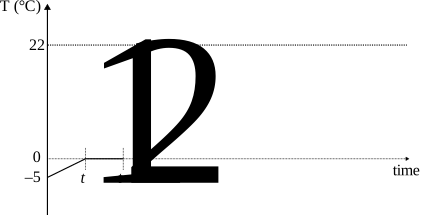
A frozen water bottle is removed from a cooler at -5\(^{\circ}\)C and placed on a desk in a room where the air temperature is 22\(^{\circ}\)C. A graph of the water bottle’s temperature over time is shown below.
 

  1. Explain the shape of the graph during the following time intervals:
  2.  i. From  \(t=0\)  to  \(t=t_1\) seconds.   (1 mark) 

    --- 3 WORK AREA LINES (style=lined) ---
  3. ii. From  \(t=t_1\)  to  \(t=t_2\) seconds.   (1 mark)

    --- 3 WORK AREA LINES (style=lined) ---
  1. On the graph provided, draw the expected temperature curve of the water bottle from \(t=t_2\) until \(t= 22\).   (2 marks)

    --- 0 WORK AREA LINES (style=lined) ---

Show Answers Only

a.i.  \(t=0\)  to  \(t=t_1:\)

  • The heat energy added to the bottle increases the kinetic energy of the ice molecules, raising its temperature.
  • The graph shows a positive linear slope, indicating a steady increase in temperature over time.

a.ii.  \(t=1\)  to  \(t=t_2:\)

  • In this interval, the ice is undergoing a phase change from solid to liquid (melting).
  • Even though heat is still being added, the temperature stays constant at 0\(^{\circ}\)C, because the energy is being used to break intermolecular bonds rather than raise temperature.

b.    
       

Show Worked Solution

a.i.  \(t=0\)  to  \(t=t_1:\)

  • The heat energy added to the bottle increases the kinetic energy of the ice molecules, raising its temperature.
  • The graph shows a positive linear slope, indicating a steady increase in temperature over time.

a.ii.  \(t=1\)  to  \(t=t_2:\)

  • In this interval, the ice is undergoing a phase change from solid to liquid (melting).
  • Even though heat is still being added, the temperature stays constant at 0\(^{\circ}\)C, because the energy is being used to break intermolecular bonds rather than raise temperature.

b.    
       

Filed Under: Thermodynamics Tagged With: Band 4, Band 6, smc-4282-50-Latent heat

HMS, HIC EQ-Bank 462

How do data collection challenges limit the Australian government's ability to effectively report on SDG progress?   (8 marks)

--- 22 WORK AREA LINES (style=lined) ---
Show Answers Only

*Recommended language to consider for “To What Extent” questions is bolded in the answer below.

Judgment Statement

  • Data collection challenges significantly limit Australia’s SDG reporting ability.
  • Evidence shows fragmented systems, missing indicators, and coordination barriers severely impact effectiveness.

Fragmented Data Systems

  • Evidence supporting this includes the fact that important data is scattered across multiple government departments with different collection methods.
  • States and territories maintain separate systems rather than unified approaches. This fragmentation means Australia cannot produce comprehensive SDG progress reports. For example, health data is collected differently in NSW versus Queensland which creates inconsistent national pictures.
  • The main factors supporting this include incompatible technology systems and varying departmental priorities.

Missing Measurement Frameworks

  • However, it is important to consider that some limitations are more severe than others.
  • Several SDG indicators have no accepted Australian measurement methods at all. This completely prevents reporting on certain goals regardless of coordination efforts.
  • Despite this, Australia remains one of the stronger performers compared to many nations because existing systems do provide partial data.
  • An alternative perspective to this issue suggests that while developing frameworks requires years of work, Australia is relatively well placed to create new measurement systems for collecting this data.
  • Nevertheless, current system shortcomings mean Australia cannot fully assess progress on all 17 SDGs.

Reaffirmation

  • Data challenges significantly constrain Australia’s SDG reporting capabilities.
  • Systemic differences in reporting between jurisdictions combine with missing indicators to create substantial barriers to reporting.
  • These limitations mean Australia cannot effectively demonstrate progress toward 2030 targets.
  • Implications suggest an urgent need for national coordination and standardised data systems.
Show Worked Solution

*Recommended language to consider for “To What Extent” questions is bolded in the answer below.

Judgment Statement

  • Data collection challenges significantly limit Australia’s SDG reporting ability.
  • Evidence shows fragmented systems, missing indicators, and coordination barriers severely impact effectiveness.

Fragmented Data Systems

  • Evidence supporting this includes the fact that important data is scattered across multiple government departments with different collection methods.
  • States and territories maintain separate systems rather than unified approaches. This fragmentation means Australia cannot produce comprehensive SDG progress reports. For example, health data is collected differently in NSW versus Queensland which creates inconsistent national pictures.
  • The main factors supporting this include incompatible technology systems and varying departmental priorities.

Missing Measurement Frameworks

  • However, it is important to consider that some limitations are more severe than others.
  • Several SDG indicators have no accepted Australian measurement methods at all. This completely prevents reporting on certain goals regardless of coordination efforts.
  • Despite this, Australia remains one of the stronger performers compared to many nations because existing systems do provide partial data.
  • An alternative perspective to this issue suggests that while developing frameworks requires years of work, Australia is relatively well placed to create new measurement systems for collecting this data.
  • Nevertheless, current system shortcomings mean Australia cannot fully assess progress on all 17 SDGs.

Reaffirmation

  • Data challenges significantly constrain Australia’s SDG reporting capabilities.
  • Systemic differences in reporting between jurisdictions combine with missing indicators to create substantial barriers to reporting.
  • These limitations mean Australia cannot effectively demonstrate progress toward 2030 targets.
  • Implications suggest an urgent need for national coordination and standardised data systems.

Filed Under: Improved health through SDGs Tagged With: Band 4, Band 5, smc-5516-30-Australia's focus

HMS, HIC EQ-Bank 461

Outline the role of universities in implementing the SDGs in Australia.   (3 marks)

--- 7 WORK AREA LINES (style=lined) ---
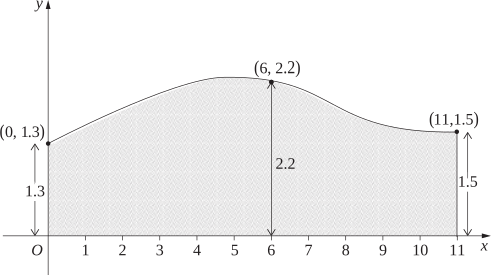
Show Answers Only
  • Provide knowledge and innovation to support SDG implementation through research expertise and evidence-based solutions for complex development challenges
  • Create future thinkers, leaders and implementers across all sectors both locally and internationally, developing human capital necessary for sustained progress
  • Integrate SDGs into undergraduate and post-graduate courses for widespread education, ensuring graduates understand sustainable development principles
  • Offer education for external sectors to provide knowledge and skills needed to address SDGs effectively in various industries and communities
Show Worked Solution
  • Provide knowledge and innovation to support SDG implementation through research expertise and evidence-based solutions for complex development challenges
  • Create future thinkers, leaders and implementers across all sectors both locally and internationally, developing human capital necessary for sustained progress
  • Integrate SDGs into undergraduate and post-graduate courses for widespread education, ensuring graduates understand sustainable development principles
  • Offer education for external sectors to provide knowledge and skills needed to address SDGs effectively in various industries and communities

Filed Under: Improved health through SDGs Tagged With: Band 4, smc-5516-30-Australia's focus

HMS, HIC EQ-Bank 460

Explain how WHO promotes shared responsibility across different sectors to improve health outcomes.   (5 marks)

--- 15 WORK AREA LINES (style=lined) ---
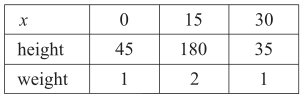
Show Answers Only

*Language highlighting the cause-effect relationship is bolded in the answer below.

  • WHO encourages multi-sector collaboration because isolated interventions fail to address health holistically.
  • Healthcare, education, workplace, urban planning and global partnerships are encouraged to work together, creating synergistic effects that amplify the impact on population health.
  • Healthcare focuses on early detection and treatment of diseases which prevents serious complications while also providing expertise for prevention programs.
  • Health education informs students about risk factors and healthy choices, thereby reducing future health burdens.
  • Workplace programs often provide exercise facilities and stress reduction that reduces sick leave, consequently improving productivity.
  • Urban planning creates parks and bike lanes that encourage physical activity which leads to decreased obesity rates.
  • Global partnerships accelerate the development of healthcare technology by enabling countries to share research findings and pool resources.
  • As a result, this multi-sector approach addresses social determinants rather than merely treating symptoms after illness occurs, thus creating sustainable health improvements.
  • This demonstrates why integrated strategies succeed where single-sector interventions fail, generating comprehensive wellbeing outcomes.
Show Worked Solution

*Language highlighting the cause-effect relationship is bolded in the answer below.

  • WHO encourages multi-sector collaboration because isolated interventions fail to address health holistically.
  • Healthcare, education, workplace, urban planning and global partnerships are encouraged to work together, creating synergistic effects that amplify the impact on population health.
  • Healthcare focuses on early detection and treatment of diseases which prevents serious complications while also providing expertise for prevention programs.
  • Health education informs students about risk factors and healthy choices, thereby reducing future health burdens.
  • Workplace programs often provide exercise facilities and stress reduction that reduces sick leave, consequently improving productivity.
  • Urban planning creates parks and bike lanes that encourage physical activity which leads to decreased obesity rates.
  • Global partnerships accelerate the development of healthcare technology by enabling countries to share research findings and pool resources.
  • As a result, this multi-sector approach addresses social determinants rather than merely treating symptoms after illness occurs, thus creating sustainable health improvements.
  • This demonstrates why integrated strategies succeed where single-sector interventions fail, generating comprehensive wellbeing outcomes.

Filed Under: Improved health through SDGs Tagged With: Band 4, Band 5, smc-5516-20-WHO health lens

HMS, HIC EQ-Bank 459

Outline how WHO recognises the interconnectedness of health with other SDGs.   (3 marks)

--- 7 WORK AREA LINES (style=lined) ---

Show Answers Only
  • Health influences and is influenced by many other SDGs beyond SDG 3: Good Health and Well-being, creating complex interdependencies.
  • Better healthcare access enhances workplace productivity and reduces poverty, demonstrating how health improvements support economic development goals.
  • Progress in education, gender equality, and clean water directly affects health outcomes like life expectancy and mental health through improved living conditions.
  • WHO emphasises that sustainable health improvements require coordinated action across multiple development sectors rather than isolated healthcare interventions.
Show Worked Solution
  • Health influences and is influenced by many other SDGs beyond SDG 3: Good Health and Well-being, creating complex interdependencies.
  • Better healthcare access enhances workplace productivity and reduces poverty, demonstrating how health improvements support economic development goals.
  • Progress in education, gender equality, and clean water directly affects health outcomes like life expectancy and mental health through improved living conditions.
  • WHO emphasises that sustainable health improvements require coordinated action across multiple development sectors rather than isolated healthcare interventions.

Filed Under: Improved health through SDGs Tagged With: Band 4, smc-5516-20-WHO health lens

HMS, HIC EQ-Bank 458

Explain how the SDGs address the interconnected nature of global challenges.   (5 marks)

--- 15 WORK AREA LINES (style=lined) ---

Show Answers Only

*Language highlighting the cause-effect relationship is bolded in the answer below.

  • The 17 SDGs address interconnected challenges because global problems share common root causes. For example, poverty can be directly linked to poor health, limited education, and environmental degradation simultaneously.
  • Due to this connection, goals need to be designed to work together rather than in isolation.
  • The framework functions through five areas: People, Planet, Prosperity, Peace, and Partnership.
  • This works by ensuring each area supports the others. For instance, when SDG 1 (poverty) improves, this leads to better outcomes in SDG 2 (hunger) and SDG 3 (health).
  • Further, there is a direct link between environmental protection and human wellbeing. This happens when climate action (SDG 13) enables food security through sustainable farming. As a result, protecting the planet directly supports human prosperity.
  • All 193 UN nations adopt SDGs because global challenges cross borders. This results in universal cooperation where wealthy nations support developing countries.
  • Consequently, coordinated global action generates measurable results by addressing interconnected challenges. In this way, the SDGs succeed through integrated solutions rather than isolated efforts.
Show Worked Solution

*Language highlighting the cause-effect relationship is bolded in the answer below.

  • The 17 SDGs address interconnected challenges because global problems share common root causes. For example, poverty can be directly linked to poor health, limited education, and environmental degradation simultaneously.
  • Due to this connection, goals need to be designed to work together rather than in isolation.
  • The framework functions through five areas: People, Planet, Prosperity, Peace, and Partnership.
  • This works by ensuring each area supports the others. For instance, when SDG 1 (poverty) improves, this leads to better outcomes in SDG 2 (hunger) and SDG 3 (health).
  • Further, there is a direct link between environmental protection and human wellbeing. This happens when climate action (SDG 13) enables food security through sustainable farming. As a result, protecting the planet directly supports human prosperity.
  • All 193 UN nations adopt SDGs because global challenges cross borders. This results in universal cooperation where wealthy nations support developing countries.
  • Consequently, coordinated global action generates measurable results by addressing interconnected challenges. In this way, the SDGs succeed through integrated solutions rather than isolated efforts.

Filed Under: Improved health through SDGs Tagged With: Band 4, Band 5, smc-5516-10-What are SDGs

PHYSICS, M3 EQ-Bank 1 MC

Objects \(\text{X}\) and \(\text{Y}\) are in thermal equilibrium. Objects \(\text{Y}\) and \(\text{Z}\) are also in thermal equilibrium.

Which of the following statements must be true?

\(\text{I.}\)  Objects \(\text{X}\), \(\text{Y}\), and \(\text{Z}\) are all at the same temperature.  
\(\text{II.}\)  Heat is flowing from object \(\text{X}\) to object \(\text{Z}\).  
\(\text{III.}\)  Objects \(\text{X}\) and \(\text{Z}\) are in thermal equilibrium.  
\(\text{IV.}\)  Object \(\text{Y}\) must be cooler than object \(\text{X}\).  


  1. \(\text{I}\) and \(\text{II}\)
  2. \(\text{I}\) and \(\text{III}\)
  3. \(\text{II}\) and \(\text{IV}\)
  4. \(\text{I}\) and \(\text{IV}\)
Show Answers Only

\(B\)

Show Worked Solution
  • \(\text{I}\) is true. If \(\text{X}\) is in thermal equilibrium with \(\text{Y}\), and \(\text{Y}\) is in thermal equilibrium with \(\text{Z}\), that means no heat is being exchanged between \(\text{X}\) and \(\text{Y}\) or between \(\text{Y}\) and \(\text{Z}\). This can only happen if all three objects are at the same temperature.
  • \(\text{II}\) is false. Since there is no temperature difference between any of the objects, no heat transfer occurs. Heat only flows from a hotter object to a cooler one.
  • \(\text{III}\) is true. If \(\text{X}\) and \(\text{Y}\) have equal temperatures, and \(\text{Y}\) and \(\text{Z}\) also have equal temperatures, then \(\text{X}\) and \(\text{Z}\) must also be at the same temperature. This means they are in thermal equilibrium, even if they are not directly in contact.
  • \(\text{IV}\) is false. They are all the same temperature as they are all in thermal equilibrium with one another.

\(\Rightarrow B\)

Filed Under: Thermodynamics Tagged With: Band 4, smc-4282-20-Thermal conductivity, smc-4282-40-Energy transfer

  • « Previous Page
  • 1
  • …
  • 11
  • 12
  • 13
  • 14
  • 15
  • …
  • 114
  • Next Page »

Copyright © 2014–2025 SmarterEd.com.au · Log in