--- 5 WORK AREA LINES (style=lined) --- --- 6 WORK AREA LINES (style=lined) ---

Aussie Maths & Science Teachers: Save your time with SmarterEd
--- 5 WORK AREA LINES (style=lined) --- --- 6 WORK AREA LINES (style=lined) ---
Find the length of the arc of the curve defined by `y = (x^4)/(4) + (1)/(8x^2) + 3` from `x = 1` to `x = 2`. Give your answer in the form `(a)/(b)`, where `a` and `b` are positive integers. (4 marks)
Given that `3x^2 + 2xy + y^2 = 6`, find `(d^2 y)/(dx^2)` at the point (1, 1). (5 marks)
--- 7 WORK AREA LINES (style=lined) ---
Part of the graph of `y = (2)/(sqrt(x^2-4x+3))`, where `x > 3`, is shown below.
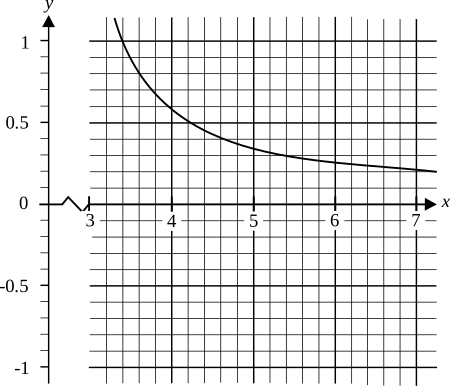
Find the volume of the solid of revolution formed when the graph of `y = (2)/(sqrt(x^2-4x+3))` from `x = 4` to `x = 6` is rotated about the `x`-axis. Give your answer in the form `a log_e(b)` where `a` and `b` are real numbers. (5 marks)
The base of a pyramid is the parallelogram `ABCD` with vertices at points `A(2,−1,3), B(4,−2,1), C(a,b,c)` and `D(4,3,−1)`. The apex (top) of the pyramid is located at `P(4,−4,9)`.
--- 4 WORK AREA LINES (style=lined) ---
--- 4 WORK AREA LINES (style=lined) ---
--- 4 WORK AREA LINES (style=lined) ---
| i. | `overset(->)(AB)` | `= (4 – 2)underset~i + (−2 + 1)underset~j + (1 – 3)underset~k` |
| `= 2underset~i – underset~j – 2underset~k` |
`text(S)text(ince)\ ABCD\ text(is a parallelogram)\ => \ overset(->)(AB)= overset(->)(DC)`
`overset(->)(DC) = (a – 4)underset~i + (b – 3)underset~j + (c + 1)underset~k`
`a – 4 = 2 \ => \ a = 6`
`b – 3 = −1 \ => \ b = 2`
`c + 1 = −2 \ => \ c = −3`
ii. `overset(->)(AB) = 2underset~i – underset~j – 2underset~k`
`overset(->)(AD) = 2underset~i + 4underset~j – 4underset~k`
| `cos angleBAD` | `= (overset(->)(AB) · overset(->)(AD))/(|overset(->)(AB)| · |overset(->)(AD)|)` |
| `= (4 – 4 + 8)/(sqrt(4 + 1 + 4) · sqrt(4 + 16 + 16))` | |
| `= 4/9` |
| iii. | `1/2 xx text(Area)_(ABCD)` | `= 1/2 ab sin c` |
| `text(Area)_(ABCD)` | `= |overset(->)(AB)| · |overset(->)(AD)| *sin(cos^(−1)\ 4/9)` |

| `:. text(Area)_(ABCD)` | `= 3 · 6 · sqrt65/9` |
| `= 2sqrt65\ text(u²)` |
A triangle has vertices `A(sqrt3 + 1, –2, 4), \ B(1, –2, 3)` and `C(2, –2, sqrt3 + 3)`.
--- 6 WORK AREA LINES (style=lined) ---
--- 3 WORK AREA LINES (style=lined) ---
A triangle has vertices `A(sqrt3 + 1, –2, 4), \ B(1, –2, 3)` and `C(2, –2, sqrt3 + 3)`. --- 6 WORK AREA LINES (style=lined) --- --- 4 WORK AREA LINES (style=lined) ---
Evaluate `int_(e^3) ^(e^4) (1)/(x log_e (x))\ dx`. (3 marks)
The number of cars per day making a U-turn at a particular location is known to be normally distributed with a standard deviation of 17.5. In a sample of 25 randomly selected days, a total of 1450 cars were observed making the U-turn.
--- 5 WORK AREA LINES (style=lined) ---
Find an approximation, correct to two decimal places, for the probability that on 25 randomly selected days the average number of U-turns is less than 53. (1 mark)
--- 3 WORK AREA LINES (style=lined) ---
a. `barx = (1450)/(25) = 58`
`(σ)/(sqrtn) = (17.5)/(sqrt25) = (35)/(2xx5) = (7)/(2)`
| `text(Limit:)\ ` | `(58-2 xx (7)/(2) \ , \ 58 + 2 xx (7)/(2)) ` |
| `= (51, 65)` |
b. `μ = 60 \ , \ (σ)/(sqrtn) = (7)/(2)`
`\ barX ∼ N (60, ((7)/(2))^2)`

| `text(Pr) (barX < 53)` | `= text(Pr) (z <–2)` |
| `= (0.05)/(2)` | |
| `= 0.025` | |
| `≈ 0.02 \ \ text{(round down)}` |
`text{(0.03 was also accepted as a correct answer)}`
A cubic polynomial has the form `p(z) = z^3 + bz^2 + cz + d, \ z ∈ C`, where `b, c, d ∈ R`.
Given that a solution of `p(z) = 0` is `z_1 = 3 - 2i` and that `p(–2) = 0`, find the values of `b, c` and `d`. (4 marks)
A cubic polynomial has the form `p(z) = z^3 + bz^2 + cz + d, \ z ∈ C`, where `b, c, d ∈ R`.
Given that a solution of `p(z) = 0` is `z_1 = 3 - 2i` and that `p(–2) = 0`, find the values of `b, c` and `d`. (4 marks)
A 10 kg mass is placed on a rough plane that inclined at 30° to the horizontal, as shown in the diagram below. A force of 40 N is applied to the mass up the slope and parallel to the slope. There is also a frictional resistance force of magnitude `F` that opposes the motion of the mass.
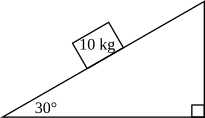
a.
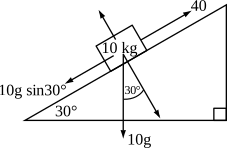
| `40 + F` | `= 10g sin30°` |
| `F` | `= 98 xx 0.5 – 40` |
| `= 9\ text(N)` |
b. `text(Frictional force)\ F\ text(acts down slope)`
| `40 + P` | `= 10g sin30° + F` |
| `P` | `= 5g + F – 40` |
| `= 49 + 9 – 40` | |
| `= 18\ text(N)` |
Evaluate `int_0^3 (8x)/(1 + x^2) \ dx`. (3 marks)
Find `int x/(x^2-3)\ dx`. (2 marks)
Differentiate with respect to `x`:
`log_e x^x`. (2 marks)
Differentiate `5^(x^2)5x`. (2 marks)
A ship sails 6 km from `A` to `B` on a bearing of 121°. It then sails 9 km to `C`. The
size of angle `ABC` is 114°.

Copy the diagram into your writing booklet and show all the information on it.
--- 2 WORK AREA LINES (style=lined) ---
--- 5 WORK AREA LINES (style=lined) ---
--- 6 WORK AREA LINES (style=lined) ---
| i. |  |
`text(Let point)\ D\ text(be due North of point)\ B`
| `/_ABD` | `=180-121\ text{(cointerior with}\ \ /_A text{)}` |
| `=59^@` | |
| `/_DBC` | `=114-59` |
| `=55^@` |
`:. text(Bearing of)\ \ C\ \ text(from)\ \ B\ \ text(is)\ 055^@`
ii. `text(Using cosine rule:)`
| `AC^2` | `=AB^2+BC^2-2xxABxxBCxxcos/_ABC` |
| `=6^2+9^2-2xx6xx9xxcos114^@` | |
| `=160.9275…` | |
| `:.AC` | `=12.685…\ \ \ text{(Noting}\ AC>0 text{)}` |
| `=13\ text(km)\ text{(nearest km)}` |
iii. `text(Need to find)\ /_ACB\ \ \ text{(see diagram)}`
| `cos/_ACB` | `=(AC^2+BC^2-AB^2)/(2xxACxxBC)` |
| `=((12.685…)^2+9^2-6^2)/(2xx(12.685..)xx9)` | |
| `=0.9018…` | |
| `/_ACB` | `=25.6^@\ text{(to 1 d.p.)}` |
`text(From diagram,)`
`/_BCE=55^@\ text{(alternate angle,}\ DB\ text(||)\ CE text{)}`
`:.\ text(Bearing of)\ A\ text(from)\ C`
| `=180+55+25.6` | |
| `=260.6` | |
| `=261^@\ text{(nearest degree)}` |

The bearing of `C` from `A` is 250° and the distance of `C` from `A` is 36 km.
--- 2 WORK AREA LINES (style=lined) ---
--- 7 WORK AREA LINES (style=lined) ---
i. `text(There is 360)^@\ text(about point)\ A`
| `:.theta + 250^@` | `= 360^@` |
| `theta` | `= 110^@` |
| ii. |  |
| `a^2` | `= b^2 + c^2 − 2ab\ cos\ A` |
| `CB^2` | `= 36^2 + 15^2 − 2 xx 36 xx 15 xx cos\ 110^@` |
| `= 1296 + 225 −(text(−369.38…))` | |
| `= 1890.38…` | |
| `:.CB` | `= 43.47…` |
| `= 43\ text{km (nearest km)}` |
The diagram shows information about the locations of towns `A`, `B` and `Q`.

Calculate her walking speed correct to the nearest km/h. (1 mark)
--- 2 WORK AREA LINES (style=lined) ---
Find the distance from Town `A` to Town `B`. Give your answer to the nearest km. (2 marks)
--- 4 WORK AREA LINES (style=lined) ---
--- 2 WORK AREA LINES (style=lined) ---
i. `text(2 hrs 48 mins) = 168\ text(mins)`
| `text(Speed)\ text{(} A\ text(to)\ Q text{)}` | `= 15/168` |
| `= 0.0892…\ text(km/min)` |
| `text(Speed)\ text{(in km/hr)}` | `= 0.0892… xx 60` |
| `= 5.357…\ text(km/hr)` | |
| `= 5\ text(km/hr)\ text{(nearest km/hr)}` |
| ii. |  |
`text(Using cosine rule)`
| `AB^2` | `= 15^2 + 10^2 – 2 xx 15 xx 10 xx cos 87^@` |
| `= 309.299…` | |
| `AB` | `= 17.586…` |
| `= 18\ text(km)\ text{(nearest km)}` |
`:.\ text(The distance from Town)\ A\ text(to Town)\ B\ text(is 18 km.)`
| iii. |  |
| `/_CAQ` | `= 31^@\ \ \ text{(} text(straight angle at)\ A text{)}` |
| `/_AQD` | `= 31^@\ \ \ text{(} text(alternate angle)\ AC\ text(||)\ DQ text{)}` |
| `/_DQB` | `= 87 – 31 = 56^@` |
| `/_QBE` | `= 56^@\ \ \ text{(} text(alternate angle)\ DQ \ text(||)\ BE text{)}` |
`:.\ text(Bearing of)\ Q\ text(from)\ B`
`= 180 + 56`
`= 236^@`
`OABC` is a quadrilateral.
`P`, `Q`, `R` and `S` divide each side of the quadrilateral in half as shown below.
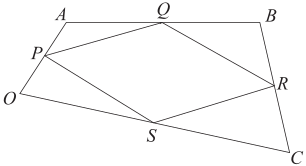
Prove, using vectors, that `PQRS` is a parallelogram. (3 marks)
--- 8 WORK AREA LINES (style=lined) ---
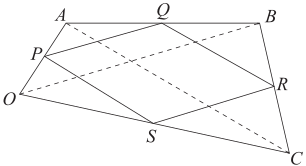
`text(Consider diagonal)\ \ overset(->)(OB):`
`overset(->)(OB) = overset(->)(OA) + overset(->)(AB) = overset(->)(OC)+ overset(->)(CB)`
`overset(->)(PQ) = overset(->)(PA) + overset(->)(AQ) = 1/2(overset(->)(OA) + overset(->)(AB)) = 1/2overset(->)(OB)`
`overset(->)(SR) = overset(->)(SC) + overset(->)(CR) = 1/2(overset(->)(OC) + overset(->)(CB)) = 1/2overset(->)(OB)`
`:.overset(->)(PQ) = overset(->)(SR)`
`text(Consider diagonal)\ \ overset(->)(AC):`
`overset(->)(AC) = overset(->)(AB) + overset(->)(BC) = overset(->)(AO) + overset(->)(OC)`
`overset(->)(QR) = overset(->)(QB) + overset(->)(BR) = 1/2(overset(->)(AB) + overset(->)(BC)) = 1/2overset(->)(AC)`
`overset(->)(PS) = overset(->)(PO) + overset(->)(OS) = 1/2(overset(->)(AO) + overset(->)(OC)) = 1/2overset(->)(AC)`
`:. overset(->)(QR) = overset(->)(PS)`
`text(S)text(ince)\ PQRS\ text(has equal opposite sides,)`
`PQRS\ text(is a parallelogram.)`
`PQRS` is a parallelogram, where `overset(->)(PQ) = underset~a` and `vec(PS) = underset~b`
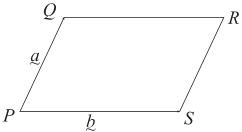
Prove, using vectors, that the sum of the squares of the lengths of the diagonals is equal to the sum of the squares of the lengths of the sides. (3 marks)
--- 8 WORK AREA LINES (style=lined) ---
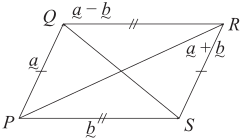
`overset(->)(PR) = underset~a + underset~b,\ \ overset(->)(SQ) = underset~a-underset~b`
`overset(->)(PQ) = overset(->)(SR) = underset~a`
`overset(->)(PS) = overset(->)(QR) = underset~b`
`text(Prove)\ \ |underset~a + underset~b|^2 + |underset~a-underset~b|^2 = 2|underset~a|^2 + 2|underset~b|^2`
| `|underset~a + underset~b|^2 + |underset~a-underset~b|^2` | `= (underset~a + underset~b) · (underset~a + underset~b) + (underset~a-underset~b)(underset~a-underset~b)` |
| `= underset~a · underset~a + underset~b · underset~b + 2underset~a · underset~b + underset~a · underset~a + underset~b · underset~b-2underset~a · underset~b` | |
| `= |underset~a|^2 + |underset~b|^2 + |underset~a|^2 + |underset~b|^2` | |
| `= 2|underset~a|^2 + 2|underset~b|^2\ \ …\ text(as required)` |
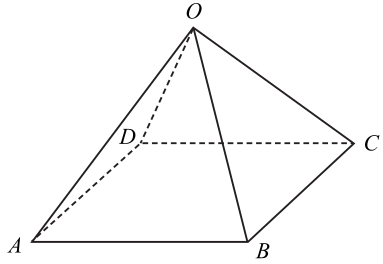
Let `OABCD` be a right square pyramid where `underset ~a = vec(OA),\ underset ~b = vec(OB),\ underset ~c = vec(OC)` and `underset ~d = vec(OD)`.
Show that `underset~a + underset~c = underset~b + underset~d`. (3 marks)
--- 6 WORK AREA LINES (style=lined) ---
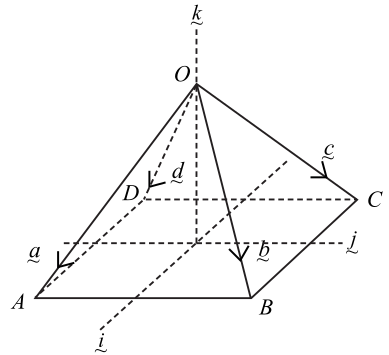
`text(Let)\ \ A=(p,–p,–k),`
| `underset ~a` | `= overset(->)(OA) = punderset~i – punderset~j – qunderset~k` |
| `underset ~b` | `= overset(->)(OB) = punderset~i + punderset~j – qunderset~k` |
| `underset ~c` | `= overset(->)(OC) = −punderset~i + punderset~j – qunderset~k` |
| `underset ~d` | `= overset(->)(OA) = −punderset~i – punderset~j – qunderset~k` |
| `underset~a + underset~c` | `= −2qunderset~k` |
| `underset ~b + underset ~d` | `= −2qunderset~k` |
`:. underset~a + underset~c = underset~b + underset~d`
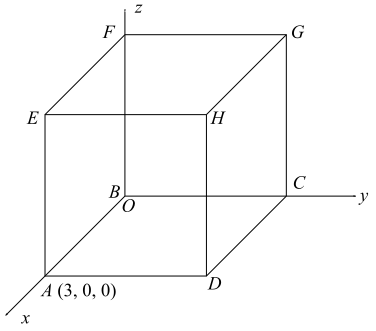
A cube with side length 3 units is pictured below.
--- 3 WORK AREA LINES (style=lined) ---
--- 7 WORK AREA LINES (style=lined) ---
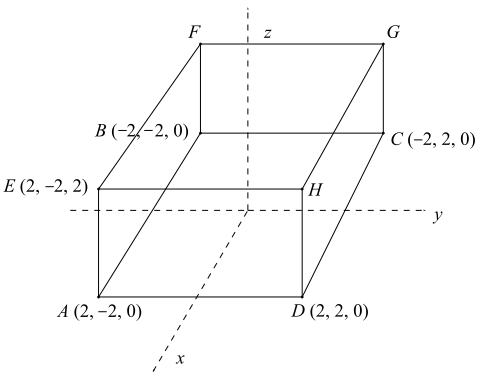
`ABCDEFGH` are the vertices of a rectangular prism.
--- 4 WORK AREA LINES (style=lined) ---
--- 6 WORK AREA LINES (style=lined) ---
Point `B` sits on the arc of a semi-circle with diameter `AC`.
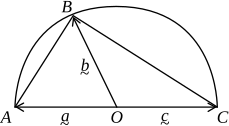
Using vectors, show `angle ABC` is a right angle. (2 marks)
--- 6 WORK AREA LINES (style=lined) ---
`text(Let)\ \ vec (OA) = underset~a, \ text(and)\ \ vec(OC)=underset~c`
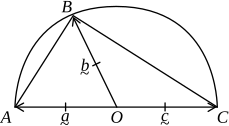
`text(Prove) \ overset(->)(AB) ⊥ overset(->)(BC)`
`|underset~a| = |underset~b| = |underset~c|\ \ \ text{(radii)}`
`underset~c = – underset~a `
| `overset(->)(AB) ⋅ overset(->)(BC)` | `= (underset~b-underset~a) (underset~c-underset~b)` |
| `= underset~b · underset~c-|underset~b|^2-underset~a · underset~c + underset~a · underset~b` | |
| `= underset~b · underset~c-|underset~b|^2 + underset~c · underset~c-underset~c · underset~b` | |
| `= |underset~c|^2-|underset~b|^2` | |
| `= 0` |
`:. \ ∠ABC \ text(is a right angle.)`
`OABD` is a trapezium in which `overset(->)(OA) = underset~a` and `overset(->)(OB) = underset~b`.
`OC` is parallel to `AB` and `DC : CB = 1:2`
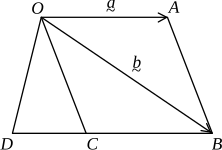
Using vectors, express `overset(->)(DA)` in terms of `underset~a` and `underset~b`. (3 marks)
--- 6 WORK AREA LINES (style=lined) ---
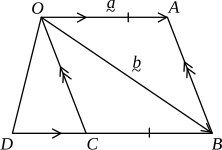
`overset(->)(DA) = overset(->)(DB) + overset(->)(BA)`
`overset(->)(BA) = underset~a – underset~b`
`text(S) text(ince) \ OC || AB \ \ text(and) \ \ OA || CB`
`=> OABC \ text(is a parallelogram)`
| `overset(->)(OA)` | `= overset(->)(CB) = underset~a` |
| `overset(->)(DC)` | `= (1)/(2) \ underset~a ` |
| `overset(->)(DB)` | `= overset(->)(DC) + overset(->)(CB)` |
| `= (3)/(2) \ underset~a` |
| `:. \ overset(->)(DA)` | `= (3)/(2) \ underset~a + (underset~a – underset~b)` |
| `= (5)/(2) \ underset~a – underset~b` |
Consider the two vector line equations
`underset~(v_1) = ((1),(4),(−2)) + lambda_1((3),(0),(−1)), qquad underset~(v_2) = ((3),(2),(2)) + lambda_2((4),(2),(−6))`
--- 6 WORK AREA LINES (style=lined) ---
--- 5 WORK AREA LINES (style=lined) ---
--- 5 WORK AREA LINES (style=lined) ---
--- 4 WORK AREA LINES (style=lined) ---
--- 5 WORK AREA LINES (style=lined) ---
Which pair of line segments intersect at exactly one point
| A. | `{(underset ~u = ((3), (2)) + lambda ((text{−1}),(2)) text{,} quad qquad 0 <= lambda <= 1), (underset ~v = ((2), (1)) + lambda ((2), (text{−4})) text{,} quad qquad 0 <= lambda <= 1):}` |
| B. | `{(underset ~u = ((4), (1)) + lambda ((3), (text{−1})) text{,} quad qquad 0 <= lambda <= 1), (underset ~v = ((3), (2)) + lambda ((2), (2)) text{,} quad qquad 0 <= lambda <= 1):}` |
| C. | `{(underset ~u = ((4), (0)) + lambda ((text{−3}),(6)) text{,} quad qquad 0 <= lambda <= 1), (underset ~v = ((0), (1)) + lambda ((1), (text{−2})) text{,} quad qquad 0 <= lambda <= 1):}` |
| D. | `{(underset ~u = ((0), (2)) + lambda ((3), (text{−2})) text{,} quad qquad 0 <= lambda <= 1), (underset ~v = ((0), (1)) + lambda ((1), (1)) text{,} quad qquad 0 <= lambda <= 1):}` |
`qquad underset ~a = ((3), (5), (1)) + lambda ((1), (3), (text{−2})),` and
`qquad underset ~b = ((text{−2}), (2), (text{−1})) + mu ((1), (text{−1}), (2))` (2 marks)
--- 6 WORK AREA LINES (style=lined) ---
--- 3 WORK AREA LINES (style=lined) ---
Use the vector form of the linear equations
`3x - 2y = 4` and `3y + 2x - 6 = 0`
to show they are perpendicular. (3 marks)
--- 6 WORK AREA LINES (style=lined) ---
Find the value of `x` and `y`, given
`underset ~r = ((5), (-1), (2)) + lambda ((x), (y), (-3))`
and `underset ~r` is perpendicular to both `underset ~v` and `underset ~w`, where
`underset ~v = ((1), (2), (1)) + mu_1 ((3), (-3), (-1))` and `underset ~w = ((-3), (1), (1)) + mu_2 ((-4), (-1), (-2))`. (2 marks)
--- 5 WORK AREA LINES (style=lined) ---
Given `f(x) = 2 sinx` and `g(x) = x`, sketch `y = f(x) + g(x)` for `0 <= x <= 2pi`.
Clearly label endpoints and all local maximum and minimums. (3 marks)
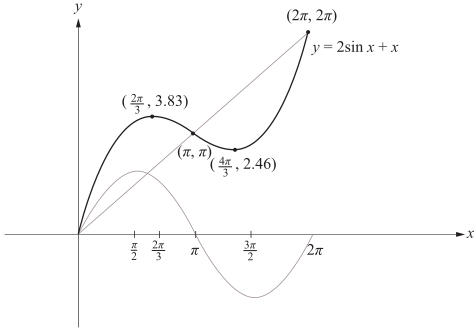
| `y` | `= 2sinx + x` |
| `(dy)/(dx)` | `= 2cosx + 1` |
| `(dy)/(dx)` | `= 0 \ => \ cosx = −1/2 => x = (2pi)/3, (4pi)/3` |
`text(MAX at)\ ((2pi)/3, 3.83)`
`text(MIN at)\ ((4pi)/3, 2.46)`
--- 8 WORK AREA LINES (style=lined) ---
--- 4 WORK AREA LINES (style=lined) ---
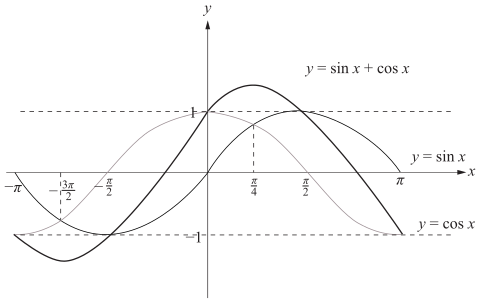
| i. | `y` | `= sinx + cosx` |
| `(dy)/(dx)` | `= cosx – sinx` | |
| `(dy)/(dx)` | `= 0\ \ text(when)\ \ sinx = cosx` |
COMMENT: Question style consistent with NESA exemplar questions in official Topic Guidance.
`:. text(SP’s when)\ \ x = pi/4, −(3pi)/4`
ii. `text(Max/min when)\ \ (dy)/(dx) = 0`
`x = pi/4, −(3pi)/4`
| `y_(text(max))` | `= sin\ pi/4 + cos\ pi/4` |
| `= 2 xx 1/sqrt2` | |
| `= sqrt2` |
`:.\ text(By symmetry, range)\ {−sqrt2 <= y <= sqrt2}`
The following diagram shows the graph of `y = g(x)`.
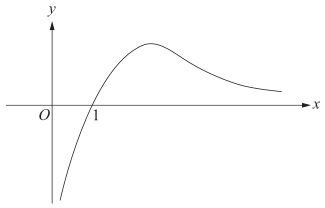
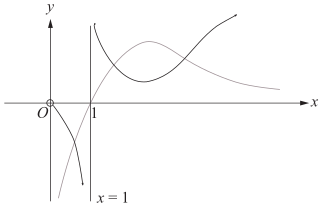
Draw separate one-third page sketches of the graphs of the following:
--- 8 WORK AREA LINES (style=lined) ---
--- 8 WORK AREA LINES (style=lined) ---
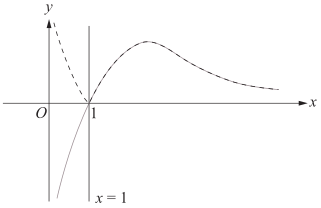
| i. | |
| ii. | |
A high school conducted a survey asking students what their favourite Summer sport was.
The Pareto chart shows the data collected.

--- 2 WORK AREA LINES (style=lined) ---
--- 2 WORK AREA LINES (style=lined) ---
Members of the association will travel to a conference in cars and minibuses:
The constraints above can be represented by the following three inequalities.
`text(Inequality 1) qquad qquad x + y <= 8`
`text(Inequality 2) qquad qquad x >= 3`
`text(Inequality 3) qquad qquad y >= 2`
A maximum of 60 people can attend the conference.
Use this information to write Inequality 4. (1 mark)
The graph below shows the four lines representing Inequalities 1 to 4.
Also shown on this graph are four of the integer points that satisfy Inequalities 1 to 4. Each of these integer points is marked with a cross (✖).
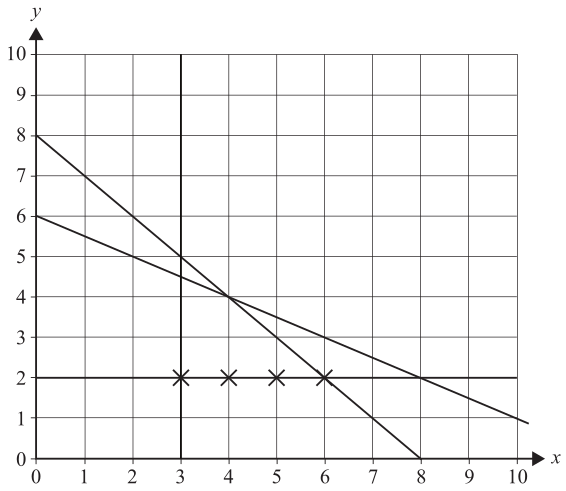
Each car will cost $70 to hire and each minibus will cost $100 to hire.
The cost of hiring each minibus remained $100.
All original constraints apply.
If the increase in the cost of hiring each car is more than `k` dollars, then the maximum cost of transporting members to this conference can only occur when using six cars and two minibuses.
Determine the value of `k`. (1 mark)
a. `5x + 10y <= 60`
| b. | 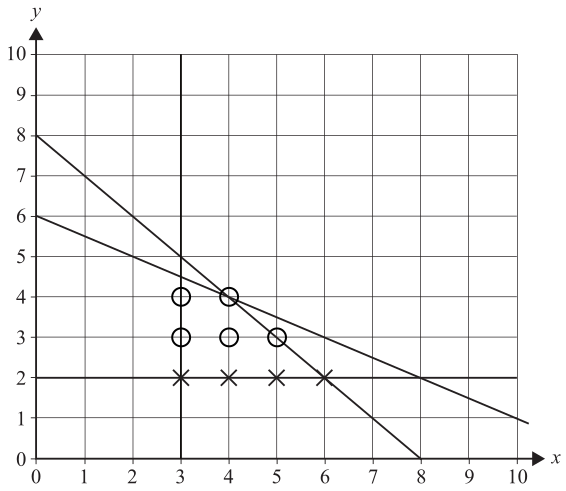 |
c. `text(Consider the line)\ \ 5x + 10y = 60\ \ text(on the graph)`
`text(Touches the feasible region at)\ (4, 4)\ text(only)`
`:.\ text (C) text(ost of 60 members)`
`= 4 xx 70 + 4 xx 100`
`= $680`
d. `text(Coordinates that allow 55 to travel) \ => \ (5, 3) and (3, 4)`
`text(C) text(ost)\ (5, 3) = 5 xx 70 + 3 xx 100 = $650`
`text(C) text(ost)\ (3, 4) = 3 xx 70 + 4 xx 100 = $610`
`:.\ text(Minimum cost is $610)`
e. `text(Objective function): \ C = ax + 100y`
`text(Max cost occurs at)\ \ (6, 2)\ \ text(when)\ \ a > 100`
`text{(i.e. graphically when the slope of}\ \ C = ax + 100y`
`text(is steeper than)\ \ x + y= 8 text{)}`
| `:. k + 70` | `= 100` |
| `k` | `= 30` |
Each branch within the association pays an annual fee based on the number of members it has.
To encourage each branch to find new members, two new annual fee systems have been proposed.
Proposal 1 is shown in the graph below, where the proposed annual fee per member, in dollars, is displayed for branches with up to 25 members.
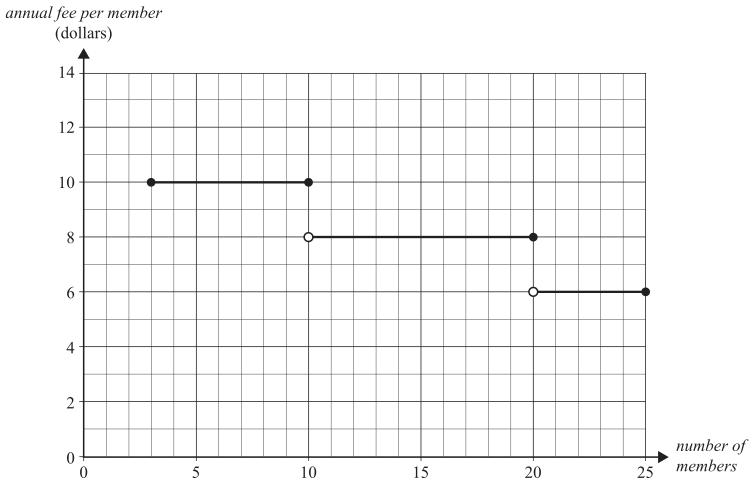
Complete the inequality by writing the appropriate symbol and number in the box provided. (1 mark)
| 3 ≤ number of members |
|
Proposal 2 is modelled by the following equation.
annual fee per member = – 0.25 × number of members + 12.25
Write down all values of the number of members for which this is the case. (1 mark)
a. `3`
b. `3 <= text(number of members) <= 10`
| c. | 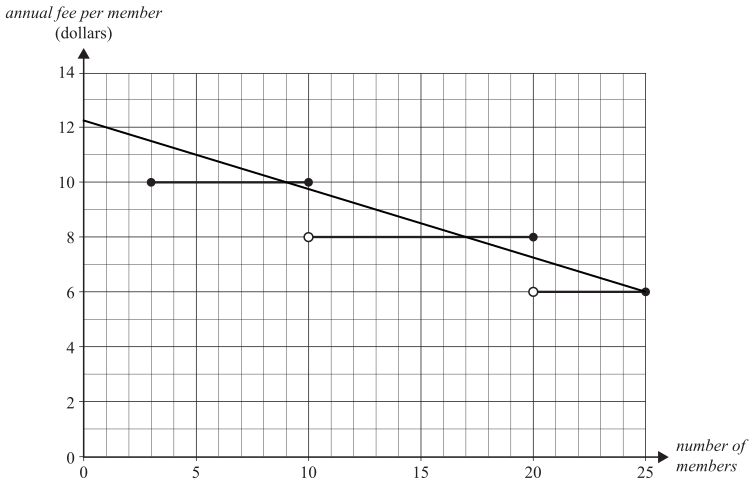 |
d. `text(Same annual fee occurs when graphs intersect.)`
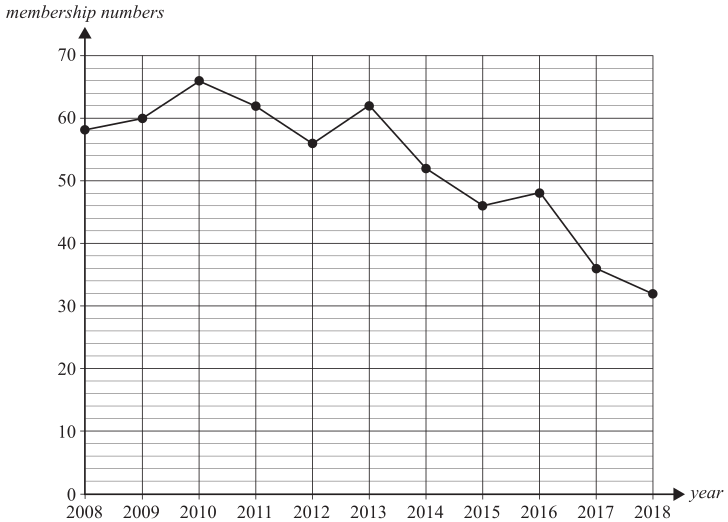
`text(Member numbers): 9, 17, 25`
The graph below shows the membership numbers of the Wombatong Rural Women’s Association each year for the years 2008–2018.
The following diagram shows a crane that is used to transfer shipping containers between the port and the cargo ship.
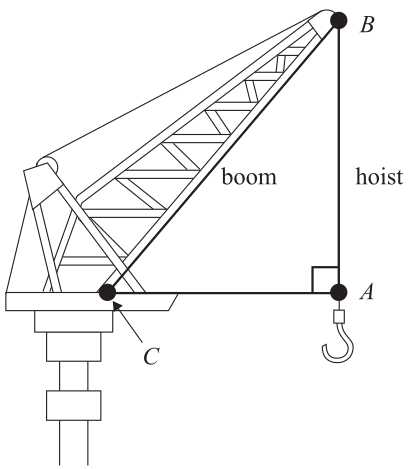
The length of the boom, `BC`, is 25 m. The length of the hoist, `AB`, is 15 m.
Round your answer to the nearest degree. (1 mark)
`qquad` 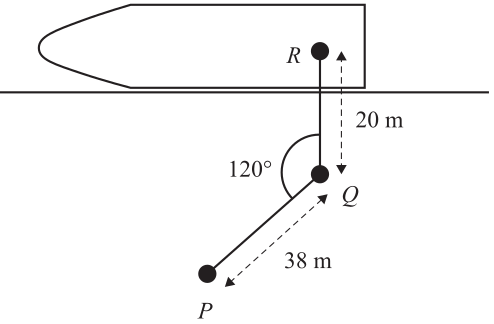
The base of the crane (`Q`) is 20 m from a shipping container at point `R`. The shipping container will be moved to point `P`, 38 m from `Q`. The crane rotates 120° as it moves the shipping container anticlockwise from `R` to `P`.
What is the distance `RP`, in metres?
Round your answer to the nearest metre. (1 mark)
Four chains connect the shipping container to a hoist at point `M`, as shown in the diagram below.
`qquad` 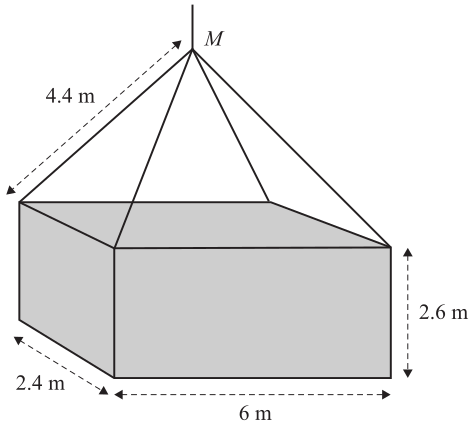
The shipping container has a height of 2.6 m, a width of 2.4 m and a length of 6 m.
Each chain on the hoist is 4.4 m in length.
What is the vertical distance, in metres, between point `M` and the top of the shipping container?
Round your answer to the nearest metre. (2 marks)
| a.i. | `AC` | `= sqrt(BC^2 – AB^2)` |
| `= sqrt(25^2 – 15^2)` | ||
| `= sqrt 400` | ||
| `= 20` |
| a.ii. | `tan\ /_ ACB` | `= 15/20` |
| `/_ ACB` | `= tan^(-1) (3/4)` | |
| `= 36.86…` | ||
| `~~ 37^@` |
b. `text(Using cosine rule:)`
| `RP^2` | `= 20^2 + 38^2 – 2 xx 20 xx 38 xx cos 120^@` |
| `= 2604` | |
| `:. RP` | `= 51.029…` |
| `~~ 51\ text(metres)` |
| c. | 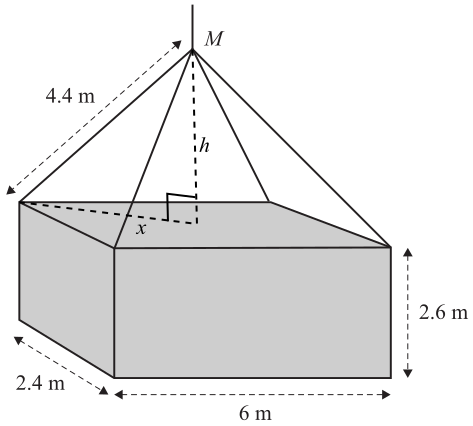 |
`text(Find)\ h => text(need to find)\ x`
`text(Consider the top of the container)`
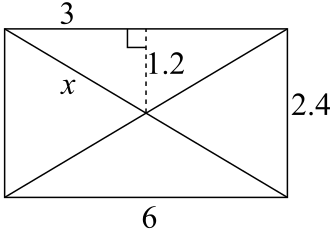
| `x` | `= sqrt(3^2 + 1.2^2)` |
| `~~ 3.2311` |
| `:. h` | `= sqrt(4.4^2 – 3.2311^2)` |
| `= 2.98…` | |
| `~~ 3\ text(metres)` |
A cargo ship travels from Magadan (60° N, 151° E) to Sydney (34° S, 151° E).
Find the shortest great circle distance between Magadan and Sydney.
Round your answer to the nearest kilometre. (1 mark)
There is a two-hour time difference between Sydney and Perth at that time of year.
How many hours did it take the cargo ship to travel from Sydney to Perth? (1 mark)
| a. | 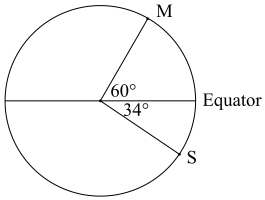 |
`text{Sydney’s angle with the equator (34°S) is smaller than Magadan’s}`
`text{(60°N) resulting in a shorter distance to the equator.)`
| b. | `text(Distance)` | `= (34 + 60)/360 xx 2pi xx 6400` |
| `~~ 10\ 500\ text(km)` |
c. `text(Perth is 2 hours behind Sydney)`
`text(6 am Sydney = 4 am Perth)`
| `:.\ text(Travel time)` | `= 4\ text{am (1 Jun)} – 10\ text{am (11 Jun)}` |
| `= 6\ text(hours) + 10\ text(days)` | |
| `= 6 + 10 xx 24` | |
| `= 246\ text(hours)` |
The following diagram shows a cargo ship viewed from above.
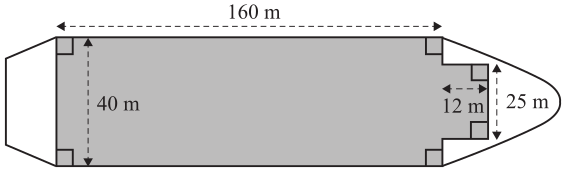
The shaded region illustrates the part of the deck on which shipping containers are stored.
Each shipping container is in the shape of a rectangular prism.
Each shipping container has a height of 2.6 m, a width of 2.4 m and a length of 6 m, as shown in the diagram below.
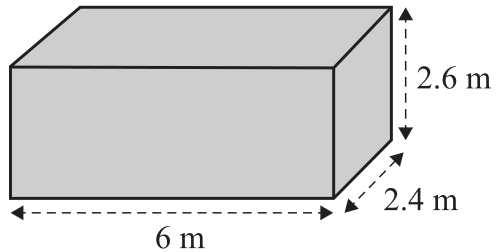
Each barrel is 1.25 m high and has a diameter of 0.73 m, as shown in the diagram below.
Each barrel must remain upright in the shipping container
`qquad qquad` 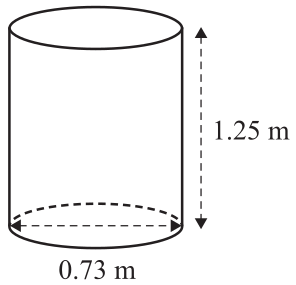
What is the maximum number of barrels that can fit in one shipping container? (1 mark)
Fencedale High School is planning to renovate its gymnasium.
This project involves 12 activities, `A` to `L`.
The directed network below shows these activities and their completion times, in weeks.

The minimum completion time for the project is 35 weeks.
--- 2 WORK AREA LINES (style=lined) ---
--- 1 WORK AREA LINES (style=lined) ---
--- 2 WORK AREA LINES (style=lined) ---
It is possible to reduce the completion time for activities `C, D, G, H` and `K` by employing more workers.
What is the minimum time, in weeks, that the renovation project could take? (1 mark)
--- 2 WORK AREA LINES (style=lined) ---
a. `text(Scanning forwards and backwards:)`
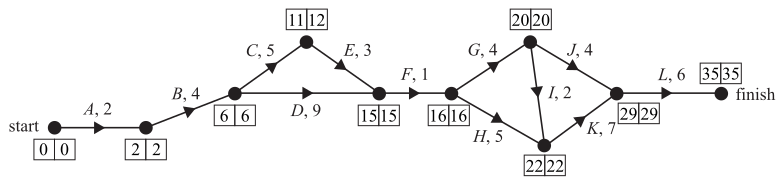 |
`text(Critical path:)\ ABDFGIKL`
`:. 8\ text(activities)`
b. `text(LST for activity)\ E = 12\ text{weeks (i.e. start of 13th week)}`
c. `text(Consider float times of all activities not on critical path.)`
`J-5, H-1, E-1, C-1`
`:.\ text(Activity)\ J\ text(has the largest float time.)`
d. `text(Critical path after reducing)\ CDGHK\ text(by 2 weeks is)`
`ABDFGIKL.`
| `:.\ text(Minimum time)` | `= 2 + 4 + 7 + 1 + 2 + 2 + 5 + 6` |
| `= 29\ text(weeks)` |
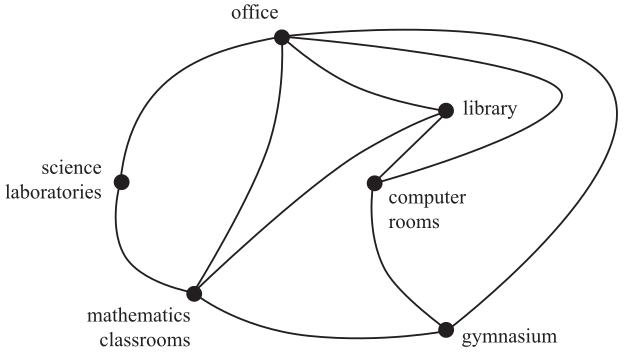
Fencedale High School has six buildings. The network below shows these buildings represented by vertices. The edges of the network represent the paths between the buildings.
--- 1 WORK AREA LINES (style=lined) ---
--- 1 WORK AREA LINES (style=lined) ---
--- 0 WORK AREA LINES (style=lined) ---
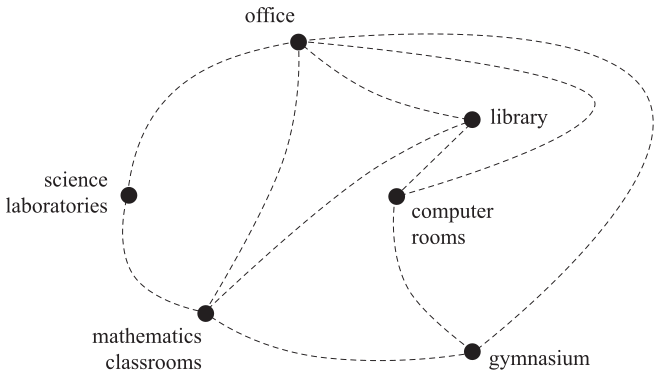
a. `text(Office)`
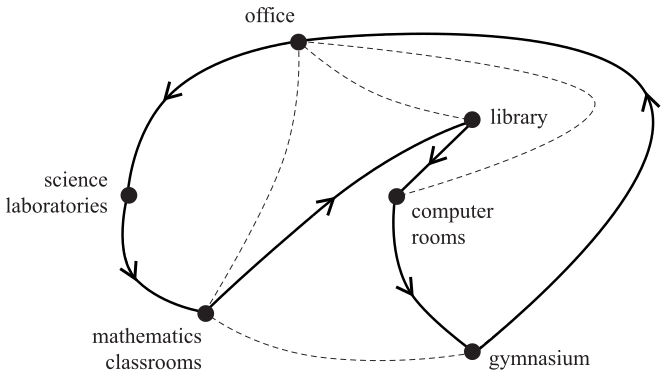
b.i. `text(Hamiltonian cycle)`
`text{(note a Hamiltonian path does not start and finish}`
`text{at the same vertex.)}`
b.ii. `text(One of many solutions:)`
On Sunday, matrix `V` is used when calculating the expected number of visitors at each location every hour after 10 am. It is assumed that the park will be at its capacity of 2000 visitors for all of Sunday.
Let `L_0` be the state matrix that shows the number of visitors at each location at 10 am on Sunday.
The number of visitors expected at each location at 11 am on Sunday can be determined by the matrix product
`{:(qquadqquadqquadqquadqquadqquadqquadqquadqquadqquadqquadqquadqquadqquadqquadqquadqquadqquadqquadqquadqquadqquadqquadqquad text(this hour)),(qquadqquadqquadqquadqquadqquadqquadqquadqquadqquadqquadqquadqquadqquadqquadqquadqquadqquadqquad qquad qquad \ A qquad quad F qquad \ G \ quad quad W),({:V xx L_0 qquad text(where) qquad L_0 = [(500), (600), (500), (400)]{:(A),(F),(G),(W):}, qquad text(and):} qquad V = [(0.3,0.4,0.6,0.3),(0.1,0.2,0.1,0.2),(0.1,0.2,0.2,0.1),(0.5,0.2,0.1,0.4)]{:(A),(F),(G),(W):}\ text(next hour)):}`
--- 3 WORK AREA LINES (style=lined) ---
--- 4 WORK AREA LINES (style=lined) ---
--- 3 WORK AREA LINES (style=lined) ---
The theme park has four locations, Air World `(A)`, Food World `(F)`, Ground World `(G)` and Water World `(W)`.
The number of visitors at each of the four locations is counted every hour.
By 10 am on Saturday the park had reached its capacity of 2000 visitors and could take no more visitors.
The park stayed at capacity until the end of the day
The state matrix, `S_0`, below, shows the number of visitors at each location at 10 am on Saturday.
`S_0 = [(600), (600), (400), (400)] {:(A),(F),(G),(W):}`
--- 2 WORK AREA LINES (style=lined) ---
Let `S_n` be the state matrix that shows the number of visitors expected at each location `n` hours after 10 am on Saturday.
The number of visitors expected at each location `n` hours after 10 am on Saturday can be determined by the matrix recurrence relation below.
`{:(qquad qquadqquadqquadqquadqquadqquadqquadqquadqquadqquadqquadqquadqquadqquadqquadqquadqquadqquadqquadqquadqquadqquad text( this hour)),(qquadqquadqquadqquadqquadqquadqquadqquadqquadqquadqquadqquadqquadqquadqquadqquadqquadqquadqquad qquad qquad quad A qquad quad F qquad \ G \ quad quad W),({:S_0 = [(600), (600), (400), (400)], qquad S_(n+1) = T xx S_n quad quad qquad text(where):}\ T = [(0.1,0.2,0.1,0.2),(0.3,0.4,0.6,0.3),(0.1,0.2,0.2,0.1),(0.5,0.2,0.1,0.4)]{:(A),(F),(G),(W):}\ text(next hour)):}`
--- 0 WORK AREA LINES (style=lined) ---
`S_1 = [(\ text{______}\ ), (\ text{______}\ ), (300),(\ text{______}\ )]{:(A),(F),(G),(W):}`
--- 3 WORK AREA LINES (style=lined) ---
Matrix `V`, below, shows the proportion of visitors moving from one location to another each hour after 10 am on Sunday.
`qquad qquad {:(qquadqquadqquadqquadqquadtext(this hour)),(qquad qquad qquad \ A qquad quad F qquad \ G \ quad quad W),(V = [(0.3,0.4,0.6,0.3),(0.1,0.2,0.1,0.2),(0.1,0.2,0.2,0.1),(0.5,0.2,0.1,0.4)]{:(A),(F),(G),(W):}\ text(next hour)):}`
Matrix `V` is similar to matrix `T` but has the first two rows of matrix `T` interchanged.
--- 4 WORK AREA LINES (style=lined) ---
For `n = 0, 1, 2,`...
let `I_n = int_0 ^{(pi)/(4)} tan^(n) theta d theta`.
--- 5 WORK AREA LINES (style=lined) ---
--- 6 WORK AREA LINES (style=lined) ---
For `n >= 0`, let `I_n = int_0 ^{(pi)/(4)} tan^(2n) theta d theta`.
--- 6 WORK AREA LINES (style=lined) ---
--- 5 WORK AREA LINES (style=lined) ---
Use integration by parts to evaluate `int_1^e x^7 log_e x dx`. (3 marks)
--- 6 WORK AREA LINES (style=lined) ---
If `ab` is divisible by 3, prove by contrapositive that `a` or `b` is divisible by 3. (3 marks)
--- 8 WORK AREA LINES (style=lined) ---
The car park at a theme park has three areas, `A, B` and `C`.
The number of empty `(E)` and full `(F)` parking spaces in each of the three areas at 1 pm on Friday are shown in matrix `Q` below.
`{:(qquad qquad qquad \ E qquad F),(Q = [(70, 50),(30, 20),(40, 40)]{:(A),(B),(C):}quad text(area)):}`
--- 1 WORK AREA LINES (style=lined) ---
--- 2 WORK AREA LINES (style=lined) ---
Drivers must pay a parking fee for each hour of parking.
Matrix `P`, below, shows the hourly fee, in dollars, for a car parked in each of the three areas.
`{:(qquad qquad qquad qquad qquad text{area}), (qquad qquad qquad A qquad quad quad B qquad qquad C), (P = [(1.30, 3.50, 1.80)]):}`
`qquad qquad qquad P xx L = [207.00]`
where matrix `L` is a `3 xx 1` matrix.
Write down matrix `L`. (1 mark)
--- 2 WORK AREA LINES (style=lined) ---
The number of whole hours that each of the 110 cars had been parked was recorded at 1 pm. Matrix `R`, below, shows the number of cars parked for one, two, three or four hours in each of the areas `A, B` and `C`.
`{:(qquadqquadqquadqquadquadtext(area)),(quad qquadqquadquad \ A qquad B qquad C),(R = [(3, 1, 1),(6, 10, 3),(22, 7,10),(19, 2, 26)]{:(1),(2),(3),(4):}\ text(hours)):}`
Complete the matrix `R^T` below. (1 mark)
--- 0 WORK AREA LINES (style=lined) ---
`qquad R^T = [( , , , , , , , , ), ( , , , , , , , , ), ( , , , , , , , , ), ( , , , , , , , , ), ( , , , , , , , , )]`
--- 2 WORK AREA LINES (style=lined) ---
If `a^2-4a + 3` is even, `a ∈ Ζ`,
prove by contrapositive that `a` is odd. (3 marks)
--- 6 WORK AREA LINES (style=lined) ---
If `x, y, z ∈ R` and `x ≠ y ≠ z`, then
--- 5 WORK AREA LINES (style=lined) ---
--- 6 WORK AREA LINES (style=lined) ---
Phil invests $200 000 in an annuity from which he receives a regular monthly payment.
The balance of the annuity, in dollars, after `n` months, `A_n`, can be modelled by the recurrence relation
`A_0 = 200\ 000, qquad A_(n + 1) = 1.0035\ A_n - 3700`
--- 1 WORK AREA LINES (style=lined) ---
--- 2 WORK AREA LINES (style=lined) ---
At some point in the future, the annuity will have a balance that is lower than the monthly payment amount.
Round your answer to the nearest cent. (1 mark)
--- 2 WORK AREA LINES (style=lined) ---
What monthly payment could Phil have received from this perpetuity? (1 mark)
--- 2 WORK AREA LINES (style=lined) ---
Four cards are placed on a table with a letter on one face and a shape on the other.
 |
 |
 |
 |
You are given the rule: "if N is on a card then a circle is on the other side."
Which cards need to be turned over to check if this rule holds?
Phil is a builder who has purchased a large set of tools.
The value of Phil’s tools is depreciated using the reducing balance method.
The value of the tools, in dollars, after `n` years, `V_n` , can be modelled by the recurrence relation shown below.
`V_0 = 60\ 000, qquad qquad V_(n + 1) = 0.9 V_n`
--- 1 WORK AREA LINES (style=lined) ---
After how many years will Phil replace these tools? (1 mark)
--- 1 WORK AREA LINES (style=lined) ---
Let `V_n` be the value of the tools after `n` years, in dollars.
Write down a recurrence relation, in terms of `V_0, V_(n + 1)` and `V_n`, that could be used to model the value of the tools using this flat rate depreciation. (1 mark)
--- 2 WORK AREA LINES (style=lined) ---
Phil is a builder who has purchased a large set of tools.
The value of Phil’s tools is depreciated using the reducing balance method.
The value of the tools, in dollars, after `n` years, `V_n` , can be modelled by the recurrence relation shown below.
`V_0 = 60\ 000, qquad V_(n + 1) = 0.9 V_n`
--- 3 WORK AREA LINES (style=lined) ---
--- 1 WORK AREA LINES (style=lined) ---
After how many years will Phil replace these tools? (1 mark)
--- 4 WORK AREA LINES (style=lined) ---
Let `V_n` be the value of the tools after `n` years, in dollars.
Write down a recurrence relation, in terms of `V_0, V_(n + 1)` and `V_n`, that could be used to model the value of the tools using this flat rate depreciation. (1 mark)
--- 3 WORK AREA LINES (style=lined) ---
The total rainfall, in millimetres, for each of the four seasons in 2015 and 2016 is shown in Table 5 below.
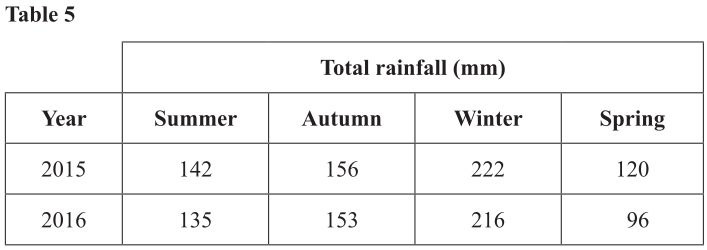
Use the values in Table 5 to find the seasonal indices for summer, autumn and spring.
--- 4 WORK AREA LINES (style=lined) ---
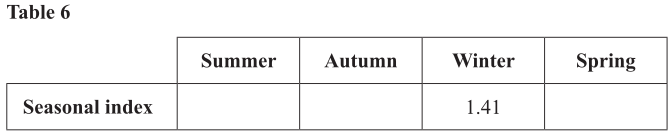

Use the appropriate seasonal index from Table 6 to deseasonalise the total rainfall for winter in 2017.
Round your answer to the nearest whole number. (1 mark)
--- 2 WORK AREA LINES (style=lined) ---
| a. | 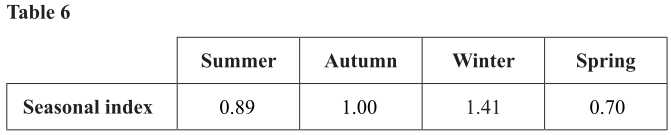 |
`text{Average rainfall (2015)}\ = (142 + 156 + 222 + 120)/4 = 160`
`text{Average rainfall (2016)}\ = (135 + 153 + 216 + 96)/4= 150`
| `text{SI (Summer)}` | `= 1/2 (142/160 + 135/150)=0.89` |
| `text{SI (Autumn)}` | `= 1/2(156/160 + 153/150)=1.00` |
| `text{SI (Spring)}` | `= 1/2 (120/160 + 96/150)=0.70` |
| b. | `text{Winter (deseasonalised)}` | `= 262/1.41` |
| `~~ 186\ text(mm)` |
The scatterplot below shows the atmospheric pressure, in hectopascals (hPa), at 3 pm (pressure 3 pm) plotted against the atmospheric pressure, in hectopascals, at 9 am (pressure 9 am) for 23 days in November 2017 at a particular weather station.
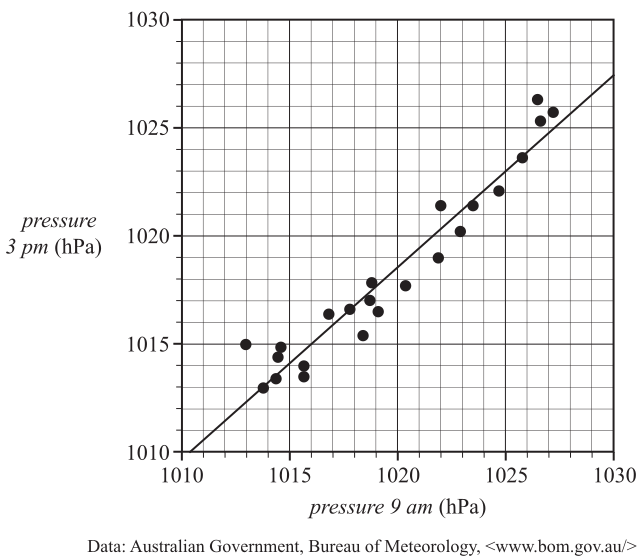
A least squares line has been fitted to the scatterplot as shown.
The equation of this line is
pressure 3 pm = 111.4 + 0.8894 × pressure 9 am
--- 2 WORK AREA LINES (style=lined) ---
--- 2 WORK AREA LINES (style=lined) ---
--- 1 WORK AREA LINES (style=lined) ---
--- 3 WORK AREA LINES (style=lined) ---
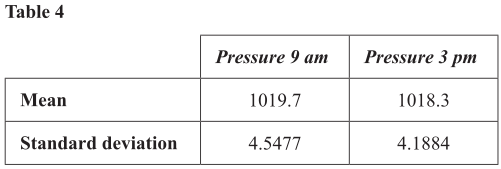
--- 3 WORK AREA LINES (style=lined) ---
--- 2 WORK AREA LINES (style=lined) ---
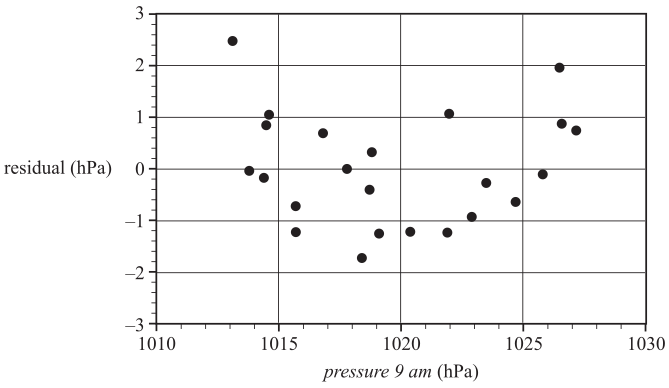
--- 2 WORK AREA LINES (style=lined) ---
--- 2 WORK AREA LINES (style=lined) ---