SmarterEd

Aussie Maths & Science Teachers: Save your time with SmarterEd

  • Login
  • Get Help
  • About

Algebra, MET1 2019 VCAA 8

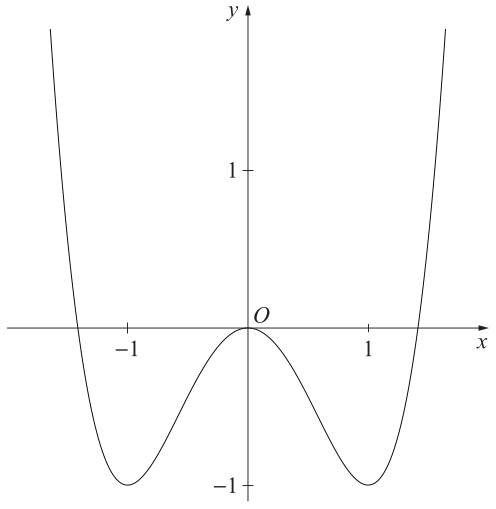
The function  `f: R -> R, \ f(x)`  is a polynomial function of degree 4. Part of the graph of  `f`  is shown below.

The graph of  `f`  touches the `x`-axis at the origin.
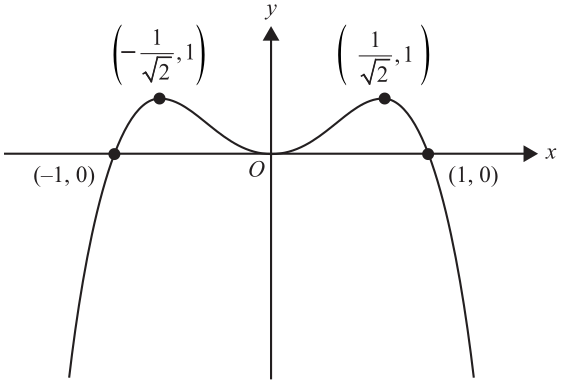


  1. Find the rule of  `f`.   (1 mark) 

    --- 4 WORK AREA LINES (style=lined) ---

Let  `g`  be a function with the same rule as  `f`.

Let  `h: D -> R, \ h(x) = log_e (g(x))-log_e (x^3 + x^2)`, where  `D`  is the maximal domain of  `h`.

  1. State  `D`.   (1 mark)

    --- 3 WORK AREA LINES (style=lined) ---

  2. State the range of  `h`.   (2 marks)

    --- 5 WORK AREA LINES (style=lined) ---
Show Answers Only
  1. `f(x) = -4x^2(x^2-1)`
  2. `x in (-1, 1) text(\{0})`
  3. `h(x) in (-oo, 3 log_e 2) text(\ {)2 log_e 2 text(})`
Show Worked Solution
a.    `y` `= ax^2 (x-1)(x + 1)`
    `= ax^2 (x^2-1)\ …\ (1)`

 
`text(Substitute)\ (1/ sqrt 2, 1)\ text{into  (1):}`

`1 = a ⋅ (1/sqrt 2)^2 ((1/sqrt 2)^2-1)`

`1 = a(1/2)(-1/2)`

`a = -4`

`:. f(x) = -4x^2(x^2-1)`


b.    `g(x) > 0` `=> -4x^2 (x^2-1) > 0`
    `=> x in (-1, 1)\  text(\{0})`

`text(and)`

`x^3 + x^2 > 0 => text(true for)\ \ x in (-1 , 1)\ text(\{0})`

`:. D:\ x in (-1, 1)\ text(\{0})`


c.    `h(x)` `= log_e ((-4x^2(x^2-1))/(x^3 + x^2))`
    `= log_e ((-4x^2(x + 1)(x-1))/(x^2(x + 1)))`
    `= log_e (4(1-x))\ \ text(where)\ \ x in (-1, 1)\ text(\{0})`

  
`text(As)\ \ x -> -1,\ \ h(x) -> log_e 8 = 3 log_e 2`

`text(As)\ \ x -> 1,\ \ h(x) -> -oo`

`text(As)\ \ x -> 0,\ \ h(x) -> log_e 4 = 2 log_e 2`

`text{(}h(x)\ text(undefined when)\ \ x = 0 text{)}`
 

`:.\ text(Range)\ \ h(x) in (-oo, 3 log_e 2)\ text(\{) 2 log_e 2 text(})`

Filed Under: Functional Equations, Log/Index Laws and Equations Tagged With: Band 4, Band 5, Band 6, smc-2745-40-Log graphs, smc-2745-50-Find Domain/Range, smc-642-40-Other functions

Measurement, NAP-L3-CA18

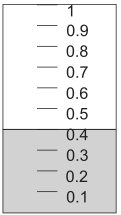
This container can hold 1 litre (L) of water.


There is 0.4 L of water in the container.

What fraction of the container is filled with water?

`1/10` `1/6` `4/6` `4/10`


Show Answers Only

`4/10`

Show Worked Solution

`4/10`

Filed Under: Units of Measurement, Units of Measurement Tagged With: Band 6, smc-3152-10-Scale measure, smc-668-10-Scale measure

Measurement, NAP-L4-CA11

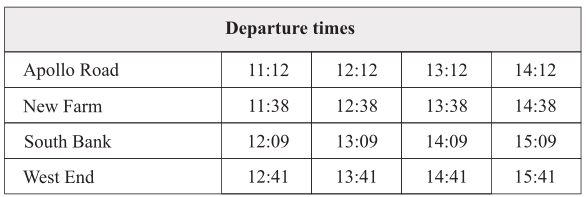
This is part of a timetable for the ferry from Apollo Road to West End.


Skye is catching a ferry from Apollo Road to West End.

She catches the first ferry that leaves Apollo Road after 1 pm.

At what time will Skye arrive at West End?

12:41 pm 1:09 pm 1:12 pm 1:41 pm 2:41 pm


Show Answers Only

`2:41\ text(pm)`

Show Worked Solution

`text(Skye catches the 13:12 ferry.)`

`=>\ text(She arrives at West End at 14:41 = 2:41 pm)`

Filed Under: Time, Time Tagged With: Band 6, smc-3184-20-Timetables, smc-3184-60-Reading 12/24 hr time, smc-895-20-Timetables, smc-895-60-Reading 12/24 hr time

Measurement, NAP-L3-CA17

This is part of a timetable for the ferry from Apollo Road to West End.


Skye is catching a ferry from Apollo Road to West End.

She catches the first ferry that leaves Apollo Road after 1 pm.

At what time will Skye arrive at West End?

12:41 pm 1:09 pm 1:12 pm 1:41 pm 2:41 pm


Show Answers Only

`2:41\ text(pm)`

Show Worked Solution

`text(Skye catches the 13:12 ferry.)`

`=>\ text(She arrives at West End at 14:41 = 2:41 pm)`

Filed Under: Time, Time Tagged With: Band 6, smc-3154-20-Timetables, smc-3154-50-Reading 12/24 hr time, smc-903-20-Timetables, smc-903-50-Reading 12/24 hr time

Statistics, NAP-L3-CA15

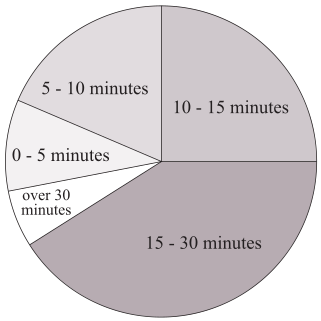
A survey was conducted that asked students how long it took them to travel to school. This graph show the results.


What percentage of students had a commute between 15-30 minutes?

 
less that 25%
 
between 25% and 50%
 
between 50% and 75%
 
more than 75%
Show Answers Only

`text(between 25% and 50%)`

Show Worked Solution

`text(S)text{ection (15-30 minutes) is more than one quarter}`

`text(of the chart and less than half.)`

`:.\ text(between 25% and 50%)`

Filed Under: Data and Interpretation, Data and Statistics (7) Tagged With: Band 6, smc-3166-14-Pie charts, smc-674-14-Pie charts

Measurement, NAP-L3-CA11

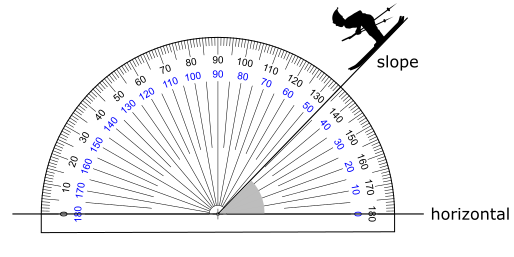
Percy skis down a straight ski slope.

Which of these is closest to the size of the angle shown between the ski slope and the horizontal?

`46°` `54°` `134°` `146°`


Show Answers Only

`46°`

Show Worked Solution

`text(Angle is less than 90°)`

`text(Measuring using the inner scale,)`

`text(Angle = 46°)`

Filed Under: Units of Measurement, Units of Measurement Tagged With: Band 6, smc-3152-60-Protractor, smc-668-60-Protractor

Probability, NAP-L4-CA08

Shirley uses this net to make a dice.

She rolls the dice once.

What is the chance that Shirley will roll a 2?

`1/6` `1/4` `1/3` `1`


Show Answers Only

`1/3`

Show Worked Solution
`P(2)` `= text(Number of 2’s)/text(Total possibilities)`
  `= 2/6`
  `= 1/3`

Filed Under: Probability, Probability Tagged With: Band 6, smc-3191-20-One-step events, smc-682-20-One-step events

Probability, NAP-L3-CA09

Shirley uses this net to make a dice.

She rolls the dice once.

What is the chance that Shirley will roll a 2?

`1/6` `1/4` `1/3` `1`


Show Answers Only

`1/3`

Show Worked Solution
`P(2)` `= text(Number of 2’s)/text(Total possibilities)`
  `= 2/6`
  `= 1/3`

Filed Under: Probability, Probability Tagged With: Band 6, smc-3167-20-One-step events, smc-675-20-One-step events

Number, NAP-L3-CA08

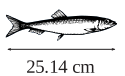
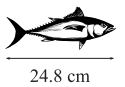
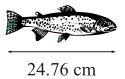
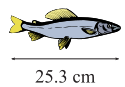
Kelly measures the length of fish she catches for her research.

Which fish has a length closest to 25 cm?


Show Answers Only

`25.14\ text(cm)`

Show Worked Solution

`text(Difference of each option:)`

`25.14 – 25` `= 0.14\ text(cm)`
`25 – 24.8` `= 0.20\ text(cm)`
`25 – 24.76` `= 0.24\ text(cm)`
`25.3 – 25` `= 0.30\ text(cm)`

 
`:. 25.14\ text(cm is closest.)`

Filed Under: Decimals, Decimals Tagged With: Band 6, smc-2136-10-Decimal order, smc-3146-10-Decimal order

Complex Numbers, EXT2 N2 2019 HSC 16b

Let  `P(z) = z^4 - 2kz^3 + 2k^2z^2 + mz + 1`, where  `k`  and  `m`  are real numbers.

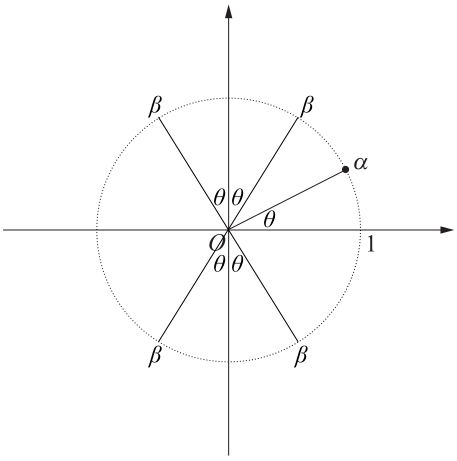
The roots of  `P(z)`  are  `alpha, bar alpha, beta, bar beta`.

It is given that  `|\ alpha\ | = 1`  and  `|\ beta\ | = 1`.

  1. Show that  `(text{Re} (alpha))^2 + (text{Re} (beta))^2 = 1`.  (3 marks)

    --- 8 WORK AREA LINES (style=lined) ---

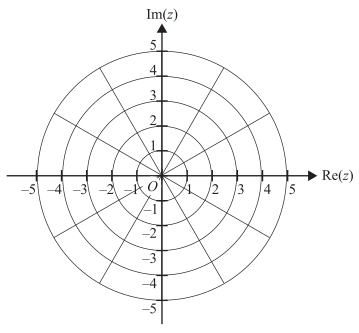
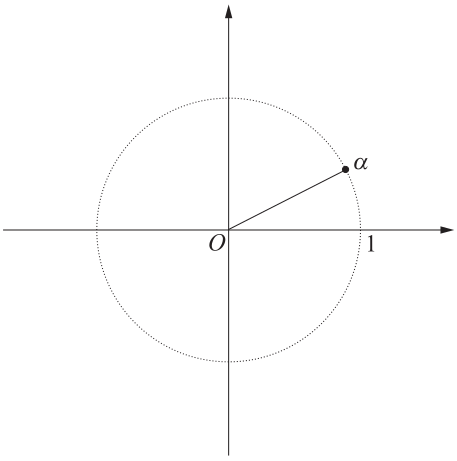
  2. The diagram shows the position of  `alpha`.


On the diagram, accurately show all possible positions of  `beta`.  (2 marks)

--- 0 WORK AREA LINES (style=lined) ---

Show Answers Only
  1. `text(Proof)\ text{(See Worked Solutions)}`
  2. `text(See Worked Solutions)`
Show Worked Solution

i.    `P(z) = z^4 – 2kz^3 + 2k^2z^2 + mz + 1,\ \ k, m in RR`

`text(Roots):\ \ alpha, bar alpha, beta, bar beta and |\ alpha\ | = 1, |\ beta\ | = 1`

`text(Show)\ \ (text{Re} (alpha))^2 + (text{Re} (beta))^2 = 1`

♦♦ Mean mark part (i) 26%.

`alpha + bar alpha + beta + bar beta` `= 2k`
`2 text{Re} (alpha) + 2 text{Re} (beta)` `= 2k`
`text{Re} (alpha) + text{Re} (beta)` `= k`


`alpha bar alpha + alpha beta + alpha bar beta + bar alpha beta + bar alpha bar beta + beta bar beta` `= 2k^2`
`|\ alpha\ |^2 + alpha(beta + bar beta) + bar alpha(beta + bar beta) + |\ beta\ |^2` `= 2k^2`
`1 + (alpha + bar alpha)(beta + bar beta) + 1` `= 2k^2`
`2 + 2 text{Re} (alpha) ⋅ 2 text{Re} (beta)` `= 2 (text{Re} (alpha) + text{Re} (beta))^2`
`2 + 4 text{Re} (alpha) text{Re} (beta)` `= 2 text{Re} (alpha)^2 + 4 text{Re} (alpha) text{Re} (beta) + 2 text{Re} (beta)^2`
`2` `= 2(text{Re} (alpha)^2 + text{Re} (beta)^2)`
`:. 1` `= text{Re} (alpha)^2 + text{Re} (beta)^2`


ii.    `|\ alpha\ | = |\ beta\ |\ \ \ text{(given)}`
  `text{Re}(alpha)^2 + text{Re}(beta)^2 = 1\ \ \ text{(see part (i))}`
  `text{Re}(alpha)^2 + text{Im}(alpha)^2 = 1\ \ \ (|\ alpha\ | = 1)`
  `=> text{Re}(beta)^2 = text{Im} (alpha)^2`
  `\ \ \ \ \ \ text{Re}(beta) = +-text{Im}(alpha)`


♦♦♦ Mean mark part (ii) 10%.

Filed Under: Geometrical Implications of Complex Numbers, Solving Equations with Complex Numbers Tagged With: Band 5, Band 6, smc-1050-35-Conjugate roots, smc-1052-50-Sketch roots

Number, NAP-L4-CA05

At sunrise the temperature is 4°C.

At midday the temperature is 32°C.

Which one of these calculations can be used to work out how many degrees warmer it is at midday than at sunrise? 

`32 - 4` `32 ÷ 4` `4 - 32` `4 + 32`


Show Answers Only

`32 – 4`

Show Worked Solution

`text(Degrees warmer)`

`= 32 – 4`

Filed Under: Basic Concepts and Calculations, Basic Concepts and Calculations Tagged With: Band 6, smc-3173-20-Basic Operators, smc-890-20-Basic Operators

Number, NAP-L4-CA03

Candice buys an apple for 75 cents and a banana for 70 cents.

She pays with a $2 coin.

How much change should Candice get?

`55\ text(cents)` `65\ text(cents)` `$1.45` `$3.45`


Show Answers Only

`55\ text(cents)`

Show Worked Solution
`75 text(c) + 70 text(c)` `= $1.45`
`$2 – $1.45` `= 0.55`
  `= 55\ text(cents)`

Filed Under: Financial Maths, Financial Maths Tagged With: Band 6, smc-3174-10-Coins and change, smc-892-10-Coins and change

Number, NAP-L4-CA04

In 2015, some wilderness parks in Tasmania lost up to `8/10` of their Tasmanian devil populations.

What is `8/10` as percentage?

`0.8%` `8%` `80%` `800%`


Show Answers Only

`80%`

Show Worked Solution

`8/10 = 80/100 = 80%`

Filed Under: Percentages, Percentages Tagged With: Band 6, smc-3176-60-Fraction/Decimal conversion, smc-893-60-Fraction/Decimal conversion

Number, NAP-L4-CA07

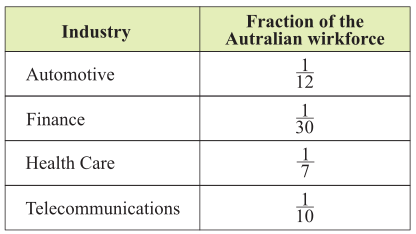
The table shows the fractions of the Australian workforce in some industries.


Which of these industries has the least number of employees in the workforce?

 
Automotive
 
Finance
 
Health Care
 
Telecommunications
Show Answers Only

`text(Finance)`

Show Worked Solution

`text(The smallest fraction is)\ \ 1/30.`

`:.\ text(The finance industry has least number.)`

Filed Under: Fractions and Decimals, Fractions and Decimals Tagged With: Band 6, smc-3175-10-Fraction order, smc-663-10-Fraction order

Number, NAP-L3-CA07

The table shows the fractions of the Australian workforce in some industries.


Which of these industries has the least number of employees in the workforce?

 
Automotive
 
Finance
 
Health Care
 
Telecommunications
Show Answers Only

`text(Finance)`

Show Worked Solution

`text(The smallest fraction is)\ \ 1/30.`

`:.\ text(The finance industry has least number.)`

Filed Under: Fractions, Fractions Tagged With: Band 6, smc-3145-10-Fraction order, smc-3145-30-Word problems, smc-662-10-Fraction order, smc-662-30-Word problems

Geometry, NAP-L3-CA06

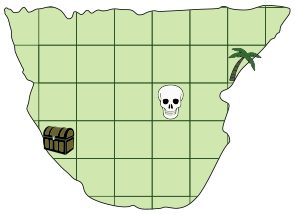
Blackbeard finds part of a treasure map.
 

The palm tree is at I5.

The skull is at G4.

Where is the treasure chest?

E1 F2 D3 H3


Show Answers Only

`text(D3)`

Show Worked Solution

`text(The palm tree and skull are 1 vertical position apart.)`

`=>\ text(numbers must run vertically)`

`=>\ text(letters run horizontally)`

`:.\ text(Treasure is in D3.)`

Filed Under: Maps and Directions, Maps and Directions Tagged With: Band 6, smc-3164-30-Grid locations, smc-667-30-Grid locations

Combinatorics, EXT1′ S1 2019 HSC 10 MC

An access code consists of 4 digits chosen from the digits 0, 1, 2, 3, 4, 5, 6, 7, 8, 9. The code will only work if the digits are entered in the correct order.

Some access codes contain exactly two different digits, for example 3377 or 5155.

How many such access codes can be made using exactly two different digits?

  1. 630
  2. 900
  3. 1080
  4. 2160
Show Answers Only

`A`

Show Worked Solution

`text(Code has 1x first digit, 3x other digit:)`

`text(First digit = 10 choices)`

`text(Position of first digit = 4 choices)`

`text(Other digit = 9 choices)`

`text(Combinations)` `= 10 xx 4 xx 9`
  `= 360`

 
`text{Code has 2 × each digit  (say}\ X and Y\text{):}`

`text(Combinations of 2 digits) = \ ^10 C_2`

`text(If)\ X\ text(in position 1) => 3\ text(combinations of last 3 digits)`

`text(If)\ Y\ text(in position 1) => 3\ text(combinations of last 3 digits)`

`text(Combinations)` `= \ ^10 C_2 xx 6`
  `= 270`

 
`:.\ text(Total access codes) = 360 + 270 = 630`

`=>   A`

Filed Under: Permutations and Combinations (Ext1) Tagged With: Band 6, smc-1082-10-Ordered Combinations

Calculus, EXT1 C2 2019 HSC 14c

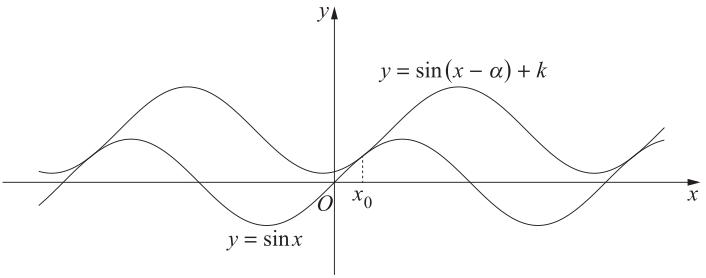
The diagram shows the two curves  `y = sin x`  and  `y = sin(x - alpha) + k`, where  `0 < alpha < pi`  and  `k > 0`. The two curves have a common tangent at `x_0` where  `0 < x_0 < pi/2`.


  1. Explain why   `cos x_0 = cos (x_0 - alpha)`.  (1 mark)

    --- 4 WORK AREA LINES (style=lined) ---

  2. Show that  `sin x_0 = -sin(x_0 - alpha)`.  (2 marks)

    --- 5 WORK AREA LINES (style=lined) ---
  3. Hence, or otherwise, find  `k`  in terms of  `alpha`.  (2 marks)

    --- 8 WORK AREA LINES (style=lined) ---

Show Answers Only
  1. `text(See Worked Solutions)`
  2. `text(Proof)\ text{(See Worked Solutions)}`
  3. `k = 2 sin\ alpha/2`
Show Worked Solution
i.    `y_1` `= sin x`
  `(dy_1)/(dx)` `= cos x`
  `y_2` `= sin(x – alpha) + k`
  `(dy_2)/(dx)` `= cos (x – alpha)`

 
`text(At)\ \ x = x_0,\ \ text(tangent is common)`

♦ Mean mark part (i) 47%.

`:. cos x_0 = cos(x_0 – alpha)`


ii.   `x_0\ \ text{is in 1st quadrant (given)}`

`text{Using part  (i):}`

`cos\ x_0 = cos(x_0 – alpha) >0`

♦♦♦ Mean mark part (ii) 19%.

`=> x_0 – alpha\ \ \ text(is in 4th quadrant)\ \ (0 < alpha < pi)`

`text(S)text(ince sin is positive in 1st quadrant and)`

`text(negative in 4th quadrant)`

`=> sin x_0 = -sin(x_0 – alpha)`


iii.   

`text(When)\ \ x = x_0,`

`y_1` `=sin x_0`  
`y_2` `=sin(x_0 – alpha) + k`  
`sin x_0` `=sin (x_0 – alpha) + k`  
  `= -sin x_0 + k`  
`k` `== 2\ sin x_0`  


♦♦ Mean mark part (iii) 21%.

`text(S)text(ince)\ \ cos x_0` `= cos(x_0 – alpha)`
`x_0` `= -(x_0 – alpha)`
`2x_0` `= alpha`
`x_0` `= alpha/2`

 
 `:. k = 2 sin\ alpha/2`

Filed Under: Harder Trig Calculus (Ext1), T2 Further Trigonometric Identities (Y11) Tagged With: Band 5, Band 6, smc-1025-20-Compound Angles, smc-1038-30-Compound angles

Proof, EXT2 P2 SM-Bank 5

Use mathematical induction to prove that

`n^5 + n^3 + 2n`

is divisible by 4 for integers  `n >= 1.`  (4 marks)

Show Answers Only

`text(See Worked Solutions)`

Show Worked Solution

`text(If)\ n = 1,`

`1 + 1 + 2 xx 1 = 4\ \ text{(divisible by 4)}`

`:. text(True for)\ n = 1`
 

`text(Assume true for)\ n = k`

`text(i.e.)\ \ k^5 + k^3 + 2k = 4P\ \ …\ text{(1)}\ \ (text(where)\ P ∈\ text(integer))`
 

`text(Prove true for)\ n = k + 1`

`text(i.e.)\ \ (k + 1)^5 + (k + 1)^3 + 2(k + 1)\ \ text(is divisible by 4)`

`text(Expanding:)`

`k^5 + 5k^4 + 10k^3 + 10k^2 + 5k + 1 + k^3 + 3k^2 + 3k + 1 + 2k + 2`

`= k^5 + 5k^4 + 11k^3 + 13k^2 + 8k + 4`

`= 4P + 5k^4 + 10k^3 + 13k^2 + 8k + 4\ \ \ \ text{(see (1) above)}`

`= 4P + 4 underbrace{(k^4 + 2k^3 + 3k^2+2k + 1)}_(text(integer)\ Q) + k^4 + 2k^3 + k^2`

`= 4(P + Q) + k^2(k^2 + 2k + 1)`

`= 4(P + Q) + k^2(k + 1)^2`
 

`text(For any integer)\ \ k >= 2, \ k^2(k + 1)^2\ \ text(is  (odd))^2 xx (text(even)^2)`

`text(and  (even))^2 = (2R)^2\ \ text(where)\ \ R ∈\ text(integer)`

`=> k^2(k + 1)^2 = 4R^2 xx (text(odd))^2\ \ \ text{(divisible by 4)}`

`:. text(True for)\ \ n = k + 1`

`:. text(S)text(ince true for)\ \ n = 1,\ text(by PMI, true for integral)\ n >= 1.`

Filed Under: Induction, P2 Induction (Ext2) Tagged With: Band 6, smc-1044-20-Divisibility, smc-5115-20-Divisibility

Algebra, STD1 A2 2019 HSC 33

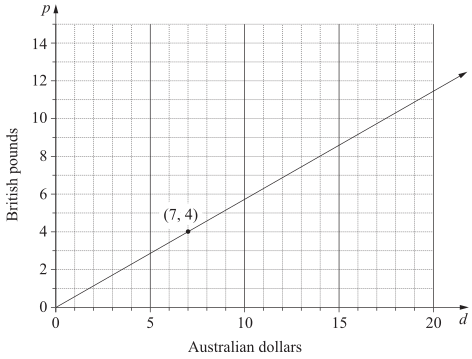
The relationship between British pounds `(p)` and Australian dollars `(d)` on a particular day is shown in the graph.


  1. Write the direct variation equation relating British pounds to Australian dollars in the form  `p = md`. Leave `m` as a fraction.  (1 mark)

    --- 2 WORK AREA LINES (style=lined) ---

  2. The relationship between Japanese yen `(y)` and Australian dollars `(d)` on the same day is given by the equation  `y = 76d`.


    Convert 93 100 Japanese yen to British pounds.  (2 marks)

    --- 4 WORK AREA LINES (style=lined) ---

Show Answers Only
  1. `p = 4/7 d`
  2. `93\ 100\ text(Yen = 700 pounds)`
Show Worked Solution

a.   `m = text(rise)/text(run) = 4/7`

♦♦♦ Mean mark part (a) 8%.

`p = 4/7 d`


b.   `text(Yen to Australian dollars:)`

♦♦ Mean mark part (b) 16%.

`y` `=76d`
`93\ 100` `= 76d`
`d` `= (93\ 100)/76`
  `= 1225`

 
`text(Aust dollars to pounds:)`

`p` `= 4/7 xx 1225`
  `= 700\ text(pounds)`

 
`:. 93\ 100\ text(Yen = 700 pounds)`

Filed Under: Applications: Currency, Fuel and Other Problems (Std 1) Tagged With: Band 5, Band 6, smc-1119-10-Currency Conversion

Financial Maths, STD1 F3 2019 HSC 32

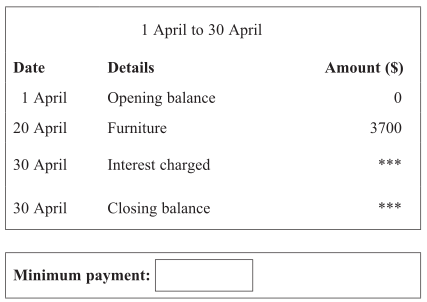
Ashley has a credit card with the following conditions:

  • There is no interest-free period.
  • Interest is charged at the end of each month at 18.25% per annum, compounding daily, from the purchase date (included) to the last day of the month (included).

Ashley's credit card statement for April is shown, with some figures missing.

The minimum payment is calculated as 2% of the closing balance on 30 April.

Calculate the minimum payment.  (3 marks)

--- 6 WORK AREA LINES (style=lined) ---

Show Answers Only

`$74.40`

Show Worked Solution
`text(Daily interest)` `= 18.25/(100 xx 365)`
  `= 0.0005`

♦♦♦ Mean mark 12%.


`text(Closing balance)` `= 3700(1.0005)^11`
  `= 3720.40`


`:.\ text(Minimum payment)` `= 3720.40 xx 0.02`
  `= $74.408…`
  `= $74.41\ \ text{(nearest cent)}`

Filed Under: Credit Cards (Std 1) Tagged With: Band 6

Measurement, STD1 M3 2019 HSC 31

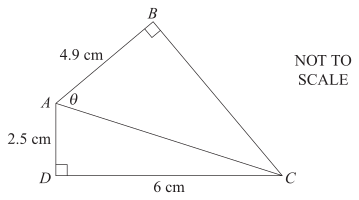
Two right-angled triangles, `ABC` and `ADC`, are shown.


Calculate the size of angle `theta`, correct to the nearest minute.  (3 marks)

--- 6 WORK AREA LINES (style=lined) ---

Show Answers Only

`41°4′\ \ text{(nearest minute)}`

Show Worked Solution

`text(Using Pythagoras in)\ DeltaACD:`

♦♦♦ Mean mark 15%.

`AC^2` `= 2.5^2 + 6^2`
  `= 42.25`
`:.AC` `= 6.5\ text(cm)`

 
`text(In)\ DeltaABC:`

`costheta` `= 4.9/6.5`
`theta` `= cos^(−1)\ 4.9/6.5`
  `= 41.075…`
  `= 41°4′31″`
  `= 41°5′\ \ text{(nearest minute)}`

Filed Under: M3 Right-Angled Triangles (Y12) Tagged With: Band 6, smc-1103-10-Pythagoras, smc-1103-20-Right-angled Trig, smc-1103-50-Rounding to the Minute

Algebra, STD1 A3 2019 HSC 9 MC

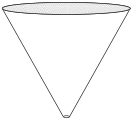
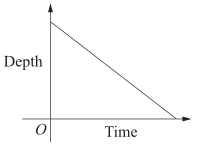
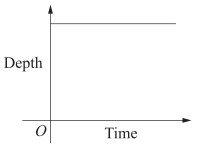
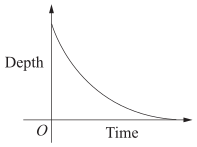
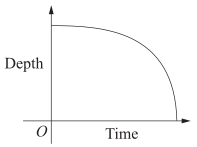
The container shown is initially full of water.
 

Water leaks out of the bottom of the container at a constant rate.

Which graph best shows the depth of water in the container as time varies?
 

A. B.
C. D.
Show Answers Only

`D`

Show Worked Solution

`text(Depth will decrease slowly at first and accelerate.)`

♦♦♦ Mean mark 10%.

`=> D`


Filed Under: A3 Types of Relationships (Y12) Tagged With: Band 6, smc-1099-50-Non-linear graphs

Statistics, STD1 S1 2019 HSC 7 MC

A school collected data related to the reasons given by students for arriving late. The Pareto chart shows the data collected.
 

What percentage of students gave the reason 'Train or bus delay'?

  1.  6%
  2.  15%
  3.  30%
  4.  92%
Show Answers Only

`A`

Show Worked Solution

`text(Train or bus delay (%))`

♦♦♦ Mean mark 4%.

`= 92 – 86`

`= 6text(%)`

`=> A`

Filed Under: Bar Charts, Histograms and Other Graphs (Std 1) Tagged With: Band 6, smc-1128-22-Pareto

Functions, EXT1 F1 2019 HSC 10 MC

The function  `f(x) = -sqrt(1 + sqrt(1 + x))`  has inverse  `f^(-1) (x)`.

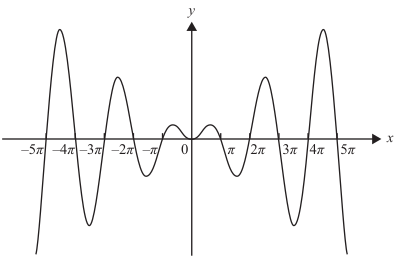
The graph of  `y = f^(-1) (x)`  forms part of the curve  `y = x^4 - 2x^2`.

The diagram shows the curve  `y = x^4 - 2x^2`.


How many points do the graphs of  `y = f(x)`  and  `y = f^(-1) (x)`  have in common?

A.   1

B.   2

C.   3

D.   4

Show Answers Only

`A`

Show Worked Solution

`f(x) = -sqrt(1 + sqrt(1 + x))`

♦♦♦ Mean mark 29%.

`text(Domain)\ \ f(x)\ \ text(is)\ \ x >= -1`

`text(Range)\ \ f(x)\ \ text(is)\ \ y <= -1\ \ text(since)\ \ y\ \ text(decreases)`

`text(as)\ \ x\ \ text(increases.)`

`f(-1) = -sqrt(1 + sqrt 0) = -1`

`:.\ text{One intersection (only) occurs at}\ \ (-1, -1).`

`=>  A`

Filed Under: Inverse Functions (Ext1) Tagged With: Band 6, smc-1034-20-Other Functions

Calculus, 2ADV C4 2019 HSC 16c

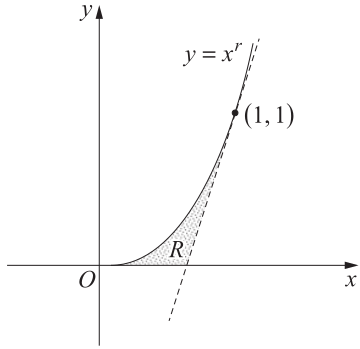
The diagram shows the region  `R`, bounded by the curve  `y = x^r`, where  `r >= 1`, the `x`-axis and the tangent to the curve at the point  `(1, 1)`.
 

  1. Show that the tangent to the curve at  `(1, 1)`  meets the `x`-axis at
     
         `qquad ((r - 1)/r, 0)`.  (2 marks)

    --- 5 WORK AREA LINES (style=lined) ---
  2. Using the result of part (i), or otherwise, show that the area of the region  `R`  is
     
         `qquad (r - 1)/(2r (r + 1))`.  (2 marks)

    --- 6 WORK AREA LINES (style=lined) ---

  3. Find the exact value of  `r`  for which the area of  `R`  is a maximum.  (3 marks)

    --- 6 WORK AREA LINES (style=lined) ---

Show Answers Only
  1. `text(Proof)\ text{(See Worked Solutions)}`
  2. `text(Proof)\ text{(See Worked Solutions)}`
  3. `r = 1 + sqrt 2`
Show Worked Solution
i.    `y` `= x^r`
  `(dy)/(dx)` `= r x^(r – 1)`

 
`text(When)\ \ x = 1, \ (dy)/(dx) = r`

♦♦ Mean mark part (i) 31%.

`text(Equation of tangent:)`

`y – 1` `= r(x – 1)`
`y` `= rx – r + 1`

 
`text(When)\ \ y = 0:`

`rx – r + 1` `= 0`
`rx` `= r – 1`
`x` `= (r – 1)/r`

 
`:.\ text(T)text(angent meets)\ x text(-axis at)\ \ ((r – 1)/r, 0)`


ii.   `text(Area under curve)`

♦♦♦ Mean mark part (ii) 21%.

`= int_0^1 x^r`

`= [1/(r + 1) ⋅ x^(r + 1)]_0^1`

`= 1/(r + 1) xx 1^(r + 1) – 0`

`= 1/(r + 1)`

 
`text(Area under tangent)`

`= 1/2 xx b xx h`

`= 1/2 (1 – (r – 1)/r) xx 1`

`= 1/2 (1 – (r – 1)/r)`
 

`:. R` `= 1/(r + 1) – 1/2(1 – (r – 1)/r)“
  `= 1/(r + 1) – 1/(2r) [r – (r – 1)]`
  `= 1/(r + 1) – 1/(2r)`
  `= (2r – (r + 1))/(2r(r + 1))`
  `= (r – 1)/(2r(r + 1))`


iii.    `R` `= (r – 1)/(2r(r + 1)) = (r – 1)/(2r^2 + 2r)`
  `(dR)/(dr)` `= ((2r^2 + 2r) xx 1 – (r – 1)(4r + 2))/(2r^2 + 2r)^2`
    `= (2r^2 + 2r – 4r^2 – 2r + 4r + 2)/(2r^2 + 2r)^2`
    `= (-2r^2 + 4r + 2)/(2r^2 + 2r)^2`
    `= (-2(r^2 – 2r – 1))/(2r^2 + 2r)^2`


`text(Find)\ \ r\ \ text(when)\ \ (dR)/(dr) = 0:`

♦♦ Mean mark part (iii) 23%.

`r^2 – 2r – 1 = 0`

`r` `= (2 +- sqrt((-2)^2 – 4 xx 1 xx (-1)))/2 `
  `= (2 +- sqrt 8)/2`
  `= 1 + sqrt 2\ \ (r >= 1)`


  `qquadr qquad` `qquad 1 qquad` `\ \ 1 + sqrt 2\ \ ` `qquad 3 qquad`
  `(dR)/(dr)` `1/4` `0` `-1/144`


`:. R_text(max)\ text(occurs when)\ \ r = 1 + sqrt 2`

Filed Under: Areas Under Curves (Y12), Maxima and Minima (Y12) Tagged With: Band 5, Band 6, smc-970-10-Area, smc-975-40-Exponential

Financial Maths, 2ADV M1 2019 HSC 16a

A person wins $1 000 000 in a competition and decides to invest this money in an account that earns interest at 6% per annum compounded quarterly. The person decides to withdraw $80 000 from this account at the end of every fourth quarter. Let  `A_n`  be the amount remaining in the account after the `n`th withdrawal.

  1.  Show that the amount remaining in the account after the withdrawal at the end of the eighth quarter is


    `qquad A_2 = 1\ 000\ 000 xx 1.015^8 - 80\ 000(1 + 1.015^4)`.  (2 marks)

    --- 5 WORK AREA LINES (style=lined) ---
  2.  For how many years can the full amount of $80 000 be withdrawn?  (3 marks)

    --- 6 WORK AREA LINES (style=lined) ---

Show Answers Only
  1. `text(Proof)\ text{(See Worked Solutions)}`
  2. `23\ text(years)`
Show Worked Solution

i.  `6 text(% p.a.)= 1.5 text(%)\ text(per quarter)`

  `A_1` `= 1\ 000\ 000 xx 1.015^4 – 80\ 000`
  `A_2` `= A_1 xx 1.015^4 – 80\ 000`
    `= (1\ 000\ 000 xx 1.015^4 – 80\ 000) xx 1.015^4 – 80\ 000`
    `= 1\ 000\ 000 xx 1.015^8 – 80\ 000 xx 1.015^4 – 80\ 000`
    `= 1\ 000\ 000 xx 1.015^8 – 80\ 000 (1 + 1.015^4)`


ii.    `A_3` `= 1\ 000\ 000 xx 1.015^12 – 80\ 000 (1 + 1.015^4 + 1.015^8)`
  `vdots`  
  `A_n` `= 1\ 000\ 000 xx 1.015^(4n) – 80\ 000\ underbrace{(1 + 1.015^4 + … + 1.015^(4n – 4))}_{text(GP where)\ a = 1,\ r = 1.015^4}`
    `= 1\ 000\ 000 xx 1.015^(4n) – 80\ 000 [(1(1.015^(4n) – 1))/(1.015^4 – 1)]`
    `= 1\ 000\ 000 xx 1.015^(4n) – 1\ 303\ 706 (1.015^(4n) – 1)`

♦♦♦ Mean mark part (ii) 19%.

`text(Find)\ \ n\ \ text(when)\ \ A_n =0:`

`0` `= 1\ 000\ 000 xx 1.015^(4n) – 1\ 303\ 706 xx 1.015^(4n) + 1\ 303\ 706`
`-1\ 303\ 706` `> -303\ 706 xx 1.015^(4n)`
`1.015^(4n)` `> (1\ 303\ 706)/(303\ 706)`
`4n` `> (ln((1\ 303\ 706)/(303\ 706)))/(ln 1.015)`
  `> 97.853…`
`n` `> 24.46…`

 
`:.\ text(Full amount can be drawn for 24 years.)`

Filed Under: Financial Applications of Series (Y12) Tagged With: Band 4, Band 6, smc-1007-30-Annuity/Deposit - Withdrawal Phase

Networks, STD2 N3 2019 HSC 40

A museum is planning an exhibition using five rooms.

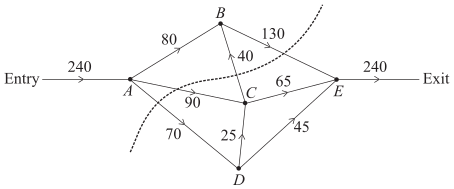
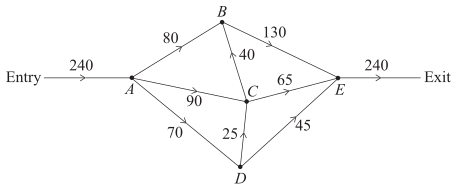
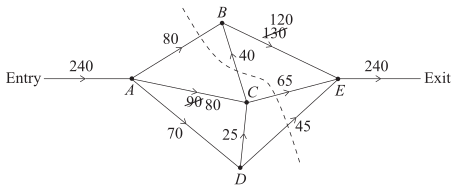
The museum manager draws a network to help plan the exhibition. The vertices `A`, `B`, `C`, `D` and `E` represent the five rooms. The number on the edges represent the maximum number of people per hour who can pass through the security checkpoints between the rooms.


  1. What is the capacity of the cut shown?  (1 mark)

    --- 2 WORK AREA LINES (style=lined) ---

  2. The museum manager is planning for a maximum of 240 visitors to pass through the exhibition each hour. By using the 'minimum cut-maximum flow' theorem, the manager determines that the plan does not provide sufficient flow capacity.


    Draw the minimum cut onto the network below and recommend a change that the manager could make to one or more security checkpoints to increase the flow capacity to 240 visitors per hour.   (2 marks)


    --- 2 WORK AREA LINES (style=lined) ---

Show Answers Only
  1. `290`
  2.   

Show Worked Solution
a.    `text(Capacity)` `= 130 + 90 + 70`
    `= 290`

♦♦ Mean mark 32%.
COMMENT: In part (a), edge BC flows from the exit to the entry and is therefore not counted.

b.   `text(Maximum flow capacity:)`


`text(Minimum cut = 80 + 40 + 65 + 45 = 230)`

♦♦♦ Mean mark 19%.
COMMENT: In part (b), edge BC now flows from entry to exit in the new “minimum” cut and is counted.

`text(If security is improved to increase the flow)`

`text(between Room C and Room B by 10 visitors)`

`text(per hour, the network’s flow capacity increases)`

`text(to 240.)`

Filed Under: Flow Networks and Minimum Cuts Tagged With: Band 5, Band 6, smc-915-10-Min Cut/Max Flow, smc-915-20-Cut Capacity, smc-915-50-Network Adjustments

Statistics, STD2 S5 2019 HSC 15 MC

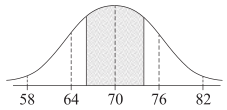
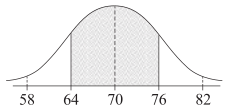
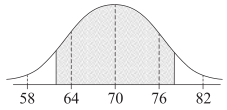
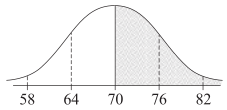
The scores on an examination are normally distributed with a mean of 70 and a standard deviation of 6. Michael received a score on the examination between the lower quartile and the upper quartile of the scores.

Which shaded region most accurately represents where Michael's score lies?
 

A. B.
C. D.
Show Answers Only

`A`

Show Worked Solution

`text{68% of marks lie between 64 and 76 (mean ± 1 σ).}`

♦♦♦ Mean mark 17%.

`text(50% of marks lie between)\ Q_1\ text(and)\ Q_3.`

`=> A`

Filed Under: Normal Distribution (Y12), S5 The Normal Distribution (Y12) Tagged With: Band 6, common-content, smc-819-20-z-score Intervals, smc-819-40-Graphs, smc-995-20-z-score Intervals, smc-995-40-Graphs

Statistics, STD2 S1 2019 HSC 10 MC

A school collected data related to the reasons given by students for arriving late. The Pareto chart shows the data collected.
 

What percentage of students gave the reason 'Train or bus delay'?

  1. `text(6%)`
  2. `text(15%)`
  3. `text(30%)`
  4. `text(92%)`
Show Answers Only

`A`

Show Worked Solution

`text(Train or bus delay (%))`

♦♦♦ Mean mark 18%.

`= 92 – 86`

`= 6text(%)`

`=> A`

Filed Under: Other Chart Types (Y12), Other Charts (Std 2) Tagged With: Band 6, common-content, smc-822-10-Pareto Charts, smc-998-10-Pareto Charts

Financial Maths, STD2 F1 2019 HSC 9 MC

What is the interest earned, in dollars, if $800 is invested for `x` months at a simple interest rate of 3% per annum?

  1. `2x`
  2. `24x`
  3. `200x`
  4. `2400x`
Show Answers Only

`A`

Show Worked Solution

♦♦♦ Mean mark 20%!

`text(Interest)` `= 800 xx x/12 xx 3/100`
  `= 2x`

 
`=> A`

Filed Under: Simple Interest, Simple Interest and S/L Depreciation (Std 2) Tagged With: Band 6, num-title-ct-corea, num-title-qs-hsc, smc-4332-10-Find interest, smc-808-10-Simple Interest

Statistics, EXT1 S1 2012 MET2 3

Steve and Jess are two students who have agreed to take part in a psychology experiment. Each has to answer several sets of multiple-choice questions. Each set has the same number of questions, `n`, where `n` is a number greater than 20. For each question there are four possible options A, B, C or D, of which only one is correct.

  1. Steve decides to guess the answer to every question, so that for each question he chooses A, B, C or D at random.


    Let the random variable `X` be the number of questions that Steve answers correctly in a particular set.

    1. What is the probability that Steve will answer the first three questions of this set correctly?  (1 mark)

      --- 1 WORK AREA LINES (style=lined) ---

    2. Use the fact that the variance of `X` is `75/16` to show that the value of `n` is 25.  (1 mark)

      --- 2 WORK AREA LINES (style=lined) ---

  1. The probability that Jess will answer any question correctly, independently of her answer to any other question, is  `p\ (p > 0)`. Let the random variable `Y` be the number of questions that Jess answers correctly in any set of 25.

    If   `P(Y > 23) = 6 xx P(Y = 25)`, show that the value of  `p=5/6`.  (2 marks)

    --- 5 WORK AREA LINES (style=lined) ---

Show Answers Only

a.i.  `1/64`

a.ii.  `text(See Worked Solutions)`

b.  `text(See Worked Solutions)`

Show Worked Solution
a.i.    `Ptext{(3 correct in a row)}` `= (1/4)^3`
    `= 1/64`


a.ii.    `text(Var)(X)` `= np(1 – p)`
  `75/16` `= n(1/4)(3/4)`
  `75` `= 3n`
  `:. n` `= 25`


b.   `Y ∼\ text(Bin)(25,p)`

♦♦♦ Mean mark part (c) 19%.
`P(Y > 23)` `= 6xx P(Y = 25)`
`P(Y = 24) + P(Y = 25)` `= 6xx P(Y = 25)`
`P(Y = 24)` `= 5xx P(Y = 25)`
`((25),(24))p^24(1 – p)^1` `= 5p^25`
`25p^24(1 – p)` `= 5p^25`
`25p^24-25p^25-5p^25` `=0`
`25p^24-30p^25` `=0`
`5p^24(5 – 6p)` `= 0`

 
`:. p = 5/6,\ \ (p>0)\ \ text(… as required)`

Filed Under: Statistics and Binomial Distributions (Ext1) Tagged With: Band 3, Band 4, Band 6, smc-1199-30-Find n/p given E(X)/Var(X)

Vectors, EXT1 V1 2018 SPEC2 12 MC

If  `|underset ~a + underset ~b| = |underset ~a| + |underset ~b|`  and  `underset ~a, underset ~b != underset ~0`, which one of the following is necessarily true?

A.   `underset ~a\ text(is parallel to)\ underset ~b`

B.   `|underset ~a| = |underset ~b|`

C.   `underset ~a = underset ~b`

D.   `underset ~a\ text(is perpendicular to)\ underset ~b` 

Show Answers Only

`A`

Show Worked Solution
`|underset ~a + underset ~b|^2` `= (|underset ~a| + |underset ~b|)^2\ \ \ text{(given)}`
  `= |underset ~a|^2 + 2|underset ~a||underset ~b|+|underset ~b|^2`
`underset ~a ⋅ underset ~b` `= |underset ~a||underset ~b| cos theta`

 
`=> 2|underset ~a||underset ~b| = (2 underset ~a ⋅ underset ~b)/(cos theta)`

♦♦♦ Mean mark 36%.

`=>|underset ~a + underset ~b|^2 = |underset ~a|^2 + (2 underset ~a ⋅ underset ~b)/(cos theta) + |b|^2`

`(underset ~a + underset ~b) * (underset ~a + underset ~b) = underset ~a ⋅ underset ~a + (2 underset ~a ⋅ underset ~b)/(cos theta) + underset ~b ⋅ underset ~b`

`underset ~a ⋅ underset ~a + 2underset ~a ⋅ underset ~b + underset ~b ⋅ underset ~b = underset ~a ⋅ underset ~a + (2 underset ~a ⋅ underset ~b)/(cos theta) + underset ~b ⋅ underset ~b`

`2 underset ~a ⋅ underset ~b = (2 underset ~a ⋅ underset ~b)/(cos theta)`

`:. cos theta = 1\ \ =>\ \  theta = 0`

`=>  A`

Filed Under: Operations With Vectors (Ext1) Tagged With: Band 6, smc-1086-20-Angles Between Vectors, smc-1086-25-Perpendicular Vectors

Calculus, MET1 2018 VCAA 9

Consider a part of the graph of  `y = xsin(x)`, as shown below.

  1.  i. Given that  `int(xsin(x))\ dx = sin(x)-xcos(x) + c`, evaluate  `int_(npi)^((n + 1)pi)(xsin(x))\ dx`  when `n` is a positive even integer or 0.
      
    Give your answer in simplest form.   (2 marks)

    --- 5 WORK AREA LINES (style=lined) ---
    ii. Given that  `int(xsin(x))\ dx = sin(x)-xcos(x) + c`, evaluate  `int_(npi)^((n + 1)pi)(xsin(x))\ dx`  when `n` is a positive odd integer.
    Give your answer in simplest form.   (1 mark)

    --- 4 WORK AREA LINES (style=lined) ---
  2.  
  3. Find the equation of the tangent to  `y = xsin(x)`  at the point  `(−(5pi)/2,(5pi)/2)`.   (2 marks)

    --- 5 WORK AREA LINES (style=lined) ---
  4. The translation `T` maps the graph of  `y = xsin(x)`  onto the graph of  `y = (3pi-x)sin(x)`, where
  5. `qquad T: R^2 -> R^2, T([(x),(y)]) = [(x),(y)] + [(a),(0)]`
  6. and `a` is a real constant.
  7. State the value of `a`.   (1 mark)

    --- 2 WORK AREA LINES (style=lined) ---
  8. Let  `f:[0,3pi] -> R, f(x) = (3pi-x)sin(x)`  and  `g:[0,3pi] -> R, g(x) = (x-3pi)sin(x)`.
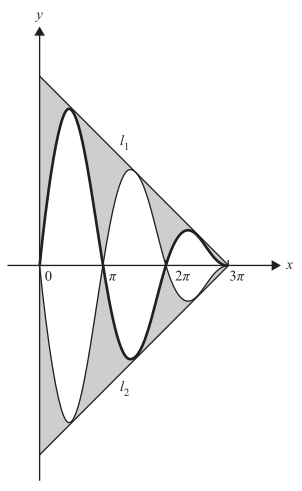
    The line `l_1` is the tangent to the graph of `f` at the point `(pi/2,(5pi)/2)` and the line `l_2` is the tangent to the graph of `g` at `(pi/2,-(5pi)/2)`, as shown in the diagram below.


    Find the total area of the shaded regions shown in the diagram above.   (2 marks)

    --- 8 WORK AREA LINES (style=lined) ---
Show Answers Only
  1.  i. `(2n + 1)pi`
    ii. `-(2n + 1)pi`
  2. `:. y =-x`
  3. `-3pi`
  4. `9pi(pi-2)`
Show Worked Solution

a.i.  `text(Given)\ \ n\ \ text(is a positive even integer:)`

♦♦ Mean mark 31%.

`int_(npi)^((n + 1)pi)(xsin(x))dx`

`= [sin(x)-xcos(x)]_(npi)^((n + 1)pi)`

`= [sin((n + 1)pi)-(n + 1)pi · cos((n + 1)pi)]-[sin(npi)-npi · cos(npi)]`

`= [0-(n + 1)pi (−1)]-[0-npi]`

`= (n + 1)pi + npi`

`= (2n + 1)pi`


a.ii. `text(Given)\ \ n\ \ text(is a positive odd integer:)`

♦♦♦ Mean mark 19%.

`int_(npi)^((n + 1)pi)(xsin(x))dx`

`= [sin((n + 1)pi)-(n + 1)pi · cos((n + 1)pi)]-[sin(npi)-npi · cos(npi)]`

`= [0-(n + 1)pi(1)]-[0-npi(−1)]`

`= -(n + 1)pi-npi`

`= -(2n + 1)pi`


b.    `y` `= xsin(x)`
  `(dy)/(dx)` `= x · cos(x) + sin(x)`


♦ Mean mark part (b) 49%.

`(dy)/(dx)` `= -(5pi)/2 · cos(-(5pi)/2) + sin(-(5pi)/2)`
  `= -(5pi)/2 · (0) + (-1)`
  `= -1`

 
`text(T)text(angent has equation)\ \ y =-x + c\ \ text(and passes through)\ \ (-(5pi)/2, (5pi)/2):`

`(5pi)/2` `= +(5pi)/2 + c`
`c` `= 0`

 
`:. y = -x`


♦♦ Mean mark part (c) 34%.

c.    `y` `= (3pi-x)sin(x)`
    `=-(x-3pi)sin(x)`

 
`:. a = 3pi`
 

d.   `f(x) = (3pi-x)sin(x)`

♦♦♦ Mean mark 7%.

  `-> l_1\ text(is the tangent)\ \ y =-x\ \ (text{using part (b)})`

`-> g(x)\ text(is)\ \ y=xsin(x)\ \ text(translated 3π to the right.)`

`-> f(x)\ text(is)\ \ g(x)\ \ text(reflected in the)\ \ x text(-axis.)`

 
`text(Area between)\ f(x)\ text(and)\ xtext(-axis)`

`= int_0^pi xsin(x)\ dx + | int_pi^(2pi) xsin(x)\ dx | + int_(2pi)^(3pi) xsin(x)\ dx`

`= (2 xx 0 + 1)pi + |-1(2 xx 1 + 1)pi | + (2 xx 2 + 1)pi\ \ (text{using part (a)})`

`= pi + 3pi + 5pi`

`= 9pi`
 

`:.\ text(Shaded Area)`

`= 2 xx (1/2 xx 3pi xx 3pi)-2 xx 9pi`

`= 9pi^2-18pi`

`= 9pi(pi-2)`

Filed Under: Area Under Curves, Tangents and Normals Tagged With: Band 5, Band 6, smc-634-30-Trig Function, smc-634-50-Find tangent given curve, smc-723-60-Trig, smc-723-80-Area between graphs

Statistics, 2ADV S3 SM-Bank 4

The continuous random variable \(X\) has a probability density function given  by
 

\(f(x)= \begin{cases}
\cos(2x)& \text {if}\quad \dfrac{3 \pi}{4}<x<\dfrac{5 \pi}{4} \\
\ \\
0 & \text{elsewhere}
\end{cases}\)
 

Find the value of  \(a\) such that  \(P(X < a) = 0.25\). Give your answer correct to 2 decimal places.   (3 marks)

--- 6 WORK AREA LINES (style=lined) ---
Show Answers Only

\(2.8\)

Show Worked Solution

\(\displaystyle \int_{\frac{3 x}{4}}^a \cos (2 x) d x=0.25\)

\begin{aligned}
\frac{1}{2}[\sin (2 x)]_{\frac{3 \pi}{4}}^a & =0.25 \\
{\left[\sin (2 a)-\sin \left(\frac{3 \pi}{2}\right)\right] } & =0.5 \\
\sin (2 a)+1 & =0.5 \\
2 a & =\sin ^{-1}(-0.5) \\
& =-0.5235
\end{aligned}

\(\text {Since sin is negative in 3rd/4th quadrants: }\)

\begin{aligned}
2 a & =\pi+0.5234 \\
a &=1.832 \ldots \quad \text { (not in range) } \\
&\text { or } \\
2a & =2 \pi-0.5234 \\
 a &=2.87989 \ldots \\
&=2.88 \quad\left(\text{in range: } \frac{3 \pi}{4}<x<\frac{5 \pi}{4}\right)
\end{aligned}

Filed Under: Probability Density Functions (Y12) Tagged With: Band 6, smc-994-30-Other Probability, smc-994-80-Trig PDF

Calculus, SPEC2 2011 VCAA 16 MC

The gradient of the the perpendicular line to a curve at any point  `P(x,y)`  is twice the gradient of the line joining `P` and the point  `Q(1,1)`.

The coordinate of points on the curve satisfy the differential equation

  1. `(dy)/(dx) + (x - 1)/(2(y - 1)) = 0`
  2. `(dy)/(dx) - (x - 1)/(2(y - 1)) = 0`
  3. `(dy)/(dx) + (2(y - 1))/(x - 1) = 0`
  4. `(dy)/(dx) + (2(x - 1))/(y - 1) = 0`
  5. `(dy)/(dx) - (2(y - 1))/(x - 1) = 0`
Show Answers Only

`A`

Show Worked Solution

`m_T = dy/dx`

♦♦♦ Mean mark 25%.
COMMENT: Easily the lowest mean mark in the 2011 MC section.

`m_⊥ = −1/(m_T) = – (dx)/(dy)`

`m_(PQ) = (y-1)/(x-1)`

`- (dx)/(dy)` `= 2m_(PQ)`
`-(dx)/(dy)` `= (2(y-1))/(x-1)`
`- (dy)/(dx)` `= (x – 1)/(2(y-1))`
`0` `=dy/dx + (x – 1)/(2(y-1))`

 
`=> A`

Filed Under: Tangents and Curve Sketching Tagged With: Band 6, smc-1182-30-Normal

Graphs, SPEC1 2012 VCAA 10

Consider the functions with rules  `f(x) = arcsin (x/2) + 3/sqrt (25 x^2-1)`  and  `g(x) = arcsin (3x)-3/sqrt (25x^2-1).`

    1. Find the maximal domain of  `f_1(x) = arcsin (x/2).`   (1 mark)

      --- 2 WORK AREA LINES (style=lined) ---
    2. Find the maximal domain of  `f_2(x) = 3/sqrt (25x^2-1).`   (1 mark)

      --- 3 WORK AREA LINES (style=lined) ---
    3. Find the largest set of values of  `x in R`  for which  `f(x)`  is defined.   (1 mark)

      --- 3 WORK AREA LINES (style=lined) ---
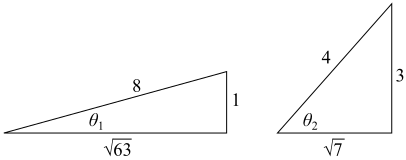
  1. Given that  `h(x) = f(x) + g(x)`  and that  `theta = h(1/4)`, evaluate  `sin (theta).`


    Give your answer in the form  `(a sqrt b)/c, \ a, b, c in Z.`   (3 marks)

    --- 7 WORK AREA LINES (style=lined) ---

Show Answers Only
    1. `-2 <= x <= 2`
    2. `x < -1/5 uu x > 1/5`
    3. `-2 <= x < -1/5 uu 1/5 < x <= 2`
  1. `(5 sqrt 7)/16`
Show Worked Solution

a.i.   `text(Maximal Domain occurs when:)`

  `-1 <= x/2 <= 1`
  `{x: -2 <= x <= 2}`

 
a.ii.
   `text(Maximal Domain occurs when:)`

♦♦ Mean mark part (a)(ii) 33%.

  `25x^2-1 > 0`
  `x^2 > 1/25`
  `{x: x < -1/5 uu x > 1/5}`


a.iii.  `text(Max domain for which)\ \ f(x)\ \ text(is defined:)`

♦♦ Mean mark part (a)(iii) 26%.

  `(-2 <= x <= 2) nn (x < -1/5 uu x > 1/5)`
  `{x: -2 <= x < -1/5 \ uu \ 1/5 < x <= 2}`


b.    `h(x)` `= sin^(-1) (x/2) + 3/sqrt(25x^2-1) + sin^(-1)(3x)-3/sqrt(25x^2-1)`
    `= sin^(-1)(x/2) + sin^(-1)(3x)`

 
`text(When)\ \ x=1/4,\ \ h(x)=theta`

♦♦♦ Mean mark part (b) 20%.

`theta=sin^(-1) (1/8) + sin^(-1) (3/4)`

`text(Let)\ \ theta_1 = sin^(-1) (1/8),\ \ theta_2 = sin^(-1) (3/4)`

`text(Using)\ \ sin(theta_1 + theta_2)=sin theta_1 cos theta_2 + cos theta_1 sin theta_2:`

`sin(theta)` `= 1/8 * sqrt7/4 + sqrt63/8 * 3/4`
  `=sqrt7/32 + (9sqrt7)/32`
  `=(5 sqrt7)/16`

Filed Under: Inverse Trig Functions (SM) Tagged With: Band 4, Band 5, Band 6, smc-1153-10-arcsin

Mechanics, SPEC2 2015 VCAA 16 MC

SPEC2 2015 VCAA 16 MC

The diagram above shows a mass suspended in equilibrium by two light strings that make angles of `60^@` and `30^@` with a ceiling. The tensions in the strings are `T_1` and `T_2`, and the weight force acting on the mass is `underset~W`. The correct statement relating the given forces is

A.   `underset~T_1 + underset~T_2 + underset~W = underset~0`

B.   `underset~T_1 + underset~T_2 - underset~W = underset~0`

C.   `underset~T_1 xx 1/2 + underset~T_2 xx sqrt3/2 = underset~0`

D.   `underset~T_1 xx sqrt3/2 + underset~T_2 xx 1/2 = underset~W`

E.   `underset~T_1 xx 1/2 + underset~T_2 xx sqrt3/2 = underset~W`

Show Answers Only

`A`

Show Worked Solution

`text(S)text(ince equilibrium exists:)`

♦♦♦ Mean mark 26%.

`sumunderset~F = underset~(T_1) + underset~(T_2) + underset~W = underset~0`

 
`=> A`

Filed Under: Pulleys, Planes and Equilibrium (SM) Tagged With: Band 6, smc-1175-40-Equilibrium

Vectors, SPEC2 2017 VCAA 5

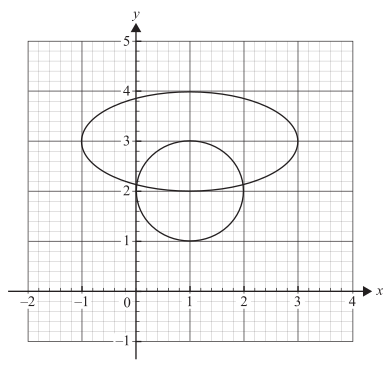
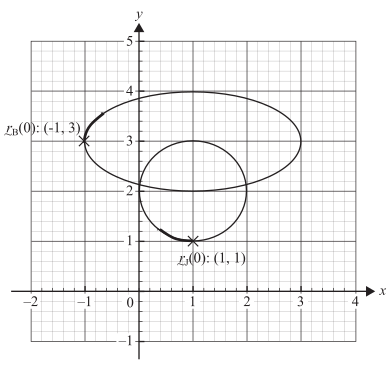
On a particular morning, the position vectors of a boat and a jet ski on a lake  `t`  minutes after they have started moving are given by  `underset~r_B(t) = (1-2cos(t)) underset~i + (3 + sin(t))underset~j`  and  `underset~r_J(t) = (1-sin(t)) underset~i + (2-cos(t))underset~j`  respectively for  `t >= 0`, where distances are measured in kilometres. The boat and the jet ski start moving at the same time. The graphs of their paths are shown below.

  1. On the diagram above, mark the initial positions of the boat and the jet ski, clearly identifying each of them. Use arrows to show the directions in which they move.   (2 marks)

    --- 4 WORK AREA LINES (style=lined) ---
    1. Find the first time for  `t > 0`  when the speeds of the boat and the jet ski are the same.   (2 marks)

      --- 4 WORK AREA LINES (style=lined) ---
    2. State the coordinates of the boat at this time.   (1 mark)

      --- 3 WORK AREA LINES (style=lined) ---
    1. Write down an expression for the distance between the jet ski and the boat at any time `t`.   (1 mark)

      --- 2 WORK AREA LINES (style=lined) ---
    2. Find the minimum distance separating the boat and the jet ski. Give your answer in kilometres, correct to two decimal places.   (1 mark)

      --- 2 WORK AREA LINES (style=lined) ---
  2. On another morning, the boat’s position vector remained the same but the jet skier considered starting from a different location with a new position vector given by  `underset~r(t) = (1-2sin(t)) underset~i + (a-cos(t))underset~j, \ t >= 0`, where `a` is a real constant. Both vessels are to start at the same time.
    Assuming the vessels would collide shortly after starting, find the time of the collision and the value of `a`.   (3 marks)

    --- 7 WORK AREA LINES (style=lined) ---
Show Answers Only
  1.  
  2.   
    1. `t = 0, t_2 = pi`
    2. `(3,3)`
  3.   
    1. `sqrt((sin(t)-2cos(t))^2 + (1 + sin(t) + cos (t))^2)`
    2. `d_text(min) ~~ 0.33`
  4. `a = 3 + 3/sqrt5, t = tan^(−1)(2)`
Show Worked Solution
a.   

`text(Initial positions occur at)\ \ t=0.`

`text(Consider the graph)\ \ underset~r_B(t)\ \ text(at)\ \ t=pi/4:`

`(1-2cos0) < (1-2cos(pi/4)) =>\ text(moves higher)`
  

`text(Consider the graph)\ \ underset~r_J(t)\ \ text(at)\ \ t=pi/4:`

`(1-sin(0)) > (1-sin(pi/4)) =>\ text(moves left)`


b.i.    `underset~dotr_B(t)` `= 2sin(t)underset~i + cos(t)underset~j`
  `|underset~dotr_B(t)|` `= sqrt(4sin^2(t) + cos^2(t))`
`underset~dotr_J(t)` `= −cos(t)underset~i + sin(t)underset~j`
`|underset~dotr_J(t)|` `= sqrt(cos^2(t) + sin(t))=1`
   

`text(Find)\ \ t\ \ text(when)\ \ sqrt(4sin^2(t) + cos^2(t))=1:`

`t = pi\ text(seconds)\ \ \ (t!=0)`


♦ Mean mark (b)(ii) 48%.

b.ii.    `(underset~r)_B(pi)` `= (1-2cos(pi))underset~i + (3 + sin(pi))underset~j`
    `= 3underset~i + 3underset~j`

`:.\ text(Boat coordinates):\  (3,3)`


c.i.    `underset~r_B-underset~r_J` `=(sin(t)-2 cos(t))i +(1+sin(t) + cos(t))`
  `:. d` `= |underset~r_B-underset~r_J|`
    `= sqrt((sin(t)-2cos(t))^2 + (1 + sin(t) + cos (t))^2)`


c.ii.  `d_text(min) ~~ 0.33\ \ \ text{(by CAS)}`

♦♦♦ Mean mark part (c)(ii) 15%.


d.   `text(Equating coefficients for collision:)`

  `x:\ \ \ 1-sin(t)` `= 1-2cos(t)\ …\ (1)`
  `sin(t)` `= 2cos(t)`
  `tan(t)` `= 2`
  `t` `=tan^(−1)(2)`

 
`y:\ \ \ a-cos(t) = 3 + sin(t)\ …\ (2)`

♦ Mean mark part (d) 41%.


`text(Using)\ \ tan(t)=2,`

`=> sin(t) = (2sqrt5)/5,\ \ cos(t) = sqrt5/5`

`text{Substitute into (1):}`

`a-1/sqrt5` `= 3 + 2/sqrt5`  
`:. a` `= 3 + 3/sqrt5`  

 
`:.\ text(Collision occurs when)\ \ t=tan^(-1)2\ \ text(and)\ \ a=3 + 3/sqrt5`

Filed Under: Forces and Motion Along a Curve Tagged With: Band 4, Band 5, Band 6, smc-1179-75-Other applications

Complex Numbers, SPEC2 2017 VCAA 4

  1. Express  `−2-2sqrt3 i`  in polar form.  (1 mark)

    --- 3 WORK AREA LINES (style=lined) ---
  2. Show that the roots of  `z^2 + 4z + 16 = 0`  are  `z = −2-sqrt3 i`  and  `z = −2 + 2sqrt3 i`.  (1 mark)

    --- 3 WORK AREA LINES (style=lined) ---
  3. Express the roots of  `z^2 + 4z + 16 = 0`  in terms of  `2-2sqrt3 i`.  (1 mark)

    --- 2 WORK AREA LINES (style=lined) ---

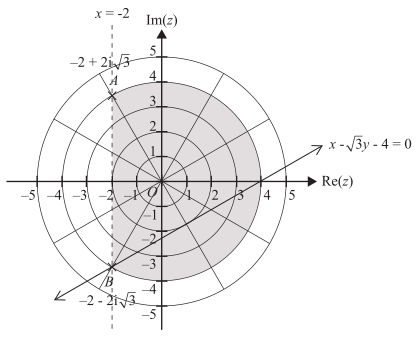
  4. Show that the cartesian form of the relation  `|z| = |z-(2-2sqrt3 i)|`  is  `x-sqrt3 y-4 = 0`  (2 marks)

    --- 5 WORK AREA LINES (style=lined) ---
  5. Sketch the line represented by  `x-sqrt3y -4 = 0`  and plot the roots of  `z^2 + 4z + 16 = 0`  on the Argand diagram below.  (2 marks)

    --- 0 WORK AREA LINES (style=lined) ---


  6. The equation of the line passing through the two roots of  `z^2 + 4z + 16 = 0`  can be expressed as  `|z-a| = |z-b|`, where  `a, b ∈ C`.


    Find `b` in terms of `a`.  (1 mark)

    --- 3 WORK AREA LINES (style=lined) ---
  7. Find the area of the major segment bounded by the line passing through the roots of  `z^2 + 4z + 16 = 0`  and the major arc of the circle given by  `|z| = 4`.  (2 marks)

    --- 5 WORK AREA LINES (style=lined) ---
Show Answers Only
  1. `4text(cis)((−2pi)/3)`
  2. `text(See Worked Solutions)`
  3. `−(2-2sqrt3 i) and-bar((2-2sqrt3 i))`
  4. `text(See Worked Solutions)`
  5.  
  6. `−4-bara`
  7. `4sqrt3 + (32pi)/3`
Show Worked Solution
a.    `r` `= sqrt((−2)^2 + (−2sqrt3)^2)=4`


`theta` `= −pi + tan^(−1)((2sqrt3)/2)`
  `= −pi + pi/3`
  `=(-2pi)/3`

 
`:. −2-2sqrt3 i = 4text(cis)((−2pi)/3)`
 

b.   `z^2 + 4z + z^2-4 + 16` `=0`
`(z + 2)^2 + 12` `= 0`
`(z + 2)^2` `= -12`
`(z + 2)^2` `= 12i^2`
`z + 2` `= ±sqrt12 i`
`z + 2` `= ±2sqrt3 i`
`:. z` `= -2 ± 2sqrt3 i`


♦♦ Mean mark part (c) 31%.

c.    `z_1` `= -2 + 2sqrt3 i = -(2-2sqrt3 i)`
  `z_2` `=-2-2sqrt3 i =-bar((2-2sqrt3 i))`


d. `|z|` `= |z-(2-2sqrt3 i)|`
     `x^2 + y^2` `= (x-2)^2 + (y + 2sqrt3)^2`
    `x^2 + y^2` `= x^2-4x + 4+ y^2 + 4sqrt3 y + 12`
  `0` `= −4x + 4sqrt3 y + 16`
  `0` `= −x + sqrt3 y + 4`

 
`:. x-sqrt3 y-4=0`


e.   


f.   `x = − 2\ \ text(is equidistant from)\ \ z_1 = a\ \ text(and)\ \ z_2 = b`

♦♦♦ Mean mark 1%!

`=> text(Im)(a) = text(Im)(a)`
 

`text(Let)\ \ a = alpha + betai, \ b = gamma + betaj`

`(alpha + gamma)/2` `= −2`
`alpha + gamma` `= −4`
`gamma` `= -4-alpha`


`:. b` `= -4-alpha + betaj`
  `= -4-(alpha + betaj)`
  `= -4-bara`


♦♦ Mean mark 31%.

g.    `text(Area)\ DeltaOAB` `= 1/2 xx (4sqrt3 xx 2)`
    `= 4sqrt3`


`text(Area of sector)\ AOB` `= pi xx 4^2 xx (2 xx pi/3)/(2pi)`
  `= (16pi)/3`

 
`:.\ text(Area of major segment area)`

`=pi(4)^2-((16pi)/3-4sqrt3)`

`= 4sqrt3 + (32pi)/3`

Filed Under: Factors and Roots (SM), Geometry and Complex Numbers (SM) Tagged With: Band 3, Band 4, Band 5, Band 6, smc-1172-10-Quadratic roots, smc-1172-60-Sketch solutions, smc-1173-30-Sketch regions, smc-1173-40-Linear

Complex Numbers, SPEC2-NHT 2017 VCAA 2

One root of a quadratic equation with real coefficients is  `sqrt 3 + i`.

    1. Write down the other root of the quadratic equation.   (1 mark)

      --- 2 WORK AREA LINES (style=lined) ---
    2. Hence determine the quadratic equation, writing it in the form  `z^2 + bz + c = 0`.   (2 marks)

      --- 5 WORK AREA LINES (style=lined) ---
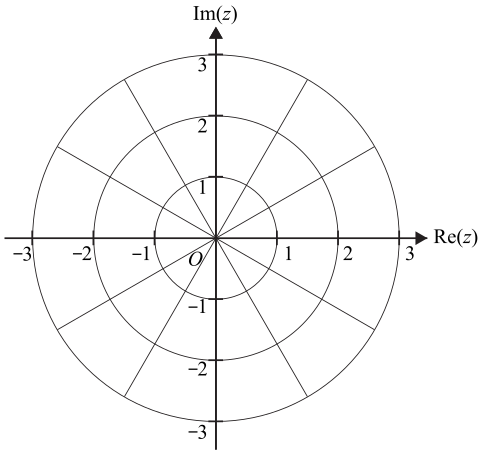
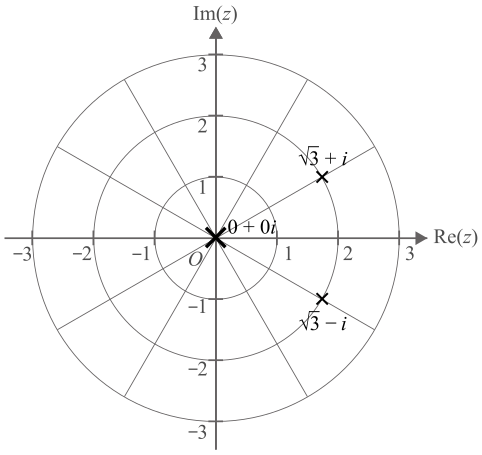
  1. Plot and label the roots of   `z^3-2 sqrt 3 z^2 + 4z = 0`  on the Argand diagram below.   (3 marks)

    --- 0 WORK AREA LINES (style=lined) ---


  1. Find the equation of the line that is the perpendicular bisector of the line segment joining the origin and the point  `sqrt 3 + i`. Express your answer in the form  `y = mx + c`.   (2 marks)

    --- 5 WORK AREA LINES (style=lined) ---
  1. The three roots plotted in part b. lie on a circle.


    Find the equation of this circle, expressing it in the form  `|z-alpha| = beta`,  where  `alpha, beta in R`.   (3 marks)

    --- 5 WORK AREA LINES (style=lined) ---
Show Answers Only
    1. `z_2 = sqrt 3-i`
    2. `z^2-2 sqrt 3 z + 4 = 0`
  1. `text(See Worked Solutions)`
  2. `y = -sqrt 3 x + 2`
  3. `|z-2/sqrt 3 | = 2/sqrt 3`
Show Worked Solution

a.i.   `z_1 = sqrt 3 + i`

 `z_2 = bar z_1 = sqrt 3-i\ \ \ text{(conjugate root)}`


a.ii.    `(z-(sqrt 3 + i))(z-(sqrt 3-i))` `= 0`
  `((z-sqrt 3)-i)((z-sqrt 3) + i)` `= 0`
  `(z-sqrt 3)^2-i^2` `= 0`
  `z^2-2 sqrt 3 z + 3 + 1` `= 0`
  `z^2-2 sqrt 3 z + 4` `= 0`


b.    `z(z^2-2 sqrt 3 z + 4)` `= 0`
  `z(z-(sqrt 3 + i))(z-(sqrt 3-i))` `= 0`

 
`text(Convert to polar form:)`

  `sqrt 3 + i` `= sqrt((sqrt 3)^2 + 1^2) * text(cis) (tan^(-1)(1/sqrt 3))`
    `= 2 text(cis) (pi/6)`
  `=> sqrt 3-i` `= 2 text(cis) (-pi/6)`


c.   `text(Equidistant from)\ (0, 0) and (sqrt 3, 1)`

`text(Midpoint)\ (x_1, y_1)` `= (sqrt 3/2, 1/2)`

 
`m = (1-0)/(sqrt 3-0) = 1/sqrt 3`

`m_(_|_) = (-1)/m = -sqrt 3`
 

`:.\ text(Equation of ⊥ bisector:)`

`y-1/2` `=-sqrt3(x-sqrt3/2)`  
`y` `=-sqrt3 x +3/2+1/2`  
`:.y` `=-sqrt3 x +2`  


d.   `text(Let)\ O = (0, 0),\ P = (sqrt 3, 1),\ Q = (sqrt 3, -1)`

`text(⊥ bisector of two points on arc of a circle passes)`

`text(through the centre of the circle.)`
 

`OP = OQ = PQ = 2`

`=> Delta OPQ\ text(is equilateral)`
 

`text(⊥ bisector of)\ PQ\ text(is)\ y=0.`

`text(Centre of circle occurs when:)`

`0 = -sqrt 3 x + 2\ \ text{(using part c)`

`x=2/sqrt3`

`=>\ text(Radius)\ = 2/sqrt3`
 

`:. |z-2/sqrt 3| = 2/sqrt 3`

Filed Under: Factors and Roots (SM), Geometry and Complex Numbers (SM) Tagged With: Band 3, Band 4, Band 5, Band 6, smc-1172-10-Quadratic roots, smc-1172-20-Cubic roots, smc-1172-60-Sketch solutions

Calculus, SPEC2-NHT 2018 VCAA 5

A horizontal beam is supported at its endpoints, which are 2 m apart. The deflection `y` metres of the beam measured downwards at a distance `x` metres from the support at the origin `O` is given by the differential equation  `80 (d^2y)/(dx^2) = 3x-4`.


  1. Given that both the inclination, `(dy)/(dx)`, and the deflection, `y`, of the beam from the horizontal at  `x = 2`  are zero, use the differential equation above to show that  `80 y = 1/2 x^3-2x^2 + 2x`.   (2 marks)

    --- 6 WORK AREA LINES (style=lined) ---
  2. Find the angle of inclination of the beam to the horizontal at the origin `O`. Give your answer as a positive acute angle in degrees, correct to one decimal place.   (2 marks)

    --- 4 WORK AREA LINES (style=lined) ---
  3. Find the value of `x`, in metres, where the maximum deflection occurs, and find the maximum deflection, in metres.   (3 marks)

    --- 5 WORK AREA LINES (style=lined) ---
  4. Find the maximum angle of inclination of the beam to the horizontal in the part of the beam where  `x >= 1`. Give your answer as a positive acute angle in degrees, correct to one decimal place.   (2 marks)

    --- 5 WORK AREA LINES (style=lined) ---
Show Answers Only
  1. `text(Proof)\ \ text{(See Worked Solutions)}`
  2. `1.4^@`
  3. `x = 2/3; quad 1/135\ text(m)`
  4. `0.5^@`
Show Worked Solution
a.   `80 * int (d^2y)/(dx^2)\ dx` `= int 3x-4\ dx`
  `80* (dy)/(dx)` `= (3x^2)/2-4x + c_0`

 
`text(When)\ \ x=2,\ \ dy/dx=0:`

`80 xx 0` `= (3xx2^2)/2-4xx2 + c_0`
`c_0` `= 2`


`80* (dy)/(dx)` `= (3x^2)/2-4x + 2`
`80y` `= int (3x^2)/2-4x + 2\ dx`
  `= 1/2 x^3-2x^2+2x +c_1`


`text(When)\ \ x=2,\ \ y=0:`

`0` `= 1/2 2^3-2 xx 2^2 + 2 xx 2 + c_1`
`c_1` `= 0`

`:. 80y = 1/2x^3-2x^2 + 2x`


b.   `text(Find)\ \ dy/dx\ \ text(when)\ \ x=0:`

  `80 *(dy)/(dx)` `= 0-0 + 2`
  `(dy)/(dx)` `= 1/40`
  `:. theta` `= tan^(-1) (1/40) ~~ 1.4^@`


c.   `text(Find)\ \ x\ \ text(when)\ \ dy/dx=0:`

`x=2\ \ text(or)\ \ 2/3`

`=>y_text(max)\ \ text(occurs at)\ \ x=2/3\ \ (y=0\ \ text(at)\ \ x=2)`


`80*y_max` `= 1/2(2/3)^3-2(2/3)^2 + 2(2/3)`
`:. y_max` `= 1/80 xx 16/27`
  `= 1/135\ text(metres)`


d.   `text(Max inclination when convexity changes)\ => (d^2y)/(dx^2) =0`

`80*(d^2y)/(dx^2) = 3x-4 = 0`

`=> x = 4/3`

`text(Find)\ \ dy/dx\ \ text(when)\ \ x = 4/3 :`

`(dy)/(dx)` `= 1/80 (3/2(4/3)^2-4(4/3) + 2)`
  `= (-1)/120`


`theta` `= tan^(-1) (|-1/120|)`
  `~~ 0.5^@`

Filed Under: Applied Contexts Tagged With: Band 4, Band 5, Band 6, smc-1184-70-Curve problems

Statistics, SPEC2 2018 VCAA 6

The heights of mature water buffaloes in northern Australia are known to be normally distributed with a standard deviation of 15 cm. It is claimed that the mean height of the water buffaloes is 150 cm.

To decide whether the claim about the mean height is true, rangers selected a random sample of 50 mature water buffaloes. The mean height of this sample was found to be 145 cm.

A one-tailed statistical test is to be carried out to see if the sample mean height of 145 cm differs significantly from the claimed population mean of 150 cm.

Let `bar X` denote the mean height of a random sample of 50 mature water buffaloes.

  1. State suitable hypotheses `H_0` and `H_1` for the statistical test.   (1 mark)

    --- 1 WORK AREA LINES (style=lined) ---

  2. Find the standard deviation of `bar X`.   (1 mark)

    --- 2 WORK AREA LINES (style=lined) ---

  3. Write down an expression for the `p` value of the statistical test and evaluate your answer to four decimal places.   (2 marks)

    --- 2 WORK AREA LINES (style=lined) ---

  4. State with a reason whether `H_0` should be rejected at the 5% level of significance.   (1 mark)

    --- 2 WORK AREA LINES (style=lined) ---

  5. What is the smallest value of the sample mean height that could be observed for `H_0` to be not rejected? Give your answer in centimetres, correct to two decimal places.   (1 mark)

    --- 2 WORK AREA LINES (style=lined) ---

  6. If the true mean height of all mature water buffaloes in northern Australia is in fact 145 cm, what is the probability that `H_0` will be accepted at the 5% level of significance? Give your answer correct to two decimal places.   (1 mark)

    --- 3 WORK AREA LINES (style=lined) ---

  7. Using the observed sample mean of 145 cm, find a 99% confidence interval for the mean height of all mature water buffaloes in northern Australia. Express the values in your confidence interval in centimetres, correct to one decimal place.   (1 mark)

    --- 3 WORK AREA LINES (style=lined) ---

Show Answers Only
  1.  `H_0: mu = 150; qquad H_1: mu < 150`
  2. `3/sqrt 2`
  3. `p = text(Pr)(bar X < 145); qquad p~~ 0.0092`
  4. `text(Yes, he should be rejected as)`
    `p~~ 0.0092 < 0.05`
  5. `bar X_min = 146.52`
  6. `0.24`
  7. `(139.5, 150.5)`
Show Worked Solution
a.    `H_0: mu =150`
  `H_1: mu < 150`


b.    `sigma_bar X` `= (sigma_X)/sqrt n`
    `= 15/sqrt 50`
    `= (3sqrt 2)/2`


c.   `p = text(Pr)(bar X < 145), qquad bar X\ ~\ N (150, 9/2)`

`p ~~ 0.0092`


d.   `text(Yes, he should be rejected as)`

`p~~ 0.0092 < 0.05`


e.  `text(Pr)(bar X < x) = 0.05`

♦ Mean mark part (e) 48%.

`x ~~ 146.511`

`text(NOT rejected:) quad bar X_min = 146.52`


f.   `bar X_2\ ~\ N (145, 9/2)`

♦♦♦ Mean mark part (f) 11%.

`text(Pr)(bar X_2 > x)` `= text(Pr)(bar X_2 > 146.51074)`  
  `~~ 0.24`  


g.   `(145-(Z_99 xx 3)/sqrt 2, 145 + (Z_99 xx 3)/sqrt 2)`

`text(Pr)(Z < Z_99) = 0.995, \ Z\ ~\ N(0, 1)`

`=>Z_99 ~~ 2.57583`

`:. 99%\ text(C.I:)\ (139.5, 150.5)`

Filed Under: Confidence Intervals and Hypothesis Testing (SM) Tagged With: Band 3, Band 4, Band 5, Band 6, smc-1162-20-Other CI (sample), smc-1162-30-One-tail test, smc-1162-50-Null/Alternative hypothesis

Calculus, SPEC1 2015 VCAA 9

Consider the curve represented by  `x^2 - xy + 3/2 y^2 = 9.`

  1. Find the gradient of the curve at any point  `(x, y).`  (2 marks)
  2. Find the equation of the tangent to the curve at the point  `(3, 0)`  and find the equation of the tangent to the curve at the point `(0, sqrt 6).`


    Write each equation in the form  `y = ax + b.`  (2 marks)

  3. Find the acute angle between the tangent to the curve at the point  `(3, 0)`  and the tangent to the curve at the point  `(0, sqrt 6).`


    Give your answer in the form  `k pi`, where `k` is a real constant  (2 marks)

Show Answers Only
  1. `(dy)/(dx) = (2x – y)/(x – 3y)`
  2. `y = 2(x – 3);\ \ \ y = 1/3 x + sqrt 6`
  3. `theta = pi/4`
Show Worked Solution
a.    `d/(dx)(x^2) – d/(dx)(xy) + 3/2* d/(dx) (y^2)` `= 0`
  `2x – x*(dy)/(dx) – y + 3/2(2y)*(dy)/(dx)` `= 0`
  `(dy)/(dx)(−x + 3y)` `= y – 2x`
  `:. (dy)/(dx)` `= (y – 2x)/(3y – x)`


b.   `m_{(3,0)} = (0 – 6)/(0 – 3) = 2`

`:.\ text{Equation of tangent at (3, 0):}`

`y = 2(x – 3)`

  `= 2x – 6`


`m_{(0,sqrt6)} = (sqrt6 – 0)/(3sqrt6 – 0) = 1/3`

`:.\ text{Equation of tangent at}\ (0,sqrt6):`

`y -sqrt6` `= 1/3(x – 0)`  
`y` `=1/3 x + sqrt6`  


c.   `m_1 = 2 = tan(theta_1), \ \ m_2 = 1/3 = tan(theta_2)`

`alpha` `= theta_1 – theta_2`
  `= tan^(−1)(2) – tan^(−1)(1/3)`
`tan(alpha)` `= tan(tan^(−1)(2) – tan^(−1)(1/3))`
  `= (tan(tan^(−1)(2)) – tan(tan^(−1)(1/3)))/(1 + tan(tan^(−1)(2)tan(tan^(−1)(1/3))))`
  `= (2 – 1/3)/(1 + 2/3)`
  `= 1`

 
`:. alpha = pi/4\ \ \ (alpha ∈ (0, pi/2))`

Filed Under: Tangents and Curve Sketching Tagged With: Band 4, Band 6, smc-1182-10-Find gradient, smc-1182-20-Find tangent, smc-1182-50-Implicit functions

Calculus, SPEC1 2014 VCAA 7

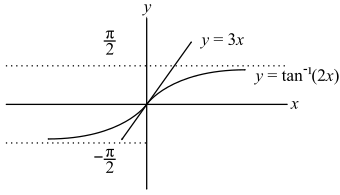
Consider  `f(x) = 3x arctan (2x)`.

  1.  Write down the range of  `f`.  (1 mark)

    --- 3 WORK AREA LINES (style=lined) ---

  2.  Show that  `f prime(x) = 3 arctan (2x) + (6x)/(1 + 4x^2)`.  (1 mark)

    --- 3 WORK AREA LINES (style=lined) ---

  3.  Hence evaluate the area enclosed by the graph of  `g(x) = arctan (2x)`, the `x`-axis and the lines  `x = 1/2`  and  `x = sqrt 3/2`.  (3 marks)

    --- 7 WORK AREA LINES (style=lined) ---

Show Answers Only

  1. `f(x) in [0, oo)`
  2. `text(Proof)\ text{(See Worked Solutions)}`
  3. `(pi sqrt 3)/6-pi/8-1/4 ln2`

Show Worked Solution

a.  `f(x) = 3x arctan (2x)`

`f(0) = 0`

♦♦♦ Mean mark 4%.

`text(When)\ \ x < 0, \ \ 3x<0,\ \ text(and)\ \ y = tan^(-1) (2x) < 0`

`text(When)\ \ x>0,\ \ 3x>0,\ \ text(and)\ \ y = tan^(-1) (2x) > 0`


 `:. f(x) in [0, oo)`


b.  `u = 3x, qquad v = tan^(-1)(2x)`

`u prime = 3, qquad v prime = 2/(1 + 4x^2)`

`:. f prime (x)` `= 3(arctan (2x)) + (2/(1 + 4x^2))(3x)`
  `= 3 arctan (2x) + (6x)/(1 + 4x^2)`


c.    `A` `= int_(1/2)^(sqrt 3/2) arctan (2x)\ dx`
    `= 1/3 int_(1/2)^(sqrt 3/2) 3arctan (2x)\ dx`
    `=1/3 int_(1/2)^(sqrt 3/2) (3 arctan (2x) + (6x)/(1 + 4x^2)-(6x)/(1 + 4x^2))\ dx`
    `= 1/3 int_(1/2)^(sqrt 3/2) 3 arctan (2x) + (6x)/(1 + 4x^2) dx-int_(1/2)^(sqrt 3/2) (2x)/(1 + 4x^2)\ dx`
    `= 1/3 [3x arctan (2x)]_(1/2)^(sqrt 3/2)-1/4 int_(1/2)^(sqrt 3/2) (8x)/(1 + 4x^2)\ dx`
    `= [sqrt 3/2 arctan (sqrt 3)-1/2 arctan (1)]-1/4[ln (1 + 4x^2)]_(1/2)^(sqrt 3/2)`
    `= sqrt 3/2 (pi/3)-1/2 (pi/4)-1/4 [ln (1 + 4(3/4))-ln(1 + 4 (1/4)]`
    `= (pi sqrt 3)/6-pi/8-1/4 (ln4-ln 2)`
    `= (pi sqrt 3)/6-pi/8-1/4 ln2`

Filed Under: Arc Lengths, Areas and Other Tagged With: Band 3, Band 4, Band 6, smc-1181-20-Area Under Curves

Calculus, MET1 2018 VCAA 8

Let  `f: R -> R, \ f(x) = x^2e^(kx)`, where `k` is a positive real constant.

  1.  Show that  `f^{′}(x) = xe^(kx)(kx + 2)`.   (1 mark)

    --- 3 WORK AREA LINES (style=lined) ---

  2. Find the value of `k` for which the graphs of  `y = f(x)`  and  `y = f^{′}(x)`  have exactly one point of intersection.   (3 marks)

    --- 6 WORK AREA LINES (style=lined) ---

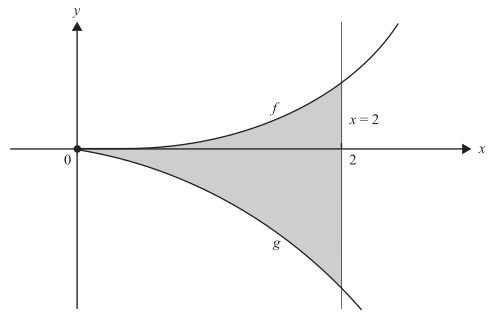
Let  `g(x) = −(2xe^(kx))/k`. The diagram below shows sections of the graphs of `f` and `g` for  `x >= 0`.


Let `A` be the area of the region bounded by the curves  `y = f(x), \ y = g(x)` and the line  `x = 2`.

  1. Write down a definite integral that gives the value of `A`.   (1 mark)

    --- 3 WORK AREA LINES (style=lined) ---

  2. Using your result from part a., or otherwise, find the value of `k` such that  `A = 16/k`.   (3 marks)

    --- 8 WORK AREA LINES (style=lined) ---

Show Answers Only
  1. `text(See Worked Solutions)`
  2. `text(One point of intersection)\ x = 0\ text(when)\ k = 1.`
  3. `int_0^2 (x^2e^(kx) + (2xe^(kx))/k)dx`
  4. `1/2 ln 4\ \ text(or)\ \ ln2`
Show Worked Solution

a.   `f(x) = x^2e^(kx)`

`f^{′}(x)` `= 2x · e^(kx) + x^2 · k · e^(kx)`
  `= xe^(kx)(kx + 2)\ \ …text(as required)`


b.  `text(Intersection occurs when:)`

♦♦♦ Mean mark 7%.
MARKER’S COMMENT: Most students found the correct quadratic equation but solved for `k`.

`x^2e^(kx)` `= xe^(kx)(kx + 2)`
`x^2-x(kx + 2)` `= 0,\ \ e^(kx) != 0`
`x^2-kx^2-2x` `= 0`
`x^2(1-k)-2x` `= 0`
`x[x(1-k)-2]` `= 0`


`:.x = 0\ \ text(or)\ \ x(1-k)-2` `= 0`
`x` `= 2/(1-k)`

 
`text(S)text(ince)\ \ x = 2/(1-k)\ \ text(is undefined when)\ \ k = 1,`

`=>\ text(One point of intersection only at)\ \ x = 0\ \ text(when)\ \ k = 1.`


c.    `A` `= int_0^2 f(x)\ dx-int_0^2 g(x)\ dx`
    `= int_0^2 x^2e^(kx)\ dx-int_0^2 −(2xe^(kx))/k \ dx`
    `= int_0^2 (x^2e^(kx) + (2xe^(kx))/k)dx`

♦♦ Mean mark 29%.


d.    `int_0^2(x^2e^(kx) + (2xe^(kx))/k)\ dx` `= 16/k`
  `1/k int_0^2(kx^2e^(kx) + 2xe^(kx))\ dx` `= 16/k`
  `1/k int_0^2(xe^(kx)(kx + 2))\ dx` `= 16/k`
  `1/k[x^2e^(kx)]_0^2` `= 16/k\ \ \ text{(using part a)}`
  `[2^2 · e^(2k)-0]` `= 16`
  `e^(2k)` `= 4`
  `2k` `= ln 4`
  `k` `= 1/2 ln 4\ \ text(or)\ \ ln2`

Filed Under: Area Under Curves Tagged With: Band 3, Band 4, Band 5, Band 6, smc-723-50-Log/Exponential, smc-723-80-Area between graphs

Algebra, MET2 2018 VCAA 20 MC

The differentiable function  `f : R -> R`  is a probability density function. It is known that the median of the probability density function  `f`  is at  `x = 0`  and  `f^{′} (0) = 4`.

The transformation  `T : R^2 -> R^2`  maps the graph of  `f`  to the graph of  `g`, where  `g : R -> R`  is a probability density function with a median at  `x = 0`  and  `g^{′} (0) = -1`.

The transformation `T` could be given by

  1. `T([(x), (y)]) = [(-2, 0), (0, 1/2)][(x), (y)]`
  2. `T([(x), (y)]) = [(2, 0), (0, -1/2)][(x), (y)]`
  3. `T([(x), (y)]) = [(2, 0), (0, 1/2)][(x), (y)]`
  4. `T([(x), (y)]) = [(-1/2, 0), (0, 2)][(x), (y)]`
  5. `T([(x), (y)]) = [(1/2, 0), (0, -2)][(x), (y)]`
Show Answers Only

`A`

Show Worked Solution

`m_f = 4`

♦♦♦ Mean mark 20%.

`text(Reflect in)\ y text(-axis): m = -4`
 

`text(Dilate by a factor of 2 from)\ y text(-axis):`

`m = (-4)/2 = -2`
 

`text(Dilate by a factor of)\ 1/2\ text{from}\ x text(-axis):`

`m = -1`

`[(-2, 0),(0, 1/2)]\ text(describes this transformation)`

`=>   A`

Filed Under: Transformations Tagged With: Band 6, smc-753-60-Matrix

Algebra, MET2 2018 VCAA 18 MC

Consider the functions  `f:R^+ -> R,\ f(x) = x^(p/q)`  and  `g: R^+ -> R,\ g(x) = x^(m/n)`, where `p, q, m` and `n` are positive integers, and `p/q` and `m/n` are fractions in simplest form.

If  `{x: f(x) > g(x)} = (0, 1)`  and  `{x: g(x) > f(x)} = (1, oo)`, which of the following must be false?

A.   `q > n and p = m`

B.   `m > p and q = n`

C.   `pn < qm`

D.   `f prime (c) = g prime(c)\ \ text(for some)\ \ c in (0, 1)`

E.   `f prime (d) = g prime(d)\ \ text(for some)\ \ d in (1, oo)`

Show Answers Only

`E`

Show Worked Solution

`text(False statement:)`

♦♦♦ Mean mark 14%.

`f prime(d) = g prime (d)\ \ text(for some)\ \ d in (1, oo)`

`text(By testing with substituted values, options)`

`A\ text(to)\ D\ text(can be shown to be true.)`

`=>   E`

Filed Under: Uncategorized Tagged With: Band 6

Financial Maths, STD2 2014 HSC 27a

Alex is buying a used car which has a sale price of  $13 380. In addition to the sale price there are the following costs:

2014 27a1

  1. Stamp Duty for this car is calculated at $3 for every $100, or part thereof, of the sale price.  
  2. Calculate the Stamp Duty payable.   (1 mark)
  3.  
  4. Alex wishes to take out comprehensive insurance for the car for 12 months. The cost of comprehensive insurance is calculated using the following: 
    1.  
    2. 2014 27a2
  5. Find the total amount that Alex will need to pay for comprehensive insurance.   (3 marks)
  6.  
  7. Alex has decided he will take out the comprehensive car insurance rather than the less expensive non-compulsory third-party car insurance.
  8. What extra cover is provided by the comprehensive car insurance?   (1 mark)


Show Answers Only
  1. `$402`
  2. `$985.74`
  3. `text(Comprehensive insurance covers Alex)`
  4. `text(for damage done to his own car as well.)`
  5.  
Show Worked Solution
♦♦♦ Mean mark 12%
IMPORTANT: “or part thereof ..” in the question requires students to round up to 134 to get the right multiple of $3 for their calculation.
(i)    `($13\ 380)/100 = 133.8`
`:.\ text(Stamp duty)` `= 134 xx $3`
  `= $402`


(ii)   `text(Base rate) = $845`

`text(FSL) =\ text(1%) xx 845 = $8.45`
 

`text(Stamp)` `=\ text(5.5%) xx(845 + 8.45)`
  `= 46.9397…`
  `= $46.94\ text{(nearest cent)}`


`text(GST)` `= 10 text(%) xx(845 + 8.45)`
  `= 85.345`
  `= $85.35`


`:.\ text(Total cost)` `= 845 + 8.45 + 46.94 + 85.35`
  `= $985.74`


♦ Mean mark 34%.
(iii)   `text(Comprehensive insurance covers Alex)`
  `text(for damage done to his own car as well.)`

Filed Under: Uncategorized Tagged With: Band 4, Band 5, Band 6

Graphs, MET2 2018 VCAA 11 MC

The graph of  `y = tan(ax)`, where  `a ∈ R^+`, has a vertical asymptote  `x = 3 pi`  and has exactly one `x`-intercept in the region  `(0, 3 pi)`.

The value of `a` is

  1. `1/6`
  2. `1/3`
  3. `1/2`
  4. `1`
  5. `2`
Show Answers Only

`C`

Show Worked Solution

`y = tan(ax)`

`tan x ->\ text(period of)\ pi,\ text(asymptotes at)\ \ x = pi/2, (3 pi)/2`

`tan(x/2) ->\ text(period of)\ 2 pi,\ text(asymptotes at)\ \ x=pi, 3 pi`

`tan(x/2) -> text(has one)\ x text(-intercept of)\ 2 pi\ \ {x: (0, 3 pi)}`

`:. a = 1/2`
 

`=>   C`

Filed Under: Trig Graphing Tagged With: Band 6, smc-2757-20-Tan, smc-2757-30-Find period

GEOMETRY, FUR2 2018 VCAA 3

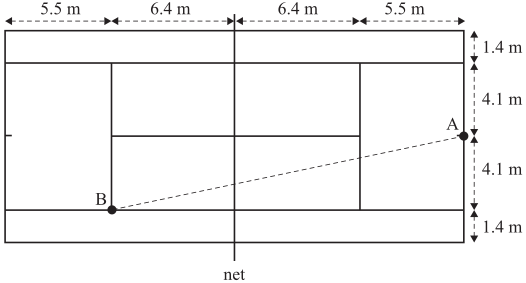
Frank owns a tennis court.

A diagram of his tennis court is shown below

Assume that all intersecting lines meet at right angles.

Frank stands at point `A`. Another point on the court is labelled point `B`.
 

  1. What is the straight-line distance, in metres, between point `A` and point `B`?


    Round your answer to one decimal place.   (1 mark)

  2. Frank hits a ball when it is at a height of 2.5 m directly above point `A`.


    Assume that the ball travels in a straight line to the ground at point `B`.


    What is the straight-line distance, in metres, that the ball travels?


    Round your answer to the nearest whole number.   (1 mark)

Frank hits two balls from point `A`.

For Frank’s first hit, the ball strikes the ground at point `P`, 20.7 m from point `A`.

For Frank’s second hit, the ball strikes the ground at point `Q`.

Point `Q` is `x` metres from point `A`.

Point `Q` is 10.4 m from point `P`.

The angle, `PAQ`, formed is 23.5°.


    1. Determine two possible values for angle `AQP`.


      Round your answers to one decimal place.   (1 mark)

    2. If point `Q` is within the boundary of the court, what is the value of `x`?


      Round your answer to the nearest metre.  (1 mark)

Show Answers Only
  1. `18.8\ text{m (to 1 d.p.)}`
  2. `19\ text(m)\ text{(nearest m)}`
    1. `52.5^@,\ 127.5^@`
    2. `13\ text(m)\ text{(nearest m)}`
Show Worked Solution
a.    `text(Using Pythagoras,)`
  `AB` `= sqrt(4.1^2 + (6.4 + 6.4 + 5.5)^2`
    `= 18.75…`
    `= 18.8\ text{m (to 1 d.p.)}`


b. `text(Let)\ \ d = text(distance travelled)`


`d` `= sqrt(2.5^2 + 18.8^2)`
  `= 18.96…`
  `= 19\ text{m (nearest m)}`


c.i.  

`/_AQP ->\ text(2 possibilities)`

♦♦ Mean mark 25%.

`text(Using Sine rule,)`

`(sin/_AQP)/20.7` `= (sin 23.5^@)/10.4`
`sin /_AQP` `= (20.7 xx sin 23.5^@)/10.4`
  `= 0.7936…`
`:. /_AQP` `= 52.5^@ or 127.5^@\ \ \ text{(to 1 d.p.)}`


♦♦♦ Mean mark 18%.

c.ii.    `Q\ text(is within court when)\ \ /_AQP = 127.5^@`
  `/_APQ = 180 – (127.5 + 23.5) = 29^@`
   
  `text(Using sine rule,)`
  `x/(sin 29^@)` `= 10.4/(sin 23.5^@)`
  `:. x` `= (10.4 xx sin 29^@)/(sin 23.5^@)`
    `= 12.64…`
    `= 13\ text{m (nearest m)}`

Filed Under: Trig - Harder Applications Tagged With: Band 4, Band 5, Band 6

NETWORKS, FUR1 2018 VCAA 8 MC

Annie, Buddhi, Chuck and Dorothy work in a factory.

Today each worker will complete one of four tasks, 1, 2, 3 and 4.

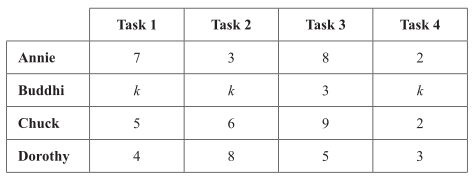
The usual completion times for Annie, Chuck and Dorothy are shown in the table below.


Buddhi takes 3 minutes for Task 3.

He takes `k` minutes for each other task.

Today the factory supervisor allocates the tasks as follows

    • Task 1 to Dorothy
    • Task 2 to Annie
    • Task 3 to Buddhi
    • Task 4 to Chuck

This allocation will achieve the minimum total completion time if the value of `k` is at least

  1. 0
  2. 1
  3. 2
  4. 3
  5. 4
Show Answers Only

`C`

Show Worked Solution

`text(Completion time of given allocation)`

`= 4 + 3 + 3 + 2`

`= 12\ text(hours)`
 

`text(Using Hungarian algorithm:)`

`text(If)\ \ k = 0\ ->\ text(Min completion time = 10)`

`text(If)\ \ k = 1\ ->\ text(Min completion time = 11)`

`text(If)\ \ k = 2\ ->\ text(Min completion = 12)`
 

`:. k\ text(must be at least 2 minutes.)`

`=> C`

Filed Under: Matching Problems Tagged With: Band 6, smc-623-10-Hungarian Algorithm

NETWORKS, FUR2 2018 VCAA 4

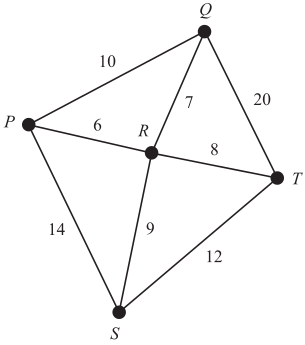
Parcel deliveries are made between five nearby towns, `P` to `T`.

The roads connecting these five towns are shown on the graph below. The distances, in kilometres, are also shown.
 

A road inspector will leave from town `P` to check all the roads and return to town `P` when the inspection is complete. He will travel the minimum distance possible.

  1.  How many roads will the inspector have to travel on more than once?   (1 mark)

    --- 3 WORK AREA LINES (style=lined) ---

  2.  Determine the minimum distance, in kilometres, that the inspector will travel.   (1 mark)

    --- 5 WORK AREA LINES (style=lined) ---

Show Answers Only
  1. `2\ text(roads)`
  2. `108\ text(km)`
Show Worked Solution

a.   `text(Minimum distance if Eulerian circuit exists.)`

♦♦ Mean mark 31%.

`->\ text(no Eulerian circuit possible since 4 vertices are odd)`

`->\ text(if 2 edges added, Eulerian circuit exists)`

`:.\ text(Inspector will travel on 2 roads more than once.)`


b.   `text(By inspection, an extra edge added to)\ PQ\ text{(10)}`

♦♦♦ Mean mark 14%.

`text(and)\ ST\ text{(12) creates an Eulerian circuit with}`

`text(minimum distance.)`
 

`:.\ text(Min distance)`

`= (10 xx 2) + (12 xx 2) + 14 + 20 + 6 + 7 + 8 + 9`

`= 108\ text(km)`

Filed Under: Travelling Problems and Adjacency Matrices Tagged With: Band 5, Band 6, smc-622-10-Euler

CORE, FUR2 2018 VCAA 6


Julie has retired from work and has received a superannuation payment of $492 800.

She has two options for investing her money.

Option 1

Julie could invest the $492 800 in a perpetuity. She would then receive $887.04 each fortnight for the rest of her life.

  1. At what annual percentage rate is interest earned by this perpetuity?  (1 mark)

    --- 4 WORK AREA LINES (style=lined) ---

Option 2

Julie could invest the $492 800 in an annuity, instead of a perpetuity.

The annuity earns interest at the rate of 4.32% per annum, compounding monthly.

The balance of Julie’s annuity at the end of the first year of investment would be $480 242.25

    1. What monthly payment, in dollars, would Julie receive?   (1 mark)

      --- 1 WORK AREA LINES (style=lined) ---

    2. How much interest would Julie’s annuity earn in the second year of investment?
    3. Round your answer to the nearest cent.    (1 mark)

      --- 6 WORK AREA LINES (style=lined) ---

Show Answers Only

  1. `4.68 text(%)`
    1. `$2800`
    2. `$20\ 488.89`

Show Worked Solution

a.    `text(Annual interest)` `= 26 xx 887.04`
    `= $23\ 063.04`

♦ Mean mark 41%.
 

`:.\ text(Annual percentage rate)` `= (23\ 063.04)/(492\ 800)`
  `= 4.68 text(%)`


b.i.   `text(Find the monthly payment by TVM Solver:)`

♦ Mean mark 48%.

`N` `= 12`
`I(%)` `= 4.32`
`PV` `= -492\ 800`
`PMT` `= ?`
`FV` `= 480\ 242.25`
`text(P/Y)` `= text(C/Y) = 12`

 
`=> PMT = $2800.00`
 

♦♦♦ Mean mark 16%.

b.ii.   `text(Year 2 start balance)` `= $480\ 242.25`
  `text(Year 2 end balance)` `= $467\ 131.14`
  `text(Balance reduction)` `= 480\ 242.25-467\ 131.14`
    `= 13\ 111.11`

 
`text(Year 2 total payment) = 12 xx 2800 = 33\ 600`

`:.\ text(Interest)` `= 33\ 600-13\ 111.11`
  `= $20\ 488.89`

Filed Under: Annuities and Perpetuities Tagged With: Band 5, Band 6, smc-2512-10-Annuity, smc-2512-20-Perpetuity, smc-2512-50-CAS solver

CORE, FUR2 2018 VCAA 3

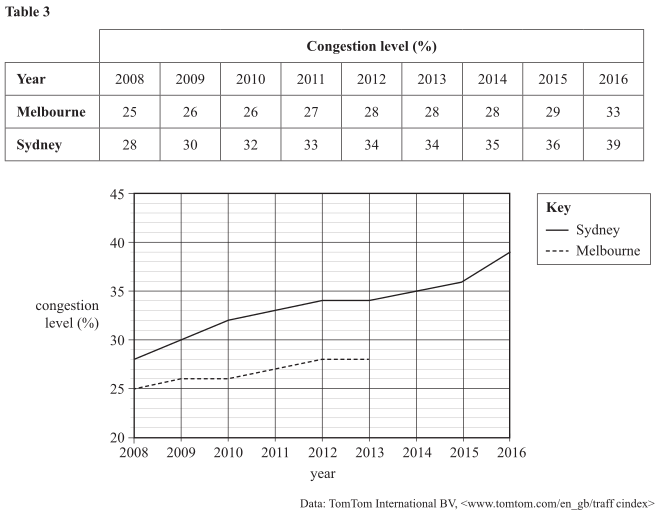
Table 3 shows the yearly average traffic congestion levels in two cities, Melbourne and Sydney, during the period 2008 to 2016. Also shown is a time series plot of the same data.

The time series plot for Melbourne is incomplete.

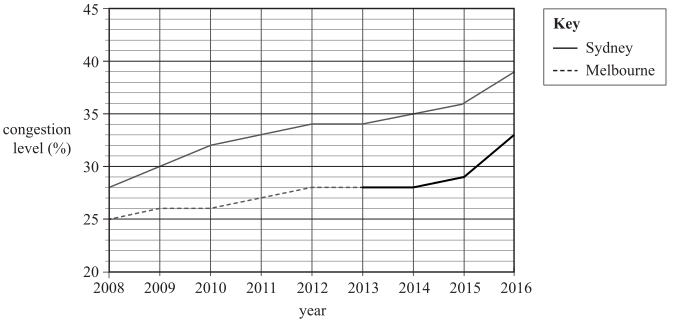
  1. Use the data in Table 3 to complete the time series plot above for Melbourne.   (1 mark)

    --- 0 WORK AREA LINES (style=lined) ---

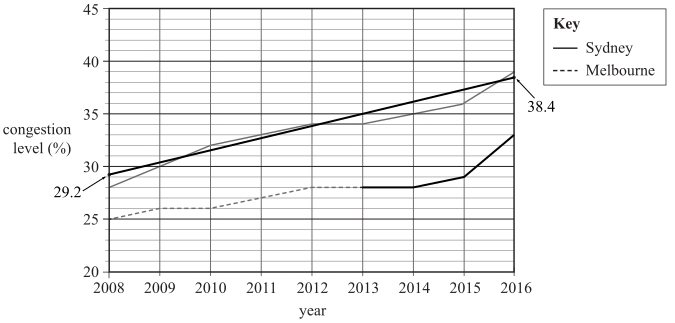
  2. A least squares line is used to model the trend in the time series plot for Sydney. The equation is

       `text(congestion level = −2280 + 1.15 × year)`

  1.   i. Draw this least squares line on the time series plot.   (1 mark)

    --- 0 WORK AREA LINES (style=lined) ---

  2.  ii. Use the equation of the least squares line to determine the average rate of increase in percentage congestion level for the period 2008 to 2016 in Sydney.   (1 mark)

    --- 2 WORK AREA LINES (style=lined) ---

    iii. Use the least squares line to predict when the percentage congestion level in Sydney will be 43%.   (1 mark)

    --- 3 WORK AREA LINES (style=lined) ---

The yearly average traffic congestion level data for Melbourne is repeated in Table 4 below.

  1. When a least squares line is used to model the trend in the data for Melbourne, the intercept of this line is approximately –1514.75556
  2. Round this value to four significant figures.   (1 mark)

    --- 1 WORK AREA LINES (style=lined) ---

  3. Use the data in Table 4 to determine the equation of the least squares line that can be used to model the trend in the data for Melbourne. The variable year is the explanatory variable.
  4. Write the values of the intercept and the slope of this least squares line in the appropriate boxes provided below.
  5. Round both values to four significant figures.   (2 marks)

    --- 0 WORK AREA LINES (style=lined) ---

congestion level = 
 
 + 
 
 × year
  1. Since 2008, the equations of the least squares lines for Sydney and Melbourne have predicted that future traffic congestion levels in Sydney will always exceed future traffic congestion levels in Melbourne.


    Explain why, quoting the values of appropriate statistics.   (2 marks)

    --- 5 WORK AREA LINES (style=lined) ---
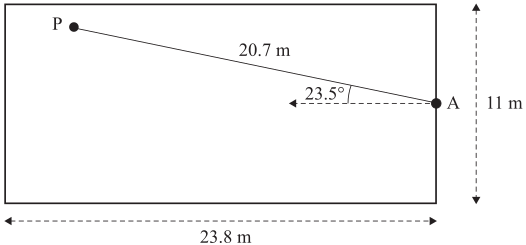
Show Answers Only
  1. `text(See Worked Solutions)`
    1. `text(See Worked Solutions)`
    2. `1.15 text(%)`
    3. `2020`
  2. `-1515`
  3. `text(congestion level) = -1515 + 0.7667 xx text(year)`
  4. `text(See Worked Solutions)`
Show Worked Solution
a.   


b.i.   


b.ii.  `text(The least squares line is 1.15% higher each year.)`

♦ Mean mark (b)(ii) 36%.
COMMENT: Major problems caused by part (b)(ii). Review!

  ` :.\ text(Average rate of increase) = 1.15 text(%)`


b.iii.    `text(Find year when:)`
  `43` `= -2280 + 1.15 xx text(year)`
  `text(year)` `= 2323/1.15`
    `= 2020`


c.  `-1515`


d.   `text(congestion level) = -1515 + 0.7667 xx text(year)`


e.   `text(Melbourne congestion level in 2008)`

♦♦♦ Mean mark 18%.

`= -1515 + 0.7667 xx 2008`

`= 24.5 text(%)`

 
`text{In 2008 Sydney has higher congestion (29.2 > 24.5)}`

`text(After 2008, Sydney congestion grows at 1.15% per)`

`text(year and Melbourne grows at 0.7667% per year.)`

`:.\ text(Sydney predicted to always exceed Melbourne.)`

Filed Under: Correlation and Regression Tagged With: Band 3, Band 4, Band 5, Band 6, page-break-before-question, smc-265-20-Find LSRL Equation/Gradient, smc-265-60-Extrapolation / Interpolation, smc-265-80-Rounding (Sig Fig)

Trigonometry, 2ADV T1 SM-Bank 1

A tower is built on flat ground.

Three tourists, `A`, `B` and `C` are observing the tower from ground level.

`A` is due north of the tower, `C` is due east and `B` is on the line of sight from `A` and `C` and between them.

The angles of elevation to the top of the tower from `A`, `B` and `C` are 26°, 28° and 30°, respectively.

What is the bearing of `B` from the tower?  (4 marks)

Show Answers Only

`005°`

Show Worked Solution

`text(Let)\ \ h =\ text(height of tower)`

`text(In)\ DeltaOAT:`

`tan26^@` `= h/(d_A)`
`d_A` `= h/(tan26^@)`

 
`text(Similarly,)`

`d_B` `= h/(tan28^@)`
`d_C` `= h/(tan30^@)`

   
`text(In)\ DeltaOAC:`

`tan angleOAC` `= (d_C)/(d_A)`
  `= (h/(tan30^@))/(h/(tan26^@))`
  `= (tan26^@)/(tan30^@)`
  `= 0.8447…`
`angleOAC` `= 40.19^@`

 
`text(Using sine rule in)\ DeltaOAB:`

`(sinangleABO)/(d_A)` `= (sinangleOAC)/(d_B)`
`sinangleABO` `= sin40.2^@ xx (tan28^@)/(tan26^@)`
  `= 0.7035…`
`angleABO` `= 44.71^@\ text(or)\ 135.29^@`


`text(S)text(ince)\ \ angleOCA` `= tan^(−1)((tan30)/(tan26))`
  `= 49.8^@`

 
`=> angleOBC = 44.71°`

`(text(otherwise angle sum)\ DeltaOBC > 180°)`
 

`angleAOB` `= 180 – (40.19 + 135.29)`
  `= 4.52`

 
`:.\ text(Bearing of)\ B\ text(from tower is)\ 005°.`

Filed Under: 3D Trigonometry (Y11), 5. Trig Ratios EXT1 Tagged With: Band 6

Calculus, SPEC2 2017 VCAA 10 MC

A function  `f`, its derivative  `fprime` and its second derivative  `f″` are defined for  `x ∈ R`  with the following properties.

`f(a) = 1, f(−a) = −1`

`f(b) = −1, f(−b) = 1`

and  `f″(x) = ((x + a)^2(x - b))/(g(x))`, where  `g(x) < 0`

The coordinates of any points of inflection of   `|\ f(x)\ |`  are

  1.  `(−a,1) and (b,1)`
  2.  `(b,−1)`
  3.  `(−a,−1) and (b,−1)`
  4.  `(−a,1)`
  5.  `(b,1)`
Show Answers Only

`B`

Show Worked Solution

`text(P.O.I. requires:)`

♦♦♦ Mean mark 6%.

`f″(x) =0\ \ text(and)\ \ f″(x)\ \ text(to change sign)`

`f″(x)\ \ text(does not change sign around)\ \ x=a`

`(b, −1)\ text(is the only P.O.I. of)\ \ f(x)`

`:. (b, 1)\ text(is the only P.O.I. of)\ \ |\ f(x)\ |`

`=>B`

Filed Under: Tangents and Curve Sketching Tagged With: Band 6, smc-1182-40-Other 1st/2nd deriv problems

Functions, 2ADV F1 SM-Bank 11

Given  `f(x) = sqrt (x^2 - 9)`  and  `g(x) = x + 5`

  1.  Find integers `c` and `d` such that  `f(g(x)) = sqrt {(x + c) (x + d)}`   (2 marks)

    --- 4 WORK AREA LINES (style=lined) ---

  2.  State the domain for which  `f(g(x))`  is defined.   (2 marks)

    --- 6 WORK AREA LINES (style=lined) ---

Show Answers Only
  1. `c = 2, d = 8 or c = 8, d = 2`
  2. `x in (– oo, – 8] uu [– 2, oo)`
Show Worked Solution
a.   `f(g(x))` `= sqrt {(x + 5)^2 – 9}`
    `= sqrt (x^2 + 10x + 16)`
    `= sqrt {(x + 2) (x + 8)}`

 
 `:. c = 2, d = 8 or c = 8, d = 2`


b.   `text(Find)\ x\ text(such that:)`

♦♦♦ Mean mark 13%.
MARKER’S COMMENT: “Very poorly answered” with a common response of  `-3 <=x<=3`  that ignored the information from part (a).

`(x+2)(x+8) >= 0`
 

 vcaa-2011-meth-4ii

`(x + 2) (x + 8) >= 0\ \ text(when)`

`x <= -8 or x >= -2`
 

`:.\ text(Domain:)\ \ x<=-8\ \ and\ \  x>=-2`

Filed Under: Composite Functions (Adv-2027), Composite Functions (Y11) Tagged With: Band 3, Band 6, smc-6216-30-Other Functions, smc-6216-40-Domain/Range, smc-986-30-Other, smc-986-40-Domain/Range

Calculus, 2ADV C4 2007* HSC 10a

An object is moving on the `x`-axis. The graph shows the velocity, `(dx)/(dt)`, of the object, as a function of time, `t`. The coordinates of the points shown on the graph are  `A (2, 1), B (4, 5), C (5, 0) and D (6, –5)`. The velocity is constant for  `t >= 6`.


  1. The object is initially at the origin. During which time(s) is the displacement of the object decreasing?  (1 mark)

    --- 1 WORK AREA LINES (style=lined) ---

  2. If the object travels 7 units in the first 4 seconds, estimate the time at which the object returns to the origin. Justify your answer.  (2 marks)

    --- 5 WORK AREA LINES (style=lined) ---
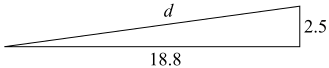
  3. Sketch the displacement, `x`, as a function of time.  (2 marks)

    --- 10 WORK AREA LINES (style=lined) ---

Show Answers Only
  1. `t > 5\ \ text(seconds)`
  2. `7.2\ \ text(seconds)`
  3.    
Show Worked Solution

i.  `text(Displacement is reducing when the velocity is negative.)`

`:. t > 5\ \ text(seconds)`


ii.  `text(At)\ B,\ text(the displacement) = 7\ text(units)`

`text(Considering displacement from)\ B\ text(to)\ D:`

`text(S)text(ince the area below the graph from)`

`B\ text(to)\ C\ text(equals the area above the)`

`text(graph from)\ C\ text(to)\ D,\ text(there is no change)`

`text(in displacement from)\ B\ text(to)\ D.`


`text(Considering)\ t >= 6`

`text(Time required to return to origin)`

`t` `= d/v`
  `= 7/5`
  `= 1.4\ \ text(seconds)`


`:.\ text(The particle returns to the origin after 7.4 seconds.)`
   

iii.   

Filed Under: Other Integration Applications (Y12) Tagged With: Band 4, Band 5, Band 6, smc-1213-10-Motion, smc-975-70-Functions - no integration

Calculus, 2ADV C4 2013* HSC 15a

The diagram shows the front of a tent supported by three vertical poles. The poles are 1.2 m apart. The height of each outer pole is 1.5 m, and the height of the middle pole is 1.8 m. The roof hangs between the poles.

2013 15a

The front of the tent has area  `A\ text(m²)`. 

  1. Use the trapezoidal rule to estimate  `A`.    (1 mark)

    --- 2 WORK AREA LINES (style=lined) ---

  2. Does the Trapezoidal rule give a higher or lower estimate of the actual area? Justify your answer.  (1 mark)

    --- 2 WORK AREA LINES (style=lined) ---

Show Answers Only
  1. `3.96\ text(m²)`
  2. `text(See Worked Solutions)`
Show Worked Solution
i.    `A` `~~ h/2 [y_0 + 2y_1 + y_2]`
    `~~ 1.2/2 [1.5 + (2 xx 1.8) + 1.5]`
    `~~ 0.6 [6.6]`
    `~~ 3.96\ text(m²)`


ii.       

`text(S)text(ince the tent roof is concave up, the)`

`text(Trapezoidal rule uses straight lines and)`

`text(will estimate a higher area.)`

Filed Under: Trapezium Rule and Newton, Trapezoidal Rule (Y12) Tagged With: Band 3, Band 6, smc-5145-04-Trapezium rule, smc-5145-20-No table, smc-5145-30-Estimate comparison, smc-976-20-No Table, smc-976-30-Estimate Comparison

  • « Previous Page
  • 1
  • …
  • 13
  • 14
  • 15
  • 16
  • 17
  • …
  • 28
  • Next Page »

Copyright © 2014–2025 SmarterEd.com.au · Log in