SmarterEd

Aussie Maths & Science Teachers: Save your time with SmarterEd

  • Login
  • Get Help
  • About

Probability, NAP-K2-28

 
Frank rolls a standard dice once.

Which of the following results is most likely?

 
Frank rolls a 6.
 
Frank rolls a number less than 3.
 
Frank rolls an even number.
 
Frank rolls a 5 or 6.
Show Answers Only

`text(Frank rolls an even number)`

Show Worked Solution

`text(Consider the chance of each option:)`

`text{Pr (rolling a 6)} = 1/6`

`text{Pr (rolling a number less than 3)} = 2/6`

`text{Pr (rolling an even number)} = 3/6`

`text{Pr (rolling a 5 or 6)} = 2/6`
 

`:.\ text(Rolling an even number is the most likely.)`

Filed Under: Chance, Chance Tagged With: Band 6, smc-3137-40-Dice, smc-699-40-Dice

Measurement, NAP-K2-26

Alvin is making red cordial.

It is made by mixing water with red concentrate.

Alvin adds 1 litre (L) of water to 75 millilitres (mL) of red concentrate.

How much cordial did Alvin make?

`175\ text(mL)` `751\ text(mL)` `1075\ text(mL)` `10\ 075\ text(mL)`


Show Answers Only

`1075\ text(mL)`

Show Worked Solution

`1\ text(L) = 1000\ text(mL)`

`:.\ text(Total cordial)` `= 1000 + 75`
  `= 1075\ text(mL)`

Filed Under: Units of Measurement, Units of Measurement Tagged With: Band 6, smc-3089-30-Convert mL/L, smc-919-30-Convert mL/L

Statistics, NAP-K2-23 SA

The picture graph shows how many tonnes of fertiliser are needed for 4 gardens.
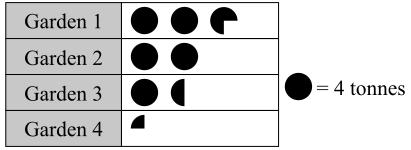


How many more tonnes of fertiliser does Garden 1 need than Garden 4?

  tonnes
Show Answers Only

`10\ text(tonnes)`

Show Worked Solution

`text(Garden 1 tonnes) = 4 + 4 + 3 = 11`

`text(Garden 4 tonnes) = 1`

`:.\ text(Garden 4 needs 10 more tonnes.)`

Filed Under: Data and Interpretation, Data and Interpretation Tagged With: Band 6, smc-3136-10-Picture graph, smc-698-10-Picture graph

Number and Algebra, NAP-K2-22 SA

Sanjeev collected football cards. He had collected 35 cards.

At school, Sanjeev and his friends put all their football cards together.

There was a total of 305 cards.

How many football cards, in total, had Sanjeev's friends collected?

 
Show Answers Only

`270`

Show Worked Solution

`text(Cards collected by Sanjeev’s friends)`

`= 305 – 35`

`= 300 – 30`

`= 270`

Filed Under: Solving problems - Add/Subtract, Solving problems - Add/Subtract Tagged With: Band 6, smc-3084-10-Addition, smc-693-10-Addition

Number and Algebra, NAP-K2-20

On Monday, Jeremy went to the doctor and was given 24 tablets.

Jeremy was to take 5 tablets each day starting from Monday.

On which day did Jeremy take the last tablet?

Thursday Friday Saturday Sunday


Show Answers Only

`text(Friday)`

Show Worked Solution
`text(Number of days)` `= 24 ÷ 5`
  `= 4\ text(remainder 4)`

 
`=>\ text(Jeremy has his last tablet on the 5th day.)`

`:.\ text(Friday)`

Filed Under: Solving Problems - Multiply/Divide, Solving Problems - Multiply/Divide, Solving problems - Multiply/Divide Tagged With: Band 6, smc-3018-20-Divide, smc-3018-35-Remainder, smc-3085-20-Division, smc-922-20-Division

Statistics, NAP-K2-19

On a school camp, each child chose their meal for dinner.

The table shows how many children chose each meal.
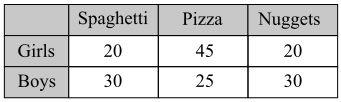


Select all the statements that are true.

 
More girls than boys chose spaghetti.
 
In total 70 children chose pizza.
 
Less than half the girls chose pizza.
 
In total, there are the same number of girls on the trip as boys.
Show Answers Only

`text(The true statements are:)`

`text(In total 70 children chose pizza)`

`text(In total, there are the same number)`

`text(of girls on the trip as boys)`

Show Worked Solution

`text(The true statements are:)`

`=>\ text(In total 70 children chose pizza.)`

`=>\ text(In total, there are the same number)`

`text(of girls on the trip as boys.)`

Filed Under: Data and Interpretation, Data and Interpretation, Data and Interpretation Tagged With: Band 6, smc-3052-40-Table data, smc-3136-60-Table data, smc-698-60-Table data

Number and Algebra, NAP-K2-18

Greg plays golf.

During one round, he found 11 golf balls and lost 4.

At the end of the round, Greg had a total of 16 golf balls.
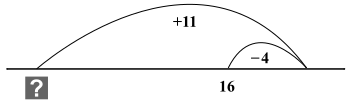


How many golf balls did Greg start with?

1 7 9 23


Show Answers Only

`9`

Show Worked Solution

`text(By trial and error:)`

`text(Consider starting with 9)`

`9 + 11 – 4 = 16`
 

`:.\ text(Greg starts with 9 golf balls.)`

Filed Under: Number and Place, Number and Place, Number and Place Value Tagged With: Band 6, smc-3016-50-Combination of Operators, smc-3083-50-Combination of operators, smc-690-50-Combination of operators

Geometry, NAP-K2-17

Christy uses some blocks to make a rectangular prism and cube.
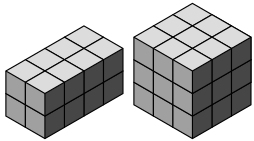


How many blocks does Christy use altogether?

17 34 43 47


Show Answers Only

`43`

Show Worked Solution

`text(Blocks in rectangular prism)\ = 2 xx 8 = 16`
  

`text(Blocks in cube)\ = 3 xx 9 = 27`
 

`:.\ text(Total blocks)` `= 16 + 27`
  `= 43`

Filed Under: 2D-3D Shapes, 2D-3D Shapes Tagged With: Band 6, smc-3121-50-Building blocks, smc-695-50-Building blocks

Harder Ext1 Topics, EXT2 2018 HSC 14d

Three people, `A`, `B` and `C`, play a series of n games, where  `n ≥ 2`. In each of the games there is one winner and each of the players is equally likely to win.

  1.  What is the probability that player `A` wins every game?  (1 mark)
  2.  Show that the probability that `A` and `B` win at least one game each but `C` never wins, is
     
         `(2/3)^n - 2(1/3)^n`.  (1 mark)
     
  3.  Show that the probability that each player wins at least one game is 
     
         `(3^(n - 1) - 2^n + 1)/(3^(n - 1))`.  (2 marks)
Show Answers Only
  1. `(1/3)^n`
  2. `text(See Worked Solutions)`
  3. `text(See Worked Solutions)`
Show Worked Solution

i.   `text{Pr (A wins every game)} = (1/3)^n`


ii.   `text{Pr (C never wins)} = (2/3)^n`

♦ Mean mark 36%.

`text(If C never wins, only 2 scenarios occur where A or B)`

`text(don’t win at least 1 game)`

`→\ text(A wins all or B wins all.)`
 

`:.\ text{Pr (No C, A and B win at least 1 game)}`

`=\ text{Pr (No C) – Pr (A wins all) – Pr (B wins all)}`

`= (2/3)^n – 2(1/3)^n`


iii.   `=>\ text{A, B or C cannot win all games (part(i)).}`

♦♦♦ Mean mark 19%.

`=>\ text(A cannot lose all games, with B and C winning)`

`text{at least 1 each (part (ii)). Similarly for each player.}`
 

`:.\ text{Pr (each player wins at least 1 game)}`

`= 1 – 3(1/3)^n – 3[(2/3)^n – 2(1/3)^n]`

`= (3^n – 3 – 3 · 2^n + 6)/(3^n)`

`= (3^n – 3 · 2^n + 3)/(3^n)`

`= (3^(n – 1) – 2^n + 1)/(3^(n – 1))\ \ …\ text(as required.)`

Filed Under: Probability and The Binomial Tagged With: Band 3, Band 5, Band 6

Number and Algebra, NAP-K2-11

Jarryd buys 3 water bottles for $1.50 each.

He pays for these water bottles with a $10 note.

How much change should Jarryd receive?

`$1.50` `$4.50` `$5.00` `$5.50`


Show Answers Only

`$5.50`

Show Worked Solution
`text(Change)` `= $10 – (3 xx $1.50)`
  `= $10 – $4.50`
  `= $5.50`

Filed Under: Financial Mathematics, Money, Money and Financial Mathematics Tagged With: Band 6, smc-2536-30-$ and cents calculations, smc-2536-40-Change, smc-3020-20-$ and cents calculations, smc-3086-30-$ and cents calculations, smc-3086-40-Change

Number and Algebra, NAP-K2-07 SA

Write a number in the box to make this number sentence true.

`6 + 8 = 10 +`
Show Answers Only

`4`

Show Worked Solution
`6 + 8` `= 14`
  `= 10 + 4`

Filed Under: Number and Place, Number and Place Value Tagged With: Band 6, smc-3083-10-Addition, smc-690-10-Addition

Financial Maths, 2ADV M1 2018 HSC 16c

Kara deposits an amount of $300 000 into an account which pays compound interest of 4% per annum, added to the account at the end of each year. Immediately after the interest is added, Kara makes a withdrawal for expenses for the coming year. The first withdrawal is `$P`. Each subsequent withdrawal is 5% greater than the previous one.

Let  `$A_n`  be the amount in the account after the `n`th withdrawal.

  1. Show that  `A_2 = 300\ 000(1.04)^2 - P[(1.04) + (1.05)]`.   (1 mark)

    --- 2 WORK AREA LINES (style=lined) ---

  2. Show that  `A_3 = 300\ 000 (1.04)^3 - P[(1.04)^2 + (1.04)(1.05) + (1.05)^2]`.   (1 mark)

    --- 2 WORK AREA LINES (style=lined) ---

  3. Show that there will be money in the account when
     
    `qquad (105/104)^n < 1 + 3000/P`   (3 marks)

    --- 6 WORK AREA LINES (style=lined) ---

Show Answers Only

i.    `text(Proof)\ \ text{(See Worked Solutions)}`

ii.   `text(Proof)\ \ text{(See Worked Solutions)}`

iii.  `text(Proof)\ \ text{(See Worked Solutions)}`

Show Worked Solution

♦ Mean mark (i) 47%.

i.     `A_1` `= 300\ 000 (1.04)-P`
  `A_2` `= [300\ 000 (1.04)-P](1.04)-P(1.05)`
    `= 300\ 000 (1.04)^2-P(1.04)-P(1.05)`
    `= 300\ 000 (1.04)^2-P[1.04 + 1.05]`


♦ Mean mark part (ii) 30%.

ii.    `A_3` `= [300\ 000 (1.04)^2-P(1.04 + 1.05)](1.04)-P(1.05)^2`
    `= 300\ 000 (1.04)^3-P(1.04)^2-P(1.04)(1.05)-P(1.05)^3`
    `= 300\ 000 (1.04)^3-P[(1.04)^2 + P(1.04)(1.05) + (1.05)^2]`


iii.   `A_4` `= 300\ 000 (1.04)^4-P[(1.04)^3 + (1.04)^2(1.05) + … + (1.05)^3]`
    `vdots`
  `A_n` `= 300\ 000 (1.04)^n`
    `-P underbrace{[(1.04)^(n-1) + (1.04)^(n-2) (1.05) + … + (1.04)(1.05)^(n-2) + (1.05)^(n-1)]}_{text(GP),\ a = (1.04)^(n-1),\ r = 1.05/1.04}`

 
`text(Money in account when)\ \ A_n > 0:`

♦♦♦ Mean mark part (iii) 8%.

`(300\ 000(1.04)^n)/P` `> (1.04)^(n-1)[((1.05/1.04)^n-1)/((1.05/1.04)-1)]`
`(300\ 000)/P` `> 1/1.04 [((1.05/1.04)^n-1)/((1.05/1.04)-1)]`
`(300\ 000)/P` `> ((1.05/1.04)^n-1)/(1.05-1.04)`
`3000/P` `> (1.05/1.04)^n-1`
`3000/P + 1` `> (105/104)^n qquad (text{s}text{ince}\ \ (1.05/1.04)^n = (105/104)^n)`

Filed Under: Annuities, Compound interest, loan repayments and annuities, Financial Applications of Series Tagged With: Band 5, Band 6, smc-1007-30-Annuity/Deposit - Withdrawal Phase, smc-7140-20-Withdrawal Phase

Probability, 2ADV S1 2018 HSC 16b

A game involves rolling two six-sided dice, followed by rolling a third six-sided die. To win the game, the number rolled on the third die must lie between the two numbers rolled previously. For example, if the first two dice show 1 and 4, the game can only be won by rolling a 2 or 3 with the third die.

  1. What is the probability that a player has no chance of winning before rolling the third die?   (2 marks)

    --- 8 WORK AREA LINES (style=lined) ---

  2. What is the probability that a player wins the game?   (2 marks)

    --- 4 WORK AREA LINES (style=lined) ---

Show Answers Only

i.    `4/9`

ii.   `5/27`

Show Worked Solution

i.   `text(Construct a sample space of possible winning rolls:)`

♦ Mean mark 40%.
COMMENT: Constructing the full sample space is a critical step here.
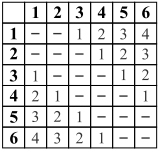
`text{P(no chance)}= text(number of pairs with no gap)/text(total possibilities)= 16/36= 4/9`
 

ii.   `text(The sample space in the table shows:)`

♦♦♦ Mean mark 7%.

`text(→ 8 combinations leave a gap for a single winning number,)`

`text(→ 6 combinations leave a gap for two winning numbers,)`

`vdots`

`:.\ text{P(winning)}` `= 1/36 [8 xx 1/6 + 6 xx 2/6 + 4 xx 3/6 + 2 xx 4/6]`
  `= 1/36 (8/6 + 12/6 + 12/6 + 8/6)`
  `= 1/36 (40/6)`
  `= 5/27`

Filed Under: 3. Probability, Multi-Stage Events, Multi-Stage Events Tagged With: Band 5, Band 6, smc-6469-40-Arrays, smc-989-40-Arrays

Quadratic, 2UA 2018 HSC 8 MC

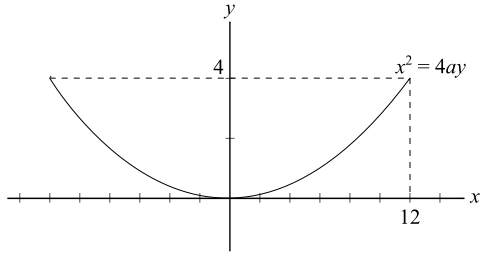
A radio telescope has a parabolic dish. The width of the opening is 24 m and the distance along the axis from the vertex to the opening is 4 m, as shown in the diagram.
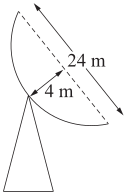


What is the focal length of the parabola?

(A)  `1/6\ text(m)`

(B)  `1/3\ text(m)`

(C)  `6\ text(m)`

(D)  `9\ text(m)`

Show Answers Only

`D`

Show Worked Solution

`text(Redraw the parabola on a number plane.)`

♦♦♦ Mean mark 16%.


`text(Substitute)\ \ (12, 4)\ \ text(into)\ \ x = 4ay:`

`12^2` `= 4 xx a xx 4`
`:. a` `= 144/16`
  `= 9`

 
`=>  D`

Filed Under: The Parabola Tagged With: Band 6

Plane Geometry, EXT1 2018 HSC 14c

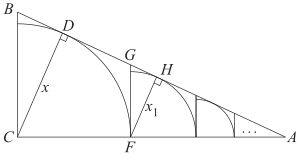
In triangle `ABC, BC` is perpendicular to `AC`. Side `BC` has length `a`, side `AC` has length `b` and side `AB` has length `c`. A quadrant of a circle of radius `x`, centered at `C`, is constructed. The arc meets side `BC` at `E`. It touches the side `AB` at `D`, and meets side `AC` at `F`. The interval `CD` is perpendicular to `AB`.
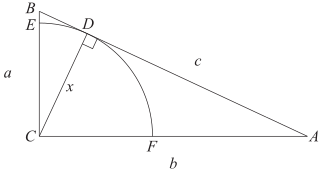


  1. Show that `Delta ABC` and `Delta ACD` are similar.  (1 mark)
  2. Show that
     
    `qquad x = (ab)/c`.  (1 mark)
     

  3. From `F`, a line perpendicular to `AC` is drawn to meet `AB` at `G`, forming the right-angled triangle `GFA`. A new quadrant is constructed in triangle `GFA` touching side `AB` at `H`. The process is then repeated indefinitely.


  4. Show that the limiting sum of the areas of all the quadrants is
     
    `qquad (pi ab^2)/(4(2c - a)).`  (4 marks)
     

  5. Hence, or otherwise, show that
     
    `qquad pi/2 < (2c - a)/b`.  (1 mark)


Show Answers Only
  1. `text(Proof)\ \ text{(See Worked Solutions)}`
  2. `text(Proof)\ \ text{(See Worked Solutions)}`
  3. `text(Proof)\ \ text{(See Worked Solutions)}`
  4. `text(Proof)\ \ text{(See Worked Solutions)}`
Show Worked Solution

(i)   `text(In)\ triangle ABC,`

`/_BCA = 90^@\ \ \ (BC _|_ AC)`
 

`/_ BCA = /_ ADC\ \ text{(right-angles)}`

`/_ BAC = /_ DAC\ \ text{(common)}`
 

`:. Delta ABC\ text(|||)\ Delta ACD\ \ text{(equiangular)}`


(ii) `(CD)/(BC)` `= (AC)/(AB)` `text{(corresponding sides of}`
   `text{similar triangles)}`
  `x/a` `= b/c`  
  `:. x` `= (ab)/c`  


(iii)
  `text(Area of)\ Q_1 = 1/4 pi x^2`

♦♦♦ Mean mark part (iii) 19%.

`text(Area of)\ Q_2 => text(find)\ x_1`


`text(Consider)\ Delta ACD and Delta AFH`

`/_ADC = /_AHF\ \ text{(right angles)}`

`/_ CAD = /_FAH\ \ text{(common)}`

`:. Delta ACD\ text(|||)\ Delta AFH\ \ text{(equiangular)}`


`(FH)/(CD)` `= (AF)/(AC)` `text{(corresponding sides}`
`text{of similar triangles)}`
`x_1/x` `= (AC – CF)/(AC)`  
  `= (b – x)/b`  
  `= (b – (ab)/c)/b` `text{(using part (ii))}`
  `= (cb – ab)/(bc)`  
  `= (c – a)/c`  
`:. x_1` `= x((c – a)/c)`  


`=> x_2\ text(will be shorter again by the same ratio)`

`x_2` `= x_1 ((c – a)/c)`
  `= x((c – a)/c)^2`
  `vdots`
`x_n` `= x((c – a)/c)^n`


`text(Limiting sum of quadrant areas)`

`= Q_1 + Q_2 + … + Q_n`

`= 1/4 pi x^2 + 1/4 {:pi x_1:}^ 2 + … + 1/4 {:pi x_n:}^2`

`= 1/4 pi x^2 + 1/4 pi x^2 ((c – a)/c)^2 + … + 1/4 pi x^2 ((c – a)/c)^(2n)`

`= 1/4 pi x^2 underbrace{[1 + ((c – a)/c)^2 + … + ((c – a)/c)^(2n)]}_{text(GP with)\ a = 1, \ r = ((c-a)/c)^2`

`= 1/4 pi x^2 [1/(1 – ((c-a)/c)^2)]`

`= 1/4 pi ((ab)/c)^2 (c^2/(c^2 – (c – a)^2))`

`= pi/4 xx (a^2 b^2)/(c^2 – c^2 + 2ac – a^2)`

`= pi/4 xx (a^2 b^2)/(a(2c – a))`

`= (pi ab^2)/(4(2c – a))\ \ \ text(… as required)`


(iv)  `text(S)text{ince the limiting sum all the quadrants (from part (iii))}`

♦♦ Mean mark part (iv) 21%.

`text(is less than the area of)\ \ Delta ABC:`

`(pi ab^2)/(4(2c – a))` `< (ab)/2`
`(pi b)/(4(2c – a))` `< 1/2`
`pi/4` `< (2c – a)/(2b)`
`pi/2` `< (2c – a)/b\ \ \ text(… as required)`

Filed Under: 2. Plane Geometry EXT1 Tagged With: Band 3, Band 5, Band 6

Networks, STD2 N3 2012 FUR1 8 MC

networks-fur1-2012-vcaa-8-mc 
 

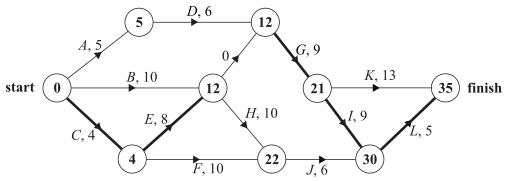
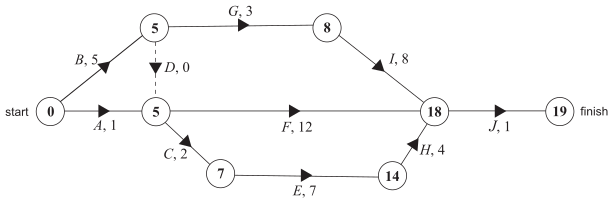
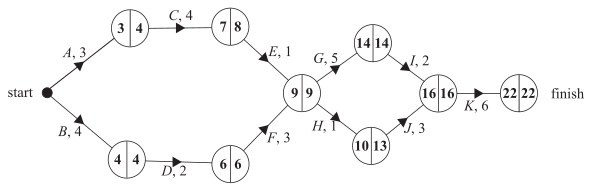
Eight activities, `A, B, C, D, E, F, G`  and  `H`, must be completed for a project.

The network above shows these activities and their usual duration in hours.

The duration of each activity can be reduced by one hour.

To complete this project in 16 hours, the minimum number of activities that must be reduced by one hour each is

  1. `1`
  2. `2`
  3. `3`
  4. `4`
Show Answers Only

`C`

Show Worked Solution

`text(Two critical paths)\ AFH\ text(and)\ BCFH => 18\ text(hours)`

♦♦ Mean mark 30%.

`text(Paths)\ AEG\ text(and)\ BCEG => 17\ text(hours)`

`text(Reducing)\ A\ text(and)\ B\ text(by 1 hour each reduces each)`

`text(path above by 1 hour.)`


`text(Need to reduce)\ AFH\ text(and)\ BCFH\ text(by 1 hour to 16 hours.)`

`=>\ text(Reducing either)\ F\ text(or)\ H\ text(by 1 hour brings the)`

`text(critical path down to 16 hours.)`

`=> C`

Filed Under: Critical Path Analysis (Y12), Critical Paths Tagged With: Band 6, smc-6916-20-Forward Scanning, smc-916-20-Forward Scanning

Networks, STD2 N3 2007 FUR2 4

A community centre is to be built on the new housing estate.

Nine activities have been identified for this building project.

The directed network below shows the activities and their completion times in weeks.
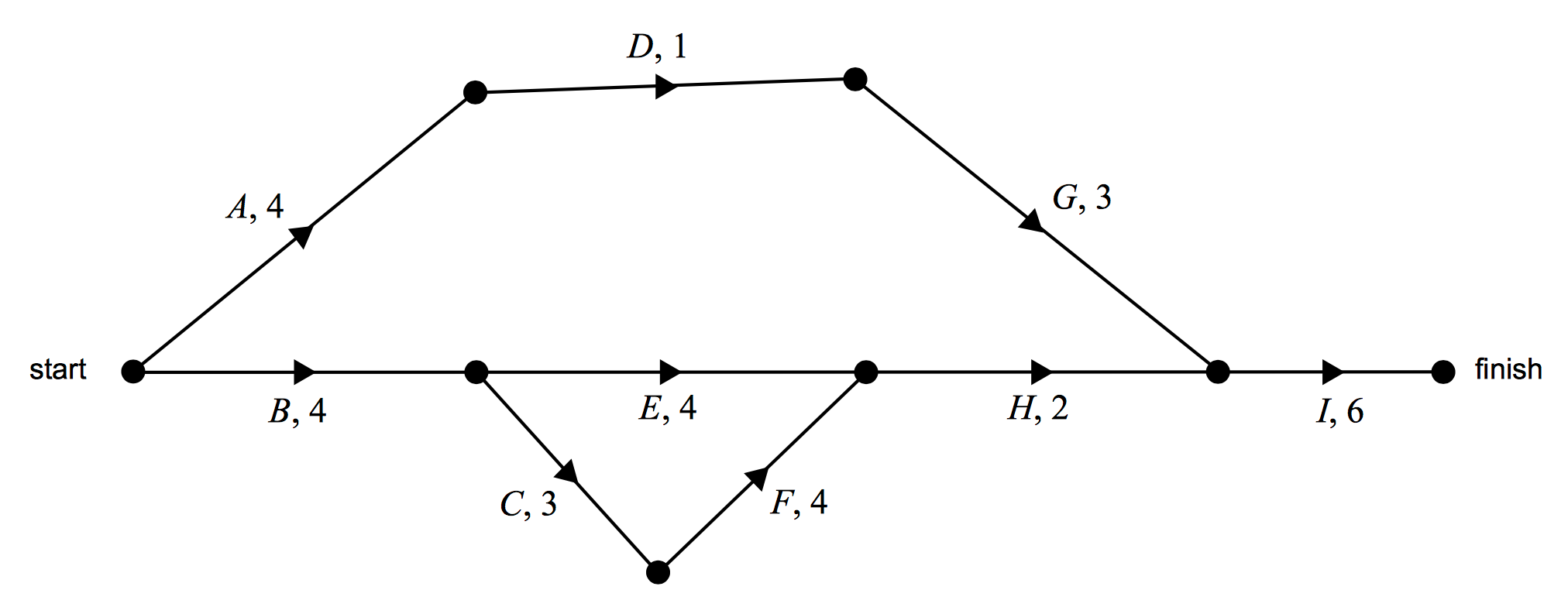
 

  1. Determine the minimum time, in weeks, to complete this project.   (1 mark)

    --- 1 WORK AREA LINES (style=lined) ---

  2. Determine the float time, in weeks, for activity `D`.   (2 marks)

    --- 4 WORK AREA LINES (style=lined) ---

The builders of the community centre are able to speed up the project.

Some of the activities can be reduced in time at an additional cost.

The activities that can be reduced in time are `A, C, F, E` and `G`.

  1. Which of these activities, if reduced in time individually, would not result in an earlier completion of the project?   (1 mark)

    --- 2 WORK AREA LINES (style=lined) ---

The owner of the estate is prepared to pay the additional cost to achieve early completion.

The cost of reducing the time of each activity is $5000 per week.

The maximum reduction in time for each one of the five activities, `A, C, E, F, G`, is 2 weeks.

  1. Determine the minimum time, in weeks, for the project to be completed now that certain activities can be reduced in time.   (1 mark)

    --- 1 WORK AREA LINES (style=lined) ---

  2. Determine the minimum additional cost of completing the project in this reduced time.   (1 mark)

    --- 1 WORK AREA LINES (style=lined) ---

Show Answers Only

a.   `19\ text(weeks)`

b.    `5\ text(weeks)`

c.    `A, E, G`

d.    `text(15 weeks)`

e.    `$25\ 000`

Show Worked Solution

a.    `text(Scanning forwards and backwards:)`
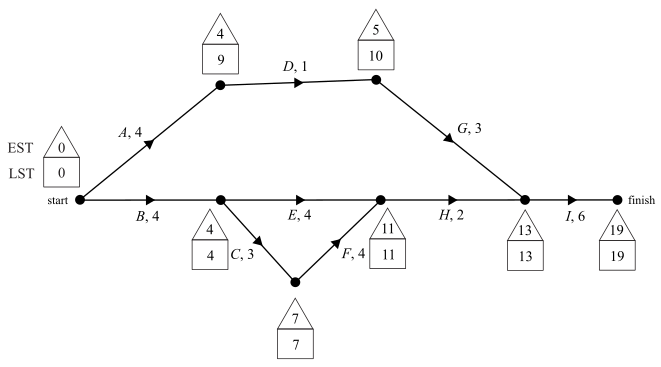


`BCFHI\ \ text(is the critical path.)`

♦ Mean mark of all parts (combined) 40%.

`:.\ text(Minimum time)= 4 + 3 + 4 + 2 + 6= 19\ text(weeks)`

  
b.    `text(EST of)\ D=4`

`text(LST of)\ D=9`

`:.\ text(Float time of)\ D= 9-4= 5\ text(weeks)`
  

c.    `A, E,\ text(and)\ G\ text(are not currently on the critical path,)`

`text(therefore reducing their time will not result in an)`

`text(earlier completion time.)`
 

d.    `text(Reduce)\ C\ text(and)\ F\ text(by 2 weeks each.)`

`text(However, a new critical path created:)\ BEHI\ \ text{(16 weeks)}`

`:.\ text(Also reduce)\ E\ text(by 1 week.)`

`:.\ text(Minimum completion time = 15 weeks)`

  
e.    `text(Additional cost)= 5 xx $5000= $25\ 000`

Filed Under: Critical Path Analysis (Y12), Critical Paths Tagged With: Band 4, Band 5, Band 6, smc-6916-30-Scanning Both Ways, smc-916-30-Scanning Both Ways

Networks, STD2 N3 2009 FUR2 4

A walkway is to be built across the lake.

Eleven activities must be completed for this building project.

The directed network below shows the activities and their completion times in weeks.
 

NETWORKS, FUR2 2009 VCAA 4
 

  1. What is the earliest start time for activity `E`?   (1 mark)

    --- 1 WORK AREA LINES (style=lined) ---

  2. Write down the critical path for this project.   (1 mark)

    --- 1 WORK AREA LINES (style=lined) ---

  3. The project supervisor correctly writes down the float time for each activity that can be delayed and makes a list of these times.


    Determine the longest float time, in weeks, on the supervisor’s list.   (1 mark)

    --- 2 WORK AREA LINES (style=lined) ---

A twelfth activity, `L`, with duration three weeks, is to be added without altering the critical path.

Activity `L` has an earliest start time of four weeks and a latest start time of five weeks.
 

NETWORKS, FUR2 2009 VCAA 4
 

  1. Draw in activity `L` on the network diagram above.   (1 mark)
  2. Activity `L` starts, but then takes four weeks longer than originally planned.


    Determine the total overall time, in weeks, for the completion of this building project.   (1 mark)

    --- 2 WORK AREA LINES (style=lined) ---

Show Answers Only

a.    `7`

b.    `BDFGIK`

c.    `H\ text(or)\ J\ text(can be delayed for)`

`text(a maximum of 3 weeks.)`

 d.

NETWORKS, FUR2 2009 VCAA 4 Answer

e.    `text(25 weeks)`

Show Worked Solution

a.    `7\ text(weeks)`

♦ Mean mark of all parts (combined): 44%.


b.    `text(Scanning forwards and backwards)`


`text(Critical Path is)\ BDFGIK`


c.    `H\ text(or)\ J\ text(can be delayed for a maximum of 3 weeks.)` 

d.     NETWORKS, FUR2 2009 VCAA 4 Answer


e.    `text(The new critical path is)\ BLEGIK.`

`=>\ text(Activity)\ L\ text(now takes 7 weeks.)`

`:.\ text(Time for completion)`

`= 4 + 7 + 1 + 5 + 2 + 6= 25\ text(weeks)`

Filed Under: Critical Paths Tagged With: Band 4, Band 5, Band 6, smc-916-30-Scanning Both Ways, smc-916-40-Critical Path Adjustments

Networks, STD2 N3 2010 FUR1 8 MC

A project has 12 activities. The network below gives the time (in hours) that it takes to complete each activity.
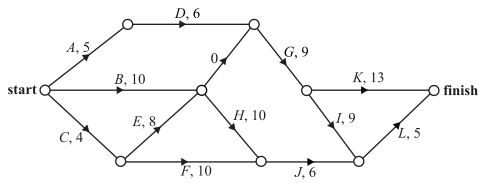


The critical path for this project is

  1. `ADGK`
  2. `ADGIL`
  3. `BHJL`
  4. `CEGIL`
Show Answers Only

`D`

Show Worked Solution

`text(Scanning forward:)`

♦ Mean mark 41%.


`text(Critical path is)\ \ CEGIL`

`=>  D`

Filed Under: Critical Paths Tagged With: Band 6, smc-916-20-Forward Scanning

Networks, STD2 N3 2006 FUR1 9 MC

The network below shows the activities and their completion times (in hours) that are needed to complete a project.
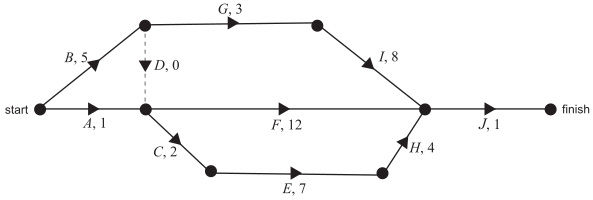


The project is to be optimised by reducing the completion time of one activity only.

This will reduce the completion time of the project by a maximum of

  1. 1 hour 
  2. 3 hours
  3. 4 hours
  4. 5 hours
Show Answers Only

`C`

Show Worked Solution

`text(Scanning forward:)`


`text(Critical path:)`

♦♦♦ Mean mark 17%.
MARKER’S COMMENT: When choosing an activity to crash, take care that a new critical path is not created.

`=> BDCEHJ\ text{(19 hours)}`
 

`text(Other routes not through)\ B,`

`ACEHJ\ text{(15 hours),}\ AFJ\ text{(14 hours)}`
 

`:.\ text(Activity)\ B\ text(could be reduced by 4 hours without)`

`text(a new critical path emerging.)`
 

`=> C`

Filed Under: Critical Path Analysis (Y12), Critical Paths Tagged With: Band 6, smc-6916-20-Forward Scanning, smc-6916-50-Dummy Activity, smc-916-20-Forward Scanning, smc-916-50-Dummy Activity

Networks, FUR2 2007 VCE 3

As an attraction for young children, a miniature railway runs throughout a new housing estate.

The trains travel through stations that are represented by nodes on the directed network diagram below.

The number of seats available for children, between each pair of stations, is indicated beside the corresponding edge.
 

NETWORKS, FUR2 2007 VCAA 3

 
Cut 1, through the network, is shown in the diagram above.

  1. Determine the capacity of Cut 1.  (1 mark)
  2. Determine the maximum number of seats available for children for a journey that begins at the West Terminal and ends at the East Terminal.  (1 mark)

On one particular train, 10 children set out from the West Terminal.

No new passengers board the train on the journey to the East Terminal.

  1. Determine the maximum number of children who can arrive at the East Terminal on this train.  (1 mark)
Show Answers Only
  1. `43`
  2. `22`
  3. `7`
Show Worked Solution

a.   `text(The capacity of Cut 1)`

♦♦ Mean mark for all parts (combined) was 33%.
MARKER’S COMMENT: A common error was counting the edge with “10” in the reverse direction (in part a).

`=14 + 8 + 13 + 8`

`= 43`


b.    networks-fur2-2007-vcaa-3-answer
`text(Maximum seats)` `=\ text(minimum cut)`
  `= 6 + 7 + 9`
  `= 22`


c.  `text{The path (edge weights) of the train setting out with}`

`text(10 children starts with: 11 → 13.)`

`text(At the next station, a maximum of 7 seats are available)`

`text(which remain until the East Terminal.)`
  

`:.\ text(Maximum number of children arriving is 7.)`

Filed Under: Uncategorized Tagged With: Band 5, Band 6

Networks, FUR2 2013 VCE 3

The rangers at the wildlife park restrict access to the walking tracks through areas where the animals breed.

The edges on the directed network diagram below represent one-way tracks through the breeding areas. The direction of travel on each track is shown by an arrow. The numbers on the edges indicate the maximum number of people who are permitted to walk along each track each day.
 

NETWORKS, FUR2 2013 VCAA 31
 

  1. Starting at `A`, how many people, in total, are permitted to walk to `D` each day?  (1 mark)

One day, all the available walking tracks will be used by students on a school excursion.

The students will start at `A` and walk in four separate groups to `D`.

Students must remain in the same groups throughout the walk.

    1. Group 1 will have 17 students. This is the maximum group size that can walk together from `A` to `D`.

      Write down the path that group 1 will take.  (1 mark)

    2. Groups 2, 3 and 4 will each take different paths from `A` to `D`.

      Complete the six missing entries shaded in the table below.  (2 marks)


      NETWORKS, FUR2 2013 VCAA 32

Show Answers Only
  1. `37`
    1. `A  B  E  C  D`
    2.  `text{One possible solution is:}`
      Networks, FUR2 2013 VCAA 3_2 Answer1
Show Worked Solution
a.    `text(Maximum flow)` `=\ text(Minimum cut through)\ CD and ED`
    `= 24 + 13`
    `= 37`
♦ Mean mark of all parts (combined) was 41%.

 
`:.\ text(A maximum of 37 people can walk)`

`text(to)\ D\ text(from)\ A.`


b.i.  `A  B  E  C  D`


b.ii.   `text(One solution using the second possible largest)`

  `text(group of 11 students and two groups from the)`

  `text(remaining 9 students is:)`
  

Networks, FUR2 2013 VCAA 3_2 Answer1

Filed Under: Uncategorized Tagged With: Band 4, Band 5, Band 6

Networks, FUR1 2014 VCE 9 MC

A network of tracks connects two car parks in a festival venue to the exit, as shown in the directed graph below.


The arrows show the direction that cars can travel along each of the tracks and the numbers show each track’s capacity in cars per minute.

Four cuts are drawn on the diagram.

The maximum number of cars per minute that will reach the exit is given by the capacity of

A.  Cut A

B.  Cut B

C.  Cut C

D.  Cut D

Show Answers Only

`text(Cut D is the minimum cut / max flow)`

`=> D`

Show Worked Solution

`text(Cut A and B don’t separate both)`

♦♦♦ Mean mark 24%.
COMMENT: Note that the “4” is not included in Cut D as it is flowing in the opposite direction.

`text(car parks from the exit.)`

`text{Cut D has the minimum cut / maximum}`

`text{flow (18) of the two cuts remaining.}`

`=>  D`

Filed Under: Uncategorized Tagged With: Band 6

Networks, FUR1 2012 VCE 7 MC

Vehicles from a town can drive onto a freeway along a network of one-way and two-way roads, as shown in the network diagram below.

The numbers indicate the maximum number of vehicles per hour that can travel along each road in this network. The arrows represent the permitted direction of travel.

One of the four dotted lines shown on the diagram is the minimum cut for this network.
 

networks-fur1-2012-vcaa-7-mc-1

 
The maximum number of vehicles per hour that can travel through this network from the town onto the freeway is

A.  `330`

B.  `350`

C.  `370`

D.  `390`

Show Answers Only

`B`

Show Worked Solution

`text(Consider each “minimum cut” line,)`

♦♦♦ Mean mark 23%.

`text(Line 1: doesn’t seperate the town and freeway)`

`text(Line 2: 240 + 110 = 350)`

`text(Line 3: 240 + 60 + 90 = 390)`

`text(Line 4: 280 + 90 = 370)`
 

`:.\ text(Line 2 gives the maximum flow)`

`rArr B`

Filed Under: Uncategorized Tagged With: Band 6

Networks, STD2 N2 2009 FUR1 8 MC

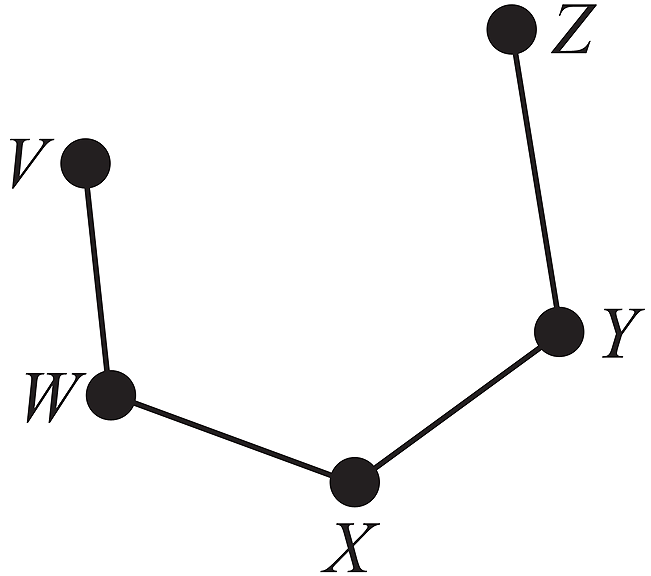
An undirected connected graph has five vertices.

Three of these vertices are of even degree and two of these vertices are of odd degree.

One extra edge is added. It joins two of the existing vertices.

In the resulting graph, it is not possible to have five vertices that are

A.   all of even degree.

B.   all of equal degree.

C.   one of even degree and four of odd degree.

D.   four of even degree and one of odd degree. 

Show Answers Only

`D`

Show Worked Solution

`text(Consider an example of the graph)`

♦♦♦ Mean mark 25%.

`text{described (below):}`
 

matrices-fur1-2009-vcaa-8-mc-answer
 

`A\ text(is possible – join)\ V\ text(and)\ Z`

`B\ text(is possible – join)\ V\ text(and)\ Z`

`C\ text(is possible – join)\ W\ text(and)\ Y`

`D\ text(is NOT possible)`

`=>  D`

Filed Under: Basic Concepts, Network Concepts Tagged With: Band 6, smc-6307-50-Degree of Vertices, smc-912-40-Degrees of Vertices

Number, NAP-K3-NC02 SA

Hendrix is driving from Bundaberg to Caloundra, a distance of 306 kilometres.

When Hendrix gets to the Sunshine Coast, he has 36 kilometres left.

What distance has Hendrix travelled when he gets to the Sunshine Coast?

    kilometres
Show Answers Only

`270`

Show Worked Solution
`text(Distance travelled)` `= 306 – 36`
  `= 270\ text(kilometres)`

Filed Under: Basic Concepts and Calculations, Basic Concepts and Calculations Tagged With: Band 6, smc-3143-20-Basic operators, smc-676-20-Basic operators

Number, NAP-K3-NC01

Jazz buys 4 avocados for $1.20 each.

He pays for the avocados with a $5 note.

How much change should Jazz receive?

`$0.20` `$0.30` `$3.80` `$4.80`


Show Answers Only

`$0.20`

Show Worked Solution

`text(Change) = 5-4xx1.20 = $0.20`

Filed Under: Financial Maths Tagged With: Band 6, smc-900-10-Coins and change

Measurement, NAP-K3-CA10

Sisko is making red cordial for his daughter's birthday party.

Red cordial is made by adding red concentrate with water.

Sisko adds 60 millilitres (mL) of red concentrate to 1 litre (L) of water.

How much red cordial has Sisko made?

`text(61 mL)` `text(160 mL)` `text(1060 mL)` `text(10060 mL)`


Show Answers Only

`text(1060 mL)`

Show Worked Solution

`text(Total volume of red cordial)`

`=1\ text(litre) + 60\ text(mL)`

`=1000 + 60`

`=1060\ text(mL)`

Filed Under: Units of Measurement, Units of Measurement, Units of Measurement Tagged With: Band 6, smc-3152-30-Convert mL/L, smc-3182-30-Convert mL/L, smc-671-30-Convert mL/L

Algebra, NAP-K3-CA08

Raphael is 2 years younger than 3 times his sister's age.

If `s` represents his sister's age, which expression represents Raphael's age?

`2 - 3s` `3s - 2` `3s + 2` `2s - 3`


Show Answers Only

`3s – 2`

Show Worked Solution

`s = text(sister’s age)`

`:.\ text(Raphael’s age = )3s – 2`

Filed Under: Basic Algebra and Rules, Basic Algebra and Rules Tagged With: Band 6, smc-3150-50-Word problems, smc-904-50-Word problems

Geometry, NAP-K3-CA07

Tran uses blocks to make rectangular prisms.
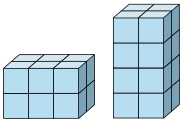


How many blocks does Tran use altogether?

`20` `23` `26` `28`


Show Answers Only

`28`

Show Worked Solution

`text(Total blocks used in both prisms)`

`= 12 + 16`

`= 28`

Filed Under: 2D-3D Shapes, 2D-3D Shapes Tagged With: Band 6, smc-3155-20-Building blocks, smc-673-20-Building blocks

Statistics, NAP-K3-CA06

Clive and Alvin asked their friends how many books they had read in the past month.

Clive draws a picture graph to show the results for his friends.

Alvin draws a column graph to show the results for his friends.
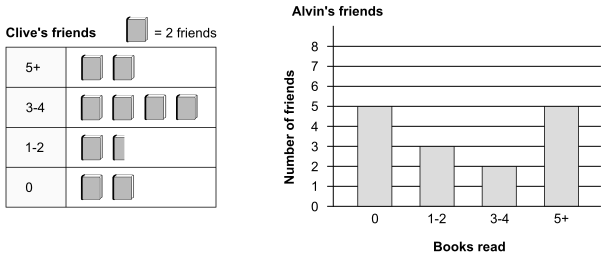


How many more of Clive's friends read 3-4 books in the last month than Alvin's friends?

`0` `4` `6` `8`


Show Answers Only

`6`

Show Worked Solution

`text(Number of Clive’s friends)`

`= 4 xx 2`

`= 8`

`text(Number of Alvin’s friends = 2)`

 
`:. 6\ text(more of Clive’s friends.)`

Filed Under: Data and Interpretation, Data and Statistics (7) Tagged With: Band 6, smc-3166-11-Picture graphs, smc-3166-12-Bar charts, smc-674-11-Picture graphs, smc-674-12-Bar charts

Probability, NAP-K3-CA02

There are 20 raffle tickets, numbered 1 to 20, in a box.

Three prizes are given away by choosing three tickets from the box. One ticket can win one prize only.

The first ticket drawn is number 15 and wins the third prize.

Which of the following is not possible?

 
Second prize is won by number 2.
 
First prize is won by a prime number.
 
Second prize is an even number.
 
First prize is won by number 15.
Show Answers Only

`text(First prize is won by number 15.)`

Show Worked Solution

`text(First prize is won by number 15 is impossible because)`

`text(number 15 has already been chosen and won 3rd prize.)`

`text{(Note that there is no replacement of tickets.)}`

Filed Under: Probability, Probability Tagged With: Band 6, smc-3167-10-Core concepts, smc-675-10-Core concepts

Measurement, NAP-K4-CA02

Kim, Bob and Liz each measure the height of the hedge in their front yards.

  • Kim's hedge is 0.72 metres tall.
  • Bob's hedge is 815 millimetres tall.
  • Liz's hedge is 68 centimetres tall

Who has the tallest hedge in their front yard?

Kim Bob Liz


Show Answers Only

`text(Bob)`

Show Worked Solution

`text(Convert each to centimetres)`

`text(Kim = 0.72 × 100 = 72 centimetres)`

`text(Bob = 815 ÷ 10 = 81.5 centimetres)`

`text(Liz = 68 centimetres)`

 
`:.\ text(Bob’s hedge is the tallest)`

Filed Under: Units of Measurement, Units of Measurement Tagged With: Band 6, smc-3182-20-Convert mm/cm/m/km, smc-671-20-Convert mm/cm/m/km

Calculus, MET1 SM-Bank 17

The diagram shows a point `T` on the unit circle  `x^2+y^2=1`  at an angle `theta` from the positive `x`-axis, where  `0<theta<pi/2`.

The tangent to the circle at  `T`  is perpendicular to  `OT`, and intersects the  `x`-axis at  `P`,  and the line  `y=1`  intersects the  `y`-axis at  `B`


  1. Show that the equation of the line `PT` is  `xcostheta+ysin theta=1`.   (2 marks)

    --- 7 WORK AREA LINES (style=lined) ---

  2. Find the length of `BQ` in terms of `theta`.   (1 mark)

    --- 4 WORK AREA LINES (style=lined) ---

  3. Show that the area, `A`,  of the trapezium `OPQB` is given by 
  4.    `A=(2-sintheta)/(2costheta)`   (2 marks)

    --- 8 WORK AREA LINES (style=lined) ---

  5. Find the angle `theta` that gives the minimum area of the trapezium.   (3 marks)

    --- 10 WORK AREA LINES (style=lined) ---

Show Answers Only
  1. `text{Proof  (See Worked Solutions)}`
  2. `(1-sin theta)/cos theta`
  3. `text{Proof  (See Worked Solutions)}`
  4. `theta=pi/6\ \ text(radians)`
Show Worked Solution
i.

`text(Find)\  T:`

♦♦ Mean mark 20%

`text(S)text(ince)\ \ cos theta=x/1\ \ \ text(and)\ \ \  sin theta=y/1`

`:. T\ (cos theta, sin theta)`

`text(Gradient of)\ OT=sin theta/cos theta`

`:.\ text(Gradient)\ PT=-cos theta/sin theta\ \ text{(} _|_ text{lines)}`

`text(Equation of)\ PT\ text(where)`

`m=-cos theta/sin theta,\ \ text(and through)\ \ (cos theta, sin theta)`

`text(Using)\ \ y-y_1` `=m(x-x_1)`
`y-sin theta` `=-cos theta/sin theta(x-cos theta)`
`y sin theta-sin^2 theta` `=-x cos theta+cos^2 theta`
`x cos theta+y sin theta` `=sin^2 theta+cos^2 theta`
`x cos theta+y sin theta` `=1\ \ \ \ \ text(… as required)`


ii.   `text(Find)\ Q:`

 `Q\ => text(intersection of)\ xcos theta+y sin theta=1\ \ text(and)\ \ y=1`

`x cos theta+sin theta` `=1`
`x cos theta` `=1-sin theta`
`x` `=(1-sin theta)/cos theta`

 
`:.\ text(Length of)\ BQ\ text(is)\ \ (1-sin theta)/cos theta\ text(units)`
 

iii.  `text(Show Area)\ \ OPQB=(2-sin theta)/(2cos theta)`

`A=1/2h(a+b)\ \ text(where)\ \ h=OB=1\ \   a=OP\ \  text(and)`  

                `b=BQ=(1-sin theta)/cos theta`

`text(Find  length)\ OP:`

`P => xcos theta+ysin theta=1 \ text(cuts)\ \ x text(-axis)`

♦♦ Mean mark (iii) 24%
`xcos theta` `=1`
`x` `=1/cos theta`
`=>\ text(Length)\ OP` `=1/cos theta`
`text(Area)\ OPQB` `=1/2xx1(1/cos theta+(1-sin theta)/cos theta)`
  `=1/2((2-sin theta)/cos theta)`
  `=(2-sin theta)/(2cos theta)\ \ text(u²)\ \ \ text(… as required)`


iv.  `text(Find)\ theta\ text(such that Area)\ OPQB\ text(is a MIN)`

`A` `=(2-sin theta)/(2cos theta)`
`(dA)/(d theta)` `=(2cos theta(-cos theta)-(2- sin theta)(-2 sin theta))/(4cos^2 theta)`
  `=(4 sin theta-2sin^2 theta-2 cos^2 theta)/(4 cos^2 theta)`
  `=(4sin theta-2(sin^2 theta+cos^2 theta))/(4 cos^2 theta)`
  `=(4sin theta-2)/(4cos^2 theta)`
  `=(2sin theta-1)/(2 cos^2 theta)`
Mean mark (iv) 19%
IMPORTANT: Look for any opportunity to use the identity `sin^2 theta“+cos^2 theta=1` as it is an examiner’s favourite and can often be the key to simplifying difficult trig equations.
 

`text(MAX or MIN when)\ (dA)/(d theta)=0`

`=>2sin theta-1` `=0`
`sin theta` `=1/2`
`theta` `=pi/6\ \ \ \ \0<theta<pi/2` 

 
`text(Test for MAX/MIN:)`

IMPORTANT: Is the 1st or 2nd derivative test easier here? Students must evaluate and choose. Examiners often make one significantly easier than the other.

`text(If)\ theta=pi/12\ \ (dA)/(d theta)<0`

`text(If)\ theta=pi/3\ \ (dA)/(d theta)>0\ \ =>text(MIN)`

`:.\text(Area)\ OPQB\ text(is a MIN when)\ theta=pi/6`.

Filed Under: Maxima and Minima Tagged With: Band 5, Band 6, smc-641-10-Area

Calculus, MET1 SM-Bank 27

A cone is inscribed in a sphere of radius `a`, centred at `O`. The height of the cone is `x` and the radius of the base is `r`, as shown in the diagram.

  1. Show that the volume, `V`, of the cone is given by
  2.    `V = 1/3 pi(2ax^2-x^3)`.   (2 marks)

    --- 6 WORK AREA LINES (style=lined) ---

  3. Find the value of `x` for which the volume of the cone is a maximum. You must give reasons why your value of `x` gives the maximum volume.   (3 marks)

    --- 9 WORK AREA LINES (style=lined) ---

Show Answers Only
  1. `text(Proof)\ \ text{(See Worked Solutions)}`
  2. `x = 4/3 a`
Show Worked Solution

i.  `text(Show)\ V = 1/3 pi (2ax^2-x^3)`
 

`V = 1/3 pi r^2 h`

`text(Using Pythagoras:)`

`(x-a)^2 + r^2` `= a^2`
`r^2` `= a^2-(x-a)^2`
  `= a^2-x^2 + 2ax-a^2`
  `= 2ax-x^2`
`:. V` `= 1/3 xx pi xx (2ax-x^2) xx x`
  `= 1/3 pi (2ax^2-x^3)\ …\ text(as required)`


ii.  `(dV)/(dx) = 1/3 pi (4ax-3x^2)`

`(d^2V)/(dx^2) = 1/3 pi (4a-6x)`

`text(Max or min when)\ (dV)/(dx) = 0`

`1/3 pi (4ax-3x^2)` `= 0`
`4ax-3x^2` `= 0`
`x(4a-3x)` `= 0`
`3x` `= 4a,` ` \ \ \ \ x ≠ 0`
`x` ` =4/3 a`  

 
`text(When)\ \ x = 4/3 a`

`(d^2V)/(dx^2)` `= 1/3 pi (4a-6 xx 4/3 a)`
  `= 1/3 pi (-4a) < 0`
`=>\ text(MAX)`

 
`:.\ text(Cone volume is a maximum when)\ \ x = 4/3 a.`

Filed Under: Maxima and Minima Tagged With: Band 5, Band 6, smc-641-30-Volume (Circular measure)

Calculus, MET1 SM-Bank 35


The diagram shows two parallel brick walls `KJ` and `MN` joined by a fence from `J` to `M`.  The wall `KJ` is `s` metres long and  `/_KJM=alpha`.  The fence `JM` is `l` metres long.

A new fence is to be built from `K` to a point `P` somewhere on `MN`.  The new fence `KP` will cross the original fence `JM` at `O`.

Let  `OJ=x`  metres, where  `0<x<l`.

  1. Show that the total area, `A`  square metres, enclosed by `DeltaOKJ` and `DeltaOMP` is given by
  2.    `A=s(x-l+l^2/(2x))sin alpha`.   (3 marks)

    --- 9 WORK AREA LINES (style=lined) ---

  3. Find the value of `x` that makes `A` as small as possible. Justify the fact that this value of `x` gives the minimum value for `A`.   (3 marks)

    --- 9 WORK AREA LINES (style=lined) ---

  4. Hence, find the length of `MP` when `A` is as small as possible.   (1 mark)

    --- 5 WORK AREA LINES (style=lined) ---

Show Answers Only
  1. `text{Proof  (See Worked Solutions)}`
  2. `l/sqrt2`
  3. `(sqrt2-1)s\ \ text(metres)`
Show Worked Solution
i.

`A=text(Area)\  Delta OJK+text(Area)\ Delta OMP`

♦♦♦ Students found this question extremely challenging (exact results not available).

`text(Using sine rule)`

`text(Area)\ Delta OJK=1/2\ x s sin alpha` 

`text(Area)\ DeltaOMP =>text(Need to find)\ \ MP`

`/_OKJ` `=/_MPO\ \ text{(alternate angles,}\ MP\ text(||)\ KJtext{)}`
`/_PMO` `=/_OJK=alpha\ \ text{(alternate angles,}\ MP\ text(||)\ KJtext{)}`

`:.\ DeltaOJK\ text(|||)\ Delta OMP\ \ text{(equiangular)}`

`=>x/s` `=(l-x)/(MP)\ ` ` text{(corresponding sides of similar triangles)}`
`MP` `=(l-x)/x *s`  
`text(Area)\ Delta\ OMP` `=1/2 (l-x)* MP * sin alpha`
  `=1/2 (l-x)*((l-x))/x* s  sin alpha`
`:. A`  `=1/2 x*s sin alpha+1/2 (l-x)*((l-x))/x* s sin alpha`
  `=s sin alpha(1/2 x+1/2 (l-x)*((l-x))/x)`
  `=s sin alpha(1/2 x+(l-x)^2/(2x))`
  `=s sin alpha(1/2 x+l^2/(2x)-l+1/2 x)`
  `=s(x-l+l^2/(2x))sin alpha\ \ \ \ text(… as required)`


ii.   `text(Find)\ x\ text(such that)\ A\ text(is a minimum)`

MARKER’S COMMENT: Students who could not complete part (i) are reminded that they can still proceed to part (ii) and attempt to differentiate the result given.
Note that `l` and `alpha` are constants when differentiating. 
`A` `=s(x-l+l^2/(2x))sin alpha`
`(dA)/(dx)` `=s(1-l^2/(2x^2))sin alpha`

 
`text(MAX/MIN when)\ (dA)/(dx)=0`

`s(1-l^2/(2x^2))sin alpha` `=0`
`l^2/(2x^2)` `=1`
`2x^2` `=l^2`
`x^2` `=l^2/2`
`x` `=l/sqrt2,\ \ \ x>0`


`(d^2A)/(dx^2)=s((l^2)/(2x^3))sin alpha`

`text(S)text(ince)\ \ 0<alpha<90°\ \ =>\ sin alpha>0,\ \ l>0\ \ text(and)\ \  x>0`

`(d^2A)/(dx^2)>0\ \ \ =>text(MIN at)\ \ x=l/sqrt2`
 

iii.   `text(S)text(ince)\ \ MP=((l-x))/x s\ \ text(and MIN when)\ \ x=l/sqrt2`

`MP` `=((l-l/sqrt2)/(l/sqrt2))s xx sqrt2/sqrt2`
  `=((sqrt2 l-l))/l s`
  `=(sqrt2-1)s\ \ text(metres)`

 
`:.\ MP=(sqrt2-1)s\ \ text(metres when)\ A\ text(is a MIN.)`

Filed Under: Maxima and Minima Tagged With: Band 4, Band 5, Band 6, smc-641-10-Area

Calculus, MET1 SM-Bank 30

A function is given by  `f(x) = 3x^4 + 4x^3-12x^2`.

  1. Find the coordinates of the stationary points of  `f(x)`  and determine their nature.   (3 marks)

    --- 9 WORK AREA LINES (style=lined) ---

  2. Hence, sketch the graph  `y = f(x)`  showing the stationary points.   (2 marks)

    --- 6 WORK AREA LINES (style=lined) ---

  3. For what values of `x` is the function increasing?   (1 mark)

    --- 2 WORK AREA LINES (style=lined) ---

  4. For what values of `k` will  `f(x) = 3x^4 + 4x^3-12x^2 + k = 0`  have no solution?   (1 mark)

    --- 3 WORK AREA LINES (style=lined) ---
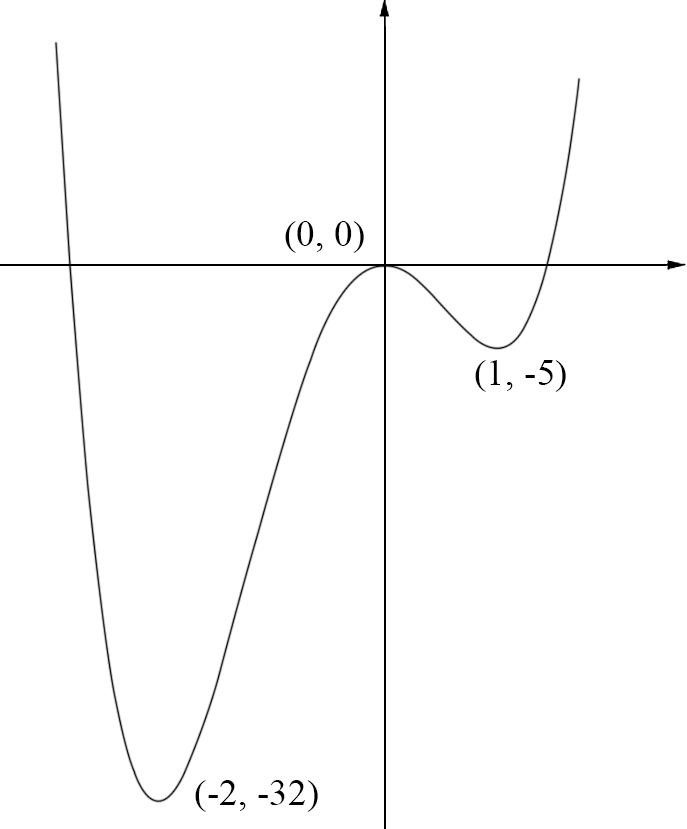
Show Answers Only
  1. `text(MAX at)\ (0,0)`
  2. `text(MIN at)\ text{(1,–5)}`
  3. `text(MIN at)\ text{(–2,–32)}`
  4. 2UA HSC 2012 14ai
     
  5. `f(x)\ text(is increasing for)\ -2 < x < 0\ text(and)\ x > 1`
  6. `text(No solution when)\ k > 32`
Show Worked Solution
i. `f(x)` `= 3x^4 + 4x^3 -12x^2`
  `f^{′}(x)` `= 12x^3 + 12x^2-24x`
  `f^{″}(x)` `= 36x^2 + 24x-24`


`text(Stationary points when)\ f prime (x) = 0`

`=> 12x^3 + 12x^2-24x` `=0`
`12x(x^2 + x-2)` `=0`
`12x (x+2) (x -1)` `=0`


`:.\ text(Stationary points at)\ x=0,\ 1\ text(or)\ –2`

`text(When)\ x=0,\ \ \ \ f(0)=0`
`f^{″}(0)` `= -24 < 0`
`:.\ text{MAX at  (0,0)}`


`text(When)\ x=1`

`f(1)` `= 3+4\-12 = -5`
`f^{″}(1)` `= 36 + 24\-24 = 36 > 0`
`:.\ text{MIN at  (1,–5)}`


`text(When)\ x=–2`

`f(–2)` `=3(–2)^4 + 4(–2)^3-12(–2)^2`
  `= 48 -32\-48`
  `= -32`
`f^{″}(–2)` `= 36(–2)^2 + 24(–2) -24`
  `=144-48-24 = 72 > 0`
`:.\ text{MIN at  (–2,–32)}`


ii.  2UA HSC 2012 14ai


♦ Mean mark (HSC) 42%
MARKER’S COMMENT: Be careful to use the correct inequality signs, and not carelessly include `>=` or `<=` by mistake.


iii. `f(x)\ text(is increasing for)`
  `-2 < x < 0\ text(and)\ x > 1`


iv.   `text(Find)\ k\ text(such that)`

♦♦♦ Mean mark (HSC) 12%.

`3x^4 + 4x^3-12x^2 + k = 0\ \ text(has no solution)`

`k\ text(is the vertical shift of)\ \ y = 3x^4 + 4x^3-12x^2`

`=>\ text(No solution if it does not cross the)\ x text(-axis.)`

`:.\ text(No solution when)\ \ k > 32`

Filed Under: Curve Sketching Tagged With: Band 4, Band 5, Band 6, smc-724-20-Degree 4, smc-724-60-Increasing/Decreasing intervals

Calculus, 2ADV C3 EQ-Bank 34

The figure shown represents a wire frame where `ABCE` is a convex quadrilateral. The point `D` is on line segment `EC` with  `AB = ED = 2\ text(cm)` and  `BC = a\ text(cm)`, where `a` is a positive constant.

`/_ BAE = /_ CEA = pi/2`

Let  `/_ CBD = theta`  where  `0 < theta < pi/2.`
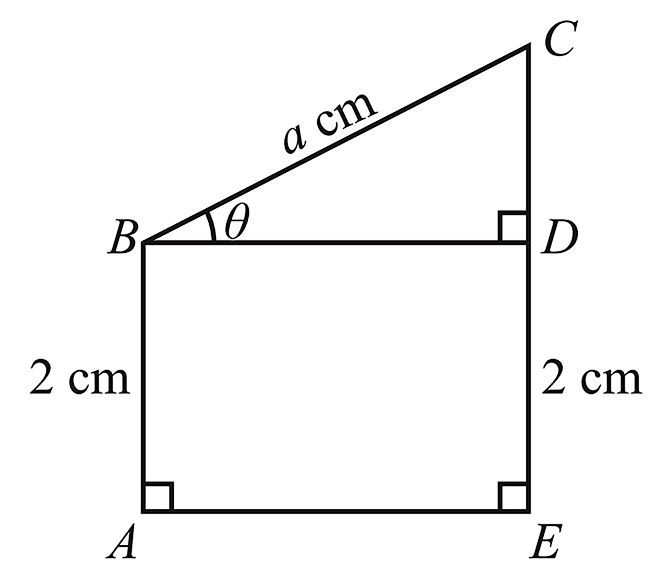
 

 vcaa-2011-meth-10a

  1. Find `BD` and `CD` in terms of `a` and `theta`.   (2 marks)

    --- 5 WORK AREA LINES (style=lined) ---

  2. Find the length, `L` cm, of the wire in the frame, including length `BD`, in terms of `a` and `theta`.   (1 mark)

    --- 2 WORK AREA LINES (style=lined) ---

  3. Find  `(dL)/(d theta)`, and hence show that  `(dL)/(d theta) = 0` when  `BD = 2CD`.   (2 marks)

    --- 5 WORK AREA LINES (style=lined) ---

  4. Find the maximum value of `L` if  `a = 3 sqrt 5`.   (1 mark)

    --- 2 WORK AREA LINES (style=lined) ---

Show Answers Only

a.    `BD = a cos theta,\ \ \ CD = a sin theta`

b.    `L = 4 + a + 2 a cos theta + a sin theta`

c.    `text(Proof)\ text{(See Worked Solutions)}`

d.    `L_max = 19 + 3 sqrt 5`

Show Worked Solution

a.   `text(In)\ \ Delta BCD:`

`cos theta= (BD)/a\ \ =>\ \ BD= a cos theta`

`sin theta= (CD)/a\ \ =>\ \ CD= a sin theta`
 

b.     `L` `= 4 + 2 BD + CD + a`
    `= 4 + 2a cos theta + a sin theta + a`
    `= 4 + a + 2a cos theta + a sin theta`


c.    `text(Noting that)\ a\ text(is a constant:)`

♦ Mean mark (c) 35%.

`(dL)/(d theta)= – 2 a sin theta + a cos theta`

`text(When)\ \ (dL)/(d theta) = 0`,

`- 2 a sin theta+ a cos theta` `= 0`
`a cos theta` `= 2 a sin theta`
`:.  BD` `= 2CD\ \ text{(using part (a))}`


d.    `text(SP’s when)\ \ (dL)/(d theta)=0,`

♦♦♦ Mean mark (d) 5%.
`- 2 a sin theta+ a cos theta` `= 0`
`sin theta` `=1/2 cos theta`
`tan theta` `=1/2`


 vcaa-2011-meth-10ai

`text(If)\ \ tan theta=1/2,\ \ cos theta = 2/sqrt5,\ \ sin theta = 1/sqrt5`

`L_(max)` `= 4 + a + 2a cos theta + a sin theta`
  `= 4 + (3 sqrt 5) + 2 (3 sqrt 5) (2/sqrt 5) + (3 sqrt 5) (1/sqrt 5)`
  `= 4 + 3 sqrt 5 + 12 + 3`
  `= 19 + 3 sqrt 5\ text(cm)`

Filed Under: Maxima and Minima, Maxima and Minima, Optimisation Tagged With: Band 4, Band 5, Band 6, smc-7134-60-Other Themes, smc-970-60-Other Themes

NETWORKS, FUR2 2017 VCAA 4

The rides at the theme park are set up at the beginning of each holiday season.

This project involves activities A to O.

The directed network below shows these activities and their completion times in days.
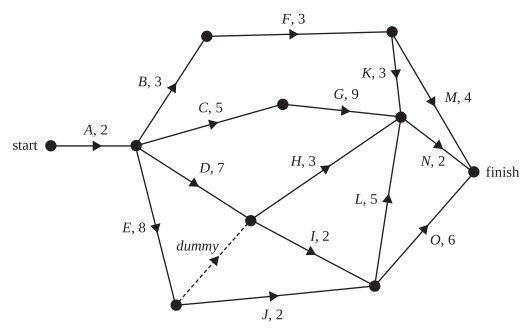
  1. Write down the two immediate predecessors of activity I.   (1 mark)

    --- 1 WORK AREA LINES (style=lined) ---

  2. The minimum completion time for the project is 19 days.


     i.  There are two critical paths. One of the critical paths is A–E–J–L–N.
    Write down the other critical path.   (1 mark)

    --- 1 WORK AREA LINES (style=lined) ---

    ii.  Determine the float time, in days, for activity F.   (1 mark)

    --- 2 WORK AREA LINES (style=lined) ---

  3. The project could finish earlier if some activities were crashed.


    Six activities, B, D, G, I, J and L, can all be reduced by one day.


    The cost of this crashing is $1000 per activity.


     i.  What is the minimum number of days in which the project could now be completed?   (1 mark)

    --- 4 WORK AREA LINES (style=lined) ---

    ii.  What is the minimum cost of completing the project in this time?   (1 mark)

    --- 3 WORK AREA LINES (style=lined) ---
Show Answers Only

a.     `D\ text(and)\ E`

b.i.   `A E I L N`

b.ii.   `6\ text(days)`

c.i.    `17`

c.ii.    `$4000`

Show Worked Solution

a.   `D\ text(and)\ E\ (text(note the dummy is not an activity.))`
  

b.i.   `A  E  I  L  N`

♦♦ Mean mark part (b)(i) 44% and part (b)(ii) 28%.
  

b.ii.    `text(Float time)` `= 19-(2 + 3 + 3 + 3 + 2)`
    `= 6\ text(days)`

  
c.i. 
 `text(Reduce activities:)\ I, J, L\ \ (text(on critical path))`

♦♦ Mean mark part (c)(i) 35%.

 `text(New critical path)\ \ A C G N\ \ text(takes 18 days.)`

`:. text(Reduce activity)\ G\ text(also.)`

`text(⇒ this critical path reduces to 17 days.)`

`text(⇒ Minimum Days = 17)`
  

c.ii.   `text(Minimum time requires crashing)\ \ I, J, L\ text(and)\ G`

♦♦♦ Mean mark part (c)(ii) 15%.

`:.\ text(Minimum Cost)` `= 4 xx 1000`
  `= $4000`

Filed Under: Critical Path Analysis Tagged With: Band 4, Band 5, Band 6, smc-621-30-Float time/LST, smc-621-40-Crashing/Reduce completion time

MATRICES, FUR2 2017 VCAA 3

Senior students at a school choose one elective activity in each of the four terms in 2018.

Their choices are communication (`C`), investigation (`I`), problem-solving (`P`) and service (`S`).

The transition matrix `T` shows the way in which senior students are expected to change their choice of elective activity from term to term.
 

`{:(qquadqquadqquadqquadquadtext(this term)),(qquadqquadqquad\ CqquadquadIqquadquadPqquad\ S),(T = [(0.4,0.2,0.3,0.1),(0.2,0.4,0.1,0.3),(0.2,0.3,0.3,0.4),(0.2,0.1,0.3,0.2)]{:(C),(I),(P),(S):}qquadtext(next term)):}`
 

Let `S_n` be the state matrix for the number of senior students expected to choose each elective activity in Term `n`.

For the given matrix `S_1`, a matrix rule that can be used to predict the number of senior students in each elective activity in Terms 2, 3 and 4 is
 

`S_1 = [(300),(200),(200),(300)],qquadS_(n + 1) = TS_n`
 

  1. How many senior students will not change their elective activity from Term 1 to Term 2?   (1 mark)

    --- 2 WORK AREA LINES (style=lined) ---

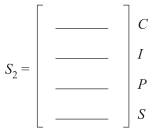
  2. Complete `S_2`, the state matrix for Term 2, below.   (1 mark)

    --- 3 WORK AREA LINES (style=lined) ---


  3. Of the senior students expected to choose investigation (`I`) in Term 3, what percentage chose service (`S`) in Term 2?   (2 marks)

    --- 5 WORK AREA LINES (style=lined) ---

  4. What is the maximum number of senior students expected in investigation (`I`) at any time during 2018?   (1 mark)

    --- 3 WORK AREA LINES (style=lined) ---

Show Answers Only
  1. `320`
  2.  
    `S_2 = [(250),(250),(300),(200)]`
  3. `text(25%)`
  4. `250`
Show Worked Solution

a.   `text(Students who do not change)`

♦ Mean mark 47%.

`= 0.4 xx 300 + 0.4 xx 200 + 0.3 xx 200 + 0.2 xx 300`

`= 120 + 80 + 60 + 60`

`= 320`


b.    `S_2 = TS_1` `= [(0.4,0.2,0.3,0.1),(0.2,0.4,0.1,0.3),(0.2,0.3,0.3,0.4),(0.2,0.1,0.3,0.2)][(300),(200),(200),(300)]`
    `= [(250),(250),(300),(200)]`


c.    `S_3` `= TS_2`
    `= [(260),(240),(295),(205)]`

♦♦♦ Mean mark 13%.
MARKER’S COMMENT: A poorly understood and answered question worthy of careful attention.

`text(Number)\ (I)\ text(in Term 3 = 240)`

`text(Number)\ (S)\ text(in Term 2 = 200)`

`text(S)text(ince 30% move from)\ S\ text(to)\ I\ text(each term:)`

`text(Percentage)` `= (0.3 xx 200)/240`
  `= 60/240`
  `= 25text(%)`


d.    `S_4` `= TS_3`
    `= [(261),(239),(294.5),(205.5)]`

♦ Mean mark 43%.

`:. text(Max number of)\ (I)\ text(students is 250.)`

`(text(During term 2))`

Filed Under: Transition Matrices - Regular Tagged With: Band 4, Band 5, Band 6, smc-618-30-State Matrix in discrete period, smc-618-62-4x4 Matrix

CORE, FUR2 2017 VCAA 4

The eggs laid by the female moths hatch and become caterpillars.

The following time series plot shows the total area, in hectares, of forest eaten by the caterpillars in a rural area during the period 1900 to 1980.

The data used to generate this plot is also given.
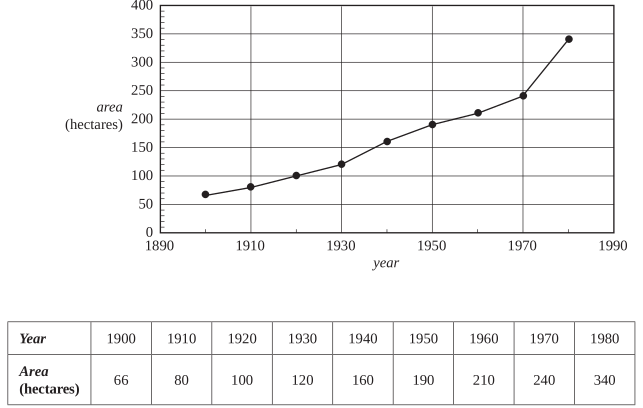
 

The association between area of forest eaten by the caterpillars and year is non-linear.

A log10 transformation can be applied to the variable area to linearise the data.

  1. When the equation of the least squares line that can be used to predict log10 (area) from year is determined, the slope of this line is approximately 0.0085385
  2. Round this value to three significant figures.   (1 mark)
  3. Perform the log10 transformation to the variable area and determine the equation of the least squares line that can be used to predict log10 (area) from year.
  4. Write the values of the intercept and slope of this least squares line in the appropriate boxes provided below.
  5. Round your answers to three significant figures.  (2 marks)

    --- 0 WORK AREA LINES (style=lined) ---

The least squares line predicts that the log10 (area) of forest eaten by the caterpillars by the year 2020 will be approximately 2.85

  1. Using this value of 2.85, calculate the expected area of forest that will be eaten by the caterpillars by the year 2020.
  2.  i. Round your answer to the nearest hectare.   (1 mark)

    --- 2 WORK AREA LINES (style=lined) ---

  3. ii. Give a reason why this prediction may have limited reliability.   (1 mark)

    --- 2 WORK AREA LINES (style=lined) ---

Show Answers Only

a.  `0.00854\ (text(3 sig fig))`

b.  `log_10(text(area)) = −14.4 + 0.000854 xx text(year)`

c.i.  `708\ text(hectares)`

c.ii. `text(This prediction extrapolates significantly from the given)`
        `text(data range and as a result, its reliability decreases.)`

Show Worked Solution

a.   `0.0085385 = 0.00854\ (text(3 sig fig))`

♦ Mean marks of part (a) and (b) 44%.


b.    `log_10(text(area))` `= −14.4 + 0.000854 xx text(year)`


♦♦ Mean mark part (c)(i) 29%.
COMMENT: When the question specifies using the value 2.85, use it!

c.i.    `log_10(text(Area))` `= 2.85`
  `:.\ text(Area)` `= 10^2.85`
    `= 707.94…`
    `= 708\ text(hectares)`


c.ii.   `text(This prediction extrapolates significantly from the given)`

  `text(data range and as a result, its reliability decreases.)`

Filed Under: Correlation and Regression Tagged With: Band 4, Band 5, Band 6, smc-265-60-Extrapolation / Interpolation, smc-265-70-Linearise - log10, smc-265-80-Rounding (Sig Fig)

Calculus, 2ADV C3 EQ-Bank 34

The graph of  `f(x) = sqrt x (1-x)`  for  `0<=x<=1`  is shown below.
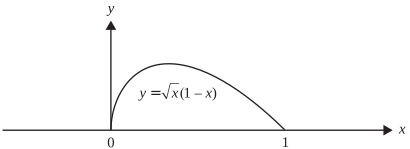
 

  1. Calculate the area between the graph of `f(x)` and the `x`-axis.   (2 marks)

    --- 5 WORK AREA LINES (style=lined) ---

  2. For `x` in the interval `(0, 1)`, show that the gradient of the tangent to the graph of `f(x)` is  `(1-3x)/(2 sqrt x)`.   (1 mark)

    --- 2 WORK AREA LINES (style=lined) ---

The edges of the right-angled triangle `ABC` are the line segments `AC` and `BC`, which are tangent to the graph of  `f(x)`, and the line segment `AB`, which is part of the horizontal axis, as shown below.

Let `theta` be the angle that `AC` makes with the positive direction of the horizontal axis.
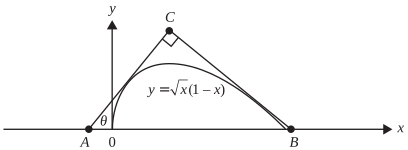
 

  1. Find the equation of the line through `B` and `C` in the form  `y = mx + c`, for  `theta = 45^@`.   (3 marks)

    --- 6 WORK AREA LINES (style=lined) ---

Show Answers Only

a.    `4/15\ text(units)^2`

b.    `text(Proof)\ \ text{(See Worked Solutions)}`

c.    `y = -x + 1`

Show Worked Solution
a.     `text(Area)` `= int_0^1 (sqrt x-x sqrt x)\ dx`
    `= int_0^1 (x^(1/2)-x^(3/2))\ dx`
    `= [2/3 x^(3/2)-2/5 x^(5/2)]_0^1`
    `= (2/3-2/5)-(0-0)`
    `= 10/15-6/15`
    `= 4/15\ text(units)^2`


b.     `f (x)` `= x^(1/2)-x^(3/2)`
  `f^{prime}(x)` `= 1/2 x^(-1/2)-3/2 x^(1/2)`
    `= 1/(2 sqrt x)-(3 sqrt x)/2`
    `= (1-3x)/(2 sqrt x)\ \ text(.. as required.)`


c.    `m_(AC) = tan 45^@=1`

♦♦♦ Mean mark (Vic) part (c) 20%.
MARKER’S COMMENT: Most successful answers introduced a pronumeral such as  `a=sqrtx`  to solve.

`=> m_(BC) =-1\ \ (m_text(BC) _|_ m_(AC))`

 
`text(At point of tangency of)\ BC,\  f^{prime}(x) =-1`

`(1-3x)/(2 sqrt x)` `=-1`
`1-3x` `=-2sqrtx`
`3x-2sqrt x-1` `=0`

 
`text(Let)\ \ a=sqrtx,`

`3a^2-2a-1` `=0`
`(3a+1)(a-1)` `=0`
`a=1 or -1/3`   
`:. sqrt x` `=1` `or`   `sqrt x=-1/3\ \ text{(no solution)}`
`x` `=1`    

 
`f(1)=sqrt1(1-1)=0\ \ =>B(1,0)`
 

`text(Equation of)\ \ BC, \ m=-1, text{through (1,0):}`

`y-0` `=-1(x-1)`
`y` `=-x+1`

Filed Under: Area Under Curves, Areas Under Curves, Tangents, Tangents and Normals Tagged With: Band 4, Band 5, Band 6, smc-1090-10-Find tangent given curve, smc-1090-65-Other Function, smc-7131-60-Other, smc-975-60-Other

Algebra, MET2 2017 VCAA 4

Let  `f : R → R :\  f (x) = 2^(x + 1)-2`. Part of the graph of  `f` is shown below.
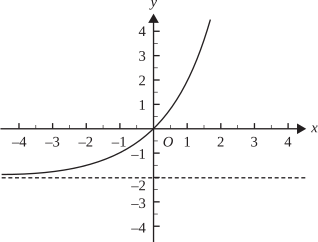
 

  1. The transformation  `T: R^2 -> R^2, \ T([(x),(y)]) = [(x),(y)] + [(c),(d)]`  maps the graph of  `y = 2^x`  onto the graph of  `f`.


    State the values of `c` and `d`.   (2 marks)

    --- 5 WORK AREA LINES (style=lined) ---

  2. Find the rule and domain for  `f^(-1)`, the inverse function of  `f`.   (2 marks)

    --- 5 WORK AREA LINES (style=lined) ---

  3. Find the area bounded by the graphs of  `f` and  `f^(-1)`.   (3 marks)

    --- 3 WORK AREA LINES (style=lined) ---
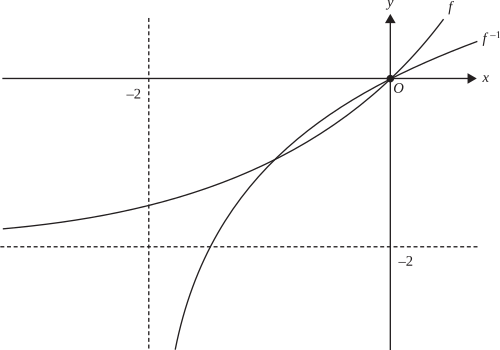
  4. Part of the graphs of  `f` and  `f^(-1)` are shown below.


    Find the gradient of  `f` and the gradient of  `f^(-1)`  at  `x = 0`.   (2 marks)

    --- 2 WORK AREA LINES (style=lined) ---

The functions of  `g_k`, where  `k ∈ R^+`, are defined with domain `R` such that  `g_k(x) = 2e^(kx)-2`.

  1. Find the value of `k` such that  `g_k(x) = f(x)`.  (1 mark)

    --- 3 WORK AREA LINES (style=lined) ---

  2. Find the rule for the inverse functions  `g_k^(-1)` of  `g_k`, where  `k ∈ R^+`.   (1 mark)

    --- 5 WORK AREA LINES (style=lined) ---
  3. i. Describe the transformation that maps the graph of  `g_1` onto the graph of  `g_k`.   (1 mark)

    --- 3 WORK AREA LINES (style=lined) ---

    ii. Describe the transformation that maps the graph of  `g_1^(-1)` onto the graph of  `g_k^(-1)`.   (1 mark)

    --- 3 WORK AREA LINES (style=lined) ---

  4. The lines `L_1` and `L_2` are the tangents at the origin to the graphs of  `g_k`  and  `g_k^(-1)`  respectively.
  5. Find the value(s) of `k` for which the angle between `L_1` and `L_2` is 30°.   (2 marks)

    --- 6 WORK AREA LINES (style=lined) ---

  6. Let `p` be the value of `k` for which  `g_k(x) = g_k^(−1)(x)`  has only one solution.
  7.  i. Find `p`.   (2 marks)

    --- 4 WORK AREA LINES (style=lined) ---

  8. ii. Let  `A(k)`  be the area bounded by the graphs of  `g_k`  and  `g_k^(-1)`  for all  `k > p`.
  9.     State the smallest value of `b` such that  `A(k) < b`.   (1 mark)

    --- 4 WORK AREA LINES (style=lined) ---

Show Answers Only
a.  `c =-1, \ d =-2`

b.  `f^(-1)(x) = log_2 (x + 2)-1, \ x ∈ (-2,∞)`

c.  `3-2/(log_e(2))\ text(units)²`

d. `f^{prime}(0)= 2log_e(2) and f^(-1)^{prime}(0)= 1/(2log_e(2))`

e.  `k = log_e(2)`

f.  `g_k^(-1)(x)= 1/k log_e((x + 2)/2)`

g.i.  `text(Dilation by factor of)\ 1/k\ text(from the)\ ytext(-axis)`

g.ii.  `text(Dilation by factor of)\ 1/k\ text(from the)\ xtext(-axis)`

h.  `k=sqrt3/6\ or\ sqrt3/2`

i.i.  `p = 1/2`

i.ii.  `b=4`

Show Worked Solution

a.   `text(Using the matrix transformation:)`

`x^{prime}` `=x+c\ \ => x=x^{prime}-c`
`y^{prime}` `=y+d\ \ =>y= y^{prime}-d`
   
`y^{prime}-d` `=2^((x)^{prime}-c)`
`y^{prime}` `= 2^((x)^{prime}-c)+d`


`:. c = -1, \ d = -2`


b.   `text(Let)\ \ y = f(x)`

`text(Inverse : swap)\ x\ ↔ \ y`

`x` `= 2^(y + 1)-2`
`x + 2` `= 2^(y + 1)`
`y + 1` `= log_2(x + 2)`
`y` `= log_2(x + 2)-1`


`text(dom)(f^(-1)) = text(ran)(f)`

`:. f^(-1)(x) = log_2 (x + 2)-1, \ x ∈ (-2,∞)`


c.   `text(Intersection points occur when)\ \ f(x)=f^(-1)(x)`

MARKER’S COMMENT: Specifically recommends using  `f^(-1)(x)-f(x)`  in this type of integral to avoid errors in stating the integral.

`x` `= -1, 0`


`text(Area)` `= int_(-1)^0 (f^(-1)(x)-f(x))\ dx`
  `= 3-2/(log_e(2))\ text(units)²`


d.    `f^{prime}(0)` `= 2log_e(2)`
  `f^{(-1)^prime}(0)` `= 1/(2log_e(2))`


e.   `g_k(x) = 2e^(kx)-2`

`text(Solve:)\ \ g_k(x) = f(x)quad text(for)\ k ∈ R^+`

`:. k = log_e(2)`


f.   `text(Let)\ \ y = g_k(x)`

`text(Inverse : swap)\ x\ text(and)\ y`

`x` `= 2e^(ky)-2`
`e^(ky)` `=(x+2)/2`
`ky` `=log_e((x+2)/2)`
`:. g_k^(-1)(x)` `= 1/k log_e((x + 2)/2)`


♦♦ Mean mark part (g)(i) 31%.

g.i.    `g_1(x)` `= 2e^x-2`
  `g_k(x)` `= 2e^(kx)-2`

 
`:. text(Dilation by factor of)\ 1/k\ text(from the)\ ytext(-axis)`


♦♦ Mean mark part (g)(ii) 30%.

g.ii.    `g_1^(-1)(x)` `= log_e((x + 2)/2)`
  `g_k^(-1)(x)` `= 1/klog_e((x + 2)/2)`

 
`:. text(Dilation by factor of)\ 1/k\ text(from the)\ xtext(-axis)`


h.   `text(When)\ \ x=0,`

♦♦♦ Mean mark part (h) 13%.

`g_k^{prime}(0)=2k\ \ => m_(L_1)=2k`

`g_k^{(-1)^prime}(0)=1/(2k)\ \ => m_(L_2)=1/(2k)`


`text(Using)\ \ tan 30^@=|(m_1-m_2)/(1+m_1m_2)|,`

`text(Solve:)\ \ 1/sqrt3` `=+- ((2k-1/(2k)))/2\ \ text(for)\ k`

 
`:. k=sqrt3/6\ or\ sqrt3/2`


i.i   `text(By inspection, graphs will touch once if at)\ \ x=0,`

♦♦♦ Mean mark part (i)(i) 4%.

`m_(L_1)` `=m_(L_2)`
`2k` `=1/(2k)`
`k` `=1/2,\ \ (k>0)`

 
`:. p = 1/2`


i.ii  `text(As)\ k→oo, text(the graph of)\ g_k\ text(approaches)\ \ x=0`

♦♦♦ Mean mark part (i)(ii) 2%.

`text{(vertically) and}\ \ y=-2\ \ text{(horizontally).}`

`text(Similarly,)\ \ g_k^(-1)\ \ text(approaches)\ \ x=-2`

`text{(vertically) and}\ \ y=0\ \ text{(horizontally).}`


`:. lim_(k→oo) A(k) = 4`

`:.b=4`

Filed Under: Area Under Curves, Logs and Exponential Functions, Tangents and Normals, Transformations Tagged With: Band 4, Band 5, Band 6, page-break-before-question, smc-5204-50-Find intersection, smc-634-20-Log/Exp Function, smc-634-80-Angle between tangents/axes, smc-723-50-Log/Exponential, smc-723-80-Area between graphs, smc-753-20-Dilation (Only), smc-753-60-Matrix

Probability, MET2 2017 VCAA 3

The time Jennifer spends on her homework each day varies, but she does some homework every day.

The continuous random variable `T`, which models the time, `t,` in minutes, that Jennifer spends each day on her homework, has a probability density function `f`, where


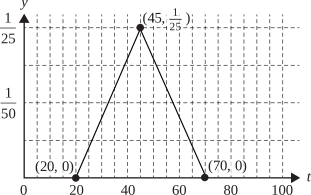
`f(t) = {{:(1/625 (t - 20)),(1/625 (70 - t)),(0):}qquad{:(20 <= t < 45),(45 <= t <= 70),(text(elsewhere)):}:}`


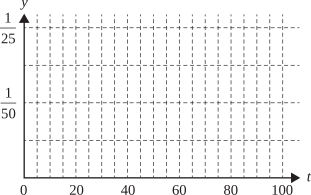
  1. Sketch the graph of `f` on the axes provided below.  (3 marks)

    --- 0 WORK AREA LINES (style=lined) ---


  2. Find  `text(Pr)(25 ≤ T ≤ 55)`.  (2 marks)

    --- 3 WORK AREA LINES (style=lined) ---

  3. Find  `text(Pr)(T ≤ 25 | T ≤ 55)`.  (2 marks)

    --- 5 WORK AREA LINES (style=lined) ---

  4. Find `a` such that  `text(Pr)(T ≥ a) = 0.7`, correct to four decimal places.  (2 marks)

    --- 5 WORK AREA LINES (style=lined) ---

  5. The probability that Jennifer spends more than 50 minutes on her homework on any given day is `8/25`. Assume that the amount of time spent on her homework on any day is independent of the time spent on her homework on any other day.


    1. Find the probability that Jennifer spends more than 50 minutes on her homework on more than three of seven randomly chosen days, correct to four decimal places.  (2 marks)

      --- 3 WORK AREA LINES (style=lined) ---

    2. Find the probability that Jennifer spends more than 50 minutes on her homework on at least two of seven randomly chosen days, given that she spends more than 50 minutes on her homework on at least one of those days, correct to four decimal places.  (2 marks)

      --- 3 WORK AREA LINES (style=lined) ---

Let `p` be the probability that on any given day Jennifer spends more than `d` minutes on her homework.

Let `q` be the probability that on two or three days out of seven randomly chosen days she spends more than `d` minutes on her homework.

  1. Express `q` as a polynomial in terms of `p`.  (2 marks)

    --- 6 WORK AREA LINES (style=lined) ---

    1. Find the maximum value of `q`, correct to four decimal places, and the value of `p` for which this maximum occurs, correct to four decimal places.  (2 marks)

      --- 3 WORK AREA LINES (style=lined) ---

    2. Find the value of `d` for which the maximum found in part g.i. occurs, correct to the nearest minute.  (2 marks)

      --- 5 WORK AREA LINES (style=lined) ---


Show Answers Only

  1.  

  2. `4/5`
  3. `1/41`
  4. `39.3649`
    1. `0.1534`
    2. `0.7626`
  5. `q =7p^2(1-p)^4(2p+3)`
    1. `p = 0.3539quadtext(and)quadq = 0.5665`
    2. `49\ text(min)`

Show Worked Solution

a.   

MARKER’S COMMENT: Many did not draw graph along `t`-axis between 0 and 20 and for  `t>70`.


b.   `text(Pr)(25 <= T <= 55)`

`= int_25^45 1/625 (t – 20)\ dt + int_45^55 1/625 (70 – t)\ dt`

`= 4/5`


c.   `text(Pr)(T ≤ 25 | T ≤ 55)`

`=(text(Pr)(T <= 25))/(text(Pr)( T <= 55))`

`= (int_20^25 1/625(t – 20)\ dt)/(1 – int_55^70 1/625(70 – t)\ dt)`

`= (1/50)/(1 – 9/50)`

`= 1/41`


d.   `text(Pr)(T ≥ a) = 0.7`

♦ Mean mark part (d) 36%.

`=>\ text(Pr)(T <= a) = 0.3`

`text(Solve:)`

`int_20^a 1/625(t – 20)\ dt` `= 0.3quadtext(for)quada ∈ (20, 45)`


`:. a == 39.3649`


e.i.   `text(Let)\ X =\ text(Number of days Jenn studies more than 50 min)`

`X ~\ text(Bi) (7, 8/25)`

`text(Pr)(X >= 4) = 0.1534`


e.ii.    `text(Pr)(X >= 2 | X >= 1)` `= (text(Pr)(X >= 2))/(text(Pr)(X >= 1))`
    `= (0.7113…)/(0.9327…)`
    `= 0.7626\ \ text{(to 4 d.p.)}`


f.   `text(Let)\ Y =\ text(Number of days Jenn spends more than)\ d\ text(min)`

`Y ~\ text(Bi)(7,p)`

♦ Mean mark part (f) 36%.

`q` `= text(Pr)(Y = 2) + text(Pr)(Y = 3)`
  `= ((7),(2))p^2(1 – p)^5 + ((7),(3))p^3(1 – p)^4`
  `= 21p^2(1 – p)^5 + 35p^3(1 – p)^4`
   `=7p^2(1-p)^4[3(1-p)+5p]`
  `=7p^2(1-p)^4(2p+3)`


g.i.   `text(Solve)\ \ q′(p) = 0,`

♦♦ Mean mark part (g)(i) 30%.

`p` `=0.35388…`
  `=0.3539\ \ text{(to 4 d.p.)}`

`:. q_text(max)= 0.5665\ \ text{(to 4 d.p.)}`


g.ii.   `text(Pr)(T > d) = p= 0.35388…`

♦♦♦ Mean mark part (g)(ii) 8%.

  `text(Solve:)`

`int_d^70 (1/625(70 – t))dt` `= 0.35388… quadtext(for)quadd ∈ (45,70)`


`:. d` `=48.967…`
  `=49\ text(mins)`

Filed Under: Binomial, Probability Density Functions Tagged With: Band 4, Band 5, Band 6, smc-637-40-Conditional probability, smc-637-45-Other probability, smc-637-50-Linear PDF, smc-638-20-binomCdf (CAS), smc-638-50-Conditional

Algebra, MET2 2017 VCAA 2

Sammy visits a giant Ferris wheel. Sammy enters a capsule on the Ferris wheel from a platform above the ground. The Ferris wheel is rotating anticlockwise. The capsule is attached to the Ferris wheel at point `P`. The height of `P` above the ground, `h`, is modelled by  `h(t) = 65-55cos((pit)/15)`, where `t` is the time in minutes after Sammy enters the capsule and `h` is measured in metres.

Sammy exits the capsule after one complete rotation of the Ferris wheel.
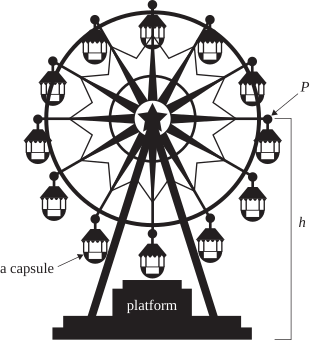


  1. State the minimum and maximum heights of `P` above the ground.   (1 mark)

    --- 2 WORK AREA LINES (style=lined) ---

  2. For how much time is Sammy in the capsule?   (1 mark)

    --- 2 WORK AREA LINES (style=lined) ---

  3. Find the rate of change of `h` with respect to `t` and, hence, state the value of `t` at which the rate of change of `h` is at its maximum.   (2 marks)

    --- 4 WORK AREA LINES (style=lined) ---

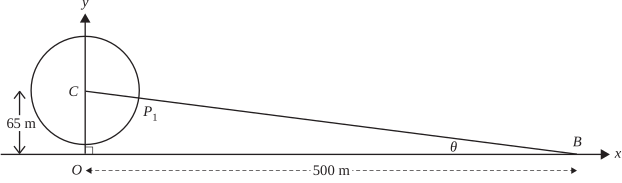
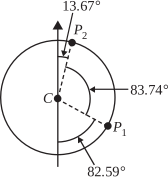
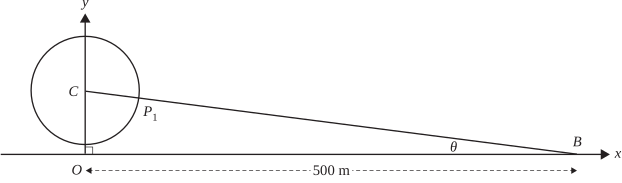
As the Ferris wheel rotates, a stationary boat at `B`, on a nearby river, first becomes visible at point `P_1`. `B` is 500 m horizontally from the vertical axis through the centre `C` of the Ferris wheel and angle `CBO = theta`, as shown below.


  1. Find `theta` in degrees, correct to two decimal places.   (1 mark)

    --- 3 WORK AREA LINES (style=lined) ---

Part of the path of `P` is given by  `y = sqrt(3025-x^2) + 65, x ∈ [-55,55]`, where `x` and `y` are in metres.

  1. Find `(dy)/(dx)`.   (1 mark)

    --- 2 WORK AREA LINES (style=lined) ---

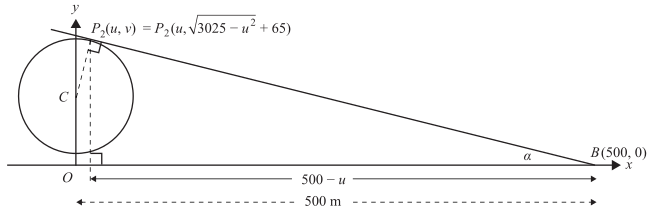
As the Ferris wheel continues to rotate, the boat at `B` is no longer visible from the point  `P_2(u, v)` onwards. The line through `B` and `P_2` is tangent to the path of `P`, where angle `OBP_2 = alpha`.
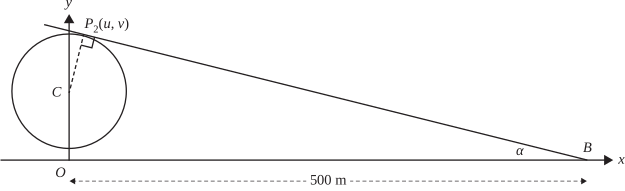


  1. Find the gradient of the line segment `P_2B` in terms of `u` and, hence, find the coordinates of `P_2`, correct to two decimal places.   (3 marks)

    --- 10 WORK AREA LINES (style=lined) ---

  2. Find `alpha` in degrees, correct to two decimal places.   (1 mark)

    --- 4 WORK AREA LINES (style=lined) ---

  3. Hence or otherwise, find the length of time, to the nearest minute, during which the boat at `B` is visible.   (2 marks)

    --- 5 WORK AREA LINES (style=lined) ---

Show Answers Only
  1. `h_text(min) = 10\ text(m), h_text(max) = 120\ text(m)`
  2. `30\ text(min)`
  3. `t = 7.5`
  4. `7.41^@`
  5. `(-x)/(sqrt(3025-x^2))`
  6. `P_2(13.00, 118.44)`
  7. `13.67^@`
  8. `7\ text(min)`
Show Worked Solution
a.    `h_text(min)` `= 65-55` `h_text(max)` `= 65 + 55`
    `= 10\ text(m)`   `= 120\ text(m)`


b.   `text(Period) = (2pi)/(pi/15) = 30\ text(min)`


c.   `h^{prime}(t) = (11pi)/3\ sin(pi/15 t)`

♦ Mean mark 50%.
MARKER’S COMMENT: A number of commons errors here – 2 answers given, calc not in radian mode, etc …


`text(Solve)\ h^{primeprime}(t) = 0, t ∈ (0,30)`

`t = 15/2\ \ text{(max)}`   `text(or)`   `t = 45/2\ \ text{(min – descending)}`

`:. t = 7.5`


d.   

♦ Mean mark 36%.
MARKER’S COMMENT: Choosing degrees vs radians in the correct context was critical here.

`tan(theta)` `= 65/500`
`:. theta` `=7.406…`
  `= 7.41^@`


e.    `(dy)/(dx)` `= (-x)/(sqrt(3025-x^2))`


f.   

`P_2(u,sqrt(3025-u^2) + 65),\ \ B(500,0)`

`:. m_(P_2B)` `= (sqrt(3025-u^2) + 65)/(u-500)`


`text{Using part (e), when}\ \ x=u,`

♦♦♦ Mean mark part (f) 18%.
MARKER’S COMMENT: Many students were unable to use the rise over run information to calculate the second gradient.

`dy/dx=(-u)/(sqrt(3025-u^2))`


`text{Solve (by CAS):}`

`(sqrt(3025-u^2) + 65)/(u-500)` `= (-u)/(sqrt(3025-u^2))\ \ text(for)\ u`


`u=12.9975…=13.00\ \ text{(2 d.p.)}`


`:. v` `= sqrt(3025-(12.9975…)^2) + 65`
  `= 118.4421…`
  `= 118.44\ \ text{(2 d.p.)}`


`:.P_2(13.00, 118.44)`


♦♦♦ Mean mark part (g) 7%.

g.    `tan alpha` `=v/(500-u)`
    `= (118.442…)/(500-12.9975…)`
  `:. alpha` `= 13.67^@\ \ text{(2 d.p.)}`


h.   

♦♦♦ Mean mark 5%.

`text(Find the rotation between)\ P_1 and P_2:`

`text(Rotation to)\ P_1 = 90-7.41=82.59^@`

`text(Rotation to)\ P_2 = 180-13.67=166.33^@`

`text(Rotation)\ \ P_1 → P_2 = 166.33-82.59 = 83.74^@`


`:.\ text(Time visible)` `= 83.74/360 xx 30\ text(min)`
  `=6.978…`
  `= 7\ text{min  (nearest degree)}`

Filed Under: Average Value and Other, Trig Graphing Tagged With: Band 2, Band 3, Band 4, Band 5, Band 6, page-break-before-question, smc-2757-15-Cos, smc-2757-80-Applications, smc-2757-85-Max/min (non-calc), smc-756-20-Trig

Calculus, MET2 2017 VCAA 17 MC

The graph of a function  `f`, where  `f(−x) = f (x)`, is shown below.
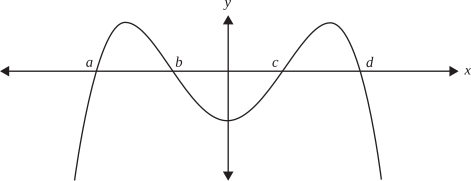
The graph has `x`-intercepts at `(a, 0)`, `(b, 0)`, `(c, 0)` and `(d, 0)` only.

The area bound by the curve and the `x`-axis on the interval `[a, d]` is

  1. `int_a^d f(x)\ dx`
  2. `int_a^b f(x)\ dx - int_c^b f(x)\ dx + int_c^d f(x)\ dx`
  3. `2int_a^b f(x)\ dx + int_b^c f(x)\ dx`
  4. `2int_a^b f(x)\ dx - 2int_b^(b + c) f(x)\ dx`
  5. `int_a^b f(x)\ dx + int_c^b f(x)\ dx + int_d^c f(x)\ dx`
Show Answers Only

`D`

Show Worked Solution

`text(S)text(ince)\ \ f(x)\ \ text(is an odd function,)`

♦♦♦ Mean mark 21%.

`=> b=-c`

`:. 2int_a^b f(x)\ dx – 2int_b^(b + c) f(x)\ dx`

`= 2int_a^b f(x)\ dx – 2int_b^(0) f(x)\ dx`

`=> D`

Filed Under: Area Under Curves Tagged With: Band 6, smc-723-70-Other

Calculus, MET1 2017 VCAA 9

The graph of  `f: [0, 1] -> R,\ f(x) = sqrt x (1-x)`  is shown below.
 

  1. Calculate the area between the graph of `f` and the `x`-axis.   (2 marks)

    --- 6 WORK AREA LINES (style=lined) ---

  2. For `x` in the interval `(0, 1)`, show that the gradient of the tangent to the graph of `f` is  `(1-3x)/(2 sqrt x)`.   (1 mark)

    --- 4 WORK AREA LINES (style=lined) ---

The edges of the right-angled triangle `ABC` are the line segments `AC` and `BC`, which are tangent to the graph of `f`, and the line segment `AB`, which is part of the horizontal axis, as shown below.

Let `theta` be the angle that `AC` makes with the positive direction of the horizontal axis, where  `45^@ <= theta < 90^@`.

  1. Find the equation of the line through `B` and `C` in the form  `y = mx + c`, for  `theta = 45^@`.   (2 marks)

    --- 7 WORK AREA LINES (style=lined) ---

  2. Find the coordinates of `C` when  `theta = 45^@`.   (4 marks)

    --- 10 WORK AREA LINES (style=lined) ---

Show Answers Only
  1. `4/15\ text(units)^2`
  2. `text(Proof)\ \ text{(See Workes Solutions)}`
  3. `y = -x + 1`
  4. `C (11/27, 16/27)`
Show Worked Solution
a.   `text(Area)` `= int_0^1 (sqrt x-x sqrt x)\ dx`
    `= int_0^1 (x^(1/2)-x^(3/2))\ dx`
    `= [2/3 x^(3/2)-2/5 x^(5/2)]_0^1`
    `= (2/3-2/5)-(0-0)`
    `= 10/15-6/15`
    `= 4/15\ text(units)^2`


♦♦ Mean mark part (b) 35%.
MARKER’S COMMENT: Establishing the common denominator in the working was required!
b.   `f (x)` `= x^(1/2)-x^(3/2)`
  `f^{′}(x)` `= 1/2 x^(-1/2)-3/2 x^(1/2)`
    `= 1/(2 sqrt x)-(3 sqrt x)/2`
    `= (1-3x)/(2 sqrt x)\ \ text(.. as required.)`


c.  `m_(AC) = tan 45^@=1`

♦♦♦ Mean mark part (c) 20%.
MARKER’S COMMENT: Most successful answers introduced a pronumeral such as `a=sqrtx` to solve.

`=> m_(BC) = -1\ \ (m_text(BC) _|_ m_(AC))`


`text(At point of tangency of)\ BC,\  f^{prime}(x) = -1`

`(1-3x)/(2 sqrt x)` `=-1`
`1-3x` `=-2sqrtx`
`3x-2sqrt x-1` `=0`


`text(Let)\ \ a=sqrtx,`

`3a^2-2a-1` `=0`
`(3a+1)(a-1)` `=0`
`a=1 or -1/3`   
`:. sqrt x` `=1` `or`   `sqrt x=- 1/3\ \ text{(no solution)}`
`x` `=1`    

 
`f(1)=sqrt1(1-1)=0\ \ =>B(1,0)`
 

`:.\ text(Equation of)\ \ BC, \ m=-1, text{through (1,0) is:}`

`y-0` `=-1(x-1)`
`y` `=-x+1`


d.  `text(Find Equation)\ AC:`

♦♦♦ Mean mark part (d) 17%.

`m_(AC) =1`

`text(At point of tangency of)\ AC,\  f^{prime}(x) = 1`

`(1-3x)/(2 sqrt x)` `=1`
`1-3x` `=2sqrtx`
`3x+2sqrt x-1` `=0`
`(3 sqrtx-1)(sqrtx+1)` `=0`
   
`:. sqrt x` `=1/3` `or`   `sqrt x=-1\ \ text{(no solution)}`
`x` `=1/9`    

 
`f(1/9)=sqrt(1/9)(1-1/9)=1/3 xx 8/9 = 8/27\ \ =>P(1/9,8/27)`
 

`:.\ text(Equation of)\ AC, m=1, text(through)\ \ P\ \ text(is):`

`y-8/27` `= 1 (x-1/9)`
`y` `= x + 5/27`

 
`C\ text(is at intersection of)\ AC and CB:`

`-x + 1` `= x + 5/27`
`2x` `= 22/27`
`:. x` `= 11/27`
`y` `= -11/27 + 1 = 16/27`

 
`:. C (11/27, 16/27)`

Filed Under: Area Under Curves, Tangents and Normals Tagged With: Band 4, Band 5, Band 6, smc-634-40-Other Function, smc-634-80-Angle between tangents/axes, smc-723-30-Square root, smc-723-70-Other

Functions, MET1 2017 VCAA 7

Let  `f: [0, oo) -> R,\ f(x) = sqrt(x + 1)`.

  1.  State the range of `f`.   (1 mark)

    --- 1 WORK AREA LINES (style=lined) ---

  2.  Let  `g: (-oo, c] -> R,\ \ g(x) = x^2 + 4x + 3`.
    1. Find the largest possible value of `c` such that the range of `g` is a subset of the domain of `f`.   (2 marks)

      --- 4 WORK AREA LINES (style=lined) ---

    2. For the value of `c` found in part b.i., state the range of `f(g(x))`.   (1 mark) 

      --- 2 WORK AREA LINES (style=lined) ---

  3. Let  `h: R -> R,\ \ h(x) = x^2 + 3`.
  4. State the range of `f(h(x))`.   (1 mark)

    --- 2 WORK AREA LINES (style=lined) ---

Show Answers Only
  1. `[1, oo)`
    1. `-3`
    2. `[1, oo)`
  2. `[2, oo)`
Show Worked Solution

a.  `text(Sketch of)\ \ f(x):`
 

`:.\ text(Range)\ \ (f) = [1, oo)`


b.i.  `text(Sketch)\ \ g(x) = (x + 1) (x + 3)`
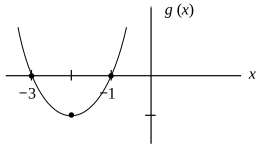
♦ Mean mark 38%.


`text(Domain of)\ \ f(x)=[0,oo)`

`text(Find domain of)\ \ g(x)\ \ text(such that Range)\ (g) = [0, oo)`

`text(Graphically, this occurs when)\ \ g(x)\ \ text(has domain:)`

`=> x ∈ (–oo, –3] ∪ [–1,oo)`

`:. c = -3`
 

b.ii.  `text(Range)\ g(x) = [0, oo) = text(Domain)\ \ f(x)`

♦♦♦ Mean mark 20%.

`:.\ text(Range)\ \ f(g(x)) = [1, oo)`
 

c.  `text(Range)\ h(x) = [3, oo)`

♦♦ Mean mark 30%.
`f(3)` `= sqrt (3 + 1)`
  `= sqrt 4`
  `= 2`


`:.\ text(Range)\ \ f(h(x)) = [2, oo)`

Filed Under: Functional Equations Tagged With: Band 4, Band 5, Band 6, smc-642-10-\((f \circ g)(x)\)

Financial Maths, STD2 F1 EQ-Bank 38

Alex is buying a used car which has a sale price of  $13 380. In addition to the sale price there are the following costs:

2014 27a1

  1. Stamp Duty for this car is calculated at $3 for every $100, or part thereof, of the sale price.  
    Calculate the Stamp Duty payable.   (1 mark)

    --- 1 WORK AREA LINES (style=lined) ---

  2. Alex wishes to take out comprehensive insurance for the car for 12 months.


    The cost of comprehensive insurance is calculated using the following:
     
          2014 27a2
    Find the total amount that Alex will need to pay for comprehensive insurance.   (3 marks)

    --- 6 WORK AREA LINES (style=lined) ---

  3. Alex has decided he will take out the comprehensive car insurance rather than the less expensive non-compulsory third-party car insurance.
  4.  

    What extra cover is provided by the comprehensive car insurance?   (1 mark)

    --- 2 WORK AREA LINES (style=lined) ---

Show Answers Only

a.    `$402`

b.    `$985.74`

c.    `text(Comprehensive insurance also covers Alex for damage to his own car.)`

Show Worked Solution

a.    `($13\ 380)/100 = 133.8`

♦♦♦ Mean mark (a) 12%
IMPORTANT: “or part thereof ..” requires students to round up to 134 to get the right multiple of $3 for their calculation.

`text(Stamp duty)= 134 xx $3= $402`
 

b.    `text(Base rate)= $845`

`text(FSL) =\ text(1%) xx 845 = $8.45`

`text(Stamp)` `=\ text(5.5%) xx(845 + 8.45)`
  `= 46.9397…`
  `= $46.94\ text{(nearest cent)}`

 
`text(GST)= 10 text(%) xx(845 + 8.45)= 85.345= $85.35`

`:.\ text(Total cost)` `= 845 + 8.45 + 46.94 + 85.35`
  `= $985.74`


♦ Mean mark (c) 34%.

 
c.
    `text(Comprehensive insurance covers Alex for damage done)`

`text{to his own car as well.}`

Filed Under: Earning Money and Budgeting, Earning Money and Budgeting, Purchasing Goods, Purchasing Goods, Tax and Percentage Increase/Decrease, Tax and Percentage Increase/Decrease Tagged With: Band 4, Band 5, Band 6, smc-1125-20-GST, smc-1125-50-Stamp Duty, smc-1126-40-Insurance, smc-6278-20-GST/VAT, smc-6278-25-Stamp Duty/Insurance, smc-6517-20-GST/VAT, smc-6517-25-Stamp Duty/Insurance, smc-810-40-Insurance, smc-831-20-GST, smc-831-50-Stamp Duty

Measurement, STD2 M1 2017 HSC 30e

A solid is made up of a sphere sitting partially inside a cone.

The sphere, centre `O`, has a radius of 4 cm and sits 2 cm inside the cone. The solid has a total height of 15 cm. The solid and its cross-section are shown.
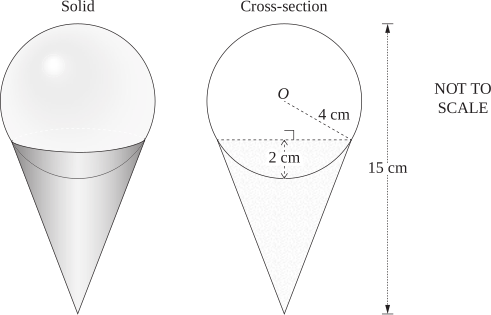


Using the formula  `V=1/3 pi r^2h`  where `r`  is the radius of the cone's circular base and `h` is the perpendicular height of the cone, find the volume of the cone, correct to the nearest cm³?   (3 marks)

--- 9 WORK AREA LINES (style=lined) ---

Show Answers Only

`113\ text{cm}^3`

Show Worked Solution

`V = 1/3 xx text(base of cone × height)`
 

`text(Consider the circular base area of the cone,)`

`text{Using Pythagoras:}`

`x^2` `= 4^2-2^2 = 16-4 = 12`
`x` `= sqrt12\ text(cm)`


`:. V` `= 1/3 xx pi xx (sqrt12)^2 xx (15-6)`
  `= 1/3 xx pi xx 12 xx 9`
  `= 113.097…`
  `= 113\ text{cm}^3\ text{(nearest cm}^3 text{)}`

Filed Under: Perimeter, Area and Volume, Volume, Volume, Mass and Capacity Tagged With: Band 6, num-title-ct-extension, num-title-qs-hsc, smc-4235-50-Pyramids/Cones, smc-4235-60-Spheres, smc-6304-30-Pyramids/Cones, smc-6304-50-Volume (Circular Measure), smc-6304-70-X-topic with Trig, smc-798-50-Volume (Circular Measure)

Proof, EXT2 P2 2017 HSC 16c

A 2 by `n` grid is made up of two rows of `n` square tiles, as shown.
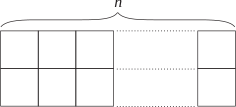
 

The tiles of the 2 by `n` grid are to be painted so that tiles sharing an edge are painted using different colours. There are `x` different colours available, where  `x ≥ 2`.

It is NOT necessary to use all the colours.

Consider the case of the 2 by 2 grid with tiles labelled A, B, C and D, as shown.
 

There are `x(x - 1)` ways to choose colours for the first column containing tiles A and B. Do NOT prove this.

  1. Assume the colours for tiles A and B have been chosen. There are two cases to consider when choosing colours for the second column. Either tile C is the same colour as tile B, or tile C is a different colour from tile B.


    By considering these two cases, show that the number of ways of choosing colours for the second column is  `x^2 - 3x +3`.  (2 marks)

    --- 6 WORK AREA LINES (style=lined) ---

  2. Prove by mathematical induction that the number of ways in which the 2 by `n` grid can be painted is  `x(x - 1)(x^2 - 3x + 3)^(n - 1)`, for  `n ≥ 1`.  (2 marks)

    --- 8 WORK AREA LINES (style=lined) ---

  3. In how many ways can a 2 by 5 grid be painted if 3 colours are available and each colour must now be used at least once?  (2 marks)

    --- 6 WORK AREA LINES (style=lined) ---

Show Answers Only
  1. `text(See Worked Solutions)`
  2. `text(See Worked Solutions)`
  3. `480`
Show Worked Solution
i.   

`text(If Colour)\ C =\ text(Colour)\ B:`

♦♦♦ Mean mark 20%.

`text(Column 2 combinations)`

`= 1 xx (x – 1)`

`= x – 1`


`text(If Colour)\ C !=\ text(Colour)\ B:`

`text(Column 2 combinations)`

`= (x – 2)(x – 2)`


`:.\ text(Total number of ways for column 2)`

`= x – 1 + (x – 2)^2`

`= x^2 – 3x + 3\ \ …\ text(as required.)`


ii.   `P(n) = x(x – 1)(x^2 – 3x + 3)^(n – 1)`

♦♦♦ Mean mark 22%.

`text(If)\ \ n = 1\ \ (text(i.e. 1 column)),`

`text(Combinations) = x(x – 1)\ \ (text(given))`

`P(1)` `= x(x – 1)(x^2 – 3x + 3)^0`
  `= x(x – 1)`

`:. text(True for)\ n = 1`


`text(Assume true for)\ n = k:`

`text(i.e. Possible combinations for)\ k\ text(columns)`

`P(k) = x(x – 1)(x^2 – 3x + 3)^(k – 1)`

`text(Prove true for)\ \ n = k + 1`

`text(i.e.)\ \ P(k + 1) = x(x – 1)(x^2 – 3x + 3)^k`


`text(Consider a grid)\ 2 xx k\ text(and add an extra two)`

`text(tiles to make a)\ 2 xx (k + 1)\ text(grid.)`

`text(Total possible combinations)`

`= text(combinations of)\ (2 xx k)\ text(grid) xx (x^2 – 3x + 3)\ \ (text{from (i)})`

`= x(x – 1)(x^2 – 3x + 3)^(k – 1) xx (x^2 – 3x + 3)`

`= x(x – 1)(x^2 – 3x + 3)^k`

`=> text(True for)\ \ n = k + 1`

`:. text(S)text(ince true for)\ n = 1,\ text(by PMI, true for integral)\ n >= 1.`


iii.   `text(If)\ \ n = 5, \ x = 3:`

♦♦♦ Mean mark 22%.

`text{Total combinations (includes using only 2 colours)}`

`P(5)` `= 3(3 – 1)(3^2 – 3.3 + 3)^4`
  `= 3(2)(3)^4`
  `= 486`


`text(Consider pattern when only 2 colours used:)`
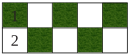
`text(Combinations that only use 2 colours)`

`=\ text(Colours in box 1 × possible colours in box 2)`

`= 3 xx 2`

`= 6`

`:.\ text(Combinations if each colour used at least once)`

`= 486 – 6`
`= 480`

Filed Under: Induction, Induction, Induction EXT2, P2 Induction, Probability and The Binomial Tagged With: Band 6, smc-1044-80-Other, smc-5115-80-Other, smc-7424-80-Other Themes

Harder Ext1 Topics, EXT2 2017 HSC 16a

  Let  `alpha = costheta + i sintheta`, where  `0 < theta < 2pi`.

  1. Show that  `alpha^k + alpha^(−k) = 2 cos ktheta`, for any integer `k`.  (1 mark)
  2. Let  `C = alpha^(−n) + … + alpha^(−1) + 1 + alpha + … + alpha^n`, where `n` is a positive integer.
  3. By summing the series, prove that  

    `C = (alpha^n + alpha^(−n) - (a^(n + 1) + alpha^(−(n + 1))))/((1 - alpha)(1 - baralpha))`.  (3 marks)

  4. Deduce, from parts (i) and (ii), that`1 + 2(costheta + cos2theta + … + cosntheta) = (cosntheta - cos(n + 1)theta)/(1 - costheta)`.  (2 marks)

  5. Show that  
    `cos\ pi/n + cos\ (2pi)/n + …  + cos\ (npi)/n`  is independent of `n`.  (1 mark)


Show Answers Only
  1. `text(See Worked Solutions)`
  2. `text(See Worked Solutions)`
  3. `text(See Worked Solutions)`
  4. `text(See Worked Solutions)`
Show Worked Solution

(i)   `alpha = costheta – isintheta`

`text(Using de Moivre:)`

`alpha^k` `= cos(ktheta) + isin(ktheta)`
`alpha^(−k)` `= cos(−ktheta) + isin(−ktheta)`
  `= cos(ktheta) – isin(ktheta)`
`:. alpha^k + alpha^(−k)` `= cos(ktheta) + isin(ktheta) + cos(ktheta) – isin(ktheta)`
  `= 2cos(ktheta)\ …\ \ text(as required.)`


(ii)   `C = alpha^(−n) + … + alpha^(−1) + 1 + alpha + … + alpha^n`

♦♦ Mean mark 34%.

`=> text(GP where)\ \ a = alpha^(−n), r = alpha`

`=> text(Number of terms) = 2n + 1`

`:. C` `= (a(1 – r^n))/(1 – r)`
  `= (alpha^(−n)(1 – alpha^(2n + 1)))/(1 – alpha)`
  `= (alpha^(−n)(1 – alpha^(2n + 1)))/(1 – alpha) xx (1 – baralpha)/(1 – baralpha)\ \ \ \ text{(where}\ baralpha = alpha^(−1) text{)}`
  `= ((alpha^(−n) – alpha^(n + 1))(1 – alpha^(−1)))/((1 – alpha)(1 – baralpha))`
  `= (alpha^(−n) – alpha^(−n – 1) – alpha^(n + 1) + alpha^n)/((1 – alpha)(1 – baralpha))`
  `= (alpha^n + alpha^(−n) – (alpha^(n + 1) + alpha^(−(n + 1))))/((1 – alpha)(1 – baralpha))\ …\ \ text(as required.)`
♦ Mean mark part (iii) 48%.


(iii)    `C` `= alpha^(−n) + a^(−n + 1) … + alpha^(−1) + 1 + alpha + … + alpha^n `
    `= 1 + (alpha + alpha^(−1)) + (alpha^2 + alpha^(−2)) + … + (alpha^n + alpha^(−n))`
    `= 1 + 2costheta + 2cos2theta + … + 2cosntheta\ \ \ \ (text{using part (i)})`
    `= 1 + 2(costheta + 2cos2theta + … + cosntheta)`


`text{Also, using part (ii)}`

`C` `= (alpha^n + alpha^(−n) – (alpha^(n + 1) + alpha^(−(n + 1))))/((1 – alpha)(1 – baralpha))`
  `= (2cosntheta – 2cos(n + 1)theta)/(1 – baralpha – alpha + 1)\ \ (text{part (i)})`
  `= (2cosntheta – 2cos(n + 1)theta)/(2 – (alpha + alpha^(−1)))`
  `= (2cosntheta – 2cos(n + 1)theta)/(2 – 2costheta)`
  `= (cosntheta – cos(n + 1)theta)/(1 – costheta)`

`:. 1 + 2(costheta, cos2theta + … + cosntheta) = (cosntheta – cos(n + 1)theta)/(1 – costheta)`

♦♦♦ Mean mark part (iv) 28%.


(iv)   `text{Rearrange the result from (iii):}`

`costheta + cos2theta + … + cosntheta = 1/2((cosntheta – cos(n + 1)theta)/(1 – costheta) – 1)`

`text(Let)\ \ theta = pi/n`

`:. cos\ pi/n + cos\ (2pi)/n + … + cos\ (npi)/n`

`= 1/2((cos((npi)/n) – cos(((n + 1)pi)/n))/(1 – cos(pi/n)) – 1)`
`= 1/2((cospi – cos(pi + pi/n))/(1 – cos(pi/n)) – 1)`
`= 1/2((−(1 – cos(pi/n)))/(1 – cos(pi/n)) – 1)`
`= 1/2 (−1 – 1)`
`= −1`


`=> text(which is independent of)\ n.`

Filed Under: Other Ext1 Topics Tagged With: Band 3, Band 5, Band 6

Conics, EXT2 2017 HSC 15c

The ellipse with equation  `(x^2)/(a^2) + (y^2)/(b^2) = 1`, where  `a > b`, has eccentricity `e`.

The hyperbola with equation  `(x^2)/(c^2) - (y^2)/(d^2) = 1`, has eccentricity `E`.

The value of `c` is chosen so that the hyperbola and the ellipse meet at  `P(x_1, y_1)`, as shown in the diagram.
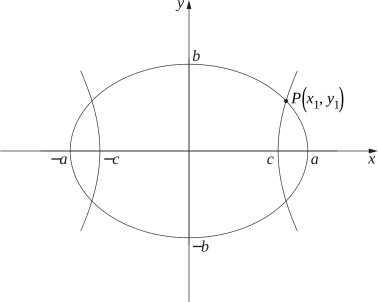
  1. Show that  
  2. `(x_1^(\ 2))/(y_1^(\ 2)) = (a^2c^2)/((a^2 - c^2)) xx ((b^2 + d^2))/(b^2d^2)`.  (2 marks)
  3. If the two conics have the same foci, show that their tangents at `P` are perpendicular.  (3 marks)


Show Answers Only
  1. `text(See Worked Solutions)`
  2. `text(See Worked Solutions)`
Show Worked Solution

(i)   `text(At)\ \ P(x_1,y_1):`

`(x_1^(\ 2))/(a^2) + (y_1^(\ 2))/(b^2)` `= (x_1^(\ 2))/(c^2) – (y_1^(\ 2))/(d^2) = 1`
`(x_1^(\ 2))/(a^2) – (x_1^(\ 2))/(c^2)` `= −(y_1^(\ 2))/(b^2) – (y_1^(\ 2))/(d^2)`
`x_1^(\ 2)(1/(a^2) – 1/(c^2))` `= −y_1^(\ 2)(1/(b^2) + 1/(d^2))`
`x_1^(\ 2)((c^2 – a^2)/(a^2c^2))` `= −y_1^(\ 2)((d^2 + b^2)/(b^2d^2))`
`(x_1^(\ 2))/(y_1^(\ 2))` `= −((a^2c^2)/(c^2 – a^2))((b^2 + d^2)/(b^2d^2))`
  `= (a^2c^2)/((a^2 – c^2)) xx ((b^2 + d^2))/(b^2d^2)\ …\ text(as required).`


(ii)   `text(Find gradient of ellipse at)\ \ P(x_1,y_1):`

♦ Mean mark 51%.
`(x^2)/(a^2) + (y^2)/(b^2)` `= 1`
`(2x)/(a^2) + (2y)/(b^2)·(dy)/(dx)` `= 0`
`(dy)/(dx)` `= −x/(a^2) xx (b^2)/y`

`text(At)\ P,\ \ m = (−x_1b^2)/(y_1a^2)`


`text(Similarly for gradient of hyperbola at)\ \ P(x_1,y_1):`

`(x^2)/(c^2) – (y^2)/(d^2)` `= 1`
`(2x)/(c^2) – (2y)/(d^2)·(dy)/(dx)` `= 0`
`(dy)/(dx)` `= x/(c^2) xx (d^2)/y`

`text(At)\ P,\ \ m = (x_1d^2)/(y_1c^2)`

`:. m_1m_2` `= −(x_1b^2)/(y_1a^2) xx (x_1d^2)/(y_1c^2)`
  `= −(x_1^2)/(y_1^2) xx (b^2d^2)/(a^2c^2)`


`text{Rearranging part (i)}`

`(x_1^(\ 2))/(y_1^(\ 2))` `= ((b^2 + d^2))/((a^2 – c^2)) xx (a^2c^2)/(b^2d^2)`
`(a^2c^2)/(b^2d^2)` `= (x_1^(\ 2))/(y_1^(\ 2))·((a^2 – c^2))/((b^2 + d^2))`
`(b^2d^2)/(a^2c^2)` `= (y_1^(\ 2)(b^2 + d^2))/(x_1^(\ 2)(a^2 – c^2))`
`:. m_1m_2` `= −(x_1^(\ 2))/(y_1^(\ 2)) xx (y_1^(\ 2)(b^2 + d^2))/(x_1^(\ 2)(a^2 – c^2))`
  `= −((b^2 + d^2))/(a^2 – c^2)\ \ …(1)`


`text(S)text{ince conics have same foci (given),}`

`ae` `= cE`    
`a^2e^2` `= c^2E^2`    
`a^2 – b^2` `= c^2 + d^2` `\ \ \ text{(using}` `\ \ b^2=a^2(1-e^2) and` 
`a^2 – c^2` `= b^2 + d^2`   `\ \ d^2=c^2(E^2-1) text{)}`


`text{Substituting into (1)}`

`m_1m_2` `= −((b^2 + d^2))/(b^2 + d^2)`
  `= −1`


`:.\ text(The two tangents are perpendicular.)`

Filed Under: Ellipse, Hyperbola Tagged With: Band 4, Band 6

MATRICES, FUR1 2017 VCAA 8 MC

Consider the matrix recurrence relation below.
 

`S_0 = [(40),(15),(20)], \ S_(n + 1) = TS_n`     where `T = [(0.3,0.2,V),(0.2,0.2,W),(X,Y,Z)]`
 

Matrix `T` is a regular transition matrix.

Given the above and that  `S_1 = [(29),(13),(33)]`, which of the following expressions is not true?

  1. `W > Z`
  2. `Y > X`
  3. `V > Y`
  4. `V + W + Z = 1`
  5. `X + Y + Z > 1`
Show Answers Only

`A`

Show Worked Solution

`TS_0 = S_1`

`[(0.3,0.2,V),(0.2,0.2,W),(X,Y,Z)][(40),(15),(20)] = [(29),(13),(33)]`

`(0.3 xx 40) + (0.2 xx 15) + 20V` `= 29`
`20V` `= 14`
`V` `= 0.7`

`text(Similarly)`

`8 + 3 + 20W` `= 13`
`20W` `= 2`
`W` `= 0.1`


`text(S)text(ince each column sums to 1:)`

`X` `= 1 – (0.3 + 0.2) = 0.5`
`Y` `= 1 – (0.2 + 0.2) = 0.6`
`Z` `= 1 – (0.7 + 0.1) = 0.2`


`:. W > Z\ \ text(is not true.)`

`=> A`

Filed Under: Transition Matrices - Regular Tagged With: Band 6, smc-618-30-State Matrix in discrete period, smc-618-61-3x3 Matrix

MATRICES, FUR1 2017 VCAA 7 MC

At a fish farm:

    • young fish (`Y`) may eventually grow into juveniles (`J`) or they may die (`D`)
    •  juveniles (`J`) may eventually grow into adults (`A`) or they may die (`D`)
    • adults (`A`) eventually die (`D`).

The initial state of this population, `F_0`, is shown below.
 

`F_0 = [(50\ 000),(10\ 000),(7000),(0)]{:(Y),(J),(A),(D):}`


Every month, fish are either sold or bought so that the number of young, juvenile and adult fish in the farm remains constant.

The population of fish in the fish farm after `n` months, `F_n`, can be determined by the recurrence rule
 

`F_(n + 1) = [(0.65,0,0,0),(0.25,0.75,0,0),(0,0.20,0.95,0),(0.10,0.05,0.05,1)]\ F_n + B`
 

where `B` is a column matrix that shows the number of young, juvenile and adult fish bought or sold each month and the number of dead fish that are removed.

Each month, the fish farm will

  1. sell 1650 adult fish.
  2. buy 1750 adult fish.
  3. sell 17 500 young fish.
  4. buy 50 000 young fish.
  5. buy 10 000 juvenile fish.
Show Answers Only

`A`

Show Worked Solution

`text(S)text(ince the number of each type of fish remains constant,)`

`F_0 = F_1 = F_n = F_(n + 1)`


`[(50\ 000),(10\ 000),(7000),(0)]` `= [(0.65,0,0,0),(0.25,0.75,0,0),(0,0.20,0.95,0),(0.10,0.05,0.05,1)][(50\ 000),(10\ 000),(7000),(0)] + B`
`:. B` `= [(50\ 000),(10\ 000),(7000),(0)] – [(32\ 500),(20\ 000),(8650),(5850)]`
  `= [(17\ 500),(−10\ 000),(−1650),(−5850)]{:(Y),(J),(A),(D):}`

 
`=> A`

Filed Under: Transition Matrices - Modified Tagged With: Band 6, smc-1893-20-State Matrix in discrete period, smc-1893-32-4x4 Matrix

GRAPHS, FUR1 2017 VCAA 8 MC

The shaded area in the graph below shows the feasible region for a linear programming problem.
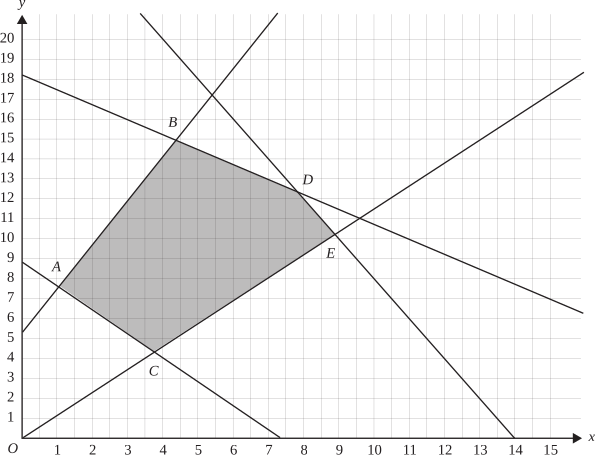
The objective function is given by

`Z = mx + ny`

Which one of the following statements is not true?

  1. When `m = 4` and `n = 1`, the minimum value of `Z` is at point `A`.
  2. When `m = 1` and `n = 6`, the maximum value of `Z` is at point `B`.
  3. When `m = 2` and `n = 5`, the minimum value of `Z` is at point `C`.
  4. When `m = 2` and `n = 6`, the maximum value of `Z` is at point `D`.
  5. When `m = 12` and `n = 1`, the maximum value of `Z` is at point `E`.
Show Answers Only

`D`

Show Worked Solution

`text(By trial and error: Consider option)\ D`

`Z` `= 2x + 6y`
`6y` `= −2x + Z`
`y` `= −1/3x + Z/6`


`text(By applying the sliding rule technique for function)`

`text(with gradient of)\ −1/3, text(the maximum value)`

`text(occurs at point)\ B,\ text(not point)\ D.`

`=> D`

Filed Under: Linear Programming Tagged With: Band 6, page-break-before-question

NETWORKS, FUR1 2017 VCAA 8 MC

The flow of oil through a series of pipelines, in litres per minute, is shown in the network below.
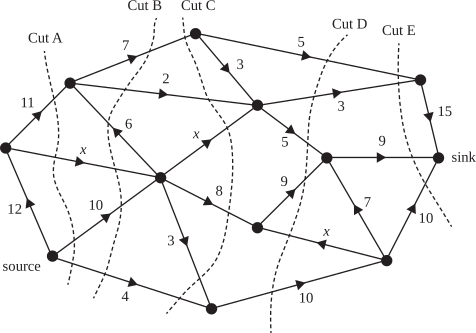


The weightings of three of the edges are labelled `x`.

Five cuts labelled A–E are shown on the network.

The maximum flow of oil from the source to the sink, in litres per minute, is given by the capacity of

  1. `text(Cut A if)\ x = 1`
  2. `text(Cut B if)\ x = 2`
  3. `text(Cut C if)\ x = 2`
  4. `text(Cut D if)\ x = 3`
  5. `text(Cut E if)\ x = 3`
Show Answers Only

`B`

Show Worked Solution

`=> B`

Filed Under: Flow Problems Tagged With: Band 6, smc-625-20-Max Flow/Min Cut

GEOMETRY, FUR1 2017 VCAA 8 MC

Three circles of radius 50 mm are placed so that they just touch each other.
The region enclosed by the circles is shaded in the diagram below.
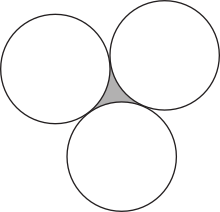
The area of the shaded region, in square millimetres, is closest to

  1.   `403`
  2.   `436`
  3. `1309`
  4. `2844`
  5. `4330`
Show Answers Only

`A`

Show Worked Solution

`text(Connect the centres of each circle to form)`

`text(an equilateral triangle.)`
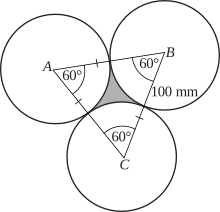
`text(Shaded area)` `=\ text(Area of triangle − Area of sectors)`
  `=1/2 ab sinC – 3 xx (60/360 xx pi r^2)`
  `= 1/2 xx 100^2 xx sin60° – 3 xx (60/360 xx pi xx 50^2)`
  `= 403.13…`

`=> A`

Filed Under: Perimeter, Area and Volume Tagged With: Band 6

GEOMETRY, FUR1 2017 VCAA 7 MC

A triangle `ABC` has:

• one side, `bar(AB)`, of length 4 cm
• one side, `bar(BC)`, of length 7 cm
• one angle, `∠ACB`, of 26°.

Which one of the following angles, correct to the nearest degree, could not be another angle in triangle `ABC`?

  1.   `24°`
  2.   `50°`
  3. `104°`
  4. `130°`
  5. `144°`
Show Answers Only

`E`

Show Worked Solution

`text(Using the sine rule,)`

`(sin x)/7` `= (sin 26)/4`
`sin x` `= (7 xx sin 26)/4`
  `= 0.767…`
   
`:. x` `= 50° text{or 130°  (nearest degree)}`

`text(If)\ \ x = 50°,\ text(other angle = 104°)`

`text(If)\ \ x = 130°,\ text(other angle = 24°)`

`=> E`

Filed Under: Trig - Harder Applications Tagged With: Band 6

CORE, FUR1 2017 VCAA 24 MC

Xavier borrowed $245 000 to pay for a house.

For the first 10 years of the loan, the interest rate was 4.35% per annum, compounding monthly.

Xavier made monthly repayments of $1800.

After 10 years, the interest rate changed.

If Xavier now makes monthly repayments of $2000, he could repay the loan in a further five years.

The new annual interest rate for Xavier’s loan is closest to
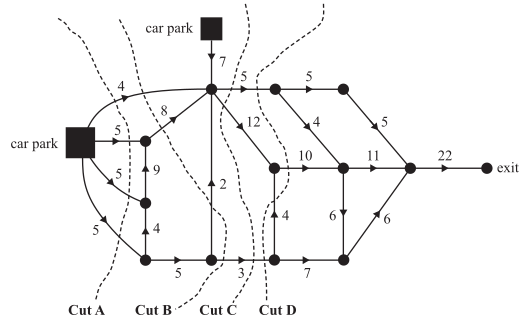
  1.  0.35%
  2.  4.1%
  3.  4.5%
  4.  4.8%
  5.  18.7%
Show Answers Only

`B`

Show Worked Solution

`text(Find principal left after 10 years:)`

`text(By TVM Solver,)`

`N` `= 10 xx 12 = 120`
`I(%)` `= 4.35`
`PV` `= 245\ 000`
`PMT` `= −1800`
`FV` `= ?`
`text(P/Y)` `= text(C/Y) = 12`

 
`=> FV = −108\ 219.1611`
 

`text(Loan can be repaid in 5 years at $2000/month.)`

`text(Find interest rate by TVM Solver;)`

`N` `= 5 xx 12 = 60`
`I(%)` `= ?`
`PV` `= 108\ 219.16`
`PMT` `= −2000`
`FV` `= 0`
`text(P/Y)` `= text(C/Y) = 12`


`=> I(%)` `= 4.1427…`
  `= 4.14text{%  (2 d.p.)}`

`=> B`

Filed Under: Borrowing and Loans Tagged With: Band 6, smc-603-22-Reducible balance loans, smc-603-65-CAS (2 step)

  • « Previous Page
  • 1
  • …
  • 15
  • 16
  • 17
  • 18
  • 19
  • …
  • 29
  • Next Page »

Copyright © 2014–2026 SmarterEd.com.au · Log in