SmarterEd

Aussie Maths & Science Teachers: Save your time with SmarterEd

  • Login
  • Get Help
  • About

Vectors, SPEC1 2021 VCAA 9

Let  `underset~r(t) = (-1 + 4cos(t))underset~i + 2/sqrt3\ sin(t)underset~j`  and  `underset~s(t) = (3 sec(t)-1)underset~i + tan(t)underset~j`  be the position vectors relative to a fixed point `O` of particle `A` and particle `B` respectively for  `0 <= 1 <= c`, where `c` is a positive real constant.

    1. Show that the cartesian equation of the path of particle `A` is  `((x + 1)^2)/16 + (3y^2)/4 = 1`.   (1 mark)

      --- 4 WORK AREA LINES (style=lined) ---

    2. Show that the cartesian equation of the path of particle `A` in the first quadrant can be written as  `y = sqrt3/6 sqrt(-x^2-2x + 15)`.   (1 mark)

      --- 4 WORK AREA LINES (style=lined) ---

    1. Show that the particles `A` and `B` will collide.   (1 mark)

      --- 5 WORK AREA LINES (style=lined) ---

    2. Hence, find the coordinates of the point of collision of the two particles.   (1 mark)

      --- 3 WORK AREA LINES (style=lined) ---

    1. Show that  `d/(dx)(8arcsin ((x + 1)/4) + ((x + 1)sqrt(-x^2 -2x + 15))/2) = sqrt(-x^2-2x + 15)`.   (2 marks)

      --- 6 WORK AREA LINES (style=lined) ---


    2.    

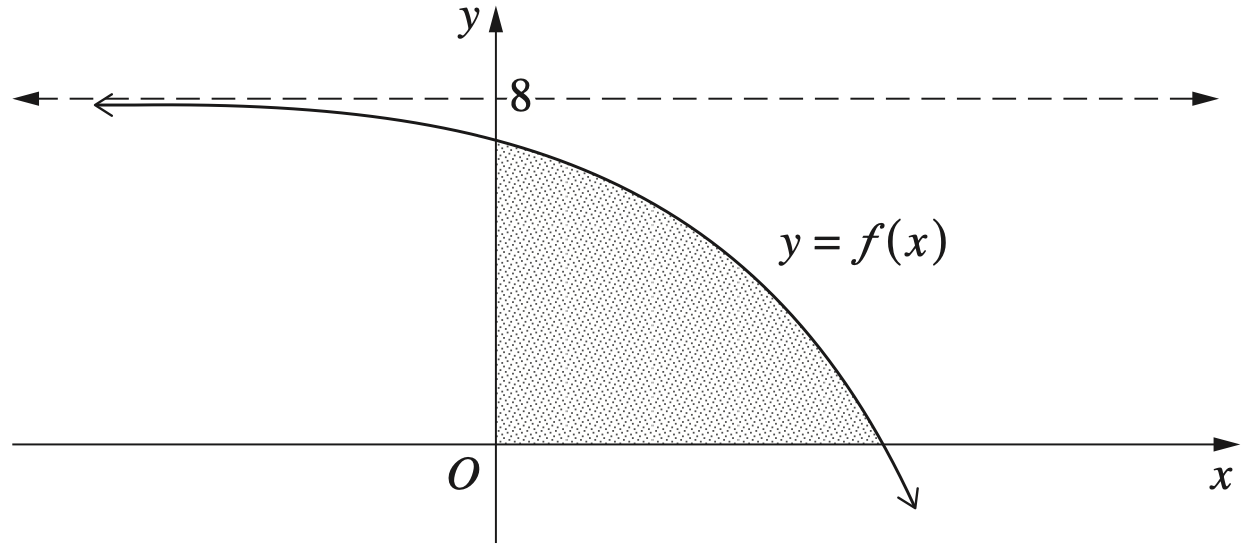
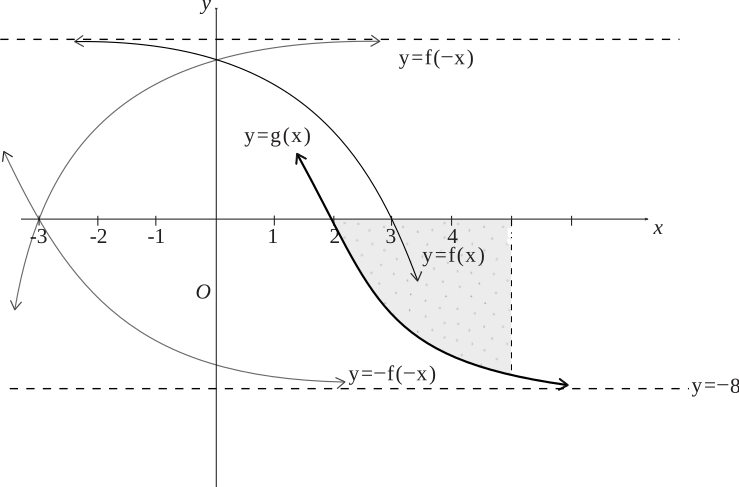
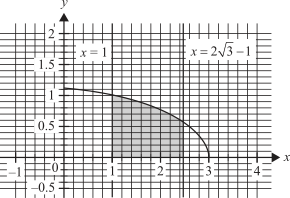
      Hence, find the area bounded by the graph of  `y = sqrt3/6 sqrt(-x^2-2x + 15)`,  the `x`-axis and the lines  `x = 1`  and  `x = 2sqrt3-1`,  as shown in the diagram above. Give your answer in the form  `(asqrt3pi)/b`, where `a` and `b` are positive integers.   (2 marks)

      --- 6 WORK AREA LINES (style=lined) ---

Show Answers Only
    1. `text(See Worked Solutions)`
    2. `text(See Worked Solutions)`
    1. `text(See Worked Solutions)`
    2. `-1 + 2sqrt3, 1/sqrt3`
    1. `text(See Worked Solutions)`
    2. `(2sqrt3pi)/9`
Show Worked Solution

a.i.   `text(Particle A)`

`underset~r(t) = (-1 + 4cos(t))underset~i + 2/sqrt3\ sin(t)underset~j`

`x` `= -1 + 4cos(t)`
`x + 1` `= 4cos(t)`
`cos(t)` `= (x + 1)/4`
`y` `= 2/sqrt3\ sin(t)`
`sin(t)` `= (sqrt3 y)/2`

 
`text(Using)\ \ cos^2(t) + sin^2(t) = 1`

`((x + 1)^2)/16 + (3y^2)/4 = 1`


a.ii.  `((x + 1)^2)/16 + (3y^2)/4 = 1`

♦ Mean mark part (a)(ii) 41%.
`(x + 1)^2 + 12y^2` `= 16`
`12y^2` `= 16-x^2-2x-1`
`y^2` `= 1/12(15-x^2-2x)`
`y` `= ±sqrt(1/12 (-x^2-2x + 15))`

 
`text(In the 1st quadrant,)\ \ y > 0`

`:. y` `= 1/sqrt12 sqrt(-x^2-2x + 15)`
  `= 1/(2sqrt3) xx sqrt3/sqrt3 sqrt(-x^2-2x + 15)`
  `= sqrt3/6 sqrt(-x^2-2x + 15)`


b.i.   `text(If particles collide, find)\ \t\ text(that satisfies)`

`-1 + 4cos(t)` `= 3sec(t)-1\ \ text(and)`
`2/sqrt3 sin(t)` `= tan(t)`

 
`text(Equate)\ underset~j\ text(components:)`

`2/sqrt3 sin(t)` `= (sin(t))/(cos(t))`
`cos(t)` `= sqrt3/2`
`t` `= pi/6`

 
`text(Check)\ underset~i\ text(components at)\ \ t= pi/6 :`

`-1 + 4cos(pi/6)` `= 3 sec(pi/6)-1`
`-1 + 4 · sqrt3/2` `= 3· 2/sqrt3-1`
`2sqrt3` `= 2sqrt3`

 
`:.\ text(Particles collide.)`


b.ii.   `text(Collision occurs at)\ \ r(pi/6)`

`r(pi/6)` `= (-1 + 4cos\ pi/6, 2/sqrt3 sin\ pi/6)`
  `= (-1 + 2sqrt3, 1/sqrt3)`
♦ Mean mark part (c)(i) 37%.


c.i.   `d/dx (8sin^(-1) ((x + 1)/4) + ((x + 1)sqrt(-x^2 -2x + 15))/2)`

`= 8/(sqrt(1-((x + 1)/4)^2)) xx 1/4 + ((x + 1))/2 xx (-2x-2)/(2sqrt(-x^2-2x + 15)) + sqrt(-x^2-2x + 15) xx 1/2`

`= 8/(sqrt(16-(x + 1)^2))-((x + 1)^2)/(2sqrt(-x^2-2x + 15)) + sqrt(-x^2 -2x + 15)/2`

`= 16/(2sqrt(-x^2-2x + 15))-((x + 1)^2)/(2sqrt(-x^2-2x + 15))+ (-x^2-2x + 15)/(2sqrt(-x^2-2x + 15))`

`= (16-x^2-2x-1-x^2-2x + 15)/(2sqrt(-x^2-2x + 15))`

`= (2(-x^2-2x + 15))/(2sqrt(-x^2-2x + 15))`

`= sqrt(-x^2-2x + 15)`

♦ Mean mark part (c)(ii) 45%.


c.ii.    `text(Area)` `= int_1^(2sqrt3-1) sqrt3/6 sqrt(-x^2-2x + 15)\ dx`
    `= sqrt3/6 int_1^(2sqrt3-1) sqrt(-x^2-2x + 15)\ dx`
    `= sqrt3/6 [8sin^(-1)((x + 1)/4) + ((x + 1)sqrt(-x^2-2x + 15))/2]_1^(2sqrt3-1)`
    `= sqrt3/6 [(8sin^(-1)(sqrt3/2) + 2sqrt3 sqrt(-(2sqrt3 -1)^2-2(2sqrt3-1) + 15)/2)-(8sin^(-1)(1/2) + (2sqrt(-1-2 + 15))/2)]`
    `= sqrt3/6 [(8pi)/3 + sqrt3 sqrt(-12 + 4sqrt3-1-4sqrt3 + 2 + 15)-((8pi)/6 + sqrt12)]`
    `= sqrt3/6 ((8pi)/3 + 2sqrt3-(8pi)/6-2sqrt3)`
    `= sqrt3/6 ((8pi)/6)`
    `= (2sqrt3pi)/9`

Filed Under: Position Vectors as a Function of Time Tagged With: Band 4, Band 5, Band 6, smc-1178-10-Find Cartesian equation, smc-1178-30-Collision

GRAPHS, FUR1 2021 VCAA 8 MC

A company produces two types of tennis racquets: the Smash and the Volley.

Let  `x`  be the number of Smash tennis racquets that are produced each week.

Let  `y` be the number of Volley tennis racquets that are produced each week.

The constraints on the production of these tennis racquets are given by the following set of inequalities.

`x` `≥ 0`
`y` `≥ 0`
`x + 2y` `<= 100`
`x + y` `≥ 20`
`x` `<= 60`


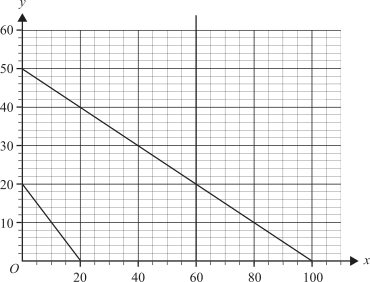
The graph below shows the lines that represent the boundaries of these inequalities.
 

The profit, `P`, that the company can make each week from the sale of these tennis racquets is in the form  `P = ax + by`.

The maximum profit will occur when 20 Smash tennis racquets and 40 Volley tennis racquets are sold each week.

If  `a = 15`, the maximum profit is

  1.   600
  2.   900
  3. 1000
  4. 1200
  5. 1500
Show Answers Only

`E`

Show Worked Solution

`text{Max profit at (20, 40) lies on}`

♦♦♦ Mean mark 29%.

`x + 2y = 100 \  \ text{with gradient} = -1/2`

`=> P = ax + by \ \ text{has gradient} = -1/2`

`P` `= 15 x + by`
`by` `=P – 15 x`
`y` `= P/b – 15/b x`

 
`text(Equating gradients:)`

`-15/b = -1/2\ \ =>\ \ b=30` 
 

`:. P_text{max}` `= 15 xx 20 + 30 xx 40`
  `= 1500`

  
`=> E`

Filed Under: Linear Programming Tagged With: Band 6

NETWORKS, FUR1 2021 VCAA 8 MC

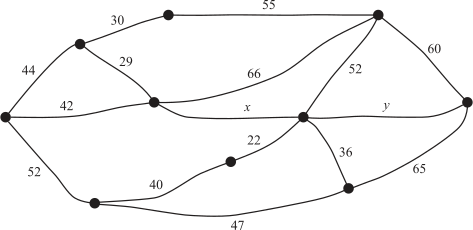
A network of roads connecting towns in an alpine region is shown below.

The distances between neighbouring towns, represented by vertices, are given in kilometres.
 

The region receives a large snowfall, leaving all roads between the towns closed to traffic.

To ensure each town is accessible by car from every other town, some roads will be cleared.

The minimal total length of road, in kilometres, that needs to be cleared is

  1. 361 if  `x` = 50 and  `y` = 55
  2. 361 if  `x` = 50 and  `y` = 60
  3. 366 if  `x` = 55 and  `y` = 55
  4. 366 if  `x` = 55 and  `y` = 60
  5. 371 if  `x` = 55 and  `y` = 65
Show Answers Only

`B`

Show Worked Solution

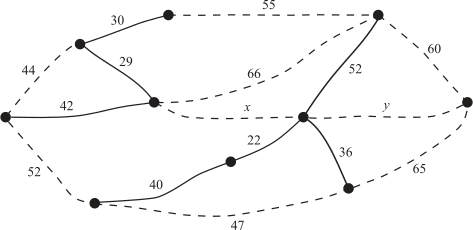
`text{A partial minimal spanning tree can be drawn:}`
 

`text{Consider each option:}`

♦ Mean mark 48%.

`A:\ text{If} \ x=50 \ text{(include),} \ y = 55 \ text{(include)}`

   `-> \ text{Total length} = 251 + 50 + 55 != 361 \ text{(incorrect)}`

`B:\ text{If} \ x=50 \ text{(include),} \ y = 60 \ text{(include)}`

   `-> \ text{Total length} = 251 + 50 + 55 = 356 \ text{(correct)}`

`text{Similarly, options} \ C, D, E \ text{can be shown to be incorrect.}`

`=> B`

Filed Under: Minimum Spanning Trees and Shortest Paths Tagged With: Band 6, smc-624-10-Distance, smc-624-50-Unknown Edge

NETWORKS, FUR1 2021 VCAA 5 MC

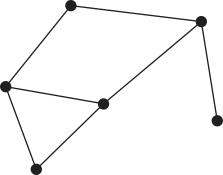
Consider the following five statements about the graph above:

    • The graph is planar.
    • The graph contains a cycle.
    • The graph contains a bridge.
    • The graph contains an Eulerian trail.
    • The graph contains a Hamiltonian path.

How many of these statements are true?

  1. 1
  2. 2
  3. 3
  4. 4
  5. 5
Show Answers Only

`D`

Show Worked Solution

`text{Consider each statement}`

♦♦♦ Mean mark 17%.

`text{Graph is planar} \ -> \ text{edges only meet at vertices (TRUE)}` 

`text{Graph contains a cycle} \ -> \ text{multiple cycles exist (TRUE)}`

`text{Graph contains a bridge} \ -> \ text{the far right edge, if removed,}`

`text{would disconnect the graph (TRUE)}`

`text{Graph contains an Eulerian trail} \ -> \ text{requires two (only)}`

`text{vertices of an odd degree (FALSE)}`

`text{Graph contains a Hamiltonian path} \ -> \ text{a path that touches}`

`text{each vertex once only (TRUE)}`
  

`=> D`

Filed Under: Travelling Problems and Adjacency Matrices Tagged With: Band 6, smc-622-10-Euler, smc-622-20-Hamiltonian

MATRICES, FUR1 2021 VCAA 8 MC

A new colony of endangered marsupials is established on a remote island.

For one week, the marsupials can feed from only one of three feeding stations: `A`, `B` or `C`.

On Monday, 50% of the marsupials were observed feeding at station `A` and 50% were observed feeding at station `B`. No marsupials were observed feeding `C`.

The marsupials are expected to change their feeding stations each day this week according to the transition matrix `T`.

`qquadqquadqquadqquad \ text(this day)`

`P = {:(qquad\ A quadquadqquad \ B quadquad \ C ),([(0.4,0.1, 0.2),(0.2,0.5,0.2),(0.4,0.4,0.6)]{:(A),(B),(C):} qquad text(next day)):}`
 

Let  `S_n` represent the state matrix showing the percentage of marsupials observed feeding at each feeding station `n`  days after Monday of this week.

The matrix recurrence rule  `S_{n+1} = TS_n`  is used to model this situation.

From Tuesday to Wednesday, the percentage of marsupials who are not expected to change their feeding location is

  1. 44.5%
  2. 45%
  3. 50%
  4. 51.5%
  5. 52
Show Answers Only

`D`

Show Worked Solution

`text{Let} \ S_0 = text{Monday}`

♦♦♦ Mean mark 29%.

`S_1 = TS_0 = [(0.4,0.1,0.2),(0.2,0.5,0.2),(0.4,0.4,0.6)] [(50),(50),(0)] = [(25),(35),(40)]`
  

`S_2 = TS_1 = [(0.4,0.1,0.2),(0.2,0.5,0.2),(0.4,0.4,0.6)] [(25),(35),(40)]`
 

`text{Percentage not expected to change}`

`= 0.4 xx 25 + 0.5 xx 35 + 0.6 xx 40`

`= 51.5`

`=> D`

Filed Under: Transition Matrices - Regular Tagged With: Band 6, smc-618-24-Interpret Matrix, smc-618-61-3x3 Matrix

Functions, MET1 2021 VCAA 9

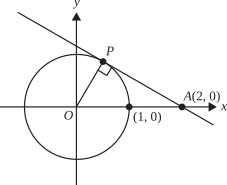
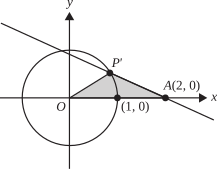
Consider the unit circle  `x^2 + y^2 = 1`  and the tangent to the circle at the point `P`, shown in the diagram below.
  

  1. Show that the equation of the line that passes through the points `A` and `P` is given by  `y = -x/sqrt3 + 2/sqrt3`.   (2 marks)

    --- 5 WORK AREA LINES (style=lined) ---

Let  `T : R^2 -> R^2, T ([(x),(y)]) = [(1, 0),(0, q)][(x),(y)]`,  where  `q ∈ R text{\}{0}`, and let the graph of the function `h` be the transformation of the line that passes through the points `A` and `P` under `T`.

    1. Find the values of `q` for which the graph of `h` intersects with the unit circle at least once.   (1 mark)

      --- 3 WORK AREA LINES (style=lined) ---

    2. Let the graph of `h` intersect the unit circle twice.
    3. Find the values of `q` for which the coordinates of the points of intersection have only positive values.   (1 mark)

      --- 4 WORK AREA LINES (style=lined) ---

  1. For  `0 < q <= 1`, let  `P^{′}` be the point of intersection of the graph of `h` with the unit circle, where  `P^{′}` is always the point of intersection that is closest to `A`, as shown in the diagram below.


Let `g` be the function that gives the area of triangle `OAP^{′}` in terms of `theta`.

    1. Define the function `g`.   (2 marks)

      --- 3 WORK AREA LINES (style=lined) ---

    2. Determine the maximum possible area of triangle `OAP^{′}`.   (2 marks)

      --- 4 WORK AREA LINES (style=lined) ---

Show Answers Only
  1. `text(See Worked Solution)`
  2.  i. `q in [–1,1]text{\}{0}`
  3. ii. `q in (sqrt3/2, 1)`
  4. i. `g(theta) = sin theta,\ \ theta in (0, pi/3]`
  5. ii. `sqrt3/2\ text(u²)`
Show Worked Solution

a.   `text(In)\ ΔOAP, text(by Pythagoras:)`

♦♦♦ Mean mark part (a) 18%.

`AP=sqrt(2^2-1^2) = sqrt3`

`tan ∠OAP = 1/sqrt3`

`=> m_(AP) =-1/sqrt3`

`text{Find equation of line}\ \ m=-1/sqrt3\ \ text{through (2, 0):}`

`y-0` `=- 1/sqrt3 (x-2)`  
`y` `=- x/sqrt3 + 2/sqrt3\ \ text{… as required}`  


♦♦♦ Mean mark part (b)(i) 6%.
bi.  `text{Transformation matrix → dilates line by a factor of}\ q\ text{from}\ xtext{-axis}`

`:. h(x)\ text{intersects circle for}\ \ q in [–1,1]text{\}{0}`


b.ii. `text(Positive coordinates → line can only intersect circle in top right quadrant.)`

 `text(Line)\ AP\ text{can move down until it cuts the circle at (0, 1)`

♦♦♦ Mean mark part (b)(ii) 4%.

`=>\ text(S)text(ince)\ AP\ text(cuts)\ ytext{-axis at}\ 2/sqrt3,`

`q=sqrt3/2\ \ text{dilates}\ AP\ text{where it cuts at (0, 1)`

`:. q in (sqrt3/2, 1)`
 

c.i.   `text(If)\ \ q=1, \ P^{′} = P and theta=pi/3`

♦♦♦ Mean mark part (c)(i) 10%.
`g(theta)` `=1/2 xx 1 xx 2 xx sin theta`  
  `=sin theta, \ \ theta in (0, pi/3]`  

 
c.ii.
  `text{S}text{ince}\ \ g(theta) = sin theta\ \ text(for)\ \ theta in (0, pi/3],`

♦♦♦ Mean mark part (c)(ii) 12%.

`text(Maximum)\ g(theta)\ text(occurs when)\ \ theta = pi/3`

`:.g(theta)_text(max)=sin (pi/3)=sqrt3/2\ \ text(u²)`

Filed Under: Coordinate Geometry, Transformations Tagged With: Band 6, smc-727-10-Equation of line, smc-753-20-Dilation (Only)

Probability, MET1 2021 VCAA 6

An online shopping site sells boxes of doughnuts.

A box contains 20 doughnuts. There are only four types of doughnuts in the box. They are:

    • glazed, with custard
    • glazed, with no custard
    • not glazed, with custard
    • not glazed, with no custard

It is known that, in the box:

    • `1/2`  of the doughnuts are with custard
    • `7/10`  of the doughnuts are not glazed
    • `1/10`  of the doughnuts are glazed, with custard
  1. A doughnut is chosen at random from the box.
  2. Find the probability that it is not glazed, with custard.  (1 mark)

    --- 5 WORK AREA LINES (style=lined) ---

  3. The 20 doughnuts in the box are randomly allocated to two new boxes, Box A and Box B.
  4. Each new box contains 10 doughnuts.
  5. One of the two new boxes is chosen at random and then a doughnut from that box is chosen at random.
  6. Let `g` be the number of glazed doughnuts in Box A.
  7. Find the probability, in terms of `g`, that the doughnut comes from box B given that it is glazed.  (2 marks)

    --- 5 WORK AREA LINES (style=lined) ---

  8. The online shopping site has over one million visitors per day.
  9. It is know that half of these visitors are less than 25 years old.
  10. Let  `overset^P`  be the random variable representing the proportion of visitors who are less than 25 years old in a random sample of five visitors.
  11. Find  `text{Pr}(overset^P >= 0.8)`. Do not use a normal approximation.  (3 marks)

    --- 6 WORK AREA LINES (style=lined) ---

Show Answers Only

  1. `2/5`
  2. `(6-g)/6`
  3. `3/16`

Show Worked Solution

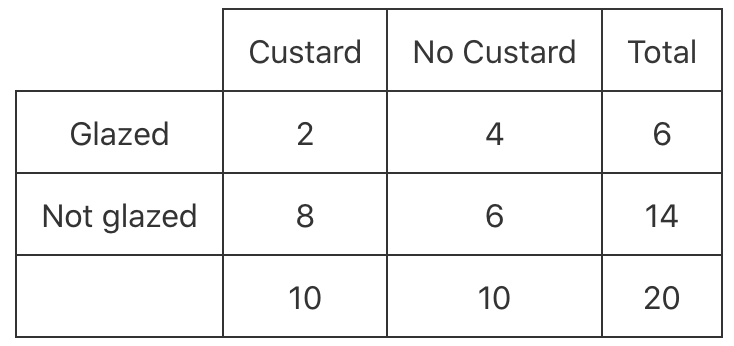
a.   `text(Create a 2-way table:)`

`text{Pr(not glazed with custard)}` `=8/20`  
  `=2/5`  

 
b.
   `A_text{glazed} = g \ => \ B_text{glazed} = 6-g`

♦♦♦ Mean mark part (b) 20%.

`text{Pr(glazed)} = 6/20`

`text{Pr}(B | text{glazed})` `= (text{Pr}(B ∩ text{glazed}))/text{Pr(glazed)}`  
  `=(1/2 xx (6-g)/10)/(6/20)`  
  `=(6-g)/20 xx 20/6`  
  `=(6-g)/6`  

 
c.
   `text(Let)\ \ X=\ text(number of visitors < 25 years)`

♦ Mean mark part (c) 40%.

`X\ ~\ text{Bi}(5, 0.5)`

`text{Pr}(hatP>=0.8)` `= text{Pr}(X>=4)`  
  `=\ ^5C_4 * (1/2)^4(1/2) + (1/2)^5`  
  `=5/32 + 1/32`  
  `=3/16`  

Filed Under: Binomial, Conditional Probability and Set Notation Tagged With: Band 4, Band 5, Band 6, smc-2736-10-Conditional probability

Complex Numbers, EXT2 N2 2021 HSC 10 MC

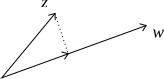
Consider the two non-zero complex numbers `z` and `w` as vectors.

Which of the following expressions is the projection of `z` onto `w` ? 

  1.  `{text{Re} (zw)}/{|w|} w`
  2.  `|z/w| w`
  3.  `text{Re} (z/w) w`
  4. `{text{Re}(z)}/{|w|} w`
Show Answers Only

`C`

Show Worked Solution

`text{Let} \ \ z = a + i b \ \ =>\ underset~z = ((a),(b))`

♦♦♦ Mean mark 30%.

`text{Let} \ \ w = c + i d \ \ =>\ underset~w = ((c),(d))`

`underset~z * underset~w = ac + bd`

`|underset~w|^2 = c^2 + d^2`

`text{proj}_(underset~w) underset~z = (underset~z*underset~w)/|underset~w|^2 *underset~w= (ac+bd)/(c^2+d^2)*underset~w`

`z/w` `=(a+ib)/(c+id) xx (c-id)/(c-id)`  
  `=(ac+bd + i(bc-ad))/(c^2+d^2)`  

 
`text{Re}(z/w) =(ac+bd)/(c^2+d^2)`

`:.\ text{proj}_(underset~w) underset~z = text{Re} (z/w) w`
 

`=> C`

Filed Under: Basic Concepts and Arithmetic, Geometrical Implications of Complex Numbers, Powers and Roots Tagged With: Band 6, smc-1052-60-Other problems, smc-1195-40-Unit Vectors and Projections, smc-1195-50-Complex numbers, smc-7430-70-Vectors

Complex Numbers, EXT2 N2 2021 HSC 16c

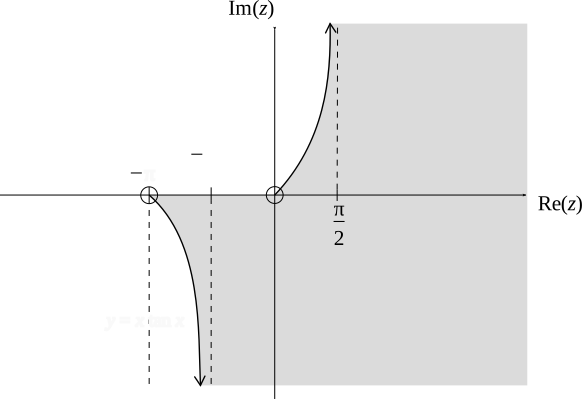
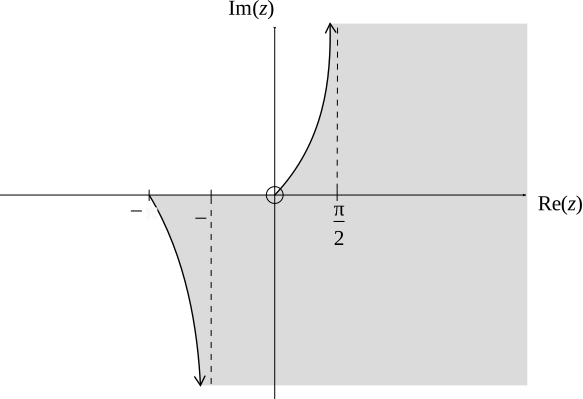
Sketch the region of the complex plane defined by  `text{Re}(z) ≥ text{Arg}(z)`  where `text{Arg}(z)` is the principal argument of `z`.   (3 marks)

--- 12 WORK AREA LINES (style=lined) ---

Show Answers Only

Show Worked Solution

`text{Find region where} \ \ text{Re}(z) ≥ text{Arg}(z).`

♦♦♦ Mean mark 15%.
`text{In quadrant 1:} \ x ≥ 0 \ , \ y ≥ 0 \ , \ 0 ≤ text{Arg}(z)≤ pi/2`
`x` `≥ tan^-1 (y/x)`  
`x tan (x)` `≥ y`  

  
`text(If)\ \ x>=pi/2, \ x>=tan^-1(y/x)\ \ text(as)\ \ tan^-1(y/x)<pi/2` 

`text{Arg}(0)\ text(is not defined.)`
 

`text{In quadrant 2:} \ \ x ≤ 0 \ , \  y ≤ 0 \ , \ pi/2 ≤ text{Arg}(z ) ≤ pi`

`text{Re}(z) < text{Arg}(z ) \ => \ text{no points satisfy}`
 

`text{In quadrant 3:} \ \ x ≤ 0 \ , \  y ≤ 0 \ , \ -pi ≤ text{Arg}(z) ≤ -pi/2`

`text{Arg}(z)` `= -pi + tan^-1 (y/x)`
`x` `≥ -pi + tan^-1 (y/x)`
`tan^-1 (y/x)` `≤ pi + x`
`y/x` `≤ tan (pi + x)`
`y` `≥ xtan (pi + x)`


`text{In the domain} \ \ -pi/2 <= x <= 0,`

`text{Arg}(z) = -pi+ tan^-1(y/x) < -pi/2\ \ \ (text{s}text{ince}\ \ tan^-1(y/x)<pi/2)`

`=>\ text(all points satisfy for)\ \ \ -pi/2 <= x <= 0`
 

`text{In quadrant 4:} \ \ x ≥ 0 \ , \  y ≤ 0 \ , \ -pi/2 ≤ text{Arg}(z) ≤ 0`

`text{Re}(z) > text{Arg}(z) \ => \ text{all points satisfy}`


Filed Under: Geometrical Implications of Complex Numbers, Lines, Curves and Regions Tagged With: Band 6, smc-1052-10-Sketch regions, smc-7431-60-Regions

Vectors, EXT2 V1 2021 HSC 16a

  1. The point  `P(x, y, z)`  lies on the sphere of radius 1 centred at the origin `O`.
  2. Using the position vector of `P, overset->{OP} = x underset~i + y underset~j + z underset~k` , and the triangle inequality, or otherwise, show that `| x | + | y | + |z | ≥ 1`.  (2 marks)

    --- 4 WORK AREA LINES (style=lined) ---

  3. Given the vectors  `underset~a = ((a_1),(a_2),(a_3))`  and  `underset~b = ((b_1),(b_2),(b_3))` , show that 
  4.    `|a_1 b_1 + a_2 b_2 + a_3 b_3 | ≤ sqrt{a_1^2 + a_2^2 + a_3^2 }\ sqrt{b_1^2 + b_2^2 + b_3^2}`.  (3 marks)

    --- 5 WORK AREA LINES (style=lined) ---

  5. As in part (i), the point  `P (x, y, z)`  lies on the sphere of radius 1 centred at the origin `O`.
  6. Using part (ii), or otherwise, show that  `| x | + | y | + | z | ≤ sqrt3`.  (2 marks)

    --- 3 WORK AREA LINES (style=lined) ---

Show Answers Only
  1. `text{See Worked Solution}`
  2. `text{See Worked Solution}`
  3. `text{See Worked Solution}`
Show Worked Solution
i.      `text{Triangle inequality:} \ |x| + |y| ≥ |x + y|`
♦ Mean mark (i) 50%.
`|x| + |y| + |z|` ` = |x_underset~i| + |y_underset~j| + |z_underset~k|`
  `≥ |x_underset~i + y_underset~j| + |z_underset~k|`
  `≥ |x_underset~i + y_underset~j + z_underset~k|`
  `≥ 1\ \ (|overset->{OP}| = | x_underset~i + y_underset~j + z_underset~k | = 1)`


ii.   `text{Using the dot product:}`

♦ Mean mark (ii) 42%.

`underset~a * underset~b = a_1 b_1 + a_2 b_2 + a_3 b_3`

`underset~a * underset~b = |underset~a| |underset~b| cos theta`


`a_1 b_1 + a_2 b_2 + a_3 b_3` `= sqrt{a_1^2 + a_2^2 + a_3^2} * sqrt{b_1^2 + b_2^2 + b_3^2} * cos theta`
`|a_1 b_1 + a_2 b_2 + a_3 b_3|` `= sqrt{a_1^2 + a_2^2 + a_3^2} * sqrt{b_1^2 + b_2^2 + b_3^2} * |cos theta|`


`text{S} text{ince} \ -1 ≤ cos theta ≤ 1 \ => \ |cos theta| ≤ 1`

`:. \ | a_1 b_1 + a_2 b_2 + a_3 b_3 | ≤ sqrt{a_1^2 + a_2^3 + a_3^2} * sqrt{b_1^2 + b_2^2 + b_3^2}`


iii.  `text{Using part (ii) with vectors:}`

♦♦♦ Mean mark (iii) 14%.

`underset~a = ((1),(1),(1)) \ , \ underset~b = (( | x| ),( |y| ),( |z| ))`

`|\ |x| + |y| + |z|\ |` `≤ sqrt{1^2 + 1^2 + 1^2} * sqrt{ x^2 + y^2 + z^2}`
`|x| + |y| + |z|` `≤ sqrt3`

Filed Under: Inequalities, Proof and Inequalities, Vectors and Geometry, Vectors and Geometry Tagged With: Band 5, Band 6, smc-1208-55-Triangle inequality, smc-1210-50-Circle/Sphere, smc-7423-55-Triangle Inequality, smc-7426-50-Circle/Sphere

Proof, EXT2 P1 2021 HSC 15b

For integers  `n ≥ 1`, the triangular numbers `t_n`  are defined by  `t_n = (n(n + 1))/2`, giving  `t_1 = 1, t_2 = 3, t_3 = 6, t_4 = 10`  and so on.

For integers  `n >= 1`,  the hexagonal numbers `h_n` are defined by  `h_n = 2n^2-n`, giving `h_1 = 1, h_2 = 6, h_3 = 15, h_4 = 28`  and so on.

  1. Show that the triangular numbers  `t_1, t_3 , t_5`, and so on, are also hexagonal numbers.   (2 marks)

    --- 8 WORK AREA LINES (style=lined) ---

  2. Show that the triangular numbers  `t_2, t_4 , t_6`, and so on, are not hexagonal numbers.   (1 mark)

    --- 7 WORK AREA LINES (style=lined) ---

Show Answers Only

i.    `text(See Worked Solution)`

ii.   `text(See Worked Solution)`

Show Worked Solution

i.   `t_n = (n(n + 1))/2`

♦ Mean mark (i) 50%.

`text(Odd triangular numbers:)`

`→ \ text(Let)\ \ n = 2k-1\ \ text(for integers)\ \ k >= 1`

`t_(2k-1)` `= ((2k-1)(2k-1 + 1))/2`
  `= (2k(2k-1))/2`
  `= 2k^2-k\ \ text{(definition of hexagonal numbers)}`

 
`:. t_1, t_3\ …\ text(are also hexagonal numbers.)`


ii.   `t_2, t_4, t_6, …`

♦ Mean mark (ii) 1%!

`→\ text(Let)\ \ n = 2k\ \ text(for integers)\ \ k > = 1`

`t_(2k)` `= (2k(2k + 1))/2`
  `= 2k^2 + k`

 
`text(Find values for)\ \ k, n\ \ text(that satisfy:)`

`2k^2 + k` `= 2n^2-n`
`2k^2-2n^2 + k + n` `= 0`
`2(k-n)(k + n) + (k + n)` `= 0`
`(k + n)(2k-2n + 1)` `= 0`

 
`k = -n =>\ text(no solution)\ (k, n >= 1)`

`2k = 2n-1 =>\ text(no solution)\ \ (2k\ \ text(is even,)\ \ 2n-1\ \ text{is odd)}`

`:. t_2, t_4, t_6, …\ text(are not hexagonal numbers.)`

Filed Under: Language and Illustrations of Proofs, Proof and Inequalities Tagged With: Band 5, Band 6, smc-1208-60-Other Proofs, smc-7422-30-Other Proofs, smc-7422-50-Odd/Even Proofs

Proof, EXT2 P1 2021 HSC 15a

For all non-negative real numbers `x` and `y, \ sqrt(xy) <= (x + y)/2`.  (Do NOT prove this.)

  1. Using this fact, show that for all non-negative real numbers `a`, `b` and `c`,
  2.     `sqrt(abc) <= (a^2 + b^2 + 2c)/4`.   (2 marks)

    --- 6 WORK AREA LINES (style=lined) ---

  3. Using part (i), or otherwise, show that for all non-negative real numbers `a`, `b` and `c`,  
  4.     `sqrt(abc) <= (a^2 + b^2 + c^2 + a + b + c)/6`.   (2 marks)

    --- 8 WORK AREA LINES (style=lined) ---

Show Answers Only

i.    `text(See Worked Solution)`

ii.   `text(See Worked Solution)`

Show Worked Solution

i.   `text(Show)\ \ sqrt(abc) <= (a^2 + b^2 + 2c)/4`

♦ Mean mark (i) 50%.

`sqrt(abc) = sqrt((ab)c) <= (ab + c)/2\ …\ (1)`
 

`text(Let)\ \ x = a^2\ \ text(and)\ \ y = b^2:`

`sqrt(xy) = sqrt(a^2b^2) ` `<= (a^2 + b^2)/2`
`ab` `<= (a^2 + b^2)/2\ …\ (2)`

 
`text{Substitute (2) into (1):}`

`sqrt(abc) <= ((a^2 + b^2)/2 + c)/2`

`sqrt(abc) <= (a^2 + b^2 + 2c)/4`


ii.   `text(Show)\ sqrt(abc) <= (a^2 + b^2 + c^2 + a + b + c)/6`

♦♦♦ Mean mark part (ii) 26%.

`text{Similarly (to part a):}`

`text(If)\ \ x = b^2\ \ text(and)\ \ y = c^2`

  `sqrt(abc) <= (b^2 + c^2 + 2a)/4`

`text(If)\ \ x = c^2\ \ text(and)\ \ y = a^2`

  `sqrt(abc) <= (c^2 + a^2 + 2b)/4`

`:.3sqrt(abc)` `<= (a^2 + b^2 + 2c + b^2 + c^2 + 2a + c^2 + a^2 + 2b)/4`
`3sqrt(abc)` `<= (2(a^2 + b^2 + c^2 + a + b + c))/4`
`sqrt(abc)` `<= (a^2 + b^2 + c^2 + a + b + c)/6`

Filed Under: Inequalities, Proof and Inequalities Tagged With: Band 5, Band 6, smc-1208-30-Proof using given equation, smc-1208-60-Other Proofs, smc-7423-30-Proof using given equation

Mechanics, EXT2 M1 2021 HSC 13d

An object is moving in simple harmonic motion along the `x`-axis. The acceleration of the object is given by  `overset¨x = – 4 (x - 3)`  where `x` is its displacement from the origin, measured in metres, after `t` seconds.

Initially, the object is 5.5 metres to the right of the origin and moving towards the origin. The object has a speed of 8 m s`\ ^(-1)` as it passes through the origin.

  1. Between which two values of `x` is the particle oscillating?  (2 marks)

    --- 6 WORK AREA LINES (style=lined) ---

  2. Find the first value of `t` for which  `x = 0`,  giving the answer correct to 2 decimal places.  (2 marks)

    --- 6 WORK AREA LINES (style=lined) ---

Show Answers Only
  1. `x = -2\ \ text(and)\ \ x = 8`
  2. `0.58\ text(seconds)`
Show Worked Solution

i.   `overset¨x = -4 (x – 3)`

♦ Mean mark 47%.
`d/(dx)(1/2 v^2)` `= -4x + 12`
`1/2 v^2` `= -2x^2 + 12x + c`

 
`v = 8\ \ text(when)\ \ x = 0:`

`1/2 xx 8^2 = c \ => \ c = 32`

`1/2 v^2 = -2x^2 + 12x + 32`
 

`text(Find)\ \ x\ \ text(when)\ \ v = 0:`

`-2x^2 + 12x + 32` `= 0`
`x^2 – 6x – 16` `= 0`
`(x – 8)(x + 2)` `= 0`


`:.\ text(Particle oscillates between)\ \ x = -2\ \ text(and)\ \ x = 8`


ii.   `overset¨x = -4 (x – 3) \ => \ n = 2`

♦♦ Mean mark 24%.

`text(Amplitude = 5,  Centre of motion at)\ \ x = 3`

`x = 5 cos(2t + alpha) + 3`
 

`text(When)\ \ t = 0, x = 5.5:`

`5.5` `= 5cos alpha + 3`
`cos alpha` `= 1/2`
`alpha` `= pi/3`

  
`:. x = 5 cos(2t + pi/3) + 3`
  

`text(Find)\ \ t\ \ text(when)\ \ x= 0:`

`cos(2t + pi/3)` `= -3/5`
`2t + pi/3` `= 2.214…`
`t` `= 1/2(2.214… – pi/3)`
  `= 0.58\ text(seconds)\ \ text{(2 d.p.)}`

Filed Under: Simple Harmonic Motion, Simple Harmonic Motion Tagged With: Band 5, Band 6, Period and Cetre, smc-1059-20-Amplitude/Period, smc-7438-20-Amplitude/Period

Calculus, EXT1 C2 2021 HSC 14e

The polynomial  \(g(x)=x^3+4 x-2\)  passes through the point \((1,3)\).

Find the gradient of the tangent to  \(f(x)=x g^{-1}(x)\)  at the point where  \(x=3\).   (3 marks)

--- 12 WORK AREA LINES (style=lined) ---

Show Answers Only

\(\text{Gradient of tangent}=\dfrac{10}{7}\)

Show Worked Solution

\(g(1)=3 \ \ \Rightarrow\ \ g^{-1}(3)=1\)

\(f(x)=x g^{-1}(x)\)

\(\text {Using product rule:}\)

\(f^{\prime}(x)=g^{-1}(x)+x \cdot \dfrac{d}{d x}\left(g^{-1}(x)\right)\)

♦♦♦ Mean mark 10%.

\(\text{Find}\ \ \dfrac{d}{d x}\left(g^{-1}(x)\right):\)

\(\text{Let} \ \ y=g^{-1}(x) \ \ \Rightarrow\ \ x=g(y)\)

\(\dfrac{d x}{d y}=g^{\prime}(y)\ \ \Rightarrow\ \ \dfrac{d y}{d x}=\dfrac{1}{g^{\prime}(y)}\)

\(\dfrac{d}{d x}\left(g^{-1}(x)\right)=\dfrac{1}{g^{\prime}\left(g^{-1}(x)\right)}\)
 

\(f^{\prime}(x)=g^{-1}(x)+\dfrac{x}{g^{\prime}\left(g^{-1}(x)\right)}\)

\(f^{\prime}(3)=g^{-1}(3)+\dfrac{3}{g^{\prime}\left(g^{-1}(3)\right)}=1+\dfrac{3}{g^{\prime}(1)}\)
 

\(g(x)=x^3+4 x-2\ \ \Rightarrow\ \ g^{\prime}(x)=3 x^2+4\)

\(f^{\prime}(3)=1+\dfrac{3}{3(1)^2+4} = \dfrac{10}{7}\)

\(\therefore \ \text{Gradient of tangent}=\dfrac{10}{7}\)

Filed Under: Inverse Functions Calculus, Inverse Functions Calculus Tagged With: Band 6, smc-1037-50-Other inverse functions, smc-7289-50-Other inverse functions, smc-7289-70-Reciprocal Deriviative Rule

Vectors, EXT1 V1 2021 HSC 14c

  1. For vector `underset~v`, show that  `underset~v · underset~v = |underset~v|^2`.  (1 mark)

    --- 2 WORK AREA LINES (style=lined) ---

  2. In the trapezium `ABCD`, `BC` is parallel to `AD` and  `|overset(->)(AC)| = |overset(->)(BD)|`.


  3. Let  `underset~a = overset(->)(AB), underset~b = overset(->)(BC)`  and  `overset(->)(AD) = koverset(->)(BC)`,  where  `k > 0`.
  4. Using part (i), or otherwise, show  `2underset~a · underset~b + (1-k)|underset~b|^2 = 0`.  (3 marks)

    --- 8 WORK AREA LINES (style=lined) ---

Show Answers Only
  1. `text(See Worked Solution)`
  2. `text(See Worked Solution)`
Show Worked Solution

i.  `text(Let)\ \ underset~v = ((x),(y))`

`|underset~v| = sqrt(x^2 + y^2)`

`underset~v · underset~v = x^2 + y^2 = (sqrt(x^2 + y^2))^2 = |underset~v|^2`


♦♦♦ Mean mark part (ii) 18%.

ii.   `text(Show)\ \ 2underset~a · underset~b + (1-k) |underset~b|^2 = 0`

`|overset(->)(AC)|` `= |overset(->)(BD)|`
`|underset~a + underset~b|` `= |kunderset~b-underset~a|`
`|underset~a + underset~b|^2` `= |kunderset~b-underset~a|^2`
`(underset~a + underset~b)(underset~a + underset~b)` `= (kunderset~b-underset~a)(kunderset~b-underset~a)\ \ text{(see part a.)}`
`underset~a · underset~a + 2underset~a · underset~b + underset~b · underset~b` `= k^2 underset~b · underset~b-2kunderset~a · underset~b + underset~a · underset~a`
`2underset~a · underset~b + 2kunderset~a · underset~b + underset~b · underset~b-k^2 underset~b · underset~b` `= 0`
`2underset~a · underset~b(1 + k) + underset~b · underset~b(1-k^2)` `= 0`
`2underset~a · underset~b(1 + k) + underset~b · underset~b(1 + k)(1-k)` `= 0`
`2underset~a · underset~b +  (1-k)|underset~b|^2` `= 0`

Filed Under: Vectors and Geometry Tagged With: Band 4, Band 6, smc-1211-35-Trapezium, smc-1211-40-Ratio/Scalar

Calculus, EXT1 C3 2021 HSC 12a

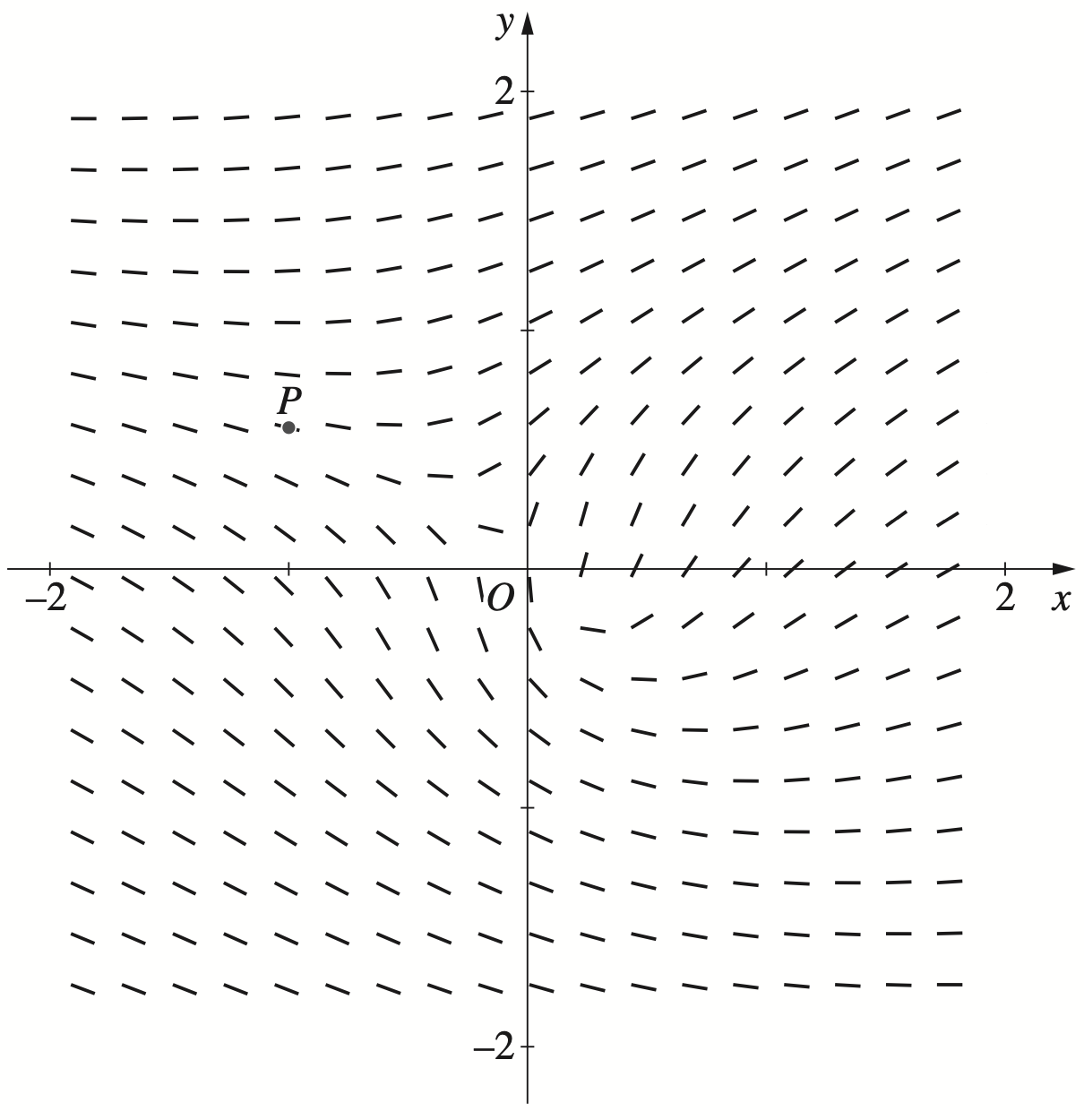
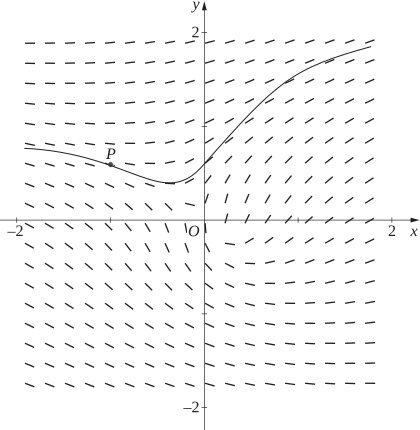
The direction field for a differential equation is shown below.

The graph of a particular solution to the differential equation passes through the point `P`.

On the graph, sketch the graph of this particular solution.  (1 mark)

--- 0 WORK AREA LINES (style=lined) ---
Show Answers Only

Show Worked Solution

♦♦♦ Mean mark 18%!
MARKER COMMENT: A solution curve does not cross any tangent line.

Filed Under: Equations and Slope Fields, Equations and Slope Fields, Euler, Pseudocode and Slope Fields Tagged With: Band 6, smc-1183-20-Slope fields, smc-1197-10-Slope Fields, smc-7296-10-Slope Fields

Financial Maths, STD1 F3 2021 HSC 30

Blake opens a new credit card account on 1 May. He uses it, for the first time, on 4 May to buy concert tickets for $850.

He makes no further purchases or repayments during the month of May.

A statement for the credit card is issued on the last day of each month.

The statement for May shows that interest is charged at 19.75% per annum, compounding daily, from 20 May (included) until 31 May (included).

  1. What is the compound interest shown on the statement issued on 31 May?   (3 marks)

    --- 5 WORK AREA LINES (style=lined) ---
  2. The minimum payment is calculated as 3% of the closing balance on 31 May. Calculate the minimum payment.   (1 mark)

    --- 1 WORK AREA LINES (style=lined) ---

Show Answers Only

a.    `$5.54`

b.    `$25.67`

Show Worked Solution

a.   `text(Daily interest rate) = 19.75/365 = 0.05411text(%) = 0.0005411`

`text(Days incurring interest = 12)`

♦♦♦ Mean mark part (a) 14%.
`text{Card balance (31 May)}` `= PV(1+r)^n`
  `= 850 (1 + 0.0005411)^12= $855.54`

  
`:.\ text(Interest)= 855.54-850= $5.54`

♦♦♦ Mean mark part (b) 15%.
b.    `text(Minimum payment)` `= 855.54 xx 0.03= $25.67“

Filed Under: Credit Cards, Credit Cards Tagged With: Band 6, smc-6847-10-Interest on Purchases, smc-6847-30-Minimum Payments

Measurement, STD1 M3 2021 HSC 28

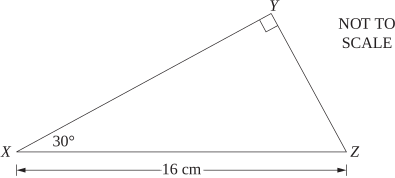
A right-angled triangle `XYZ` is shown. The length of `XZ` is 16 cm and `angleYXZ = 30^@`.


  1. Find the side length, `XY`, of the triangle in centimetres, correct to two decimal places.   (2 marks)

    --- 4 WORK AREA LINES (style=lined) ---

  2. Hence, find the area of triangle `XYZ` in square centimetres, correct to one decimal place.   (3 marks)

    --- 6 WORK AREA LINES (style=lined) ---
Show Answers Only

a.    `13.86\ text(cm)`

b.    `55.4\ text(cm)^2`

Show Worked Solution
♦♦ Mean mark part (a) 24%.
a.     `cos 30^@` `=(XY)/16`
  `XY` `=16 xx cos30^@`
    `=13.856\ …=13.86\ text(cm)\ \ text{(2 d.p.)}`


b.    `text(Using the sine rule:)`

♦♦♦ Mean mark part (b) 14%.

`text(Find )YZ`

`sin30^@` `=(YZ)/16`
`YZ` `=16\times sin30^@=8`


`text(Area)\ DeltaXYZ` `= 1/2 xx8 xx 13.86`
  `=55.44=55.4\ text(cm)^2\ \ text{(1 d.p.)}`

Filed Under: M3 Right-Angled Triangles (Y12), Right-angled Triangles (Y12) Tagged With: Band 5, Band 6, smc-1103-20-Right-angled Trig, smc-6834-20-Trigonometry

Financial Maths, STD1 F3 2021 HSC 27

Tracy takes out a 30-year reducing balance loan of $680 000 to buy a house. Interest is charged at 0.25% per month. The loan is to be repaid in equal monthly instalments of $2866.91 over a term of 30 years.

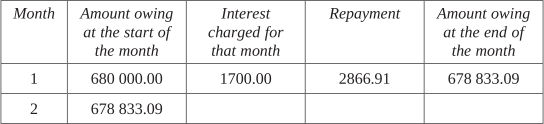
Part of a spreadsheet used to model the reducing balance loan is shown.


  1. Find the amount owing at the end of the second month.   (2 marks)

    --- 4 WORK AREA LINES (style=lined) ---
  2. Suppose that the interest rate reduces to 0.15% per month and the monthly instalments remain as $2866.91.
  3. What will happen to the term of the loan? Explain your answer without using calculations.   (2 marks)

    --- 5 WORK AREA LINES (style=lined) ---

Show Answers Only

a.    `$677\ 663.26`

b.    `text(Loan term will decrease.)`

`text(The repayment will pay down more of the principal each)`

`text(month, reducing the term of the loan.)`

Show Worked Solution

a.   `text(In month 2:)`

♦♦ Mean mark part (a) 31%.

`text(Interest) = 678\ 833.09 xx 0.0025 = $1697.08`

`text(Repayment) = $2866.91`

`text(Balance owing)` `= 678\ 833.09 + 1697.08-2866.91`
  `= $677\ 663.26`


b.   `text(The term of the loan will decrease.)`

♦♦♦ Mean mark part (b) 18%.

`text(If interest rate reduces, the monthly interest amount)`

`text(payable decreases.)`

`text(The repayment will pay down more of the principal each)`

`text(month, reducing the term of the loan.)`

Filed Under: Loans, Loans Tagged With: Band 5, Band 6, smc-1140-20-\(P+I-R\ \) Tables, smc-6846-10-\(P+I-R\ \) Tables

Financial Maths, STD1 F1 2021 HSC 19

Yin purchased a car for $20 000. The value of the car decreases according to a linear model. The graph shows the value of the car,  $\(V\), against the time,  \(t\) months, since it was purchased.


  1. By how much does the value of the car decrease every 10 months?   (1 mark)

    --- 2 WORK AREA LINES (style=lined) ---

  2. Find the value of the car after 5 years.   (1 mark)

    --- 1 WORK AREA LINES (style=lined) ---

  3. Identify ONE problem with using this model to determine the value of Yin’s car over time.   (1 mark)

    --- 2 WORK AREA LINES (style=lined) ---

Show Answers Only

a.    \($2000\)

b.    \($8000\)

c.    \(\text{Car will have a negative value after 100 months.}\)

Show Worked Solution

a.    \(\text{Decrease (10 months)}= 20\,000-18\,000= $2000\)
  

b.    \(\text{5 years} = 5 \times 12 = 60\ \text{months}\)

\(\text{At}\ \ t=60\ \text{(from graph)}:\)

\(V = $8000\)

c.    \(\text{Car will have a negative value after 100 months.}\)

♦ Mean mark (c) 11%.

Filed Under: Depreciation, Simple Interest and S/L Depreciation, Simple Interest and S/L Depreciation Tagged With: Band 4, Band 6, smc-1124-20-Straight-line Depreciation, smc-6845-10-Straight-line, smc-808-20-Straight Line Depreciation

Calculus, 2ADV C4 2021 HSC 28

The region bounded by the graph of the function  `f(x) = 8-2^x`  and the coordinate axes is shown
 

  1. Show that the exact area of the shaded region is given by  `24-7/ln2`.   (3 marks)

    --- 6 WORK AREA LINES (style=lined) ---

  2. A new function  `g(x)`  is found by taking the graph of   `y =-f(-x)`  and translating it by 5 units to the right.
  3. Sketch the graph of  `y = g(x)`  showing the `x`-intercept and the asymptote.   (2 marks)

    --- 8 WORK AREA LINES (style=lined) ---

  4. Hence, find the exact value of  `int_2^5 g(x)\ dx`.   (1 mark)

    --- 1 WORK AREA LINES (style=lined) ---

Show Answers Only

a.    `text(See Worked Solution)`

b.    

 c.    `7/(ln2)-24`

Show Worked Solution

a.    `xtext(-intercept occurs when)`

`8-2^x = 0 \ => \ x = 3`

`text(Area)` `= int_0^3 8-2^x\ dx`
  `= [8x-(2^x)/(ln2)]_0^3`
  `= 24-8/(ln 2)-(0-1/(ln2))`
  `= 24-8/(ln2) + 1/(ln2)`
  `= 24-7/(ln2)\ \ text(u²)`

♦ Mean mark part (b) 48%.
b.    

`y = f(-x) -> text(reflect)\ \ y = f(x)\ \ text(in the)\ ytext(-axis)`

`y =-f(-x) -> text(reflect)\ \ y = f(-x)\ \ text(in the)\ xtext(-axis)`
 

♦♦♦ Mean mark part (c) 13%.

c.   `int_2^5 g(x)\ dx\ \ text{is the same area as found in part (a)}`

`text(except it is below the)\ xtext(-axis.)`

`:. int_2^5 g(x)\ dx = 7/(ln2)-24`

Filed Under: Area Under Curves, Areas Under Curves Tagged With: Band 4, Band 5, Band 6, smc-7131-40-Exponential/Log, smc-7131-80-X-topic Transformations, smc-975-40-Exponential, smc-975-80-AUC and Transformations

Probability, 2ADV S1 2021 HSC 34

A discrete random variable has probability distribution as shown in the table where  `n`  is a finite positive integer.

\begin{array} {|c|c|c|c|c|c|c|c|}
\hline
\rule{0pt}{2.5ex} x \rule[-1ex]{0pt}{0pt} & \ \ \ r\ \ \  & \ \ \ r^{2}\ \ \  & \ \ \ r^{3}\ \ \  & \ \ \ ...\ \ \  & \ \ \ r^{k}\ \ \ &\ \ \ ...\ \ \ & \ \ \ r^{n}\ \ \ \\
\hline
\rule{0pt}{2.5ex} P(X=x) \rule[-1ex]{0pt}{0pt} & r^{n} & r^{n-1} & r^{n-2} & ... & r^{n-k+1} & ... & r  \\
\hline
\end{array}

Show that  `E(X) = n( 2r-1)`.   (3 marks)

--- 6 WORK AREA LINES (style=lined) ---

Show Answers Only

`text(See Worked Solution)`

Show Worked Solution
♦♦♦ Mean mark 18%.
`E(X)` `= ∑x · P(X = x)`
  `= r · r^n + r^2 · r^(n + 1) + … + r^n · r`
  `= r^(n + 1) + r^(n + 1) + … + r^(n + 1)`
  `= nr^(n + 1) …\ (1)`

  
`text(Sum of probabilities = 1)`

`underset (text(GP where)\ a = r,\ r = r) (underbrace {r + r^2 + r^3 + … + r^(n-1) + r^n}) = 1`

`(r(1-r^n))/(1-r)` `= 1`
`r-r^(n + 1)` `= 1-r`
`r^(n + 1)` `= 2r-1 …\ (2)`

 
`text{Substitute (2) into (1):}`

`E(X) = n(2r-1)`

Filed Under: Discrete Probability Distributions, Discrete Random Variables Tagged With: Band 6, smc-7136-10-Sum of Probabilities = 1, smc-7136-20-\(E(X)\) / Mean, smc-992-10-Sum of Probabilities = 1, smc-992-20-E(X) / Mean

Statistics, 2ADV S3 2021 HSC 33

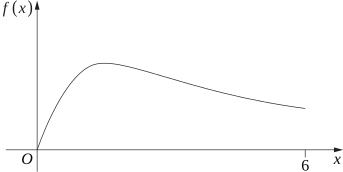
People are given a maximum of six hours to complete a puzzle. The time spent on the puzzle, in hours, can be modelled using the continuous random variable \(X\) which has probability density function

\(f(x)= \begin{cases}
\dfrac{A x}{x^2+4} & \text{for } 0 \leq x \leq 6,(\text { where } A>0) \\
\ \\
0 & \text {for all other values of } x
\end{cases}\)

The graph of the probability density function is shown below. The graph has a local maximum.
 

  1. Show that  \(A=\dfrac{2}{\ln 10}\).   (2 marks)

    --- 6 WORK AREA LINES (style=lined) ---

  2. Show that the mode of \(X\) is two hours.   (2 marks)

    --- 6 WORK AREA LINES (style=lined) ---

  3. Show that  \(P(X<2)=\log _{10} 2\).   (2 marks)

    --- 5 WORK AREA LINES (style=lined) ---

  4. The Intelligence Quotient (IQ) scores of people are normally distributed with a mean of 100 and standard deviation of 15.
  5. It has been observed that the puzzle is generally completed more quickly by people with a high IQ.
  6. It is known that 80% of people with an IQ greater than 130 can complete the puzzle in less than two hours.
  7. A person chosen at random can complete the puzzle in less than two hours.
  8. What is the probability that this person has an IQ greater than 130? Give your answer correct to three decimal places.   (2 marks)

    --- 4 WORK AREA LINES (style=lined) ---

Show Answers Only

a.    \(\text{See Worked Solution}\)

b.    \(\text{See Worked Solution}\)

c.    \(\text{See Worked Solution}\)

d.    \(0.066\)

Show Worked Solution

a.    \(\displaystyle\int_0^6 \dfrac{A x}{x^2+4} \, d x=1\)

\(\begin{aligned} \dfrac{A}{2} \int_0^6 \dfrac{2 x}{x^2+4} d x & =1 \\
\dfrac{A}{2}\left[\ln \left(x^2+4\right)\right]_0^6 & =1 \\
\dfrac{A}{2}(\ln 40-\ln 4) & =1 \\
\dfrac{A}{2} \ln \left(\dfrac{40}{4}\right) & =1 \\
\dfrac{A}{2} \ln 10 & =1 \\
A & =\dfrac{2}{\ln 10}\end{aligned}\)
 

b.    \(\text{Mode \(\rightarrow f(x)\) is a MAX}\)

♦♦♦ Mean mark (b) 24%.

\(\begin{aligned}
f(x) & =\dfrac{A x}{x^2+4} \\
f^{\prime}(x) & =\dfrac{A\left(x^2+4\right)-A x(2 x)}{\left(x^2+4\right)^2} \\
& =\dfrac{A x^2+4 A-2 A x^2}{\left(x^2+4\right)^2} \\
& =\dfrac{A\left(4-x^2\right)}{\left(x^2+4\right)^2}
\end{aligned}\)

\(\text{\(f(x)\) max occurs when \(f^{\prime}(x)=0\) :}\)

\(\begin{aligned}
4-x^2 & =0 \\
x & =2 \quad(x>0)
\end{aligned}\)
  

♦♦ Mean mark part (c) 30%.
c.     \(P(X<2)\) \(=\displaystyle \int_0^2 \dfrac{A x}{x^2+4} d x\)
    \(=\dfrac{A}{2}\left[\ln \left(x^2+4\right)\right]_0^2\)
    \(=\dfrac{1}{\ln 10}(\ln 8-\ln 4)\)
    \(=\dfrac{1}{\ln 10}\left(\ln \dfrac{8}{4}\right)\)
    \(=\dfrac{1}{\ln 10} \cdot \ln 2\)
    \(=\log _{10} 2\)

  
d. 
   \(z \text{-score}(130)=\dfrac{x-\mu}{\sigma}=\dfrac{130-100}{15}=2\)

♦♦ Mean mark (d) 25%.

\(P(z>2)=2.5 \%\)

\begin{aligned}
P(\text { IQ }>130 \mid x<2) & =\dfrac{P(\text { IQ }>130 \cap X<2)}{P(X<2)} \\
& =\dfrac{0.8 \times 0.025}{\log _{10} 2} \\
& =0.0664 \ldots \\
& =0.066\ \text{(3 d.p.)}
\end{aligned}

Filed Under: Continuous Random Variables, Probability Density Functions Tagged With: Band 4, Band 5, Band 6, smc-7137-20-Mode, smc-7137-40-CDF, smc-7137-90-Other PDF functions, smc-7137-95-X-topic, smc-994-20-Mode, smc-994-40-Cumulative Distribution Fn, smc-994-90-Other PDF functions, smc-994-97-X-Topic Transformations

Statistics, STD2 S5 2021 HSC 41

In a particular city, the heights of adult females and the heights of adult males are each normally distributed.

Information relating to two females from that city is given in Table 1.
 

The means and standard deviations of adult females and males, in centimetres, are given in Table 2.
 

A selected male is taller than 84% of the population of adult males in this city.

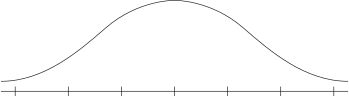
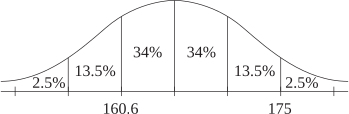
By first labelling the normal distribution curve below with the heights of the two females given in Table 1, calculate the height of the selected male, in centimetres, correct to two decimal places.  (4 marks)


--- 6 WORK AREA LINES (style=lined) ---

Show Answers Only

`178.95 \ text{cm}`

Show Worked Solution

`z text{-score (175 cm, female)} = 2`

♦♦♦ Mean mark 16%.

`z text{-score (160.6 cm, female)} = -1`
 

`text{Find} \ mu \ text{of female heights:}`

`mu-sigma` `= 160.6`  
`mu + 2sigma` `= 175`  
`3 sigma` `= 175-160.6`  
`sigma` `= 14.4/3= 4.8 \ text{cm}`  
`:. \ mu` `= 165.4 \ text{cm}`  

  
`text{Selected male’s height has} \ z text{-score} = 1`

`mu text{(male)} = 1.05 times 165.4 = 173.67`

`sigma \ text{(male)} = 1.1 times 4.8 = 5.28`

`:. \ text{Actual male height}` `= 173.67 + 5.28`  
  `= 178.95 \ text{cm}`  

Filed Under: S5 The Normal Distribution (Y12) Tagged With: 2adv-std2-common, Band 6, common-content, smc-819-30-Comparisons of Data Sets, smc-819-40-Graphs

Algebra, STD1 A3 2021 HSC 29

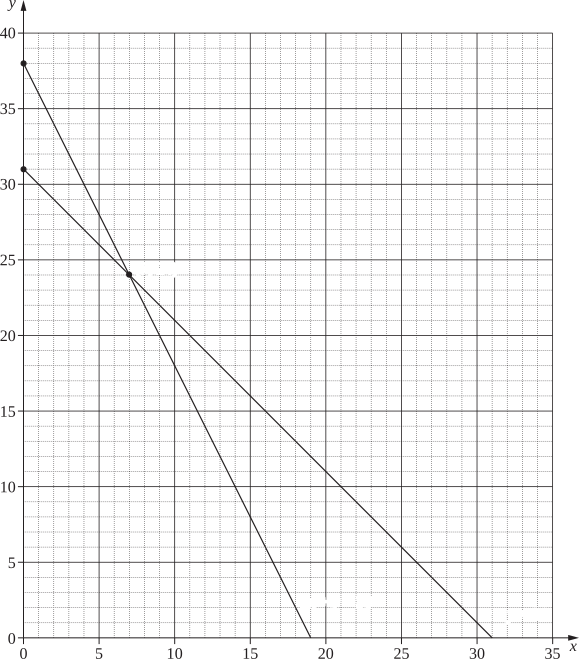
In a park the only animals are goannas and emus. Let `x` be the number of goannas and let `y` be the number of emus.

The number of goannas plus the number of emus in the park is 31. Hence  `x + y = 31`.

Each goanna has four legs and each emu has two legs. In total the emus and goannas have 76 legs.

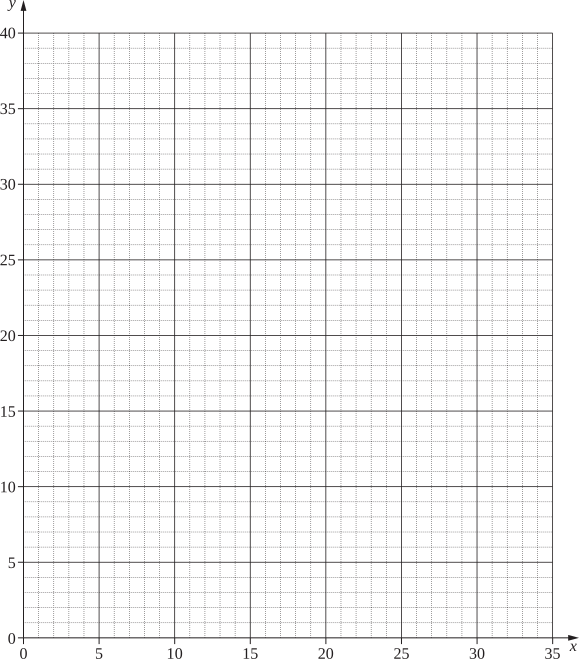
By writing another relevant equation and graphing both equations on the grid, find the number of goannas and the number of emus in the park.   (4 marks)

--- 6 WORK AREA LINES (style=lined) ---


Number of goannas = _______________

Number of emus = _________________

Show Answers Only

`text{7 goannas, 24 emus}`

Show Worked Solution

`text{Total goanna legs} = 4x`

♦♦♦ Mean mark 8%.

`text{Total emu legs} = 2y`

`text{Total legs} = 76`

`4x + 2y` `= 76`  
`2x + y` `= 38\ \ …\ (1)`  
`x + y` `= 31\ \ …\ (2)`  


`text{Number of goannas}\ (x) = 7`

`text{Number of emus}\ (y) = 24`

Filed Under: A3 Types of Relationships (Y12), Simultaneous Linear Equations Tagged With: Band 6, smc-1099-20-Other SE applications, smc-1099-30-Find intersection, smc-1099-40-Sketch equations, smc-6839-20-Other SE Applications, smc-6839-30-Find Intersection

Algebra, STD2 A4 2021 HSC 34

In a park the only animals are goannas and emus. Let `x` be the number of goannas and let `y` be the number of emus.

The number of goannas plus the number of emus in the park is 31. Hence  `x + y = 31`.

Each goanna has four legs and each emu has two legs. In total the emus and goannas have 76 legs.

By writing another relevant equation and graphing both equations on the grid on the following page, find the number of goannas and the number of emus in the park.   (4 marks)

--- 1 WORK AREA LINES (style=lined) ---


Number of goannas = _______________

Number of emus = _________________

--- 0 WORK AREA LINES (style=lined) ---
Show Answers Only

`text{7 goannas, 24 emus}`

Show Worked Solution

`text{Total goanna legs} = 4x`

♦♦♦ Mean mark 29%.

`text{Total emu legs} = 2y`

`4x + 2y` `= 76`
`2x + y` `= 38 \ …\ (1)`
`x + y` `= 31 \ …\ (2)`


`text{Number of goannas} = 7`

`text{Number of emus} = 24`

Filed Under: Simultaneous Equations and Applications, Simultaneous Linear Equations Tagged With: Band 6, smc-6920-15-Other SE Applications, smc-6920-20-Find Intersection, smc-6920-30-Sketch Linear Equations, smc-794-15-Other SE Applications, smc-794-20-Find Intersection, smc-794-30-Sketch Linear Equations

Statistics, STD2 S4 2021 HSC 33

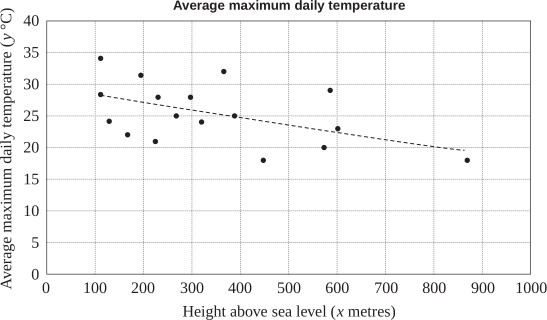
For a sample of 17 inland towns in Australia, the height above sea level, `x` (metres), and the average maximum daily temperature, `y` (°C), were recorded.

The graph shows the data as well as a regression line.


The equation of the regression line is  `y = 29.2-0.011x`.

The correlation coefficient is  `r =-0.494`.

  1. i.  By using the equation of the regression line, predict the average maximum daily temperature, in degrees Celsius, for a town that is 540 m above sea level. Give your answer correct to one decimal place.   (1 mark)

    --- 1 WORK AREA LINES (style=lined) ---

  2. ii. The gradient of the regression line is −0.011. Interpret the value of this gradient in the given context.   (2 marks)

    --- 4 WORK AREA LINES (style=lined) ---

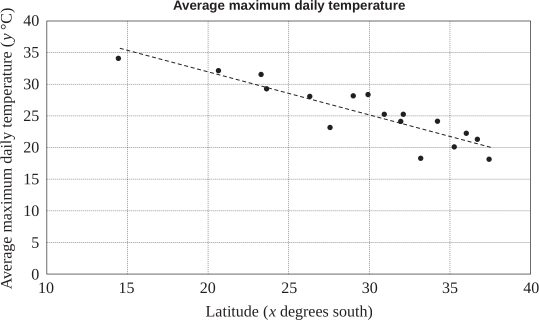
  3. The graph below shows the relationship between the latitude, `x` (degrees south), and the average maximum daily temperature, `y` (°C), for the same 17 towns, as well as a regression line.


    The equation of the regression line is  `y = 45.6-0.683x`.
  4. The correlation coefficient is  `r =-0.897`.
  5. Another inland town in Australia is 540 m above sea level. Its latitude is 28 degrees south.
  6. Which measurement, height above sea level or latitude, would be better to use to predict this town’s average maximum daily temperature? Give a reason for your answer.   (1 mark)

    --- 2 WORK AREA LINES (style=lined) ---

Show Answers Only

a.    i.  `23.3°text(C)`

ii. `text(See Worked Solutions)`

b.    `text(Latitude. Correlation coefficient shows a stronger relationship.)`

Show Worked Solution
a.i.     `y` `=29.2-0.011(540)`
    `=23.26`
    `=23.3°text{C  (1 d.p.)`
♦♦ Mean mark (a.ii.) 28%.

 
a.ii.
`text(On average, the average maximum daily temperature of)`

`text(inland towns drops by 0.011 of a degree for every metre)`

`text(above sea level the town is situated.)`
 

♦♦♦ Mean mark (b) 18%.

b.    `text(The correlation co-efficient of the regression line using)`

`text(latitude is significantly stronger than the equivalent)`

`text(co-efficient for the regression line using height above sea)`

`text(level.)`

`:.\ text(The equation using latitude is preferred.)`

Filed Under: Bivariate Data Analysis (Y12), S4 Bivariate Data Analysis (Y12) Tagged With: 2adv-std2-common, Band 4, Band 5, Band 6, common-content, smc-6934-20-LSRL, smc-6934-30-Correlation, smc-6934-50-Gradient Interpretation, smc-785-20-Least-Squares Regression Line, smc-785-30-Correlation, smc-785-50-Gradient Interpretation

Statistics, STD2 S5 2021 HSC 38

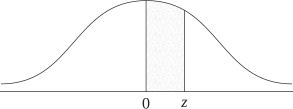
A random variable is normally distributed with mean 0 and standard deviation 1. The table gives the probability that this random variable lies between 0 and `z` for different values of `z`.


The probability values given in the table for different values of `z` are represented by the shaded area in the following diagram.
 

  1. Using the table, show that the probability that a value from a random variable that is normally distributed with mean 0 and standard deviation 1 is greater than 0.3 is equal to 0.3821.   (1 mark)

    --- 1 WORK AREA LINES (style=lined) ---

  2. Birth weights are normally distributed with a mean of 3300 grams and a standard deviation of 570 grams. By first calculating a `z`-score, find how many babies, out of 1000 born, are expected to have a birth weight greater than 3471 grams.   (3 marks)

    --- 6 WORK AREA LINES (style=lined) ---
Show Answers Only
  1. `text(See Worked Solutions)`
  2. `382`
Show Worked Solution

a.   `P(z>0)=0.5`

♦♦♦ Mean mark part (a) 1%.
COMMENT: Note the Std2 and Advanced questions varied slightly but used the same table and graph.

`P(0<z<0.3)=0.1179`

`P(z>0.3) = 0.5-0.1179=0.3821`
 

b.   `z text{-score (3471)}` `=(x-mu)/sigma`
    `=(3471-3300)/570`
    `=0.3`

 
`P(z>0.3) = 0.3821\ \ text{(see part (a))}`
  

`:.\ text(Number of babies > 3471 grams)`  
`=1000 xx 0.3821`  
`=382\ \ text{(nearest whole)}`  

Filed Under: S5 The Normal Distribution (Y12) Tagged With: Band 4, Band 6, common-content, smc-819-10-Single z-score, smc-819-50-z-score table

Algebra, STD2 A4 2021 HSC 35

A publisher sells a book for $10. At this price, 5000 copies of the book will be sold and the revenue raised will be  `5000 xx 10=$50\ 000`.

The publisher is considering increasing the price of the book. For every dollar the price of the book is increased, the publisher will sell 50 fewer copies of the book.

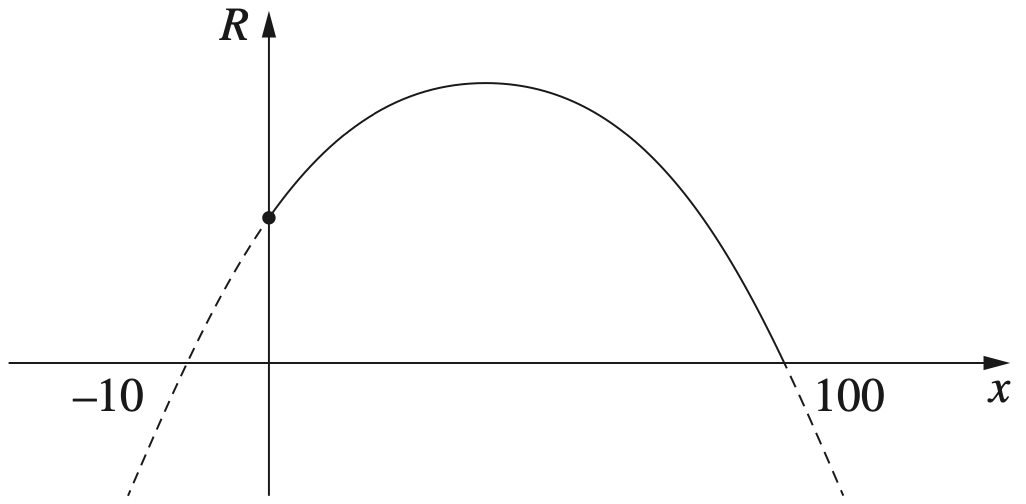
If the publisher charges `(10+x)` dollars for each book, a quadratic model for the revenue raised, `R`, from selling books is

`R=-50x^2+4500x + 50\ 000`


  1. By first finding a suitable value of `x`, find the price the publisher should charge for each book to maximise the revenues raised from sales of the book.   (2 marks)

    --- 4 WORK AREA LINES (style=lined) ---
  2. Find the value of the intercept of the parabola with the vertical axis.   (1 mark) 

    --- 2 WORK AREA LINES (style=lined) ---

Show Answers Only

a.    `$55`

b.    `$50\ 000`

Show Worked Solution

a.    `text{Highest revenue}\ (R)\ text(occurs halfway between)`

`x= –10 and x=100.`

`text{Midpoint}\ =(-10 + 100)/2 = 45`

♦♦♦ Mean mark part (a) 16%.

`:.\ text(Price of book for)\ R_text(max)`

`=45 + 10=$55`
 

♦♦♦ Mean mark part (b) 21%.

b.    `ytext(-intercept → find)\ \ R\ \ text(when)\ \ x=0:`

`R= -50(0)^2 + 4500(0) + 50\ 000=$50\ 000`

Filed Under: Non-Linear: Exponential/Quadratics, Quadratic Relationships Tagged With: Band 6, smc-6922-10-Find Vertex, smc-6922-20-Practical Problems, smc-6922-30-Find Intercept, smc-830-20-Quadratics

Measurement, STD1 M5 2021 HSC 21

A rectangular sportsground has been drawn to scale on a 1-cm grid as shown. The scale used is `1:3000`.
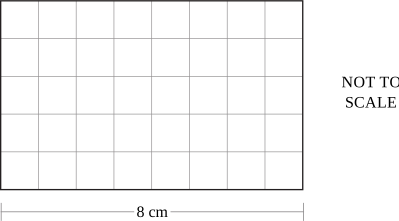
 

Kerry took 12 minutes to walk around the perimeter of this sportsground.

What was Kerry's average speed in kilometres per hour?   (4 marks)

--- 8 WORK AREA LINES (style=lined) ---

Show Answers Only

`3.9 \ text{km/hr}`

Show Worked Solution
`text{Distance walked on map} \ = \ 2 times (8 + 5) = 26 \ text{cm}`
♦♦♦ Mean mark 24%.
 
`text{Actual distance}` ` =26 times 3000`  
  `= 78\ 000 \ text{cm}`  
  `=780 \ text{m}`  
  `= 0.78 \ text{km}`  

 
`12 \ text{minutes}\ = 12/60 = 0.2 \ text{hours}`
 

`text{Speed}` `= text{distance}/text{time}`  
  `= 0.78/0.2`  
  `= 3.9 \ text{km/hr}`  

Filed Under: M5 Scale Drawings (Y12), Ratios Tagged With: Band 6, smc-1105-20-Maps and Scale Drawings, smc-6858-10-Maps and Scale Drawings

Calculus, 2ADV C3 2021 HSC 10 MC

The line  `y = mx`  is a tangent to the curve  `y = cos x`  at the point where  `x = a`, as shown in the diagram.
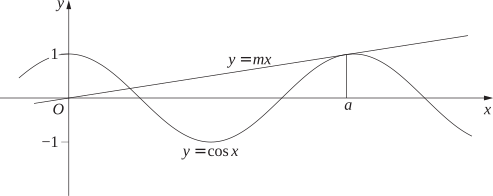
 

Which of the following statements is true?

  1. `m < 1/a < 1/(2pi)`
  2. `1/(2pi) < m < 1/a`
  3. `1/(2pi) < 1/a < m`
  4. `m < 1/(2pi) < 1/a`
Show Answers Only

`B`

Show Worked Solution

`text(By Elimination:)`

♦♦♦ Mean mark 27%.

`a < 2pi \ => \ 1/a > 1/(2pi)`

`->\ text(Eliminate A)`
 

`m ~~ 1/(2pi) ~~ 1/6`

`1/a\ text{is much closer to 1 (by inspection)}`

`1/a > m`

`->\ text(Eliminate C)`
 

`text(At)\ \ x = 2pi,`

`y = cos 2pi = 1\ \ text(and)\ \ y = mx > 1`

`m > 1/(2pi)`

`:. 1/(2pi) < m < 1/a`

 
`=>B`

Filed Under: Tangents Tagged With: Band 6, smc-1090-60-Trig Function

Measurement, STD2 M7 2021 HSC 15 MC

A total of 11 400 people entered a running race. The ratio of professional runners to amateurs was  `3 : 16`. All the professional runners completed the race while 600 of the amateurs did not complete the race.

For those who completed the race, what is the ratio, in its simplest form, of professional runners to amateurs?

  1. `1 : 2`
  2. `1 : 5`
  3. `1 : 8`
  4. `1 : 19`
Show Answers Only

`B`

Show Worked Solution

`3:16 =>\ text(Total parts = 19)`

♦♦ Mean mark 28%.

`text(Number of professionals) = 3/19 xx 11\ 400 = 1800`

`text(Number of amateurs) = 16/19 xx 11\ 400 = 9600`

`text(Amateurs who finished) = 9600-600 = 9000`
 

`:.\ text{Ratio of professionals : amateurs (who finished)}`

`= 1800 : 9000=1:5`

 
`=> B`

Filed Under: Ratio and Scale, Ratios Tagged With: Band 6, smc-1187-10-Ratio (2 part), smc-6931-10-Ratio (2 part)

Geometry, NAP-E3-CA09v1

Greg is a professional diver and performs a one and a half backward somersault before entering the water.

By how many degrees has Greg rotated his body?

`150^@` `450^@` `480^@` `540^@`


Show Answers Only

`540^@`

Show Worked Solution

`text(One somersault rotates)\ 360^@.`

`:.1.5\ text(somersaults)` `= 1.5 xx 360^@`
  `= 540^@`

Filed Under: Triangles and Other Geometric Properties Tagged With: Band 6, smc-3165-60-Other problems

Number, NAP-B3-CA05v1

Two places are 3.6 cm apart on a map.

On the map 1 cm represents 3 km.

What is the actual distance between the two places?

`1.2\ text(km)` `6.6\ text(km)` `10.8\ text(km)` `32.4\ text(km)`


Show Answers Only

`10.8\ text(km)`

Show Worked Solution
`text(Actual distance)` `=3.6 xx 3`
  `=10.8\ text(km)`

Filed Under: Maps and Directions Tagged With: Band 6, smc-3164-20-Map scales

Geometry, NAP-B3-NC07 SA v1

Collette folds this net to make a rectangular prism.


Which face is opposite of `E`?

Show Answers Only

`B`

Show Worked Solution

`B`

Filed Under: 2D-3D Shapes Tagged With: Band 6, smc-3155-50-Nets

Measurement, NAP-E3-NC13v1

A new plane had test run where it took off and landed at the same airport.

The pilot took off at 5:20 am and landed  `15 1/2` hours later.

At what time did the pilot land the plane?

`7:10\ text(pm)` `8:50\ text(pm)` `9:10\ text(pm)` `10:50\ text(pm)`


Show Answers Only

`text(8:50 pm)`

Show Worked Solution

`text(One strategy:)`

`5:20\ text(am plus)\ 15 1/2\ text(hours)` `=\ text(5:20 pm plus)\ 3 1/2\ text(hours)`
  `=\ text(8:50 pm)`

Filed Under: Time Tagged With: Band 6, smc-3154-10-Time intervals

Measurement, NAP-F3-CA06v1

Two sides of a triangle measure 3 cm and 5 cm.

Which one of these statements about the length of the third side is true?

 
Its length is 4 cm.
 
Its length is less than 3 cm.
 
Its length is greater than 8 cm.
 
Its length is greater than 2 cm but less than 8 cm.
Show Answers Only

`text(Its length is greater than 2 cm but less than 8 cm.)`

Show Worked Solution

`=>\ text(One side of a triangle cannot be longer than)`

`text(the sum of the 2 other sides.)`

`=>\ text(One side of a triangle cannot be shorter than)`

`text(the difference between the other 2 sides.)`

`:.\ text(Its length is greater than 2 cm but less)`

`text(than 8 cm)` 

Filed Under: Perimeter, Area and Volume Tagged With: Band 6, smc-3153-10-Perimeter

Measurement, NAP-B3-CA10v1

A petrol container has a capacity of 10.25 L.

How many millilitres does the petrol container hold when it is full?

`1025` `10\ 025` `10\ 250` `102\ 500`


Show Answers Only

`10\ 250\ text(mL)`

Show Worked Solution

`text(1 litre = 1000 mL:)`

`:. 10.25\ text(L) xx 1000 = 10\ 250\ text(mL)`

Filed Under: Units of Measurement Tagged With: Band 6, smc-3152-30-Convert mL/L

Number, NAP-B3-NC08 SA v1

A number is multiplied by itself and then divided by 2.

The answer is 32.

What is the number?

Show Answers Only

`8`

Show Worked Solution

`text(Reversing the order of operations:)`

`32 xx 2 =64`

`8 xx 8 = 64`
 

`text(Check answer:)`

`8 xx 8 -: 2 = 32`

`:.\ text(The number is 8.)`

Filed Under: Multi-Step Problems Tagged With: Band 6

Number, NAP-I3-CA01v1

Chilla just turned 16 years old.

Snix is 7 years younger than twice Chilla's age.

How old is Snix?

`9` `18` `21` `25`


Show Answers Only

`25`

Show Worked Solution
`text(Snix’s age)` `= (16 xx 2) -7`
  `= 25`

Filed Under: Multi-Step Problems Tagged With: Band 6

Number, NAP-G3-NC11v1

A tram at the zoo does a complete 5 kilometre loop in 30 minutes.

If the tram travelled at the same speed, how long did it take to complete 2 kilometres?

`text(8 minutes)` `text(12 minutes)` `text(18 minutes)` `text(24 minutes)`


Show Answers Only

`text(12 minutes)`

Show Worked Solution

`text(Time taken for 2 kilometres)`

`=2/5 xx 30`

`= 12\ text(minutes)`

Filed Under: Rates, Ratios and Scale Tagged With: Band 6, smc-3148-50-D=SxT

Number, NAP-A3-NC10 SA v1

What is the missing number?

`3 xx`   `= 9 xx 4`

Show Answers Only

`12`

Show Worked Solution
`9 xx 4` `36`
`3 xx 12` `=36`
`:. 3 xx 12` `= 9 xx 4`

Filed Under: Basic Concepts and Calculations, TESTLET AN Tagged With: Band 6

Number, NAP-A3-NC07v1

Max wanted to buy a squash racquet that cost $75.

He has saved $60.

How much extra does he need to save as a percentage of the cost price?

`text(7.5%)` `text(20%)` `text(25%)` `text(75%)`


Show Answers Only

`text(20%)`

Show Worked Solution
`text(Percentage)` `= 15/75 xx 100`
  `= 1/5 xx 100`
  `= 20 text(%)`

Filed Under: Percentages Tagged With: Band 6, smc-3147-10-Calculate %

Number, NAP-K3-CA29 SA v2

It takes a ray of sunlight 479.746 seconds to reach the earth from the sun.

How long is this, rounded to two decimal places?

    seconds 
Show Answers Only

`479.75`

Show Worked Solution
`text(Time)` `= 479.746`
  `=479.75\ text{seconds (to 2 d.p.)}`

Filed Under: Decimals Tagged With: Band 6, smc-2136-40-Rounding

Number, NAP-K3-CA29 SA v1

Usain is timed at 9.8472 seconds for the 100 metre sprint.

What is Usain's time, rounded to two decimal places?

    seconds 
Show Answers Only

`9.88`

Show Worked Solution
`text(Time)` `= 9.8769`
  `=9.88\ text{seconds (to 2 d.p.)}`

Filed Under: Decimals Tagged With: Band 6, smc-3146-40-Rounding

Number, NAP-J3-CA06 SA v1

36 surfers were asked "Have you snapped a surfboard in the last 12 months?"

`3/4` of the surfers answered "Yes".

How many surfers answered "Yes"?

Show Answers Only

`27`

Show Worked Solution

`text(Surfers who have snapped a board)`

`= 3/4 xx 36`

`= 27`

Filed Under: Fractions Tagged With: Band 6, smc-3145-30-Word problems

Number, NAP-H3-CA03v1

Sid is selling bike tyre tubes at a market stall.

He makes $54 from selling 6 bike tyre tubes.

All bike tyre tubes cost the same.

How much will Sid make if he sells 11 bike tyre tubes.

`$65` `$83` `$99` `$108`


Show Answers Only

`$99`

Show Worked Solution
`text(Price of 1 tube)` `=54/6=$9`


`:.\ text(Price of 11 tubes)` `=11 xx 9`
  `=$99`

Filed Under: Financial Maths, Rates, Ratios and Scale Tagged With: Band 6, smc-3144-50-Other problems, smc-3148-60-Rates and cost

Number, NAP-K3-NC01v1

Yanni buys 7 peaches for $1.30 each.

He pays for the peaches with a $10 note.

How much change should Yanni receive?

`$0.90` `$1.10` `$1.90` `$8.10`


Show Answers Only

`$0.90`

Show Worked Solution
`text(Change)` `=10.00 – 7 xx 1.30`  
  `=10-9.10`  
  `=$0.90`  

Filed Under: Financial Maths Tagged With: Band 6, smc-3144-10-Coins and change

Number, NAP-H3-CA07v1

Which one of these numbers is a factor of 65?

`3` `6` `13` `130`


Show Answers Only

`13`

Show Worked Solution

`text(Test each option:)`

`65 -: 3 = 21\ text(remainder 2)`

`65 -: 6 = 10\ text(remainder 5)`

`65 -: 13 = 5`

`:. 13\ text(is a factor of 65)`

Filed Under: Basic Concepts and Calculations Tagged With: Band 6, smc-3143-15-Factors

Measurement, NAP-E2-05v2

Libby started a meeting at 11:25 am.

The meeting finished at 1:22 pm.

How long did Libby's meeting go for?

`text(57 minutes)` `text(63 minutes)` `text(97 minutes)` `text(117 minutes)`


Show Answers Only

`text(117 minutes)`

Show Worked Solution

`text(One Strategy:)`

`text(11:25 pm to 12:00 pm = 35 minutes)`

`text(12:00 pm to 1:00 pm = 60 minutes)`

`text(1:00 pm to 1:22 pm = 22 minutes)`

`text(Meeting time = 35 + 60 + 22 = 117 minutes)`

Filed Under: Time Tagged With: Band 6, smc-3037-12-Time difference

Number and Algebra, NAP-J2-28v1

Dostoy has 73 match sticks.

He uses 6 match sticks to make two small triangles.


What is the largest number of small triangles that Dostoy can make with his 73 match sticks?

`19` `21` `24` `27`


Show Answers Only

`24`

Show Worked Solution

`text(3 match sticks are used for 1 triangle.)`

`text(Number of triangles)` `= 73 ÷ 3`
  `= 24\ text(remainder 1)`

 
`:.\ text(24 triangles.)`

Filed Under: Patterns, Solving Problems - Multiply/Divide Tagged With: Band 6, smc-3018-20-Divide, smc-3018-35-Remainder, smc-3021-20-Patterns and images

Number and Algebra, NAP-F2-26 SA v1

Dorian and Ava save money each week.

Dorian saves $9 per week and Ava saves $6 per week.

After 9 weeks, how much more money has Dorian saved than Ava?

$  
Show Answers Only

`$27`

Show Worked Solution

`text(Dorian saves $3 more than Ava per week.)`

`:.\ text(Extra money saved after 9 weeks)`

`= 9 xx 3`

`= $27`

Filed Under: Money Tagged With: Band 6, smc-3020-15-Whole $ calculations

Number and Algebra, NAP-G2-32v2

Which of these has the same value as  10.4?

 
`100 + 4`
 
`10 + 4/100`
 
`1+ 4/100`
 
`10 + 4/10`
Show Answers Only

`10 + 4/10`

Show Worked Solution

`10 + 4/10`

Filed Under: Fractions and Decimals Tagged With: Band 6, smc-3019-60-Fraction/decimal conversion

Number and Algebra, NAP-B1-29v2

Pinto needs 3 bars of chocolate to make a birthday cake.

He adds `1/4` bar of chocolate at a time in the recipe.

How many `1/4` bars of chocolate will he need to add?

`3` `4` `8` `12`


Show Answers Only

`12`

Show Worked Solution
`4 xx 1/4` `= 1\ text(bars)`
`8 xx 1/4` `= 2\ text(bars)`
`12 xx 1/4` `= 3\ text(bars)`


`=>\ text(Pinto needs)\ 12 xx 1/4\ text(chocolate bars.)`

Filed Under: Fractions and Decimals Tagged With: Band 6, smc-3019-25-Quarters, smc-3019-40-Counting by fractions

Number and Algebra, NAP-B1-29v1

Kate uses 1 cup of flour to make one muffin.

She measures `1/3` cup each time.

How many `1/3` cups will she need to make 6 muffins?

`2` `3` `12` `18`


Show Answers Only

`18`

Show Worked Solution
`3 xx 1/3\ text(cup)` `= 1\ text(cupcake)`
`6 xx 1/3\ text(cup)` `= 2\ text(muffins)`
`12 xx 1/3\ text(cup)` `= 4\ text(muffins)`
`18 xx 1/3\ text(cup)` `= 6\ text(muffins)`


`=>\ text(Kate needs 18)\ xx 1/3\ text(cups.)`

Filed Under: Fractions and Decimals Tagged With: Band 6, smc-3019-30-Other fractions, smc-3019-40-Counting by fractions

Number and Algebra, NAP-C2-25v1

7.42 is equal to

 
`0.7 + 0.4 + 0.2`
 
`7.0 + 0.4 + 0.2`
 
`7 + 0.04 + 0.02`
 
`7 + 0.4 + 0.02`
Show Answers Only

`7 + 0.4 + 0.02`

Show Worked Solution

`7 + 0.4 + 0.02`

Filed Under: Fractions and Decimals Tagged With: Band 6, smc-3019-70-Decimals - Other

Number and Algebra, NAP-H2-22v1

Australia changed its currency from pounds to dollars in 1966.

Approximately how many years ago did this change occur?

`60` `65` `75` `85`


Show Answers Only

`60`

Show Worked Solution

`text(1966 plus 60 years → 2026.)`

`text(The closest approximation is 60 years.)`

Filed Under: Solving Problems - Add/Subtract Tagged With: Band 6, smc-3017-10-Addition

Number and Algebra, NAP-E2-8v2

How many numbers between 8 and 51 are divisible by 6?

`5`    `6`   `7` `8`


Show Answers Only

`6`

Show Worked Solution

`text(Listing the numbers divisible by 6 between 8 and 51:)`

`12,18,24,30,36,42,48`

`:.\ text(There are 7 numbers.)`

Filed Under: Number and Place, Solving Problems - Multiply/Divide Tagged With: Band 6, smc-3016-90-Other problems, smc-3018-10-Multiply

Number and Algebra, NAP-J2-15v1

In one year, a motor company makes:

  • thirteen thousand and eighty-two cars
  • five thousand, eight hundred and one trucks

Write these as numbers in the boxes below:

 
  cars
 
  trucks
Show Answers Only

`text(13 082 cars)`

`text(5801 trucks)`

Show Worked Solution

`text(13 082 cars)`

`text(5801 trucks)`

Filed Under: Number and Place Tagged With: Band 6, smc-3016-60-Place Value

MATRICES, FUR2 2020 VCAA 4

A second market research project also suggested that if the Westmall shopping centre were sold, each of the three centres (Westmall, Grandmall and Eastmall) would continue to have regular shoppers but would attract and lose shoppers on a weekly basis.

Let `R_n` be the state matrix that shows the expected number of shoppers at each of the three centres `n` weeks after Westmall is sold.

A matrix recurrence relation that generates values of `R_n` is

`R_(n+1) = TR_n + B`

`{:(quad qquad qquad qquad qquad qquad qquad qquad text(this week)),(qquad qquad qquad qquad qquad qquad quad \ W qquad quad G qquad quad \ E),(text(where)\ T = [(quad 0.78, 0.13, 0.10),(quad 0.12, 0.82, 0.10),(quad 0.10, 0.05, 0.80)]{:(W),(G),(E):}\ text(next week,) qquad qquad  B = [(-400), (700), (500)]{:(W),(G),(E):}):}`
 

The matrix `R_2` is the state matrix that shows the expected number of shoppers at each of the three centres in the second week after Westmall is sold

`R_2 = [(239\ 060), (250\ 840), (192\ 900)]{:(W),(G),(E):}`

  1. Determine the expected number of shoppers at Westmall in the third week after it is sold.   (1 mark)

    --- 3 WORK AREA LINES (style=lined) ---

  2. Determine the expected number of shoppers at Westmall in the first week after it is sold.   (1 mark)

    --- 3 WORK AREA LINES (style=lined) ---

Show Answers Only
  1. `237\ 966`
  2. `241\ 000`
Show Worked Solution

♦ Mean mark part (a) 50%.
a.   `R_3` `= TR_2 + B`
    `= [(0.78, 0.13, 0.1),(0.12, 0.82, 0.1),(0.10, 0.05, 0.8)][(239\ 060),(250\ 840),(192\ 900)]+[(-400),(700),(500)] = [(237\ 966),(254\ 366),(191\ 268)]`

 
`:. text(Expected Westmall shoppers) = 237\ 966`
 

♦♦♦ Mean mark part (b) 20%.
b.   `R_2` `= TR_1 + B`
  `R_1` `= T^(-1)[R_2-B]`
    `= [(241\ 000), (246\ 000), (195\ 000)]`

 
`:. text(Expected Westmall shoppers) = 241\ 000`

Filed Under: Transition Matrices - Modified Tagged With: Band 5, Band 6, smc-1893-20-State Matrix in discrete period, smc-1893-25-Inverse Matrix, smc-1893-31-3x3 Matrix

  • « Previous Page
  • 1
  • …
  • 11
  • 12
  • 13
  • 14
  • 15
  • …
  • 29
  • Next Page »

Copyright © 2014–2026 SmarterEd.com.au · Log in