SmarterEd

Aussie Maths & Science Teachers: Save your time with SmarterEd

  • Login
  • Get Help
  • About

Probability, NAPX-p169473v02

Noel has a bowl full of red chewing gum balls and blue chewing gum balls.

The chance of randomly picking a red chewing gum ball is 85%.

What is the probability of randomly picking a blue chewing gum ball?

  %
Show Answers Only

`text(15%)`

Show Worked Solution

`P(text(Red)) + P(text(Blue)) = 100text(%)`

`P(text(blue))` `= 100 – 85`
  `= 15text(%)`

Filed Under: Probability Tagged With: Band 6, NAPX-SingleAnswer

Probability, NAPX-p169473v01

Tristan's laundry has a lost clothing basket that contains only black and white socks.

The probability of randomly picking a black sock from the basket is 35%.

What is the probability of randomly picking a white sock?

  %
Show Answers Only

`text(65%)`

Show Worked Solution

`P(text(white)) + P(text(black)) = 100text(%)`

`P(text(white))` `= 100 – 35`
  `= 65text(%)`

Filed Under: Probability Tagged With: Band 6, NAPX-SingleAnswer

Algebra, NAPX-p169467v02

A manufacturer makes horse floats.

The table below shows how many floats it makes each month.
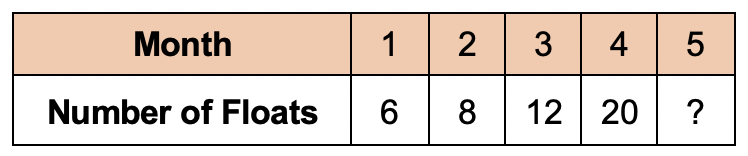
The number of floats made grows each month and follows the rule:

Double the number made last month and deduct 4

How many horse floats are made in the 5th month?

 
22
 
28
 
32
 
36

Show Answers Only

`36`

Show Worked Solution

`text(Using the rule:)`

`text(Floats made in 5th month)` `= (20 xx 2) – 4`
  `= 40 – 4`
  `= 36`

Filed Under: Patterns and Coordinate Geometry, TESTLET E Tagged With: Band 6, NAPX-MultipleChoice

Algebra, NAPX-p169467v01

Norman started cycling to stay fit.

The table below shows the distance he cycles on his rides.
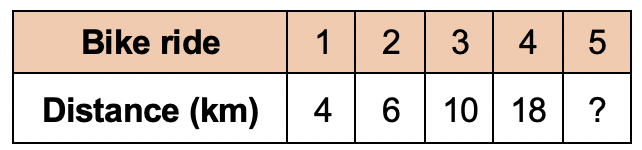
The distance he cycles increases each ride and follows the rule:

Double the last distance and deduct 2.

What is the distance travelled by Norman on his 5th ride?

 
26 km
 
30 km
 
34 km
 
36 km

Show Answers Only

`34\ text(km)`

Show Worked Solution

`text(Using the rule:)`

`text(Distance of 5th ride)` `= (18 xx 2) – 2`
  `= 36 – 2`
  `= 34\ text(km)`

Filed Under: Basic Algebra and Rules Tagged With: Band 6, NAPX-MultipleChoice

Number, NAPX-p111587v02

Lorenzo had a $10 note.

He decided to buy 13 tokens that are worth 60 cents each to play in the arcade.

How much change will he get?

 
$2.20
 
$3.20
 
$6.80
 
$7.80

Show Answers Only

`$2.20`

Show Worked Solution
`text(Change)` `= 10 – (13 xx 0.60)`
  `= 10 – 7.80`
  `= $2.20`

Filed Under: Financial Maths Tagged With: Band 6, NAPX-MultipleChoice

Number, NAPX-p111587v01

Jillian has $25 for buying some groceries.

At the supermarket, she bought 10 oranges that cost $0.25 each and 8 sweet potatoes that cost $1.50 each.

How much change will she get?

 
$7.50
 
$9.50
 
$10.50
 
$12.50

Show Answers Only

`$10.50`

Show Worked Solution
`text(Total cost)` `= (10 xx 0.25) + (8 xx 1.50)`
  `= 2.50 + 12.00`
  `= $14.50`


`text(Change)` `= 25.00 – 14.50`
  `= $10.50`

Filed Under: Financial Maths Tagged With: Band 6, NAPX-MultipleChoice

Algebra, NAPX-p169224v02

A company ships crates overseas and calculates the cost of shipping per crate.

This company uses a formula for calculating the size and cost of shipping.

The formula is shown below:

Size = Length + Width + Height

The maximum size of crates to be shipped overseas is 350 cm.

Which of the following crates is oversized?

  Length Width Height
 
200 60 80
 
150 130 90
 
160 100 70
 
130 120 100
Show Answers Only

`text(Oversized: Length = 150, width = 130, height = 90)`

Show Worked Solution

`text(Check each option:)`

`text(Option 1 – 200 + 60 + 80 = 340)`

`text{Option 2 – 150 + 130 + 90 = 370 (Oversized)}`

`text(Option 3 – 160 + 100 + 70 = 330)`

`text(Option 4 – 130 + 120 + 100 = 350)`

Filed Under: Basic Algebra and Rules Tagged With: Band 6, NAPX-MultipleChoice

Algebra, NAPX-p169224v01

A delivery company uses a formula to determine the cost of shipping different sizes of boxes.

The formula they use is as follows:

Size of box = length + width + height

The maximum size that can be shipped is 240 cm.

Which box is oversized?

  Length Width Height
 
100 80 60
 
70 60 90
 
90 90 50
 
90 110 50

Show Answers Only

`text(Oversized: Length = 90, width = 110, height = 50)`

Show Worked Solution

`text(Check each option:)`

`text(Option 1 – 100 + 80 + 60 = 240)`

`text(Option 2 – 70 + 60 + 90 = 220)`

`text(Option 3 – 90 + 90 + 50 = 230)`

`text{Option 4 – 90 + 110 + 50 = 250 (Oversized)}`

Filed Under: Basic Algebra and Rules Tagged With: Band 6, NAPX-MultipleChoice

Number, NAPX-p109670v02

Kelly wants to give away some of the apples that came from her family’s farm.

The two small boxes shown below fit either 5 apples or 6 apples.
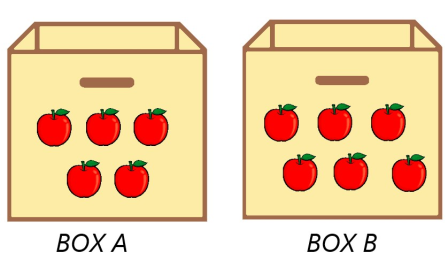
Kelly has 9 BOX A's and 10 BOX B's.

She shares the apples equally among 15 of her friends.

How many apples will each of her friends receive?

 
     5
 
     7
 
     8
 
  104
 
  105
Show Answers Only

`7`

Show Worked Solution
`text{Total apples}` `= (5 xx 9) + (6 xx 10) `
  `= 45 + 60 `
  `= 105`


`text{Apples per friend}` `= frac{105}{15}`
  `= 7`

Filed Under: Multi-Step Problems, TESTLET E Tagged With: Band 6, NAPX-MultipleChoice

Number, NAPX-p109670v01

John bought two different bags of bread rolls.
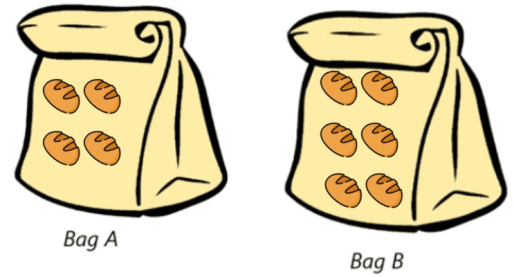


He bought 5 Bags A's and 10 Bag B's.

John then divided the bread rolls equally among 20 families.

How many bread rolls did each family receive?

 
     4
 
     5
 
     6
 
   70
 
   80
Show Answers Only

`4`

Show Worked Solution
`text{Total bread rolls}` `= (4 xx 5) + (6 xx 10) `
  `= 20 + 60 `
  `= 80`


`:.\ text{Bread rolls per family}` `= frac{80}{20}`
  `= 4`

Filed Under: Multi-Step Problems Tagged With: Band 6, NAPX-MultipleChoice

Number, NAPX-p168435v02

A student needs 12 folder dividers for each subject.

This student is enrolled in 5 subjects.

A school supply store sells the folder dividers in packets of 8.

How many packets should the student buy?

 
    4
 
    6
 
    7
 
    8
Show Answers Only

`8`

Show Worked Solution

`text{Dividers required } \ = 12 xx 5 = 60`

`:.\ text{Packets required}` `= frac{60}{8}`  
  `=7.5`  
  `=8\ text{packets (round up)}`  

Filed Under: Multi-Step Problems Tagged With: Band 6, NAPX-MultipleChoice

Number, NAPX-p168435v01

William needs 4 eggs for each cake he will bake.

He wants to make 12 cakes.

A certain store sells eggs in bags of 5.

How many bags must he buy in order to make 12 cakes?

 
    8
 
    9
 
  10
 
  12
Show Answers Only

`10`

Show Worked Solution

`text{Eggs required} \ = 4 xx 12 = 48`

`:.\ text{Bags required}` `= frac{48}{5}`  
  `=9.6`  
  `=10\ text{bags (round up)}`  

Filed Under: Multi-Step Problems Tagged With: Band 6, NAPX-MultipleChoice

Geometry, NAPX-p168433v01

A regular decagon is folded in half along the dotted line.
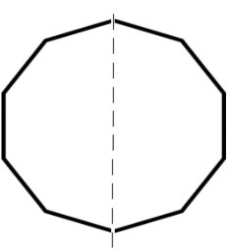
The folded shape can be also called a?

 
  hexagon
 
  dodecagon
 
  quadrilateral
 
  octagon
Show Answers Only

`text{Hexagon}`

Show Worked Solution

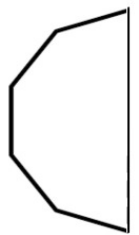
The folded shape has 6 sides → hexagon.
Filed Under: Triangles and Other Geometrical Properties Tagged With: Band 6, NAPX-MultipleChoice

Statistics, NAPX-p168209v02

The time spent by Mark playing video games on his computer is recorded in a table.
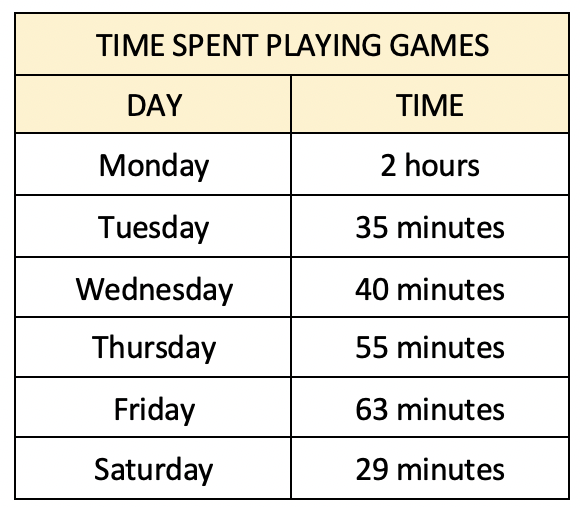


What was the average time per day that Mark spent playing video games over this period?

 
    41 minutess
 
    57 minutes
 
    63 minutes
 
  342 minutes
Show Answers Only

`57 \ text{minutes}`

Show Worked Solution

`text(1 hour = 60 minutes.)`

`text{Average time}` `= frac{120+35+40+55+63+29}{6}`
  `= frac{342}{6}`
  `= 57 \ text{minutes}`

Filed Under: Data and Statistics Tagged With: Band 6, NAPX-MultipleChoice

Statistics, NAPX-p168209v01

The table shown below records Emily's jogging time over six days.
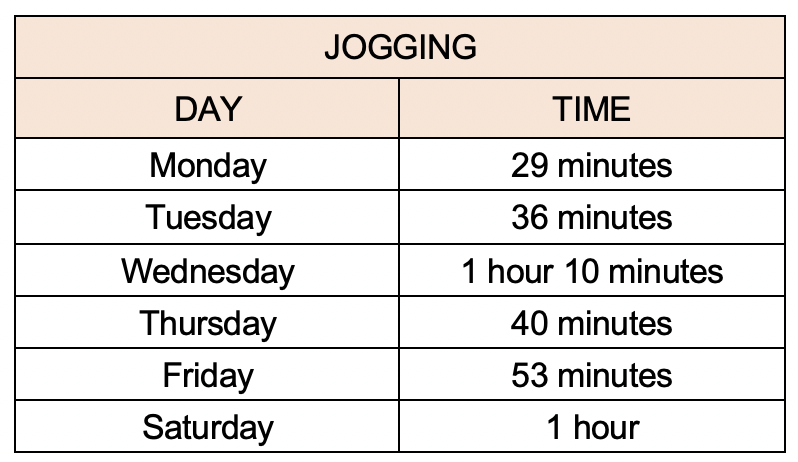
 

What was the average time Emily jogged each day?

 
     48 minutes
 
     61 minutes
 
   288 minutes
 
   368 minutes
Show Answers Only

`48 \ text{minutes}`

Show Worked Solution

`text(1 hour = 60 minutes.)`

`text{Average time}` `= frac{29+36+70+40+53+60}{6}`
  `= frac{288}{6}`
  `= 48 \ text{minutes}`

Filed Under: Data and Statistics, TESTLET E Tagged With: Band 6, NAPX-MultipleChoice

Geometry, NAPX-p109101v02

Troy built a solid figure using cubes.
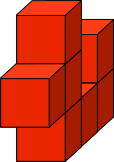


He paints all the outer sides red, including the base, and then separates the cubes.

How many faces are painted red?

 
   24
 
   30
 
   34
 
   36
Show Answers Only

`30`

Show Worked Solution

`text{Number of faces painted blue (top down, back to front)}`

`=5+5+3+5+4+4+4`

`=30`

Filed Under: 2D-3D Shapes and Location Tagged With: Band 6, NAPX-MultipleChoice

Geometry, NAPX-p109101v01

Sarah creates a solid figure using five cubes.
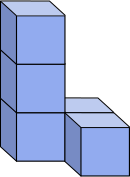


She paints all the outer sides blue, including the base, and then separates the cubes.

How many faces are painted blue?

 
   18
 
   22
 
   24
 
   26
Show Answers Only

`22`

Show Worked Solution

`text{Number of faces painted blue (top down, back to front)}`

`=5+4+4+4+5`

`=22`

Filed Under: 2D-3D Shapes and Location Tagged With: Band 6, NAPX-MultipleChoice

Algebra, NAPX-p168204v02

`12.5 xx Z = 2.5`

Find the value of  `Z`  in order to make this number sentence correct

 
   1.35
 
   0.40
 
   5.0
 
   0.20
Show Answers Only

`0.20`

Show Worked Solution

`text{Check each option:}`

`12.5 xx 1.35 = 16.875 \ \ text{(Incorrect)}`

`12.5 xx 0.40 = 5 \ \ text{(Incorrect)}`

`12.5 xx 5.0 = 62.5 \ \ text{(Incorrect)}`

`12.5 xx 0.20 = 2.5 \ \ text{(Correct)}`

`therefore \ Z=0.2`

Filed Under: Basic Algebra and Rules Tagged With: Band 6, NAPX-MultipleChoice

Algebra, NAPX-p168204v01

`1.36 xx B = 0.68`

Find the value of  `B`  that makes this number sentence correct.

 
   0.75
 
   0.60
 
   0.50
 
   0.20
Show Answers Only

`0.50`

Show Worked Solution

`text{Check each option:}`

`1.36 xx 0.75 = 1.02 \ \ text{(Incorrect)}`

`1.36 xx 0.60 = 0.816 \ \ text{(Incorrect)}`

`1.36 xx 0.50 = 0.68 \ \ text{(Correct)}`

`1.36 xx 0.20 = 0.272 \ \ text{(Incorrect)}`

`therefore \ B = 0.50`

Filed Under: Basic Algebra, TESTLET E Tagged With: Band 6, NAPX-MultipleChoice

Number, NAPX-p168203v02

The results of a men's 100 metre swimming race is recorded in the table below.
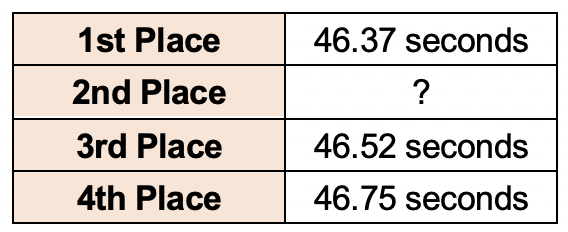
   

What could be the finishing time of the 2nd placed swimmer?

 
  46.28 seconds
 
  46.61 seconds
 
  46.48 seconds
 
  46.80 seconds
Show Answers Only

`text{46.48 seconds}`

Show Worked Solution

`text{The time of the 2nd swimmer must be between 46.37 and 46.52 seconds.}`

`therefore \ text{Time for 2nd could have been 46.48 seconds.}`

Filed Under: Decimals, TESTLET E Tagged With: Band 6, NAPX-MultipleChoice

Number, NAPX-p168203v01

The result of a 100-metre dash was recorded in the table shown below.
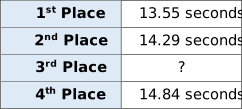


What could be the time of the runner in 3rd place?

 
   13.85 seconds
 
   14.26 seconds
 
   14.58 seconds
 
   14.92 seconds
Show Answers Only

`14.58 \ text{seconds}`

Show Worked Solution

`text{The time of the 3rd runner must be between 14.29 and 14.84 seconds.}`

`therefore \ text{the time of the 3rd runner to finish was 14.58 seconds.}`

Filed Under: Fractions and Decimals Tagged With: Band 6, NAPX-MultipleChoice

Probability, NAPX-p167447v02

Lester schedules a company meeting twice every 5 working days.

Today is a working day.

What is the probability that there is a meeting scheduled?

 
`2/7`
 
`0.40`
 
`3/5`
 
`text(25%)`

Show Answers Only

`0.40`

Show Worked Solution
`P` `= text(Favorable Events)/text(Total Possible Events)`
  `= 2/5`
  `= 0.40`

Filed Under: Probability, TESTLET B Tagged With: Band 6, NAPX-MultipleChoice

Probability, NAPX-p167447v01

Laura's country hut is visited by a possum twice every week.

What is the probability that the possum visits her hut today?

 
`2/7`
 
`2/5`
 
`0.70`
 
`text(25%)`

Show Answers Only

`2/7`

Show Worked Solution

`text{There are 7 days in a week.}`

`P` `= text(Favorable Events)/text(Total Possible Events)`
  `= 2/7`

Filed Under: Probability Tagged With: Band 6, NAPX-MultipleChoice

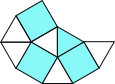
Geometry, NAPX-p107263v03

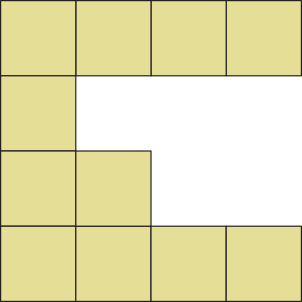
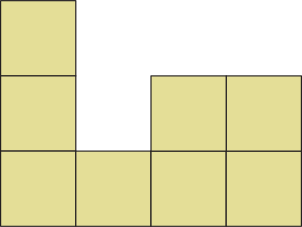
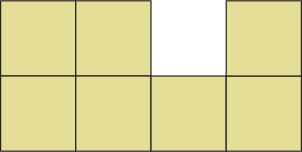
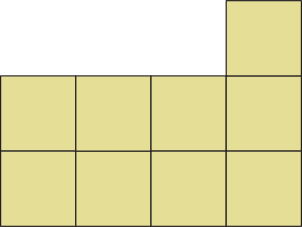
Some tiles are missing in the tile pattern shown below.
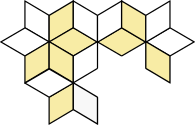
When completed, the tile pattern has one line of symmetry

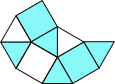
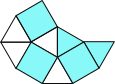
Which of these could be the missing tiles?


Show Answers Only

Show Worked Solution

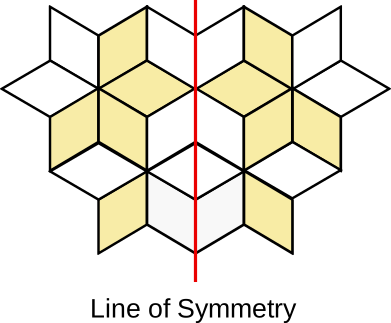
`text{The completed pattern is shown below.}`
Filed Under: 2D-3D Shapes and Location, TESTLET B Tagged With: Band 6, NAPX-MultipleChoice

Geometry, NAPX-p107263v02

Some shapes are missing in this pattern.
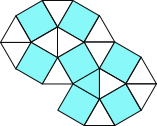


When completed, the pattern has one line of symmetry.

Which of these could be the missing part of the pattern?


Show Answers Only

Show Worked Solution

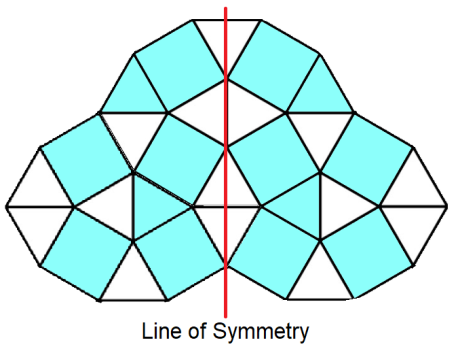
`text(The completed pattern is shown below.)`
Filed Under: 2D-3D Shapes and Location Tagged With: Band 6, NAPX-MultipleChoice

Geometry, NAPX-p167443v02

Henry got lost on his way to visit his uncle’s house and made 3 U-turns before arriving.

In total, how many degrees does Henry turn through when making U-turns on his trip?

 
  150°
 
  270°
 
  540°
 
1080°

Show Answers Only

`540^@`

Show Worked Solution

`text{One U-turn rotates the car by 180}^@`

`:. 3\ text(U-turns)` `= 3 xx 180`
  `= 540^@`

Filed Under: Triangles and Other Geometrical Properties Tagged With: Band 6, NAPX-MultipleChoice

Geometry, NAPX-p167443v01

During an X-Games snowboarding competition, an athlete performed 4 full backward summersaults before landing.

By how many degrees did the athlete rotate her body during this move?

 
  360°
 
  920°
 
1080°
 
1440°

Show Answers Only

`1440^@`

Show Worked Solution

`text{One rotation = 360°}`

`:. 4\ text(back dives)` `= 4 xx 360^@`
  `= 1440^@`

Filed Under: TESTLET B, Triangles and Other Geometric Properties Tagged With: Band 6, NAPX-MultipleChoice

Number, NAPX-p167439v02

A pack of sugar weighs `1/4` of a kilogram.

Josh bought 6 packs for baking.

How many kilograms of sugar did he buy?

 
`2/3`
 
`1 1/2`
 
`2 1/4`
 
`3`

Show Answers Only

`1 1/2`

Show Worked Solution
`text{Weight of six packs}` `= 6 xx 1/4`
  `= 6/4`
  `= 1 1/2\ text(kg)`

Filed Under: Fractions, TESTLET AN Tagged With: Band 6, NAPX-MultipleChoice

Number, NAPX-p167439v01

A box of apples weighs `2/3` of a kilogram

Lou bought 3 boxes.

How many kilograms of apples did he bought?

 
   `1 frac{4}{9} \ text{kg}`
 
  `2 \ text{kg}`
 
  `frac{8}{9} \ text{kg}`
 
  `2 frac{2}{3} \ text{kg}`

Show Answers Only

`2\ text{kg}`

Show Worked Solution
`text(Total kilograms)` `=3 xx 2/3`  
  `=6/3`  
  `=2`  

Filed Under: Fractions and Decimals Tagged With: Band 6, NAPX-MultipleChoice

Probability, NAPX-p116940v05

The arrow pictured below is spun once.
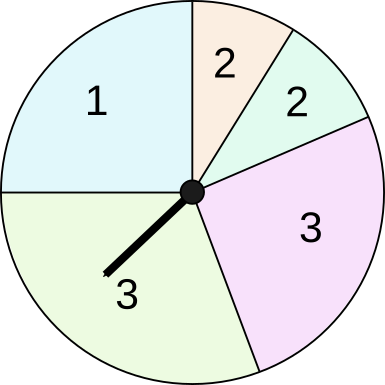


Which number is the spinner least likely to land on?

  1   2   3   1 or 2


Show Answers Only

`2`

Show Worked Solution

` text{Least likely to land on 2.}`

`text{It takes up the smallest area on the spinner}`

Filed Under: Chance, TESTLET B Tagged With: Band 6, NAPX-MultipleChoice

Probability, NAPX-p116940v04

A disk is thrown onto the table pictured below.
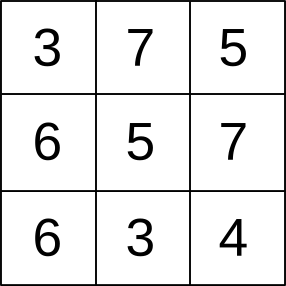


It has an equal chance of landing in any square.

Which numbered square is the disk least likely to land in?

  3   4   5 same chance for each number


Show Answers Only

`4`

Show Worked Solution

` text{Only 1 square is numbered 4 (all other numbers have 2 squares).}`

`therefore \ text{Least likely to land in square 4}`

Filed Under: Probability Tagged With: Band 6, NAPX-MultipleChoice

Number, NAPX-p116689v02

The tallest living giraffe is measured at five thousand, seven hundred and eight millimetres tall.

Write this as a number in the box below

  millimetres

Show Answers Only

`5708 \ text{millimetres}`

Show Worked Solution

`5708 \ text{millimetres}`

Filed Under: Number and Place Value Tagged With: Band 6, NAPX-SingleAnswer

Number, NAPX-p116689v05

The exact length of great white shark is measured as five thousand and ninety six millimetres.

Write this as a number in the box below

  millimetres

Show Answers Only

`5096 \ text{millimetres}`

Show Worked Solution

`5096 \ text{millimetres}`

Filed Under: Number and Place Value Tagged With: Band 6, NAPX-SingleAnswer

Calculus, SPEC2 2020 VCAA 3

Let  `f(x) = x^2e^(−x)`.

  1. Find an expression for  `f′(x)`  and state the coordinates of the stationary points of  `f(x)`.  (2 marks)
  2. State the equation(s) of any asymptotes of  `f(x)`.  (1 mark)
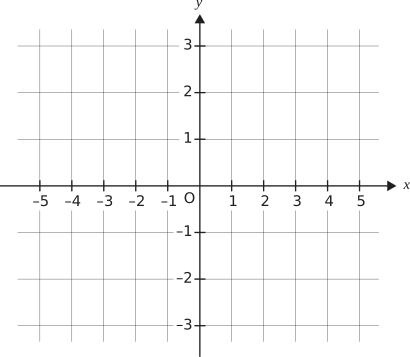
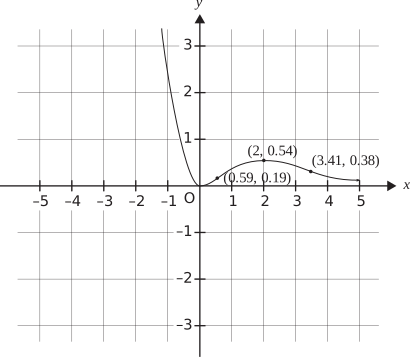
  3. Sketch the graph of  `y = f(x)`  on the axes provided below, labelling the local maximum stationary point and all points of inflection with their coordinates, correct to two decimal places.  (3 marks)


Let  `g(x) = x^n e^(−x)`, where  `n ∈ Z`.
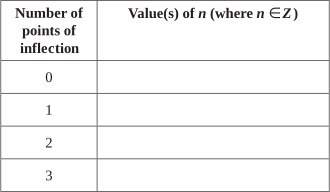
  1. Write down an expression for  `g″(x)`.  (1 mark)
  2.  i. Find the non-zero values of `x` for which  `g″(x) = 0`.  (1 mark)
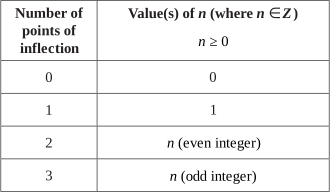
  3. ii. Complete the following table by stating the value(s) of `n` for which the graph of  `g(x)`  has the given number of points of inflection.  (2 marks)


Show Answers Only
  1. `f(0) = 0; f(2) = 4e^(−2) text(and SP’s at)\ (0, 0), (2, 4e^(−2))`
  2. `y = 0`
  3.   
  4. `g″(x) = x^(n – 2) e^(−x)(x^2 – 2xn + n^2 – n)`
  5.  i. `x = x ± sqrtn`
  6. ii.
       
Show Worked Solution

a.   `f′(x) = 2xe^(−x) – x^2e^(−x)`

`text(SP’s when)\ \ f′(x) = 0:`

`x^2e^(−x)` `= 2xe^(−x)`
`x` `= 2\ \ text(or)\ \ 0`

 
`f(0) = 0; \ f(2) = 4e^(−2)`

`:. text(SP’s at)\ \ (0, 0) and  (2, 4e^(−2))`


b.   `text(As)\ \ x -> ∞, \ f(x) -> 0^+`

`:. text(Horizontal asymptote at)\ \ y = 0`


c.   

`text(POI when)\ \ f″(x) = 0`

`:. text(POI’s:)\ (0.59, 0.19), \ (3.41, 0.38)`


d.   `g′(x) = x^(n – 1) e^(−x)(n – x)`

`g″(x) = x^(n – 2) e^(−x)(x^2 – 2xn + n^2 – n)`


e.i.   `text(Solve:)\ \ x^2 – 2xn + n^2 – n = 0`

`x = n ± sqrtn`

♦♦♦ Mean mark (e)(ii) 9%.


e.ii.   

Filed Under: Tangents and Curve Sketching Tagged With: Band 3, Band 4, Band 6, smc-1182-35-Sketch curve, smc-1182-40-Other 1st/2nd deriv problems

Probability, NAPX-p116940v03

A spinning wheel has sections labelled with different numbers.
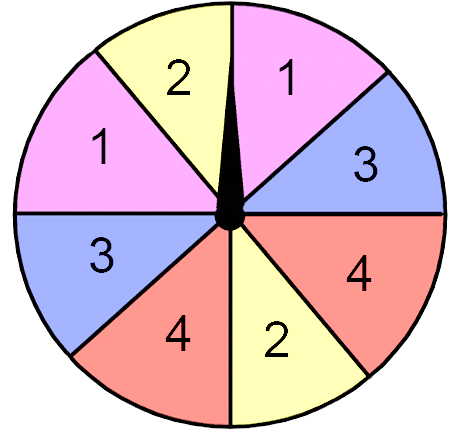


Which of the numbers in the wheel is the spinner most likely to land on?

 
  1 or 3
 
  1
 
  2 or 4
 
  All of the colours are equally likely
Show Answers Only

`text{All of the colours are likely to land on}`

Show Worked Solution

`text{S}text{ince the spinner is divided into 8 equal parts and each colour has}`

`text{2 parts → all colours are equally likely.}`

Filed Under: Probability Tagged With: Band 6, NAPX-MultipleChoice

Probability, NAPX-p116940v02

A spinning wheel has 3 different colours.
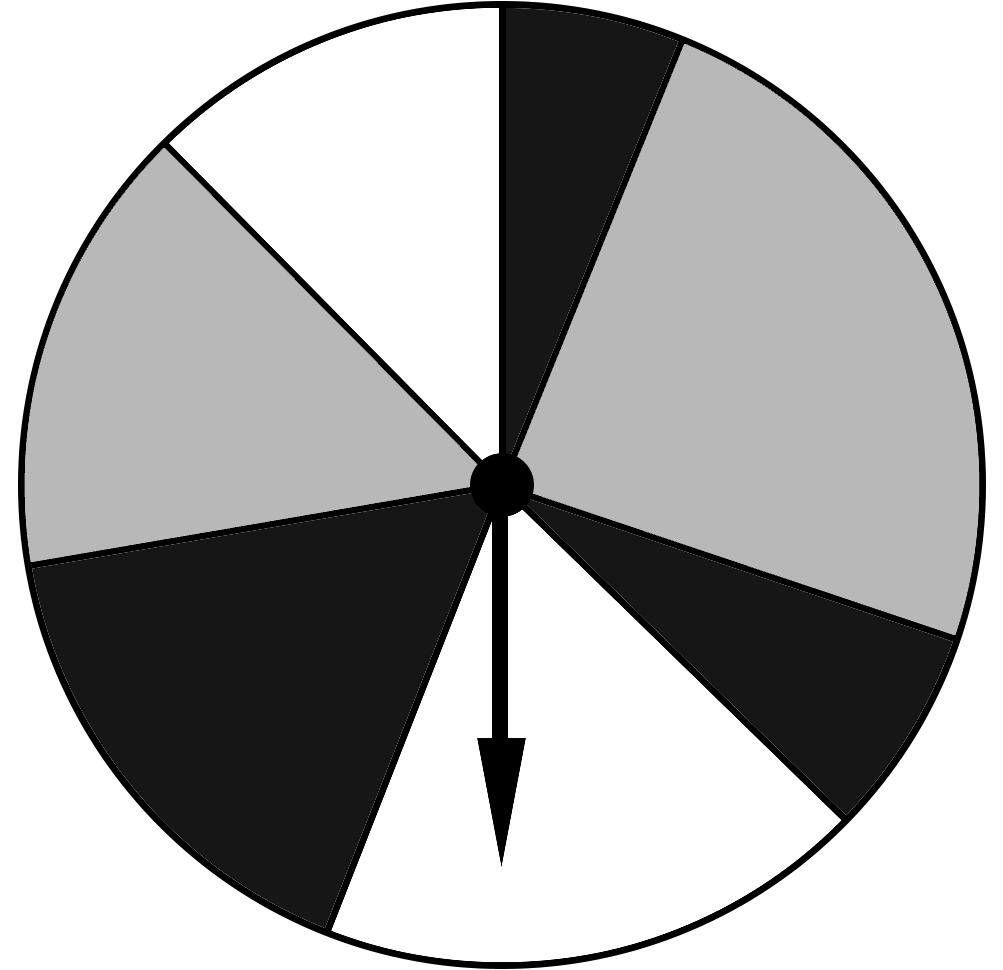


Which colour in the wheel is most likely to land on?

 
  White
 
  Black
 
  Grey
 
  All of the colours are equally likely
Show Answers Only

`text{Grey}`

Show Worked Solution

`text{By inspection, grey is the most likely as it it shades the}`

`text{largest area of the wheel.}`

Filed Under: Probability Tagged With: Band 6, NAPX-MultipleChoice

Number, NAPX-p167229v02

A circle is divided into 8 equal parts, as shown in the image below.
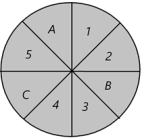


What percentage of the circle’s area has been labelled with letters?

 
30%
 
37.5%
 
42.5%
 
45%
 
47.5%

Show Answers Only

`text(37.5%)`

Show Worked Solution

`text(S)text(ince all areas are equal:)`

`text(Percentage)` `= text(Number of letters)/text(Total number of sections) xx 100`
  `= 3/8 xx 100`
  `= 37.5text(%)`

Filed Under: Percentages, TESTLET B Tagged With: Band 6, NAPX-MultipleChoice

Geometry, NAPX-p167209v02

Yohan was driving from the hospital to his house.
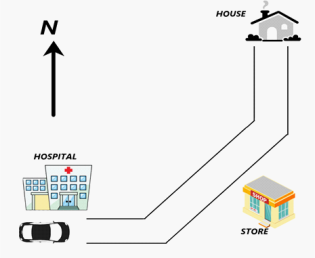


What directions best describe Yohan’s travel from the hospital to his house?

 
East, north-east, north
 
West, north-west, north
 
East, north-east, south
 
West, north-west, south

Show Answers Only

`text(East, north-east, north)`

Show Worked Solution

`text(The directions travelled by Yohan:)`
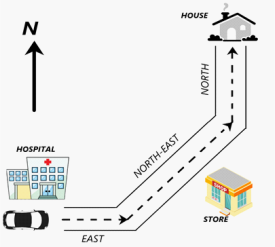


`text(The direction was East, North-East, and North)`

Filed Under: Maps and Bearings, TESTLET D Tagged With: Band 6, NAPX-MultipleChoice

Geometry, NAPX-p167209v01

A man drives from his house to his office.
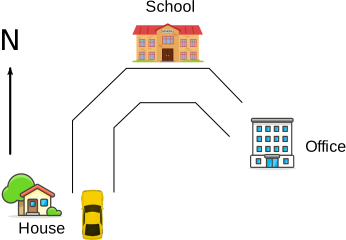


What directions best describe his way to the office?

 
North, north-west, west, south-west
 
North, north-east, east, south-east
 
North, north-east, east, south
 
North, north-west, east, south-east

Show Answers Only

`text(North, north-east, east, south-east)`

Show Worked Solution

`text(The directions travelled by the man:)`
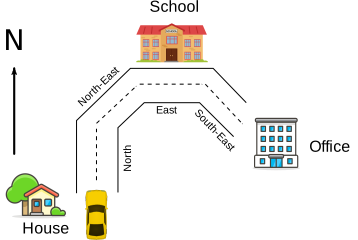


`:.\ text(The direction was north, north-east, east, south-east.)`

Filed Under: Maps and Bearings, TESTLET D Tagged With: Band 6, NAPX-MultipleChoice

Measurement, NAPX-p167202v02

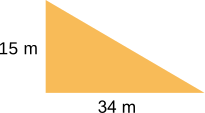
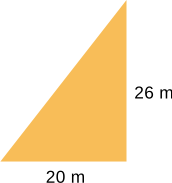
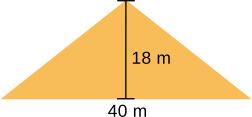
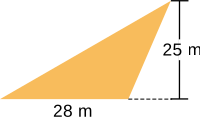
Four triangular shaped playgrounds are shown below.

Which of these play grounds has the least surface area?


Show Answers Only

Show Worked Solution

`text(Check each option:)`

`text(Option 1 -)\ \ 1/2 xx 34 xx 15 = 255\ text(m)^2`

`text(Option 2 -)\ \ 1/2 xx 20 xx 26 = 260\ text(m)^2`

`text(Option 3 -)\ \ 1/2 xx40 xx 18 = 360\ text(m)^2`

`text(Option 4 -)\ \ 1/2 xx28 xx 25 = 350\ text(m)^2`
 

`:.\ text(The backyard with the least area is:`

Filed Under: Perimeter, Area and Volume Tagged With: Band 6, NAPX-MultipleChoice

Measurement, NAPX-p167202v01

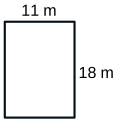
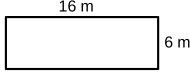
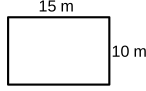
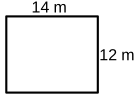
In a suburb, four families measured the dimensions of their rectangular backyards.

Which backyard has the largest area?


Show Answers Only


Show Worked Solution

`text(Checking each option:)`

`text(Option 1:)\ 11 xx 18 = 198 text(m)^2`

`text(Option 2:)\ 16 xx 6 = 96 text(m)^2`

`text(Option 3:)\ 15 xx 10 = 150 text(m)^2`

`text(Option 4:)\ 14 xx 12 = 168 text(m)^2`
 

`:. text(The backyard with the largest area is the)\ 11\ text(m) xx 18\ text(m)`

`text(with a total area of 198 square metres.)`


Filed Under: Perimeter, Area and Volume, TESTLET D Tagged With: Band 6, NAPX-MultipleChoice

Statistics, NAPX-p167236v02

A store sells second hand mobile phones.

The graph below shows the price of 2 similar second-hand phones.
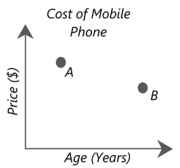


Which of the following is true based on the graph shown?

 
Phone A is older and less expensive than Phone B
 
Phone B is older and more expensive than phone A
 
Phone A is newer and more expensive than Phone B
 
Phone A is older and more expensive than Phone B

Show Answers Only

`text(Phone A is newer and more expensive than Phone B)`

Show Worked Solution

`text(Phone A is left of Phone B → it is newer.)`

`text(Phone A is higher than Phone B → it is more expensive.)`

`:.\ text(Phone A is newer and more expensive than Phone B.)`

Filed Under: Data and Statistics Tagged With: Band 6, NAPX-MultipleChoice

Statistics, NAPX-p167236v01

A man bought a plot of land in the past and now he is selling it.

The graph marks the price of the land when the man bought it and the price of the land now.
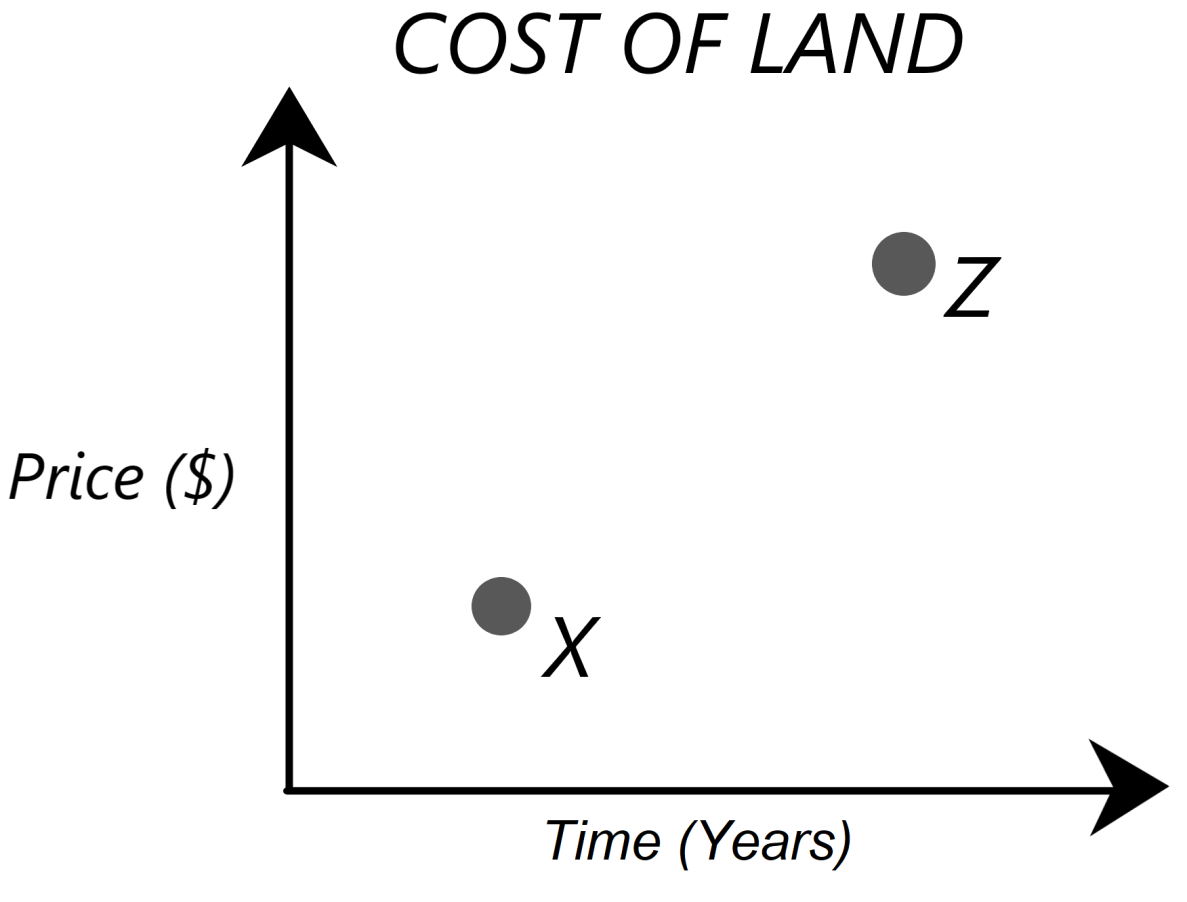


Which of the following is true based on the graph shown?

 
The land is less expensive now than when it was purchased.
 
The land is more expensive years ago than now.
 
The land is more expensive now than years ago.
 
The price of the land does not change with time.

Show Answers Only

`text(The land is more expensive now than years ago.)`

Show Worked Solution

`text(Z is further right on the x-axis → most recent price.)`

`text(Z is higher on the y-axis → more expensive.)`

`:.\ text(The land is more expensive now than years ago.)`

Filed Under: Data and Statistics, TESTLET D Tagged With: Band 6, NAPX-MultipleChoice

Number, NAPX-p167229v01

A circle is divided into 8 equal parts, as shown in the diagram below.
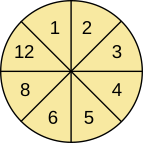


What percentage of the circle’s area has been labelled with even numbers?

 
37.5%
 
50%
 
57.5%
 
62.5%
 
70%

Show Answers Only

`text(62.5%)`

Show Worked Solution

`text(S)text(ince all areas are equal:)`

`text(Percentage)` `= text(Number of even numbers)/text(Total number of sections) xx 100`
  `= 5/8 xx 100`
  `= 62.5text(%)`

Filed Under: Percentages, TESTLET B, TESTLET D Tagged With: Band 6, NAPX-MultipleChoice

Algebra, SPEC2 2020 VCAA 7 MC

For non-zero constants `a` and `b`, where  `b < 0`, the expression  `1/(ax(x^2 + b))`  in partial fraction form with linear denominators, where  `A, B`  and  `C`  are real constants, is

  1. `A/(ax) + (Bx + C)/(x^2 + b)`
  2. `A/(ax) + B/(x + sqrtb) + C/(x - sqrtb)`
  3. `A/x + B/(ax + sqrt|b|) + C/(ax - sqrt|b|)`
  4. `A/x + B/(x + sqrt|b|) + C/(x - sqrt|b|)`
  5. `A/(ax) + B/((x + sqrtb)^2) + C/(x + sqrtb)`
Show Answers Only

`D`

Show Worked Solution

♦♦♦ Mean mark 26%.
MARKER’S COMMENT: Option A results from not considering `b<0`.
`1/(ax(x^2 + b))` `= 1/a (A_1/x + B_1/(x + sqrt|b|) + C_1/(x – sqrt|b|))`
  `= A/x + B/(x + sqrt|b|) + C/(x – sqrt|b|)`

 
`=>D`


Filed Under: Partial Fractions, Quotient and Other Functions Tagged With: Band 6, smc-1154-20-Partial fractions

Trigonometry, SPEC2 2020 VCAA 4 MC

Let  `f(x) = sqrt(x - 1)/x`  over its implied domain and  `g(x) = text(cosec)^2 x`  for  `0 < x < pi/2`.

The rule for  `f(g(x))`  and the range, respectively, are given by

  1. `f(g(x)) = text(cosec)^2(sqrt(x - 1)/x), [1, ∞)`
  2. `f(g(x)) = text(cosec)^2(sqrt(x - 1)/x), [2, ∞)`
  3. `f(g(x)) = sin(x)cos(x), [−0.5, 0.5]\\ {0}`
  4. `f(g(x)) = sin(x)cos(x), (0, 1/2)`
  5. `f(g(x)) = 1/2 sin(2x), (0, 1/2]`
Show Answers Only

`E`

Show Worked Solution

♦♦♦ Mean mark 28%.
`f(g(x))` `= sqrt(text(cosec)^2(x) – 1)/(text(cosec)^2(x))`
  `= sqrt(cot^2(x))/(text(cosec)^2(x))`
  `= (cos(x))/(sin(x)) · sin^2(x)`
  `= cos(x)sin(x)`
  `= 1/2 sin(2x)`

 
`text(Given)\ \ 0 < x < pi/2`,

`text(Range)\ \ f(g(x)) :\ \ (0, 1/2]`

`=>E`

Filed Under: Trigonometry Tagged With: Band 6, smc-1150-30-Composite

Number, NAPX-p73124v02

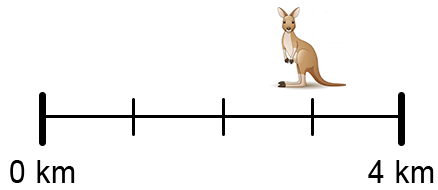
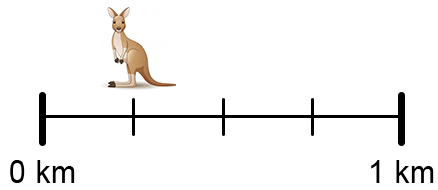
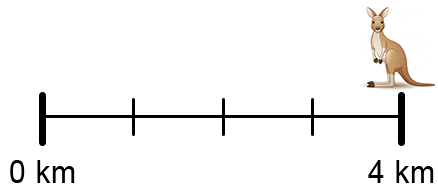
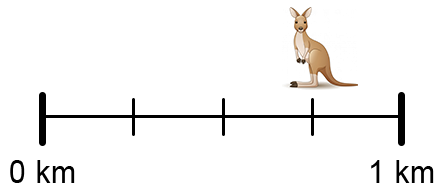
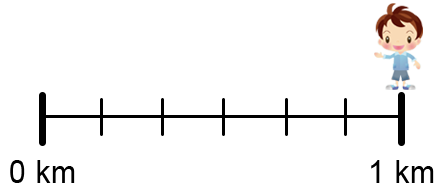
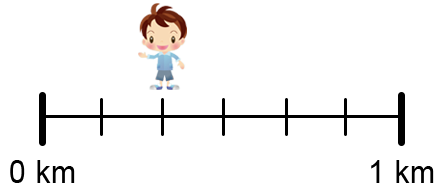
Julian was driving into town and hit a kangaroo `3/4` of a kilometre into his trip.

Which of these represent where Julian hit the kangaroo?


Show Answers Only

Show Worked Solution

`text(Each spacing is worth)\ 1/4\ text(km.)`
 

Filed Under: Fractions and Decimals Tagged With: Band 6, NAPX-MultipleChoice

Number, NAPX-p73124v01

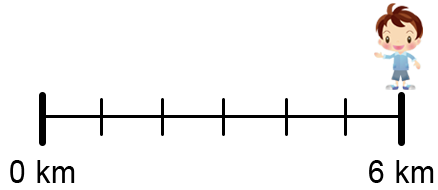
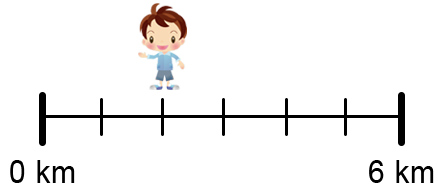
Axe went jogging and stopped after  `2/6`  of a kilometre to take a rest. 

Which of these represents where Axe stopped jogging?


Show Answers Only

Show Worked Solution

`text(Each spacing is worth)\ 1/6\ text(km.)`
Filed Under: Fractions and Decimals Tagged With: Band 6, NAPX-MultipleChoice

Geometry, NAPX-Z3-CA07 v1


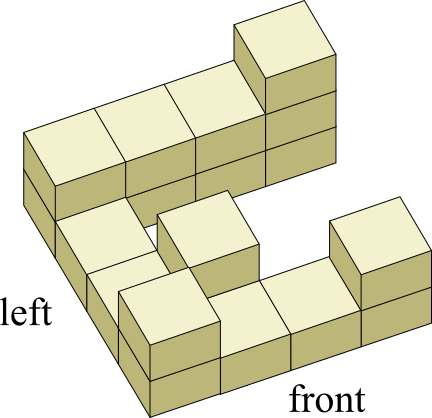
Which of these is the left view of this object made from cubes?


Show Answers Only

Show Worked Solution

Filed Under: 2D-3D Shapes and Location, TESTLET A1 Tagged With: Band 6, NAPX-MultipleChoice

Number, NAPX-Z3-CA06 v1

What number is exactly halfway between `4 frac{1}{4}` and `6 frac{3}{4}`


  `4 frac{3}{4}`
 
 
  `5`
 
 
  `5 frac{1}{4}`
 
 
  `5 frac{1}{2}`
Show Answers Only

`5 frac{1}{2}`

Show Worked Solution
  `text{Halfway}` `= (4 frac{1}{4} + 6 frac{3}{4}) \ div 2`
    `= 11/2`
    `= 5 frac{1}{2}`

Filed Under: Fractions, TESTLET A1, TESTLET A2 Tagged With: Band 6, NAPX-MultipleChoice

NETWORKS, FUR1 2020 VCAA 10 MC

The directed network below shows the sequence of activities, `A` to `I`, that is required to complete an office renovation.

The time taken to complete each activity, in weeks, is also shown.


The project manager would like to complete the office renovation in less time.

The project manager asks all the workers assigned to activity `H` to also work on activity `F`.

This will reduce the completion time of activity `F` to three weeks.

The workers assigned to activity `H` cannot work on both activity `H` and activity `F` at the same time.

No other activity times will be changed.

This change to the network will result in a change to the completion time of the office renovation.

Which one of the following is correct?

  1. The completion time will be reduced by one week if activity `F` is completed before activity `H` is started.
  2. The completion time will be reduced by three weeks if activity `F` is completed before activity `H` is started.
  3. The completion time will be reduced by one week if activity `H` is completed before activity `F` is started.
  4. The completion time will be reduced by three weeks if activity `H` is completed before activity `F` is started.
  5. The completion time will be increased by three weeks if activity `H` is completed before activity `F` is started.
Show Answers Only

`A`

Show Worked Solution

`text{Original forward scan (note}\ F\ text{is 6 origionally but}`

♦♦♦ Mean mark 24%.

`text{is reduced to 3 for the adjusted critical path):}`


`text(Original critical path is:)\ ACEFGI = 2+5+3+6+4+5=25`

`text(If activity)\ F\ text(is completed in 3 weeks, and then)`

`text(activity)\ H\ text(starts, new critical path is:)`

`ACEF\ text{(dummy)}\ HI = 24\ text(weeks)`

`=>  A`

Filed Under: Critical Path Analysis Tagged With: Band 6, smc-621-20-Critical Paths/EST, smc-621-40-Crashing/Reduce completion time

NETWORKS, FUR1 2020 VCAA 9 MC

The flow of liquid through a series of pipelines, in litres per minute, is shown in the directed network below.


Five cuts labelled A to E are shown on the network.

The number of these cuts with a capacity equal to the maximum flow of liquid from the source to the sink, in litres per minute, is

  1. 1
  2. 2
  3. 3
  4. 4
  5. 5
Show Answers Only

`C`

Show Worked Solution

`text(Minimum cut) = 33`

`text(Cut)\ A = 8 + 15 + 15 = 38`

`text(Cut)\ B = 8 + 15 + 10 = 33`

`text(Cut)\ C = 15 + 8 + 10 = 33`

`text(Cut)\ D = 15 + 8 + 10 = 33`

`text(Cut)\ E = 15 + 8 + 5 + 10 = 38`

`text{(Note that it is arguable that the flow of 5 should not be counted}`

`text{in Cut}\ E,\ text(making the correct answer)\ D.\ text(This is because this)`

`text{edge cannot hold any flow in the network as given.)}`

`=>  C`

Filed Under: Flow Problems Tagged With: Band 6, smc-625-20-Max Flow/Min Cut

CORE, FUR1 2020 VCAA 26 MC

Ray deposited $5000 in an investment account earning interest at the rate of 3% per annum, compounding quarterly.

A rule for the balance, `R_n` , in dollars, after `n` years is given by

  1. `R_n = 5000 xx 0.03^n`
  2. `R_n = 5000 xx 1.03^n`
  3. `R_n = 5000 xx 0.03^(4n)`
  4. `R_n = 5000 xx 1.0075^n`
  5. `R_n = 5000 xx 1.0075^(4n)`
Show Answers Only

`E`

Show Worked Solution

`text(Quarterly rate) = 0.03/4 = 0.0075`

♦♦♦ Mean mark 20%.

`text(Compounding periods) = 4n`

`:.\ text(Balance after)\ n\ text(years)`

`= 5000 xx 1.0075^(4n)`
 

`=>  E`

Filed Under: Interest Rates and Investing Tagged With: Band 6, smc-604-20-Compound interest

Calculus, MET1 2020 VCAA 8

Part of the graph of  `y = f(x)`, where  `f:(0, ∞) -> R, \ f(x) = xlog_e(x)`, is shown below.


The graph of `f` has a minimum at the point `Q(a, f(a))`, as shown above.

  1. Find the coordinates of the point `Q`.   (2 marks)

    --- 6 WORK AREA LINES (style=lined) ---

  2. Using  `(d(x^2log_e(x)))/(dx) = 2x log_e(x) + x`, show that  `xlog_e(x)`  has an antiderivative  `(x^2log_e(x))/2-(x^2)/4`.   (1 mark)

    --- 3 WORK AREA LINES (style=lined) ---

  3. Find the area of the region that is bounded by `f`, the lines  `x = a`  and the horizontal axis for  `x ∈ [a, b]`, where `b` is the `x`-intercept of `f`.   (2 marks)

    --- 7 WORK AREA LINES (style=lined) ---

  4. Let  `g: (a, ∞) -> R, \ g(x) = f(x) + k`  for  `k ∈ R`.


    i. Find the value of `k` for which  `y = 2x`  is a tangent to the graph of `g`.   (1 mark)

    --- 6 WORK AREA LINES (style=lined) ---

    ii. Find all values of `k` for which the graphs of `g` and `g^(-1)` do not intersect.   (2 marks)

    --- 5 WORK AREA LINES (style=lined) ---

Show Answers Only
  1. `Q(1/e, -1/e)`
  2. `text(See Worked Solutions)`
  3. `1/4-3/(4e^2)\ text(u)^2`
  4. i.  `e`
  5. ii.  `k ∈ (1, ∞)`
Show Worked Solution

a.   `y = xlog_e x`

`(dy)/(dx)` `= x · 1/x + log_e x`
  `= 1 + log_e x`

 
`text(Find)\ x\ text(when)\ (dy)/(dx) = 0:`

`1 + log_e x` `= 0`
`log_e x` `= -1`
`x` `= 1/e`
`y` `= 1/e log_e (e^(-1))`
  `= -1/e`

 
`:. Q(1/e, -1/e)`


b.    `int 2x log_e(x) + x\ dx` `= x^2 log_e (x) + c`
  `2 int x log_e(x)\ dx` `= x^2 log_e (x)-intx\ dx + c`
  `:. int x log_e(x)\ dx` `= (x^2 log_e (x))/2-(x^2)/4 \ \ (c = 0)`


c.   

`text(When)\ \ x log_e x = 0 \ => \ x = 1`

`=> b = 1`

`:.\ text(Area)` `= −int_(1/e)^1 x log_e(x)\ dx`
  `= [(x^2)/4-(x^2 log_e(x))/2]_(1/e)^1`
  `= (1/4-0)-(1/(4e^2)-(log_e(e^(-1)))/(2e^2))`
  `= 1/4-(1/(4e^2) + 1/(2e^2))`
  `= 1/4-3/(4e^2) \ text(u)^2`


d.i.   `text(When)\ \ f^{prime}(x) = m_text(tang) = 2,`

`1 + log_e(x)` `= 2`
`x` `= e`

 
`text(T)text(angent meets)\ \ g(x)\ \ text(at)\ \ (e, 2e)`

`g(e)` `= f(e) + k`
`2e` `= e log_e e + k`
`:.k` `= e`


d.ii. `text(Find the value of)\ k\ text(when)\ \ y = x\ \ text(is a tangent to)\ g(x):`

`text(When)\ \ f^{prime}(x) = 1,`

`1 + log_e(x)` `= 1`
`x` `= 1`

 
`text(T)text(angent occurs at)\ (1, 1)`

`g(1) = f(1) + k \ => \ k = 1`
 

`:.\ text(Graphs don’t intersect for)\ k ∈ (1, ∞)`

Filed Under: Area Under Curves, Tangents and Normals Tagged With: Band 4, Band 5, Band 6, smc-723-50-Log/Exponential

Calculus, EXT2 C1 2020 HSC 16b

Let  `I_n = int_0^(frac{pi}{2}) sin^(2n + 1)(2theta)\ d theta, \ n = 0, 1, ...`

  1. Prove that  `I_n = frac{2n}{2n + 1} I_(n-1) , \ n ≥ 1`.  (3 marks)

    --- 8 WORK AREA LINES (style=lined) ---

  2. Deduce that  `I_n = frac{2^(2n)(n!)^2}{(2n +1)!}`.  (3 marks)

    --- 8 WORK AREA LINES (style=lined) ---

Let  `J_n = int_0^1 x^n (1 - x)^n\ dx , \ n = 0, 1, 2,...`

  1. Using the result of part (ii), or otherwise, show that  `J_n = frac{(n!)^2}{(2n + 1)!}`.  (3 marks)

    --- 8 WORK AREA LINES (style=lined) ---

  2. Prove that  `(2^n n!)^2 ≤ (2n + 1)!`.  (2 marks)

    --- 10 WORK AREA LINES (style=lined) ---

Show Answers Only
  1. `text{See Worked Solutions}`
  2. `text{See Worked Solutions}`
  3. `text{See Worked Solutions}`
  4. `text{See Worked Solutions}`
Show Worked Solution

i.    `text{Prove} \ \ I_n = frac{2n}{2n + 1} I_(n-1) , \ n ≥ 1`

♦ Mean mark (i) 48%.

`I_n = int_0^(frac{pi}{2}) sin^(2n) (2 theta) * sin (2 theta)\ d theta`

`text{Integrating by parts:}`

`u = sin^(2n) (2 theta)`   `u^(′) = 2n sin^(2n -1) (2 theta)  xx -frac(1)(2) cos (2 theta)`
`v = -frac{1}{2} cos (2 theta)`   `v^(′) = sin 2 theta`


`I_n` `= [ sin^(2n) (2 theta) * -frac{1}{2} cos (2 theta)]_0^(frac{pi}{2}) -2n int_0^(frac{pi}{2}) sin^(2n -1) (2 theta) * 2 cos (2 theta) * -frac{1}{2} cos (2 theta)\ d theta`
`I_n` `= 0 + 2n int_0^(frac{pi}{2}) sin^(2n-1) (2 theta) * cos^2 (2 theta)\ d theta`
`I_n` `= 2 n int_0^(frac{pi}{2}) sin^(2n-1) (2 theta) (1 – sin^2 (2 theta))\ d theta`
`I_n` `= 2 n int_0^(frac{pi}{2}) sin^(2n-1) ( 2 theta) – sin^(2n+1) (2 theta)\ d theta`
`I_n` `= 2n (I_(n-1) – I_n)`
`I_n + 2 n  I_n` `= 2 n I_(n-1)`
`I_n (2n + 1)` `= 2 n I_(n-1)`
`therefore I_n` `= frac{2n}{2n +1} I_(n-1)`
♦ Mean mark (ii) 36%.


ii.     `I_0` `= int_0^(frac{pi}{2}) sin (2 theta)\ d theta`
    `= [ -frac(1)(2) cos (2 theta) ]_0^(frac{pi}{2}`
    `=( -frac{1}{2} cos pi + frac{1}{2} cos 0 )`
    `= 1`
     
`I_n` `= frac{2n}{2n + 1} I_(n-1)`
`I_(n-1)` `= frac{2(n -1)}{2n -1} I_(n-2)`
  `vdots`
`I_1` `= frac{2}{3} I_0`


`I_n` `= frac{2n}{2n + 1} xx frac{2(n-1)}{2n-1} xx frac{2(n-2)}{2n-3} xx … xx frac{2}{3} xx 1`
  `= frac{2n}{2n+1} xx frac{2n}{2n} xx frac{2(n-1)}{2n-1} xx frac{2(n-1)}{2n-2} xx … xx frac{2}{3} xx frac{2}{2} xx 1`
  `= frac{2^n (n xx (n-1) xx .. xx 1) xx 2^n (n xx (n – 1) xx … xx 1)}{(2n + 1)!}`
  `= frac{2^(2n) (n!)^2}{(2n + 1)!}`
♦♦♦ Mean mark (iii) 16%.


iii.   `J_n = int_0^1 x^n (1-x)^n\ dx ,  \ n = 0, 1, 2, …`

`text{Let} \ \ x` `= sin^2 theta`
`frac{dx}{d theta}` `= 2 sin theta \ cos theta \ => \ dx = 2 sin theta \ cos theta \ d theta`


`text{When}`    `x = 0 \ ,` ` \ theta = 0`
  `x = 1  \ ,` ` \ theta = frac{pi}{2}`


`J_n` `= int_0^(frac{pi}{2}) (sin^2 theta)^n (1 – sin^2 theta)^n * 2 sin theta \ cos theta \ d theta`
  `= int_0^(frac{pi}{2}) sin^(2n) theta \ cos^(2n) theta * sin (2 theta)\ d theta`
  `= frac{1}{2^(2n)} int_0^(frac{pi}{2}) 2^(2n) sin^(2n) theta \ cos^(2n) theta * sin (2 theta)\ d theta`
  `= frac{1}{2^(2n)} int_0^(frac{pi}{2}) sin^(2n) (2 theta) * sin (2 theta)\ d theta`
  `= frac{1}{2^(2n)} int_0^(frac{pi}{2}) sin^(2n+1) (2 theta)\ d theta`
  `= frac{1}{2^(2n)} * frac{2^(2n) (n!)^2}{(2n+1)!}\ \ \ text{(using part (ii))}`
  `= frac{(n!)^2}{(2n + 1)!}`
♦♦♦ Mean mark (iv) 10%.


iv.   `text{If} \ \ I_n ≤ 1,`

`2^(2n) (n!)^2` ` ≤ (2n + 1)!`
`(2^n n!)^2` `≤ (2n + 1)!`

  
`text{Show} \ \ I_n ≤ 1 :`

`text{Consider the graphs}`

`y = sin(2 theta) \ \ text{and}\ \ y = sin^(2n + 1) (2 theta) \ \ text{for} \ \ 0 ≤ theta ≤ frac{pi}{2}`
 

`int_0^(frac{pi}{2}) sin(2 theta)` `= [ – frac{1}{2} cos (2 theta) ]_0^(frac{pi}{2})`
  `= – frac{1}{2} cos \ pi + frac{1}{2} cos \ 0`
  `= 1`

 
`y = sin(2 theta) \ => \ text{Range} \ [0, 1] \ \ text{for}\ \ theta ∈ [0, frac{pi}{2}]`

`sin^(2n+1) (2 theta)` `≤ sin (2 theta) \ \ text{for}\ \ theta ∈ [0, frac{pi}{2}]`
`sin^(2n+1) (2 theta)` `≤ 1`
`I_n` `≤ 1`
`therefore (2^n n!)^2` `≤ (2n + 1) !`

Filed Under: Recurrence Relations, Recurrence Relations Tagged With: Band 5, Band 6, smc-1054-10-Trig, smc-7436-10-Trig

Measurement, STD1 M5 2020 HSC 28

Two similar right-angled triangles are shown.


The length of side `AB` is 8 cm and the length of side `EF` is 4 cm.

The area of triangle `ABC` is 20 cm2.

Calculate the length in centimetres of side `DF` in Triangle II, correct to two decimal places.   (4 marks)

--- 8 WORK AREA LINES (style=lined) ---

Show Answers Only

`7.55\ \text{cm}`

Show Worked Solution

`text{Consider} \ Δ ABC :`

`text{Area}` `= frac{1}{2} xx AB xx BC`
`20` `= frac{1}{2} xx 8 xx BC`
`therefore \ BC` `= 5`


`text{Using Pythagoras in} \ Δ ABC :`

♦♦♦ Mean mark 11%.

`AC = sqrt(8^2 + 5^2) = sqrt89`


`text{S} text{ince} \ Δ ABC\ text{|||}\ Δ DEF,`

`frac{AC}{BC}` `= frac{DF}{EF}`
`frac{sqrt89}{5}` `= frac{DF}{4}`
`therefore \ DF` `= frac{4 sqrt89}{5}`
  `= 7.547 …`
  `= 7.55 \ text{cm (to 2 d.p.)}`

Filed Under: M5 Scale Drawings (Y12), Similarity Tagged With: Band 6, num-title-ct-pathb, num-title-qs-hsc, smc-1105-30-Similarity, smc-4746-20-Similar triangles, smc-4746-40-Areas and Volumes

Trigonometry, EXT1 T3 2020 HSC 14b

  1. Show that  `sin^3 theta-3/4 sin theta + (sin(3theta))/4 = 0`.   (2 marks)

    --- 7 WORK AREA LINES (style=lined) ---

  2. By letting  `x = 4sin theta`  in the cubic equation  `x^3-12x + 8 = 0`.


    Show that  `sin (3theta) = 1/2`.   (2 marks)

    --- 7 WORK AREA LINES (style=lined) ---

  3. Prove that  `sin^2\ pi/18 + sin^2\ (5pi)/18 + sin^2\ (25pi)/18 = 3/2`.   (3 marks)

    --- 10 WORK AREA LINES (style=lined) ---

Show Answers Only
  1. `text(See Worked Solutions)`
  2. `text(See Worked Solutions)`
  3. `text(See Worked Solutions)`
Show Worked Solution

i.   `text(Prove:)\  \ sin^3 theta-3/4 sin theta + (sin(3theta))/4 = 0`

`text(LHS)` `= sin^3 theta-3/4 sin theta + 1/4 (sin 2thetacostheta + cos2thetasintheta)`
  `= sin^3 theta-3/4 sintheta + 1/4(2sinthetacos^2theta + sintheta(1-2sin^2theta))`
  `= sin^3theta-3/4 sintheta + 1/4(2sintheta(1-sin^2theta) + sintheta – 2sin^3theta)`
  `= sin^3theta-3/4 sintheta + 1/4(2sintheta-2sin^3theta + sintheta-2sin^3theta)`
  `= sin^3theta-3/4sintheta + 3/4sintheta-sin^3theta`
  `= 0`


ii.   `text(Show)\ \ sin(3theta) = 1/2`

`text{Using part (i):}`

`(sin(3theta))/4` `= 3/4 sintheta-sin^3 theta`
`sin(3theta)` `= 3sintheta-4sin^3theta\ …\ (1)`

 
`x^3-12x + 8 = 0`

`text(Let)\ \ x = 4 sin theta`

`(4sintheta)^3-12(4sintheta) + 8` `= 0`
`64sin^3theta-48sintheta` `= 0`
`−16underbrace{(3sintheta-4sin^2theta)}_text{see (1) above}` `= −8`
`-16 sin(3theta)` `= −8`
`sin(3theta)` `= 1/2`
♦♦♦ Mean mark (iii) 21%.


iii.   `text(Prove:)\ \ sin^2\ pi/18 + sin^2\ (5pi)/18 + sin^2\ (25pi)/18 = 3/2`

`text(Solutions to)\ \ x^3-12x + 8 = 0\ \ text(are)`

`x = 4sintheta\ \ text(where)\ \ sin(3theta) = 1/2`

`text(When)\ \ sin3theta = 1/2,`

`3theta` `= pi/6, (5pi)/6, (13pi)/6, (17pi)/6, (25pi)/6, (29pi)/6, …`
`theta` `= pi/18, (5pi)/18, (13pi)/18, (17pi)/18, (25pi)/18, (29pi)/18, …`

 
`:.\ text(Solutions)`

`x = 4sin\ pi/18 \ \ \ (= 4sin\ (17pi)/18)`

`x = 4sin\ (5pi)/18 \ \ \ (= 4sin\ (13pi)/18)`

`x = 4sin\ (25pi)/18 \ \ \ (= 4sin\ (29pi)/18)`
 

`text(If roots of)\ \ x^3-12x + 8 = 0\ \ text(are)\ \ α, β, γ:`

`α + β + γ = -b/a = 0`

`αβ + βγ + αγ = c/a = -12`

`(4sin\ pi/18)^2 + (4sin\ (5pi)/18)^2 + (4sin\ (25pi)/18)^2` `= (α + β + γ)^2-2(αβ + βγ + αγ)`
`16(sin^2\ pi/18 + sin^2\ (5pi)/18 + sin^2\ (25pi)/18)` `= 0-2(-12)`
`:. sin^2\ pi/18 + sin^2\ (5pi)/18 + sin^2\ (25pi)/18` `= 24/16=3/2`

Filed Under: Identities, Equations and 't' formulae, Other Trig Equations, Sum, Products and Multiplicity of Roots, Sums and Products of Zeroes Tagged With: Band 4, Band 6, smc-1076-15-Compound Angles, smc-1205-10-Sum and Product, smc-6645-10-Sum and Product, smc-6675-20-Compound Angles

Algebra, STD1 A3 2020 HSC 29

There are two tanks on a property, Tank A and Tank B. Initially, Tank A holds 1000 litres of water and Tank B is empty.

  1. Tank A begins to lose water at a constant rate of 20 litres per minute.


    The volume of water in Tank A is modelled by  `V = 1000-20t`  where `V` is the volume in litres and  `t`  is the time in minutes from when the tank begins to lose water.


    On the grid below, draw the graph of this model and label it as Tank A.   (1 mark)


  2. Tank B remains empty until  `t=15`  when water is added to it at a constant rate of 30 litres per minute.
    By drawing a line on the grid (above), or otherwise, find the value of  `t`  when the two tanks contain the same volume of water.   (2 marks)
  3. Using the graphs drawn, or otherwise, find the value of  `t`  (where  `t > 0`) when the total volume of water in the two tanks is 1000 litres.   (1 mark)

    --- 2 WORK AREA LINES (style=lined) ---

Show Answers Only

 a.    `text{T} text{ank} \ A \ text{will pass trough (0, 1000) and (50, 0)}` 


b.    `29 \ text{minutes}`

c.    `45 \ text{minutes}`

Show Worked Solution

a.    `text{T} text{ank} \ A \ text{will pass trough (0, 1000) and (50, 0)}`

♦ Mean mark part (a) 45%.


b.    `text{T} text{ank} \ B \ text{will pass through (15, 0) and (45, 900)}`

♦♦ Mean mark part (b) 24%.


`text{By inspection, the two graphs intersect at} \ \ t = 29 \ text{minutes}`

 
c.    `text{Strategy 1}`

♦♦♦ Mean mark part (c) 5%.

`text{By inspection of the graph, consider} \ \ t = 45`

`text{T} text{ank A} = 100 \ text{L} , \ text{T} text{ank B} =900 \ text{L} `

`:.\ text(Total volume = 1000 L when  t = 45)`
  

`text{Strategy 2}`

`text{Total Volume}` `=text{T} text{ank A} + text{T} text{ank B}`
`1000` `= 1000-20t + (t-15) xx 30`
`1000` `= 1000-20t + 30t-450 `
`10t` `= 450`
`t` `= 45 \ text{minutes}`

Filed Under: A3 Types of Relationships (Y12), Simultaneous Linear Equations Tagged With: Band 5, Band 6, smc-1099-20-Other SE applications, smc-1099-40-Sketch equations, smc-6839-20-Other SE Applications

Algebra, STD1 A2 2020 HSC 10 MC

A plumber charges a call-out fee of $90 as well as $2 per minute while working.

Suppose the plumber works for  `t`  hours.

Which equation expresses the amount the plumber charges ($`C`) as a function of time (`t`  hours)?

  1. `C = 2 + 90t`
  2. `C = 90 + 2t`
  3. `C = 120 + 90t`
  4. `C = 90 + 120t`
Show Answers Only

`D`

Show Worked Solution

♦♦♦ Mean mark 21%.

`text(Hourly rate)= 60 xx 2= $120`

`therefore  C = 90 + 120t`

Filed Under: Applications of Linear Relationships, Applications: Currency, Fuel and Other Problems Tagged With: Band 6, smc-1119-30-Other Linear Applications, smc-6513-30-Other Linear Applications, std2-std1-common

Measurement, STD1 M1 2020 HSC 3 MC

What is 0.002073 expressed in standard form with two significant figures?

  1. `2.07 xx 10^(-2)`
  2. `2.1 xx 10^(-2)`
  3. `2.07 xx 10^(-3)`
  4. `2.1 xx 10^(-3)`
Show Answers Only

`B`

Show Worked Solution

♦♦♦ Mean mark 12%.
`0.002073` `= 2.073 xx 10^(-3)`  
  `=2.1 xx 10^(-3)\ \ \ text{(to 2 sig fig)}`  

 
`=> B`

Filed Under: Identify and Convert Between Units, Units and Measurement Error Tagged With: Band 6, smc-1120-20-Scientific Notation, smc-1120-30-Significant Figures, smc-6303-50-smc-6519-50-Significant Figures, smc-6519-40-Scientific Notation

  • « Previous Page
  • 1
  • …
  • 12
  • 13
  • 14
  • 15
  • 16
  • …
  • 29
  • Next Page »

Copyright © 2014–2026 SmarterEd.com.au · Log in