SmarterEd

Aussie Maths & Science Teachers: Save your time with SmarterEd

  • Login
  • Get Help
  • About

Complex Numbers, EXT2 N2 2025 HSC 14c

Let \(w\) be a complex number such that  \(1+w+w^2+\cdots+w^6=0\).

  1. Show that \(w\) is a 7th root of unity.   (1 mark)

    --- 4 WORK AREA LINES (style=lined) ---

The complex number  \(\alpha=w+w^2+w^4\)  is a root of the equation  \(x^2+b x+c=0\), where \(b\) and \(c\) are real and \(\alpha\) is not real.

  1. Find the other root of  \(x^2+b x+c=0\)  in terms of positive powers of \(w\).  (2 marks)

    --- 8 WORK AREA LINES (style=lined) ---

  2. Find the numerical value of \(c\).  (1 mark)

    --- 5 WORK AREA LINES (style=lined) ---
Show Answers Only

i.    \(\text{If \(w\) is a \(7^{\text{th}}\) root of \(1 \ \Rightarrow \ w^7=1\)}\)

\(1+w+w^2+\ldots+w^6=0\ \text{(given)}\)

\((1-w)\left(1+w+w^2+\cdots+w^6\right)\) \(=0\)
\(1-w^7\) \(=0\)
\(w^7=1\) \(=1\)

ii.   \(w^6+w^5+w^3\)

iii.  \(2\)

Show Worked Solution

i.    \(\text{If \(w\) is a \(7^{\text{th}}\) root of \(1 \ \Rightarrow \ w^7=1\)}\)

\(1+w+w^2+\ldots+w^6=0\ \ \text{(given,}\ w\neq 1)\)

\((1-w)\left(1+w+w^2+\cdots+w^6\right)\) \(=0\)
\(1-w^7\) \(=0\)
\(w^7\) \(=1\)

 
ii.
    \(\text {Find the other root of:} \ \ x^2+b x+c=0\)

\(\text{Since \(b, c\) are real (given),}\)

\(\text{Using conjugate root theory, other root}\ =\bar{\alpha}\)

\(\bar{\alpha}\) \(=\overline{w+w^2+w^4}\)
  \(=\overline{w}+\overline{w^2}+\overline{w^4}\)
  \(=\dfrac{1}{w}+\dfrac{1}{w^2}+\dfrac{1}{w^4} \quad\left( \bar{w}=\dfrac{1}{w} \ \text{since} \ \ \abs{w}=1\right)\)
  \(=\dfrac{w^7}{w}+\dfrac{w^7}{w^2}+\dfrac{w^7}{w^4}\)
  \(=w^6+w^5+w^3\)


iii.    \(\text{Product of roots}=\dfrac{c}{a}=c\)

\(c\) \(=\left(w+w^2+w^4\right)\left(w^6+w^5+w^3\right)\)
  \(=w^7+w^6+w^4+w^8+w^7+w^5+w^{10}+w^9+w^7\)
  \(=1+w^6+w^4+\left(w^7 \cdot w\right)+1+w^5+\left(w^7 \cdot w^3\right)+\left(w^7 \cdot w^2\right)+1\)
  \(=2+\underbrace{1+w+w^2+w^3+w^4+w^5+w^6}_{=0}\)
  \(=2\)

Filed Under: Solving Equations with Complex Numbers Tagged With: Band 4, Band 5, smc-1050-10-Quadratic roots, smc-1050-30-Roots > 3, smc-1050-35-Conjugate roots

Complex Numbers, EXT2 N2 2024 HSC 16b

The number  \(w=e^{\small{\dfrac{2 \pi i}{3}}}\)  is a complex cube root of unity. The number \(\gamma\) is a cube root of \(w\).

  1. Show that  \(\gamma+\bar{\gamma}\)  is a real root of  \(z^3-3 z+1=0\).   (3 marks)

    --- 12 WORK AREA LINES (style=lined) ---

  2. By using part (i) to find the exact value of  \(\cos \dfrac{2 \pi}{9} \cos \dfrac{4 \pi}{9} \cos \dfrac{8 \pi}{9}\), deduce the value(s) of  \(\cos \dfrac{2^n \pi}{9} \cos \dfrac{2^{n+1} \pi}{9} \cos \dfrac{2^{n+2} \pi}{9}\)  for all integers  \(n \geq 1\). Justify your answer.   (3 marks)

    --- 12 WORK AREA LINES (style=lined) ---

Show Answers Only

i.     \(w=e^{\small{\dfrac{2 \pi i}{3}}} \Rightarrow \ \text{complex (cube) root of 1}\)

\(\gamma^3=w, \quad \gamma \bar{\gamma}=\abs{\gamma}^2=1\)

\(\text{Show}\ \ \gamma+\bar{\gamma}\ \ \text{is a real root of} \ \ z^3-3 z+1=0:\)

  \((\gamma+\bar{\gamma})^3-3(\gamma+\bar{\gamma})+1\)
    \(=\gamma^3+3 \gamma^2 \bar{\gamma}+3 \gamma \bar{\gamma}^2+\bar{\gamma}^3-3 \gamma-3 \bar{\gamma}+1\)
    \(=\gamma^3+3 \gamma\abs{\gamma}^2+3 \bar{\gamma}\abs{\gamma}^2+\bar{\gamma}^3-3 \gamma-3 \bar{\gamma}+1\)
    \(=w+3 \gamma+3 \bar{\gamma}+\bar{w}-3 \gamma-3 \bar{\gamma}+1\)
    \(=w+\bar{w}+1\)
    \(=0 \quad \text{(Sum of complex roots of 1 = 0)}\)

 
\(\text{Show}\ \ \gamma+\bar{\gamma} \ \ \text{is real:}\)

\(\gamma+\bar{\gamma}=a+b i+a-b i=2 a \quad(a \in \mathbb{R})\)

\(\therefore \gamma+\bar{\gamma} \ \ \text{is a real root of} \ \  z^3-3 z+1=0.\)
 

ii.   \(e^{\small{\dfrac{2 \pi i}{9}}}\ \ \text{is a cube root of}\ \ \omega \ \Rightarrow \ \Bigg(e^{\small{\dfrac{2 \pi i}{9}}}\Bigg)^3=e^{\small{\dfrac{2 \pi i}{3}}}\)

\(\text{Cubic roots are} \ \dfrac{2}{3} \ \text {rotations from each other.}\)

\(\text{Roots of} \ \ z^3-3 z+1=0:\)

  \((\gamma+\bar{\gamma})_1\) \(=2 \cos \left(\dfrac{2 \pi}{9}\right)\)
  \((\gamma+\bar{\gamma})_2\) \(=2 \cos \left(\dfrac{8 \pi}{9}\right)\)
  \((\gamma+\bar{\gamma})_3\) \(=2 \cos \left(\dfrac{4\pi}{9}\right)\)


\(\text{Product of roots} \ \ \alpha B \gamma=-\dfrac{d}{a}:\)

  \(2 \cos \left(\dfrac{2 \pi}{9}\right) \cdot 2 \cos \left(\dfrac{8 \pi}{9}\right) \cdot 2 \cos \left(\dfrac{4 \pi}{4}\right)\) \(=-1\)
  \(\cos \left(\dfrac{2 \pi}{9}\right) \cdot \cos \left(\dfrac{8 \pi}{9}\right) \cdot \cos \left(\dfrac{4 \pi}{9}\right)\) \(=-\dfrac{1}{8}\)

 
\(\text{Consider} \ \ \cos \left(\dfrac{2 \pi}{9}\right) \cdot \cos \left(\dfrac{2^{n+1} \pi}{9}\right) \cdot \cos \left(\dfrac{2^{n+2} \pi}{9}\right):\)

\(\text{If} \ \ n=1,\)

\(\cos \left(\dfrac{2 \pi}{9}\right) \cdot \cos \left(\dfrac{4 \pi}{9}\right) \cdot \cos \left(\dfrac{8 \pi}{9}\right)=-\dfrac{1}{8}\ \ \text{(see above)}\)

\(\text {If} \ \ n=2,\)

\(\cos \left(\dfrac{4 \pi}{9}\right) \cdot \cos \left(\dfrac{8 \pi}{9}\right) \cdot \cos \left(\dfrac{2\pi}{9}\right)=-\dfrac{1}{8}\)

 
\(\Rightarrow \ \text{Multiplying each argument by 2 does not change the equation}\)

\(\therefore \cos \left(\dfrac{2^n \pi}{9}\right) \cdot \cos \left(\dfrac{2^{n+1} \pi}{9}\right) \cdot \cos \left(\dfrac{2^{n+2} \pi}{9}\right)=-\dfrac{1}{8}\)

Show Worked Solution

i.     \(w=e^{\small{\dfrac{2 \pi i}{3}}} \Rightarrow \ \text{complex (cube) root of 1}\)

\(\gamma^3=w, \quad \gamma \bar{\gamma}=\abs{\gamma}^2=1\)

\(\text{Show}\ \ \gamma+\bar{\gamma}\ \ \text{is a real root of} \ \ z^3-3 z+1=0:\)

♦♦ Mean mark (i) 36%.
  \((\gamma+\bar{\gamma})^3-3(\gamma+\bar{\gamma})+1\)
    \(=\gamma^3+3 \gamma^2 \bar{\gamma}+3 \gamma \bar{\gamma}^2+\bar{\gamma}^3-3 \gamma-3 \bar{\gamma}+1\)
    \(=\gamma^3+3 \gamma\abs{\gamma}^2+3 \bar{\gamma}\abs{\gamma}^2+\bar{\gamma}^3-3 \gamma-3 \bar{\gamma}+1\)
    \(=w+3 \gamma+3 \bar{\gamma}+\bar{w}-3 \gamma-3 \bar{\gamma}+1\)
    \(=w+\bar{w}+1\)
    \(=0 \quad \text{(Sum of complex roots of 1 = 0)}\)


\(\text{Show}\ \ \gamma+\bar{\gamma} \ \ \text{is real:}\)

\(\gamma+\bar{\gamma}=a+b i+a-b i=2 a \quad(a \in \mathbb{R})\)

\(\therefore \gamma+\bar{\gamma} \ \ \text{is a real root of} \ \  z^3-3 z+1=0.\)
 

ii.   \(e^{\small{\dfrac{2 \pi i}{9}}}\ \ \text{is a cube root of}\ \ \omega \ \Rightarrow \ \Bigg(e^{\small{\dfrac{2 \pi i}{9}}}\Bigg)^3=e^{\small{\dfrac{2 \pi i}{3}}}\)

\(\text{Cubic roots are} \ \dfrac{2}{3} \ \text {rotations from each other.}\)

♦♦♦ Mean mark (ii) 18%.

\(\text{Roots of} \ \ z^3-3 z+1=0:\)

  \((\gamma+\bar{\gamma})_1\) \(=2 \cos \left(\dfrac{2 \pi}{9}\right)\)
  \((\gamma+\bar{\gamma})_2\) \(=2 \cos \left(\dfrac{8 \pi}{9}\right)\)
  \((\gamma+\bar{\gamma})_3\) \(=2 \cos \left(\dfrac{4\pi}{9}\right)\)


\(\text{Product of roots} \ \ \alpha B \gamma=-\dfrac{d}{a}:\)

  \(2 \cos \left(\dfrac{2 \pi}{9}\right) \cdot 2 \cos \left(\dfrac{8 \pi}{9}\right) \cdot 2 \cos \left(\dfrac{4 \pi}{4}\right)\) \(=-1\)
  \(\cos \left(\dfrac{2 \pi}{9}\right) \cdot \cos \left(\dfrac{8 \pi}{9}\right) \cdot \cos \left(\dfrac{4 \pi}{9}\right)\) \(=-\dfrac{1}{8}\)

 
\(\text{Consider} \ \ \cos \left(\dfrac{2 \pi}{9}\right) \cdot \cos \left(\dfrac{2^{n+1} \pi}{9}\right) \cdot \cos \left(\dfrac{2^{n+2} \pi}{9}\right):\)

\(\text{If} \ \ n=1,\)

\(\cos \left(\dfrac{2 \pi}{9}\right) \cdot \cos \left(\dfrac{4 \pi}{9}\right) \cdot \cos \left(\dfrac{8 \pi}{9}\right)=-\dfrac{1}{8}\ \ \text{(see above)}\)

\(\text {If} \ \ n=2,\)

\(\cos \left(\dfrac{4 \pi}{9}\right) \cdot \cos \left(\dfrac{8 \pi}{9}\right) \cdot \cos \left(\dfrac{2\pi}{9}\right)=-\dfrac{1}{8}\)

 
\(\Rightarrow \ \text{Multiplying each argument by 2 does not change the equation}\)

\(\therefore \cos \left(\dfrac{2^n \pi}{9}\right) \cdot \cos \left(\dfrac{2^{n+1} \pi}{9}\right) \cdot \cos \left(\dfrac{2^{n+2} \pi}{9}\right)=-\dfrac{1}{8}\)

Filed Under: Solving Equations with Complex Numbers Tagged With: Band 5, Band 6, smc-1050-20-Cubic roots, smc-1050-35-Conjugate roots, smc-1050-50-Exponential form

Complex Numbers, EXT2 N2 2024 HSC 4 MC

A monic polynomial, \(f(x)\), of degree 3 with real coefficients has \(3\) and  \(2+i\)  as two of its roots.

Which of the following could be \(f(x)\) ?

  1. \(f(x)=x^3-7 x^2-17 x+15\)
  2. \(f(x)=x^3-7 x^2+17 x-15\)
  3. \(f(x)=x^3+7 x^2-17 x+15\)
  4. \(f(x)=x^3+7 x^2+17 x-15\)
Show Answers Only

\(B\)

Show Worked Solution

\(\text{Since coefficients are real, roots are:}\ \ 3, 2+i, 2-i\)

\[ \sum \text{roots} = 7 = \dfrac{-b}{1}\ \ \Rightarrow \ b=-7\]

\(\text{Product of roots}\ = 3(2+i)(2-i)=15=\dfrac{-d}{1}\ \ \Rightarrow \ d=-15\)

\(\Rightarrow B\)

Filed Under: Solving Equations with Complex Numbers Tagged With: Band 3, smc-1050-20-Cubic roots, smc-1050-35-Conjugate roots

Complex Numbers, EXT2 N2 2023 HSC 12e

The complex number  \(2+i\)  is a zero of the polynomial

\(P(z)=z^4-3 z^3+c z^2+d z-30\)

where \(c\) and \(d\) are real numbers.

  1. Explain why  \(2-i\)  is also a zero of the polynomial \(P(z)\).  (1 marks)

    --- 2 WORK AREA LINES (style=lined) ---

  2. Find the remaining zeros of the polynomial \(P(z)\).  (2 marks)

    --- 6 WORK AREA LINES (style=lined) ---

Show Answers Only

i.    \(\text{Since all coefficients are real and given}\ P(x)\ \text{has a complex root} \)

\((2+i), \ \text{then its conjugate pair}\ (2-i)\ \text{is also a root.} \)

ii.   \(\text{Remaining zeros:}\ \ -3, 2 \)

Show Worked Solution

i.    \(\text{Since all coefficients are real and given}\ P(x)\ \text{has a complex root} \)

\((2+i), \ \text{then its conjugate pair}\ (2-i)\ \text{is also a root.} \)


ii.    \(P(z)=z^4-3 z^3+c z^2+d z-30\)

\(\text{Let roots be:}\ \ 2+i, 2-i, \alpha, \beta \)

\( \sum\ \text{roots:}\)

\(2+i+2-i+\alpha + \beta\) \(=-\dfrac{b}{a} \)  
\(4+\alpha+\beta\) \(=3\)  
\(\alpha + \beta\) \(=-1\ \ \ …\ (1) \)  

 
\(\text{Product of roots:} \)

\((2+i)(2-i)\alpha\beta \) \(= \dfrac{e}{a} \)  
\(5\alpha\beta\) \(=-30\)  
\(\alpha \beta \) \(=-6\ \ \ …\ (2) \)  

 
\(\text{Substitute}\ \ \beta=-\alpha-1\ \ \text{into (2):} \)

\(\alpha(-\alpha-1) \) \(=-6 \)  
\(-\alpha^2-\alpha \) \(=-6\)  
\(\alpha^2+\alpha-6\) \(=0\)  
\( (\alpha+3)(\alpha-2) \) \(=0\)  

 
\(\therefore\ \text{Remaining zeros:}\ \ -3, 2 \)

Filed Under: Solving Equations with Complex Numbers Tagged With: Band 3, Band 4, smc-1050-30-Roots > 3, smc-1050-35-Conjugate roots

Complex Numbers, EXT2 N2 2022 HSC 16d

Find all the complex numbers `z_1, z_2, z_3` that satisfy the following three conditions simultaneously.  (3 marks)

`{[|z_(1)|=|z_(2)|=|z_(3)|],[z_(1)+z_(2)+z_(3)=1],[z_(1)z_(2)z_(3)=1]:}`

--- 8 WORK AREA LINES (style=lined) ---

Show Answers Only

`z_1,z_2,z_3=1,i,-i \ \ text{(in any order)}`

Show Worked Solution

`z_1z_2z_3=1\ \ =>\ \ abs(z_1) abs(z_2) abs(z_3)=1`

`text{Given}\ \ abs(z_1) = abs(z_2) = abs(z_3)`

`=>abs (z_1)^3=1 \ \ => \ \ abs(z_1)=1`

`:.abs(z_1) = abs(z_2) = abs(z_3)=1`


♦♦♦ Mean mark 12%.

`text{Consider}\ \ z_1=e^(itheta):`

`1/z_1=e^(-itheta)=bar(e^(itheta))=bar(z)_1`

`text{Similarly,}`

`1/z_2=bar(z)_2, \ 1/z_3=bar(z)_3`

`=>z_1z_2z_3=1`

  
`text{Consider}\ \ z_1z_2:`

`z_1z_2=1/z_3=barz_3`

`text{Similarly,}`

`z_2z_3=1/z_1=barz_1, \ z_1z_3=1/z_2=barz_2`

`z_1z_2+z_1z_3+z_2z_3` `=barz_3+barz_2+barz_1`  
  `=bar(z_1+z_2+z_3)`  
  `=1`  

 
`z_1, z_2,z_3\ \ text{are zeros of polynomial:}`

`z^3-z^2+z-1` `=0`  
`(z-1)(z^2+1)` `=0`  

 
`z_1,z_2,z_3=1,i,-i \ \ text{(in any order)}`

Filed Under: Solving Equations with Complex Numbers Tagged With: Band 6, smc-1050-20-Cubic roots, smc-1050-35-Conjugate roots, smc-1050-50-Exponential form

Complex Numbers, EXT2 N2 2022 HSC 6 MC

It is known that a particular complex number `z` is NOT a real number.

Which of the following could be true for this number `z` ?

  1. `bar(z)=iz`
  2. `bar(z)=|z^(2)|`
  3. `text{Re}(iz)= text{Im}(z)`
  4. `text{Arg}(z^(3))= text{Arg}(z)`
Show Answers Only

`A`

Show Worked Solution

`z in CC, z !in RR`

`text{Let}\ \ z=a+ib\ \ =>\ \ barz=a-ib`

`iz=i(a+ib)=-b+ia`

`text{If}\ \ barz=iz,`

`a-ib=-b+ia`

`a=-b\ \ text{(satisfies)}`

`:.∃ a,b (b!=0)\ \ text{such that}\ \ barz=iz`

`=>A`


♦♦ Mean mark 31%.

Filed Under: Solving Equations with Complex Numbers Tagged With: Band 5, smc-1050-35-Conjugate roots

Complex Numbers, EXT2 N2 SM-Bank 10

The polynomial  `p(z) = z^3 + alpha z^2 + beta z + gamma`, where  `z ∈ C`  and  `alpha, beta, gamma ∈ R`, can also be written as  `p(z) = (z - z_1)(z - z_2)(z - z_3)`, where  `z_1 ∈ R`  and  `z_2, z_3 ∈ C`.

  1. State the relationship between `z_2` and `z_3`.  (1 mark)

    --- 2 WORK AREA LINES (style=lined) ---

  2. Determine the values of  `alpha, beta` and `gamma`, given that  `p(2) = -13, |z_2 + z_3| = 0`  and  `|z_2 - z_3| = 6`.  (3 marks)

    --- 8 WORK AREA LINES (style=lined) ---

Show Answers Only
  1. `z_2 = barz_3`
  2. `alpha = -3, beta = 9, gamma = -27`
Show Worked Solution

i.   `text(By conjugate root theory)`

`z_2 = barz_3`


ii.   `text(Let)\ \ z_1 = a + bi, \ z_2 = a – bi`

`|z_2 + z_3| = |2a| = 0 \ => \ a = 0`

`|z_2 – z_3| = |2b| = 6 \ => \ b = ±3`
 

`text(Using)\ \ p(2) = -13`

`(2 – z_1)(2 – 3i)(2 + 3i)` `= -13`
`(2 – z_1)(4 + 9)` `= -13`
`2 – z_1` `= -1`
`z_1` `= 3`


`p(z)` `= (z – 3)(z – 3i)(z + 3i)`
  `= (z – 3)(z^2 + 9)`
  `= z^3 – 3z^2 + 9z – 27`

 
`:. alpha = –3, \ beta = 9, \ gamma = –27`

Filed Under: Solving Equations with Complex Numbers Tagged With: Band 2, Band 4, smc-1050-20-Cubic roots, smc-1050-35-Conjugate roots

Complex Numbers, EXT2 N2 2021 HSC 6 MC

Which polynomial could have  `2 + i`  as a zero, given that `k` is a real number?

  1. `x^3 − 4 x^2 + k x`
  2. `x^3 − 4 x^2 + k x + 5`
  3. `x^3 − 5 x^2 + k x`
  4. `x^3 − 5 x^2 + k x + 5`
Show Answers Only

`A`

Show Worked Solution

`text{Roots:} \ 2 + i \ , \ 2- i \ text{(conjugative roots),} \ alpha\ text{(real)}`

`-b` `= 2 + i + 2 – i + 2 = 4 + alpha`  
`k` `= (2 + i)(2 – i) + alpha(2 + i) + alpha (2 – i)`  
  `= 5 + 4 alpha`  
`-d` `= (2 + i)(2 – 1) α = 5 alpha`  


`text{Test coefficients for each option}`

`A: \ 4 + alpha = 4 \ => \ alpha = 0 \ , \ d= 0 \ text{(correct)}` 

`B: \ 4 + alpha = 4 \ => \ alpha = 0 \ , \ d= 5 ≠ 0`

`C: \ 4 + alpha = 5 \ => \ alpha = 1 \ , \ d= 0 ≠ -5`

`D: \ 4 + alpha = 5 \ => \ alpha = 1 \ , \ d= 5 ≠ -5`
 

`=>\ A`

Filed Under: Solving Equations with Complex Numbers Tagged With: Band 4, smc-1050-20-Cubic roots, smc-1050-35-Conjugate roots

Complex Numbers, EXT2 N2 2019 SPEC1-N 1

A cubic polynomial has the form  `p(z) = z^3 + bz^2 + cz + d, \ z ∈ C`, where  `b, c, d ∈ R`.

Given that a solution of  `p(z) = 0`  is  `z_1 = 3 - 2i`  and that  `p(–2) = 0`, find the values of  `b, c` and `d`.   (4 marks)

Show Answers Only

`b =-4 \ , \ c = 1 \ , \ d = 26`

Show Worked Solution

`text(Roots:)\  \ z_1 = 3 – 2i \ , \ z_2 = 3 + 2i \ , \ z_3 = -2`
 

`p(z)` `= (z – 3 + 2i )(z – 3 – 2i )(z + 2)`
  `= ((z-3)^2 – (2i)^2)(z+2)`
  `= (z^2 – 6z + 9 + 4)(z + 2)`
  `= (z^2 – 6z + 13)(z + 2)`
  `= z^3 + 2z^2 – 6z^2 – 12z + 13z + 26`
  `= z^3 – 4z^2 + z + 26`


`:. \ b =-4 \ , \ c = 1 \ , \ d = 26`

Filed Under: Solving Equations with Complex Numbers Tagged With: Band 4, smc-1050-20-Cubic roots, smc-1050-35-Conjugate roots

Complex Numbers, EXT2 N2 2019 HSC 16b

Let  `P(z) = z^4 - 2kz^3 + 2k^2z^2 + mz + 1`, where  `k`  and  `m`  are real numbers.

The roots of  `P(z)`  are  `alpha, bar alpha, beta, bar beta`.

It is given that  `|\ alpha\ | = 1`  and  `|\ beta\ | = 1`.

  1. Show that  `(text{Re} (alpha))^2 + (text{Re} (beta))^2 = 1`.  (3 marks)

    --- 8 WORK AREA LINES (style=lined) ---

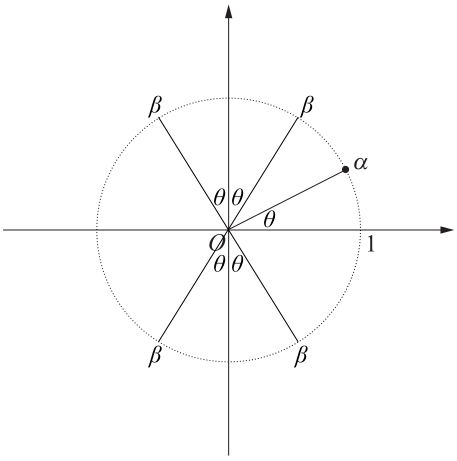
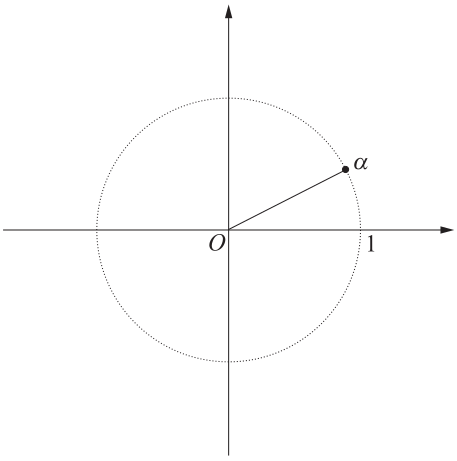
  2. The diagram shows the position of  `alpha`.


On the diagram, accurately show all possible positions of  `beta`.  (2 marks)

--- 0 WORK AREA LINES (style=lined) ---

Show Answers Only
  1. `text(Proof)\ text{(See Worked Solutions)}`
  2. `text(See Worked Solutions)`
Show Worked Solution

i.    `P(z) = z^4 – 2kz^3 + 2k^2z^2 + mz + 1,\ \ k, m in RR`

`text(Roots):\ \ alpha, bar alpha, beta, bar beta and |\ alpha\ | = 1, |\ beta\ | = 1`

`text(Show)\ \ (text{Re} (alpha))^2 + (text{Re} (beta))^2 = 1`

♦♦ Mean mark part (i) 26%.

`alpha + bar alpha + beta + bar beta` `= 2k`
`2 text{Re} (alpha) + 2 text{Re} (beta)` `= 2k`
`text{Re} (alpha) + text{Re} (beta)` `= k`


`alpha bar alpha + alpha beta + alpha bar beta + bar alpha beta + bar alpha bar beta + beta bar beta` `= 2k^2`
`|\ alpha\ |^2 + alpha(beta + bar beta) + bar alpha(beta + bar beta) + |\ beta\ |^2` `= 2k^2`
`1 + (alpha + bar alpha)(beta + bar beta) + 1` `= 2k^2`
`2 + 2 text{Re} (alpha) ⋅ 2 text{Re} (beta)` `= 2 (text{Re} (alpha) + text{Re} (beta))^2`
`2 + 4 text{Re} (alpha) text{Re} (beta)` `= 2 text{Re} (alpha)^2 + 4 text{Re} (alpha) text{Re} (beta) + 2 text{Re} (beta)^2`
`2` `= 2(text{Re} (alpha)^2 + text{Re} (beta)^2)`
`:. 1` `= text{Re} (alpha)^2 + text{Re} (beta)^2`


ii.    `|\ alpha\ | = |\ beta\ |\ \ \ text{(given)}`
  `text{Re}(alpha)^2 + text{Re}(beta)^2 = 1\ \ \ text{(see part (i))}`
  `text{Re}(alpha)^2 + text{Im}(alpha)^2 = 1\ \ \ (|\ alpha\ | = 1)`
  `=> text{Re}(beta)^2 = text{Im} (alpha)^2`
  `\ \ \ \ \ \ text{Re}(beta) = +-text{Im}(alpha)`


♦♦♦ Mean mark part (ii) 10%.

Filed Under: Geometrical Implications of Complex Numbers, Solving Equations with Complex Numbers Tagged With: Band 5, Band 6, smc-1050-35-Conjugate roots, smc-1052-50-Sketch roots

Complex Numbers, EXT2 N2 2017 HSC 6 MC

It is given that  `z = 2 + i`  is a root of  `z^3 + az^2 - 7z + 15 = 0`, where `a` is a real number.

What is the value of `a`?

  1. `−1`
  2. `1`
  3. `7`
  4. `−7`
Show Answers Only

`A`

Show Worked Solution

`text(S)text(ince)\ \ z_1 = 2 + i\ \ text(is a root.)`

`=> z_2 = 2 – i\ \ text(is a root.)`


`text(Roots are)\ \ z_1, z_2, alpha.`

`text(Using product of roots:)`

`z_1z_2alpha` `= −15`
`(2 + i)(2 – i)alpha` `= −15`
`5alpha` `= −15`
`a` `= −3`


`text(Using sum of roots:)`

`z_1 + z_2 + alpha` `=-a`
`2 + i + 2 – i + −3` `= −a`
`a` `= −1`

`=> A`

Filed Under: Arithmetic and Complex Numbers, Roots and Coefficients, Solving Equations with Complex Numbers Tagged With: Band 4, smc-1050-20-Cubic roots, smc-1050-35-Conjugate roots

Copyright © 2014–2025 SmarterEd.com.au · Log in