SmarterEd

Aussie Maths & Science Teachers: Save your time with SmarterEd

  • Login
  • Get Help
  • About

Complex Numbers, EXT2 N2 2023 HSC 16a

Let \(w\) be the complex number  \(z=e^{\small{\dfrac{2i \pi}{3}}} \).

  1. Show that  \(1+w+w^2=0\).   (2 marks)

    --- 8 WORK AREA LINES (style=lined) ---

The vertices of a triangle can be labelled \(A, B\) and \(C\) in anticlockwise or clockwise direction, as shown.
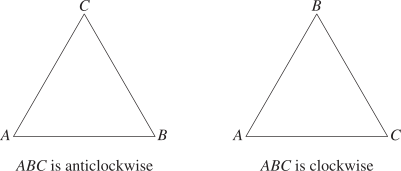
 

Three complex numbers \(a, b\) and \(c\) are represented in the complex plane by points \(A, B\) and \(C\) respectively.

  1. Show that if triangle \(A B C\) is anticlockwise and equilateral, then  \(a+b w+c w^2=0\).   (2 marks)

    --- 8 WORK AREA LINES (style=lined) ---

  2. It can be shown that if triangle \(A B C\) is clockwise and equilateral, then \(a+b w^2+c w=0\). (Do NOT prove this.)
  3. Show that if \(A B C\) is an equilateral triangle, then

\(a^2+b^2+c^2=a b+b c+c a .\)  (2 marks)

--- 8 WORK AREA LINES (style=lined) ---
Show Answers Only
  1. \(\text{See Worked Solutions}\)
  2. \(\text{See Worked Solutions}\)
  3. \(\text{See Worked Solutions}\)
Show Worked Solution

i.    \(w=e^{\small{\dfrac{2i \pi}{3}}} \)

\(w^2=e^{\small{-\dfrac{2i \pi}{3}}} = \overline w \)

\(\text{Re}(w)=\cos \Big{(}\dfrac{2\pi}{3} \Big{)}=-\dfrac{1}{2} \)

\(1+w+w^2\) \(=1+w+\overline w \)  
  \(=1+ 2 \times \text{Re}(w) \)  
  \(=1+2 \times -\dfrac{1}{2} \)  
  \(=0\)  

 
ii.
    \(\text{Rotate}\ \ b-c\ \ \text{anticlockwise by}\ \ \dfrac{2\pi}{3} \)

\(\Rightarrow (b-c)w = c-a\)

\(\therefore bw-cw-c+a = a+bw-c(1+w) = 0 \)

\(\text{Substitute}\ \ 1+w=-w^2\ \ \text{(using part (i))} \)

\(a+bw-c(-w^2) \) \(=0\)  
\(a+bw+cw^2\) \(=0\ \ …\ \text{as required} \)  
♦♦♦ Mean mark (ii) 18%.

iii.   \(a+b w^2+c w=0\ \ \text{(if}\ \Delta ABC\ \text{is clockwise – given)} \)

\(a+bw+cw^2=0\ \ \text{(if}\ \Delta ABC\ \text{is anticlockwise)} \)

\(\Rightarrow (a+b w^2+c w)(a+bw+cw^2) = 0\ …\ (1)\)
 

\(\text{Expand (1) using part (i):}\ \ w+w^2=-1\ \ \text{and}\ \ w^3 = z^3 = 1 \)

\(a^2+abw^2+acw+bwa+b^2w^3+bcw^2+cw^2a+cbw^4+c^2w^3\) \(=0\)  
\(a^2+b^2+c^2+ab(w+w^2)+bc(w+w^2)+ca(w+w^2)\) \(=0\)  
\(a^2+b^2+c^2+ab(-1)+bc(-1)+ca(-1) \) \(=0\)  

 
\(\therefore a^2+b^2+c^2 = ab+bc+ca\ …\ \text{as required} \)

♦♦♦ Mean mark (iii) 11%.

Filed Under: Geometrical Implications of Complex Numbers Tagged With: Band 3, Band 6, smc-1052-20-Triangles, smc-1052-55-Rotations, smc-1052-70-Vectors

Complex Numbers, EXT2 N2 2023 14a

Let \(z\) be the complex number  \(z=e^{\small{\dfrac{i \pi}{6}}} \)  and \(w\) be the complex number  \(w=e^{\small{\dfrac{3 i \pi}{4}}} \).

  1. By first writing \(z\) and \(w\) in Cartesian form, or otherwise, show that
  2.    \(|z+w|^2=\dfrac{4-\sqrt{6}+\sqrt{2}}{2}\).  (3 marks)

    --- 6 WORK AREA LINES (style=lined) ---

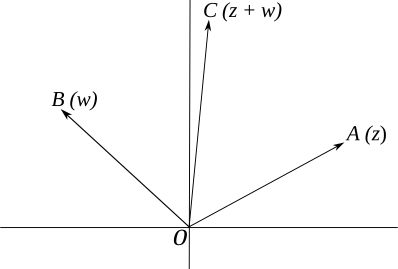
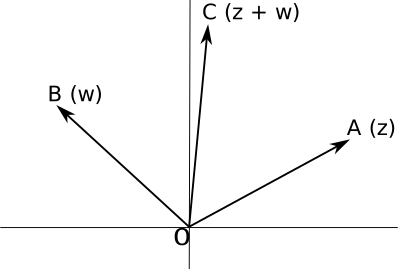
  3. The complex numbers \(z, w\) and \(z+w\) are represented in the complex plane by the vectors \(\overrightarrow{O A},\overrightarrow{O B}\) and \(\overrightarrow{O C}\) respectively, where \(O\) is the origin.
  4. Show that  \(\angle A O C=\dfrac{7 \pi}{24}\).  (2 marks)

    --- 8 WORK AREA LINES (style=lined) ---
  5. Deduce that  \(\cos \dfrac{7 \pi}{24}=\dfrac{\sqrt{8-2 \sqrt{6}+2 \sqrt{2}}}{4}\).  (1 mark)

    --- 5 WORK AREA LINES (style=lined) ---

Show Answers Only
  1. \(\text{See Worked Solutions}\)
  2. \(\text{See Worked Solutions}\)
  3. \(\text{See Worked Solutions}\)
Show Worked Solution

i.    \(z=e^{\small\dfrac{i \pi}{6}} = \cos\,\dfrac{\pi}{6} + i \,\sin\,\dfrac{\pi}{6} = \dfrac{\sqrt3}{2} + \dfrac{1}{2}i \)

\(w=e^{\small\dfrac{3i \pi}{4}} = \cos\,\dfrac{3\pi}{4} + i \,\sin\,\dfrac{3\pi}{4} = -\dfrac{1}{\sqrt2} + \dfrac{i}{\sqrt2} \)

\(|z+w|^2\) \(=\Bigg{|} \dfrac{\sqrt3}{2}+\dfrac{1}{2}i-\dfrac{1}{\sqrt2}+\dfrac{i}{\sqrt2} \Bigg{|}\)  
  \(=\Bigg{|} \Bigg{(}\dfrac{\sqrt3}{2}-\dfrac{1}{\sqrt2} \Bigg{)} +\Bigg{(}\dfrac{1}{2}+\dfrac{1}{\sqrt2}\Bigg{)}\,i \Bigg{|}\)  
  \(=\Bigg{|} \dfrac{\sqrt6-2}{2\sqrt2}+\dfrac{\sqrt2+2}{2\sqrt2}\,i \Bigg{|}\)  
  \(= \dfrac{(\sqrt6-2)^2+(\sqrt2+2)^2}{(2\sqrt2)^2}\)  
  \(= \dfrac{6-4\sqrt6+4+2+4\sqrt2+4}{8}\)  
  \(=\dfrac{16-4\sqrt6+4\sqrt2}{8} \)  
  \(=\dfrac{4-\sqrt6+\sqrt2}{2} \)  

 
ii.   

\(\angle AOB= \arg(w)-\arg(z)=\dfrac{3\pi}{4}-\dfrac{\pi}{6}=\dfrac{7\pi}{12} \)

\( |z|=|w|=1\ \Rightarrow AOBC\ \text{is a rhombus.} \)

\(\overrightarrow{OC}\ \text{is a diagonal of rhombus}\ AOBC \)

\(\Rightarrow \overrightarrow{OC}\ \text{bisects}\ \angle AOB \)

\(\therefore \angle AOC= \dfrac{1}{2} \times \dfrac{7\pi}{12}=\dfrac{7\pi}{24} \)
  

iii.   \(\text{In}\ \triangle AOC: \)

\( \overrightarrow{AC}=\overrightarrow{OC}-\overrightarrow{OA} = \overrightarrow{OB} \)

\(\Rightarrow \overrightarrow{OB}\ \text{is represented by}\ w. \)
 

\(\text{Using the cos rule in}\ \triangle AOC: \)

\(\cos\,\dfrac{7\pi}{24}\) \(=\dfrac{|z|^2+|z+w|^2-|w|^2}{2|z||z+w|}\)  
  \(=\dfrac{ 1+\frac{4-\sqrt6+\sqrt2}{2}-1}{2 \times 1  \sqrt{\frac{4-\sqrt6+\sqrt2}{2}}} \)  
  \(=\dfrac{\sqrt{\frac{4-\sqrt6+\sqrt2}{2}} \times 2} {2 \times 2} \)  
  \(=\dfrac{\sqrt{4( \frac{4-\sqrt6+\sqrt2}{2})}} {4} \)  
  \(=\dfrac{8-2\sqrt6+2\sqrt2}{4} \)  
♦♦ Mean mark (iii) 26%.

Filed Under: Geometrical Implications of Complex Numbers Tagged With: Band 3, Band 4, Band 5, smc-1052-60-Other problems, smc-1052-70-Vectors

Copyright © 2014–2025 SmarterEd.com.au · Log in